

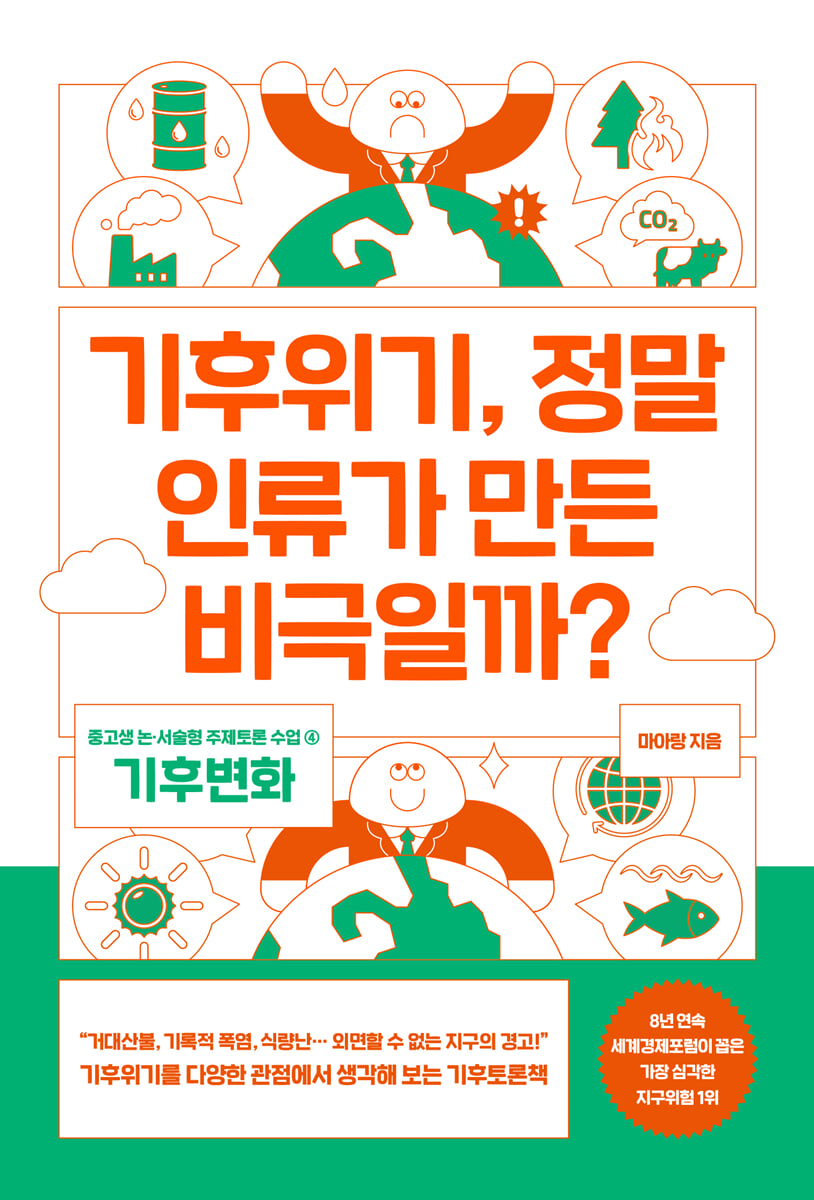
Is the climate crisis truly a tragedy of human origin?
 |
Description
Book Introduction
“The climate crisis is scary, but is it hard to give up the conveniences we have now?”
For eight consecutive years, the World Economic Forum has ranked it as the most serious global risk.
Not exaggerated fear or excessive optimism
A climate discussion book that explores five perspectives based on scientific facts!
The climate crisis is no longer a story of the distant future; it has become a part of our daily lives.
Flooded streets, suffocating heat, increasingly long winters, food shortages… these are all the new realities created by climate change.
In these times, it has become more important than ever for young people to accept the climate crisis as their own problem, not someone else's, and to seriously question and discuss it.
This book begins its story from that very starting point.
It doesn't say that we should immediately take steps to protect the environment, such as reducing disposable use and refraining from using air conditioners.
Rather than panicking about the imminent destruction of the Earth or hopeful thinking that technology will solve everything, we delve into the climate crisis based on scientific facts.
Is the climate crisis truly a tragedy of human origin? Who should bear responsibility? Should we halt economic growth for the sake of the environment? By examining the background and phenomenon of the climate crisis and debating the pros and cons, we foster environmental awareness.
Young people are the generation that will suffer the most from the climate crisis, but they are also the generation that can make the biggest changes.
The climate crisis is frightening and daunting, but it's also true that it's difficult to give up the conveniences we have today.
This book addresses the climate crisis not simply as a scientific or environmental issue, but rather examines it from a variety of perspectives, including economics, politics, society, and psychology, prompting young people to consider, "What kind of world do I want, and what kind of life do I choose?"
By the time you finish this book, you will have developed your own thoughts on the climate crisis and the ability to express them in your own words.
This book contains discussion classes essential for young people living in the era of climate crisis.
For eight consecutive years, the World Economic Forum has ranked it as the most serious global risk.
Not exaggerated fear or excessive optimism
A climate discussion book that explores five perspectives based on scientific facts!
The climate crisis is no longer a story of the distant future; it has become a part of our daily lives.
Flooded streets, suffocating heat, increasingly long winters, food shortages… these are all the new realities created by climate change.
In these times, it has become more important than ever for young people to accept the climate crisis as their own problem, not someone else's, and to seriously question and discuss it.
This book begins its story from that very starting point.
It doesn't say that we should immediately take steps to protect the environment, such as reducing disposable use and refraining from using air conditioners.
Rather than panicking about the imminent destruction of the Earth or hopeful thinking that technology will solve everything, we delve into the climate crisis based on scientific facts.
Is the climate crisis truly a tragedy of human origin? Who should bear responsibility? Should we halt economic growth for the sake of the environment? By examining the background and phenomenon of the climate crisis and debating the pros and cons, we foster environmental awareness.
Young people are the generation that will suffer the most from the climate crisis, but they are also the generation that can make the biggest changes.
The climate crisis is frightening and daunting, but it's also true that it's difficult to give up the conveniences we have today.
This book addresses the climate crisis not simply as a scientific or environmental issue, but rather examines it from a variety of perspectives, including economics, politics, society, and psychology, prompting young people to consider, "What kind of world do I want, and what kind of life do I choose?"
By the time you finish this book, you will have developed your own thoughts on the climate crisis and the ability to express them in your own words.
This book contains discussion classes essential for young people living in the era of climate crisis.
- You can preview some of the book's contents.
Preview
index
preface
Before the inconvenient truth becomes an uncontrollable disaster,
Stories We Must Share for the Earth
Chapter 1.
Is the climate crisis truly a tragedy of human origin?
The climate crisis is a tragedy created by humanity.
The climate crisis is a natural phenomenon.
Chapter 2.
Climate Crisis: Who Really Is Responsible?
Developed countries must take responsibility for solving the climate crisis.
Developing countries also have a responsibility to address the climate crisis.
Chapter 3.
Can technological advancements solve the climate crisis?
Technological advancements can solve the climate crisis.
-Technological advancement alone will not solve the climate crisis.
Chapter 4.
Should we limit economic growth to reduce waste for the sake of the environment?
-We must curb economic growth and reduce waste.
There is no need to suppress economic growth to reduce waste.
Chapter 5.
Should a carbon tax be introduced?
The introduction of a carbon tax can solve the climate crisis.
-Introducing a carbon tax will actually lead to economic inequality.
Before the inconvenient truth becomes an uncontrollable disaster,
Stories We Must Share for the Earth
Chapter 1.
Is the climate crisis truly a tragedy of human origin?
The climate crisis is a tragedy created by humanity.
The climate crisis is a natural phenomenon.
Chapter 2.
Climate Crisis: Who Really Is Responsible?
Developed countries must take responsibility for solving the climate crisis.
Developing countries also have a responsibility to address the climate crisis.
Chapter 3.
Can technological advancements solve the climate crisis?
Technological advancements can solve the climate crisis.
-Technological advancement alone will not solve the climate crisis.
Chapter 4.
Should we limit economic growth to reduce waste for the sake of the environment?
-We must curb economic growth and reduce waste.
There is no need to suppress economic growth to reduce waste.
Chapter 5.
Should a carbon tax be introduced?
The introduction of a carbon tax can solve the climate crisis.
-Introducing a carbon tax will actually lead to economic inequality.
Detailed image
.jpg)
Publisher's Review
The climate crisis is considered the greatest threat to the Earth in the 21st century!
A story we must share before it becomes an irreversible disaster.
『Middle and High School Students' Essay-Based Topic Debate Class Series』Series ④
To the youth who will live in the future
Discussing the climate crisis, the most urgent challenge
This is the fourth book in a series of essay-based discussion classes for middle and high school students, and this time we discuss the climate crisis, a global challenge.
The series of topical discussion classes, which previously examined social issues from various angles through topics such as wealth inequality, population crisis, and youth human rights, delves into various aspects of the climate crisis, including the collapse of biodiversity, climate inequality, climate justice, carbon tax, climate tech, and the green economy, in this book.
The climate crisis is not simply an environmental issue; it is a complex topic encompassing economics, politics, human rights, and intergenerational equity.
To make it easier to understand, the story unfolds around climate issues that are closely related to the lives of teenagers.
This virtual debate will be an engaging and engaging experience, with intriguing questions like: is the climate crisis truly a problem caused by unprecedented environmental pollution? Is the Earth truly at risk if we don't give up all the conveniences we enjoy today? Should we give up trends for the sake of the environment?
As we grapple with the question of which path is more correct between these two polarized positions, our understanding of the climate crisis will deepen, and we will replace vague anxiety with accurate facts and a balanced perspective.
By the time you finish the book, you'll be thinking about what attitude you should have toward life in the face of the enormous climate crisis.
Abnormal weather phenomena that are recurring more frequently and more intensely,
Even if you don't have any knowledge, if you read along,
A magical discussion book that lets you speak and express your thoughts naturally!
The "Middle and High School Students' Essay-Based Topic Debate Class Series" is a four-stage discussion book designed to enable students to think and speak sufficiently about topics even with limited background knowledge.
It is structured to be immediately applicable to school classes or reading discussion classes, focusing on examples and interesting cases tailored to the level of middle school students, making it a useful resource for current teachers, parents, and youth alike.
With the recurrence of extreme weather events such as heat waves, heavy rain, droughts, and wildfires, the climate crisis is no longer just an issue for environmental activists.
In fact, the World Economic Forum, which has been analyzing the major factors threatening the global economy every year, has selected the 'climate crisis' as the greatest threat facing humanity for eight consecutive years.
However, there is a paradox that inventions made to protect the environment actually harm the environment.
Plastic bags were actually first conceived as an alternative to the deforestation caused by the production of paper bags.
Also, the volume-based waste disposal system, a system for reducing waste, was successfully established in Korea, but in some countries, such as Hong Kong, it failed due to public opposition and difficulties in implementation.
Through these diverse examples, this book presents the climate crisis not as a problem with a definitive answer, but as something to be thought about and discussed together.
Even without prior background knowledge, the author, who is currently working on sustainable development policy and at the forefront of the environmental field, has provided a wealth of domestic and international case studies, research, and statistical data to help readers explore diverse perspectives on the climate crisis and develop their own perspectives.
Through this book, young people will encounter diverse perspectives surrounding the climate crisis, including economics, science, politics, culture, and ethics, and develop the power to speak with their own voices.
The climate crisis is a major issue frequently addressed in college entrance essays, interviews, and performance assessments, so preparing for it will not only help students improve their ability to think critically about social issues, but also contribute to their overall well-being.
A story we must share before it becomes an irreversible disaster.
『Middle and High School Students' Essay-Based Topic Debate Class Series』Series ④
To the youth who will live in the future
Discussing the climate crisis, the most urgent challenge
This is the fourth book in a series of essay-based discussion classes for middle and high school students, and this time we discuss the climate crisis, a global challenge.
The series of topical discussion classes, which previously examined social issues from various angles through topics such as wealth inequality, population crisis, and youth human rights, delves into various aspects of the climate crisis, including the collapse of biodiversity, climate inequality, climate justice, carbon tax, climate tech, and the green economy, in this book.
The climate crisis is not simply an environmental issue; it is a complex topic encompassing economics, politics, human rights, and intergenerational equity.
To make it easier to understand, the story unfolds around climate issues that are closely related to the lives of teenagers.
This virtual debate will be an engaging and engaging experience, with intriguing questions like: is the climate crisis truly a problem caused by unprecedented environmental pollution? Is the Earth truly at risk if we don't give up all the conveniences we enjoy today? Should we give up trends for the sake of the environment?
As we grapple with the question of which path is more correct between these two polarized positions, our understanding of the climate crisis will deepen, and we will replace vague anxiety with accurate facts and a balanced perspective.
By the time you finish the book, you'll be thinking about what attitude you should have toward life in the face of the enormous climate crisis.
Abnormal weather phenomena that are recurring more frequently and more intensely,
Even if you don't have any knowledge, if you read along,
A magical discussion book that lets you speak and express your thoughts naturally!
The "Middle and High School Students' Essay-Based Topic Debate Class Series" is a four-stage discussion book designed to enable students to think and speak sufficiently about topics even with limited background knowledge.
It is structured to be immediately applicable to school classes or reading discussion classes, focusing on examples and interesting cases tailored to the level of middle school students, making it a useful resource for current teachers, parents, and youth alike.
With the recurrence of extreme weather events such as heat waves, heavy rain, droughts, and wildfires, the climate crisis is no longer just an issue for environmental activists.
In fact, the World Economic Forum, which has been analyzing the major factors threatening the global economy every year, has selected the 'climate crisis' as the greatest threat facing humanity for eight consecutive years.
However, there is a paradox that inventions made to protect the environment actually harm the environment.
Plastic bags were actually first conceived as an alternative to the deforestation caused by the production of paper bags.
Also, the volume-based waste disposal system, a system for reducing waste, was successfully established in Korea, but in some countries, such as Hong Kong, it failed due to public opposition and difficulties in implementation.
Through these diverse examples, this book presents the climate crisis not as a problem with a definitive answer, but as something to be thought about and discussed together.
Even without prior background knowledge, the author, who is currently working on sustainable development policy and at the forefront of the environmental field, has provided a wealth of domestic and international case studies, research, and statistical data to help readers explore diverse perspectives on the climate crisis and develop their own perspectives.
Through this book, young people will encounter diverse perspectives surrounding the climate crisis, including economics, science, politics, culture, and ethics, and develop the power to speak with their own voices.
The climate crisis is a major issue frequently addressed in college entrance essays, interviews, and performance assessments, so preparing for it will not only help students improve their ability to think critically about social issues, but also contribute to their overall well-being.
GOODS SPECIFICS
- Date of issue: August 10, 2025
- Page count, weight, size: 196 pages | 272g | 130*190*20mm
- ISBN13: 9791191309911
- ISBN10: 1191309916
You may also like
카테고리
korean


korean

![GQ KOREA Mark (Monthly): December [2025]](http://librairie.coreenne.fr/cdn/shop/files/8ef265dbbfbf186523ed75ba7319009d.jpg?v=1765340328&width=3840)


