

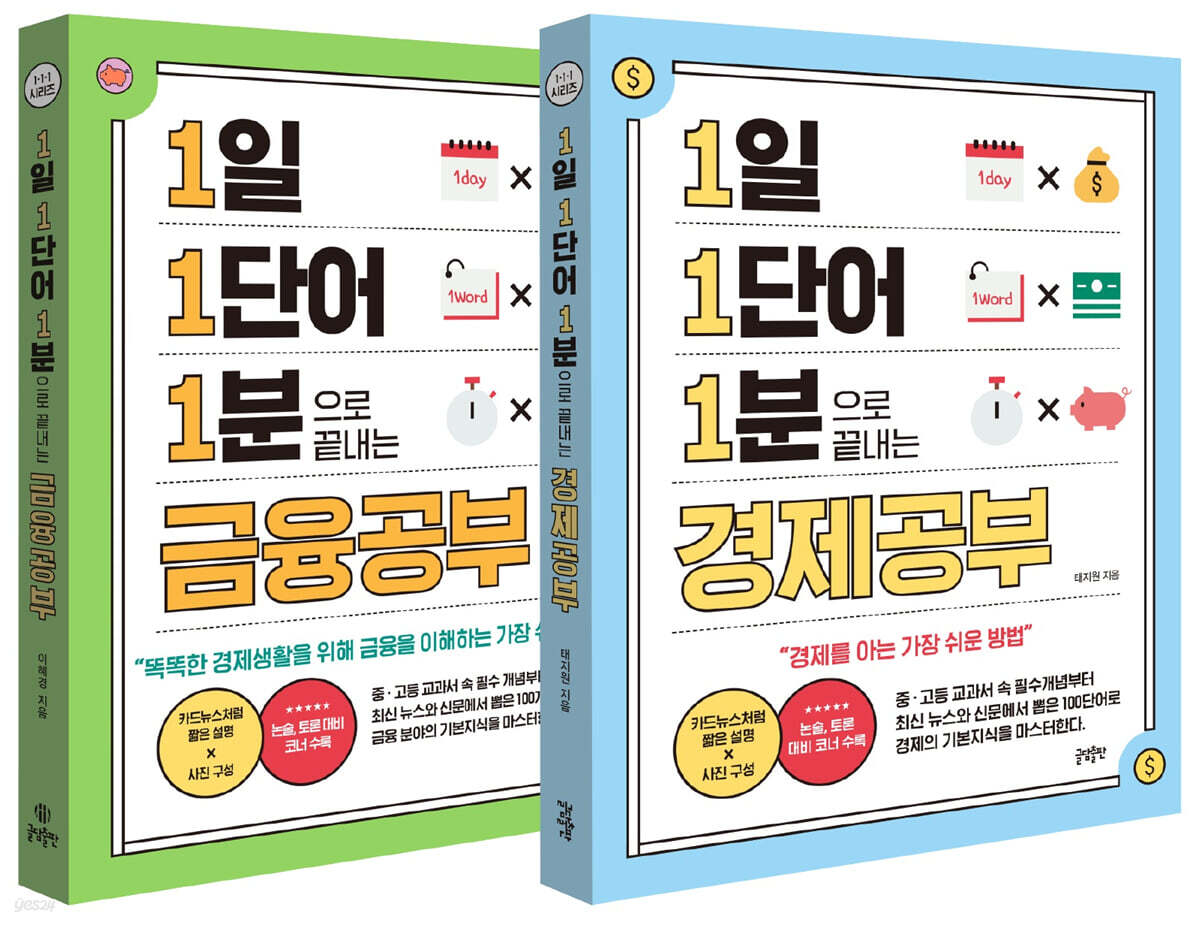
A set of economics and finance studies that can be completed in one minute, one word a day.
 |
Description
Book Introduction
Interest rates, exchange rates, stocks, open banking, fintech, blockchain, NFTs…
Just reading for one minute a day will help you build basic knowledge of economics and finance!
A 22-year veteran economics, finance, and securities expert reporter and a 10-year veteran teacher
We provide knowledge that will serve as the foundation for a smart economic life in an easy and fun way!
"One Word a Day, One Minute Economics Study"
Bitcoin, minimum wage, stocks... Is there a way to study economics, which has become essential even for teenagers, in an easy and fun way? "One Word a Day, One Minute Economics Study" helps students master the fundamentals of economics by covering essential concepts from middle and high school textbooks and extracting concepts from the latest news and newspapers.
We've gathered all the concepts that frequently appear on exams so that they can be immediately helpful for school grades and entrance exams.
Even if you are studying economics for the first time, the concept is explained through fun stories that children will find interesting, such as how Ryu Hyun-jin's annual salary changes depending on the exchange rate and economic keywords hidden in actress Yoon Yeo-jeong's acceptance speech, so that even beginners can easily understand.
The most notable feature is its short, clear explanations with colorful visuals that can be read in one minute for children who are more familiar with images than text.
It is stored in your head automatically without you having to try to memorize it.
"Financial Studies: One Word a Day, One Minute"
Finance is a complex subject that makes even the mere thought of it a headache. Isn't it possible to study it in an easy and fun way? "One Word a Day, One Minute Financial Study" focuses on 100 words frequently appearing in middle and high school textbooks, the latest news, and newspapers, helping you quickly and easily master the fundamentals of finance.
From terms that are frequently used in daily life, such as deposits and savings, credit cards and check cards, and assets and liabilities, but whose concepts and differences are difficult to easily explain, to topics that are of high interest to teenagers, such as stocks, funds, subscription accounts, blockchain, and NFTs, interesting examples and visual materials are used to explain them in an easy-to-understand manner at the level of teenagers.
You can also find answers to everyday questions like, "What's the difference between investing and speculation?", "The unemployment rate is low, so why is it so hard to get a job?", "If the bank I used to work with fails, can I get my deposit back?", and "The ads say I can get a loan quickly and easily, so can I trust the loan sharks?"
Financial education in schools is still inadequate, and financial education at home is limited.
In this situation, young people are not able to build proper financial knowledge by randomly accepting the information overflowing through YouTube and social media.
Even this kind of misunderstood information often leads to poor investments or illegal loans, making financial education for youth urgently needed.
"Financial Studies in One Minute, One Word a Day" will help young people develop sound values about money and the economy by organizing the most fundamental knowledge for financial education, laying the foundation for a healthy economic life.
Just reading for one minute a day will help you build basic knowledge of economics and finance!
A 22-year veteran economics, finance, and securities expert reporter and a 10-year veteran teacher
We provide knowledge that will serve as the foundation for a smart economic life in an easy and fun way!
"One Word a Day, One Minute Economics Study"
Bitcoin, minimum wage, stocks... Is there a way to study economics, which has become essential even for teenagers, in an easy and fun way? "One Word a Day, One Minute Economics Study" helps students master the fundamentals of economics by covering essential concepts from middle and high school textbooks and extracting concepts from the latest news and newspapers.
We've gathered all the concepts that frequently appear on exams so that they can be immediately helpful for school grades and entrance exams.
Even if you are studying economics for the first time, the concept is explained through fun stories that children will find interesting, such as how Ryu Hyun-jin's annual salary changes depending on the exchange rate and economic keywords hidden in actress Yoon Yeo-jeong's acceptance speech, so that even beginners can easily understand.
The most notable feature is its short, clear explanations with colorful visuals that can be read in one minute for children who are more familiar with images than text.
It is stored in your head automatically without you having to try to memorize it.
"Financial Studies: One Word a Day, One Minute"
Finance is a complex subject that makes even the mere thought of it a headache. Isn't it possible to study it in an easy and fun way? "One Word a Day, One Minute Financial Study" focuses on 100 words frequently appearing in middle and high school textbooks, the latest news, and newspapers, helping you quickly and easily master the fundamentals of finance.
From terms that are frequently used in daily life, such as deposits and savings, credit cards and check cards, and assets and liabilities, but whose concepts and differences are difficult to easily explain, to topics that are of high interest to teenagers, such as stocks, funds, subscription accounts, blockchain, and NFTs, interesting examples and visual materials are used to explain them in an easy-to-understand manner at the level of teenagers.
You can also find answers to everyday questions like, "What's the difference between investing and speculation?", "The unemployment rate is low, so why is it so hard to get a job?", "If the bank I used to work with fails, can I get my deposit back?", and "The ads say I can get a loan quickly and easily, so can I trust the loan sharks?"
Financial education in schools is still inadequate, and financial education at home is limited.
In this situation, young people are not able to build proper financial knowledge by randomly accepting the information overflowing through YouTube and social media.
Even this kind of misunderstood information often leads to poor investments or illegal loans, making financial education for youth urgently needed.
"Financial Studies in One Minute, One Word a Day" will help young people develop sound values about money and the economy by organizing the most fundamental knowledge for financial education, laying the foundation for a healthy economic life.
index
Studying economics in one minute, one word a day
Chapter 1: Economic Concepts
001 Scarcity: Why are the world's precious things expensive?
002 Opportunity Cost: Why There Is No Free Lunch in the World
003 Efficiency and Equity: Should We Make the Pie Bigger or Share It Fairly?
004 Market: Why is Carrot Market also a market in economics?
005 Economic Activity: Am I, a student, engaged in economic activity?
006 Public Goods: Why Should the Government Create Free Parks and Water Supply Facilities?
007 Substitutes and Complements: What's the Secret Behind "Chicken Instead of Pheasant" and "Chi-Maek"?
008 Normal and Inferior Goods: When people's finances improve, what is the first thing they do?
009 Unemployment: Are we all unemployed if we don't work?
010 Stocks vs.
Bonds: Two Ways to Roll Money?
011 Externalities: Why do people get the flu shot less often than we think?
012 Privatization of Public Enterprises: Why Would the Government Sell Off Its Enterprises to the Private Sector?
013 Sharing Economy: Is it true that you have to own something to be able to consume it?
Reading the World through Economics I Economic Development vs.
Environmental Protection: What's a Rational Choice?_Environmental Pollution and Rational Choice
Reading the World Through Economics II: Will Everyone Be Happy in a Sharing Economy? _The Light and Shadow of the Sharing Economy
Chapter 2 Economic Phenomena
014 The Bandwagon Effect: Why Is Social Media Word-of-Mouth Important for Product Sales?
015 The Snob Effect: How Does the Sophisticated White Heron Consume?
016 Concorde's Fallacy: Why Can't We Stop Even When We Know It's Losing?
017 Business Cycle: Does the National Economy Have a Biorhythm?
018 Inflation: Why do the prices of jajangmyeon keep rising?
019 Deflation: Why Are Falling Prices So Fearful?
020 Stagflation: Adding insult to injury, what's the most dangerous economic situation?
021 Nudge Effect: What unexpected effects can emerge from a gentle nudge?
022 Market Failure: Can the 'Invisible Hand' Solve Everything?
023 Government Failure: Can the Government Be a Panacea?
024 Gentrification: Why do hot neighborhoods rise and fall so quickly?
025 Moral Hazard: Why Does Car Insurance Make You More Afraid to Drive Safely?
026 Regional Economic Bloc: What if nearby countries joined forces economically?
027 The Tragedy of the Commons: What Happens in an Unclaimed Pasture?
Reading the World Through Economics I: Why Are Venezuelans, Once Oil-Rich, Now Finding It Hard to Make a Living? - Hyperinflation
Reading the World Through Economics II: Is the Assumption That Humans Are Rational Beings True?_Behavioral Economics
Chapter 3 Economic History
028 A History of Capitalism: Can the Face of Capitalism Change?
029 Commercial Capitalism: Did Capitalism Have a Fetal Stage?
030 Industrial Revolution: What event brought about human abundance?
031 Industrial Capitalism: How Did Capitalism Change the World?
032 Monopoly Capitalism: Why did degenerate capitalism start seeking colonies?
033 The Great Depression: What was the worst recession in history that terrified the world?
034 New Deal Policy: What new card did the government pull out to solve the Great Depression?
035 Revision Capitalism: How to Rewrite the History of Capitalism?
036 Oil Crisis: Was there a time when gas stations ran out of gas?
037 Neoliberalism: Why did Prime Minister Thatcher, the 'Iron Lady', receive both praise and criticism?
038 Global Financial Crisis: What crisis started on Wall Street and swept across the financial markets?
039 Japan's Bubble Economy: How Did Japan's Shining Golden Age End?
040 3 Low Boom: When was the greatest golden age for our country's economy?
041 The 1997 Foreign Exchange Crisis: When was the greatest crisis that changed the history of the Korean economy?
Reading the World Through Economics Ⅰ Why Are There So Many Dystopian Films About a Dark Future? _The Fourth Industrial Revolution and the Future
Reading the World Through Economics II: Why Did the Government Provide Disaster Relief Funds After COVID-19? _The Impact of Disaster Relief Funds on the Economy
Chapter 4: Economists
042 Adam Smith: Does the 'invisible hand' rule the market?
043 David Ricardo: Why is trade between countries beneficial to everyone?
044 Chapter Baptiste Say: Which comes first, supply or demand?
045 Thomas Malthus: Is population growth a social disaster?
046 Alfred Marshall: Why are supply and demand like a pair of scissors?
047 Karl Marx: Will Capitalism Really Fall?
048 Thorstein Veblen: Why do people like luxury brands?
049 John Maynard Keynes: Is the 'Invisible Hand' Really a Panacea?
050 Joseph Schumpeter: What is the entrepreneurial spirit that leads to social change?
051 Paul Samuelson: All economic problems boil down to three things?
052 Ronald Coase: How to solve the noise problem between floors without force?
053 Friedrich Hayek: Who was the economist who pioneered a new path of liberalism?
054 George Akerlof: Why are more and more defective cars left in the used car market?
055 Thomas Piketty: How did we get to a world where money makes money?
Reading the World Through Economics I: What if Only One Lane in a Two-Lane Tunnel Is Blocked? - The Tunnel Effect, Income, and Distribution
Reading the World Through Economics II Why did Warren Buffett, one of the world's richest men, call for more taxes from the wealthy?
_Controversy over the introduction of a wealth tax
Chapter 5 Economic System
056 Market Economy: What is the most powerful economic system in the world?
057 Planned Economy System: What if the economy runs according to government orders and plans?
058 Depositor Protection System: If a bank goes bankrupt, can I get my deposits back?
059 Central Bank: Where will our country's currency come from?
060 Maximum Price System: Did the 'Half-Price Milk' Policy Surge Milk Prices?
061 Minimum Wage System: Why does the government set a minimum wage standard?
062 Progressive Tax: The more money you earn, the more taxes you have to pay?
063 Budget System: How Does the Government Manage the Nation's Finances?
064 Organisation for Economic Co-operation and Development: Why has 'OECD standards' become a staple in the news?
065 Monopoly Regulation and Fair Trade Act: Can the Government Correct Unfair Game Rules?
066 Economic Stabilization Policy: Can the Government and Central Bank Maintain the Economy's Appropriate Temperature?
067 Fiscal Policy: Why does the government release or collect money?
068 Financial Policy: What if we sprayed money from helicopters?
069 Fixed exchange rate system vs.
Floating Exchange Rate System: Two Methods of Setting Exchange Rates: Which is Better?
Reading the World Through Economics I: Will the Minimum Wage System Help Workers? The Controversy Surrounding the Minimum Wage System
Reading the World Through Economics II: What if the State Gave Every Citizen a Free Monthly Salary? The Debate on Basic Income
Chapter 6 Economic Indicators
070 Gross Domestic Product: Can it measure the height and weight of a national economy?
071 Gross National Product: Will the foreign currency earned by Korean singers be included in our country's economic size statistics?
072 Economic Growth Rate: How Do We Know If an Economy is Growing?
073 Price Index: If things at the supermarket become more expensive, does that mean prices have gone up?
074 Big Mac Index: How did the hamburger become a benchmark for measuring inflation?
075 Base Rate: Is there a 'standard' for interest rates?
076 KOSPI Index: How to Identify Stock Price Changes That Make Investors Laugh and Cry
077 Bitcoin: A Vehicle of Speculation or the New Currency of the Future?
078 Lorenz Curve and Gini Coefficient: Can the Income Gap Be Represented in Numbers?
079 Decile Distribution: Can We Measure Inequality?
080 Relative Poverty Rate: How Serious Is Poverty in Our Country?
081 Unemployment Rate: Why do people look unemployed but aren't?
082 Exchange Rate: At what rate will foreign currency and domestic currency be exchanged?
083 Foreign Exchange Reserves: Why does the government set aside foreign currency reserves?
084 Balance of Payments: Should the government also record its transactions with other countries in its ledgers?
Reading the World Through Economics I: Are We Happier, True to the Saying, "Let's Live Well"? _GDP and the Happiness Index
Reading the World Through Economics II: Would Baseball Player Ryu Hyun-jin Enjoy a Rising Exchange Rate? The Impact of Exchange Rate Fluctuations on Our Lives
Chapter 7: The Laws of Economics
085 Life Cycle Hypothesis: Why Should We Consume Stably?
086 The Law of Demand: Can you make a profit by selling something cheap?
087 Law of Supply: What will producers do when the price of a good increases?
088 Equilibrium Price: What are the market traffic lights that regulate supply and demand?
089 Fluctuations in Demand and Quantity Demanded: How Can We Reduce Tobacco Consumption?
090 Price Elasticity of Demand: Why is the meat section of a supermarket located inside?
091 Price Elasticity of Supply: Do Farmers Hate Good Harvests?
092 Price Discrimination: Why Are Amusement Park Price Lists So Complex?
093 Economies of Scale: The More You Make, the Better?
094 The Law of Three-Way Equivalence of National Income: Where will the money I spend today go?
095 Phillips Curve: Why Are Unemployment and Inflation Difficult to Control Simultaneously?
096 The Paradox of Savings: Is Saving Too Much a Problem?
097 The Fool in the Shower: Why Is Temperature Control in the National Economy So Fail-Prone?
098 Game Theory: Why is a game of reading the mood more disadvantageous?
099 Law of Diminishing Marginal Utility: Can you keep eating your favorite food without getting sick of it?
100 The Vicious Cycle of Poverty: Why Do Poor Countries Stay Poor?
Reading the World Through Economics I: The Economics of COVID-19 and Masks: The Impact of Product Elasticity on Society
Reading the World Through Economics II: Why Can't Oil-Producing Countries Easily Reduce Oil Production? _The Prisoner's Dilemma for Oil-Producing Countries
Reading the World Through Economics III: Does More Money Mean Happiness? _The Law of Diminishing Marginal Utility Between Money and Happiness
Financial Study: One Word a Day, One Minute
Chapter 1: Financial Concepts
001 Finance: Why can't the economy function properly when finance is unstable?
002 Interest Rates: Why does my mom buy me less chicken when interest rates rise?
003 Savings: Why does a country's economy grow when people save more?
004 Investment and Speculation: Should I invest if I risk losing my principal?
005 Credit and Credit Rating: Why is it important to repay your debts?
006 Assets and Liabilities: Why is it dangerous to have a lot of debt even if you have a lot of assets?
007 Trade: Why are there so many "Made in China" products in our country?
008 Currency: Are the numbers in your account, not cash, really money?
009 Credit Creation: Money Makes Money?
010 Credit Crunch: If you can't borrow money, will financial markets freeze?
011 Payment: Why is it so complicated when I'm just paying for the item?
012 Financial Markets: Where to Go to Trade Money?
013 Investment: How to invest well?
014 Accounting: Do companies and governments also keep household ledgers?
Reading the World Through Finance I: Even Financial Statements Get Makeup? - Creative Accounting
Chapter 2 Financial Products
015 Deposits and Savings: Turning Windmills with Savings?
016 Loans: Wouldn't it be great if you could get a large loan quickly?
017 Stocks: Can you buy the value of a company with money?
018 Fund: Is there a financial product that can make a mountain out of a little bit of dust?
019 Bonds: Can you lend money to anyone as long as they pay a high interest rate?
020 Derivatives: What happens when the desire to secure popular goods meets investment?
021 Insurance: How to prepare for unexpected accidents?
022 Credit Cards and Check Cards: Why Use a Card Even If You Have Cash?
023 Subscription Account: Is there an account that can be used to purchase an apartment?
024 Old-Age Pension: Why Does the Government Make It Mandatory to Join the National Pension?
Reading the World Through Finance II: Increasing Corporate Value Through Active Shareholders_Activist Investment
Chapter 3: History and Major Events of Finance
025 The Dawn of Finance: Why Did Jewish Moneylenders Get a Bad Image?
026 The Crusades: How the Crusaders Became Masters of Finance
027 Age of Exploration: Did Europe's love of pepper lead to the creation of banks?
028 Dutch Tulip Mania: Did tulips cause the first economic bubble in history?
029 Gold Standard: Was there a time when the value of currency was assessed by the price of gold?
030 Bretton Woods System: How Did the US Dollar Become the World's Key Player in Finance?
031 The Great Depression of 1929: Why did the 1929 US economic crisis spread to Europe?
032 Black Monday, 1987: Why did the term "Black Monday" come about?
033 1997 Economic Crisis: When was the biggest economic crisis since the founding of our country?
034 The 2002 Credit Card Crisis: Why Was the "Get Rich" Ad So Popular?
035 The Global Financial Crisis of 2007-2008: Why Did the Global Economy Fall into Crisis When the U.S. Real Estate Bubble Burst?
036 The COVID-19 Pandemic 2020-2022: Will a Sudden Epidemic Ruin the Economy?
Reading the World Through Finance III: Two Famous Swans in the Financial World: Black Swans and Green Swans
Chapter 4: Legends of the Financial World
037 The Rothschilds: The origins of financial capitalism that dominated the European financial world
038 John Pierpont Morgan: The ruthless giant of American finance
039 Benjamin Graham: The founder of value investing and Warren Buffett's mentor
040 Philip Fisher: A master of growth investing and Warren Buffett's investment mentor.
041 Warren Buffett: The world's fifth-richest man, a philanthropist, and a symbol of value investing.
042 Charles Thomas Munger: Warren Buffett's right-hand man and a wise billionaire investor
043 Peter Lynch: A legendary fund manager known for "discovering investment opportunities in everyday life."
044 André Kostolany: European investment legend known for the egg model and the walking dog theory.
045 John Templeton: A master bargain hunter and pioneer of overseas investment.
046 John Bogle: The founder of index funds, hailed as the "Saint of Wall Street."
047 George Soros: A legend in the hedge fund world, the greatest fund manager of the 20th century.
048 Ray Dalio: The hedge fund guru famous for his All Seasons Portfolio
049 Howard Marks: A Risk Management Philosopher Trusted Even by Investment Legends
Reading the World Through Finance IV: The Greatest Multi-Level Fraudster Who Disrupted the Financial Ecosystem - Bernard Madoff, the Ponzi Scammer
Chapter 5 Financial Indicators
050 Gross Domestic Product: How can we know the economic level of a country?
051 Composite Economic Index: Want to know the overall economic situation?
052 Exchange Rates: Is it better for the exchange rate to rise or fall?
053 Unemployment and Employment Rates: Why is it so hard to get a job when the unemployment rate is low?
054 Price Index: What is the most frequently encountered economic indicator in real life?
055 Consumer Sentiment Index and Business Survey Index: What will determine whether the economy will be good or bad going forward?
056 Stock Index: Can you tell the state of a country's economy by looking at the stock index?
057 Volatility Index: Is There an Index That Sounds a Risk Alert in the Stock Market?
058 Bank for International Settlements Capital Ratio: How do I know if the bank I'm dealing with is safe?
059 Economic Indicators in Everyday Life: Is there a way to understand economic conditions without complex indices?
Reading the World Through Finance V This is How Teenagers Learn Finance These Days_ From Teenager-Specific Financial Apps to Financial Education Programs
Chapter 6 Financial Institutions
060 Bank of Korea: Where do banks and governments borrow money?
061 Bank: Can I still be considered a bank even if I don't have an offline branch?
062 Securities Company: It wasn't just a company that helped with stock trading?
063 Asset Management Company: There's a company that invests my money for me?
064 Insurance Companies: The Financial Companies of Last Resort in an Emergency?
065 Mutual Finance and Comprehensive Finance: A Bank-Like Financial Company That's Not a Bank?
066 Savings Bank: Savings banks are not banks?
067 Venture Capital: Are there any financial firms that primarily invest in startups?
068 Specialized Financial Company for Goddesses: Do you know of a financial company that only does lending?
069 Loan shark: Is it easy to use a loan shark?
070 Financial Services Commission and Financial Supervisory Service: Is there a grim reaper who punishes financial companies that do wrong?
071 Deposit Insurance Corporation: Is there a guardian angel who will return my money when the bank fails?
072 Financial Settlement Center: How does money move between different banks?
073 Korea Exchange: What does the company that runs the stock market do?
074 Credit Rating Agencies: Is there a place that scores you on whether you're likely to repay your debt?
075 Financial Associations: What will happen when financial companies from various fields come together?
076 The International Bank for Reconstruction and Development and the International Monetary Fund: Where to Lenders for Cash-Strapped Countries?
Reading the World Through Finance Ⅵ Do you know a bank that supports the self-reliance of the poor? _ Microcredit
Chapter 7: Financial Theory and Financial Phenomena
077 Leverage Effect: Do you use leverage when investing?
078 Portfolio Theory: Is there a way to avoid losing your investment?
079 Efficient Market Hypothesis and Random Walk Hypothesis: Is It Possible to Predict Stock Prices?
080 Behavioral Economics Theory: Are People Making Rational Economic Decisions?
081 Dow Theory: Can I Know in Advance Whether My Stock Price Will Rise or Fall?
082 The Wimbledon Effect: Do We Only Do Good Things at Our Events?
083 Milestone Jinx: Is there a jinx in the stock market?
084 Bank Run: What if everyone withdraws money when bank finances are unstable?
Reading the World Through Finance VII: Putting Money in a Washing Machine and Running It?_ Money Laundering
Chapter 8 Financial Policy and Financial Systems
085 Financial Policy: Why Do Interest Rates Rise When Prices Rise?
086 Quantitative Easing and Tapering: Why Do Central Banks Inject Money into the Market When the Economy Is Bad?
087 Depositor Protection System: Can I get my deposits back if the bank I was dealing with fails?
088 Real-Name Financial System: Why can't I open a bank account in someone else's name?
089 Geumsan Separation: Why aren't there Samsung Bank or LG Bank?
090 Public Notice: How can I find information about a company that isn't in the news?
091 Electronic Signature Authentication: How do I prove my identity when conducting financial transactions online?
092 Open Banking: Check your accounts at multiple banks at once with just one banking app?
093 Year-end Tax Settlement: They even give you a refund for taxes you've already paid?
094 My Data: How can I find the financial product that's right for me?
Reading the World Through Finance Ⅷ Is Stock Investment for Youth Safe? _ Natural Economic Study vs. Uneasy Self-Control
Chapter 9: The Future of Finance
095 Fintech: What happens when IT meets financial services?
096 Virtual Assets: Is Bitcoin a Currency or Not?
097 Blockchain: Can the financial system survive without banks?
098 Robo-Advisor: An AI Butler Who Manages Your Assets?
099 NFT: Do Virtual Digital Assets Have Authenticity Certificates?
100 Piece Investment: How to become a building owner with just 5,000 won?
Reading the World Through Finance Ⅸ The Accelerating Digitalization of Finance and the Left Behind: The Digital Financial Divide
Chapter 1: Economic Concepts
001 Scarcity: Why are the world's precious things expensive?
002 Opportunity Cost: Why There Is No Free Lunch in the World
003 Efficiency and Equity: Should We Make the Pie Bigger or Share It Fairly?
004 Market: Why is Carrot Market also a market in economics?
005 Economic Activity: Am I, a student, engaged in economic activity?
006 Public Goods: Why Should the Government Create Free Parks and Water Supply Facilities?
007 Substitutes and Complements: What's the Secret Behind "Chicken Instead of Pheasant" and "Chi-Maek"?
008 Normal and Inferior Goods: When people's finances improve, what is the first thing they do?
009 Unemployment: Are we all unemployed if we don't work?
010 Stocks vs.
Bonds: Two Ways to Roll Money?
011 Externalities: Why do people get the flu shot less often than we think?
012 Privatization of Public Enterprises: Why Would the Government Sell Off Its Enterprises to the Private Sector?
013 Sharing Economy: Is it true that you have to own something to be able to consume it?
Reading the World through Economics I Economic Development vs.
Environmental Protection: What's a Rational Choice?_Environmental Pollution and Rational Choice
Reading the World Through Economics II: Will Everyone Be Happy in a Sharing Economy? _The Light and Shadow of the Sharing Economy
Chapter 2 Economic Phenomena
014 The Bandwagon Effect: Why Is Social Media Word-of-Mouth Important for Product Sales?
015 The Snob Effect: How Does the Sophisticated White Heron Consume?
016 Concorde's Fallacy: Why Can't We Stop Even When We Know It's Losing?
017 Business Cycle: Does the National Economy Have a Biorhythm?
018 Inflation: Why do the prices of jajangmyeon keep rising?
019 Deflation: Why Are Falling Prices So Fearful?
020 Stagflation: Adding insult to injury, what's the most dangerous economic situation?
021 Nudge Effect: What unexpected effects can emerge from a gentle nudge?
022 Market Failure: Can the 'Invisible Hand' Solve Everything?
023 Government Failure: Can the Government Be a Panacea?
024 Gentrification: Why do hot neighborhoods rise and fall so quickly?
025 Moral Hazard: Why Does Car Insurance Make You More Afraid to Drive Safely?
026 Regional Economic Bloc: What if nearby countries joined forces economically?
027 The Tragedy of the Commons: What Happens in an Unclaimed Pasture?
Reading the World Through Economics I: Why Are Venezuelans, Once Oil-Rich, Now Finding It Hard to Make a Living? - Hyperinflation
Reading the World Through Economics II: Is the Assumption That Humans Are Rational Beings True?_Behavioral Economics
Chapter 3 Economic History
028 A History of Capitalism: Can the Face of Capitalism Change?
029 Commercial Capitalism: Did Capitalism Have a Fetal Stage?
030 Industrial Revolution: What event brought about human abundance?
031 Industrial Capitalism: How Did Capitalism Change the World?
032 Monopoly Capitalism: Why did degenerate capitalism start seeking colonies?
033 The Great Depression: What was the worst recession in history that terrified the world?
034 New Deal Policy: What new card did the government pull out to solve the Great Depression?
035 Revision Capitalism: How to Rewrite the History of Capitalism?
036 Oil Crisis: Was there a time when gas stations ran out of gas?
037 Neoliberalism: Why did Prime Minister Thatcher, the 'Iron Lady', receive both praise and criticism?
038 Global Financial Crisis: What crisis started on Wall Street and swept across the financial markets?
039 Japan's Bubble Economy: How Did Japan's Shining Golden Age End?
040 3 Low Boom: When was the greatest golden age for our country's economy?
041 The 1997 Foreign Exchange Crisis: When was the greatest crisis that changed the history of the Korean economy?
Reading the World Through Economics Ⅰ Why Are There So Many Dystopian Films About a Dark Future? _The Fourth Industrial Revolution and the Future
Reading the World Through Economics II: Why Did the Government Provide Disaster Relief Funds After COVID-19? _The Impact of Disaster Relief Funds on the Economy
Chapter 4: Economists
042 Adam Smith: Does the 'invisible hand' rule the market?
043 David Ricardo: Why is trade between countries beneficial to everyone?
044 Chapter Baptiste Say: Which comes first, supply or demand?
045 Thomas Malthus: Is population growth a social disaster?
046 Alfred Marshall: Why are supply and demand like a pair of scissors?
047 Karl Marx: Will Capitalism Really Fall?
048 Thorstein Veblen: Why do people like luxury brands?
049 John Maynard Keynes: Is the 'Invisible Hand' Really a Panacea?
050 Joseph Schumpeter: What is the entrepreneurial spirit that leads to social change?
051 Paul Samuelson: All economic problems boil down to three things?
052 Ronald Coase: How to solve the noise problem between floors without force?
053 Friedrich Hayek: Who was the economist who pioneered a new path of liberalism?
054 George Akerlof: Why are more and more defective cars left in the used car market?
055 Thomas Piketty: How did we get to a world where money makes money?
Reading the World Through Economics I: What if Only One Lane in a Two-Lane Tunnel Is Blocked? - The Tunnel Effect, Income, and Distribution
Reading the World Through Economics II Why did Warren Buffett, one of the world's richest men, call for more taxes from the wealthy?
_Controversy over the introduction of a wealth tax
Chapter 5 Economic System
056 Market Economy: What is the most powerful economic system in the world?
057 Planned Economy System: What if the economy runs according to government orders and plans?
058 Depositor Protection System: If a bank goes bankrupt, can I get my deposits back?
059 Central Bank: Where will our country's currency come from?
060 Maximum Price System: Did the 'Half-Price Milk' Policy Surge Milk Prices?
061 Minimum Wage System: Why does the government set a minimum wage standard?
062 Progressive Tax: The more money you earn, the more taxes you have to pay?
063 Budget System: How Does the Government Manage the Nation's Finances?
064 Organisation for Economic Co-operation and Development: Why has 'OECD standards' become a staple in the news?
065 Monopoly Regulation and Fair Trade Act: Can the Government Correct Unfair Game Rules?
066 Economic Stabilization Policy: Can the Government and Central Bank Maintain the Economy's Appropriate Temperature?
067 Fiscal Policy: Why does the government release or collect money?
068 Financial Policy: What if we sprayed money from helicopters?
069 Fixed exchange rate system vs.
Floating Exchange Rate System: Two Methods of Setting Exchange Rates: Which is Better?
Reading the World Through Economics I: Will the Minimum Wage System Help Workers? The Controversy Surrounding the Minimum Wage System
Reading the World Through Economics II: What if the State Gave Every Citizen a Free Monthly Salary? The Debate on Basic Income
Chapter 6 Economic Indicators
070 Gross Domestic Product: Can it measure the height and weight of a national economy?
071 Gross National Product: Will the foreign currency earned by Korean singers be included in our country's economic size statistics?
072 Economic Growth Rate: How Do We Know If an Economy is Growing?
073 Price Index: If things at the supermarket become more expensive, does that mean prices have gone up?
074 Big Mac Index: How did the hamburger become a benchmark for measuring inflation?
075 Base Rate: Is there a 'standard' for interest rates?
076 KOSPI Index: How to Identify Stock Price Changes That Make Investors Laugh and Cry
077 Bitcoin: A Vehicle of Speculation or the New Currency of the Future?
078 Lorenz Curve and Gini Coefficient: Can the Income Gap Be Represented in Numbers?
079 Decile Distribution: Can We Measure Inequality?
080 Relative Poverty Rate: How Serious Is Poverty in Our Country?
081 Unemployment Rate: Why do people look unemployed but aren't?
082 Exchange Rate: At what rate will foreign currency and domestic currency be exchanged?
083 Foreign Exchange Reserves: Why does the government set aside foreign currency reserves?
084 Balance of Payments: Should the government also record its transactions with other countries in its ledgers?
Reading the World Through Economics I: Are We Happier, True to the Saying, "Let's Live Well"? _GDP and the Happiness Index
Reading the World Through Economics II: Would Baseball Player Ryu Hyun-jin Enjoy a Rising Exchange Rate? The Impact of Exchange Rate Fluctuations on Our Lives
Chapter 7: The Laws of Economics
085 Life Cycle Hypothesis: Why Should We Consume Stably?
086 The Law of Demand: Can you make a profit by selling something cheap?
087 Law of Supply: What will producers do when the price of a good increases?
088 Equilibrium Price: What are the market traffic lights that regulate supply and demand?
089 Fluctuations in Demand and Quantity Demanded: How Can We Reduce Tobacco Consumption?
090 Price Elasticity of Demand: Why is the meat section of a supermarket located inside?
091 Price Elasticity of Supply: Do Farmers Hate Good Harvests?
092 Price Discrimination: Why Are Amusement Park Price Lists So Complex?
093 Economies of Scale: The More You Make, the Better?
094 The Law of Three-Way Equivalence of National Income: Where will the money I spend today go?
095 Phillips Curve: Why Are Unemployment and Inflation Difficult to Control Simultaneously?
096 The Paradox of Savings: Is Saving Too Much a Problem?
097 The Fool in the Shower: Why Is Temperature Control in the National Economy So Fail-Prone?
098 Game Theory: Why is a game of reading the mood more disadvantageous?
099 Law of Diminishing Marginal Utility: Can you keep eating your favorite food without getting sick of it?
100 The Vicious Cycle of Poverty: Why Do Poor Countries Stay Poor?
Reading the World Through Economics I: The Economics of COVID-19 and Masks: The Impact of Product Elasticity on Society
Reading the World Through Economics II: Why Can't Oil-Producing Countries Easily Reduce Oil Production? _The Prisoner's Dilemma for Oil-Producing Countries
Reading the World Through Economics III: Does More Money Mean Happiness? _The Law of Diminishing Marginal Utility Between Money and Happiness
Financial Study: One Word a Day, One Minute
Chapter 1: Financial Concepts
001 Finance: Why can't the economy function properly when finance is unstable?
002 Interest Rates: Why does my mom buy me less chicken when interest rates rise?
003 Savings: Why does a country's economy grow when people save more?
004 Investment and Speculation: Should I invest if I risk losing my principal?
005 Credit and Credit Rating: Why is it important to repay your debts?
006 Assets and Liabilities: Why is it dangerous to have a lot of debt even if you have a lot of assets?
007 Trade: Why are there so many "Made in China" products in our country?
008 Currency: Are the numbers in your account, not cash, really money?
009 Credit Creation: Money Makes Money?
010 Credit Crunch: If you can't borrow money, will financial markets freeze?
011 Payment: Why is it so complicated when I'm just paying for the item?
012 Financial Markets: Where to Go to Trade Money?
013 Investment: How to invest well?
014 Accounting: Do companies and governments also keep household ledgers?
Reading the World Through Finance I: Even Financial Statements Get Makeup? - Creative Accounting
Chapter 2 Financial Products
015 Deposits and Savings: Turning Windmills with Savings?
016 Loans: Wouldn't it be great if you could get a large loan quickly?
017 Stocks: Can you buy the value of a company with money?
018 Fund: Is there a financial product that can make a mountain out of a little bit of dust?
019 Bonds: Can you lend money to anyone as long as they pay a high interest rate?
020 Derivatives: What happens when the desire to secure popular goods meets investment?
021 Insurance: How to prepare for unexpected accidents?
022 Credit Cards and Check Cards: Why Use a Card Even If You Have Cash?
023 Subscription Account: Is there an account that can be used to purchase an apartment?
024 Old-Age Pension: Why Does the Government Make It Mandatory to Join the National Pension?
Reading the World Through Finance II: Increasing Corporate Value Through Active Shareholders_Activist Investment
Chapter 3: History and Major Events of Finance
025 The Dawn of Finance: Why Did Jewish Moneylenders Get a Bad Image?
026 The Crusades: How the Crusaders Became Masters of Finance
027 Age of Exploration: Did Europe's love of pepper lead to the creation of banks?
028 Dutch Tulip Mania: Did tulips cause the first economic bubble in history?
029 Gold Standard: Was there a time when the value of currency was assessed by the price of gold?
030 Bretton Woods System: How Did the US Dollar Become the World's Key Player in Finance?
031 The Great Depression of 1929: Why did the 1929 US economic crisis spread to Europe?
032 Black Monday, 1987: Why did the term "Black Monday" come about?
033 1997 Economic Crisis: When was the biggest economic crisis since the founding of our country?
034 The 2002 Credit Card Crisis: Why Was the "Get Rich" Ad So Popular?
035 The Global Financial Crisis of 2007-2008: Why Did the Global Economy Fall into Crisis When the U.S. Real Estate Bubble Burst?
036 The COVID-19 Pandemic 2020-2022: Will a Sudden Epidemic Ruin the Economy?
Reading the World Through Finance III: Two Famous Swans in the Financial World: Black Swans and Green Swans
Chapter 4: Legends of the Financial World
037 The Rothschilds: The origins of financial capitalism that dominated the European financial world
038 John Pierpont Morgan: The ruthless giant of American finance
039 Benjamin Graham: The founder of value investing and Warren Buffett's mentor
040 Philip Fisher: A master of growth investing and Warren Buffett's investment mentor.
041 Warren Buffett: The world's fifth-richest man, a philanthropist, and a symbol of value investing.
042 Charles Thomas Munger: Warren Buffett's right-hand man and a wise billionaire investor
043 Peter Lynch: A legendary fund manager known for "discovering investment opportunities in everyday life."
044 André Kostolany: European investment legend known for the egg model and the walking dog theory.
045 John Templeton: A master bargain hunter and pioneer of overseas investment.
046 John Bogle: The founder of index funds, hailed as the "Saint of Wall Street."
047 George Soros: A legend in the hedge fund world, the greatest fund manager of the 20th century.
048 Ray Dalio: The hedge fund guru famous for his All Seasons Portfolio
049 Howard Marks: A Risk Management Philosopher Trusted Even by Investment Legends
Reading the World Through Finance IV: The Greatest Multi-Level Fraudster Who Disrupted the Financial Ecosystem - Bernard Madoff, the Ponzi Scammer
Chapter 5 Financial Indicators
050 Gross Domestic Product: How can we know the economic level of a country?
051 Composite Economic Index: Want to know the overall economic situation?
052 Exchange Rates: Is it better for the exchange rate to rise or fall?
053 Unemployment and Employment Rates: Why is it so hard to get a job when the unemployment rate is low?
054 Price Index: What is the most frequently encountered economic indicator in real life?
055 Consumer Sentiment Index and Business Survey Index: What will determine whether the economy will be good or bad going forward?
056 Stock Index: Can you tell the state of a country's economy by looking at the stock index?
057 Volatility Index: Is There an Index That Sounds a Risk Alert in the Stock Market?
058 Bank for International Settlements Capital Ratio: How do I know if the bank I'm dealing with is safe?
059 Economic Indicators in Everyday Life: Is there a way to understand economic conditions without complex indices?
Reading the World Through Finance V This is How Teenagers Learn Finance These Days_ From Teenager-Specific Financial Apps to Financial Education Programs
Chapter 6 Financial Institutions
060 Bank of Korea: Where do banks and governments borrow money?
061 Bank: Can I still be considered a bank even if I don't have an offline branch?
062 Securities Company: It wasn't just a company that helped with stock trading?
063 Asset Management Company: There's a company that invests my money for me?
064 Insurance Companies: The Financial Companies of Last Resort in an Emergency?
065 Mutual Finance and Comprehensive Finance: A Bank-Like Financial Company That's Not a Bank?
066 Savings Bank: Savings banks are not banks?
067 Venture Capital: Are there any financial firms that primarily invest in startups?
068 Specialized Financial Company for Goddesses: Do you know of a financial company that only does lending?
069 Loan shark: Is it easy to use a loan shark?
070 Financial Services Commission and Financial Supervisory Service: Is there a grim reaper who punishes financial companies that do wrong?
071 Deposit Insurance Corporation: Is there a guardian angel who will return my money when the bank fails?
072 Financial Settlement Center: How does money move between different banks?
073 Korea Exchange: What does the company that runs the stock market do?
074 Credit Rating Agencies: Is there a place that scores you on whether you're likely to repay your debt?
075 Financial Associations: What will happen when financial companies from various fields come together?
076 The International Bank for Reconstruction and Development and the International Monetary Fund: Where to Lenders for Cash-Strapped Countries?
Reading the World Through Finance Ⅵ Do you know a bank that supports the self-reliance of the poor? _ Microcredit
Chapter 7: Financial Theory and Financial Phenomena
077 Leverage Effect: Do you use leverage when investing?
078 Portfolio Theory: Is there a way to avoid losing your investment?
079 Efficient Market Hypothesis and Random Walk Hypothesis: Is It Possible to Predict Stock Prices?
080 Behavioral Economics Theory: Are People Making Rational Economic Decisions?
081 Dow Theory: Can I Know in Advance Whether My Stock Price Will Rise or Fall?
082 The Wimbledon Effect: Do We Only Do Good Things at Our Events?
083 Milestone Jinx: Is there a jinx in the stock market?
084 Bank Run: What if everyone withdraws money when bank finances are unstable?
Reading the World Through Finance VII: Putting Money in a Washing Machine and Running It?_ Money Laundering
Chapter 8 Financial Policy and Financial Systems
085 Financial Policy: Why Do Interest Rates Rise When Prices Rise?
086 Quantitative Easing and Tapering: Why Do Central Banks Inject Money into the Market When the Economy Is Bad?
087 Depositor Protection System: Can I get my deposits back if the bank I was dealing with fails?
088 Real-Name Financial System: Why can't I open a bank account in someone else's name?
089 Geumsan Separation: Why aren't there Samsung Bank or LG Bank?
090 Public Notice: How can I find information about a company that isn't in the news?
091 Electronic Signature Authentication: How do I prove my identity when conducting financial transactions online?
092 Open Banking: Check your accounts at multiple banks at once with just one banking app?
093 Year-end Tax Settlement: They even give you a refund for taxes you've already paid?
094 My Data: How can I find the financial product that's right for me?
Reading the World Through Finance Ⅷ Is Stock Investment for Youth Safe? _ Natural Economic Study vs. Uneasy Self-Control
Chapter 9: The Future of Finance
095 Fintech: What happens when IT meets financial services?
096 Virtual Assets: Is Bitcoin a Currency or Not?
097 Blockchain: Can the financial system survive without banks?
098 Robo-Advisor: An AI Butler Who Manages Your Assets?
099 NFT: Do Virtual Digital Assets Have Authenticity Certificates?
100 Piece Investment: How to become a building owner with just 5,000 won?
Reading the World Through Finance Ⅸ The Accelerating Digitalization of Finance and the Left Behind: The Digital Financial Divide
Detailed image

GOODS SPECIFICS
- Date of issue: March 18, 2025
- Page count, weight, size: 512 pages | 170*225*35mm
- ISBN13: 9791191309805
- ISBN10: 1191309800
You may also like
카테고리
korean


korean

![GQ KOREA Mark (Monthly): December [2025]](http://librairie.coreenne.fr/cdn/shop/files/8ef265dbbfbf186523ed75ba7319009d.jpg?v=1765340328&width=3840)


