

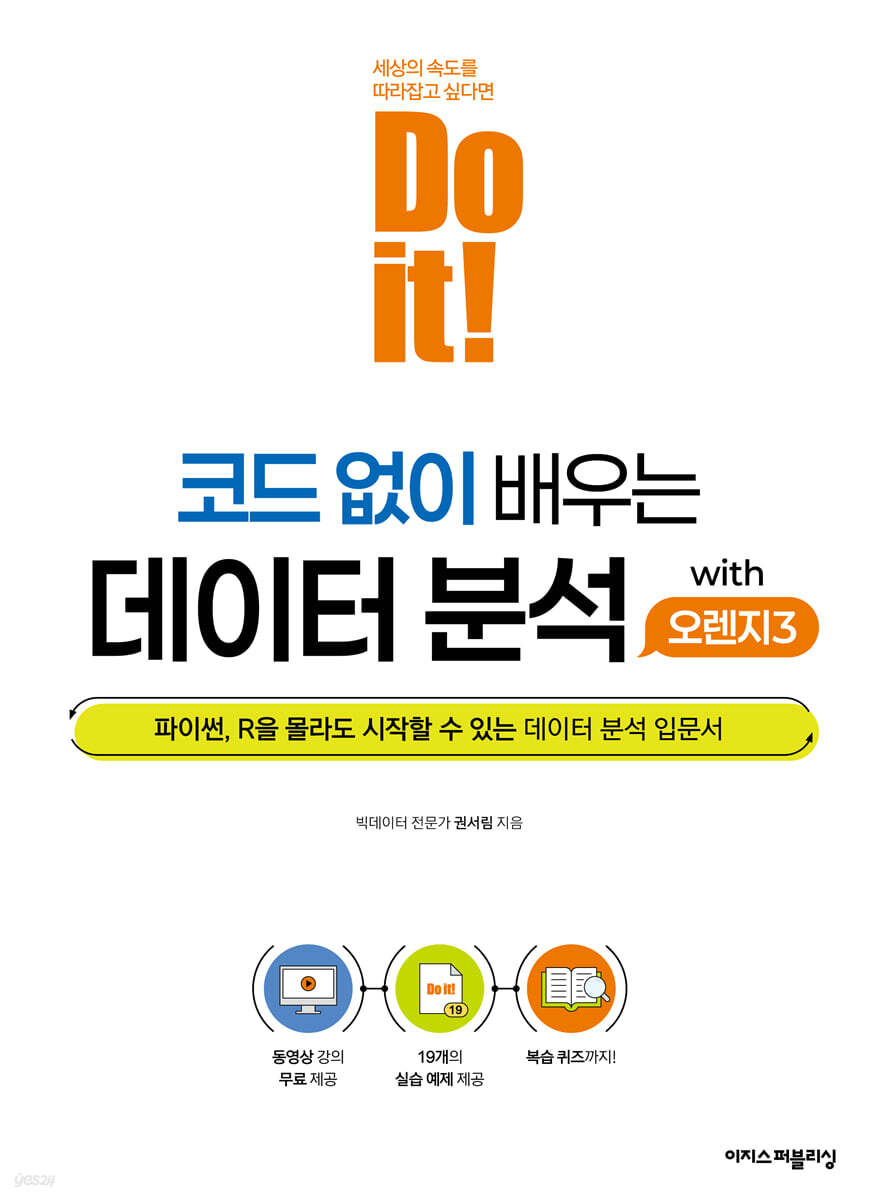
Do it! Learn Data Analysis Without Code with Orange3
 |
Description
Book Introduction
It's okay if you don't know Python or analytics theory!
Start with the fundamentals of data analysis without code with this book!
"Do it! Learn Data Analysis Without Code with Orange 3" helps those who want to study data analysis but struggle to even get started due to Python or analytical theory, take their first steps in data analysis without coding.
Build your data foundational knowledge with easy-to-understand illustrations and text, and start analyzing data with a click of the mouse.
Develop your analytical skills by systematically learning fundamental data concepts like predictive analysis, classification analysis, and cluster analysis, as well as data analysis methods like data mining, preprocessing, and visualization, through 19 practical exercises!
Start with the fundamentals of data analysis without code with this book!
"Do it! Learn Data Analysis Without Code with Orange 3" helps those who want to study data analysis but struggle to even get started due to Python or analytical theory, take their first steps in data analysis without coding.
Build your data foundational knowledge with easy-to-understand illustrations and text, and start analyzing data with a click of the mouse.
Develop your analytical skills by systematically learning fundamental data concepts like predictive analysis, classification analysis, and cluster analysis, as well as data analysis methods like data mining, preprocessing, and visualization, through 19 practical exercises!
- You can preview some of the book's contents.
Preview
index
Preparing for First Yard Data Analysis
Chapter 01 Before starting data analysis
__01-1 Why data analysis is gaining attention
____Changes in decision-making methods and technological advancements
____Data Analysis Case
__01-2 Data analysis, isn't it difficult?
____Data analysis is not coding!
____Anyone can do data analysis!
Chapter 2 What is data?
__02-1 What exactly is the data?
____Understanding the data
__02-2 Understanding the types of data
____Distinguish by data type
____structured data
____Unstructured data
Chapter 3 Data Analysis
__03-1 What exactly is data analysis?
Understanding the Relationship Between ____AI, Machine Learning, and Deep Learning
____Let's analyze data with machine learning
__03-2 Understanding the data analysis process
Step 1: Planning the Analysis
Step 2: Collecting Data
Step 3: Preprocessing the data
Step 4: Analyze the data
Step 5: Interpreting the Results
Starting the Second Yard Data Analysis
Chapter 4 What is Orange 3?
__04-1 Understanding Orange 3
____Advantages of Orange3, a no-code analysis tool
____Check out the Orange 3 website
__04-2 Preparing for Orange 3 Practice
____[Do it! Practice] Installing Orange 3
__04-3 Getting Started with Orange 3
____[Do it! Practice] Running Orange 3
____[Do it! Practice] Learning how to use Orange 3
Chapter 5: Handling Data
__05-1 Preparing the data
____Using data files
____Using other data
__05-2 Handling Data
What is ____iris data?
____[Do it! Practice] Selecting Data
____[Do it! Practice] Summarizing Data
____[Do it! Practice] Combining Data
Chapter 6: Exploring Data
__06-1 What is EDA?
Understanding ____EDA
Why ____EDA is Important
__06-2 Trying EDA with Orange3
____[Do it! Practice] Exploratory Data Analysis
____[Do it! Practice] Visualizing Data
Third Yard Structured Data Analysis
Chapter 7: Predictive Analysis
__07-1 Getting Started with Predictive Analysis
____What is predictive analytics?
__07-2 Simple linear regression
____[Do it! Practice] Predicting Sales Compared to Advertising Spend
__07-3 Multiple Linear Regression
____[Do it! Practice] Predicting Insurance Premiums Based on Personal Characteristics
Chapter 8 Classification Analysis
__08-1 Starting classification analysis
What is ____classification analysis?
__08-2 Decision Tree
____What is a decision tree?
____[Do it! Practice] Classifying Iris Varieties
__08-3 Random Forest
____What is a random forest?
____[Do it! Practice] Classifying and Analyzing Bank Customer Attrition
__08-4 kNN
What is ____kNN?
____[Do it! Practice] Classifying and Analyzing Oranges and Grapefruits
Chapter 9: Cluster Analysis
__09-1 Starting Cluster Analysis
____What is cluster analysis?
__09-2 Hierarchical cluster analysis
____What is hierarchical cluster analysis?
____[Do it! Practice] Cluster Analysis Using Nutritional Information from Cafe Drinks
__09-3 k-means cluster analysis
What is ____k-means cluster analysis?
____[Do it! Practice] Cluster Analysis Using Restaurant Rating Data
Fourth Yard: Unstructured Data Analysis
Chapter 10: Analyzing Images
__10-1 Getting Started with Image Analysis
____What is image analysis?
____Learn about the Image Analysis Widget
__10-2 Image Cluster Analysis
____What is image clustering analysis?
____[Do it! Practice] Clustering Fruit Images
__10-3 Image Classification Analysis
____What is image classification analysis?
____[Do it! Practice] Classifying and Analyzing Weather Images
Chapter 11: Analyzing Text
__11-1 Getting Started with Text Analysis
____What is text analysis?
____Learn about the Text Analysis widget
__11-2 Word Cloud Analysis
____What is a word cloud?
____[Do it! Practice] Comparative Analysis of News Article Topic-Specific Word Clouds
__11-3 Text classification analysis
____What is text classification analysis?
____[Do it! Practice] Classifying and Analyzing Spam Texts
Search
Chapter 01 Before starting data analysis
__01-1 Why data analysis is gaining attention
____Changes in decision-making methods and technological advancements
____Data Analysis Case
__01-2 Data analysis, isn't it difficult?
____Data analysis is not coding!
____Anyone can do data analysis!
Chapter 2 What is data?
__02-1 What exactly is the data?
____Understanding the data
__02-2 Understanding the types of data
____Distinguish by data type
____structured data
____Unstructured data
Chapter 3 Data Analysis
__03-1 What exactly is data analysis?
Understanding the Relationship Between ____AI, Machine Learning, and Deep Learning
____Let's analyze data with machine learning
__03-2 Understanding the data analysis process
Step 1: Planning the Analysis
Step 2: Collecting Data
Step 3: Preprocessing the data
Step 4: Analyze the data
Step 5: Interpreting the Results
Starting the Second Yard Data Analysis
Chapter 4 What is Orange 3?
__04-1 Understanding Orange 3
____Advantages of Orange3, a no-code analysis tool
____Check out the Orange 3 website
__04-2 Preparing for Orange 3 Practice
____[Do it! Practice] Installing Orange 3
__04-3 Getting Started with Orange 3
____[Do it! Practice] Running Orange 3
____[Do it! Practice] Learning how to use Orange 3
Chapter 5: Handling Data
__05-1 Preparing the data
____Using data files
____Using other data
__05-2 Handling Data
What is ____iris data?
____[Do it! Practice] Selecting Data
____[Do it! Practice] Summarizing Data
____[Do it! Practice] Combining Data
Chapter 6: Exploring Data
__06-1 What is EDA?
Understanding ____EDA
Why ____EDA is Important
__06-2 Trying EDA with Orange3
____[Do it! Practice] Exploratory Data Analysis
____[Do it! Practice] Visualizing Data
Third Yard Structured Data Analysis
Chapter 7: Predictive Analysis
__07-1 Getting Started with Predictive Analysis
____What is predictive analytics?
__07-2 Simple linear regression
____[Do it! Practice] Predicting Sales Compared to Advertising Spend
__07-3 Multiple Linear Regression
____[Do it! Practice] Predicting Insurance Premiums Based on Personal Characteristics
Chapter 8 Classification Analysis
__08-1 Starting classification analysis
What is ____classification analysis?
__08-2 Decision Tree
____What is a decision tree?
____[Do it! Practice] Classifying Iris Varieties
__08-3 Random Forest
____What is a random forest?
____[Do it! Practice] Classifying and Analyzing Bank Customer Attrition
__08-4 kNN
What is ____kNN?
____[Do it! Practice] Classifying and Analyzing Oranges and Grapefruits
Chapter 9: Cluster Analysis
__09-1 Starting Cluster Analysis
____What is cluster analysis?
__09-2 Hierarchical cluster analysis
____What is hierarchical cluster analysis?
____[Do it! Practice] Cluster Analysis Using Nutritional Information from Cafe Drinks
__09-3 k-means cluster analysis
What is ____k-means cluster analysis?
____[Do it! Practice] Cluster Analysis Using Restaurant Rating Data
Fourth Yard: Unstructured Data Analysis
Chapter 10: Analyzing Images
__10-1 Getting Started with Image Analysis
____What is image analysis?
____Learn about the Image Analysis Widget
__10-2 Image Cluster Analysis
____What is image clustering analysis?
____[Do it! Practice] Clustering Fruit Images
__10-3 Image Classification Analysis
____What is image classification analysis?
____[Do it! Practice] Classifying and Analyzing Weather Images
Chapter 11: Analyzing Text
__11-1 Getting Started with Text Analysis
____What is text analysis?
____Learn about the Text Analysis widget
__11-2 Word Cloud Analysis
____What is a word cloud?
____[Do it! Practice] Comparative Analysis of News Article Topic-Specific Word Clouds
__11-3 Text classification analysis
____What is text classification analysis?
____[Do it! Practice] Classifying and Analyzing Spam Texts
Search
Detailed image

Publisher's Review
Why Beginners Should Start Data Analysis with This Book!
ㆍ You can build basic data knowledge with easy pictures and text without difficult formulas, from basic concepts like structured and unstructured data to advanced concepts like supervised and unsupervised learning.
ㆍ You can learn how to use Orange 3 by using 'widgets' that contain various analysis functions and 'workflows' that combine them, and start data analysis even if you don't know Python or R.
ㆍ You can improve your practical skills by utilizing not only learning data like Iris, but also real-life data like sales and customer analysis.
ㆍ The author, a big data expert, provides video lectures and a final review quiz at the end of each chapter, making it easy for even beginners to learn on their own.
dot
Recommended for these types of people!
ㆍ Office workers who must carry out everything from data planning to management and decision-making.
ㆍ Students who want to quickly learn concepts related to data analysis
ㆍ Planners and marketers who want to mine and visualize practical data
ㆍTeachers and middle and high school students preparing for machine learning or data science classes
An easy-to-learn introduction to data analysis using Orange 3, the leading no-code data analysis tool!
This book lays the foundation for data analysis using Orange 3.
This book lowers the barrier to entry for data analysts by utilizing the free, freely available "no-code" tool Orange3, enabling data analysis without coding knowledge.
Orange3 is based on an intuitive GUI that allows you to retrieve and preprocess data with just mouse clicks and drags, and then derive meaningful analysis results.
Additionally, we provide a balanced mix of fundamental data analysis theory and practical exercises designed according to the actual data analysis process, and we structure the content to cover both structured and unstructured data.
Created with the experience of teaching directly by a big data expert and know-how accumulated in the field,
A useful data analysis textbook for educational and practical use!
This book is structured around examples that can be immediately applied to data analysis practice.
You can systematically learn various analysis techniques, including predictive analysis using advertising spend and sales data, classification analysis using churn customer data, and cluster analysis to identify patterns using nutritional information and rating data.
You will also experience data analysis applications, including how to handle unstructured data such as image and text data, and in-depth analysis using machine learning and deep learning models.
This book's structure will serve as a useful guide for both teachers and students teaching data analysis in educational settings. Its rich, practical examples and friendly instructions for using Orange3 make it ideal for both practical analysis and educational settings.
'Do it!' helps you learn as quickly as possible, according to your schedule.
Study plan + lecture video + practice file provided!
Page 8 of this book provides a study plan.
If you're studying alone, write down your target dates on this schedule.
Studying 20 pages a day for 11 days will help you overcome the data analysis beginner stage.
To enhance the learning effectiveness of self-study, the author's YouTube channel provides video lectures by experienced lecturer Kwon Seo-rim, and the author's blog provides information on Orange 3, analysis workflows, and update news.
And the various data files used in this book can be downloaded from the Aegis Publishing website.
Author's YouTube: youtube.com/@digital_lab3
Author's blog: blog.naver.com/open_lab
Easy Publishing website: www.easyspub.co.kr → [Data Room] → Book Title Search
Apply for a study group at 'Do it! Study Room'!
You can meet friends and receive books as gifts.
If you study alone, you'll get tired quickly.
Join the "Do it! Study Room" study group! Meet fellow study partners, share your studies, and receive a free book if you verify your progress.
If you have any questions, please leave a question on the 'Do it! Study Room' bulletin board.
Experts and authors will provide clear answers.
Do it! Study Room: cafe.naver.com/doitstudyroom
ㆍ You can build basic data knowledge with easy pictures and text without difficult formulas, from basic concepts like structured and unstructured data to advanced concepts like supervised and unsupervised learning.
ㆍ You can learn how to use Orange 3 by using 'widgets' that contain various analysis functions and 'workflows' that combine them, and start data analysis even if you don't know Python or R.
ㆍ You can improve your practical skills by utilizing not only learning data like Iris, but also real-life data like sales and customer analysis.
ㆍ The author, a big data expert, provides video lectures and a final review quiz at the end of each chapter, making it easy for even beginners to learn on their own.
dot
Recommended for these types of people!
ㆍ Office workers who must carry out everything from data planning to management and decision-making.
ㆍ Students who want to quickly learn concepts related to data analysis
ㆍ Planners and marketers who want to mine and visualize practical data
ㆍTeachers and middle and high school students preparing for machine learning or data science classes
An easy-to-learn introduction to data analysis using Orange 3, the leading no-code data analysis tool!
This book lays the foundation for data analysis using Orange 3.
This book lowers the barrier to entry for data analysts by utilizing the free, freely available "no-code" tool Orange3, enabling data analysis without coding knowledge.
Orange3 is based on an intuitive GUI that allows you to retrieve and preprocess data with just mouse clicks and drags, and then derive meaningful analysis results.
Additionally, we provide a balanced mix of fundamental data analysis theory and practical exercises designed according to the actual data analysis process, and we structure the content to cover both structured and unstructured data.
Created with the experience of teaching directly by a big data expert and know-how accumulated in the field,
A useful data analysis textbook for educational and practical use!
This book is structured around examples that can be immediately applied to data analysis practice.
You can systematically learn various analysis techniques, including predictive analysis using advertising spend and sales data, classification analysis using churn customer data, and cluster analysis to identify patterns using nutritional information and rating data.
You will also experience data analysis applications, including how to handle unstructured data such as image and text data, and in-depth analysis using machine learning and deep learning models.
This book's structure will serve as a useful guide for both teachers and students teaching data analysis in educational settings. Its rich, practical examples and friendly instructions for using Orange3 make it ideal for both practical analysis and educational settings.
'Do it!' helps you learn as quickly as possible, according to your schedule.
Study plan + lecture video + practice file provided!
Page 8 of this book provides a study plan.
If you're studying alone, write down your target dates on this schedule.
Studying 20 pages a day for 11 days will help you overcome the data analysis beginner stage.
To enhance the learning effectiveness of self-study, the author's YouTube channel provides video lectures by experienced lecturer Kwon Seo-rim, and the author's blog provides information on Orange 3, analysis workflows, and update news.
And the various data files used in this book can be downloaded from the Aegis Publishing website.
Author's YouTube: youtube.com/@digital_lab3
Author's blog: blog.naver.com/open_lab
Easy Publishing website: www.easyspub.co.kr → [Data Room] → Book Title Search
Apply for a study group at 'Do it! Study Room'!
You can meet friends and receive books as gifts.
If you study alone, you'll get tired quickly.
Join the "Do it! Study Room" study group! Meet fellow study partners, share your studies, and receive a free book if you verify your progress.
If you have any questions, please leave a question on the 'Do it! Study Room' bulletin board.
Experts and authors will provide clear answers.
Do it! Study Room: cafe.naver.com/doitstudyroom
GOODS SPECIFICS
- Date of issue: December 1, 2024
- Page count, weight, size: 272 pages | 188*257*107mm
- ISBN13: 9791163036616
You may also like
카테고리
korean


korean

![GQ KOREA Mark (Monthly): December [2025]](http://librairie.coreenne.fr/cdn/shop/files/8ef265dbbfbf186523ed75ba7319009d.jpg?v=1765340328&width=3840)


