

My first environmental class
 |
Description
Book Introduction
The more we misunderstand, the more it is not the Earth that is destroyed, but us!
The minimum environmental education that is beneficial to me
Advances in science have allowed us to discover new facts about our daily lives and use energy more efficiently.
Thanks to science, the harmful effects of lead and other toxic substances have been revealed, the use of freon gas, which destroys the ozone layer, has been stopped, and eco-friendly technologies that reduce carbon dioxide emissions are being developed.
But this is not all that science does.
Climate change is not only altering the Earth's environment, but is also creating new changes and causing problems across all areas of politics, economy, and society, including carbon colonialism, pollution exports, and carbon finance markets.
At this time, science seeks to address the massive inequalities created by the climate crisis by providing appropriate technologies accessible to those who do not have access to the benefits of civilization, or by making carbon emissions credits, a new currency within the carbon capitalist system, available for anyone to trade.
Science is the minimum option for practically solving the problems of today and the new problems that will arise in the future that cannot be solved simply through ethical consumption.
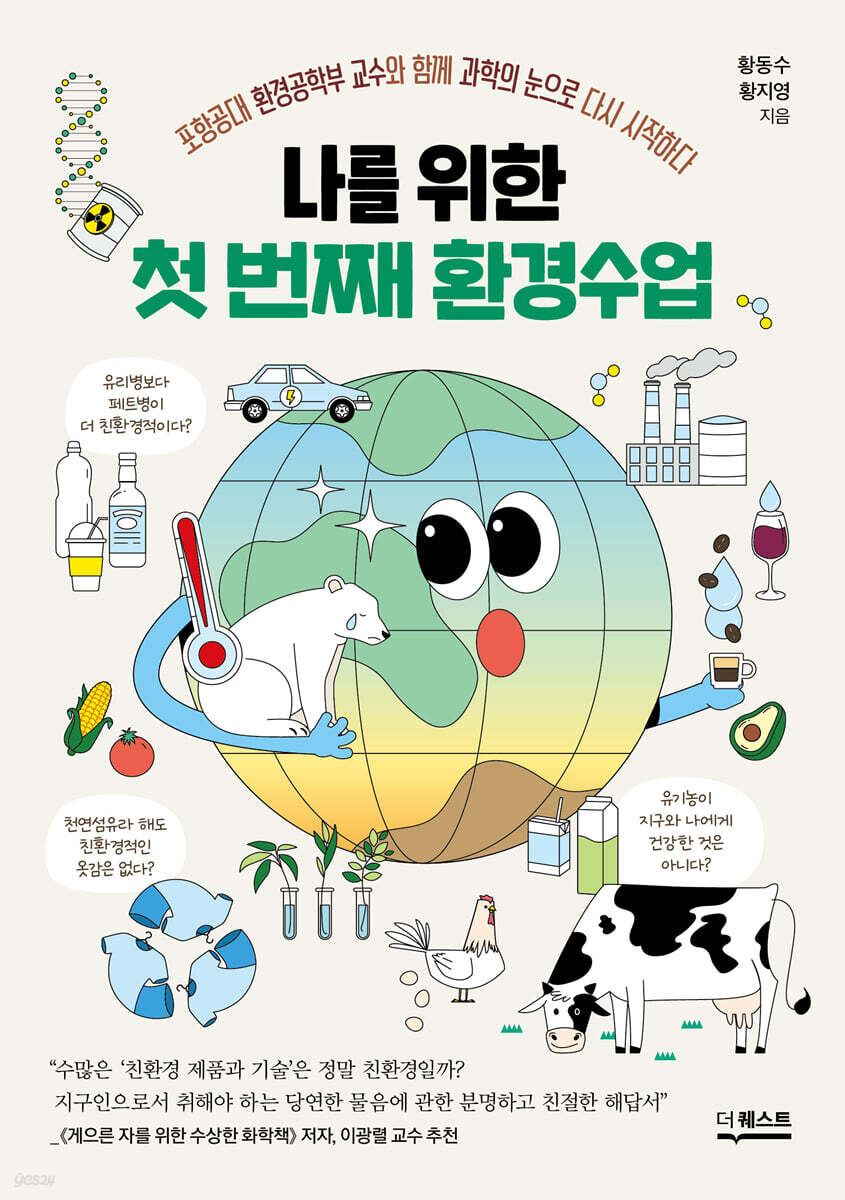
"My First Environmental Lesson" examines the problems arising from environmental pollution from various perspectives through the lens of science.
As you read this book, you will likely find yourself confused because the problems caused by environmental pollution are so complex and different from what you knew before.
But life in the future cannot be thought of separately from the environment.
Science and environmental knowledge are essential liberal arts for the future.
I hope that you will learn about the environment in a new way with “My First Environmental Lesson” and become a smarter citizen of the Earth.
The minimum environmental education that is beneficial to me
Advances in science have allowed us to discover new facts about our daily lives and use energy more efficiently.
Thanks to science, the harmful effects of lead and other toxic substances have been revealed, the use of freon gas, which destroys the ozone layer, has been stopped, and eco-friendly technologies that reduce carbon dioxide emissions are being developed.
But this is not all that science does.
Climate change is not only altering the Earth's environment, but is also creating new changes and causing problems across all areas of politics, economy, and society, including carbon colonialism, pollution exports, and carbon finance markets.
At this time, science seeks to address the massive inequalities created by the climate crisis by providing appropriate technologies accessible to those who do not have access to the benefits of civilization, or by making carbon emissions credits, a new currency within the carbon capitalist system, available for anyone to trade.
Science is the minimum option for practically solving the problems of today and the new problems that will arise in the future that cannot be solved simply through ethical consumption.
"My First Environmental Lesson" examines the problems arising from environmental pollution from various perspectives through the lens of science.
As you read this book, you will likely find yourself confused because the problems caused by environmental pollution are so complex and different from what you knew before.
But life in the future cannot be thought of separately from the environment.
Science and environmental knowledge are essential liberal arts for the future.
I hope that you will learn about the environment in a new way with “My First Environmental Lesson” and become a smarter citizen of the Earth.
- You can preview some of the book's contents.
Preview
index
Entering
No effort is needed for the Earth. Companies that use eco-friendliness. How science approaches the answer. Why a scientific perspective is still needed for environmental issues.
1.
Is carbon dioxide really the culprit behind the climate crisis?
1.5 degrees: The Maginot Line for the Climate Crisis┃Will a 1.5-degree rise really be a disaster?┃The most likely suspects, according to science and data┃We can't completely control carbon dioxide┃We can't go back to the past┃The best option without giving up abundance
2.
Smart Earthlings Think Efficiency First
What are the choices that protect the environment? ┃Why we don't have an immediate energy shortage┃High efficiency, low waste┃Are electric cars truly eco-friendly?┃Why Tesla may not be an eco-friendly company┃How can electric cars become cleaner┃What if we put a price on carbon dioxide emissions?┃In search of decarbonized energy
3.
Am I a rational clothes buyer?
Now that recycled fibers are trending, you're wearing plastic. The myth that natural fibers are safe. Why are recycled fibers more expensive? It's only eco-friendly if you wear them for a long time.
4.
A diet that's good for me and the environment
The Close Relationship Between Food and the Environment┃Nitrogen, the Key to Life┃The Scientific Reasons Why a Vegetarian Diet is Better for the Environment Than Meat┃The Challenge of Food┃The Emergence of Small Livestock┃Clearing the Avocado's Name┃Organic Food May Not Be the Answer Either┃Are GMOs Really Bad for Your Health?┃What Standards Should We Use When Choosing a Diet?
5.
A new future that requires science
Is there a perfect energy source? ┃Why we can't stop dangerous nuclear power ┃Find new energy sources ┃Increase absorption rather than emissions ┃The future lies in the ocean ┃Prepare for the new economic crisis brought about by carbon
6.
Scientists Reveal Surprising Eco-Friendly Habits
Could plastic bottles be more eco-friendly than glass? ┃The best way to dispose of leftover food ┃Why you should use detergent ┃How can I live more eco-friendly?
Going out
There is no perfect solution┃The minimum choice Earthlings can make
No effort is needed for the Earth. Companies that use eco-friendliness. How science approaches the answer. Why a scientific perspective is still needed for environmental issues.
1.
Is carbon dioxide really the culprit behind the climate crisis?
1.5 degrees: The Maginot Line for the Climate Crisis┃Will a 1.5-degree rise really be a disaster?┃The most likely suspects, according to science and data┃We can't completely control carbon dioxide┃We can't go back to the past┃The best option without giving up abundance
2.
Smart Earthlings Think Efficiency First
What are the choices that protect the environment? ┃Why we don't have an immediate energy shortage┃High efficiency, low waste┃Are electric cars truly eco-friendly?┃Why Tesla may not be an eco-friendly company┃How can electric cars become cleaner┃What if we put a price on carbon dioxide emissions?┃In search of decarbonized energy
3.
Am I a rational clothes buyer?
Now that recycled fibers are trending, you're wearing plastic. The myth that natural fibers are safe. Why are recycled fibers more expensive? It's only eco-friendly if you wear them for a long time.
4.
A diet that's good for me and the environment
The Close Relationship Between Food and the Environment┃Nitrogen, the Key to Life┃The Scientific Reasons Why a Vegetarian Diet is Better for the Environment Than Meat┃The Challenge of Food┃The Emergence of Small Livestock┃Clearing the Avocado's Name┃Organic Food May Not Be the Answer Either┃Are GMOs Really Bad for Your Health?┃What Standards Should We Use When Choosing a Diet?
5.
A new future that requires science
Is there a perfect energy source? ┃Why we can't stop dangerous nuclear power ┃Find new energy sources ┃Increase absorption rather than emissions ┃The future lies in the ocean ┃Prepare for the new economic crisis brought about by carbon
6.
Scientists Reveal Surprising Eco-Friendly Habits
Could plastic bottles be more eco-friendly than glass? ┃The best way to dispose of leftover food ┃Why you should use detergent ┃How can I live more eco-friendly?
Going out
There is no perfect solution┃The minimum choice Earthlings can make
Detailed image

Into the book
This is called greenwashing, which promotes something as if it is eco-friendly even though it is not.
Paying a little more for a product that claims to be made with the environment in mind, only to find out you were fooled into opening your wallet by a false marketing tactic, is even worse than using a product that's blatantly environmentally unfriendly.
So how can we determine whether a product is eco-friendly or not? A scientific perspective can help us distinguish between "relatively" eco-friendly choices and those that aren't.
--- From "Entering"
The data that most significantly contributes to the conclusion that current climate change is entirely caused by human activity are global temperature observations from the National Oceanic and Atmospheric Administration (NOAA), the longest-running research organization on the Earth and oceans. Since 1971, NOAA has been collecting and sharing atmospheric data from around the world.
According to this data, the global average temperature from 2011 to 2020 increased by a whopping 1.1 degrees Celsius compared to data from 1850 to 1900.
Estimates of Earth's temperature going back millions of years show that even at its hottest, a 1.1°C rise in 100 years has never been observed, allowing the IPCC to point to humans as the cause of recent rapid climate change.
It has been scientifically confirmed that human activities are the cause of climate change.
--- 「Chapter 1.
Is carbon dioxide really the culprit behind the climate crisis?
Can we go back to the past? Perhaps we could, but only if rapid environmental destruction renders our current way of life unsustainable. Having tasted abundance, we can't afford to make our own clothes, hand-wash our own clothes, and eat only the ingredients we grow ourselves, all for the sake of the environment.
Additionally, if nitrogen fertilizers were not fully used, most of the world's 8 billion people could go hungry.
And because we can no longer support the massive numbers of livestock we feed on surplus grain, meat prices will skyrocket and fewer people will be able to afford meat.
While radical change may be difficult, I believe we should at least be somewhat conscious of the benefits we enjoy without paying a true price to the planet, and make an effort not to abuse them.
Making choices that harm the environment a little less is what we do.
That would be one of the things you could do.
--- 「Chapter 1.
Is carbon dioxide really the culprit behind the climate crisis?
How efficiently are we using energy today? The amount of fuel we put into our cars is actually much smaller than we think, used to propel them.
When driving a car, only 15 to 28 percent of the energy in gasoline is used to actually move the car, while the remaining 72 to 85 percent is emitted as heat energy or is lost through incomplete combustion.
Even so, the final energy efficiency of a car does not exceed 20 percent, as one-third of the energy is used for things like the water pump that circulates the coolant, the generator that supplies electricity to the car's air conditioner and lighting, and the idling power.
In other words, out of 10 liters of gasoline put in a car, only 2 liters are used to move the car.
--- Chapter 2.
From "Smart Earthlings Think Efficiency First"
Because rayon factories are built to be easily disassembled and reassembled, production is moving from developed countries to developing countries, and then to even poorer countries.
Wonjin Rayon's machines were originally used in the United States, but when health problems arose among workers, they were exported to Japan, then to Korea, and then to China.
Many factories are now located in Southeast Asian countries.
This is partly because labor costs are low, but also to avoid regulations.
As a result, the price of Jjajangmyeon may have risen tenfold over 20 years, but the price of socks may have remained the same.
This phenomenon of manufacturing moving across borders to maintain low prices rather than improve production environments is called "pollution export."
--- 「Chapter 3.
Am I a rational clothes buyer?
First, in the case of foods processed from organic products, the raw ingredients may be organic, but the finished product may not be environmentally friendly or healthy.
For example, organic milk loses much of its good nutrients during the pasteurization process and is packaged in thick, aluminum-coated paper cartons.
Cows and chickens are truly organic livestock products that are actually left to graze in nature and find their own food.
However, if they are left to graze in the wild, there is a high probability that they will eat grass sprayed with pesticides, so they are raised in barns and fed organic feed.
Therefore, the same problems that occur in livestock raised on grain rather than natural feed can occur.
--- Chapter 4.
From “A diet that is good for me and the environment”
How important is seaweed farming in achieving carbon neutrality? As mentioned earlier, the world consumes approximately 4.5 billion tons of oil annually.
The current production of bioethanol and biomass, which can partially replace this, is about 1 billion tons per year.
This is not enough to replace all petrochemicals anytime soon.
However, if we use kelp, a macroalgae, as biomass, we can grow and use biodegradable biomass that absorbs 6,000 tons of carbon dioxide per year per square kilometer of ocean area.
--- Chapter 5.
From “A New Future That Requires Science”
I think it would be very worthwhile to carry a tumbler instead of a disposable plastic cup.
However, if you do not use the tumbler properly, it can actually be detrimental to environmental conservation.
Tumblers are mostly made of metal, so they are made at much higher temperatures and use more energy and raw materials.
Additionally, various raw materials are mixed and used to enhance the heat retention effect.
This means that once they are thrown away, they are difficult to recycle.
To get the most out of your tumbler, you need to use it for as long as possible.
According to the Life Cycle Energy Analysis Institute in the United States, stainless steel tumblers should be used at least 1,000 times.
If you're someone who gets bored quickly and frequently buys and throws away things, using paper cups may actually be more environmentally friendly.
Paying a little more for a product that claims to be made with the environment in mind, only to find out you were fooled into opening your wallet by a false marketing tactic, is even worse than using a product that's blatantly environmentally unfriendly.
So how can we determine whether a product is eco-friendly or not? A scientific perspective can help us distinguish between "relatively" eco-friendly choices and those that aren't.
--- From "Entering"
The data that most significantly contributes to the conclusion that current climate change is entirely caused by human activity are global temperature observations from the National Oceanic and Atmospheric Administration (NOAA), the longest-running research organization on the Earth and oceans. Since 1971, NOAA has been collecting and sharing atmospheric data from around the world.
According to this data, the global average temperature from 2011 to 2020 increased by a whopping 1.1 degrees Celsius compared to data from 1850 to 1900.
Estimates of Earth's temperature going back millions of years show that even at its hottest, a 1.1°C rise in 100 years has never been observed, allowing the IPCC to point to humans as the cause of recent rapid climate change.
It has been scientifically confirmed that human activities are the cause of climate change.
--- 「Chapter 1.
Is carbon dioxide really the culprit behind the climate crisis?
Can we go back to the past? Perhaps we could, but only if rapid environmental destruction renders our current way of life unsustainable. Having tasted abundance, we can't afford to make our own clothes, hand-wash our own clothes, and eat only the ingredients we grow ourselves, all for the sake of the environment.
Additionally, if nitrogen fertilizers were not fully used, most of the world's 8 billion people could go hungry.
And because we can no longer support the massive numbers of livestock we feed on surplus grain, meat prices will skyrocket and fewer people will be able to afford meat.
While radical change may be difficult, I believe we should at least be somewhat conscious of the benefits we enjoy without paying a true price to the planet, and make an effort not to abuse them.
Making choices that harm the environment a little less is what we do.
That would be one of the things you could do.
--- 「Chapter 1.
Is carbon dioxide really the culprit behind the climate crisis?
How efficiently are we using energy today? The amount of fuel we put into our cars is actually much smaller than we think, used to propel them.
When driving a car, only 15 to 28 percent of the energy in gasoline is used to actually move the car, while the remaining 72 to 85 percent is emitted as heat energy or is lost through incomplete combustion.
Even so, the final energy efficiency of a car does not exceed 20 percent, as one-third of the energy is used for things like the water pump that circulates the coolant, the generator that supplies electricity to the car's air conditioner and lighting, and the idling power.
In other words, out of 10 liters of gasoline put in a car, only 2 liters are used to move the car.
--- Chapter 2.
From "Smart Earthlings Think Efficiency First"
Because rayon factories are built to be easily disassembled and reassembled, production is moving from developed countries to developing countries, and then to even poorer countries.
Wonjin Rayon's machines were originally used in the United States, but when health problems arose among workers, they were exported to Japan, then to Korea, and then to China.
Many factories are now located in Southeast Asian countries.
This is partly because labor costs are low, but also to avoid regulations.
As a result, the price of Jjajangmyeon may have risen tenfold over 20 years, but the price of socks may have remained the same.
This phenomenon of manufacturing moving across borders to maintain low prices rather than improve production environments is called "pollution export."
--- 「Chapter 3.
Am I a rational clothes buyer?
First, in the case of foods processed from organic products, the raw ingredients may be organic, but the finished product may not be environmentally friendly or healthy.
For example, organic milk loses much of its good nutrients during the pasteurization process and is packaged in thick, aluminum-coated paper cartons.
Cows and chickens are truly organic livestock products that are actually left to graze in nature and find their own food.
However, if they are left to graze in the wild, there is a high probability that they will eat grass sprayed with pesticides, so they are raised in barns and fed organic feed.
Therefore, the same problems that occur in livestock raised on grain rather than natural feed can occur.
--- Chapter 4.
From “A diet that is good for me and the environment”
How important is seaweed farming in achieving carbon neutrality? As mentioned earlier, the world consumes approximately 4.5 billion tons of oil annually.
The current production of bioethanol and biomass, which can partially replace this, is about 1 billion tons per year.
This is not enough to replace all petrochemicals anytime soon.
However, if we use kelp, a macroalgae, as biomass, we can grow and use biodegradable biomass that absorbs 6,000 tons of carbon dioxide per year per square kilometer of ocean area.
--- Chapter 5.
From “A New Future That Requires Science”
I think it would be very worthwhile to carry a tumbler instead of a disposable plastic cup.
However, if you do not use the tumbler properly, it can actually be detrimental to environmental conservation.
Tumblers are mostly made of metal, so they are made at much higher temperatures and use more energy and raw materials.
Additionally, various raw materials are mixed and used to enhance the heat retention effect.
This means that once they are thrown away, they are difficult to recycle.
To get the most out of your tumbler, you need to use it for as long as possible.
According to the Life Cycle Energy Analysis Institute in the United States, stainless steel tumblers should be used at least 1,000 times.
If you're someone who gets bored quickly and frequently buys and throws away things, using paper cups may actually be more environmentally friendly.
--- Chapter 6.
From "Surprised Eco-Friendly Habits Revealed by Scientists"
From "Surprised Eco-Friendly Habits Revealed by Scientists"
Publisher's Review
Are plastic bottles more environmentally friendly than glass bottles?
Even if it's made of natural fibers, there are no eco-friendly fabrics?
Isn't organic healthy for the planet and me?
Some people pay more and spend more time hoping that it will help the environment and their health, such as those who buy groceries at organic supermarkets, those who buy clothes with recycling tags, those who insist on cotton sanitary pads over disposable ones, and those who buy multiple tumblers.
Are their choices truly beneficial to the environment and to me? Organic foods may contain organic ingredients, but the finished product may not be environmentally friendly or healthy. Furthermore, recycled clothing in Korea often imports recycled plastic from overseas, generating even more carbon dioxide emissions.
When we look at our daily lives from various perspectives with a scientific lens, we realize that the choices we made thinking they were eco-friendly were not.
Meanwhile, science can also help improve environmental problems.
We are developing technologies to capture carbon dioxide from the deep sea to reduce its concentration in the atmosphere, and we are researching decarbonized energy and truly eco-friendly vehicles to reduce carbon dioxide emissions.
Science creates a new future like that.
There is no perfect solution to this complex environmental problem, but there are minimal options.
That's what "My First Environmental Lesson" is all about.
Environmental science in every moment of eating, wearing, and using
We are the largest emitter of carbon dioxide.
We burn fossil fuels 24 hours a day to keep us comfortable in the summer and warm in the winter, and this generates carbon dioxide.
Carbon dioxide is also emitted when we make soap, toothbrushes, and toothpaste, which we use when we wake up in the morning and get ready for school.
The water purification process used in showering also emits carbon dioxide.
Whether you eat salad or meat for breakfast, most foods are made with massive amounts of carbon dioxide.
Modern agriculture often takes place in greenhouses, using fuel and electricity to control the temperature in the greenhouses.
Fertilizer also emits carbon dioxide during its production process.
Every moment we make choices about how we eat, move, and write has an impact on the environment.
But sometimes our choices go in the wrong direction.
There are cases where a choice made because it was thought to be environmentally friendly actually turns out to be unenvironmentally friendly.
So we need to know science.
A scientific perspective can help us distinguish between relatively environmentally friendly and less environmentally friendly choices.
New scientifically proven facts we didn't know
〉Are PET bottles more environmentally friendly than glass bottles?
PET bottles take longer to decompose in nature than glass bottles or cans, but they produce the least carbon dioxide when they are made, transported, and used.
If you are perfectly separating your waste, using plastic bottles is the best option.
〉Organic food isn't healthy for the planet and me?
Organic products are treated with preservatives during the import and export process.
Additionally, if all farming methods are converted to organic farming, greenhouse gas emissions will decrease, but crop production per unit area will decrease and the variety will not be able to meet demand, increasing the amount of food imported from overseas.
Ultimately, transporting food may result in more carbon dioxide emissions.
〉Are Korea's recycled clothes harmful to the environment?
Why are recycled fiber clothes so expensive? It's because they're made from recycled plastic imported from overseas.
In foreign countries, only transparent PET bottles are produced, and when separated and collected, labels and caps are removed to create high-purity recycled plastic.
South Korea, which is not doing so, is emitting more carbon dioxide in the process of importing recycled plastic.
〉Why can’t we give up dangerous nuclear energy?
Nuclear power generation has the disadvantage of being difficult to control radiation energy and difficult to decompose nuclear waste.
However, research on how to properly handle nuclear energy must continue because it produces no carbon dioxide or exhaust gases during the energy production process and produces the most energy at a low cost.
Even if it's made of natural fibers, there are no eco-friendly fabrics?
Isn't organic healthy for the planet and me?
Some people pay more and spend more time hoping that it will help the environment and their health, such as those who buy groceries at organic supermarkets, those who buy clothes with recycling tags, those who insist on cotton sanitary pads over disposable ones, and those who buy multiple tumblers.
Are their choices truly beneficial to the environment and to me? Organic foods may contain organic ingredients, but the finished product may not be environmentally friendly or healthy. Furthermore, recycled clothing in Korea often imports recycled plastic from overseas, generating even more carbon dioxide emissions.
When we look at our daily lives from various perspectives with a scientific lens, we realize that the choices we made thinking they were eco-friendly were not.
Meanwhile, science can also help improve environmental problems.
We are developing technologies to capture carbon dioxide from the deep sea to reduce its concentration in the atmosphere, and we are researching decarbonized energy and truly eco-friendly vehicles to reduce carbon dioxide emissions.
Science creates a new future like that.
There is no perfect solution to this complex environmental problem, but there are minimal options.
That's what "My First Environmental Lesson" is all about.
Environmental science in every moment of eating, wearing, and using
We are the largest emitter of carbon dioxide.
We burn fossil fuels 24 hours a day to keep us comfortable in the summer and warm in the winter, and this generates carbon dioxide.
Carbon dioxide is also emitted when we make soap, toothbrushes, and toothpaste, which we use when we wake up in the morning and get ready for school.
The water purification process used in showering also emits carbon dioxide.
Whether you eat salad or meat for breakfast, most foods are made with massive amounts of carbon dioxide.
Modern agriculture often takes place in greenhouses, using fuel and electricity to control the temperature in the greenhouses.
Fertilizer also emits carbon dioxide during its production process.
Every moment we make choices about how we eat, move, and write has an impact on the environment.
But sometimes our choices go in the wrong direction.
There are cases where a choice made because it was thought to be environmentally friendly actually turns out to be unenvironmentally friendly.
So we need to know science.
A scientific perspective can help us distinguish between relatively environmentally friendly and less environmentally friendly choices.
New scientifically proven facts we didn't know
〉Are PET bottles more environmentally friendly than glass bottles?
PET bottles take longer to decompose in nature than glass bottles or cans, but they produce the least carbon dioxide when they are made, transported, and used.
If you are perfectly separating your waste, using plastic bottles is the best option.
〉Organic food isn't healthy for the planet and me?
Organic products are treated with preservatives during the import and export process.
Additionally, if all farming methods are converted to organic farming, greenhouse gas emissions will decrease, but crop production per unit area will decrease and the variety will not be able to meet demand, increasing the amount of food imported from overseas.
Ultimately, transporting food may result in more carbon dioxide emissions.
〉Are Korea's recycled clothes harmful to the environment?
Why are recycled fiber clothes so expensive? It's because they're made from recycled plastic imported from overseas.
In foreign countries, only transparent PET bottles are produced, and when separated and collected, labels and caps are removed to create high-purity recycled plastic.
South Korea, which is not doing so, is emitting more carbon dioxide in the process of importing recycled plastic.
〉Why can’t we give up dangerous nuclear energy?
Nuclear power generation has the disadvantage of being difficult to control radiation energy and difficult to decompose nuclear waste.
However, research on how to properly handle nuclear energy must continue because it produces no carbon dioxide or exhaust gases during the energy production process and produces the most energy at a low cost.
GOODS SPECIFICS
- Date of issue: November 20, 2024
- Page count, weight, size: 231 pages | 328g | 148*210*15mm
- ISBN13: 9791140711628
- ISBN10: 1140711628
You may also like
카테고리
korean


korean

![GQ KOREA Mark (Monthly): December [2025]](http://librairie.coreenne.fr/cdn/shop/files/8ef265dbbfbf186523ed75ba7319009d.jpg?v=1765340328&width=3840)


