

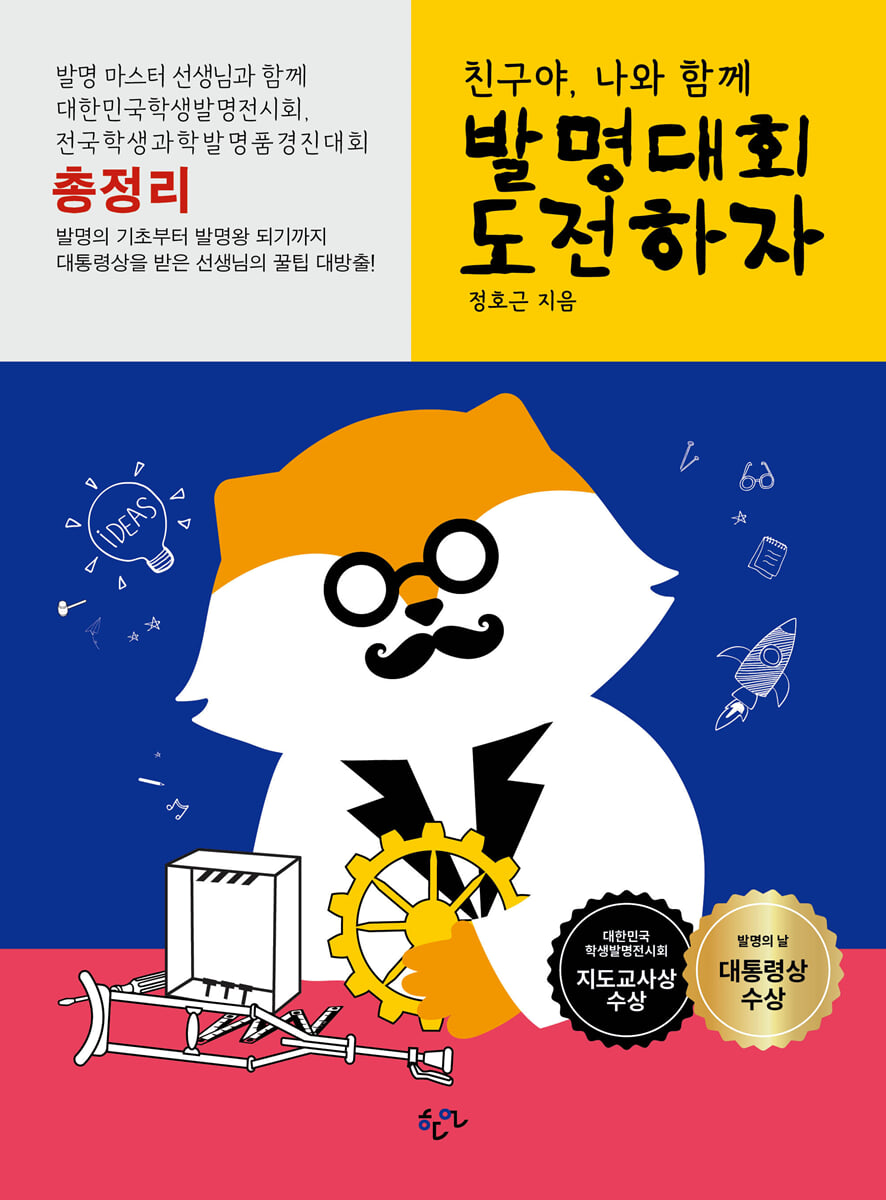
Hey friend, let's take on the invention contest together.
 |
Description
Book Introduction
A must-read for students, parents, and teachers preparing for invention competitions.
The know-how of a master inventor who served as a judge at an invention contest is revealed!
This book provides detailed information on the outline, process, judging criteria, and participation methods of the 'Korea Student Invention Exhibition' and the 'National Student Science Invention Competition', which are representative invention competitions in Korea.
In this book, invention master Jeong Ho-geun, who served as a judge for the Korea Student Invention Exhibition, has compiled all the questions that countless students and guardians have in common.
How do you invent something? How do you achieve success in invention competitions? This guide answers the most frequently asked questions, making it easy to find the information you need.
We also introduce various award-winning cases, ranging from invention ideas found in everyday life, such as the X-shaped folding mobile bike stand and the simple wall-mounted drying rack, to ideas found in incidents and accidents, and ideas for the disabled and elderly.
An invention journal that covers the entire process of invention, from the initial idea to the creation of a model, will provide readers with concrete help in developing their own ideas.
It also contains answers to questions raised during the invention process and interesting stories related to the invention.
The author emphasizes the importance of developing creativity-based problem-solving skills and that the successes and failures students experience as they find and solve problems on their own will serve as the foundation for their growth.
It shows how invention experiences can help students actively explore career paths by introducing how they are connected to career paths.
Reading this book will help you observe your surroundings to identify problems, develop ideas to solve them, and even lay the foundation for achieving outstanding results in invention competitions.
Above all, you will want to invent and say things like this.
“Hey friend, let’s challenge the invention contest together!”
The know-how of a master inventor who served as a judge at an invention contest is revealed!
This book provides detailed information on the outline, process, judging criteria, and participation methods of the 'Korea Student Invention Exhibition' and the 'National Student Science Invention Competition', which are representative invention competitions in Korea.
In this book, invention master Jeong Ho-geun, who served as a judge for the Korea Student Invention Exhibition, has compiled all the questions that countless students and guardians have in common.
How do you invent something? How do you achieve success in invention competitions? This guide answers the most frequently asked questions, making it easy to find the information you need.
We also introduce various award-winning cases, ranging from invention ideas found in everyday life, such as the X-shaped folding mobile bike stand and the simple wall-mounted drying rack, to ideas found in incidents and accidents, and ideas for the disabled and elderly.
An invention journal that covers the entire process of invention, from the initial idea to the creation of a model, will provide readers with concrete help in developing their own ideas.
It also contains answers to questions raised during the invention process and interesting stories related to the invention.
The author emphasizes the importance of developing creativity-based problem-solving skills and that the successes and failures students experience as they find and solve problems on their own will serve as the foundation for their growth.
It shows how invention experiences can help students actively explore career paths by introducing how they are connected to career paths.
Reading this book will help you observe your surroundings to identify problems, develop ideas to solve them, and even lay the foundation for achieving outstanding results in invention competitions.
Above all, you will want to invent and say things like this.
“Hey friend, let’s challenge the invention contest together!”
- You can preview some of the book's contents.
Preview
index
Prologue
Chapter 1 Ideas start from observing the surroundings!
01 Teacher, what is the first attitude we should have in order to invent?
02 Teacher, this is my first time trying to invent something! How should I get started?
03 Teacher, I want to get better at inventing.
Is there a way?
04 Teacher, are there many invention-related activities taking place in other countries as well?
05 Teacher, how are STEAM education, maker education, and software education related to invention education?
06 Teacher, I want to learn the invention education process systematically.
Please tell me how!
07 Teacher, is invention education important?
08 Teacher, should I participate in an invention contest? What are the benefits of participating?
09 Teacher, is there an invention contest that even students who don't know much about invention can participate in? (Korea Student Invention Exhibition)
10. Teacher, I want to participate in an invention competition where I develop my invention idea through a step-by-step research process (National Student Science Invention Competition).
Teacher, do inventions influence our career paths? Please tell us about an example of an invention connecting with a career path.
Chapter 2: Challenge yourself to the Korea Student Invention Exhibition!
01 Teacher, I'm curious about the process for participating in the Korea Student Invention Exhibition!
02 What works have won awards at the Korea Student Invention Exhibition so far?
1.
Ideas found in life
1) Invention found in the bathroom
2) An invention discovered while studying
3) Inventions discovered while riding a bicycle
2.
Ideas found in tools
1) Invention found in a delivery
2) Inventions found in drivers
3.
Ideas from experience
1) Inventions found in vending machines
2) Inventions found in crutches
3) Inventions found on the road
4.
Ideas I found in class
1) Inventions discovered through compasses
2) Inventions found in books
5.
Ideas for safety
1) Inventions discovered from incidents and accidents
2) Inventions for public places
3) Inventions found in architecture
4) Inventions discovered during maritime disasters
Chapter 3: Challenge yourself in the National Student Science Invention Competition!
01 Teacher, please tell us about the process of participating in the National Student Science Invention Competition.
02 Teacher, how should we prepare to participate in the National Student Science Invention Competition?
03 Teacher, please introduce the winning cases from the National Student Science Invention Competition.
1.
Ideas found in life
1) Invention found in a clothes hanger
2) Inventions found in stand-alone clothes drying racks
2.
Ideas found in tools
1) Inventions found in drivers
3.
Ideas from experience
1) Invention found in an elevator
4.
Ideas I found in class
1) Inventions discovered while studying mathematics
5.
Ideas for the disabled and elderly
1) Inventions for the visually impaired
2) Invention for maternal grandfather
Chapter 4 Let's solve the questions that arose while inventing!
01 Teacher, how do you come up with and develop invention ideas?
02 Teacher, I want to do a patent search!
03 Teacher, I'm trying to make a model for the first time while inventing.
What should I do?
04 Teacher, have you ever won an award by making a paper model and submitting it?
05 Teacher, is there a president who invented something?
06 Teacher, how were the household items we use invented?
07 Teacher, please introduce an invention from our country that we can brag about to our friends around the world!
References
Chapter 1 Ideas start from observing the surroundings!
01 Teacher, what is the first attitude we should have in order to invent?
02 Teacher, this is my first time trying to invent something! How should I get started?
03 Teacher, I want to get better at inventing.
Is there a way?
04 Teacher, are there many invention-related activities taking place in other countries as well?
05 Teacher, how are STEAM education, maker education, and software education related to invention education?
06 Teacher, I want to learn the invention education process systematically.
Please tell me how!
07 Teacher, is invention education important?
08 Teacher, should I participate in an invention contest? What are the benefits of participating?
09 Teacher, is there an invention contest that even students who don't know much about invention can participate in? (Korea Student Invention Exhibition)
10. Teacher, I want to participate in an invention competition where I develop my invention idea through a step-by-step research process (National Student Science Invention Competition).
Teacher, do inventions influence our career paths? Please tell us about an example of an invention connecting with a career path.
Chapter 2: Challenge yourself to the Korea Student Invention Exhibition!
01 Teacher, I'm curious about the process for participating in the Korea Student Invention Exhibition!
02 What works have won awards at the Korea Student Invention Exhibition so far?
1.
Ideas found in life
1) Invention found in the bathroom
2) An invention discovered while studying
3) Inventions discovered while riding a bicycle
2.
Ideas found in tools
1) Invention found in a delivery
2) Inventions found in drivers
3.
Ideas from experience
1) Inventions found in vending machines
2) Inventions found in crutches
3) Inventions found on the road
4.
Ideas I found in class
1) Inventions discovered through compasses
2) Inventions found in books
5.
Ideas for safety
1) Inventions discovered from incidents and accidents
2) Inventions for public places
3) Inventions found in architecture
4) Inventions discovered during maritime disasters
Chapter 3: Challenge yourself in the National Student Science Invention Competition!
01 Teacher, please tell us about the process of participating in the National Student Science Invention Competition.
02 Teacher, how should we prepare to participate in the National Student Science Invention Competition?
03 Teacher, please introduce the winning cases from the National Student Science Invention Competition.
1.
Ideas found in life
1) Invention found in a clothes hanger
2) Inventions found in stand-alone clothes drying racks
2.
Ideas found in tools
1) Inventions found in drivers
3.
Ideas from experience
1) Invention found in an elevator
4.
Ideas I found in class
1) Inventions discovered while studying mathematics
5.
Ideas for the disabled and elderly
1) Inventions for the visually impaired
2) Invention for maternal grandfather
Chapter 4 Let's solve the questions that arose while inventing!
01 Teacher, how do you come up with and develop invention ideas?
02 Teacher, I want to do a patent search!
03 Teacher, I'm trying to make a model for the first time while inventing.
What should I do?
04 Teacher, have you ever won an award by making a paper model and submitting it?
05 Teacher, is there a president who invented something?
06 Teacher, how were the household items we use invented?
07 Teacher, please introduce an invention from our country that we can brag about to our friends around the world!
References
Publisher's Review
Invention isn't difficult! Let's start by observing our surroundings.
This book is for students, parents, and teachers who are interested in inventions and want to participate in invention competitions. It answers general questions about inventions and presents practical methods for participating in invention competitions.
Based on his 20 years of experience in invention education, author Jeong Ho-geun has compiled and organized the content into a format that answers questions he has repeatedly received from numerous students, parents, and teachers.
It guides the entire invention process from generating invention ideas in everyday life to making them concrete and actual models, and emphasizes the importance of invention education.
Chapter 1 mainly covers the basic attitude to starting an invention and how to find ideas around you.
Emphasize that observing everyday problems around you can be a starting point for invention, helping students overcome their vague fear of invention and actively explore ideas.
It stimulates interest in inventions by citing examples of inventions that are readily available on the street but were introduced relatively recently, such as crosswalk shades and floor traffic lights.
The author explains the importance of invention education by linking it to STEAM education, maker education, and software education.
He emphasizes how critical creativity-based problem solving is in fostering future talent, and how the successes and failures students experience as they find and solve problems on their own will serve as the foundation for their growth.
Chapter 1 provides guidance on how to receive invention education and provides an overview of invention competitions.
Invention, the power to solve problems! Let's share your ideas with the world through invention contests.
Chapter 2 covers the Korea Student Invention Exhibition, and Chapter 3 covers the National Student Science Invention Competition.
From the application stage to the final submission stage of Korea's representative invention contest, we provide detailed guidance on the parts that many participants experience trial and error.
You can see all the information about the competition process, judging criteria, etc. all at once.
Many students feel pressured to enter invention contests with outrageous ideas.
This book introduces award-winning cases of ideas discovered in everyday life, lowering the barrier to entry for invention contests.
For example, have you ever dropped a small object into the sink drain in the bathroom, or experienced a clogged drain that prevented water from draining properly? Or perhaps you've ever felt that a standing clothes dryer takes up too much space indoors? This book presents invention ideas that have won awards at invention contests, solving problems most people have encountered at least once.
In addition, we raise awareness of inventions that take social value into account, such as inventions that can help in disaster situations or invention ideas for the disabled and elderly.
Because the invention journal is included as is, it will be of specific help to readers in coming up with their own invention ideas.
Chapter 4 addresses questions that arise during the invention process.
It provides practical tips on how to develop an idea, conduct a patent search, and navigate the challenges of building a prototype, equipping readers with all the information they need to tackle an invention competition.
You can learn about the history of invention by looking at how the household items we use today were invented and what some of Korea's most notable inventions are.
This book is more than just a guide to invention contests; it's a valuable resource that helps students develop their creativity and problem-solving skills.
It will be of great help to anyone who is interested in invention and wants to challenge themselves in invention competitions.
This book is for students, parents, and teachers who are interested in inventions and want to participate in invention competitions. It answers general questions about inventions and presents practical methods for participating in invention competitions.
Based on his 20 years of experience in invention education, author Jeong Ho-geun has compiled and organized the content into a format that answers questions he has repeatedly received from numerous students, parents, and teachers.
It guides the entire invention process from generating invention ideas in everyday life to making them concrete and actual models, and emphasizes the importance of invention education.
Chapter 1 mainly covers the basic attitude to starting an invention and how to find ideas around you.
Emphasize that observing everyday problems around you can be a starting point for invention, helping students overcome their vague fear of invention and actively explore ideas.
It stimulates interest in inventions by citing examples of inventions that are readily available on the street but were introduced relatively recently, such as crosswalk shades and floor traffic lights.
The author explains the importance of invention education by linking it to STEAM education, maker education, and software education.
He emphasizes how critical creativity-based problem solving is in fostering future talent, and how the successes and failures students experience as they find and solve problems on their own will serve as the foundation for their growth.
Chapter 1 provides guidance on how to receive invention education and provides an overview of invention competitions.
Invention, the power to solve problems! Let's share your ideas with the world through invention contests.
Chapter 2 covers the Korea Student Invention Exhibition, and Chapter 3 covers the National Student Science Invention Competition.
From the application stage to the final submission stage of Korea's representative invention contest, we provide detailed guidance on the parts that many participants experience trial and error.
You can see all the information about the competition process, judging criteria, etc. all at once.
Many students feel pressured to enter invention contests with outrageous ideas.
This book introduces award-winning cases of ideas discovered in everyday life, lowering the barrier to entry for invention contests.
For example, have you ever dropped a small object into the sink drain in the bathroom, or experienced a clogged drain that prevented water from draining properly? Or perhaps you've ever felt that a standing clothes dryer takes up too much space indoors? This book presents invention ideas that have won awards at invention contests, solving problems most people have encountered at least once.
In addition, we raise awareness of inventions that take social value into account, such as inventions that can help in disaster situations or invention ideas for the disabled and elderly.
Because the invention journal is included as is, it will be of specific help to readers in coming up with their own invention ideas.
Chapter 4 addresses questions that arise during the invention process.
It provides practical tips on how to develop an idea, conduct a patent search, and navigate the challenges of building a prototype, equipping readers with all the information they need to tackle an invention competition.
You can learn about the history of invention by looking at how the household items we use today were invented and what some of Korea's most notable inventions are.
This book is more than just a guide to invention contests; it's a valuable resource that helps students develop their creativity and problem-solving skills.
It will be of great help to anyone who is interested in invention and wants to challenge themselves in invention competitions.
GOODS SPECIFICS
- Date of issue: October 15, 2024
- Page count, weight, size: 336 pages | 170*230*30mm
- ISBN13: 9788955969689
- ISBN10: 8955969686
You may also like
카테고리
korean


korean

![GQ KOREA Mark (Monthly): December [2025]](http://librairie.coreenne.fr/cdn/shop/files/8ef265dbbfbf186523ed75ba7319009d.jpg?v=1765340328&width=3840)


