

Reading with the teacher
 |
Description
Book Introduction
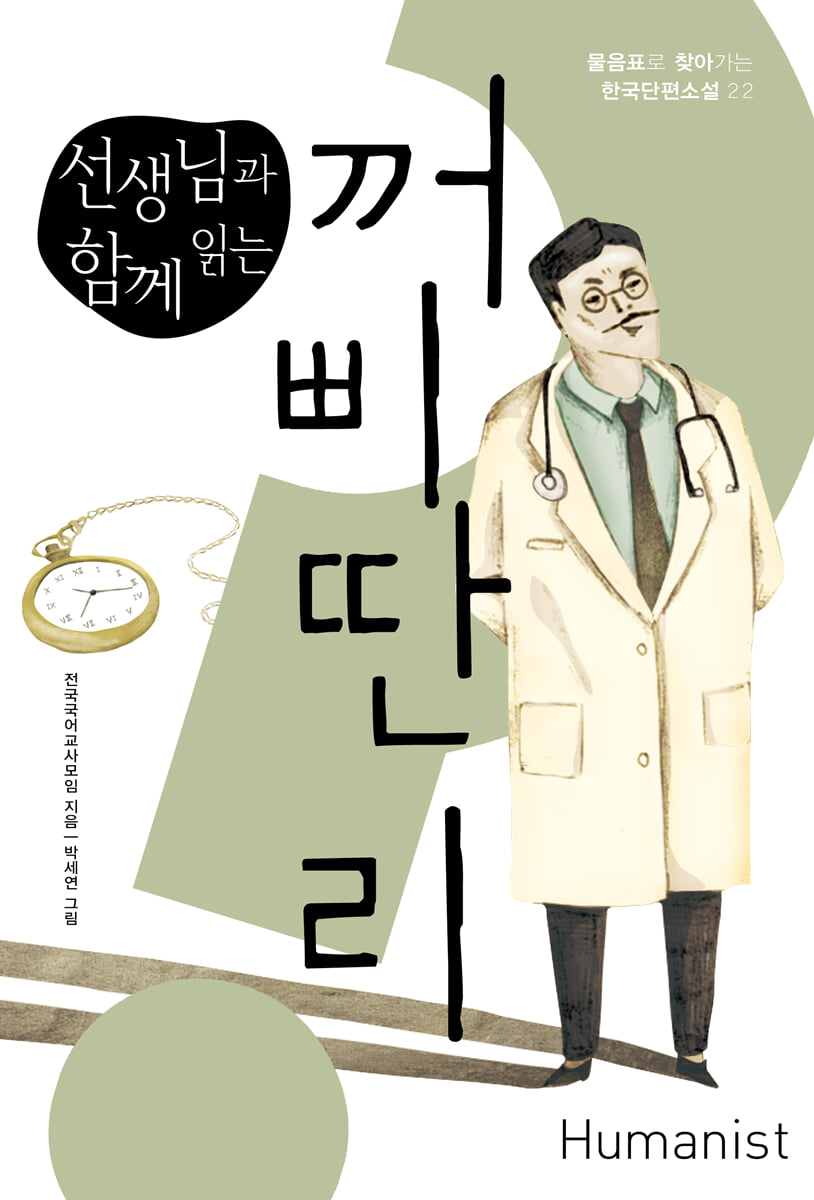
『(Reading with a Teacher) Keoppi-tan Lee』 is the 22nd book in the series ‘Korean Short Stories with Question Marks’ planned and written by the National Association of Korean Language Teachers.
This book is filled with meaningful questions students ask after reading "Kkeoppi-tan Lee" and Korean language teachers answering those questions.
"The Tale of the Two Sisters" is a work that allows us to glimpse the typical opportunistic human being through the protagonist's actions and desires, who lives only for personal glory and comfort, flattering those in power in a turbulent era.
This book contains a lot of information about 'Kkappitan Lee' that you didn't know and need to know.
In addition, you can encounter various stories such as the life of the author of this work, Jeon Gwang-yong, the circumstances of the time when the work was written, works worth reading together, and virtual conversations for character exploration.
This book is filled with meaningful questions students ask after reading "Kkeoppi-tan Lee" and Korean language teachers answering those questions.
"The Tale of the Two Sisters" is a work that allows us to glimpse the typical opportunistic human being through the protagonist's actions and desires, who lives only for personal glory and comfort, flattering those in power in a turbulent era.
This book contains a lot of information about 'Kkappitan Lee' that you didn't know and need to know.
In addition, you can encounter various stories such as the life of the author of this work, Jeon Gwang-yong, the circumstances of the time when the work was written, works worth reading together, and virtual conversations for character exploration.
- You can preview some of the book's contents.
Preview
index
Publishing the series 'Korean Short Stories with Question Marks'
preface
Reading the work: "Kkeoppitan Lee" _ Jeon Gwang-yong
Reading Deeply: Reading "Keoppitan Lee" through Questions and Answers
1_ Examining the author's intention
Why is the title 'Kkeoppitan Lee'?
Why is the main character a bad guy?
Is Lee In-guk a real person?
Why did you mix up the order of the stories?
2_ Looking into the times
Are the Self-Defense Forces and the Security Forces different?
What is a pro-Japanese collaborator?
Did you have to speak Japanese during the Japanese colonial period?
Why did 'Namiko' become an offensive name after liberation?
Why does Lee In-guk hate his daughter marrying an American?
3_ Uncovering the character's true nature
Why does Lee In-guk treasure his watch so much?
Why does Lee In-guk study foreign languages so hard?
What kind of books are 《The Annals of the Joseon Dynasty》 and 《Daedong Yaseung》?
Why does Lee In-guk want to go to America?
He lived hard, so why is Lee In-guk a bad person?
Reading Broadly: A Look Beyond the Work
Author Story - A Chronology of Jeon Gwang-yong's Life and Works, Learn More About the Author
A Story of the Times - From the Japanese Colonial Period to the Early 1960s
Reading Together - Characters Resembling Lee In-guk, Characters Different from Lee In-guk
Rereading - A Virtual Conversation between Lee In-guk and Jang Gi-ryeo
Reader's Stories - "Keoppitan Lee" Reading Newspaper
References
preface
Reading the work: "Kkeoppitan Lee" _ Jeon Gwang-yong
Reading Deeply: Reading "Keoppitan Lee" through Questions and Answers
1_ Examining the author's intention
Why is the title 'Kkeoppitan Lee'?
Why is the main character a bad guy?
Is Lee In-guk a real person?
Why did you mix up the order of the stories?
2_ Looking into the times
Are the Self-Defense Forces and the Security Forces different?
What is a pro-Japanese collaborator?
Did you have to speak Japanese during the Japanese colonial period?
Why did 'Namiko' become an offensive name after liberation?
Why does Lee In-guk hate his daughter marrying an American?
3_ Uncovering the character's true nature
Why does Lee In-guk treasure his watch so much?
Why does Lee In-guk study foreign languages so hard?
What kind of books are 《The Annals of the Joseon Dynasty》 and 《Daedong Yaseung》?
Why does Lee In-guk want to go to America?
He lived hard, so why is Lee In-guk a bad person?
Reading Broadly: A Look Beyond the Work
Author Story - A Chronology of Jeon Gwang-yong's Life and Works, Learn More About the Author
A Story of the Times - From the Japanese Colonial Period to the Early 1960s
Reading Together - Characters Resembling Lee In-guk, Characters Different from Lee In-guk
Rereading - A Virtual Conversation between Lee In-guk and Jang Gi-ryeo
Reader's Stories - "Keoppitan Lee" Reading Newspaper
References
Detailed image

Publisher's Review
Planned and written by the National Korean Language Teachers Association
A Guide to Appreciating Short Stories in Textbooks
1.
I dream of a literature class overflowing with wild imaginations and lively questions!
The 'Korean Short Stories with Question Marks' series is a book planned and written by the National Korean Language Teachers Association, which dreams of 'exciting and fun literature classes.'
It was created as a reflection on literature classes designed for entrance exams and examinations, that is, literature classes that provide students with uniform and mechanical information about works, and with the intention of informing students about what they actually wonder about after reading the works.
Through this, we aimed to break away from one-sided literature classes that were consistent with fragmentary understanding and forced memorization, and to establish a foundation for a user-centered literature class that allows students to understand and empathize with the work.
The 'Korean Short Stories with Question Marks' series focuses on short stories that have been widely read by many people for a long time among those included in middle and high school Korean language and literature textbooks.
After reading these selected works directly to the students, I collected all the questions they had.
Among them, we selected those that were frequent, meaningful, novel, and original.
Then, the Korean language teachers looked up books and papers and answered the questions based on what they had studied.
It was explained in simple language so that students can read it easily, and pictures, photos, and reference materials were also included.
In this way, I tried to approach the more universal meaning of the work.
The 'Question Marks Guide to Korean Short Stories' series is unprecedented content that can elicit diverse and profound thoughts.
This series will not only open up a new horizon of "student-centered novel appreciation," but will also serve as a stepping stone for students to become more familiar with literary works.
2.
Read Korea's representative short stories deeply and broadly in one book!
The 'Question Marks to Find Korean Short Stories' series originated from the regret over the current educational reality where students are increasingly moving away from literature due to memorization-based, problem-solving-based literature classes.
And it is being created with the will and passion of teachers who want to make literary works come alive and breathe close to students.
This book goes far beyond the fragmentary interpretation and understanding of novels found in existing textbooks or reference books.
Because it covers historical, cultural, social, and literary information in an easy and fun way based on questions that students actually ask when reading the work, it is of great help in fully understanding a single work.
This book is structured as 'reading the work - reading deeply - reading broadly'.
‘Reading the Work’ is literally a section containing the full text of the novel (‘Shower’ and ‘Kkeoppi-tan Lee’ were replaced with detailed synopses due to copyright issues).
Based on the original text, it is composed with illustrations that stimulate fun and imagination.
'Deep Reading' is filled with meaningful questions that students have while reading the work, selected from among them, and teachers' answers to them.
It focuses on the background, characters, events, and themes related to the work itself, allowing readers to internalize the work in various ways while reading.
'Reading Broadly' broadens the understanding of the work by examining the elements surrounding the work, the author's life, and the circumstances of the time.
Additionally, by including the results of students reading and working on the work, we were able to get a glimpse into the thoughts of their peers on the work.
And by introducing other works with similar materials or themes through ‘linked reading,’ we were able to broaden the reading experience and the scope of literary appreciation.
3.
"Keoppitan Lee" - An opportunistic person, or a master of worldly wisdom
《(Reading with a Teacher) Keoppi-tan Lee》 is the 22nd book in the series ‘Korean Short Stories with Question Marks’ planned and written by the National Association of Korean Language Teachers.
Jeon Gwang-yong's "Kkeoppi-tan Lee" is a work that critically depicts the life of an individual who lived through the dark modern and contemporary history of our country, from the Japanese colonial period, through the post-liberation period of US-Soviet military rule, and from the Korean War to the early 1960s.
As the title suggests, this work deals with the character's personal history.
More specifically, it focuses on the life and desires of the main character, Lee In-guk, who lives only for personal glory and comfort, flattering those in power in the midst of a turbulent era.
Lee In-guk's life, which continued from pro-Japanese to pro-Soviet to pro-American, can be said to be the epitome of an opportunistic person.
It is revealed through the 'desire' of individualism and career orientation and the 'conduct' of thoroughly bowing down to power.
From Lee In-guk's perspective, he may have overcome numerous difficulties through his own efforts and considered himself a 'successful doctor', but it is clear that the process was mean, unjust, and immoral.
Lee In-guk is the epitome of an opportunistic person.
He should have been judged by history and justice, but he survived bravely with his own way of living.
And when you return to the United States, you will live a life of greater fame and wealth as a doctor.
Ironically… … .
This book contains a lot of information about "Keoppitan Lee" that you didn't know and need to know.
If you happen to read "Geoppitan Lee" and think, "What's wrong with Lee In-guk? There are so many people like that these days."
And if you thought, ‘This is a world where such people live well…’, this book will serve as an excuse to correct that thinking.
And it will also help you discover what a more valuable life is.
A Guide to Appreciating Short Stories in Textbooks
1.
I dream of a literature class overflowing with wild imaginations and lively questions!
The 'Korean Short Stories with Question Marks' series is a book planned and written by the National Korean Language Teachers Association, which dreams of 'exciting and fun literature classes.'
It was created as a reflection on literature classes designed for entrance exams and examinations, that is, literature classes that provide students with uniform and mechanical information about works, and with the intention of informing students about what they actually wonder about after reading the works.
Through this, we aimed to break away from one-sided literature classes that were consistent with fragmentary understanding and forced memorization, and to establish a foundation for a user-centered literature class that allows students to understand and empathize with the work.
The 'Korean Short Stories with Question Marks' series focuses on short stories that have been widely read by many people for a long time among those included in middle and high school Korean language and literature textbooks.
After reading these selected works directly to the students, I collected all the questions they had.
Among them, we selected those that were frequent, meaningful, novel, and original.
Then, the Korean language teachers looked up books and papers and answered the questions based on what they had studied.
It was explained in simple language so that students can read it easily, and pictures, photos, and reference materials were also included.
In this way, I tried to approach the more universal meaning of the work.
The 'Question Marks Guide to Korean Short Stories' series is unprecedented content that can elicit diverse and profound thoughts.
This series will not only open up a new horizon of "student-centered novel appreciation," but will also serve as a stepping stone for students to become more familiar with literary works.
2.
Read Korea's representative short stories deeply and broadly in one book!
The 'Question Marks to Find Korean Short Stories' series originated from the regret over the current educational reality where students are increasingly moving away from literature due to memorization-based, problem-solving-based literature classes.
And it is being created with the will and passion of teachers who want to make literary works come alive and breathe close to students.
This book goes far beyond the fragmentary interpretation and understanding of novels found in existing textbooks or reference books.
Because it covers historical, cultural, social, and literary information in an easy and fun way based on questions that students actually ask when reading the work, it is of great help in fully understanding a single work.
This book is structured as 'reading the work - reading deeply - reading broadly'.
‘Reading the Work’ is literally a section containing the full text of the novel (‘Shower’ and ‘Kkeoppi-tan Lee’ were replaced with detailed synopses due to copyright issues).
Based on the original text, it is composed with illustrations that stimulate fun and imagination.
'Deep Reading' is filled with meaningful questions that students have while reading the work, selected from among them, and teachers' answers to them.
It focuses on the background, characters, events, and themes related to the work itself, allowing readers to internalize the work in various ways while reading.
'Reading Broadly' broadens the understanding of the work by examining the elements surrounding the work, the author's life, and the circumstances of the time.
Additionally, by including the results of students reading and working on the work, we were able to get a glimpse into the thoughts of their peers on the work.
And by introducing other works with similar materials or themes through ‘linked reading,’ we were able to broaden the reading experience and the scope of literary appreciation.
3.
"Keoppitan Lee" - An opportunistic person, or a master of worldly wisdom
《(Reading with a Teacher) Keoppi-tan Lee》 is the 22nd book in the series ‘Korean Short Stories with Question Marks’ planned and written by the National Association of Korean Language Teachers.
Jeon Gwang-yong's "Kkeoppi-tan Lee" is a work that critically depicts the life of an individual who lived through the dark modern and contemporary history of our country, from the Japanese colonial period, through the post-liberation period of US-Soviet military rule, and from the Korean War to the early 1960s.
As the title suggests, this work deals with the character's personal history.
More specifically, it focuses on the life and desires of the main character, Lee In-guk, who lives only for personal glory and comfort, flattering those in power in the midst of a turbulent era.
Lee In-guk's life, which continued from pro-Japanese to pro-Soviet to pro-American, can be said to be the epitome of an opportunistic person.
It is revealed through the 'desire' of individualism and career orientation and the 'conduct' of thoroughly bowing down to power.
From Lee In-guk's perspective, he may have overcome numerous difficulties through his own efforts and considered himself a 'successful doctor', but it is clear that the process was mean, unjust, and immoral.
Lee In-guk is the epitome of an opportunistic person.
He should have been judged by history and justice, but he survived bravely with his own way of living.
And when you return to the United States, you will live a life of greater fame and wealth as a doctor.
Ironically… … .
This book contains a lot of information about "Keoppitan Lee" that you didn't know and need to know.
If you happen to read "Geoppitan Lee" and think, "What's wrong with Lee In-guk? There are so many people like that these days."
And if you thought, ‘This is a world where such people live well…’, this book will serve as an excuse to correct that thinking.
And it will also help you discover what a more valuable life is.
GOODS SPECIFICS
- Date of issue: September 30, 2024
- Page count, weight, size: 120 pages | 152*225*20mm
- ISBN13: 9791170872436
- ISBN10: 1170872433
You may also like
카테고리
korean


korean

![GQ KOREA Mark (Monthly): December [2025]](http://librairie.coreenne.fr/cdn/shop/files/8ef265dbbfbf186523ed75ba7319009d.jpg?v=1765340328&width=3840)


