

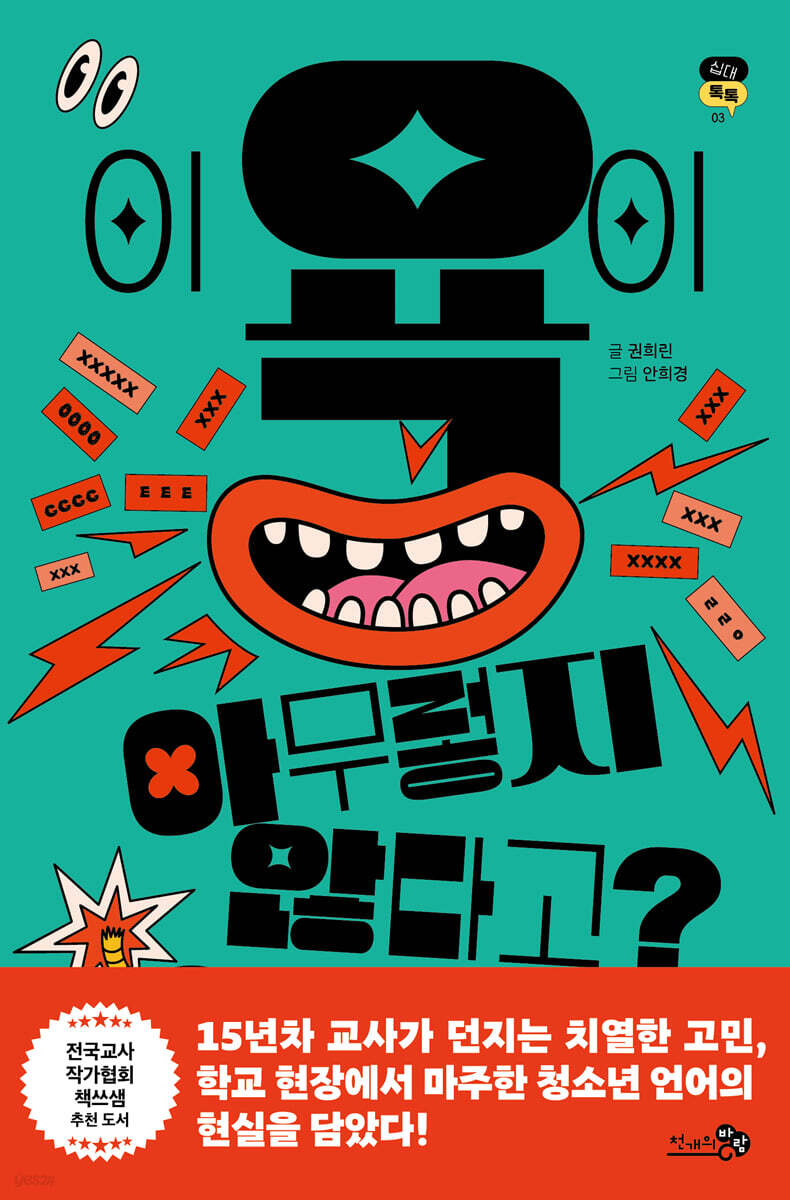
You don't mind this insult?
 |
Description
Book Introduction
“Why do our children swear?”
It contains the intense concerns of a teacher with 15 years of experience who personally experiences the language life of young people by spending daily life with them at school.
Children mostly swear because other people use it.
Swearing is one of the means of communicating with peers or forming bonds, and the reality is that it is so commonplace that it doesn't feel like swearing.
Even as if to reflect this youth language lifestyle, various media, broadcasts, and advertisements that engage in swear marketing are running rampant.
In a society where broadcasters and celebrities do not hesitate to swear, where swear words are used in the lyrics of idol songs, and where swear words and abbreviations serve as humor, it may seem natural for teenagers to swear.
Ultimately, the uncomfortable reality is that while our society turns a blind eye to the swearing behavior of youth, the serious problems caused by the use of swear words are only growing.
Not only does swearing have a negative impact on adolescent brain development, it also causes problems with intellectual development and social formation.
Today, the use of profanity by teenagers is a major factor in the low literacy and vocabulary of teenagers.
Our children are becoming stupid and swearing.
This book provides an opportunity for teenagers to reflect on their own language habits and ask themselves, "Is swearing okay like this?"
It really raises the sharp question of 'Is this curse really nothing?' and leads us to find the right direction.
It contains the intense concerns of a teacher with 15 years of experience who personally experiences the language life of young people by spending daily life with them at school.
Children mostly swear because other people use it.
Swearing is one of the means of communicating with peers or forming bonds, and the reality is that it is so commonplace that it doesn't feel like swearing.
Even as if to reflect this youth language lifestyle, various media, broadcasts, and advertisements that engage in swear marketing are running rampant.
In a society where broadcasters and celebrities do not hesitate to swear, where swear words are used in the lyrics of idol songs, and where swear words and abbreviations serve as humor, it may seem natural for teenagers to swear.
Ultimately, the uncomfortable reality is that while our society turns a blind eye to the swearing behavior of youth, the serious problems caused by the use of swear words are only growing.
Not only does swearing have a negative impact on adolescent brain development, it also causes problems with intellectual development and social formation.
Today, the use of profanity by teenagers is a major factor in the low literacy and vocabulary of teenagers.
Our children are becoming stupid and swearing.
This book provides an opportunity for teenagers to reflect on their own language habits and ask themselves, "Is swearing okay like this?"
It really raises the sharp question of 'Is this curse really nothing?' and leads us to find the right direction.
- You can preview some of the book's contents.
Preview
index
Chapter 1: Cursing, Why Do We Do It?
The words we spit out… 011 / We have become homosexuals / We communicate through Yaminjeongeum, abbreviations, and initial consonants / Slang, a language only we know / Slang that crosses the line / Obsessed with vulgar language / Have you heard of it, new words and slang… 026 / You think new words are novel? / Words that belittle someone / It’s fun and convenient, but why? / There’s a slang in new words / TokTok Plus Inssa Ability Assessment / Why do we swear? … 039 / Everyone else uses it, so what? / I feel catharsis every time I swear! / I swear because I don’t want to seem easy / Habits are scary / Media, don’t cross the line! … 054 / Marketing with swear words / It’s vulgar, but / Is it okay if it’s funny? / Responding to something meant to be funny with a documentary / Finding laughter that doesn’t cross the line
Chapter 2: Cursing, do you know how to do it?
성적인 의미가 담긴 욕 … 069 / 말끝마다 붙는 씨발 / 부사처럼 쓰는 존나 / 호칭처럼 부르는 개새끼 / 이 말이 비속어라고? … 078 / 관용 표현이면 괜찮을까 / '엿 먹어라'는 어쩌다 욕이 되었나 / 남을 아프게 하는 말 / 너의 말에 담긴 차별 … 087 / 장애인을 비하하는 말 / 나한테만 재밌는 말 / 일본어에서 유래한 차별의 말 / 톡톡 플러스 혐오, 비하, 차별의 말들 / 너의 말에 담긴 혐오 … 097 / 풍자와 혐오는 다르다 / 누구나 벌레가 되는 세상 / 톡톡 플러스 표현의 자유 아닌가요?
Chapter 3: Cursing, is this okay?
The curse that controls our emotions… 109 / The limbic system that makes us curse / The more we curse, the more our brain shrinks / The brain of the person being cursed cannot feel safe either / The negative emotions that curses create / The curse that controls our vocabulary… 118 / Low literacy is the biggest cause / What about my vocabulary? / Universal language that applies in any situation / Verbal violence is also violence… 127 / There are no planned malicious comments / Verbal violence is also school violence
Chapter 4: Cursing, Can It Be Stopped?
Emotional tools that enrich language life… 139 / TokTok Plus representative emotional tools / Weaving emotional tools like a Möbius strip / Poems full of emotional tools / TokTok Plus fresh alternative words / Nothing is as good as a good comment… 152 / Posting a good comment that changes thoughts and actions / It’s hard to find a bad comment in a field of good comments / How do you do a good comment? / A word that raises everyone’s self-esteem… 163 / Speaking with the ‘I conversation method’ / Even UP the other person’s self-esteem! / Diagnosing language habits through TokTok Plus metacognition
The words we spit out… 011 / We have become homosexuals / We communicate through Yaminjeongeum, abbreviations, and initial consonants / Slang, a language only we know / Slang that crosses the line / Obsessed with vulgar language / Have you heard of it, new words and slang… 026 / You think new words are novel? / Words that belittle someone / It’s fun and convenient, but why? / There’s a slang in new words / TokTok Plus Inssa Ability Assessment / Why do we swear? … 039 / Everyone else uses it, so what? / I feel catharsis every time I swear! / I swear because I don’t want to seem easy / Habits are scary / Media, don’t cross the line! … 054 / Marketing with swear words / It’s vulgar, but / Is it okay if it’s funny? / Responding to something meant to be funny with a documentary / Finding laughter that doesn’t cross the line
Chapter 2: Cursing, do you know how to do it?
성적인 의미가 담긴 욕 … 069 / 말끝마다 붙는 씨발 / 부사처럼 쓰는 존나 / 호칭처럼 부르는 개새끼 / 이 말이 비속어라고? … 078 / 관용 표현이면 괜찮을까 / '엿 먹어라'는 어쩌다 욕이 되었나 / 남을 아프게 하는 말 / 너의 말에 담긴 차별 … 087 / 장애인을 비하하는 말 / 나한테만 재밌는 말 / 일본어에서 유래한 차별의 말 / 톡톡 플러스 혐오, 비하, 차별의 말들 / 너의 말에 담긴 혐오 … 097 / 풍자와 혐오는 다르다 / 누구나 벌레가 되는 세상 / 톡톡 플러스 표현의 자유 아닌가요?
Chapter 3: Cursing, is this okay?
The curse that controls our emotions… 109 / The limbic system that makes us curse / The more we curse, the more our brain shrinks / The brain of the person being cursed cannot feel safe either / The negative emotions that curses create / The curse that controls our vocabulary… 118 / Low literacy is the biggest cause / What about my vocabulary? / Universal language that applies in any situation / Verbal violence is also violence… 127 / There are no planned malicious comments / Verbal violence is also school violence
Chapter 4: Cursing, Can It Be Stopped?
Emotional tools that enrich language life… 139 / TokTok Plus representative emotional tools / Weaving emotional tools like a Möbius strip / Poems full of emotional tools / TokTok Plus fresh alternative words / Nothing is as good as a good comment… 152 / Posting a good comment that changes thoughts and actions / It’s hard to find a bad comment in a field of good comments / How do you do a good comment? / A word that raises everyone’s self-esteem… 163 / Speaking with the ‘I conversation method’ / Even UP the other person’s self-esteem! / Diagnosing language habits through TokTok Plus metacognition
Detailed image

Publisher's Review
Features of this book
1.
Analyze the reasons why teenagers swear, linking them to their lives.
‘Swearing’ has become an inseparable habit and culture from the daily lives of most teenagers.
Teenagers often use visual symbolic language to express emotions, such as the Yaminjeongeum, initial consonants, abbreviations, and swear words, or use slang that has sexual connotations, isolates, or degrades appearances.
New words and colloquialisms that make it difficult to guess the context of a conversation hinder communication between youth and the older generation, leading to generational conflict.
Teenagers swear to communicate with their peers or to make things fun and realistic.
Also, cursing allows you to experience catharsis and relieve your frustration.
Or, there are teenagers who deliberately swear to show others a strong image.
Or, it just becomes a habit and we end up using curse words as if they were exclamations or adverbs.
'Homo-yokkus' is a new word that refers to a human being who lives in a close relationship with swearing and expresses his thoughts and emotions through swearing.
This book analyzes the language life of our youth, who have become homosexuals today.
“Teacher, this kid is so annoying and clingy!”
“The weather is so hot today.
“Teacher, please turn on the air conditioner!”
When I first heard this in class, I thought, "Is this a challenge to the teacher?" But as time went on, I realized it.
That this is your peer culture and your natural everyday language.
- From the text, “This cursing is nothing?”
2.
It reveals the etymology of swearing, the hidden meaning behind idiomatic expressions, and words of hatred, contempt, and discrimination.
It is rare to know the exact meaning or etymology of the curse words that we habitually use.
I can only guess that it has a vaguely bad meaning.
Most swear words have vulgar meanings and have sexual or vulgar origins.
These are very embarrassing and explicit words, so they are not easy to spit out if you know exactly what they mean.
Even among commonly used idioms, there are many expressions that have vulgar meanings, and there are also expressions that are used to belittle, mock, or discriminate against others.
This book delves into the hidden meanings of expressions we use without thinking and reveals their precise meanings.
Young people can have an opportunity to think about their own language and ask themselves, 'Is the language I am using now okay?'
The two boys even called each other 'fucking bitches'.
Isn't it strange? When I first heard it, I was really curious why the boys would sing "bitch" instead of "guy."
I found out the reason was because they consider women inferior to men.
The worst insult is being treated like a woman.
I was so surprised.
That very thought is a feeling that belittles and hates women.
- From the text, “This cursing is nothing?”
3.
It addresses the negative impact of swearing on adolescents' emotional and brain development, and the reality that it can lead to verbal abuse.
Cursing strongly stimulates the limbic system, which is called the emotional brain, and blocks the activity of the frontal lobe, which is responsible for rational functioning.
So most people who curse are not well-planned and try to solve problems impulsively.
In addition, exposure to swearing can damage the corpus callosum, which connects the left and right brain, causing problems with vocabulary and social skills.
A brain influenced by desire even makes our emotions negative.
When you hear a curse, the negative effect imprints the bad words in your head and you can't forget them.
The problem is that our brain retains the words that leave a strong impression and prunes the rest.
Eventually, the more we curse, the more the vocabulary we normally use disappears, and only curses occupy our minds.
Herein lies the reason why the vocabulary and literacy levels of today's youth are so seriously low.
Furthermore, poor language habits can lead to verbal abuse and school violence. Indiscriminate verbal abuse on social media and in group chats, or the posting of malicious comments and insults, can leave lifelong scars on individuals and create serious social problems.
This book serves as a warning to teenagers who trivialize verbal abuse by saying it is just chatting with friends.
When you're angry, upset, or frustrated, you've probably sworn at someone without even realizing it.
Almost instinctively, you know.
So, let's think about the curses you often use. If you think about it carefully, you'll discover something interesting.
The curse words we use repeatedly are used in a wide variety of situations.
Don't you say 'fuck' when you're feeling good and 'fuck' when you're feeling bad?
- From the text, “This cursing is nothing?”
4.
As alternatives to cursing, we suggest using emotional tools, substitute words, and using pre-emptive strikes.
The curses come out impulsively and indiscriminately.
When you feel wronged or frustrated, uncomfortable or unpleasant, or have difficulty expressing yourself logically, you express your feelings by swearing.
So, is it possible to stop swearing? This book presents specific methods and alternatives to stop swearing.
For example, it provides a method to learn 'emotional vocabulary', which is a vocabulary that can be used to express one's emotions, and it also provides representative emotional vocabulary.
Knowing a lot of emotional vocabulary can reduce the number of times you accidentally swear because you have a wider vocabulary to express your rich emotions.
It also suggests ways to find alternative words, or 'alternative words', that can be used instead of swear words.
It provides examples of substitute words for swear words and provides an opportunity to think about substitute words on your own.
1.
Analyze the reasons why teenagers swear, linking them to their lives.
‘Swearing’ has become an inseparable habit and culture from the daily lives of most teenagers.
Teenagers often use visual symbolic language to express emotions, such as the Yaminjeongeum, initial consonants, abbreviations, and swear words, or use slang that has sexual connotations, isolates, or degrades appearances.
New words and colloquialisms that make it difficult to guess the context of a conversation hinder communication between youth and the older generation, leading to generational conflict.
Teenagers swear to communicate with their peers or to make things fun and realistic.
Also, cursing allows you to experience catharsis and relieve your frustration.
Or, there are teenagers who deliberately swear to show others a strong image.
Or, it just becomes a habit and we end up using curse words as if they were exclamations or adverbs.
'Homo-yokkus' is a new word that refers to a human being who lives in a close relationship with swearing and expresses his thoughts and emotions through swearing.
This book analyzes the language life of our youth, who have become homosexuals today.
“Teacher, this kid is so annoying and clingy!”
“The weather is so hot today.
“Teacher, please turn on the air conditioner!”
When I first heard this in class, I thought, "Is this a challenge to the teacher?" But as time went on, I realized it.
That this is your peer culture and your natural everyday language.
- From the text, “This cursing is nothing?”
2.
It reveals the etymology of swearing, the hidden meaning behind idiomatic expressions, and words of hatred, contempt, and discrimination.
It is rare to know the exact meaning or etymology of the curse words that we habitually use.
I can only guess that it has a vaguely bad meaning.
Most swear words have vulgar meanings and have sexual or vulgar origins.
These are very embarrassing and explicit words, so they are not easy to spit out if you know exactly what they mean.
Even among commonly used idioms, there are many expressions that have vulgar meanings, and there are also expressions that are used to belittle, mock, or discriminate against others.
This book delves into the hidden meanings of expressions we use without thinking and reveals their precise meanings.
Young people can have an opportunity to think about their own language and ask themselves, 'Is the language I am using now okay?'
The two boys even called each other 'fucking bitches'.
Isn't it strange? When I first heard it, I was really curious why the boys would sing "bitch" instead of "guy."
I found out the reason was because they consider women inferior to men.
The worst insult is being treated like a woman.
I was so surprised.
That very thought is a feeling that belittles and hates women.
- From the text, “This cursing is nothing?”
3.
It addresses the negative impact of swearing on adolescents' emotional and brain development, and the reality that it can lead to verbal abuse.
Cursing strongly stimulates the limbic system, which is called the emotional brain, and blocks the activity of the frontal lobe, which is responsible for rational functioning.
So most people who curse are not well-planned and try to solve problems impulsively.
In addition, exposure to swearing can damage the corpus callosum, which connects the left and right brain, causing problems with vocabulary and social skills.
A brain influenced by desire even makes our emotions negative.
When you hear a curse, the negative effect imprints the bad words in your head and you can't forget them.
The problem is that our brain retains the words that leave a strong impression and prunes the rest.
Eventually, the more we curse, the more the vocabulary we normally use disappears, and only curses occupy our minds.
Herein lies the reason why the vocabulary and literacy levels of today's youth are so seriously low.
Furthermore, poor language habits can lead to verbal abuse and school violence. Indiscriminate verbal abuse on social media and in group chats, or the posting of malicious comments and insults, can leave lifelong scars on individuals and create serious social problems.
This book serves as a warning to teenagers who trivialize verbal abuse by saying it is just chatting with friends.
When you're angry, upset, or frustrated, you've probably sworn at someone without even realizing it.
Almost instinctively, you know.
So, let's think about the curses you often use. If you think about it carefully, you'll discover something interesting.
The curse words we use repeatedly are used in a wide variety of situations.
Don't you say 'fuck' when you're feeling good and 'fuck' when you're feeling bad?
- From the text, “This cursing is nothing?”
4.
As alternatives to cursing, we suggest using emotional tools, substitute words, and using pre-emptive strikes.
The curses come out impulsively and indiscriminately.
When you feel wronged or frustrated, uncomfortable or unpleasant, or have difficulty expressing yourself logically, you express your feelings by swearing.
So, is it possible to stop swearing? This book presents specific methods and alternatives to stop swearing.
For example, it provides a method to learn 'emotional vocabulary', which is a vocabulary that can be used to express one's emotions, and it also provides representative emotional vocabulary.
Knowing a lot of emotional vocabulary can reduce the number of times you accidentally swear because you have a wider vocabulary to express your rich emotions.
It also suggests ways to find alternative words, or 'alternative words', that can be used instead of swear words.
It provides examples of substitute words for swear words and provides an opportunity to think about substitute words on your own.
GOODS SPECIFICS
- Publication date: November 23, 2023
- Page count, weight, size: 176 pages | 280g | 135*205*10mm
- ISBN13: 9791165734633
- ISBN10: 116573463X
You may also like
카테고리
korean


korean

![GQ KOREA Mark (Monthly): December [2025]](http://librairie.coreenne.fr/cdn/shop/files/8ef265dbbfbf186523ed75ba7319009d.jpg?v=1765340328&width=3840)


