

Geography through sports
 |
Description
Book Introduction
After sports that involve rolling, running, rowing, and letting the wind take over,
Discovering the power of geography that we didn't know about
Exhilarating geography that will make your body tingle!
- A geography story of the five oceans and six continents that brought sports to life, told by a geography teacher.
Whether watching or enjoying sports firsthand, sports are one of the most important leisure activities for modern people.
Recently, somewhat unfamiliar sports such as surfing and yachting have begun to gain popularity among the public.
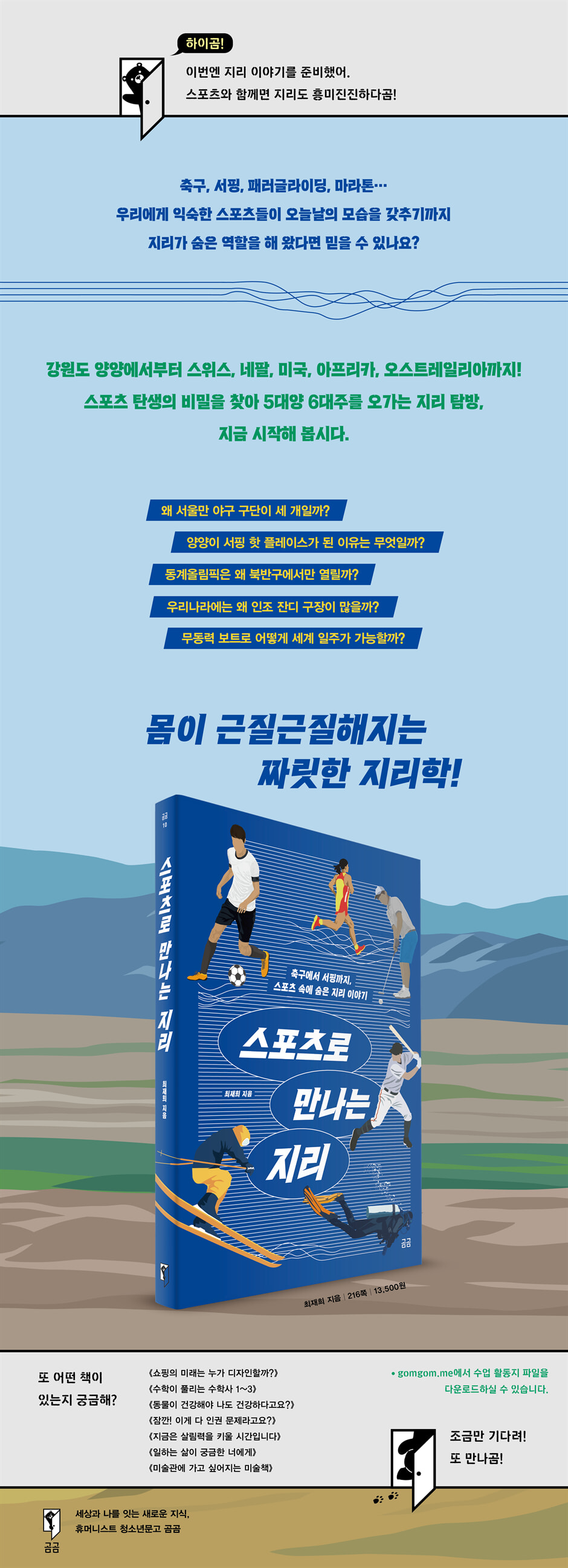
But have you ever wondered: Why did Yangyang become Korea's premier surfing destination? How can a yacht be powered solely by the wind? "Geography Through Sports" began with these questions.
"Geography through Sports" is a geography textbook that introduces various geographical knowledge through familiar sports.
Soccer, surfing, rock climbing, paragliding, marathons... We take a geographic look at the role that the Earth's land, water, and wind played in shaping these familiar sports into their current form.
The movement of the Paleozoic plates that created Europe's football leagues, the Alps and Himalayas, home to paragliding spots, and the alluvial plains that serve as the backdrop for marathons... Following this intriguing story, you will naturally encounter the concept of geography.
This book, which explores the secrets hidden in sports across physical and human geography, offers the joy of thinking through geography.
When you hold the key called geography in your hand, the hills, streams, rocks, and wind around you that you have passed by without a second thought will begin to look new.
The author, a high school geography teacher, says, “I hope this book will make studying geography more enriching and fun,” and guides us into the easy and interesting world of geography.
Discovering the power of geography that we didn't know about
Exhilarating geography that will make your body tingle!
- A geography story of the five oceans and six continents that brought sports to life, told by a geography teacher.
Whether watching or enjoying sports firsthand, sports are one of the most important leisure activities for modern people.
Recently, somewhat unfamiliar sports such as surfing and yachting have begun to gain popularity among the public.
But have you ever wondered: Why did Yangyang become Korea's premier surfing destination? How can a yacht be powered solely by the wind? "Geography Through Sports" began with these questions.
"Geography through Sports" is a geography textbook that introduces various geographical knowledge through familiar sports.
Soccer, surfing, rock climbing, paragliding, marathons... We take a geographic look at the role that the Earth's land, water, and wind played in shaping these familiar sports into their current form.
The movement of the Paleozoic plates that created Europe's football leagues, the Alps and Himalayas, home to paragliding spots, and the alluvial plains that serve as the backdrop for marathons... Following this intriguing story, you will naturally encounter the concept of geography.
This book, which explores the secrets hidden in sports across physical and human geography, offers the joy of thinking through geography.
When you hold the key called geography in your hand, the hills, streams, rocks, and wind around you that you have passed by without a second thought will begin to look new.
The author, a high school geography teacher, says, “I hope this book will make studying geography more enriching and fun,” and guides us into the easy and interesting world of geography.
- You can preview some of the book's contents.
Preview
index
Introduction: Welcome to the world of spatial sensitivity.
1.
Because there are high and rugged mountains, we get closer to the sky and faster to the ground!
Paragliding: Sky, Wind, People, and Geography!
Rock Climbing: The Climber and the Magic Stone
Skiing: Topographic snow, a strong ally of alpine skiing
2.
A spectacle unfolding on the ground
Baseball: A Geographical Sketch of Major League Baseball
Soccer: The Cradle of Soccer, the Gogi Fold Mountain Range
Cycling: Understanding Spatial Grammar While Pedaling
SsireumKorean traditional wrestling: Ssireum must be played on a sand ring.
3.
The mystery and thrill of cutting through the water with your whole body
Surfing: The joy of surfing on a pocket beach
Scuba Diving: A Coral Story for New Humans Under the Sea
Sailing yacht: A yachtie's desire to flow with the wind
Rafting: Whitewater Riding, a Canyon Geography
Rowing: River Grammar for the Human Water Strider Race
4.
Islands, forests, and cities are all ultimately connected.
Marathon: The Power of Geography in Planning a Marathon Course
Golf: The Geographical Fit Between Korea's Environmental Constitution and Golf
Backpacking: The Backpacking Mecca Created by Social Distancing
Image source
1.
Because there are high and rugged mountains, we get closer to the sky and faster to the ground!
Paragliding: Sky, Wind, People, and Geography!
Rock Climbing: The Climber and the Magic Stone
Skiing: Topographic snow, a strong ally of alpine skiing
2.
A spectacle unfolding on the ground
Baseball: A Geographical Sketch of Major League Baseball
Soccer: The Cradle of Soccer, the Gogi Fold Mountain Range
Cycling: Understanding Spatial Grammar While Pedaling
SsireumKorean traditional wrestling: Ssireum must be played on a sand ring.
3.
The mystery and thrill of cutting through the water with your whole body
Surfing: The joy of surfing on a pocket beach
Scuba Diving: A Coral Story for New Humans Under the Sea
Sailing yacht: A yachtie's desire to flow with the wind
Rafting: Whitewater Riding, a Canyon Geography
Rowing: River Grammar for the Human Water Strider Race
4.
Islands, forests, and cities are all ultimately connected.
Marathon: The Power of Geography in Planning a Marathon Course
Golf: The Geographical Fit Between Korea's Environmental Constitution and Golf
Backpacking: The Backpacking Mecca Created by Social Distancing
Image source
Detailed image
Publisher's Review
After sports that involve rolling, running, rowing, and letting the wind take over,
Discovering the power of geography that we didn't know about
Exhilarating geography that will make your body tingle!
- A geography story of the five oceans and six continents that brought sports to life, told by a geography teacher.
Whether watching or enjoying sports firsthand, sports are one of the most important leisure activities for modern people.
Recently, somewhat unfamiliar sports such as surfing and yachting have begun to gain popularity among the public.
But have you ever wondered: Why did Yangyang become Korea's premier surfing destination? How can a yacht be powered solely by the wind? "Geography Through Sports" began with these questions.
《Geography through Sports》 is a geography textbook that introduces various geographical knowledge through familiar sports.
Soccer, surfing, rock climbing, paragliding, marathons... We take a geographic look at the role that the Earth's land, water, and wind played in shaping these familiar sports into their current form.
The movement of the Paleozoic plates that created Europe's football leagues, the Alps and Himalayas, home to paragliding spots, and the alluvial plains that serve as the backdrop for marathons... Following this intriguing story, you will naturally encounter the concept of geography.
This book, which explores the secrets hidden in sports across physical and human geography, offers the joy of thinking through geography.
When you hold the key called geography in your hand, the hills, streams, rocks, and wind around you that you have passed by without a second thought will begin to look new.
The author, a high school geography teacher, says, “I hope this book will make studying geography more enriching and fun,” and guides us into the easy and interesting world of geography.
A new world opens up when you look through the eyes of geography.
- A general textbook covering Korean geography, world geography, human geography, and physical geography.
- Easy introduction to geographic information with abundant photos and friendly illustrations.
《Geography through Sports》 introduces various geographical knowledge through 15 sports.
Concepts that once seemed difficult, such as mountain valley wind and temperature inversion, are transformed into exciting stories when paired with questions like, "What kind of wind is needed for a paraglider to fly higher?" and "How high can a paraglider fly?"
This book comprehensively covers everything from physical geography, such as orogeny, trade winds, and topographic snowfall, to human geography, such as the formation of coal fields and cities and Zipf's law, helping students reimagine their geography studies.
It is rich in photographs and illustrations, making it useful for both self-study by young people and for teachers who are struggling to teach geography to students in a fun way.
This book also looks at sports from a global perspective, examining the topographical and climatic characteristics of various regions around the world.
By examining the geographical commonalities of regions with developed soccer leagues, the common characteristics of rafting destinations, and the conditions required for hosting the Winter Olympics, we can develop geographical thinking skills that allow us to compare and infer various regions.
The seasons of the English Premier League on the west coast of the Eurasian continent and the K-League on the east coast of the continent can also be explained by 'climate'.
Although they are both located in the mid-latitudes of the Northern Hemisphere and have the same seasons, their game seasons are opposite due to their climatic characteristics.
This is where the wind comes into play.
The western coast of the Eurasian continent is influenced by moist westerly winds blowing from the sea throughout the year.
So, even in winter, the weather is mild and games can be played.
On the other hand, during the winter, the continent is so cold that the ground freezes due to the influence of cold air masses that develop on the continent.
Looking at it this way, you can see why there are so many artificial grass fields in our country, right?
- From [The Cradle of Soccer, the Meat Fold Mountains] (page 77)
Let's broaden our horizons and explore other locations where orographic snowfall has helped Alpine events thrive. For starters, it's best to avoid areas so cold they're covered in ice year-round.
If you look for these conditions in mid-latitudes, it would probably be in the westerly wind region over the wide ocean.
This region has something in common: they have hosted the Winter Olympics, almost as if by promise.
- From [Terrained Snow, a Strong Aid to Alpine Skiing] (Page 43)
A good way to enjoy this book is to start reading about the sports you enjoy or are interested in among the sports introduced in the book.
Interest and curiosity are our best friends, leading us to new knowledge and answers.
If you immerse yourself in the joy of viewing the world through the lens of geography, you will not only gain a richer perspective on your favorite sport, but also deepen your understanding of the spaces, world, and people in your daily life.
If you're wondering how Colorado and Arizona, two of the most arid regions in the American West, managed to host Major League Baseball teams, you're a true Major League Baseball fan! The answer to this geographical curiosity can also be found in the Rocky Mountains.
The northern snow clouds that arrive in winter meet the Rocky Mountains and deposit snow in the highlands.
This could help dry areas like Colorado and Arizona address their water shortages.
Major League Baseball teams in arid regions were able to establish themselves thanks to the Rocky Mountains, a strong supporter.
The secret is geography!
- From [Geographic Sketches for Major League Baseball] (page 58)
Rediscovering nature, the backdrop to human culture
- The climate crisis, COVID-19… In an era where it's difficult to enjoy sports as before, ecological sensitivity is required of us.
- A book that will be helpful not only to young people interested in geography, but also to those who wish to pursue careers in sports and tourism.
Sport is a human activity that takes advantage of specific locations, geography, and climate.
There are examples of technological solutions to overcome environmental limitations, such as building an artificial golf course in the middle of the Dubai desert, but the economic and ecological costs are significant.
And now we have entered an era where it is difficult to enjoy sports as before.
We hear that the climate crisis is making it increasingly difficult to find suitable locations to host the Winter Olympics, and that heat waves are forcing the cancellation of outdoor events.
The COVID-19 pandemic has even forced the postponement of the Olympic Games, which are held every four years.
Can we ever return to the daily routine of enjoying sports together in one space, filling stadiums to cheer, and traveling to experience new sports? To do so, we must correctly recognize that the sports culture we've created and enjoyed is only possible when rooted in nature.
Based on this perspective, this book encourages reflection on what attitude we should have as human beings when enjoying and savoring sports culture.
The 2014 Winter Olympics held in Sochi, Russia were plagued by extreme heat.
Alpine skiing, which takes place outdoors, is directly affected by global warming.
As the temperature rises, the snow naturally melts.
The only way to prevent this is to create artificial snow, which comes at an astronomical cost.
All courses for Alpine competitions must be covered with a uniform snow cover of approximately 1.5 meters.
This is why the International Olympic Committee predicts that the number of regions that will be unable to host the Winter Olympics will increase over time.
- From [Terrained Snow, a Strong Aid to Alpine Skiing] (pp. 47-48)
All places around the world where bleaching is severe have one thing in common: rising water temperatures.
Although coral prefers warm waters, when the temperature exceeds a critical point, it cannot withstand the stress and chooses death.
Changes in water temperature are ultimately intertwined with the Earth's environmental problem of climate change.
As sea temperatures rise due to climate change, ocean water absorbs more carbon dioxide from the atmosphere, creating a vicious cycle of increasing ocean acidity.
If by any chance all the coral reefs die and all the life that lives around them leaves, the beautiful scenery we can see through scuba diving will also disappear.
- From [Coral Stories for New Humans in the Sea] (pp. 132-133)
From Yangyang in Gangwon-do to Interlaken in Switzerland, Pokhara in Nepal, Yosemite National Park in the United States, the Zambezi River in Africa, and the Great Barrier Reef in Australia.
This book, which travels across five oceans and six continents in search of sports venues, introduces famous places and their characteristics from around the world with vivid photographs.
It provides an interesting reading experience not only for young people interested in world geography, but also for those who wish to major in tourism.
It will also provide helpful knowledge to young people who wish to pursue a career in sports, as they will be able to learn the principles and history behind each sport.
If you map out the world's paragliding destinations, you'll come across the Alps and Himalayan mountain ranges.
The Alpine-Himalayan orogenic belt is a new orogenic belt that extends east to west, starting from the Atlas Mountains in Africa, passing through the Alps and Anatolian Peninsula in Europe, and then over the Himalayas to the Indochina Peninsula.
The new mountain belt was created by the interaction of tectonic plates, so the mountains are generally high and rugged.
- From [Sky, Wind, People, and Geography!] (Page 18)
Sugarloaf is also a famous landmark and tourist attraction in South America, with the same formation process and characteristics as the granite dome.
It is very interesting to look at space from a geographical perspective.
A proper understanding of Half Dome can help us connect similar landscapes from around the world.
If you're interested in becoming a rock climber, check out Granite Dome.
As the saying goes, you see as much as you know, so anything becomes new the more you know.
- From [The Rock Climber and the Magic Stone] (page 35)
Discovering the power of geography that we didn't know about
Exhilarating geography that will make your body tingle!
- A geography story of the five oceans and six continents that brought sports to life, told by a geography teacher.
Whether watching or enjoying sports firsthand, sports are one of the most important leisure activities for modern people.
Recently, somewhat unfamiliar sports such as surfing and yachting have begun to gain popularity among the public.
But have you ever wondered: Why did Yangyang become Korea's premier surfing destination? How can a yacht be powered solely by the wind? "Geography Through Sports" began with these questions.
《Geography through Sports》 is a geography textbook that introduces various geographical knowledge through familiar sports.
Soccer, surfing, rock climbing, paragliding, marathons... We take a geographic look at the role that the Earth's land, water, and wind played in shaping these familiar sports into their current form.
The movement of the Paleozoic plates that created Europe's football leagues, the Alps and Himalayas, home to paragliding spots, and the alluvial plains that serve as the backdrop for marathons... Following this intriguing story, you will naturally encounter the concept of geography.
This book, which explores the secrets hidden in sports across physical and human geography, offers the joy of thinking through geography.
When you hold the key called geography in your hand, the hills, streams, rocks, and wind around you that you have passed by without a second thought will begin to look new.
The author, a high school geography teacher, says, “I hope this book will make studying geography more enriching and fun,” and guides us into the easy and interesting world of geography.
A new world opens up when you look through the eyes of geography.
- A general textbook covering Korean geography, world geography, human geography, and physical geography.
- Easy introduction to geographic information with abundant photos and friendly illustrations.
《Geography through Sports》 introduces various geographical knowledge through 15 sports.
Concepts that once seemed difficult, such as mountain valley wind and temperature inversion, are transformed into exciting stories when paired with questions like, "What kind of wind is needed for a paraglider to fly higher?" and "How high can a paraglider fly?"
This book comprehensively covers everything from physical geography, such as orogeny, trade winds, and topographic snowfall, to human geography, such as the formation of coal fields and cities and Zipf's law, helping students reimagine their geography studies.
It is rich in photographs and illustrations, making it useful for both self-study by young people and for teachers who are struggling to teach geography to students in a fun way.
This book also looks at sports from a global perspective, examining the topographical and climatic characteristics of various regions around the world.
By examining the geographical commonalities of regions with developed soccer leagues, the common characteristics of rafting destinations, and the conditions required for hosting the Winter Olympics, we can develop geographical thinking skills that allow us to compare and infer various regions.
The seasons of the English Premier League on the west coast of the Eurasian continent and the K-League on the east coast of the continent can also be explained by 'climate'.
Although they are both located in the mid-latitudes of the Northern Hemisphere and have the same seasons, their game seasons are opposite due to their climatic characteristics.
This is where the wind comes into play.
The western coast of the Eurasian continent is influenced by moist westerly winds blowing from the sea throughout the year.
So, even in winter, the weather is mild and games can be played.
On the other hand, during the winter, the continent is so cold that the ground freezes due to the influence of cold air masses that develop on the continent.
Looking at it this way, you can see why there are so many artificial grass fields in our country, right?
- From [The Cradle of Soccer, the Meat Fold Mountains] (page 77)
Let's broaden our horizons and explore other locations where orographic snowfall has helped Alpine events thrive. For starters, it's best to avoid areas so cold they're covered in ice year-round.
If you look for these conditions in mid-latitudes, it would probably be in the westerly wind region over the wide ocean.
This region has something in common: they have hosted the Winter Olympics, almost as if by promise.
- From [Terrained Snow, a Strong Aid to Alpine Skiing] (Page 43)
A good way to enjoy this book is to start reading about the sports you enjoy or are interested in among the sports introduced in the book.
Interest and curiosity are our best friends, leading us to new knowledge and answers.
If you immerse yourself in the joy of viewing the world through the lens of geography, you will not only gain a richer perspective on your favorite sport, but also deepen your understanding of the spaces, world, and people in your daily life.
If you're wondering how Colorado and Arizona, two of the most arid regions in the American West, managed to host Major League Baseball teams, you're a true Major League Baseball fan! The answer to this geographical curiosity can also be found in the Rocky Mountains.
The northern snow clouds that arrive in winter meet the Rocky Mountains and deposit snow in the highlands.
This could help dry areas like Colorado and Arizona address their water shortages.
Major League Baseball teams in arid regions were able to establish themselves thanks to the Rocky Mountains, a strong supporter.
The secret is geography!
- From [Geographic Sketches for Major League Baseball] (page 58)
Rediscovering nature, the backdrop to human culture
- The climate crisis, COVID-19… In an era where it's difficult to enjoy sports as before, ecological sensitivity is required of us.
- A book that will be helpful not only to young people interested in geography, but also to those who wish to pursue careers in sports and tourism.
Sport is a human activity that takes advantage of specific locations, geography, and climate.
There are examples of technological solutions to overcome environmental limitations, such as building an artificial golf course in the middle of the Dubai desert, but the economic and ecological costs are significant.
And now we have entered an era where it is difficult to enjoy sports as before.
We hear that the climate crisis is making it increasingly difficult to find suitable locations to host the Winter Olympics, and that heat waves are forcing the cancellation of outdoor events.
The COVID-19 pandemic has even forced the postponement of the Olympic Games, which are held every four years.
Can we ever return to the daily routine of enjoying sports together in one space, filling stadiums to cheer, and traveling to experience new sports? To do so, we must correctly recognize that the sports culture we've created and enjoyed is only possible when rooted in nature.
Based on this perspective, this book encourages reflection on what attitude we should have as human beings when enjoying and savoring sports culture.
The 2014 Winter Olympics held in Sochi, Russia were plagued by extreme heat.
Alpine skiing, which takes place outdoors, is directly affected by global warming.
As the temperature rises, the snow naturally melts.
The only way to prevent this is to create artificial snow, which comes at an astronomical cost.
All courses for Alpine competitions must be covered with a uniform snow cover of approximately 1.5 meters.
This is why the International Olympic Committee predicts that the number of regions that will be unable to host the Winter Olympics will increase over time.
- From [Terrained Snow, a Strong Aid to Alpine Skiing] (pp. 47-48)
All places around the world where bleaching is severe have one thing in common: rising water temperatures.
Although coral prefers warm waters, when the temperature exceeds a critical point, it cannot withstand the stress and chooses death.
Changes in water temperature are ultimately intertwined with the Earth's environmental problem of climate change.
As sea temperatures rise due to climate change, ocean water absorbs more carbon dioxide from the atmosphere, creating a vicious cycle of increasing ocean acidity.
If by any chance all the coral reefs die and all the life that lives around them leaves, the beautiful scenery we can see through scuba diving will also disappear.
- From [Coral Stories for New Humans in the Sea] (pp. 132-133)
From Yangyang in Gangwon-do to Interlaken in Switzerland, Pokhara in Nepal, Yosemite National Park in the United States, the Zambezi River in Africa, and the Great Barrier Reef in Australia.
This book, which travels across five oceans and six continents in search of sports venues, introduces famous places and their characteristics from around the world with vivid photographs.
It provides an interesting reading experience not only for young people interested in world geography, but also for those who wish to major in tourism.
It will also provide helpful knowledge to young people who wish to pursue a career in sports, as they will be able to learn the principles and history behind each sport.
If you map out the world's paragliding destinations, you'll come across the Alps and Himalayan mountain ranges.
The Alpine-Himalayan orogenic belt is a new orogenic belt that extends east to west, starting from the Atlas Mountains in Africa, passing through the Alps and Anatolian Peninsula in Europe, and then over the Himalayas to the Indochina Peninsula.
The new mountain belt was created by the interaction of tectonic plates, so the mountains are generally high and rugged.
- From [Sky, Wind, People, and Geography!] (Page 18)
Sugarloaf is also a famous landmark and tourist attraction in South America, with the same formation process and characteristics as the granite dome.
It is very interesting to look at space from a geographical perspective.
A proper understanding of Half Dome can help us connect similar landscapes from around the world.
If you're interested in becoming a rock climber, check out Granite Dome.
As the saying goes, you see as much as you know, so anything becomes new the more you know.
- From [The Rock Climber and the Magic Stone] (page 35)
GOODS SPECIFICS
- Publication date: October 4, 2021
- Page count, weight, size: 216 pages | 310g | 135*200*13mm
- ISBN13: 9791160807141
- ISBN10: 1160807140
You may also like
카테고리
korean


korean

![GQ KOREA Mark (Monthly): December [2025]](http://librairie.coreenne.fr/cdn/shop/files/8ef265dbbfbf186523ed75ba7319009d.jpg?v=1765340328&width=3840)


