

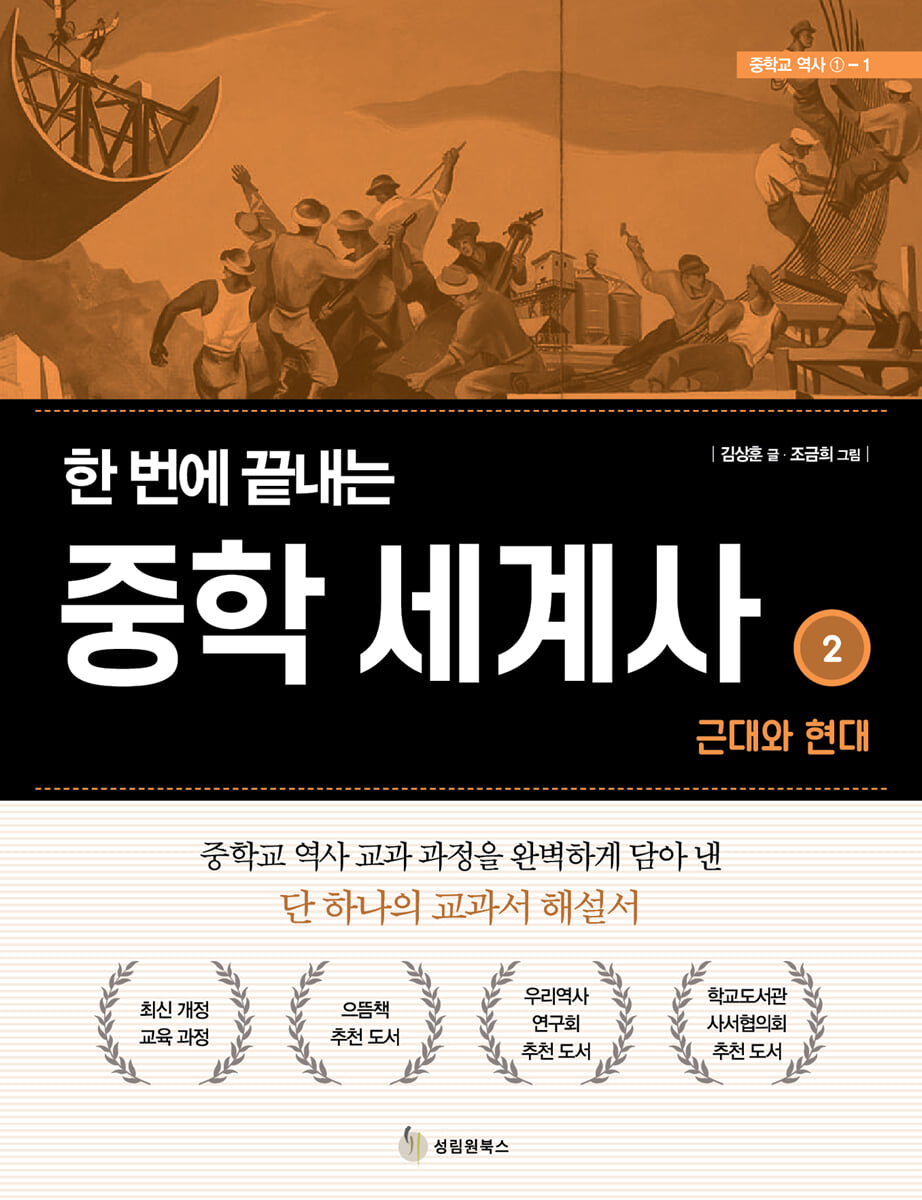
Middle School World History 2: Modern and Contemporary History in One Go
 |
Description
Book Introduction
《Middle School World History in One Go》explains the curriculum and content of 'Middle School History ①' in detail.
Above all, it is very helpful in understanding the flow of history because it kindly explains the causal relationships of history at each point in time to see how what happened now was influenced by certain events.
History is a subject that requires memorization, but the depth of your achievements depends on your understanding of the context and terminology of history.
This is the point that this book considers most important.
We have lowered the level of understanding so that even readers with limited historical knowledge and weak literacy and reading skills can fully understand it, and we have also paid careful attention to the definitions of terms and words.
The storytelling skills of a bestselling historical author are added to make it even more entertaining.
At the end of each unit, a corner is provided to summarize the previous content, thereby enhancing the learning effect for young readers.
As the author says, reading the relevant section 2-3 times during exam period will be of great help.
Above all, it is very helpful in understanding the flow of history because it kindly explains the causal relationships of history at each point in time to see how what happened now was influenced by certain events.
History is a subject that requires memorization, but the depth of your achievements depends on your understanding of the context and terminology of history.
This is the point that this book considers most important.
We have lowered the level of understanding so that even readers with limited historical knowledge and weak literacy and reading skills can fully understand it, and we have also paid careful attention to the definitions of terms and words.
The storytelling skills of a bestselling historical author are added to make it even more entertaining.
At the end of each unit, a corner is provided to summarize the previous content, thereby enhancing the learning effect for young readers.
As the author says, reading the relevant section 2-3 times during exam period will be of great help.
- You can preview some of the book's contents.
Preview
index
We'll help you solve your problems with history textbooks by starting this book.
I recommend this book, as it suggests a new direction for studying history.
IV Imperialist Invasion and the Movement to Build a Nation-State
: Europe and America, dominating the world
12 Nation-state systems in Europe and America
: Rise up for freedom and equality!
How did the constitutional monarchy begin? - The Puritan Revolution and the Glorious Revolution / Why did North American colonists throw chests of tea into the sea? - The beginning of the American Revolution / Which country first applied the principle of separation of powers? - The United States, the first democratic republic / Why did the citizens of Paris storm the Bastille? - The Enlightenment and the outbreak of the French Revolution / Why did the citizens of Paris turn their backs on the republic? - The development and conclusion of the French Revolution / Why did Napoleon dismantle the Holy Roman Empire? - The Napoleonic Wars and the spread of French revolutionary ideology / Why was Louis Philippe called the 'Citizen King'? - The Vienna System and the French Liberal Revolution / Why did no revolution occur in England? - The British liberal movement and economic development / Why did Germany proclaim the establishment of the German Empire in Paris? - The spread of nationalism and the unification of Italy and Germany / Why was the Russian Tsar assassinated? - Russian reforms and the establishment of a nation-state / Why is the path that the Indians followed called the 'Trail of Tears'? - American Territorial Expansion and the Civil War / Whose Name is Bolivia? - Latin America's Independence Fever
Unit Summary Notes
1.
The political development of Britain / 2.
The Founding of the United States / 3.
The French Revolution and the Process of Political Change
13 Industrialization and Imperialism in Europe
: The era of survival of the fittest triggered by the Industrial Revolution
Why was the vacant lot fenced off? - The beginning and development of the Industrial Revolution / What are the three major elements of capitalism? - The spread of the Industrial Revolution and the development of capitalism / Why did workers break machines? - The emergence of social problems due to the development of capitalism / Why did Romanticism reject the Enlightenment? - Science and art in the 19th century / Did Darwin's theory of evolution become the ideology of imperialism? - The emergence and expansion of imperialism / Why did the great powers target China? - The invasion of Asia and Africa by the imperialist powers
Unit Summary Notes
1.
Why the Industrial Revolution Happened First in Britain / 2.
Why the great powers established colonies
14 Nation-building movements in West Asia and India
: Fighting imperialism with the modernization movement
Why did the young Ottoman officers start a revolution? - Reform and revolution in the Ottoman Empire / Why did the Suez Canal not become Egypt's? - Modernization and national movements in Egypt and Africa / Why did the Arab people oppose the Ottoman Sultan? - The Arabian nation-building movement and the Iranian Revolution / Why did the Indian cotton textile industry collapse? - The Sepoy Mutiny and the British annexation of India / Why did the British try to partition Bengal? - The anti-British movement of the Indian National Congress / Why was Thailand able to avoid becoming a colony? - The nation-building movement in Southeast Asia
Unit Summary Notes
1.
The Rise and Decline of the Ottoman Empire / 2.
Representative nation-building movements in West Asia and India
15. Nation-building movements in East Asia
: How to overcome the great powers?
Why did Britain sell opium to China? - Triangular trade through opium / Why was extraterritoriality an unequal treaty? - The outbreak of the Opium Wars and the opening of China / Why were there so many women in the Taiping Rebellion? - The Taiping Rebellion and the Self-Strengthening Movement / Why did Kang Youwei promote the Reform and Self-Strengthening Movement? - The Reform and Self-Strengthening Movement and the Boxer Rebellion / Why did Yuan Shikai overthrow the Qing Dynasty? - The Xinhai Revolution and the establishment of the Republic of China / Why did the Japanese start eating pork cutlets? - The opening of Japan's ports and the Meiji Restoration / Why did Japan commit the Yunyo Incident? - Japan's invasion of Joseon and the First Sino-Japanese War / Why did Japan wage war with Russia? - Japan's imperialistic invasion and the Russo-Japanese War / What organizations did Joseon establish for the modernization movement? - Joseon's modernization movement and nation-building movement
Unit Summary Notes
1.
The process of establishing the Republic of China / 2.
Japan's modernization process
World War V and Social Change
: Beyond the Age of Barbarism and Inhumanity
World War 16 and the Changing International Order
: The worst war in human history
Why did the Sarajevo youth shoot the Austrian Archduke? - The outbreak of World War I / Why was the United States enraged by the sinking of a British passenger ship? - The development and end of World War I / Why was the principle of national self-determination not applied to Korea? - The Versailles system and changes after World War I / What is the difference between the Soviet Union and the parliament? - The background of the Russian Revolution and the February Revolution / Why did the Soviet Union pursue the New Economic Policy? - The background of the Russian Revolution and the February Revolution / Why did Gandhi spin and make clothes? - National movements in China and India / Why is Egyptian independence called conditional independence? - National movements in Southeast Asia, West Asia, and Africa / Why did the world reel from the American Depression? - The outbreak of the Great Depression and the American New Deal / Why did fascism and Nazism gain public support? - The rise of totalitarianism / Why did Hemingway take up arms in Spain? - The outbreak of the Spanish Civil War and World War II / Hitler invades the Soviet Union - The development and end of World War II / What international organizations were created under the Atlantic Charter? - The end of the war and the establishment of a new international order
Unit Summary Notes
1.
The Outbreak of World War I / 2.
The course and outcome of World War I / 3.
The circumstances of Germany, Italy, and Japan that caused World War II / 4.
The post-war process and consequences of World War II
17 Spread of Democracy
Sovereignty always resides with the people.
Which country first gave women the right to vote? - The development of democracy and the expansion of suffrage / Why is the United States of the 1920s called the Roaring Age? - The development of capitalism and the expansion of workers' rights
Unit Summary Notes
1.
Women's Suffrage / 2.
The background of the United States becoming the world's greatest power after World War II
18 Efforts to restore human rights and spread peace
: Give a genuine apology, reflect on your actions, and make amends.
Why did Germany build showers in Jewish concentration camps? - Uncovering the truth about mass murder / Why won't Japan offer a genuine apology? - Efforts to resolve the comfort women issue / Why are war museums created? - The international community's efforts to maintain peace
Unit Summary Notes
1.
Crimes against humanity committed during war / 2.
Differences between Germany and Japan on crimes against humanity
Ⅵ Developments and Challenges of the Modern World
: Beyond the Age of Conflict and into the Future
19 The Cold War System and the Formation of the Third World
: The era of ideological conflict between the left and right
Why did capitalism and communism come into conflict? - The formation of the Cold War system / Why did communism win the Vietnam War? - The Cold War escalated into a heated war / Why did India and Pakistan split? - Independence and conflict in Southeast Asia and India / Why was 1960 the 'Year of Africa'? - Independence in West Asia and Africa and the Middle East war / Why did newly independent countries gather in Bandung? - Third World resistance to the Cold War system / What was the movement competition that the United States waged to improve relations with China? - Divisions within the left and right camps and the easing of the Cold War system /
Unit Summary Notes
1.
The Four Ideologies That Created the Cold War / 2.
The Cold War System and the Third World
20 Globalization and Economic Integration
: Free Trade and a United World
Why did Gorbachev pursue reform and openness policies? - The collapse of the Cold War and the dissolution of the Soviet Union / What does it mean to say that a cat, whether white or black, catches mice? - China's reform and openness policies / Is the World Trade Organization truly fair? - Globalization and neoliberalism / What are the advantages and disadvantages of multinational corporations? - The expansion of globalization and economic blocs
Unit Summary Notes
1.
The collapse of the Cold War system / 2.
Globalization and Economic Blocs
21. Anti-authoritarianism movement and the development of popular culture
: Breaking old customs and entering a new future
Why did black people march on Washington? - The development of the civil rights and democratization movements / Why were young people so enthusiastic about rock music? - The development of the student and women's movements / Why is the Internet so attractive as a mass medium? - The formation of mass society and the development of popular culture
Unit Summary Notes
1.
What is de-authoritarianism? / 2.
Forms of the anti-authoritarian movement / 3.
Popular culture and popular society
22 Efforts to solve problems in the modern world
: The future of humanity depends on our current response.
Why do Israel and Palestine fight so often? - Growing international conflicts / Will expelling refugees prevent terrorism? - The refugee issue and the anti-war peace movement / Why is the gap between underdeveloped and developed countries called a North-South problem? - The North-South problem and the problems of poverty, hunger, and disease / Why do we need to reduce carbon dioxide emissions? - Environmental issues and international cooperation
Unit Summary Notes
Challenges we must address as we navigate the future
I recommend this book, as it suggests a new direction for studying history.
IV Imperialist Invasion and the Movement to Build a Nation-State
: Europe and America, dominating the world
12 Nation-state systems in Europe and America
: Rise up for freedom and equality!
How did the constitutional monarchy begin? - The Puritan Revolution and the Glorious Revolution / Why did North American colonists throw chests of tea into the sea? - The beginning of the American Revolution / Which country first applied the principle of separation of powers? - The United States, the first democratic republic / Why did the citizens of Paris storm the Bastille? - The Enlightenment and the outbreak of the French Revolution / Why did the citizens of Paris turn their backs on the republic? - The development and conclusion of the French Revolution / Why did Napoleon dismantle the Holy Roman Empire? - The Napoleonic Wars and the spread of French revolutionary ideology / Why was Louis Philippe called the 'Citizen King'? - The Vienna System and the French Liberal Revolution / Why did no revolution occur in England? - The British liberal movement and economic development / Why did Germany proclaim the establishment of the German Empire in Paris? - The spread of nationalism and the unification of Italy and Germany / Why was the Russian Tsar assassinated? - Russian reforms and the establishment of a nation-state / Why is the path that the Indians followed called the 'Trail of Tears'? - American Territorial Expansion and the Civil War / Whose Name is Bolivia? - Latin America's Independence Fever
Unit Summary Notes
1.
The political development of Britain / 2.
The Founding of the United States / 3.
The French Revolution and the Process of Political Change
13 Industrialization and Imperialism in Europe
: The era of survival of the fittest triggered by the Industrial Revolution
Why was the vacant lot fenced off? - The beginning and development of the Industrial Revolution / What are the three major elements of capitalism? - The spread of the Industrial Revolution and the development of capitalism / Why did workers break machines? - The emergence of social problems due to the development of capitalism / Why did Romanticism reject the Enlightenment? - Science and art in the 19th century / Did Darwin's theory of evolution become the ideology of imperialism? - The emergence and expansion of imperialism / Why did the great powers target China? - The invasion of Asia and Africa by the imperialist powers
Unit Summary Notes
1.
Why the Industrial Revolution Happened First in Britain / 2.
Why the great powers established colonies
14 Nation-building movements in West Asia and India
: Fighting imperialism with the modernization movement
Why did the young Ottoman officers start a revolution? - Reform and revolution in the Ottoman Empire / Why did the Suez Canal not become Egypt's? - Modernization and national movements in Egypt and Africa / Why did the Arab people oppose the Ottoman Sultan? - The Arabian nation-building movement and the Iranian Revolution / Why did the Indian cotton textile industry collapse? - The Sepoy Mutiny and the British annexation of India / Why did the British try to partition Bengal? - The anti-British movement of the Indian National Congress / Why was Thailand able to avoid becoming a colony? - The nation-building movement in Southeast Asia
Unit Summary Notes
1.
The Rise and Decline of the Ottoman Empire / 2.
Representative nation-building movements in West Asia and India
15. Nation-building movements in East Asia
: How to overcome the great powers?
Why did Britain sell opium to China? - Triangular trade through opium / Why was extraterritoriality an unequal treaty? - The outbreak of the Opium Wars and the opening of China / Why were there so many women in the Taiping Rebellion? - The Taiping Rebellion and the Self-Strengthening Movement / Why did Kang Youwei promote the Reform and Self-Strengthening Movement? - The Reform and Self-Strengthening Movement and the Boxer Rebellion / Why did Yuan Shikai overthrow the Qing Dynasty? - The Xinhai Revolution and the establishment of the Republic of China / Why did the Japanese start eating pork cutlets? - The opening of Japan's ports and the Meiji Restoration / Why did Japan commit the Yunyo Incident? - Japan's invasion of Joseon and the First Sino-Japanese War / Why did Japan wage war with Russia? - Japan's imperialistic invasion and the Russo-Japanese War / What organizations did Joseon establish for the modernization movement? - Joseon's modernization movement and nation-building movement
Unit Summary Notes
1.
The process of establishing the Republic of China / 2.
Japan's modernization process
World War V and Social Change
: Beyond the Age of Barbarism and Inhumanity
World War 16 and the Changing International Order
: The worst war in human history
Why did the Sarajevo youth shoot the Austrian Archduke? - The outbreak of World War I / Why was the United States enraged by the sinking of a British passenger ship? - The development and end of World War I / Why was the principle of national self-determination not applied to Korea? - The Versailles system and changes after World War I / What is the difference between the Soviet Union and the parliament? - The background of the Russian Revolution and the February Revolution / Why did the Soviet Union pursue the New Economic Policy? - The background of the Russian Revolution and the February Revolution / Why did Gandhi spin and make clothes? - National movements in China and India / Why is Egyptian independence called conditional independence? - National movements in Southeast Asia, West Asia, and Africa / Why did the world reel from the American Depression? - The outbreak of the Great Depression and the American New Deal / Why did fascism and Nazism gain public support? - The rise of totalitarianism / Why did Hemingway take up arms in Spain? - The outbreak of the Spanish Civil War and World War II / Hitler invades the Soviet Union - The development and end of World War II / What international organizations were created under the Atlantic Charter? - The end of the war and the establishment of a new international order
Unit Summary Notes
1.
The Outbreak of World War I / 2.
The course and outcome of World War I / 3.
The circumstances of Germany, Italy, and Japan that caused World War II / 4.
The post-war process and consequences of World War II
17 Spread of Democracy
Sovereignty always resides with the people.
Which country first gave women the right to vote? - The development of democracy and the expansion of suffrage / Why is the United States of the 1920s called the Roaring Age? - The development of capitalism and the expansion of workers' rights
Unit Summary Notes
1.
Women's Suffrage / 2.
The background of the United States becoming the world's greatest power after World War II
18 Efforts to restore human rights and spread peace
: Give a genuine apology, reflect on your actions, and make amends.
Why did Germany build showers in Jewish concentration camps? - Uncovering the truth about mass murder / Why won't Japan offer a genuine apology? - Efforts to resolve the comfort women issue / Why are war museums created? - The international community's efforts to maintain peace
Unit Summary Notes
1.
Crimes against humanity committed during war / 2.
Differences between Germany and Japan on crimes against humanity
Ⅵ Developments and Challenges of the Modern World
: Beyond the Age of Conflict and into the Future
19 The Cold War System and the Formation of the Third World
: The era of ideological conflict between the left and right
Why did capitalism and communism come into conflict? - The formation of the Cold War system / Why did communism win the Vietnam War? - The Cold War escalated into a heated war / Why did India and Pakistan split? - Independence and conflict in Southeast Asia and India / Why was 1960 the 'Year of Africa'? - Independence in West Asia and Africa and the Middle East war / Why did newly independent countries gather in Bandung? - Third World resistance to the Cold War system / What was the movement competition that the United States waged to improve relations with China? - Divisions within the left and right camps and the easing of the Cold War system /
Unit Summary Notes
1.
The Four Ideologies That Created the Cold War / 2.
The Cold War System and the Third World
20 Globalization and Economic Integration
: Free Trade and a United World
Why did Gorbachev pursue reform and openness policies? - The collapse of the Cold War and the dissolution of the Soviet Union / What does it mean to say that a cat, whether white or black, catches mice? - China's reform and openness policies / Is the World Trade Organization truly fair? - Globalization and neoliberalism / What are the advantages and disadvantages of multinational corporations? - The expansion of globalization and economic blocs
Unit Summary Notes
1.
The collapse of the Cold War system / 2.
Globalization and Economic Blocs
21. Anti-authoritarianism movement and the development of popular culture
: Breaking old customs and entering a new future
Why did black people march on Washington? - The development of the civil rights and democratization movements / Why were young people so enthusiastic about rock music? - The development of the student and women's movements / Why is the Internet so attractive as a mass medium? - The formation of mass society and the development of popular culture
Unit Summary Notes
1.
What is de-authoritarianism? / 2.
Forms of the anti-authoritarian movement / 3.
Popular culture and popular society
22 Efforts to solve problems in the modern world
: The future of humanity depends on our current response.
Why do Israel and Palestine fight so often? - Growing international conflicts / Will expelling refugees prevent terrorism? - The refugee issue and the anti-war peace movement / Why is the gap between underdeveloped and developed countries called a North-South problem? - The North-South problem and the problems of poverty, hunger, and disease / Why do we need to reduce carbon dioxide emissions? - Environmental issues and international cooperation
Unit Summary Notes
Challenges we must address as we navigate the future
Into the book
As we entered the modern era, the bourgeoisie emerged as a new power in Europe.
The bourgeoisie is a term that refers to the newly emerging merchants and manufacturers who emerged as commerce and industry developed.
They opposed feudalism and absolute monarchy and sought to create a citizen-centered society.
The revolution centered around them is called a citizens' revolution.
The bourgeoisie later transformed into industrial capitalists after the Industrial Revolution and the establishment of the capitalist economic system.
--- p.24~25
France also had a parliament.
The French Parliament was called the Estates-General because it consisted of representatives of the three estates.
The clergy were the first estate, the nobility the second estate, and the citizens and the rest of the people the third estate.
The First and Second Estates combined only made up 2% of the total population.
However, they owned about half of the French territory and were very powerful.
--- p.35
Influenced by the February Revolution in France, nationalists Mazzini and Garibaldi began a movement for Italian unification.
Although the movement was not successful, the enthusiasm for unification grew even higher.
Then, Sardinia, a country in northern Italy, started a movement for unification again.
Sardinia's prime minister, Cavour, fostered industry and organized the army.
We need to build up our internal strength first to be able to fight against the great power Austria.
--- p.51~52
Didn't the Middle Ages have territory, people, or sovereignty? Of course not.
Territory was uneven, and the concept of 'I am a citizen of some country' did not even exist.
It was because the feudal class system was strong.
So, the concept of sovereignty, where the people are the masters of the country, was completely unimaginable.
But look at Europe after the French Revolution.
The tricolor flag used by citizens during the French Revolution became the French national flag (1794), and the revolutionary song [La Marseillaise] sung by citizens was designated as the French national anthem (1795).
Waving the tricolor flag and singing La Marseillaise, the French people proudly declared, “I am a French citizen and a master of France.”
--- p.57
The Industrial Revolution began in Britain.
Of course, there is a good reason for that.
First, political stability was achieved with the establishment of parliamentary politics.
Second, it was rich in resources such as iron and coal, which were essential for industrial development.
Third, Britain had sufficient capital (money) and technology thanks to the early development of the woolen textile industry.
Fourth, thanks to securing many colonies, we could obtain raw materials for products cheaply and sell finished products easily.
--- p.73
For a capitalist system to be established, there must first be capitalists and workers.
Capitalists run factories with capital and hire workers, and workers hired by capitalists are responsible for production and receive wages in return.
Product prices are determined flexibly based on production and consumption volume.
If a lot of people look for it, the price goes up, and if not many people look for it, the price goes down.
In this way, the market plays a role in determining the production and consumption of products.
The capitalist system is only complete when these three elements—capitalists, workers, and markets—are present.
--- p.78
Socialism is the idea that workers, the main drivers of production, should share the products together.
Simply put, it is unfair that the majority of workers do the work while a small number of capitalists who do not work take most of the profits.
The argument is that the factory should be shared between the capitalist and the worker, and both should work equally and share the profits.
Karl Marx argued that because the capitalists would not accept these demands, the workers must stage a revolution and overthrow the capitalists.
The bourgeoisie is a term that refers to the newly emerging merchants and manufacturers who emerged as commerce and industry developed.
They opposed feudalism and absolute monarchy and sought to create a citizen-centered society.
The revolution centered around them is called a citizens' revolution.
The bourgeoisie later transformed into industrial capitalists after the Industrial Revolution and the establishment of the capitalist economic system.
--- p.24~25
France also had a parliament.
The French Parliament was called the Estates-General because it consisted of representatives of the three estates.
The clergy were the first estate, the nobility the second estate, and the citizens and the rest of the people the third estate.
The First and Second Estates combined only made up 2% of the total population.
However, they owned about half of the French territory and were very powerful.
--- p.35
Influenced by the February Revolution in France, nationalists Mazzini and Garibaldi began a movement for Italian unification.
Although the movement was not successful, the enthusiasm for unification grew even higher.
Then, Sardinia, a country in northern Italy, started a movement for unification again.
Sardinia's prime minister, Cavour, fostered industry and organized the army.
We need to build up our internal strength first to be able to fight against the great power Austria.
--- p.51~52
Didn't the Middle Ages have territory, people, or sovereignty? Of course not.
Territory was uneven, and the concept of 'I am a citizen of some country' did not even exist.
It was because the feudal class system was strong.
So, the concept of sovereignty, where the people are the masters of the country, was completely unimaginable.
But look at Europe after the French Revolution.
The tricolor flag used by citizens during the French Revolution became the French national flag (1794), and the revolutionary song [La Marseillaise] sung by citizens was designated as the French national anthem (1795).
Waving the tricolor flag and singing La Marseillaise, the French people proudly declared, “I am a French citizen and a master of France.”
--- p.57
The Industrial Revolution began in Britain.
Of course, there is a good reason for that.
First, political stability was achieved with the establishment of parliamentary politics.
Second, it was rich in resources such as iron and coal, which were essential for industrial development.
Third, Britain had sufficient capital (money) and technology thanks to the early development of the woolen textile industry.
Fourth, thanks to securing many colonies, we could obtain raw materials for products cheaply and sell finished products easily.
--- p.73
For a capitalist system to be established, there must first be capitalists and workers.
Capitalists run factories with capital and hire workers, and workers hired by capitalists are responsible for production and receive wages in return.
Product prices are determined flexibly based on production and consumption volume.
If a lot of people look for it, the price goes up, and if not many people look for it, the price goes down.
In this way, the market plays a role in determining the production and consumption of products.
The capitalist system is only complete when these three elements—capitalists, workers, and markets—are present.
--- p.78
Socialism is the idea that workers, the main drivers of production, should share the products together.
Simply put, it is unfair that the majority of workers do the work while a small number of capitalists who do not work take most of the profits.
The argument is that the factory should be shared between the capitalist and the worker, and both should work equally and share the profits.
Karl Marx argued that because the capitalists would not accept these demands, the workers must stage a revolution and overthrow the capitalists.
--- p.83
Publisher's Review
Middle School History ① A textbook commentary that perfectly captures the curriculum
The world's kindest and most entertaining youth history book, written by the author of "A Complete History of the World," which sold 250,000 copies!
As the middle school history curriculum was reorganized, the previous method of studying world history and Korean history together was changed to a method of separating world history (2nd grade) and Korean history (3rd grade).
It appears to be a choice made based on the judgment that studying history, which crosses world history and Korean history, could be burdensome for middle school students.
In any case, ‘history’ is an unpleasant subject for the younger generation.
Because a vast amount of information is included in a single textbook, it is written superficially, making it difficult to understand the content even if you study the textbook diligently.
Even current teachers cannot delve into the subject in depth due to the severe lack of class time.
History is a clear causal relationship in which subsequent events arise from the influence and consequences of previous events. However, if you take your eyes off the flow of history and lose sight of it, it will be difficult to understand the context of the historical events you are currently encountering.
Even if you try to get help from a textbook or reference book, it is difficult to understand because it compresses long stories into just a few sentences, just like a textbook.
In one way or another, young people who lack basic knowledge of history are bound to become increasingly distant from history.
《Middle School World History in One Go》explains the curriculum and content of 'Middle School History ①' in detail.
Above all, it is of great help in grasping the context of history because it kindly explains the causal relationships of history at each point in time to see how what happened now was influenced by certain events.
History is a subject that requires memorization, but the depth of your achievements depends on your understanding of the context and terminology of history.
This is the point that this book considers most important.
We have lowered the level of understanding so that even readers with limited historical knowledge and weak literacy and reading skills can fully understand it, and we have also paid careful attention to the definitions of terms and words.
The storytelling skills of a bestselling historical author are added to make it even more entertaining.
At the end of each unit, a corner is provided to summarize the previous content, thereby enhancing the learning effect for young readers.
As the author says, reading the relevant section 2-3 times during exam period will be of great help.
A new history book tailored to young readers' eye level
The biggest challenge for students and parents in learning history is the lack of textbooks that are appropriate for the knowledge level of young readers.
History is a subject that conveys and accepts vast stories that have accumulated over thousands of years.
Inevitably, from a teaching perspective, the ability to convey information must be guaranteed.
However, our country's education and publishing environment is not responding to the reality faced by young readers.
There is a void between children's educational comics and adult history books.
Moreover, textbooks and other learning materials tend to summarize vast amounts of information in just a few lines, and current teachers are unable to provide in-depth instruction due to the severe lack of class time.
For most young readers who lack a basic understanding of history, the barrier to entry to accessing history is too high.
What should be done to solve these problems?
*****
First, the content of history must be conveyed at a level that is accessible to young people.
Second, unfamiliar and difficult historical terms and words must be sufficiently explained.
Third, the storytelling must be excellent to capture the interest of young readers.
Fourth, above all, the learning effect must be high enough to help with exams and school grades.
*****
《Middle School World History in One Go》 sufficiently satisfies these four requirements.
From the writing stage, we took into account the needs of young readers and the wishes of current teachers, and during the editing process, we went through multiple reviews to ensure that the opinions of students and teachers were sufficiently reflected.
The storytelling skills of the bestselling author who received the love of 250,000 readers with “A Complete History of the World” have been added, making it even more fun.
We've even added [Unit Summary Notes] to help you organize what you've read here in a clear manner.
Young readers can also verify the skills they have accumulated through the "Middle School World History 'Workbook'" published in conjunction with this book.
A textbook commentary perfectly aligned with the order and content of middle school history classes.
The thing I paid the most attention to while creating this book was its connection to school curriculum.
So, this book follows the order and content of the [Middle School History ①] textbook.
The greatest strength of this book is that it provides a rich explanation of the causal relationships in history that textbooks and school classes cannot provide, through friendly commentary.
They say history is a subject that requires memorization, but if you don't understand the flow of history, not only will you not remember what you've memorized for long, you won't be able to answer descriptive questions properly.
The core of studying history is understanding how previous events and phenomena influenced what happened later and what results they produced.
But as I mentioned earlier, it's almost impossible to know these facts from a text summarized in just a few sentences.
《World History for Middle School Students in One Go》 presents history in a way that is appropriate for the historical knowledge and intellectual level of young readers, while also enhancing readers' understanding by placing appropriate illustrations and maps at the appropriate time.
If you read this book while looking at your textbook, you will achieve groundbreaking achievements you have never experienced before.
Unique features and advantages of "World History for Middle School Students in One Go"
This book has the following features and advantages, having been written through a process that faithfully reflects the wishes of history teachers and middle school readers.
*****
First, it was organized perfectly to match the order of middle school history textbooks.
Second, all middle school history textbooks were analyzed in detail to ensure that only the essential content was included.
Third, difficult terms are explained in an easy-to-understand manner, and condensed content is accompanied by helpful explanations and stories.
Fourth, learning objectives were set for each unit to provide direction for reading.
Fifth, [Unit Summary Notes] were placed for each unit so that the previously read content could be visualized at a glance.
Sixth, it organically linked relevant events in world history and Korean history.
*****
《Middle School World History in One Go》 does not stop at ‘middle school.’
We've added essential information to help you prepare for the high school history curriculum.
Let's finish 'World History', a difficult subject with a low score and a lot of content, perfectly with this book in middle school.
Middle school students who find studying history difficult and challenging will have the opportunity to become closer to history through this book, while also achieving satisfactory results in school.
The world's kindest and most entertaining youth history book, written by the author of "A Complete History of the World," which sold 250,000 copies!
As the middle school history curriculum was reorganized, the previous method of studying world history and Korean history together was changed to a method of separating world history (2nd grade) and Korean history (3rd grade).
It appears to be a choice made based on the judgment that studying history, which crosses world history and Korean history, could be burdensome for middle school students.
In any case, ‘history’ is an unpleasant subject for the younger generation.
Because a vast amount of information is included in a single textbook, it is written superficially, making it difficult to understand the content even if you study the textbook diligently.
Even current teachers cannot delve into the subject in depth due to the severe lack of class time.
History is a clear causal relationship in which subsequent events arise from the influence and consequences of previous events. However, if you take your eyes off the flow of history and lose sight of it, it will be difficult to understand the context of the historical events you are currently encountering.
Even if you try to get help from a textbook or reference book, it is difficult to understand because it compresses long stories into just a few sentences, just like a textbook.
In one way or another, young people who lack basic knowledge of history are bound to become increasingly distant from history.
《Middle School World History in One Go》explains the curriculum and content of 'Middle School History ①' in detail.
Above all, it is of great help in grasping the context of history because it kindly explains the causal relationships of history at each point in time to see how what happened now was influenced by certain events.
History is a subject that requires memorization, but the depth of your achievements depends on your understanding of the context and terminology of history.
This is the point that this book considers most important.
We have lowered the level of understanding so that even readers with limited historical knowledge and weak literacy and reading skills can fully understand it, and we have also paid careful attention to the definitions of terms and words.
The storytelling skills of a bestselling historical author are added to make it even more entertaining.
At the end of each unit, a corner is provided to summarize the previous content, thereby enhancing the learning effect for young readers.
As the author says, reading the relevant section 2-3 times during exam period will be of great help.
A new history book tailored to young readers' eye level
The biggest challenge for students and parents in learning history is the lack of textbooks that are appropriate for the knowledge level of young readers.
History is a subject that conveys and accepts vast stories that have accumulated over thousands of years.
Inevitably, from a teaching perspective, the ability to convey information must be guaranteed.
However, our country's education and publishing environment is not responding to the reality faced by young readers.
There is a void between children's educational comics and adult history books.
Moreover, textbooks and other learning materials tend to summarize vast amounts of information in just a few lines, and current teachers are unable to provide in-depth instruction due to the severe lack of class time.
For most young readers who lack a basic understanding of history, the barrier to entry to accessing history is too high.
What should be done to solve these problems?
*****
First, the content of history must be conveyed at a level that is accessible to young people.
Second, unfamiliar and difficult historical terms and words must be sufficiently explained.
Third, the storytelling must be excellent to capture the interest of young readers.
Fourth, above all, the learning effect must be high enough to help with exams and school grades.
*****
《Middle School World History in One Go》 sufficiently satisfies these four requirements.
From the writing stage, we took into account the needs of young readers and the wishes of current teachers, and during the editing process, we went through multiple reviews to ensure that the opinions of students and teachers were sufficiently reflected.
The storytelling skills of the bestselling author who received the love of 250,000 readers with “A Complete History of the World” have been added, making it even more fun.
We've even added [Unit Summary Notes] to help you organize what you've read here in a clear manner.
Young readers can also verify the skills they have accumulated through the "Middle School World History 'Workbook'" published in conjunction with this book.
A textbook commentary perfectly aligned with the order and content of middle school history classes.
The thing I paid the most attention to while creating this book was its connection to school curriculum.
So, this book follows the order and content of the [Middle School History ①] textbook.
The greatest strength of this book is that it provides a rich explanation of the causal relationships in history that textbooks and school classes cannot provide, through friendly commentary.
They say history is a subject that requires memorization, but if you don't understand the flow of history, not only will you not remember what you've memorized for long, you won't be able to answer descriptive questions properly.
The core of studying history is understanding how previous events and phenomena influenced what happened later and what results they produced.
But as I mentioned earlier, it's almost impossible to know these facts from a text summarized in just a few sentences.
《World History for Middle School Students in One Go》 presents history in a way that is appropriate for the historical knowledge and intellectual level of young readers, while also enhancing readers' understanding by placing appropriate illustrations and maps at the appropriate time.
If you read this book while looking at your textbook, you will achieve groundbreaking achievements you have never experienced before.
Unique features and advantages of "World History for Middle School Students in One Go"
This book has the following features and advantages, having been written through a process that faithfully reflects the wishes of history teachers and middle school readers.
*****
First, it was organized perfectly to match the order of middle school history textbooks.
Second, all middle school history textbooks were analyzed in detail to ensure that only the essential content was included.
Third, difficult terms are explained in an easy-to-understand manner, and condensed content is accompanied by helpful explanations and stories.
Fourth, learning objectives were set for each unit to provide direction for reading.
Fifth, [Unit Summary Notes] were placed for each unit so that the previously read content could be visualized at a glance.
Sixth, it organically linked relevant events in world history and Korean history.
*****
《Middle School World History in One Go》 does not stop at ‘middle school.’
We've added essential information to help you prepare for the high school history curriculum.
Let's finish 'World History', a difficult subject with a low score and a lot of content, perfectly with this book in middle school.
Middle school students who find studying history difficult and challenging will have the opportunity to become closer to history through this book, while also achieving satisfactory results in school.
GOODS SPECIFICS
- Publication date: September 27, 2021
- Page count, weight, size: 320 pages | 560g | 173*225*18mm
- ISBN13: 9791188762262
- ISBN10: 1188762265
You may also like
카테고리
korean


korean

![GQ KOREA Mark (Monthly): December [2025]](http://librairie.coreenne.fr/cdn/shop/files/8ef265dbbfbf186523ed75ba7319009d.jpg?v=1765340328&width=3840)


