

Please take care of our water parsley
 |
Description
Book Introduction
At the border between machine and human
Unbiased questions from author Duna
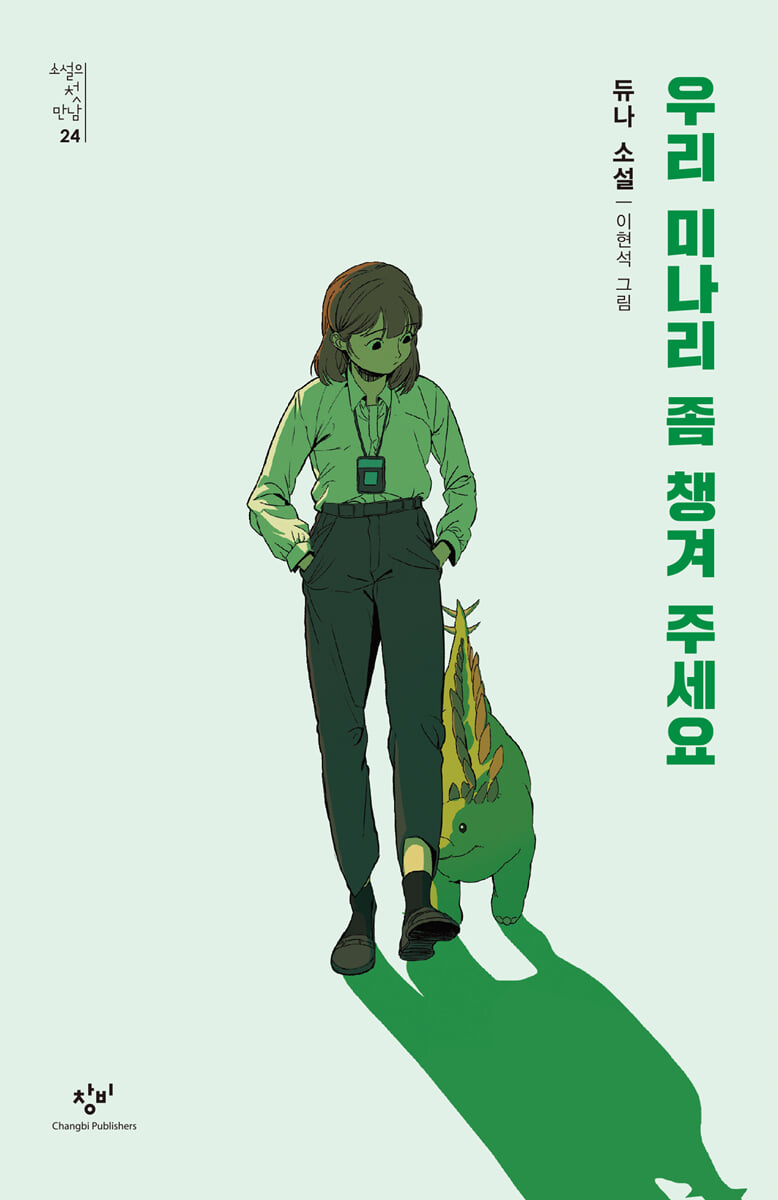
Author Duna, who has been showcasing his own unique SF world, has published the serial novel "Please Take Care of Our Minari" as the twenty-fourth book in the [First Encounter with Novels] series.
The story of the mecha dinosaur 'Carrot' and the biological dinosaur 'Minari' unfolds in a society where biological humans and mecha humans, biological dinosaurs and mecha dinosaurs created based on DNA, coexist.
It is a masterpiece that asks the question of how we will live together in a future where new beings have appeared.
Beyond the dichotomous boundary between humans and machines that already appears in many works, the emergence of characters that defy simple definitions, such as humans with parts of their bodies replaced by machines or artificially created creatures, broadens the horizons of our thinking.
The discrimination against Mecca, hidden throughout the work, reminds us of the various minority issues in our reality, and the more we read, the more we think about it.
Illustrator Lee Hyeon-seok's sophisticated drawings blend in with the novel, serving as a guide to the questions the work poses.
Unbiased questions from author Duna
Author Duna, who has been showcasing his own unique SF world, has published the serial novel "Please Take Care of Our Minari" as the twenty-fourth book in the [First Encounter with Novels] series.
The story of the mecha dinosaur 'Carrot' and the biological dinosaur 'Minari' unfolds in a society where biological humans and mecha humans, biological dinosaurs and mecha dinosaurs created based on DNA, coexist.
It is a masterpiece that asks the question of how we will live together in a future where new beings have appeared.
Beyond the dichotomous boundary between humans and machines that already appears in many works, the emergence of characters that defy simple definitions, such as humans with parts of their bodies replaced by machines or artificially created creatures, broadens the horizons of our thinking.
The discrimination against Mecca, hidden throughout the work, reminds us of the various minority issues in our reality, and the more we read, the more we think about it.
Illustrator Lee Hyeon-seok's sophisticated drawings blend in with the novel, serving as a guide to the questions the work poses.
- You can preview some of the book's contents.
Preview
index
Our carrot did nothing wrong
Please take care of our water parsley
Author's Note
Please take care of our water parsley
Author's Note
Detailed image

Publisher's Review
A future where Mecca exists
What would it be like there?
All this is common sense in Haenam, a town where mecha pterosaurs and archaeopteryx fly around instead of police drones, and mecha amphibians work as coastal lifeguards.
-Page 10
The virtual space of Haenam, the setting of "Please Take Care of Our Minari," is a place where "mecha humans" and "mecha dinosaurs," whose bodies are all or partly mechanical, live together with biological beings.
One day, while walking with 'Parang', the promotional officer of Haenam Paleontological Park, the mecha dinosaur 'Carrot' stops a group of male students from attacking a student.
At first glance, it may seem like Carrot has threatened a group of humans, but Parang fiercely defends Carrot, but the people are indifferent, as if they think the series of events is just another 'dinosaur show' that they can easily watch.
“Get out of here, you fucking worm!”
A boy screamed in a raspy voice, but when the male police officer glared at him, he looked away in fear.
―Page 14
The reason three students attacked another student is because they are of different races and genders, and part of their body is a mecha.
In this scene, which seems to show a cross-section of the real world, the police click their tongues, saying that it looks like a historical drama, as they imitate actions from centuries ago, but Parang, who is watching this, cannot hide his worry.
What is the reason for this imitation, if it can't simply be dismissed as an imitation of behavior from centuries ago? Who is responsible for the process that led to the utterance of discriminatory language?
“The minari is gone, Zookeeper.”
The invisible boundary that separates them and us
The worries that continue in “Our Carrot Did Nothing Wrong” are further strengthened in “Please Take Care of Our Minari.”
At Haenam Paleontological Park, Minari, a biological dinosaur created based on ostrich dinosaur DNA, becomes friends with Sodam, a baby mecha dinosaur.
Even as engineers from the Denver Dinosaur Zoo visit the Haenam Paleontological Park, where Minari is cared for, and talk to the caretakers, the conflicts that shroud this world like a fog are glimpsed.
No matter how much we try to claim that the world is free of prejudice, it is difficult to truly achieve such a world.
I just didn't feel the need to distinguish between the two to determine which one was Mecca.
―Page 61
Meanwhile, Sodam disappears with Minari, and their location is no longer visible in the park management system.
The mecha dinosaurs that manage the park try to connect with other mecha dinosaurs, but are also rejected.
How can we resolve the existing boundaries between different beings on a night when their own collective consciousness, invisible to the management system, hides the water parsley?
Could discrimination exist there, too, if not now?
How other beings live together
Of course, in the real world, it is still difficult to find unfamiliar intelligent beings.
However, discrimination that arises among humans due to differences is rampant.
Discrimination based on gender, sexual identity, disability, and race remains one of the most pressing issues on the planet.
"Please Take Care of Our Minari" ponders the possibility of discrimination becoming more intense as unfamiliar beings emerge due to human development, while also listening to real-life stories.
Will a day come when the discrimination of our time will be dismissed as "a quaint act from centuries ago"? And what new boundaries await us then? "Please Take Care of Our Minari" is a broad lens that views both the present and the future.
It asks how we should live with new beings that will appear, and speaks of the need to coexist with beings that we now consider different.
Introduction to the [First Encounter with a Novel] series
The first path to encountering a novel
A welcome reading for those who have grown distant from books, a first encounter with a novel.
'First Encounter with a Novel' is a thin and beautiful paperback book decorated with a new sensibility.
A literary masterpiece, this short story is richly illustrated.
With engaging stories, short volumes of less than 100 pages, and captivating illustrations, it allows even those who lack time or are unfamiliar with reading to easily access excellent contemporary works.
For adolescent readers who have stopped reading at fairy tales, it will serve as a stepping stone to novels.
To pump water from a deep well, you must pour a bucket of water from above.
The "First Encounter with a Novel" series will serve as a welcome aid to those who have become increasingly distant from literature, helping them reconnect with books and inject fresh vitality into our reading culture.
What would it be like there?
All this is common sense in Haenam, a town where mecha pterosaurs and archaeopteryx fly around instead of police drones, and mecha amphibians work as coastal lifeguards.
-Page 10
The virtual space of Haenam, the setting of "Please Take Care of Our Minari," is a place where "mecha humans" and "mecha dinosaurs," whose bodies are all or partly mechanical, live together with biological beings.
One day, while walking with 'Parang', the promotional officer of Haenam Paleontological Park, the mecha dinosaur 'Carrot' stops a group of male students from attacking a student.
At first glance, it may seem like Carrot has threatened a group of humans, but Parang fiercely defends Carrot, but the people are indifferent, as if they think the series of events is just another 'dinosaur show' that they can easily watch.
“Get out of here, you fucking worm!”
A boy screamed in a raspy voice, but when the male police officer glared at him, he looked away in fear.
―Page 14
The reason three students attacked another student is because they are of different races and genders, and part of their body is a mecha.
In this scene, which seems to show a cross-section of the real world, the police click their tongues, saying that it looks like a historical drama, as they imitate actions from centuries ago, but Parang, who is watching this, cannot hide his worry.
What is the reason for this imitation, if it can't simply be dismissed as an imitation of behavior from centuries ago? Who is responsible for the process that led to the utterance of discriminatory language?
“The minari is gone, Zookeeper.”
The invisible boundary that separates them and us
The worries that continue in “Our Carrot Did Nothing Wrong” are further strengthened in “Please Take Care of Our Minari.”
At Haenam Paleontological Park, Minari, a biological dinosaur created based on ostrich dinosaur DNA, becomes friends with Sodam, a baby mecha dinosaur.
Even as engineers from the Denver Dinosaur Zoo visit the Haenam Paleontological Park, where Minari is cared for, and talk to the caretakers, the conflicts that shroud this world like a fog are glimpsed.
No matter how much we try to claim that the world is free of prejudice, it is difficult to truly achieve such a world.
I just didn't feel the need to distinguish between the two to determine which one was Mecca.
―Page 61
Meanwhile, Sodam disappears with Minari, and their location is no longer visible in the park management system.
The mecha dinosaurs that manage the park try to connect with other mecha dinosaurs, but are also rejected.
How can we resolve the existing boundaries between different beings on a night when their own collective consciousness, invisible to the management system, hides the water parsley?
Could discrimination exist there, too, if not now?
How other beings live together
Of course, in the real world, it is still difficult to find unfamiliar intelligent beings.
However, discrimination that arises among humans due to differences is rampant.
Discrimination based on gender, sexual identity, disability, and race remains one of the most pressing issues on the planet.
"Please Take Care of Our Minari" ponders the possibility of discrimination becoming more intense as unfamiliar beings emerge due to human development, while also listening to real-life stories.
Will a day come when the discrimination of our time will be dismissed as "a quaint act from centuries ago"? And what new boundaries await us then? "Please Take Care of Our Minari" is a broad lens that views both the present and the future.
It asks how we should live with new beings that will appear, and speaks of the need to coexist with beings that we now consider different.
Introduction to the [First Encounter with a Novel] series
The first path to encountering a novel
A welcome reading for those who have grown distant from books, a first encounter with a novel.
'First Encounter with a Novel' is a thin and beautiful paperback book decorated with a new sensibility.
A literary masterpiece, this short story is richly illustrated.
With engaging stories, short volumes of less than 100 pages, and captivating illustrations, it allows even those who lack time or are unfamiliar with reading to easily access excellent contemporary works.
For adolescent readers who have stopped reading at fairy tales, it will serve as a stepping stone to novels.
To pump water from a deep well, you must pour a bucket of water from above.
The "First Encounter with a Novel" series will serve as a welcome aid to those who have become increasingly distant from literature, helping them reconnect with books and inject fresh vitality into our reading culture.
GOODS SPECIFICS
- Publication date: July 15, 2021
- Page count, weight, size: 80 pages | 136g | 122*188*6mm
- ISBN13: 9788936459505
- ISBN10: 8936459503
You may also like
카테고리
korean


korean

![GQ KOREA Mark (Monthly): December [2025]](http://librairie.coreenne.fr/cdn/shop/files/8ef265dbbfbf186523ed75ba7319009d.jpg?v=1765340328&width=3840)


