

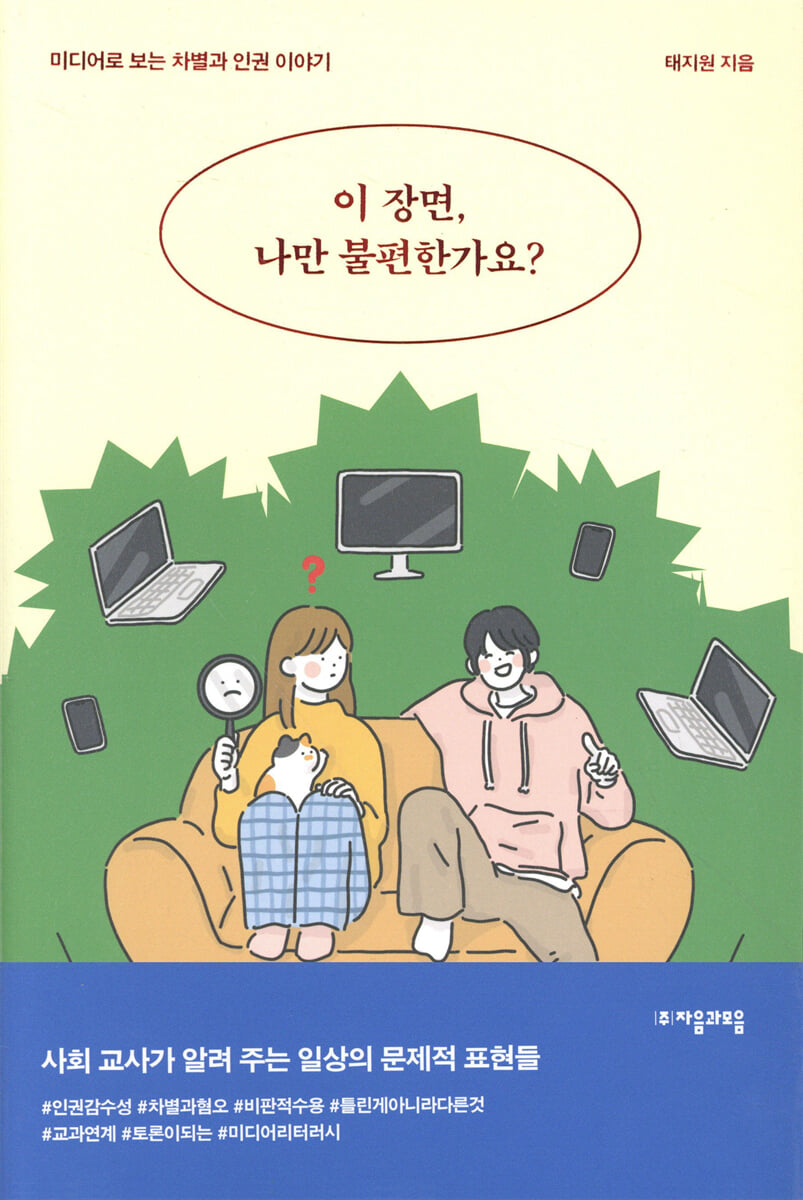
Am I the only one who finds this scene uncomfortable?
 |
Description
Book Introduction
- A word from MD
- [What's wrong with being a professional inconveniencer!] Discrimination and hatred in the media are highly contagious.
A current social studies teacher has declared himself a 'professional inconveniencer' for teenagers addicted to media.
This book helps us develop human rights awareness and critical tolerance by pointing out discrimination and hatred in scenes we often overlook.
This book will be the first step toward a society that can address insensitivity rather than sensitivity.
- Youth MD Kim So-jeong
“Oh, now that I think about it, it’s discrimination?”
Everyday problematic expressions taught by a social studies teacher
Are the words we use so thoughtlessly really okay? Could it be that we unknowingly use words or actions that discriminate against or hate others? Discrimination and hatred exist even in moments we don't even notice.
They hide behind a mask of laughter and playfulness, or within a social atmosphere that has been taken for granted for a long time, and blend in with people's daily lives.
How sensitive can we be to this discrimination and hatred?
The author, who has communicated with teenagers in various ways as a social studies teacher, has now returned as a 'professional inconveniencer.'
He focused on the uncomfortable expressions that exist around us.
In "Am I the only one who finds this scene uncomfortable?", we examine how such expressions are used, where they originated, and why we must be careful and avoid using them indiscriminately.
We took a close look at the discrimination and hatred that exists in our society, from inequality of opportunity, gender, social minorities, the gap between the rich and the poor, to appearance discrimination.
And it explains in language that is easy for young people to understand how dangerous the discrimination and hatred hidden in our daily lives are.
Additionally, at the end of the book, a discussion using the contents of each chapter is included to help teenagers organize their thoughts on their own.
By following the human rights story told in a friendly and calm voice in "Am I the only one uncomfortable with this scene?", young people will be able to understand others and society, and broaden their perspective on the world.
In addition, you will be able to develop the attitude and strength to correctly interpret and critically accept the information and expressions that pour in from the media every day.
Everyday problematic expressions taught by a social studies teacher
Are the words we use so thoughtlessly really okay? Could it be that we unknowingly use words or actions that discriminate against or hate others? Discrimination and hatred exist even in moments we don't even notice.
They hide behind a mask of laughter and playfulness, or within a social atmosphere that has been taken for granted for a long time, and blend in with people's daily lives.
How sensitive can we be to this discrimination and hatred?
The author, who has communicated with teenagers in various ways as a social studies teacher, has now returned as a 'professional inconveniencer.'
He focused on the uncomfortable expressions that exist around us.
In "Am I the only one who finds this scene uncomfortable?", we examine how such expressions are used, where they originated, and why we must be careful and avoid using them indiscriminately.
We took a close look at the discrimination and hatred that exists in our society, from inequality of opportunity, gender, social minorities, the gap between the rich and the poor, to appearance discrimination.
And it explains in language that is easy for young people to understand how dangerous the discrimination and hatred hidden in our daily lives are.
Additionally, at the end of the book, a discussion using the contents of each chapter is included to help teenagers organize their thoughts on their own.
By following the human rights story told in a friendly and calm voice in "Am I the only one uncomfortable with this scene?", young people will be able to understand others and society, and broaden their perspective on the world.
In addition, you will be able to develop the attitude and strength to correctly interpret and critically accept the information and expressions that pour in from the media every day.
- You can preview some of the book's contents.
Preview
index
prolog
Chapter 1: A Just Outcome: Equality of Opportunity: A Story of Inequality of Opportunity Seen Through the Media
Why was my one-pick idol eliminated?
High school seniors in popular dramas are also depressed.
How did they become headquarters?
Chapter 2: Beyond Innate Gender: Stories of Gender Equality Seen Through Media
Who will save the troublemaker protagonist?
Why did beauty pageants disappear from TV?
Violence disguised as romance
Chapter 3: A World Where People Are a Little Different: Stories of Social Minorities Seen Through the Media
Even the "neighborhood idiot" needs rights.
Sexual minorities who escaped the shadows
How old am I?
I plan to become a foreigner in Korea.
Chapter 4: How to Walk Together Even When Living in Different Neighborhoods: A Story of the Wealth Gap Seen Through the Media
A renter? Words, words, words spread by the news.
Why did poor people become bad people?
Why people click on articles about celebrities born with a silver spoon in their mouths
Chapter 5: Look at Humanity, Not Race: Stories of Racism Seen in the Media
Why is the word 'black' problematic?
Are there superiorities and inferiorities in culture?
Disney's Choice of Black Little Mermaid
Chapter 6: Standing Up for Myself: Stories of Lookism Seen Through the Media
You forgive me because I'm pretty and handsome?
How does the media force us to look good?
Media in search of new beauty
supplement.
A discussion beyond discrimination and hate
References
Chapter 1: A Just Outcome: Equality of Opportunity: A Story of Inequality of Opportunity Seen Through the Media
Why was my one-pick idol eliminated?
High school seniors in popular dramas are also depressed.
How did they become headquarters?
Chapter 2: Beyond Innate Gender: Stories of Gender Equality Seen Through Media
Who will save the troublemaker protagonist?
Why did beauty pageants disappear from TV?
Violence disguised as romance
Chapter 3: A World Where People Are a Little Different: Stories of Social Minorities Seen Through the Media
Even the "neighborhood idiot" needs rights.
Sexual minorities who escaped the shadows
How old am I?
I plan to become a foreigner in Korea.
Chapter 4: How to Walk Together Even When Living in Different Neighborhoods: A Story of the Wealth Gap Seen Through the Media
A renter? Words, words, words spread by the news.
Why did poor people become bad people?
Why people click on articles about celebrities born with a silver spoon in their mouths
Chapter 5: Look at Humanity, Not Race: Stories of Racism Seen in the Media
Why is the word 'black' problematic?
Are there superiorities and inferiorities in culture?
Disney's Choice of Black Little Mermaid
Chapter 6: Standing Up for Myself: Stories of Lookism Seen Through the Media
You forgive me because I'm pretty and handsome?
How does the media force us to look good?
Media in search of new beauty
supplement.
A discussion beyond discrimination and hate
References
Into the book
In dramas, the idea that companies are the 'private property' of conglomerates is portrayed as natural.
The second generation of a conglomerate is often portrayed as not only the son of the chairman but also a person with management skills, and it is not portrayed as natural for them to rise to a high position or take over management at a young age.
When you see scenes like this, it doesn't seem strange that the second or third generation of a conglomerate rises to a high position at an early age.
But if you look closely, they don't necessarily reach high positions just because of their outstanding abilities or efforts.
Especially when you take a position with unproven abilities, you're essentially taking away an opportunity from someone more capable and hard-working.
It is a personal freedom to enjoy watching dramas about conglomerates.
However, when we see scenes like this, we need to question the structure in which children of chaebol families quickly rise through the ranks and inherit management rights.
If we take unfair realities for granted, unfair structures can become more firmly rooted in society.
It is necessary to think about the problems of the conglomerate group, such as illegal or unlawful management and management succession.
--- pp.40~41
Think about a scene on a variety show where a female guest forcibly touches a male guest or makes sexually harassing remarks, causing laughter.
In the past, it was common for actions that would have been heavily criticized if done by a male performer to a female performer, but were passed off as simple pranks when the man was the victim.
But now, there are more and more cases where women point out problems when men behave in this way.
Sexual harassment means making the other person feel sexually ashamed through unwanted words or actions.
What matters is how the other person feels, rather than what the person who said or did something intended.
As social awareness of adulthood has increased, it is time to consider the other person's perspective and be careful with what we say and do.
--- p.73
At some point, the word 'Tttak' started to circulate on the Internet.
It is one of the expressions that hates the elderly, and is a derogatory word used to look down on the older generation who wear dentures.
On the one hand, it's also a bit strange.
Since ancient times, our country has considered respecting the elderly as a basic moral principle.
But at some point, the elderly went beyond being marginalized and became objects of hatred.
When did hate speech toward the elderly begin?
As democratization progressed and etiquette in daily life became more important, the images of some elderly people who were called 'thoughtless' were exposed in the mass media.
Unlike the younger generation who advocate for the democratization of politics, the older generation with conservative political leanings were often featured in the media.
Looking at the older generation, hate speech has increased, especially in online communities.
--- pp.105~106
“What kind of spoon were you born with?”
Nowadays, there are almost no people in South Korea who do not understand what this question is.
This is because the spoon class theory, which began to circulate around online communities around 2015, is now used as everyday terminology.
Spoon class theory refers to a new class theory that divides people into gold spoons, silver spoons, and dirt spoons based on their assets or income.
In addition, terms such as diamond spoon and copper spoon began to appear.
There are even spoon games and spoon bingo games on the internet that allow you to find out which spoon you belong to.
The spoon class theory originally originated from the European proverb, “born with a silver spoon in one’s mouth.”
In the past, in Europe, expensive silver spoons were only available to the upper class, so this proverb was used to mean that one was born into a wealthy family.
This story came to 21st century Korea and transformed into the 'spoon class theory'.
--- pp.133~134
Stereotypes about black people aren't limited to Western countries like the United States or Europe.
Similar stereotypes and prejudices have taken root in our country, which has been heavily influenced by Western culture since liberation.
Words that stem from these stereotypes and prejudices can be discriminatory, even if they are not intended to be.
The word 'black' can also be racist in a similar context.
Some explain that it is not a word used in a derogatory sense, but rather has a positive and friendly meaning.
Some people say that it doesn't have a negative meaning because it comes from the image of a 'black person who is big, athletic, and good at music or rapping.'
But if you look closely, these words contain stereotypes about black people.
Are all Black people big, athletic, or talented in music or rap? Positive stereotypes also don't respect individual characteristics.
It can cause all social groups belonging to a given category to feel uncomfortable and unpleasant by lumping them into one characteristic.
--- pp.165~166
Appearance-based evaluations and discrimination are not new, not only in mass media but also in new media such as social media, internet communities, and online news.
The recent popularity of the face-to-face culture on social media also reflects this trend.
Eolpyeong is an abbreviation for 'face evaluation' and it means evaluating someone's appearance.
For example, you can evaluate someone's appearance level by giving them a score between 1 and 5 hearts after seeing their photo posted on social media.
It is said that this culture of comparing faces is especially widespread among elementary, middle, and high school students.
Not only do teenagers comment on other people's faces, they also boldly post their own photos asking for 'face reviews.'
Why do teenagers ask others to rate their faces? Experts say the adolescent desire for recognition, coupled with a tendency toward lookism, has given rise to a culture of face-criticism.
The second generation of a conglomerate is often portrayed as not only the son of the chairman but also a person with management skills, and it is not portrayed as natural for them to rise to a high position or take over management at a young age.
When you see scenes like this, it doesn't seem strange that the second or third generation of a conglomerate rises to a high position at an early age.
But if you look closely, they don't necessarily reach high positions just because of their outstanding abilities or efforts.
Especially when you take a position with unproven abilities, you're essentially taking away an opportunity from someone more capable and hard-working.
It is a personal freedom to enjoy watching dramas about conglomerates.
However, when we see scenes like this, we need to question the structure in which children of chaebol families quickly rise through the ranks and inherit management rights.
If we take unfair realities for granted, unfair structures can become more firmly rooted in society.
It is necessary to think about the problems of the conglomerate group, such as illegal or unlawful management and management succession.
--- pp.40~41
Think about a scene on a variety show where a female guest forcibly touches a male guest or makes sexually harassing remarks, causing laughter.
In the past, it was common for actions that would have been heavily criticized if done by a male performer to a female performer, but were passed off as simple pranks when the man was the victim.
But now, there are more and more cases where women point out problems when men behave in this way.
Sexual harassment means making the other person feel sexually ashamed through unwanted words or actions.
What matters is how the other person feels, rather than what the person who said or did something intended.
As social awareness of adulthood has increased, it is time to consider the other person's perspective and be careful with what we say and do.
--- p.73
At some point, the word 'Tttak' started to circulate on the Internet.
It is one of the expressions that hates the elderly, and is a derogatory word used to look down on the older generation who wear dentures.
On the one hand, it's also a bit strange.
Since ancient times, our country has considered respecting the elderly as a basic moral principle.
But at some point, the elderly went beyond being marginalized and became objects of hatred.
When did hate speech toward the elderly begin?
As democratization progressed and etiquette in daily life became more important, the images of some elderly people who were called 'thoughtless' were exposed in the mass media.
Unlike the younger generation who advocate for the democratization of politics, the older generation with conservative political leanings were often featured in the media.
Looking at the older generation, hate speech has increased, especially in online communities.
--- pp.105~106
“What kind of spoon were you born with?”
Nowadays, there are almost no people in South Korea who do not understand what this question is.
This is because the spoon class theory, which began to circulate around online communities around 2015, is now used as everyday terminology.
Spoon class theory refers to a new class theory that divides people into gold spoons, silver spoons, and dirt spoons based on their assets or income.
In addition, terms such as diamond spoon and copper spoon began to appear.
There are even spoon games and spoon bingo games on the internet that allow you to find out which spoon you belong to.
The spoon class theory originally originated from the European proverb, “born with a silver spoon in one’s mouth.”
In the past, in Europe, expensive silver spoons were only available to the upper class, so this proverb was used to mean that one was born into a wealthy family.
This story came to 21st century Korea and transformed into the 'spoon class theory'.
--- pp.133~134
Stereotypes about black people aren't limited to Western countries like the United States or Europe.
Similar stereotypes and prejudices have taken root in our country, which has been heavily influenced by Western culture since liberation.
Words that stem from these stereotypes and prejudices can be discriminatory, even if they are not intended to be.
The word 'black' can also be racist in a similar context.
Some explain that it is not a word used in a derogatory sense, but rather has a positive and friendly meaning.
Some people say that it doesn't have a negative meaning because it comes from the image of a 'black person who is big, athletic, and good at music or rapping.'
But if you look closely, these words contain stereotypes about black people.
Are all Black people big, athletic, or talented in music or rap? Positive stereotypes also don't respect individual characteristics.
It can cause all social groups belonging to a given category to feel uncomfortable and unpleasant by lumping them into one characteristic.
--- pp.165~166
Appearance-based evaluations and discrimination are not new, not only in mass media but also in new media such as social media, internet communities, and online news.
The recent popularity of the face-to-face culture on social media also reflects this trend.
Eolpyeong is an abbreviation for 'face evaluation' and it means evaluating someone's appearance.
For example, you can evaluate someone's appearance level by giving them a score between 1 and 5 hearts after seeing their photo posted on social media.
It is said that this culture of comparing faces is especially widespread among elementary, middle, and high school students.
Not only do teenagers comment on other people's faces, they also boldly post their own photos asking for 'face reviews.'
Why do teenagers ask others to rate their faces? Experts say the adolescent desire for recognition, coupled with a tendency toward lookism, has given rise to a culture of face-criticism.
--- pp.203~204
Publisher's Review
- How did 'flex' become a trend?
- Why get angry about cheating on audition programs?
- Why is the word 'black' a problem?
Inequality of opportunity and the gap between rich and poor, gender and social minorities, appearance and race…
Discrimination and hatred were hidden in scenes we passed by without noticing!
Recently, the feminist movement and other socially disadvantaged and minorities have been raising their voices and bringing about change in society.
The debate over the enactment of a 'comprehensive anti-discrimination law' also reflects this change.
This law aims to prevent unreasonable discrimination and inequality in all areas of society based on gender, age, race, disability, social status, etc.
We grow up learning from a young age that we should not discriminate against anyone.
But why is there such a heated debate surrounding the enactment of laws prohibiting discrimination? Discrimination and hatred are still rampant in society, often without our awareness. There's also discrimination that has persisted for so long that it's taken for granted.
In fact, hatred and discrimination are readily found in everyday life today, and the resulting social conflicts are also intensifying.
Discrimination and hatred are problematic in themselves, but their continued expansion and spread are even more concerning.
It can be said that the media plays a major role in this expansion and propagation.
Most people today use a multitude of media.
Teenagers also come into contact with various media channels, including broadcasting, advertisements, movies, social media, YouTube videos, and internet news.
As a result, the power of media on youth is enormous.
Discrimination and hate speech on television and in online communities continues to increase, but young people often unthinkingly accept it and repeat it in real life.
"Am I the only one who finds this scene uncomfortable?" speaks to the expressions of discrimination and hatred that we must never ignore.
Beginning with the concept of discrimination, we look back at the past and present to see how the media we frequently use are related to discrimination and hatred in our daily lives.
Through this, we illuminate the forms of discrimination that occur in our society, ranging from inequality of opportunity, gender, the gap between the rich and the poor, social minorities, appearance, and race, and examine how they are spread through the media.
Readers will learn that cultivating critical acceptance of media and a sensitivity to human rights, and that acknowledging differences is the power to overcome discrimination.
Furthermore, it will be an opportunity to cultivate the capacity to recognize discrimination and explore alternatives that can be prepared for everyone to live together.
#HumanRightsSensitivity #DiscriminationandHate #CriticalAcceptance #MediaLiteracy
- Why get angry about cheating on audition programs?
- Why is the word 'black' a problem?
Inequality of opportunity and the gap between rich and poor, gender and social minorities, appearance and race…
Discrimination and hatred were hidden in scenes we passed by without noticing!
Recently, the feminist movement and other socially disadvantaged and minorities have been raising their voices and bringing about change in society.
The debate over the enactment of a 'comprehensive anti-discrimination law' also reflects this change.
This law aims to prevent unreasonable discrimination and inequality in all areas of society based on gender, age, race, disability, social status, etc.
We grow up learning from a young age that we should not discriminate against anyone.
But why is there such a heated debate surrounding the enactment of laws prohibiting discrimination? Discrimination and hatred are still rampant in society, often without our awareness. There's also discrimination that has persisted for so long that it's taken for granted.
In fact, hatred and discrimination are readily found in everyday life today, and the resulting social conflicts are also intensifying.
Discrimination and hatred are problematic in themselves, but their continued expansion and spread are even more concerning.
It can be said that the media plays a major role in this expansion and propagation.
Most people today use a multitude of media.
Teenagers also come into contact with various media channels, including broadcasting, advertisements, movies, social media, YouTube videos, and internet news.
As a result, the power of media on youth is enormous.
Discrimination and hate speech on television and in online communities continues to increase, but young people often unthinkingly accept it and repeat it in real life.
"Am I the only one who finds this scene uncomfortable?" speaks to the expressions of discrimination and hatred that we must never ignore.
Beginning with the concept of discrimination, we look back at the past and present to see how the media we frequently use are related to discrimination and hatred in our daily lives.
Through this, we illuminate the forms of discrimination that occur in our society, ranging from inequality of opportunity, gender, the gap between the rich and the poor, social minorities, appearance, and race, and examine how they are spread through the media.
Readers will learn that cultivating critical acceptance of media and a sensitivity to human rights, and that acknowledging differences is the power to overcome discrimination.
Furthermore, it will be an opportunity to cultivate the capacity to recognize discrimination and explore alternatives that can be prepared for everyone to live together.
#HumanRightsSensitivity #DiscriminationandHate #CriticalAcceptance #MediaLiteracy
GOODS SPECIFICS
- Publication date: March 12, 2021
- Page count, weight, size: 248 pages | 464g | 152*225*16mm
- ISBN13: 9788954446761
- ISBN10: 8954446760
- KC Certification: Certification Type: Conformity Confirmation
You may also like
카테고리
korean


korean

![GQ KOREA Mark (Monthly): December [2025]](http://librairie.coreenne.fr/cdn/shop/files/8ef265dbbfbf186523ed75ba7319009d.jpg?v=1765340328&width=3840)


