

Friendly East Asian history told by a history teacher
 |
Description
Book Introduction
Korean history is full of news
Written by teachers from the National History Teachers Association
An introduction to East Asian history for teenagers!
Many East Asian countries, including ours, have maintained close political, economic, and cultural ties since ancient times.
However, since the 2000s, the entire East Asia has been suffering from historical and territorial conflicts.
When I watch news about Dokdo sovereignty, the Japanese military's "comfort women" issue, and China's distortion of history, as a Korean, I feel a sense of injustice and anger.
But is it inevitable that this resentment and anger will be channeled into slander? Is there no wiser way to resolve it?
Teachers from the National History Teachers Association, who have been deeply contemplating this issue, have presented the results of their long-term research into East Asian history.
The authors ask questions about East Asia's past history, why conflicts arose between nations, and how to resolve these conflicts and achieve peace, and seek clues to solutions.
This book follows the flow of the high school "East Asian History" curriculum, but explains the characteristics of each era in an easy-to-understand and friendly way by topic. It will help readers feel more familiar with East Asia and seek harmony by viewing the history of East Asia surrounding Korea from a broader perspective.
Written by teachers from the National History Teachers Association
An introduction to East Asian history for teenagers!
Many East Asian countries, including ours, have maintained close political, economic, and cultural ties since ancient times.
However, since the 2000s, the entire East Asia has been suffering from historical and territorial conflicts.
When I watch news about Dokdo sovereignty, the Japanese military's "comfort women" issue, and China's distortion of history, as a Korean, I feel a sense of injustice and anger.
But is it inevitable that this resentment and anger will be channeled into slander? Is there no wiser way to resolve it?
Teachers from the National History Teachers Association, who have been deeply contemplating this issue, have presented the results of their long-term research into East Asian history.
The authors ask questions about East Asia's past history, why conflicts arose between nations, and how to resolve these conflicts and achieve peace, and seek clues to solutions.
This book follows the flow of the high school "East Asian History" curriculum, but explains the characteristics of each era in an easy-to-understand and friendly way by topic. It will help readers feel more familiar with East Asia and seek harmony by viewing the history of East Asia surrounding Korea from a broader perspective.
- You can preview some of the book's contents.
Preview
index
Introduction _ East Asian History, Who Are You? 4
Changes in Major Regions and Place Names in East Asia 8
01_ What countries are in East Asia today? 15
The divided Korean Peninsula, North and South _ The vast continent of China _ Japan, the land of 'earthquakes' _ Small but strong Taiwan
Mongolia, the descendants of Genghis Khan _ Vietnam, the rising dragon of Asia
_COLUMN _People demanding independence within China
02_ When did East Asians start eating rice? 23
Producing Food _ Agricultural Culture Revealed in Myths _ Farming Transforms Life
03_ Why do nomads move around to survive? 29
Living on the Grasslands _Another Family, Livestock _Nomads, Dominating East Asia _Can Agriculture and Nomadism Be Discussed as Superior?
_COLUMN _Why was the Great Wall of China built?
04_ What was the first country to appear in East Asia? 36
The Birth of a Nation _ A Dynasty Appears in the Central Plains _ Gojoseon Appears in Manchuria and the Korean Peninsula _ States Form in Japan and Vietnam
05_ How did population migration change the East Asian world? 43
Why did population migration occur? _The spread and exchange of cultural artifacts through population movement _The formation of the East Asian cultural sphere through cultural exchange
06_ Why was Buddhism popular in East Asia? 50
Buddhism traveled along the Silk Road _ Various East Asian countries accepted Buddhism _ Monks active in East Asia
07_ How did East Asian rulers govern their people? 58
Why were the statutes created? _The Encounter of the Statutes and Confucianism_The statutes were perceived differently across countries.
08_ What are the characteristics of East Asian diplomacy? 66
Investiture and tribute become established diplomatic forms in East Asia _ East Asian diplomacy that pursued practicality _ Various aspects of investiture and tribute relations
_COLUMN _Cultural Spreader, Princess Hwaban
09_ How did the nomadic people who crossed the Great Wall of China live? 74
The Khitan and Jurchen expand their influence into the Central Plains. The Song achieves peace through silver and silk. The Goryeo strategizes its national interests.
_COLUMN _Yeonun 16 weeks, a small but important land
10_ What kind of country was the Yeke Mongol Ulus? 83
New Ulus Appearing on the Steppes _ Genghis Khan's Empire, Yeke Mongol Ulus
How did the Mongols govern diverse peoples? _Ulus, leading to post stations
11_ How did the samurai rule Japan? 91
The emergence of the samurai and the establishment of the shogunate - The samurai of the Kamakura period govern their territories.
Japan's long-lasting samurai regime - Edo period samurai gathered in cities
12_ Why did the scholar-officials accept Neo-Confucianism? 100
The Changing Civil Service System: Creating the Aristocrats _ Seeing the World Through the Eyes of Neo-Confucianism _ The Aristocrats, Creating a Nation of Neo-Confucianism
13_ How did the Manchus come to rule the grasslands? 107
The Mongol Ulus Returned to the Steppes _How Did the Name "Manchuria" Come About? _The Manchus Rule the Mongolian Steppes
_COLUMN _Who are the 'barbarians'?
14_ What impact did the Imjin War have on East Asian society? 115
The international war that shook East Asia _ The international war that lasted for seven years _ The changes brought about by the war
_COLUMN _Same war, different names
15_ How did Rubens paint a man in hanbok? 122
The Manhunt War, the Slave War _ Saya, who became Kim Chung-seon _ The peppers that appeared on the Joseon table
16_ Why did the population explode in the 17th and 18th centuries? 130
Political stability following the East Asian War _ Agricultural productivity increased dramatically
When a merchant gets angry, the feudal lords of the world tremble in fear. _The Light and Dark Side of Population Growth
17_ What changes did silver circulation bring to East Asia? 142
Silver becomes a medium of exchange in international trade _ Goods travel along the 'Silver Road' _ East Asian society transformed by silver circulation
18_ Why did Van Gogh paint Japanese paintings? 152
The Chonin who enjoyed a leisure life that was the envy of others _ The common people's culture of the Qing Dynasty that developed along with commerce and industry _ The world that the common people of the late Joseon Dynasty dreamed of
_COLUMN _Ukiyo-e that even Van Gogh fell in love with
19_ How did East Asia respond to imperialism? 160
East Asian countries face crises both domestically and internationally, and internal conflicts rage over how to overcome the crisis.
Relations between East Asian countries begin to change.
20_ What impact did the Sino-Japanese War have on East Asia? 169
Qing and Japan wage war in Joseon _ Japan becomes an imperialist nation _ Japan expels Russia and seizes Korea's diplomatic rights
_COLUMN _Pyongyang, reduced to ruins by Qing and Japanese troops
21_ What is true patriotism? 178
Anxiety and discontent breed fascism. Justifying wars of aggression by emphasizing 'patriotism.' It's okay to call them 'traitors.'
_COLUMN _Outline of the Japanese Anti-War Alliance North China Union
22_ When and why did "The school bell rings, let's gather together" begin? 186
Winning the competition is the only way to survive. _Western-style education is introduced. _Physical education is emphasized.
23_ Did peace come to East Asia after World War II? 193
Japan, a war criminal nation, escapes judgment. A red star rises over mainland China. The Korean Peninsula becomes a battleground.
_COLUMN _The Japan-South Korea Peace Treaty: Who is it for?
24_ What did the Vietnam War leave behind? 201
Vietnam declares independence. Vietnam calls for unification. The Vietnam War transforms the international order in East Asia.
_COLUMN _The Tragedy of the Unfinished Vietnam War
25_ How is the East Asian economy changing? 209
Two economic systems are locked in a fierce battle in the Cold War. _Exports are the only way to survive. _Economy over ideology. _It's hard to live without 'you.'
_COLUMN _The '3 Lows' Phenomenon and Korea's Economic Development
26_ What problems is East Asia suffering from? 219
Falling into the swamp of low birth rates and an aging population _ Catch the silent killer, 'fine dust' _ Participating citizens create a healthy society
_COLUMN _What is a 'peasant worker'?
27_ Is Article 1 of East Asian Constitutions Being Implemented? 226
Singing for Democracy with a Burning Thirst: The Collapse of the 55-Year-Old Liberal Democratic Party-Centred System
Democracy in China and North Korea is barely taking its first steps. Taiwan's lifelong president and "perpetual parliament" are abolished.
_COLUMN _The Peace Constitution and the Abe Administration
28_ East Asia's Conflict: Is Reconciliation Possible? 235
The Girl Becomes a Symbol of the Women's Movement and Human Rights _ History Textbooks Distort the Invasion
The Voice of Conscience and Human Rights Resonates _ Writing History Together, East Asia Together
_COLUMN _Youth from Korea, China, and Japan Open the Future of East Asia
East Asian Chronology 246
References and Sources 250
Search 252
About the Author 255
Changes in Major Regions and Place Names in East Asia 8
01_ What countries are in East Asia today? 15
The divided Korean Peninsula, North and South _ The vast continent of China _ Japan, the land of 'earthquakes' _ Small but strong Taiwan
Mongolia, the descendants of Genghis Khan _ Vietnam, the rising dragon of Asia
_COLUMN _People demanding independence within China
02_ When did East Asians start eating rice? 23
Producing Food _ Agricultural Culture Revealed in Myths _ Farming Transforms Life
03_ Why do nomads move around to survive? 29
Living on the Grasslands _Another Family, Livestock _Nomads, Dominating East Asia _Can Agriculture and Nomadism Be Discussed as Superior?
_COLUMN _Why was the Great Wall of China built?
04_ What was the first country to appear in East Asia? 36
The Birth of a Nation _ A Dynasty Appears in the Central Plains _ Gojoseon Appears in Manchuria and the Korean Peninsula _ States Form in Japan and Vietnam
05_ How did population migration change the East Asian world? 43
Why did population migration occur? _The spread and exchange of cultural artifacts through population movement _The formation of the East Asian cultural sphere through cultural exchange
06_ Why was Buddhism popular in East Asia? 50
Buddhism traveled along the Silk Road _ Various East Asian countries accepted Buddhism _ Monks active in East Asia
07_ How did East Asian rulers govern their people? 58
Why were the statutes created? _The Encounter of the Statutes and Confucianism_The statutes were perceived differently across countries.
08_ What are the characteristics of East Asian diplomacy? 66
Investiture and tribute become established diplomatic forms in East Asia _ East Asian diplomacy that pursued practicality _ Various aspects of investiture and tribute relations
_COLUMN _Cultural Spreader, Princess Hwaban
09_ How did the nomadic people who crossed the Great Wall of China live? 74
The Khitan and Jurchen expand their influence into the Central Plains. The Song achieves peace through silver and silk. The Goryeo strategizes its national interests.
_COLUMN _Yeonun 16 weeks, a small but important land
10_ What kind of country was the Yeke Mongol Ulus? 83
New Ulus Appearing on the Steppes _ Genghis Khan's Empire, Yeke Mongol Ulus
How did the Mongols govern diverse peoples? _Ulus, leading to post stations
11_ How did the samurai rule Japan? 91
The emergence of the samurai and the establishment of the shogunate - The samurai of the Kamakura period govern their territories.
Japan's long-lasting samurai regime - Edo period samurai gathered in cities
12_ Why did the scholar-officials accept Neo-Confucianism? 100
The Changing Civil Service System: Creating the Aristocrats _ Seeing the World Through the Eyes of Neo-Confucianism _ The Aristocrats, Creating a Nation of Neo-Confucianism
13_ How did the Manchus come to rule the grasslands? 107
The Mongol Ulus Returned to the Steppes _How Did the Name "Manchuria" Come About? _The Manchus Rule the Mongolian Steppes
_COLUMN _Who are the 'barbarians'?
14_ What impact did the Imjin War have on East Asian society? 115
The international war that shook East Asia _ The international war that lasted for seven years _ The changes brought about by the war
_COLUMN _Same war, different names
15_ How did Rubens paint a man in hanbok? 122
The Manhunt War, the Slave War _ Saya, who became Kim Chung-seon _ The peppers that appeared on the Joseon table
16_ Why did the population explode in the 17th and 18th centuries? 130
Political stability following the East Asian War _ Agricultural productivity increased dramatically
When a merchant gets angry, the feudal lords of the world tremble in fear. _The Light and Dark Side of Population Growth
17_ What changes did silver circulation bring to East Asia? 142
Silver becomes a medium of exchange in international trade _ Goods travel along the 'Silver Road' _ East Asian society transformed by silver circulation
18_ Why did Van Gogh paint Japanese paintings? 152
The Chonin who enjoyed a leisure life that was the envy of others _ The common people's culture of the Qing Dynasty that developed along with commerce and industry _ The world that the common people of the late Joseon Dynasty dreamed of
_COLUMN _Ukiyo-e that even Van Gogh fell in love with
19_ How did East Asia respond to imperialism? 160
East Asian countries face crises both domestically and internationally, and internal conflicts rage over how to overcome the crisis.
Relations between East Asian countries begin to change.
20_ What impact did the Sino-Japanese War have on East Asia? 169
Qing and Japan wage war in Joseon _ Japan becomes an imperialist nation _ Japan expels Russia and seizes Korea's diplomatic rights
_COLUMN _Pyongyang, reduced to ruins by Qing and Japanese troops
21_ What is true patriotism? 178
Anxiety and discontent breed fascism. Justifying wars of aggression by emphasizing 'patriotism.' It's okay to call them 'traitors.'
_COLUMN _Outline of the Japanese Anti-War Alliance North China Union
22_ When and why did "The school bell rings, let's gather together" begin? 186
Winning the competition is the only way to survive. _Western-style education is introduced. _Physical education is emphasized.
23_ Did peace come to East Asia after World War II? 193
Japan, a war criminal nation, escapes judgment. A red star rises over mainland China. The Korean Peninsula becomes a battleground.
_COLUMN _The Japan-South Korea Peace Treaty: Who is it for?
24_ What did the Vietnam War leave behind? 201
Vietnam declares independence. Vietnam calls for unification. The Vietnam War transforms the international order in East Asia.
_COLUMN _The Tragedy of the Unfinished Vietnam War
25_ How is the East Asian economy changing? 209
Two economic systems are locked in a fierce battle in the Cold War. _Exports are the only way to survive. _Economy over ideology. _It's hard to live without 'you.'
_COLUMN _The '3 Lows' Phenomenon and Korea's Economic Development
26_ What problems is East Asia suffering from? 219
Falling into the swamp of low birth rates and an aging population _ Catch the silent killer, 'fine dust' _ Participating citizens create a healthy society
_COLUMN _What is a 'peasant worker'?
27_ Is Article 1 of East Asian Constitutions Being Implemented? 226
Singing for Democracy with a Burning Thirst: The Collapse of the 55-Year-Old Liberal Democratic Party-Centred System
Democracy in China and North Korea is barely taking its first steps. Taiwan's lifelong president and "perpetual parliament" are abolished.
_COLUMN _The Peace Constitution and the Abe Administration
28_ East Asia's Conflict: Is Reconciliation Possible? 235
The Girl Becomes a Symbol of the Women's Movement and Human Rights _ History Textbooks Distort the Invasion
The Voice of Conscience and Human Rights Resonates _ Writing History Together, East Asia Together
_COLUMN _Youth from Korea, China, and Japan Open the Future of East Asia
East Asian Chronology 246
References and Sources 250
Search 252
About the Author 255
Into the book
Can we really argue about the superiority of farming and nomadism? Choosing a livelihood is a crucial decision.
Because it determines the lifestyle and culture of the people in that region.
The most important thing in that process was to survive in the natural environment each person was in.
Therefore, it is impossible to say which characteristic is superior due to the way of living determined by adapting to the environment.
In a grassland environment, raising livestock is a natural thing.
Likewise, in areas supported by sufficient rainfall and fertile plains, farming is the most suitable way of life.
--- p.34
Goguryeo appears to have practiced pragmatic diplomacy, paying tribute to both the Northern and Southern Dynasties and attempting to maintain its own sphere of influence in Manchuria and the northern part of the Korean Peninsula.
Through these examples, we can see that the tributary states also used the investiture and tribute relationship to their advantage.
Through investiture, the investiture nation was able to establish its prestige as a great nation and maintain peace in its borders.
Tributary states also viewed it as a means of accepting advanced civilization, securing political status at home, and maintaining a stable position in the international community.
--- p.71
Before the Imjin War, Joseon mainly imported silk, medicinal herbs, and books from the Ming Dynasty, and exported ginseng and timber.
However, since exports were less than imports, import payments were mainly made in silver.
However, due to the large imports of luxury goods, such as the Saraneungdan, there was always a shortage of silver.
At that time, Japan, whose tribute trade with the Ming Dynasty was cut off, turned its attention to trade with Joseon.
Joseon exported raw silk and silk imported from China to Japan and received silver in return, which was used to purchase Chinese goods.
In this way, in the 16th century, the three Northeast Asian countries developed a mutual trade system through products such as raw silk, silk, porcelain, and medicinal herbs from China, ginseng, grain, cotton, and silver from Joseon, and silver and copper from Japan. European merchants entered this system and formed a global trade system.
--- p.147
What, exactly, is true patriotism? Is it actively cooperating in a war waged for self-interest by a government in collusion with conglomerates producing war materials, while also hating and enthusiastically murdering the citizens of other countries? Or is it promoting peace with other nations while reminding them that the government's duty is to protect the lives and safety of its citizens, and directly criticizing and judging the government when it pursues wrongful policies? Seeing the current Japanese government, which fails to reflect on its past acts of aggression, instead glorifying the war criminals as heroes and fomenting conflict with neighboring countries, we are forced to consider the path for the Japanese people, as sovereign citizens, to truly love their country.
--- p.184
In international relations and the global economy, expanding free trade alone is not the answer.
As free trade expands, South Korea's rural economy is increasingly struggling due to cheap agricultural and marine products from China.
Therefore, shared prosperity and sustainable development can be found through mutual understanding and cooperation among nations.
--- p.217
The way we view history can vary depending on our position and perception.
Even in the same country, it can vary depending on the time and place.
(Omitted) There are many hurdles to overcome in recognizing history together, but we can recognize that achieving peace is beneficial to you and me, everyone.
When that consensus is reached, historical distortion will lose its power.
If citizens' opposition to Japan's distortion of history textbooks was a rebuke of Japan's wrongdoing, then the joint writing of textbooks and the development of historical dialogue can be seen as a search for a more proactive solution.
Because it determines the lifestyle and culture of the people in that region.
The most important thing in that process was to survive in the natural environment each person was in.
Therefore, it is impossible to say which characteristic is superior due to the way of living determined by adapting to the environment.
In a grassland environment, raising livestock is a natural thing.
Likewise, in areas supported by sufficient rainfall and fertile plains, farming is the most suitable way of life.
--- p.34
Goguryeo appears to have practiced pragmatic diplomacy, paying tribute to both the Northern and Southern Dynasties and attempting to maintain its own sphere of influence in Manchuria and the northern part of the Korean Peninsula.
Through these examples, we can see that the tributary states also used the investiture and tribute relationship to their advantage.
Through investiture, the investiture nation was able to establish its prestige as a great nation and maintain peace in its borders.
Tributary states also viewed it as a means of accepting advanced civilization, securing political status at home, and maintaining a stable position in the international community.
--- p.71
Before the Imjin War, Joseon mainly imported silk, medicinal herbs, and books from the Ming Dynasty, and exported ginseng and timber.
However, since exports were less than imports, import payments were mainly made in silver.
However, due to the large imports of luxury goods, such as the Saraneungdan, there was always a shortage of silver.
At that time, Japan, whose tribute trade with the Ming Dynasty was cut off, turned its attention to trade with Joseon.
Joseon exported raw silk and silk imported from China to Japan and received silver in return, which was used to purchase Chinese goods.
In this way, in the 16th century, the three Northeast Asian countries developed a mutual trade system through products such as raw silk, silk, porcelain, and medicinal herbs from China, ginseng, grain, cotton, and silver from Joseon, and silver and copper from Japan. European merchants entered this system and formed a global trade system.
--- p.147
What, exactly, is true patriotism? Is it actively cooperating in a war waged for self-interest by a government in collusion with conglomerates producing war materials, while also hating and enthusiastically murdering the citizens of other countries? Or is it promoting peace with other nations while reminding them that the government's duty is to protect the lives and safety of its citizens, and directly criticizing and judging the government when it pursues wrongful policies? Seeing the current Japanese government, which fails to reflect on its past acts of aggression, instead glorifying the war criminals as heroes and fomenting conflict with neighboring countries, we are forced to consider the path for the Japanese people, as sovereign citizens, to truly love their country.
--- p.184
In international relations and the global economy, expanding free trade alone is not the answer.
As free trade expands, South Korea's rural economy is increasingly struggling due to cheap agricultural and marine products from China.
Therefore, shared prosperity and sustainable development can be found through mutual understanding and cooperation among nations.
--- p.217
The way we view history can vary depending on our position and perception.
Even in the same country, it can vary depending on the time and place.
(Omitted) There are many hurdles to overcome in recognizing history together, but we can recognize that achieving peace is beneficial to you and me, everyone.
When that consensus is reached, historical distortion will lose its power.
If citizens' opposition to Japan's distortion of history textbooks was a rebuke of Japan's wrongdoing, then the joint writing of textbooks and the development of historical dialogue can be seen as a search for a more proactive solution.
--- p.242
Publisher's Review
Studying History: Breaking Out of the Frog in the Well
Countries in East Asia have been interacting with each other for a long time and have influenced each other.
Since prehistoric times, this region has been subject to frequent migration due to climate and environmental changes.
After the emergence of the state, exchanges took place through population movement and war, and books containing laws, Chinese character culture, and Confucian and Buddhist ideologies came and went.
In the process, diplomatic relations unique to East Asia, such as investiture and tribute, emerged, and as goods traveled along the "Silver Road," Joseon, Ming, and Japan became centers of trade connecting the global economy.
Also, during a similar period, agricultural productivity in each country increased, populations rapidly increased, and commerce developed.
It is also true that they are closely intertwined historically, such as the Ming Dynasty, which failed to check the growth of the Jurchen forces due to its participation in the Imjin War, Nurhachi, who did not miss the opportunity to establish the Later Jin Dynasty, and Gwanghaegun, who pursued a pragmatic foreign policy between the Ming and Later Jin Dynasty.
Therefore, major historical events can only be properly understood or contextualized when compared not only with one's own history but also with that of neighboring countries.
This is precisely the difference in position between Korea, China, and Japan regarding the name of the Imjin War.
Korea officially refers to the war as the 'Imjin War' (Japanese invasion).
North Korea most often uses the term 'Imjin Patriotic War' (war to defend the fatherland), and Japan most often uses the term 'Munrok-Gyeongjang's War' (suppression of rebels).
China calls it the "Aid War" (the war that helped Joseon), because each country has a different perspective on the war.
Through these specific examples, the authors hope to prevent us from becoming trapped in Korean history and developing a biased, nation-centered view of history, and instead foster a healthy view of history based on mutual understanding.
This is because ‘it will be a meaningful opportunity to understand East Asia as a regional unit and lead cooperation between countries’ (p. 121).
An engaging read of unfamiliar East Asian history with contextual stories.
With the goal of enabling future generations to broadly understand the history and culture of others, including our own, and to develop an attitude of contributing to the mutual development and peace of the East Asian region, the subject of "East Asian History" was introduced in high schools in 2012.
Five years have passed since East Asian history was introduced, but it is still an unfamiliar subject in schools.
The difficulty that students and teachers felt was the absence of a ‘story.’
It is difficult to properly understand the complex history of East Asia by reading it only in chronological order.
To properly understand the era, it is important to examine its political, cultural, and economic context.
So, history teachers from the field came together to create a 'story' of East Asian history.
Based on the regrets they felt while teaching East Asian history, the authors have tightly woven together stories with clear themes, including national outlines, cultural and historical aspects such as diet, diplomatic relations and governance, Western domination and the pre- and post-war eras, and present-day East Asia and the search for peace.
Therefore, this book can be enjoyed by both students new to East Asian history and general readers as a reference book, offering an enjoyable and enjoyable read.
Understanding today's problems and conflicts through past history
In the 20th century, East Asia suffered bitter wounds from the invasion of Western imperialism and the Asia-Pacific War initiated by Japan.
The 21st century is one of anticipation for a new East Asia, one that transcends these pains, and with that anticipation, East Asia is approaching each other as precious beings.
However, conflicts still exist, centered around historical wars.
After Japan's defeat in World War II, East Asia was embroiled in the Cold War, divided into capitalist and communist blocs, and was forced to endure war.
Unfortunately, the issue of Japan's apology and compensation for the war was not properly resolved during the Cold War.
The current conflict in East Asia is a wound left by history that has not healed.
Facing these historical wounds will be the first step toward peace and reconciliation in East Asia.
Furthermore, with the increasing number of international exchanges, including migrant workers, international marriages, joint responses to environmental issues, and economic exchanges such as ASEAN+3, the need to recognize East Asia as a single community is growing.
Reading the friendly stories in this book will help you get a closer look at the characteristics of the East Asian region and the lives of its people, and gain a full understanding of the region's history.
By moving beyond a nation-centered history and understanding the history and culture of East Asia as a whole, we can discover the causes and solutions to the conflicts that have persisted since the past.
Expand your thinking with friendly and diverse resources and appendices.
The cornerstone of understanding history broadly and viewing it from various perspectives is the activity of comparing and analyzing materials related to the topic.
This book includes a map at the beginning that shows the major regions and place name changes in East Asia at a glance, helping readers understand the content.
Any supplementary content not covered in the main text is organized as 'Information', and topics worth exploring in depth are organized as 'Columns' containing the author's perspective.
The book is also packed with helpful supplementary materials, including vivid photographs taken and collected by the authors themselves, new visual materials not found in other books, and diagrams reflecting the most up-to-date information.
Additionally, cartoon illustrations, friendly and humorous characters, and maps that are expressed in an easy and fun way also help with understanding.
The process of understanding and deeply exploring historical causality based on diverse sources will greatly assist students in developing an integrated understanding of East Asian history from their own perspectives.
Countries in East Asia have been interacting with each other for a long time and have influenced each other.
Since prehistoric times, this region has been subject to frequent migration due to climate and environmental changes.
After the emergence of the state, exchanges took place through population movement and war, and books containing laws, Chinese character culture, and Confucian and Buddhist ideologies came and went.
In the process, diplomatic relations unique to East Asia, such as investiture and tribute, emerged, and as goods traveled along the "Silver Road," Joseon, Ming, and Japan became centers of trade connecting the global economy.
Also, during a similar period, agricultural productivity in each country increased, populations rapidly increased, and commerce developed.
It is also true that they are closely intertwined historically, such as the Ming Dynasty, which failed to check the growth of the Jurchen forces due to its participation in the Imjin War, Nurhachi, who did not miss the opportunity to establish the Later Jin Dynasty, and Gwanghaegun, who pursued a pragmatic foreign policy between the Ming and Later Jin Dynasty.
Therefore, major historical events can only be properly understood or contextualized when compared not only with one's own history but also with that of neighboring countries.
This is precisely the difference in position between Korea, China, and Japan regarding the name of the Imjin War.
Korea officially refers to the war as the 'Imjin War' (Japanese invasion).
North Korea most often uses the term 'Imjin Patriotic War' (war to defend the fatherland), and Japan most often uses the term 'Munrok-Gyeongjang's War' (suppression of rebels).
China calls it the "Aid War" (the war that helped Joseon), because each country has a different perspective on the war.
Through these specific examples, the authors hope to prevent us from becoming trapped in Korean history and developing a biased, nation-centered view of history, and instead foster a healthy view of history based on mutual understanding.
This is because ‘it will be a meaningful opportunity to understand East Asia as a regional unit and lead cooperation between countries’ (p. 121).
An engaging read of unfamiliar East Asian history with contextual stories.
With the goal of enabling future generations to broadly understand the history and culture of others, including our own, and to develop an attitude of contributing to the mutual development and peace of the East Asian region, the subject of "East Asian History" was introduced in high schools in 2012.
Five years have passed since East Asian history was introduced, but it is still an unfamiliar subject in schools.
The difficulty that students and teachers felt was the absence of a ‘story.’
It is difficult to properly understand the complex history of East Asia by reading it only in chronological order.
To properly understand the era, it is important to examine its political, cultural, and economic context.
So, history teachers from the field came together to create a 'story' of East Asian history.
Based on the regrets they felt while teaching East Asian history, the authors have tightly woven together stories with clear themes, including national outlines, cultural and historical aspects such as diet, diplomatic relations and governance, Western domination and the pre- and post-war eras, and present-day East Asia and the search for peace.
Therefore, this book can be enjoyed by both students new to East Asian history and general readers as a reference book, offering an enjoyable and enjoyable read.
Understanding today's problems and conflicts through past history
In the 20th century, East Asia suffered bitter wounds from the invasion of Western imperialism and the Asia-Pacific War initiated by Japan.
The 21st century is one of anticipation for a new East Asia, one that transcends these pains, and with that anticipation, East Asia is approaching each other as precious beings.
However, conflicts still exist, centered around historical wars.
After Japan's defeat in World War II, East Asia was embroiled in the Cold War, divided into capitalist and communist blocs, and was forced to endure war.
Unfortunately, the issue of Japan's apology and compensation for the war was not properly resolved during the Cold War.
The current conflict in East Asia is a wound left by history that has not healed.
Facing these historical wounds will be the first step toward peace and reconciliation in East Asia.
Furthermore, with the increasing number of international exchanges, including migrant workers, international marriages, joint responses to environmental issues, and economic exchanges such as ASEAN+3, the need to recognize East Asia as a single community is growing.
Reading the friendly stories in this book will help you get a closer look at the characteristics of the East Asian region and the lives of its people, and gain a full understanding of the region's history.
By moving beyond a nation-centered history and understanding the history and culture of East Asia as a whole, we can discover the causes and solutions to the conflicts that have persisted since the past.
Expand your thinking with friendly and diverse resources and appendices.
The cornerstone of understanding history broadly and viewing it from various perspectives is the activity of comparing and analyzing materials related to the topic.
This book includes a map at the beginning that shows the major regions and place name changes in East Asia at a glance, helping readers understand the content.
Any supplementary content not covered in the main text is organized as 'Information', and topics worth exploring in depth are organized as 'Columns' containing the author's perspective.
The book is also packed with helpful supplementary materials, including vivid photographs taken and collected by the authors themselves, new visual materials not found in other books, and diagrams reflecting the most up-to-date information.
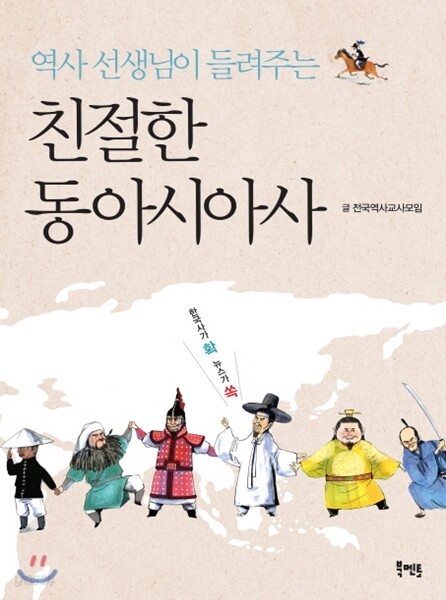
Additionally, cartoon illustrations, friendly and humorous characters, and maps that are expressed in an easy and fun way also help with understanding.
The process of understanding and deeply exploring historical causality based on diverse sources will greatly assist students in developing an integrated understanding of East Asian history from their own perspectives.
GOODS SPECIFICS
- Date of publication: March 24, 2017
- Page count, weight, size: 256 pages | 517g | 176*235*13mm
- ISBN13: 9788963192239
- ISBN 10: 8963192237
- KC Certification: Certification Type: Conformity Confirmation
You may also like
카테고리
korean


korean

![GQ KOREA Mark (Monthly): December [2025]](http://librairie.coreenne.fr/cdn/shop/files/8ef265dbbfbf186523ed75ba7319009d.jpg?v=1765340328&width=3840)


