

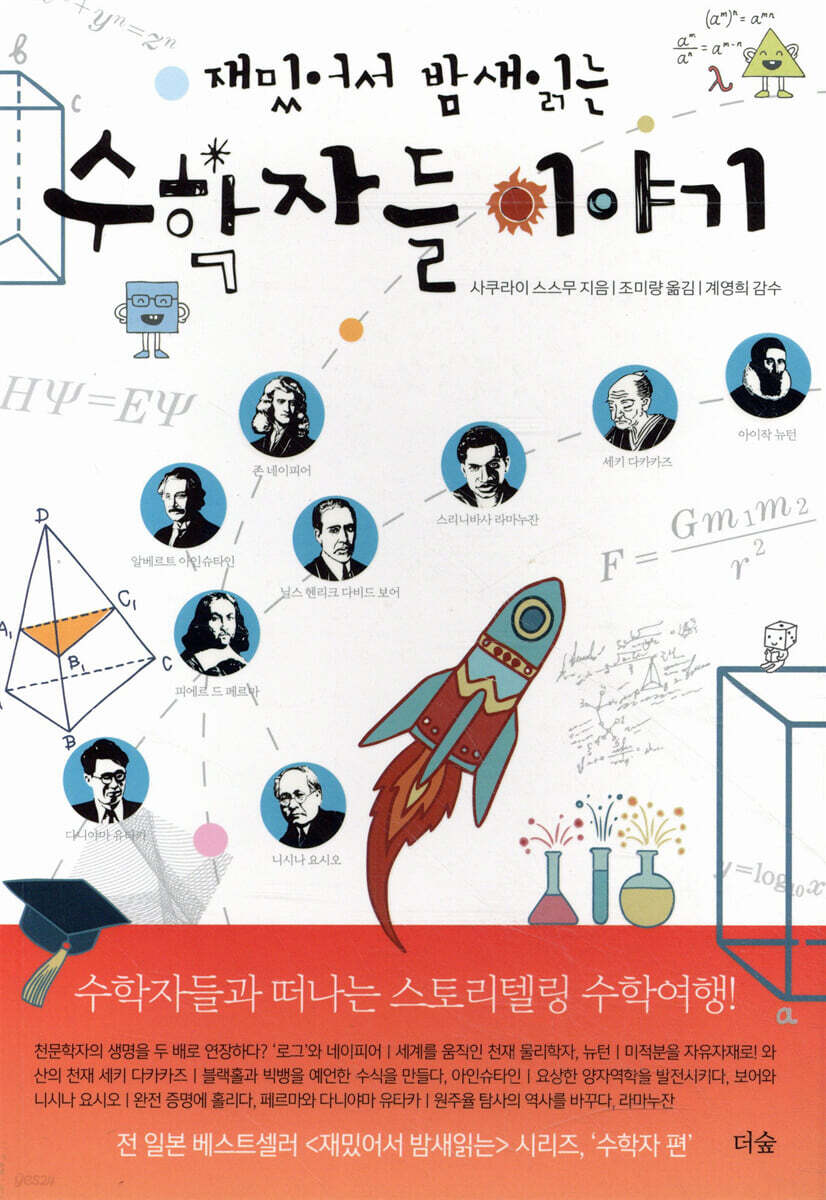
The story of mathematicians who read all night because it's fun
 |
Description
Book Introduction
The "Mathematician" series, a Japanese bestseller so fun you'll read it all night long.
Math is easy~ A storytelling math trip with mathematicians!
The "Mathematician's Edition" of the "So Fun You Can Read It All Night" series has been recognized in Japan, selling over 350,000 copies, and in Korea, it has been selected as an excellent science book by the Ministry of Science and ICT and as a recommended youth culture book by various organizations.
As Japan's first science navigator, the author, who teaches math and physics to teenagers in a fun and easy-to-understand way, has come to find readers who want to learn math in a fun way with an even more powerful 'storytelling math' following [Fun Math Stories You'll Read All Night] and [Super Fun Math Stories You'll Read All Night].
Recently, the phenomenon of 'science concentration' due to the employment crisis is accelerating.
As integrated education in the humanities and sciences is being discussed, mathematics has become a 'required subject' rather than a subject that can be given up on because it is difficult. However, many students still feel distant from mathematics.
However, this book, [The Story of Mathematicians Who Are So Interesting You'll Stay Up All Night Reading], will help young people shake off the burden of difficult mathematics by providing them with not only the fun of mathematics but also a wonderful sense of emotion through the dramatic lives of mathematicians hidden behind complex mathematical formulas.
In this book, the author not only explains important mathematical concepts covered in middle and high school textbooks, such as sequences, exponents and logarithms, equations and functions, trigonometric functions and differentiation and integration, and Fermat's theorem, but also tells the exciting story of how physics theories about the mysteries of the universe, such as gravity, black holes, and the Big Bang, began with 'mathematics', along with the lives of top scholars such as Napier, Newton, Einstein, and Bohr.
“It is inspiring to think of how many explorers have raced to discover and perfectly prove just one formula,” says the author. Let’s embark on a fun-filled storytelling math journey with the author.
Math is easy~ A storytelling math trip with mathematicians!
The "Mathematician's Edition" of the "So Fun You Can Read It All Night" series has been recognized in Japan, selling over 350,000 copies, and in Korea, it has been selected as an excellent science book by the Ministry of Science and ICT and as a recommended youth culture book by various organizations.
As Japan's first science navigator, the author, who teaches math and physics to teenagers in a fun and easy-to-understand way, has come to find readers who want to learn math in a fun way with an even more powerful 'storytelling math' following [Fun Math Stories You'll Read All Night] and [Super Fun Math Stories You'll Read All Night].
Recently, the phenomenon of 'science concentration' due to the employment crisis is accelerating.
As integrated education in the humanities and sciences is being discussed, mathematics has become a 'required subject' rather than a subject that can be given up on because it is difficult. However, many students still feel distant from mathematics.
However, this book, [The Story of Mathematicians Who Are So Interesting You'll Stay Up All Night Reading], will help young people shake off the burden of difficult mathematics by providing them with not only the fun of mathematics but also a wonderful sense of emotion through the dramatic lives of mathematicians hidden behind complex mathematical formulas.
In this book, the author not only explains important mathematical concepts covered in middle and high school textbooks, such as sequences, exponents and logarithms, equations and functions, trigonometric functions and differentiation and integration, and Fermat's theorem, but also tells the exciting story of how physics theories about the mysteries of the universe, such as gravity, black holes, and the Big Bang, began with 'mathematics', along with the lives of top scholars such as Napier, Newton, Einstein, and Bohr.
“It is inspiring to think of how many explorers have raced to discover and perfectly prove just one formula,” says the author. Let’s embark on a fun-filled storytelling math journey with the author.
- You can preview some of the book's contents.
Preview
index
preface
Reviewer's note
Chapter 1.
Napier: The drama surrounding the log that saved many lives.
An emotional experience hidden in logarithms / A story that began in 16th-century Scotland / Confronting the world of absurd calculations / Using logarithms makes multiplication a little easier / Logarithms that doubled the life of an astronomer / A man who spent a third of his life calculating / The true meaning of 'wonderful' in the book title / Napier who faced 'infinity' head-on / Napier's logarithms that were not understood / The birth of the common logarithm 'y=log10X' / Logarithms, the sacred land of mankind / Why is Euler's 'e' called Napier's number / Are logarithms implanted in humans? / Logarithms that created many technologically advanced countries
Chapter 2.
Newton: The genius physicist who still moves the world
Newton's 'Two Miraculous Years' / Finding the Area of a Graph / The 'Master of Calculation' Who Calculated 50 Digits by Hand / What Newton and Seki Takakazu Have in Common / 'Newton of Differentiation' and 'Leibniz of Integration' / Unraveling Celestial Motion / Is a Circle a Straight Line!? / Why Does Circular Motion Occur? / Cars and Airplanes Are Both Explained by F=ma / Is Light a 'Wave' or a 'Particle'?
Chapter 3.
Seki Takakazu: A genius of Wasan who mastered calculus.
Were math books bestsellers in the Edo period? / Discovering Bernoulli's numbers before Bernoulli himself / Solving equations of degree 61! / Why "maniacs" around the world continue to challenge themselves / The Edo environment that supported Wasan / The inherited "Sekiryu" Wasan lineage / Wasan's soil is beautiful yet rugged
Chapter 4.
Einstein: The Equation That Predicted Black Holes and the Big Bang
Condensing the mysteries of the universe into just three words / Why I was fascinated by Einstein / Special theory of relativity: Time can both expand and contract / General theory of relativity, explaining gravity and universal gravitation / The theory of relativity that proved the existence of black holes / Einstein's theory applied to our daily lives / Why was I disappointed with the Nobel Prize? / What Einstein taught me
Chapter 5.
Bohr and Yoshio Nishina: The Scientists Who Developed Quantum Mechanics
A cat becomes a zombie!? / The bizarre 'Copenhagen interpretation' / The function 'Ψ' that creates 'existence' / What does the 'psi group' do? / What Einstein never acknowledged / The 'EPR' paradox that predicted the future / Creating a currency that can never be stolen / A society created by quantum teleportation / A Japanese scientist who participated in Bohr's research / The 'world-class Bohr' visits Japan / The long-awaited large-scale cyclotron has been completed, but... / The achievements of Yoshio Nishina, who led Japanese physics
Chapter 6.
Fermat, Yutaka Taniyama: Mathematicians Obsessed with Complete Proofs of Super-Difficult Problems
The ultimate baton given by God to futile humans / Several theorems written in the margins / The Taniyama-Shimura conjecture that astonished mathematicians around the world / If Taniyama is right, Fermat is right too / The wondrous world of numbers revealed by the zeta function / The death of genius mathematician Yutaka Taniyama
Chapter 7.
Ramanujan: The Beautiful Formula and the Story of Pi
Meeting Ramanujan / My Only Interest is Mathematics / Meeting Hardy / Ramanujan's Formula for Modern Life / Calculating at Amazing Speed / Ramanujan Who Changed the History of Pi Exploration / Ramanujan and His Formula Bringing Joy
Conclusion
Reviewer's note
Chapter 1.
Napier: The drama surrounding the log that saved many lives.
An emotional experience hidden in logarithms / A story that began in 16th-century Scotland / Confronting the world of absurd calculations / Using logarithms makes multiplication a little easier / Logarithms that doubled the life of an astronomer / A man who spent a third of his life calculating / The true meaning of 'wonderful' in the book title / Napier who faced 'infinity' head-on / Napier's logarithms that were not understood / The birth of the common logarithm 'y=log10X' / Logarithms, the sacred land of mankind / Why is Euler's 'e' called Napier's number / Are logarithms implanted in humans? / Logarithms that created many technologically advanced countries
Chapter 2.
Newton: The genius physicist who still moves the world
Newton's 'Two Miraculous Years' / Finding the Area of a Graph / The 'Master of Calculation' Who Calculated 50 Digits by Hand / What Newton and Seki Takakazu Have in Common / 'Newton of Differentiation' and 'Leibniz of Integration' / Unraveling Celestial Motion / Is a Circle a Straight Line!? / Why Does Circular Motion Occur? / Cars and Airplanes Are Both Explained by F=ma / Is Light a 'Wave' or a 'Particle'?
Chapter 3.
Seki Takakazu: A genius of Wasan who mastered calculus.
Were math books bestsellers in the Edo period? / Discovering Bernoulli's numbers before Bernoulli himself / Solving equations of degree 61! / Why "maniacs" around the world continue to challenge themselves / The Edo environment that supported Wasan / The inherited "Sekiryu" Wasan lineage / Wasan's soil is beautiful yet rugged
Chapter 4.
Einstein: The Equation That Predicted Black Holes and the Big Bang
Condensing the mysteries of the universe into just three words / Why I was fascinated by Einstein / Special theory of relativity: Time can both expand and contract / General theory of relativity, explaining gravity and universal gravitation / The theory of relativity that proved the existence of black holes / Einstein's theory applied to our daily lives / Why was I disappointed with the Nobel Prize? / What Einstein taught me
Chapter 5.
Bohr and Yoshio Nishina: The Scientists Who Developed Quantum Mechanics
A cat becomes a zombie!? / The bizarre 'Copenhagen interpretation' / The function 'Ψ' that creates 'existence' / What does the 'psi group' do? / What Einstein never acknowledged / The 'EPR' paradox that predicted the future / Creating a currency that can never be stolen / A society created by quantum teleportation / A Japanese scientist who participated in Bohr's research / The 'world-class Bohr' visits Japan / The long-awaited large-scale cyclotron has been completed, but... / The achievements of Yoshio Nishina, who led Japanese physics
Chapter 6.
Fermat, Yutaka Taniyama: Mathematicians Obsessed with Complete Proofs of Super-Difficult Problems
The ultimate baton given by God to futile humans / Several theorems written in the margins / The Taniyama-Shimura conjecture that astonished mathematicians around the world / If Taniyama is right, Fermat is right too / The wondrous world of numbers revealed by the zeta function / The death of genius mathematician Yutaka Taniyama
Chapter 7.
Ramanujan: The Beautiful Formula and the Story of Pi
Meeting Ramanujan / My Only Interest is Mathematics / Meeting Hardy / Ramanujan's Formula for Modern Life / Calculating at Amazing Speed / Ramanujan Who Changed the History of Pi Exploration / Ramanujan and His Formula Bringing Joy
Conclusion
Detailed image
Into the book
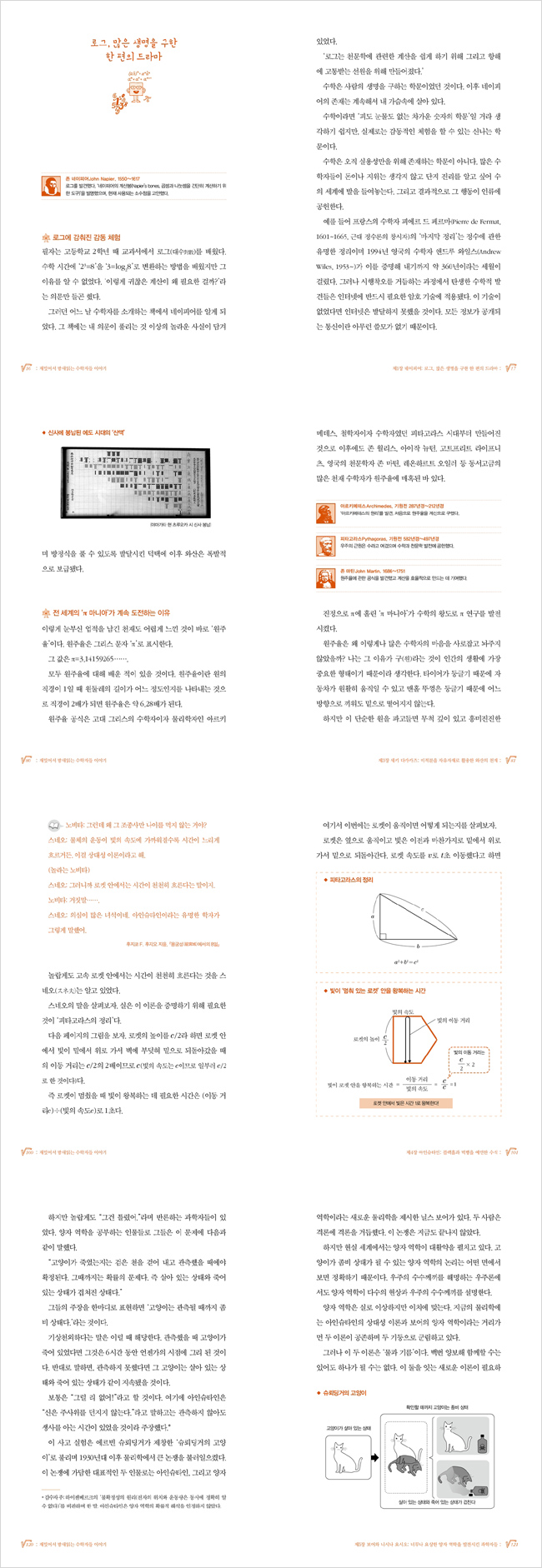
The 16th century was a time of war in Europe, but it was also an age of exploration.
At that time, the issue of celestial ephemeris and maritime accidents was a hot topic at the observatory.
An 'ephemeris' is a calendar that predicts the movements of stars.
At that time, there were no calculators or other things, so the ephemeris, which required extensive calculations, was not very accurate.
For this reason, sailors sailing far away often found themselves in trouble.
They observed the exact time and the positions of the stars and checked this with an ephemeris to roughly determine their location.
If the ephemeris was not accurate, it was easy to lose track of one's position and end up heading in the wrong direction.
This meant shipwreck, that is, death.
Napier must have been determined to see astronomers struggling with calculations.
"Yes! I'll figure out a way to easily calculate ephemeris."
At the time, Napier was 44 years old.
If you were 44 years old 400 years ago, it would be the last years of your life.
At an age when you don't know when you'll die, you're trying to step into the world of absurd calculations.
And that too alone.
This fact alone is enough to make one unable to hide one's surprise.
(…) ‘1000×100’ can be answered by adding the 0s of ‘1000’ and ‘100’ and writing them out as 1’00000’.
In other words, we think of '1000' as the cube of '10' and '100' as the square of '10', and then we derive the answer by adding 3 and 2 of the cube and square.
Napier took note of this law of numbers and established the concept of logarithms.
What Napier was trying to do was, simply put, create a structure (algorithm) that would turn multiplication into addition.
After hearing the explanation so far, some of you may have thought, “That’s not an exponential law.”
However, in Napier's time, exponent notation did not exist and its concept was not clear.
This is why he is a great genius.
Napier discovered logarithms without exponents and organized them into a single system.
-[Napier: Rogue, a drama that saved many lives]
During the Edo period, Japan's independently developed landscape painting, "Wasan," became very popular among the common people, and people of all ages, from adults to children, enjoyed it as a hobby.
A Wasanga named Yoshida Mitsuyoshi studied Chinese mathematics books and published the first comprehensive arithmetic book in Japan, the Jinkyokki, in 1627.
This book was full of practical problems that were helpful in everyday life, such as how to use an abacus, the measurement methods needed to find the area or volume of a field, the oil division method that considers how to divide oil when dividing it into doe (for example, when you need to make 5 doe from 10 doe of oil using only 3 doe containers, the arithmetic method that provides the answer through three or four processes), and the math problem of calculating the number of cranes and turtles (the math problem of finding out how many each crane and turtle are by finding out the total sum of the cranes and turtles and the sum of their legs).
Therefore, it was a bestseller at the time, so much so that 'one copy per household' was usually kept on hand.
The book was so popular that pirated copies were circulated, and continued to sell until the end of the Edo period.
Wasan was very popular among the common people.
Here, Yoshida presents a difficult problem in this book as a 'problem' (a problem presented in a math textbook for future generations to find the answer) and challenges the reader by saying, "Try solving it."
When a Wasan enthusiast in the village read this and challenged the problem and found the answer, he would write the answer on a clean wooden board and offer it to the shrine, as if responding, “How about it? I solved it.”
This is the beginning of the 'San-Ak (traditional Japanese math puzzle) dedication'.
- From [Seki Takakazu: The genius of Wasan who freely used calculus]
Einstein published the 'special theory of relativity' in 1905, and the 'general theory of relativity' ten years later, in 1915 and 1916.
In his first special theory of relativity, Einstein explained that the 'speed of light (the speed of light in a vacuum, c = 299,792,458 meters/second)' is constant, and that time, weight, and length, which were known to be constant until then, are not necessarily constant.
Just as rubber stretches and contracts, time, weight, and length also increase and decrease.
Einstein said:
“Place your hand on a hot stove for one minute.
It will feel like an hour.
But when you sit with a beautiful woman for an hour, it feels like a minute.”
In other words, time is relative and time is perceived differently depending on the observer.
This is the core of the theory of relativity.
(…) For example, let’s say a person goes to a planet in a rocket traveling at 99% of the speed of light (since nothing travels faster than the speed of light) and returns after 10 years.
By the time he returned, about seven times as much time had passed, meaning the child who saw him off on Earth would have been 70 years older.
The child who saw me off has already become a grandfather.
This can actually happen.
The same thing applies to length and weight as well as time.
In the theory of relativity, the closer you get to the speed of light, the slower time passes.
-[Einstein: The formula that predicted black holes and the Big Bang]
At that time, the issue of celestial ephemeris and maritime accidents was a hot topic at the observatory.
An 'ephemeris' is a calendar that predicts the movements of stars.
At that time, there were no calculators or other things, so the ephemeris, which required extensive calculations, was not very accurate.
For this reason, sailors sailing far away often found themselves in trouble.
They observed the exact time and the positions of the stars and checked this with an ephemeris to roughly determine their location.
If the ephemeris was not accurate, it was easy to lose track of one's position and end up heading in the wrong direction.
This meant shipwreck, that is, death.
Napier must have been determined to see astronomers struggling with calculations.
"Yes! I'll figure out a way to easily calculate ephemeris."
At the time, Napier was 44 years old.
If you were 44 years old 400 years ago, it would be the last years of your life.
At an age when you don't know when you'll die, you're trying to step into the world of absurd calculations.
And that too alone.
This fact alone is enough to make one unable to hide one's surprise.
(…) ‘1000×100’ can be answered by adding the 0s of ‘1000’ and ‘100’ and writing them out as 1’00000’.
In other words, we think of '1000' as the cube of '10' and '100' as the square of '10', and then we derive the answer by adding 3 and 2 of the cube and square.
Napier took note of this law of numbers and established the concept of logarithms.
What Napier was trying to do was, simply put, create a structure (algorithm) that would turn multiplication into addition.
After hearing the explanation so far, some of you may have thought, “That’s not an exponential law.”
However, in Napier's time, exponent notation did not exist and its concept was not clear.
This is why he is a great genius.
Napier discovered logarithms without exponents and organized them into a single system.
-[Napier: Rogue, a drama that saved many lives]
During the Edo period, Japan's independently developed landscape painting, "Wasan," became very popular among the common people, and people of all ages, from adults to children, enjoyed it as a hobby.
A Wasanga named Yoshida Mitsuyoshi studied Chinese mathematics books and published the first comprehensive arithmetic book in Japan, the Jinkyokki, in 1627.
This book was full of practical problems that were helpful in everyday life, such as how to use an abacus, the measurement methods needed to find the area or volume of a field, the oil division method that considers how to divide oil when dividing it into doe (for example, when you need to make 5 doe from 10 doe of oil using only 3 doe containers, the arithmetic method that provides the answer through three or four processes), and the math problem of calculating the number of cranes and turtles (the math problem of finding out how many each crane and turtle are by finding out the total sum of the cranes and turtles and the sum of their legs).
Therefore, it was a bestseller at the time, so much so that 'one copy per household' was usually kept on hand.
The book was so popular that pirated copies were circulated, and continued to sell until the end of the Edo period.
Wasan was very popular among the common people.
Here, Yoshida presents a difficult problem in this book as a 'problem' (a problem presented in a math textbook for future generations to find the answer) and challenges the reader by saying, "Try solving it."
When a Wasan enthusiast in the village read this and challenged the problem and found the answer, he would write the answer on a clean wooden board and offer it to the shrine, as if responding, “How about it? I solved it.”
This is the beginning of the 'San-Ak (traditional Japanese math puzzle) dedication'.
- From [Seki Takakazu: The genius of Wasan who freely used calculus]
Einstein published the 'special theory of relativity' in 1905, and the 'general theory of relativity' ten years later, in 1915 and 1916.
In his first special theory of relativity, Einstein explained that the 'speed of light (the speed of light in a vacuum, c = 299,792,458 meters/second)' is constant, and that time, weight, and length, which were known to be constant until then, are not necessarily constant.
Just as rubber stretches and contracts, time, weight, and length also increase and decrease.
Einstein said:
“Place your hand on a hot stove for one minute.
It will feel like an hour.
But when you sit with a beautiful woman for an hour, it feels like a minute.”
In other words, time is relative and time is perceived differently depending on the observer.
This is the core of the theory of relativity.
(…) For example, let’s say a person goes to a planet in a rocket traveling at 99% of the speed of light (since nothing travels faster than the speed of light) and returns after 10 years.
By the time he returned, about seven times as much time had passed, meaning the child who saw him off on Earth would have been 70 years older.
The child who saw me off has already become a grandfather.
This can actually happen.
The same thing applies to length and weight as well as time.
In the theory of relativity, the closer you get to the speed of light, the slower time passes.
-[Einstein: The formula that predicted black holes and the Big Bang]
--- From the text
Publisher's Review
The "Mathematician" edition of the all-time Japanese bestseller "So Fun You'll Read It All Night" series has been released.
Math is easy~ A storytelling math trip with mathematicians!
The "Mathematician's Edition" of the "Fun to Read All Night" series, which has sold over 350,000 copies in Japan and has been recognized in Korea as an excellent science book certified by the Ministry of Science, ICT and Future Planning and as a recommended youth culture book by various organizations, has finally been published.
As Japan's first science navigator, the author, who teaches math and physics to teenagers in a fun and easy-to-understand way, has come to find readers who want to learn math in a fun way with an even more powerful 'storytelling math' following [Fun Math Stories You'll Read All Night] and [Super Fun Math Stories You'll Read All Night].
Recently, the phenomenon of 'science concentration' due to the employment crisis is accelerating.
As integrated education in the humanities and sciences is being discussed, mathematics has become a 'required subject' rather than a subject that can be given up on because it is difficult. However, many students still feel distant from mathematics.
However, this book, [The Story of Mathematicians Who Are So Interesting You'll Stay Up All Night Reading], will help young people shake off the burden of difficult mathematics by providing them with not only the fun of mathematics but also a wonderful sense of emotion through the dramatic lives of mathematicians hidden behind complex mathematical formulas.
In this book, the author not only explains important mathematical concepts covered in middle and high school textbooks, such as sequences, exponents and logarithms, equations and functions, trigonometric functions and differentiation and integration, and Fermat's theorem, but also tells the exciting story of how physics theories about the mysteries of the universe, such as gravity, black holes, and the Big Bang, began with 'mathematics', along with the lives of top scholars such as Napier, Newton, Einstein, and Bohr.
“It is inspiring to think of how many explorers have raced to discover and perfectly prove just one formula,” says the author. Let’s embark on a fun-filled storytelling math journey with the author.
Knowing mathematicians makes math easier and physics more visible.
Genius scholars who dedicated their lives to proving formulas, uncovering the secrets of science and uncovering the mysteries of the universe!
This book introduces the history of mathematics through scholars who purely pursued the truth of mathematics.
As we read the interesting stories of how the mathematical formulas we are familiar with came into being and how they were completed by the hands of mathematicians, we often discover the beauty of formulas in the world of infinite numbers.
But knowing mathematicians isn't just about knowing mathematics.
An understanding of mathematics also provides background and basic knowledge about 'physics', which plays an important role in solving the mysteries of the universe.
The story of Napier, who invented the 'logarithm' after 20 years of immersion in calculations, helping sailors by enabling easy and accurate measurement of celestial ephemeris, or Newton, who discovered the secrets of gravity and motion through the law of universal gravitation, shows how closely mathematics is related to science.
Additionally, Einstein's theory of relativity, which predicted black holes and the Big Bang, and the quantum mechanics theories of Niels Bohr, Psy, Yoshio Nishina, and Paul Dirac suggest that mathematics is an important starting point for physics.
You can also experience practical and playful mathematics that has been passed down from the past through the famous Japanese arithmetic method, "Wasan," and the traditional math puzzle, "Sanak Bonnap." You can also approach quantum mechanics in an easy and fun way through Schrödinger's (zombie) cat theory, and you can fully exercise your scientific imagination by watching the inevitable theoretical debate between Einstein and Niels Bohr.
You can immerse yourself in the fun of mathematics by naturally learning the concept of 'logarithm', which was completed through Napier-Briggs-Euler, etc., or you can be moved by the close bond between Ramanujan-Hardy and Napier-Briggs, who were the only ones to recognize the formula that you had worked so hard to prove.
The challenging and adventurous lives of these genius scholars, captivated by the grandeur and fun of mathematics and its eternity, will lead young people into the mysterious world of mathematics and the mystical sciences.
Mathematics is a 'never-ending story'!
It's more fun and easier to read as a story!
Although storytelling-based mathematics has been introduced in line with educational policy, textbooks are still full of boring and difficult mathematics.
Teenagers lose interest in math, which is rapidly becoming more difficult, and they do not feel aptitude for it.
But the author counters by asking whether saying “I hate math” doesn’t mean “I hate the way math is taught.”
“Mathematics is a story.
But the textbook doesn't explain this.
In textbooks, everything is so sudden.
When you advance to middle school, letters that weren't there in elementary school appear, and equations, functions, exponents, and trigonometric ratios appear. When you enter high school, sequences, logarithms, trigonometric functions, differentiation, and integration appear like a typhoon without any warning and overwhelm everyone.
Even though I endured the unexpected typhoon, which drenched my whole body, heavy rain and strong winds continued to pour down.
(…)
Mathematics is the crystallization of wisdom, the greatest intellectual asset of mankind, which has been painstakingly perfected.
Mathematics contains the past, present, and future.
The grand story of mathematics contains the astonishing truth that humanity has, one after another, inherited and acquired treasures that no human could possibly possess: 'infinity' and 'eternity.'
Wouldn't it be truly absurd if such interesting stories were included in textbooks only to be disguised as boring?
Math is not a subject that can be learned by force.
Once you miss the timing, it is not easy to catch up.
That is why it is important to be able to have an 'interest' in mathematics from the beginning.
In that sense, this book will provide teachers with a new educational direction and will serve as an excellent integrated textbook on mathematics and physics for young people.
Math is easy~ A storytelling math trip with mathematicians!
The "Mathematician's Edition" of the "Fun to Read All Night" series, which has sold over 350,000 copies in Japan and has been recognized in Korea as an excellent science book certified by the Ministry of Science, ICT and Future Planning and as a recommended youth culture book by various organizations, has finally been published.
As Japan's first science navigator, the author, who teaches math and physics to teenagers in a fun and easy-to-understand way, has come to find readers who want to learn math in a fun way with an even more powerful 'storytelling math' following [Fun Math Stories You'll Read All Night] and [Super Fun Math Stories You'll Read All Night].
Recently, the phenomenon of 'science concentration' due to the employment crisis is accelerating.
As integrated education in the humanities and sciences is being discussed, mathematics has become a 'required subject' rather than a subject that can be given up on because it is difficult. However, many students still feel distant from mathematics.
However, this book, [The Story of Mathematicians Who Are So Interesting You'll Stay Up All Night Reading], will help young people shake off the burden of difficult mathematics by providing them with not only the fun of mathematics but also a wonderful sense of emotion through the dramatic lives of mathematicians hidden behind complex mathematical formulas.
In this book, the author not only explains important mathematical concepts covered in middle and high school textbooks, such as sequences, exponents and logarithms, equations and functions, trigonometric functions and differentiation and integration, and Fermat's theorem, but also tells the exciting story of how physics theories about the mysteries of the universe, such as gravity, black holes, and the Big Bang, began with 'mathematics', along with the lives of top scholars such as Napier, Newton, Einstein, and Bohr.
“It is inspiring to think of how many explorers have raced to discover and perfectly prove just one formula,” says the author. Let’s embark on a fun-filled storytelling math journey with the author.
Knowing mathematicians makes math easier and physics more visible.
Genius scholars who dedicated their lives to proving formulas, uncovering the secrets of science and uncovering the mysteries of the universe!
This book introduces the history of mathematics through scholars who purely pursued the truth of mathematics.
As we read the interesting stories of how the mathematical formulas we are familiar with came into being and how they were completed by the hands of mathematicians, we often discover the beauty of formulas in the world of infinite numbers.
But knowing mathematicians isn't just about knowing mathematics.
An understanding of mathematics also provides background and basic knowledge about 'physics', which plays an important role in solving the mysteries of the universe.
The story of Napier, who invented the 'logarithm' after 20 years of immersion in calculations, helping sailors by enabling easy and accurate measurement of celestial ephemeris, or Newton, who discovered the secrets of gravity and motion through the law of universal gravitation, shows how closely mathematics is related to science.
Additionally, Einstein's theory of relativity, which predicted black holes and the Big Bang, and the quantum mechanics theories of Niels Bohr, Psy, Yoshio Nishina, and Paul Dirac suggest that mathematics is an important starting point for physics.
You can also experience practical and playful mathematics that has been passed down from the past through the famous Japanese arithmetic method, "Wasan," and the traditional math puzzle, "Sanak Bonnap." You can also approach quantum mechanics in an easy and fun way through Schrödinger's (zombie) cat theory, and you can fully exercise your scientific imagination by watching the inevitable theoretical debate between Einstein and Niels Bohr.
You can immerse yourself in the fun of mathematics by naturally learning the concept of 'logarithm', which was completed through Napier-Briggs-Euler, etc., or you can be moved by the close bond between Ramanujan-Hardy and Napier-Briggs, who were the only ones to recognize the formula that you had worked so hard to prove.
The challenging and adventurous lives of these genius scholars, captivated by the grandeur and fun of mathematics and its eternity, will lead young people into the mysterious world of mathematics and the mystical sciences.
Mathematics is a 'never-ending story'!
It's more fun and easier to read as a story!
Although storytelling-based mathematics has been introduced in line with educational policy, textbooks are still full of boring and difficult mathematics.
Teenagers lose interest in math, which is rapidly becoming more difficult, and they do not feel aptitude for it.
But the author counters by asking whether saying “I hate math” doesn’t mean “I hate the way math is taught.”
“Mathematics is a story.
But the textbook doesn't explain this.
In textbooks, everything is so sudden.
When you advance to middle school, letters that weren't there in elementary school appear, and equations, functions, exponents, and trigonometric ratios appear. When you enter high school, sequences, logarithms, trigonometric functions, differentiation, and integration appear like a typhoon without any warning and overwhelm everyone.
Even though I endured the unexpected typhoon, which drenched my whole body, heavy rain and strong winds continued to pour down.
(…)
Mathematics is the crystallization of wisdom, the greatest intellectual asset of mankind, which has been painstakingly perfected.
Mathematics contains the past, present, and future.
The grand story of mathematics contains the astonishing truth that humanity has, one after another, inherited and acquired treasures that no human could possibly possess: 'infinity' and 'eternity.'
Wouldn't it be truly absurd if such interesting stories were included in textbooks only to be disguised as boring?
Math is not a subject that can be learned by force.
Once you miss the timing, it is not easy to catch up.
That is why it is important to be able to have an 'interest' in mathematics from the beginning.
In that sense, this book will provide teachers with a new educational direction and will serve as an excellent integrated textbook on mathematics and physics for young people.
GOODS SPECIFICS
- Date of issue: April 20, 2015
- Page count, weight, size: 208 pages | 332g | 145*210*20mm
- ISBN13: 9788994418896
- ISBN10: 899441889X
You may also like
카테고리
korean


korean

![GQ KOREA Mark (Monthly): December [2025]](http://librairie.coreenne.fr/cdn/shop/files/8ef265dbbfbf186523ed75ba7319009d.jpg?v=1765340328&width=3840)


