

Life science stories that are so fun you'll read them all night long
 |
Description
Book Introduction
The [So Fun You'll Read It All Night] series, which sold over 350,000 copies in Japan, now has a life science edition!
Clearly explaining the complex and vast scope of life science through the principles of 'evolution'.
There are countless living things on Earth, and the biological phenomena that follow are also infinite.
That's why many students believe that life science, which deals with living things and biological phenomena, is so vast and complex that it is "dizzyingly" difficult.
However, this book explains that life science is a discipline that starts with the topic of “How” and explains “Why”, and based on these two questions, it organizes the vast field of life science in a clear manner through the principle of “evolution.”
“Life science is not simply a collection of miscellaneous knowledge that must be memorized.
It is a comprehensive phenomenon that is supported by the principles of biology, chemistry, and evolution and is established based on their laws.
Therefore, if you understand that process and know why it happened that way, the phenomena that living things show will be easily imprinted in your head,” he explained. This book explains life science in a friendly and easy-to-understand way through the theory of evolution rather than listing phenomena, and systematically divides and explains things like cells and organs of numerous living things, helping you easily memorize things that you inevitably have to memorize through understanding.
Clearly explaining the complex and vast scope of life science through the principles of 'evolution'.
There are countless living things on Earth, and the biological phenomena that follow are also infinite.
That's why many students believe that life science, which deals with living things and biological phenomena, is so vast and complex that it is "dizzyingly" difficult.
However, this book explains that life science is a discipline that starts with the topic of “How” and explains “Why”, and based on these two questions, it organizes the vast field of life science in a clear manner through the principle of “evolution.”
“Life science is not simply a collection of miscellaneous knowledge that must be memorized.
It is a comprehensive phenomenon that is supported by the principles of biology, chemistry, and evolution and is established based on their laws.
Therefore, if you understand that process and know why it happened that way, the phenomena that living things show will be easily imprinted in your head,” he explained. This book explains life science in a friendly and easy-to-understand way through the theory of evolution rather than listing phenomena, and systematically divides and explains things like cells and organs of numerous living things, helping you easily memorize things that you inevitably have to memorize through understanding.
- You can preview some of the book's contents.
Preview
index
Introduction Biological phenomena have a reason.
Reviewer's note
PART 1 Living things act rationally.
The birth of life is a single miracle
What is not conveyed remains
Living things are rational
Why is DNA a double helix?
DNA Story 1: Genetic Information is Doubly Protected
DNA Story 2: Base Pairs and the "Ladder Theory"
DNA Story 3: Why Base Pairing Is Hydrogen Bonding
Why did genetic material become DNA?
Catalytic function of enzymes using proteins
How were cells born?
Chloroplasts and mitochondria entering the cell
A genetic war where cooperation and confrontation coexist
Creating Energy 1 - Why Do Enzyme Reactions Occur in Water?
Energy Generation 2: Why Is the Electron Transport Chain Anchor to the Membrane?
PART 2 Life Science Stories You'll Want to Tell Someone
Why are plants green?
Cells cooperate with each other
Why do ants and bees cooperate?
Why do only animals have hearts?
All cells in a multicellular organism have the same genes
Is it more advantageous to raise a younger sister than a daughter?
The birth of a superindividual that seeks to improve group efficiency
Even cells without wisdom can create tissues!?
PART 3 Life Science: Fun to Read All Night
The Secret of Low-Intelligence Ants Making the Best Choices
The brain and ants are similar
Both humans and bees become depressed
The Life Science of Genetics, Probability, and Chance
The story of heredity according to the principle of separation and combination
Why sex emerged
Why do males and females exist?
Generational shift, nuclear shift, and aliens?
A battle between the sexes to gain more profit
A creature in which males give birth to males and females give birth to females
Should I fight to survive or should I run away?
Conclusion: Understand the principles that govern biological phenomena.
Reviewer's note
PART 1 Living things act rationally.
The birth of life is a single miracle
What is not conveyed remains
Living things are rational
Why is DNA a double helix?
DNA Story 1: Genetic Information is Doubly Protected
DNA Story 2: Base Pairs and the "Ladder Theory"
DNA Story 3: Why Base Pairing Is Hydrogen Bonding
Why did genetic material become DNA?
Catalytic function of enzymes using proteins
How were cells born?
Chloroplasts and mitochondria entering the cell
A genetic war where cooperation and confrontation coexist
Creating Energy 1 - Why Do Enzyme Reactions Occur in Water?
Energy Generation 2: Why Is the Electron Transport Chain Anchor to the Membrane?
PART 2 Life Science Stories You'll Want to Tell Someone
Why are plants green?
Cells cooperate with each other
Why do ants and bees cooperate?
Why do only animals have hearts?
All cells in a multicellular organism have the same genes
Is it more advantageous to raise a younger sister than a daughter?
The birth of a superindividual that seeks to improve group efficiency
Even cells without wisdom can create tissues!?
PART 3 Life Science: Fun to Read All Night
The Secret of Low-Intelligence Ants Making the Best Choices
The brain and ants are similar
Both humans and bees become depressed
The Life Science of Genetics, Probability, and Chance
The story of heredity according to the principle of separation and combination
Why sex emerged
Why do males and females exist?
Generational shift, nuclear shift, and aliens?
A battle between the sexes to gain more profit
A creature in which males give birth to males and females give birth to females
Should I fight to survive or should I run away?
Conclusion: Understand the principles that govern biological phenomena.
Detailed image
Into the book
Living things have not been multicellular and have complex organs and control systems like humans today.
The first life forms were much simpler in structure than modern cells.
Then, through the process of evolution, creatures with complex systems gradually emerged, and the diverse biota of today were born.
Even though organisms could have evolved into more rational forms, they acquired new properties by exploiting previously existing systems, which now seem irrational.
It changed its appearance depending on the situation.
Therefore, to understand the appearance of current living things, it is good to know the history of past biological evolution.
If we organize life science from this perspective, we can 'understand' biological phenomena rather than 'memorize' them.
Just as puns are easier to remember if they have meaning, understanding life sciences will be much easier if you organize your thoughts based on why biological phenomena happen the way they do.
- From [Introduction_There is a reason for biological phenomena]
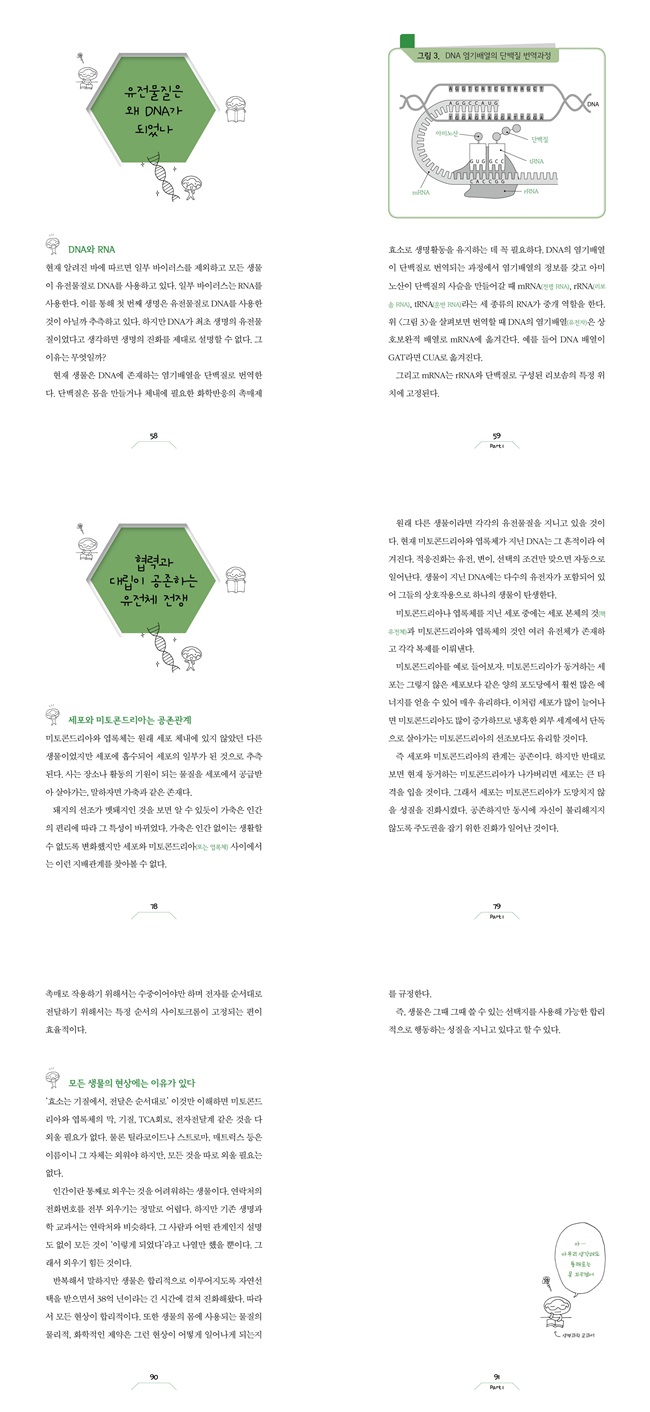
There is one more reason why genetic information in DNA is more securely protected than in RNA.
This is the existence of a genetic cap unique to DNA. DNA has a double helix structure, and because the bases are complementary (AT, GC combinations), essentially the same information exists in both chains.
Although only one strand of the gene is decoded and translated into a protein, the cap also contains the same information.
When DNA is translated, the two strands unwind and the sequence of one side is decoded.
Even if the decoded chain is lost at this time, if the cap portion remains, the original information can be restored through it.
This is not possible with a single strand of RNA.
Genetic information, the blueprint of life, is doubly protected using DNA as shown above.
- From [DNA Story ① - Genetic information is doubly protected]
Do animals also experience depression?
Several interesting research results have been published on this proposition.
First, let's talk about crayfish.
Male crayfish fight with other males over females, and the losing crayfish tries not to fight for a while.
At this time, when the crayfish's brain was examined, it was confirmed that the secretion of neurotransmitters was low.
The physiological state of the brain of crayfish that had lost motivation was similar to that of people who were depressed.
It can be interpreted as being stressed by the truth and falling into a kind of depressed state.
And it has also been found that when antidepressants are administered to depressed crayfish, they start fighting again. () A recent study on fish reported that when antidepressants flowed in the river, the fish behaved boldly.
Perhaps the amount of neurotransmitters secreted was greater than normal, causing an excited state like that of a human.
Since excitement clearly reduces survival rates, depression may have the opposite effect of increasing survival rates.
This also shows that the functions of the human mind have evolved and been inherited from our ancestors who first had a brain.
If so, it is clear that depression also has some meaningful function.
- From [Humans and Bees Get Depressed]
The first life forms were much simpler in structure than modern cells.
Then, through the process of evolution, creatures with complex systems gradually emerged, and the diverse biota of today were born.
Even though organisms could have evolved into more rational forms, they acquired new properties by exploiting previously existing systems, which now seem irrational.
It changed its appearance depending on the situation.
Therefore, to understand the appearance of current living things, it is good to know the history of past biological evolution.
If we organize life science from this perspective, we can 'understand' biological phenomena rather than 'memorize' them.
Just as puns are easier to remember if they have meaning, understanding life sciences will be much easier if you organize your thoughts based on why biological phenomena happen the way they do.
- From [Introduction_There is a reason for biological phenomena]
There is one more reason why genetic information in DNA is more securely protected than in RNA.
This is the existence of a genetic cap unique to DNA. DNA has a double helix structure, and because the bases are complementary (AT, GC combinations), essentially the same information exists in both chains.
Although only one strand of the gene is decoded and translated into a protein, the cap also contains the same information.
When DNA is translated, the two strands unwind and the sequence of one side is decoded.
Even if the decoded chain is lost at this time, if the cap portion remains, the original information can be restored through it.
This is not possible with a single strand of RNA.
Genetic information, the blueprint of life, is doubly protected using DNA as shown above.
- From [DNA Story ① - Genetic information is doubly protected]
Do animals also experience depression?
Several interesting research results have been published on this proposition.
First, let's talk about crayfish.
Male crayfish fight with other males over females, and the losing crayfish tries not to fight for a while.
At this time, when the crayfish's brain was examined, it was confirmed that the secretion of neurotransmitters was low.
The physiological state of the brain of crayfish that had lost motivation was similar to that of people who were depressed.
It can be interpreted as being stressed by the truth and falling into a kind of depressed state.
And it has also been found that when antidepressants are administered to depressed crayfish, they start fighting again. () A recent study on fish reported that when antidepressants flowed in the river, the fish behaved boldly.
Perhaps the amount of neurotransmitters secreted was greater than normal, causing an excited state like that of a human.
Since excitement clearly reduces survival rates, depression may have the opposite effect of increasing survival rates.
This also shows that the functions of the human mind have evolved and been inherited from our ancestors who first had a brain.
If so, it is clear that depression also has some meaningful function.
- From [Humans and Bees Get Depressed]
--- From the text
Publisher's Review
The [So Fun You'll Read It All Night] series, which sold over 350,000 copies in Japan, now has a life science edition!
Clearly explaining the complex and vast scope of life science through the principles of 'evolution'.
The [Fun to Read All Night] series, which has sold over 350,000 copies in Japan and has been selected as an excellent science book and recommended book in Korea, has been well-received by parents and teenagers, and has published a life science edition.
This series, which promotes "friendly and fun science," has now introduced life sciences following chemistry, physics, and earth sciences, finally covering all subjects in the field of scientific inquiry.
This book, written by Eisuke Hasegawa, a Japanese evolutionary biologist and bestselling author, explains the basic principles and principles of life science in an easy-to-understand manner, and is expected to be a useful science textbook for young people who find science difficult to study.
There are countless living things on Earth, and the biological phenomena that follow are also infinite.
That's why many students believe that life science, which deals with living things and biological phenomena, is so vast and complex that it is "dizzyingly" difficult.
However, this book explains that life science is a discipline that starts with the topic of “How” and explains “Why”, and based on these two questions, it organizes the vast field of life science in a clear manner through the principle of “evolution.”
“Life science is not simply a collection of miscellaneous knowledge that must be memorized.
It is a comprehensive phenomenon that is supported by the principles of biology, chemistry, and evolution and is established based on their laws.
Therefore, if you understand that process and know why it happened that way, the phenomena that living things show will be easily imprinted in your head,” he explained. This book explains life science in a friendly and easy-to-understand way through the theory of evolution rather than listing phenomena, and systematically divides and explains things like cells and organs of numerous living things, helping you easily memorize things that you inevitably have to memorize through understanding.
Pikachu is a metamorphosis, not an evolution? The genetic information wasn't originally contained in the DNA?
Transforming the vaguely perceived life sciences into a friendly and fun story!
Although it is said that life science can be explained through 'evolution', 'evolution' is not an easy subject to approach either.
So the author explains evolution and biological phenomena in an interesting way through history, examples, and analogies.
Before explaining the concept of evolution, the animation [Pokemon] explains the difference between evolution and metamorphosis through 'evolution into Pichu, Pikachu, and Raichu', which arouses interest in studying science and instills the concept of evolution in the mind so that it remains firmly in the mind.
Additionally, the conditions and process of evolution, such as the transmission of genetic information (genetics), the non-uniformity of information (mutation), and the differences in reproductive rates (selection), are explained and understood by comparing them to the 'whispering game'.
After this solid explanation of evolution, the book begins to clearly organize the vast array of biological phenomena.
It explains life science knowledge that students find difficult in textbooks, such as why and how living things transmit genetic information through DNA, the significance and role of organs in higher organisms, and the characteristics of bryophytes and ferns, from the perspective of evolution.
Next, based on the purpose of evolution, which is to 'pass on genetic information to future generations most efficiently,' it explains how the first living organisms became higher organisms of today, and also clearly explains the biological phenomena of various living organisms.
By explaining evolution and the resulting life phenomena through causal relationships, it enables one to naturally acquire the mechanisms of life science.
The final chapter in the scientific exploration field, following chemistry, physics, and earth science.
Minimize memorization and instill interest in science studies.
Once you understand the principles of life science, the infinite biological phenomena on Earth become not something to be memorized, but rather an interesting explanation that enriches your knowledge.
The vast array of biological stories told in this book, such as why frog eggs are black, how unintelligent bees and ants build nests and find food in a single-minded manner, and why crayfish suffer from depression, are interesting and fascinating stories even if you put aside the scientific study.
Also, by explaining insects that utilize majority rule, it makes us think again about the similarities and differences between democracy and human society, and by telling us that the survival rate of fish that live in rivers with antidepressant ingredients is low, it suggests that depression, which makes us suffer, may play a role in increasing our survival rate. It provides clues that can expand the story of amazing creatures to the story of human society, and this book will go beyond a simple study of life sciences and play a role in comparing and reflecting on our lives through scientific evidence.
Clearly explaining the complex and vast scope of life science through the principles of 'evolution'.
The [Fun to Read All Night] series, which has sold over 350,000 copies in Japan and has been selected as an excellent science book and recommended book in Korea, has been well-received by parents and teenagers, and has published a life science edition.
This series, which promotes "friendly and fun science," has now introduced life sciences following chemistry, physics, and earth sciences, finally covering all subjects in the field of scientific inquiry.
This book, written by Eisuke Hasegawa, a Japanese evolutionary biologist and bestselling author, explains the basic principles and principles of life science in an easy-to-understand manner, and is expected to be a useful science textbook for young people who find science difficult to study.
There are countless living things on Earth, and the biological phenomena that follow are also infinite.
That's why many students believe that life science, which deals with living things and biological phenomena, is so vast and complex that it is "dizzyingly" difficult.
However, this book explains that life science is a discipline that starts with the topic of “How” and explains “Why”, and based on these two questions, it organizes the vast field of life science in a clear manner through the principle of “evolution.”
“Life science is not simply a collection of miscellaneous knowledge that must be memorized.
It is a comprehensive phenomenon that is supported by the principles of biology, chemistry, and evolution and is established based on their laws.
Therefore, if you understand that process and know why it happened that way, the phenomena that living things show will be easily imprinted in your head,” he explained. This book explains life science in a friendly and easy-to-understand way through the theory of evolution rather than listing phenomena, and systematically divides and explains things like cells and organs of numerous living things, helping you easily memorize things that you inevitably have to memorize through understanding.
Pikachu is a metamorphosis, not an evolution? The genetic information wasn't originally contained in the DNA?
Transforming the vaguely perceived life sciences into a friendly and fun story!
Although it is said that life science can be explained through 'evolution', 'evolution' is not an easy subject to approach either.
So the author explains evolution and biological phenomena in an interesting way through history, examples, and analogies.
Before explaining the concept of evolution, the animation [Pokemon] explains the difference between evolution and metamorphosis through 'evolution into Pichu, Pikachu, and Raichu', which arouses interest in studying science and instills the concept of evolution in the mind so that it remains firmly in the mind.
Additionally, the conditions and process of evolution, such as the transmission of genetic information (genetics), the non-uniformity of information (mutation), and the differences in reproductive rates (selection), are explained and understood by comparing them to the 'whispering game'.
After this solid explanation of evolution, the book begins to clearly organize the vast array of biological phenomena.
It explains life science knowledge that students find difficult in textbooks, such as why and how living things transmit genetic information through DNA, the significance and role of organs in higher organisms, and the characteristics of bryophytes and ferns, from the perspective of evolution.
Next, based on the purpose of evolution, which is to 'pass on genetic information to future generations most efficiently,' it explains how the first living organisms became higher organisms of today, and also clearly explains the biological phenomena of various living organisms.
By explaining evolution and the resulting life phenomena through causal relationships, it enables one to naturally acquire the mechanisms of life science.
The final chapter in the scientific exploration field, following chemistry, physics, and earth science.
Minimize memorization and instill interest in science studies.
Once you understand the principles of life science, the infinite biological phenomena on Earth become not something to be memorized, but rather an interesting explanation that enriches your knowledge.
The vast array of biological stories told in this book, such as why frog eggs are black, how unintelligent bees and ants build nests and find food in a single-minded manner, and why crayfish suffer from depression, are interesting and fascinating stories even if you put aside the scientific study.
Also, by explaining insects that utilize majority rule, it makes us think again about the similarities and differences between democracy and human society, and by telling us that the survival rate of fish that live in rivers with antidepressant ingredients is low, it suggests that depression, which makes us suffer, may play a role in increasing our survival rate. It provides clues that can expand the story of amazing creatures to the story of human society, and this book will go beyond a simple study of life sciences and play a role in comparing and reflecting on our lives through scientific evidence.
GOODS SPECIFICS
- Date of publication: October 27, 2014
- Page count, weight, size: 212 pages | 334g | 145*210*13mm
- ISBN13: 9788994418780
- ISBN10: 8994418784
You may also like
카테고리
korean


korean

![GQ KOREA Mark (Monthly): December [2025]](http://librairie.coreenne.fr/cdn/shop/files/8ef265dbbfbf186523ed75ba7319009d.jpg?v=1765340328&width=3840)


