

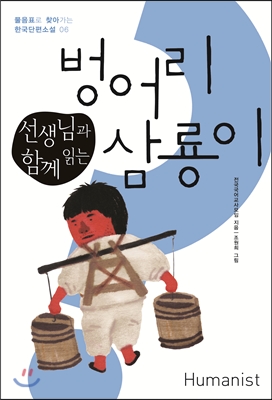
Mute Samryong reading with his teacher
 |
Description
Book Introduction
The sixth book in the series 'Korean Short Stories with Question Marks' is Na Do-hyang's 'The Mute Samryongi'.
It is structured as 'Reading a Novel - Reading Deeply - Reading Broadly', so that you can internalize the work in various ways while reading and broaden your understanding of the work.
And by introducing other works with similar materials or themes through ‘linked reading,’ we were able to broaden the reading experience and the scope of literary appreciation.
"The Mute Samryongi" is a story about Samryongi, a servant of Oh Saengwon who cannot speak and has an ugly appearance.
It depicts the process of an honest and loyal servant who lived his life believing that his appearance and the treatment he received from others were his fate, but who goes against his fate as he discovers his true feelings.
By looking at the commentary included in the book, you can guess what Samryong was trying to tell us by looking at why the author portrayed Samryong as mute, how the character relationships and conflicts unfold, etc.
It is structured as 'Reading a Novel - Reading Deeply - Reading Broadly', so that you can internalize the work in various ways while reading and broaden your understanding of the work.
And by introducing other works with similar materials or themes through ‘linked reading,’ we were able to broaden the reading experience and the scope of literary appreciation.
"The Mute Samryongi" is a story about Samryongi, a servant of Oh Saengwon who cannot speak and has an ugly appearance.
It depicts the process of an honest and loyal servant who lived his life believing that his appearance and the treatment he received from others were his fate, but who goes against his fate as he discovers his true feelings.
By looking at the commentary included in the book, you can guess what Samryong was trying to tell us by looking at why the author portrayed Samryong as mute, how the character relationships and conflicts unfold, etc.
index
Publishing the series 'Korean Short Stories with Question Marks'
preface
Reading the work "The Mute Samryongi"_Nadohyang
Reading Deeply, Asking and Answering "The Mute Samryongi"
1_ Samryong who obeys fate
· Where is Yeonhwabong Peak?
· What kind of person is Samryong?
· Is Samryongi a servant of Oh Saengwon?
· Why doesn't Oh Saeng-won scold his son for bullying Samryong?
· Why doesn't Samryong leave his master's house?
2_ The power of love that defies fate
· Why did the little master and the young lady get married?
· What attracted Samryong to you?
· Why doesn't the lady stand up to her husband's violence?
· Why did Samryong change his mind?
· Why did Samryong set the fire?
3_ The Hidden Heart of the Author
· Aren't the characters' personalities a bit strange?
· Why is the main character an ugly mute?
· Why did the author make Samryong die tragically?
· What is the author trying to say?
Reading broadly: A look into the world beyond the work
Author's Story - Na Do-hyang's Life and Literature
A Tale of the Times - 1920-1925
A Novel That Resolves Conflict with Fire
Reread - Are Samryongs still abused today?
Reader's Notes - "The Mute Samryongi," "This is Strange"
References
preface
Reading the work "The Mute Samryongi"_Nadohyang
Reading Deeply, Asking and Answering "The Mute Samryongi"
1_ Samryong who obeys fate
· Where is Yeonhwabong Peak?
· What kind of person is Samryong?
· Is Samryongi a servant of Oh Saengwon?
· Why doesn't Oh Saeng-won scold his son for bullying Samryong?
· Why doesn't Samryong leave his master's house?
2_ The power of love that defies fate
· Why did the little master and the young lady get married?
· What attracted Samryong to you?
· Why doesn't the lady stand up to her husband's violence?
· Why did Samryong change his mind?
· Why did Samryong set the fire?
3_ The Hidden Heart of the Author
· Aren't the characters' personalities a bit strange?
· Why is the main character an ugly mute?
· Why did the author make Samryong die tragically?
· What is the author trying to say?
Reading broadly: A look into the world beyond the work
Author's Story - Na Do-hyang's Life and Literature
A Tale of the Times - 1920-1925
A Novel That Resolves Conflict with Fire
Reread - Are Samryongs still abused today?
Reader's Notes - "The Mute Samryongi," "This is Strange"
References
Detailed image

Publisher's Review
Dreaming of a literature class overflowing with wild imaginations and lively questions!
The National Korean Language Teachers Association has been thinking about how to make literature classes more exciting and fun.
And finally, I came up with the idea of 'finding with a question mark'.
This is not a literature class that has been conducted so far, that is, a class that provides students with uniform and mechanical information about the work, but a method that provides answers to the questions that students actually have after reading the work.
Through this, we aimed to establish a foundation for a user-centered literature class that allows students to understand and empathize with the work, rather than a one-sided literature class that was consistently focused on fragmentary understanding and forced memorization.
The series 'Korean Short Stories with Question Marks' can be considered a guide to help this type of literature class take root in schools.
'Korean Short Stories with Question Marks' selected short stories from middle and high school Korean language and literature textbooks that have been widely read by many people for a long time.
After reading these selected works directly to the students, I collected all the questions they had.
Among them, we selected those that were frequently asked, meaningful, novel, and original, and created a list of questions in a set manner.
Then, current Korean language teachers answered the questions based on what they had studied by searching through numerous books and papers.
It was written in simple language for students to read, and illustrations, photos, and reference materials were placed appropriately.
In this way, I tried to approach the more universal meaning of the work.
'Question Marks for Korean Short Stories' is a new, unprecedented content that provides reading materials and information that can elicit diverse and profound thoughts.
It will not only open up the horizon of 'student-centered novel appreciation' but also provide students with an opportunity to become closer to literary works.
Discover Korea's representative short stories from textbooks in a single, deep and broad volume!
'Finding Korean Short Stories with Question Marks' was born from the sorrow of the educational reality in which children are increasingly moving away from literature due to memorization-based and problem-solving-based literature classes.
And it is being created with the will and passion of teachers who want to make literary works come alive and breathe close to children.
This book goes far beyond the fragmentary interpretation and understanding of novels found in existing textbooks or reference books.
Because it covers historical, cultural, social, and literary information in an easy and fun way based on questions that students actually ask when reading the work, it will be of great help in fully understanding a single work.
This book is structured as 'Reading Novels - Reading Deeply - Reading Broadly'.
'Deep Reading' is filled with meaningful questions that children have while reading the work, selected from among them, and teachers' answers to them.
It focuses on the background, characters, events, and themes related to the work itself, and allows readers to internalize the work in various ways while reading.
'Reading Broadly' aims to broaden the understanding of a work by examining the elements surrounding the work, such as the author and the circumstances of the time.
Additionally, the results of students' reading and activities on the work were included, allowing students to get a glimpse into their peers' thoughts on the work.
And by introducing other works with similar materials or themes through ‘linked reading,’ we were able to broaden the reading experience and the scope of literary appreciation.
'Mute Samryongi', burning his fate and dying as a man!
『(Reading with the Teacher) Mute Samryongi』 is the sixth book in the series ‘Korean Short Stories with Question Marks’ planned by the National Association of Korean Language Teachers.
'The Mute Samryongi' is a story about 'Samryongi', a servant of Oh Saengwon who cannot speak and has an ugly appearance.
It depicts the process of an honest and loyal servant who lived his life believing that his appearance and the treatment he received from others were his fate, but who goes against his fate as he discovers his true feelings.
This book contains questions and answers such as what kind of person Samryong is, why the author drew Samryong as mute, what the author wanted to say by doing so, how the people around Samryong treat him, why Oh Saeng-won is so kind to Samryong, why the master's son treats Samryong so rudely, and what the lady thinks of Samryong.
After reading this book, you will understand what Samryong wanted to tell us.
The National Korean Language Teachers Association has been thinking about how to make literature classes more exciting and fun.
And finally, I came up with the idea of 'finding with a question mark'.
This is not a literature class that has been conducted so far, that is, a class that provides students with uniform and mechanical information about the work, but a method that provides answers to the questions that students actually have after reading the work.
Through this, we aimed to establish a foundation for a user-centered literature class that allows students to understand and empathize with the work, rather than a one-sided literature class that was consistently focused on fragmentary understanding and forced memorization.
The series 'Korean Short Stories with Question Marks' can be considered a guide to help this type of literature class take root in schools.
'Korean Short Stories with Question Marks' selected short stories from middle and high school Korean language and literature textbooks that have been widely read by many people for a long time.
After reading these selected works directly to the students, I collected all the questions they had.
Among them, we selected those that were frequently asked, meaningful, novel, and original, and created a list of questions in a set manner.
Then, current Korean language teachers answered the questions based on what they had studied by searching through numerous books and papers.
It was written in simple language for students to read, and illustrations, photos, and reference materials were placed appropriately.
In this way, I tried to approach the more universal meaning of the work.
'Question Marks for Korean Short Stories' is a new, unprecedented content that provides reading materials and information that can elicit diverse and profound thoughts.
It will not only open up the horizon of 'student-centered novel appreciation' but also provide students with an opportunity to become closer to literary works.
Discover Korea's representative short stories from textbooks in a single, deep and broad volume!
'Finding Korean Short Stories with Question Marks' was born from the sorrow of the educational reality in which children are increasingly moving away from literature due to memorization-based and problem-solving-based literature classes.
And it is being created with the will and passion of teachers who want to make literary works come alive and breathe close to children.
This book goes far beyond the fragmentary interpretation and understanding of novels found in existing textbooks or reference books.
Because it covers historical, cultural, social, and literary information in an easy and fun way based on questions that students actually ask when reading the work, it will be of great help in fully understanding a single work.
This book is structured as 'Reading Novels - Reading Deeply - Reading Broadly'.
'Deep Reading' is filled with meaningful questions that children have while reading the work, selected from among them, and teachers' answers to them.
It focuses on the background, characters, events, and themes related to the work itself, and allows readers to internalize the work in various ways while reading.
'Reading Broadly' aims to broaden the understanding of a work by examining the elements surrounding the work, such as the author and the circumstances of the time.
Additionally, the results of students' reading and activities on the work were included, allowing students to get a glimpse into their peers' thoughts on the work.
And by introducing other works with similar materials or themes through ‘linked reading,’ we were able to broaden the reading experience and the scope of literary appreciation.
'Mute Samryongi', burning his fate and dying as a man!
『(Reading with the Teacher) Mute Samryongi』 is the sixth book in the series ‘Korean Short Stories with Question Marks’ planned by the National Association of Korean Language Teachers.
'The Mute Samryongi' is a story about 'Samryongi', a servant of Oh Saengwon who cannot speak and has an ugly appearance.
It depicts the process of an honest and loyal servant who lived his life believing that his appearance and the treatment he received from others were his fate, but who goes against his fate as he discovers his true feelings.
This book contains questions and answers such as what kind of person Samryong is, why the author drew Samryong as mute, what the author wanted to say by doing so, how the people around Samryong treat him, why Oh Saeng-won is so kind to Samryong, why the master's son treats Samryong so rudely, and what the lady thinks of Samryong.
After reading this book, you will understand what Samryong wanted to tell us.
GOODS SPECIFICS
- Date of publication: October 8, 2012
- Page count, weight, size: 120 pages | 153*224*20mm
- ISBN13: 9788958625445
- ISBN10: 8958625449
You may also like
카테고리
korean


korean

![GQ KOREA Mark (Monthly): December [2025]](http://librairie.coreenne.fr/cdn/shop/files/8ef265dbbfbf186523ed75ba7319009d.jpg?v=1765340328&width=3840)


