

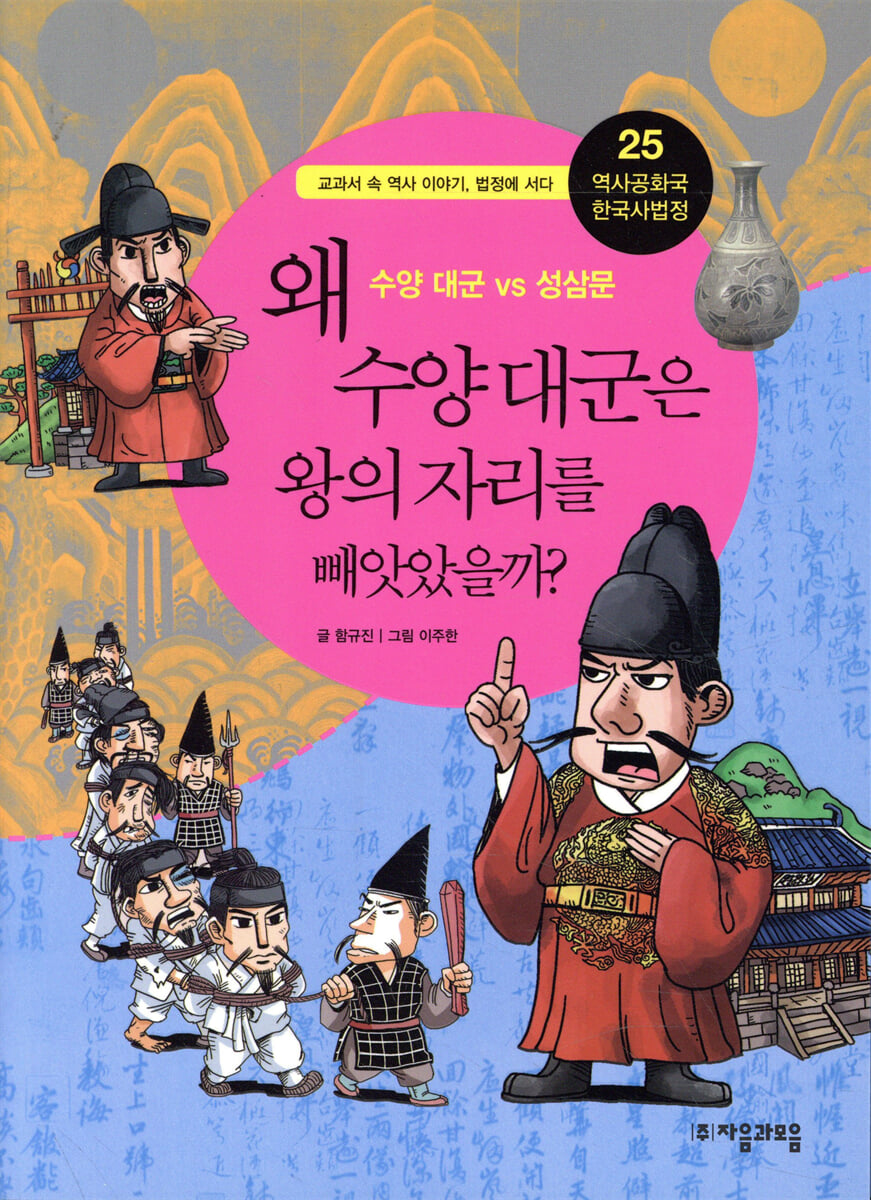
Why did Prince Suyang usurp the throne?
 |
Description
Book Introduction
A republic of history where rivals from history gather together and hold trials.
It is often said that history is 'written by the victors'.
So, most history textbooks and books are interpreted based only on the 'winners' in history.
That is why even if new historical evidence that could overturn history books appears, it is not easily reflected in history books.
Featuring a diverse cast of witnesses, including the plaintiff and the defendant, "Republic of History: Korean History Court, World History Court" vividly presents historical stories from textbooks from a balanced perspective.
This allows readers to free themselves from prejudice and independently judge the stories in history.
The events and content introduced in 『History Republic, Korean History Court, World History Court』 were selected from current elementary, middle, and high school textbooks.
The authors are also current professors and teachers who have specialized in Korean and world history and teach students in the field, and they critically review the core contents of the curriculum.
Meanwhile, unlike existing history books or textbooks where the story unfolds through explanations, this series adds dramatic fun with a 'courtroom-style' structure where the plaintiff and defendant engage in a lawsuit.
Through this, readers can observe history in a three-dimensional way by following the fierce battles between historical figures, and develop a subjective worldview that will allow them to live wisely in the world.
It is often said that history is 'written by the victors'.
So, most history textbooks and books are interpreted based only on the 'winners' in history.
That is why even if new historical evidence that could overturn history books appears, it is not easily reflected in history books.
Featuring a diverse cast of witnesses, including the plaintiff and the defendant, "Republic of History: Korean History Court, World History Court" vividly presents historical stories from textbooks from a balanced perspective.
This allows readers to free themselves from prejudice and independently judge the stories in history.
The events and content introduced in 『History Republic, Korean History Court, World History Court』 were selected from current elementary, middle, and high school textbooks.
The authors are also current professors and teachers who have specialized in Korean and world history and teach students in the field, and they critically review the core contents of the curriculum.
Meanwhile, unlike existing history books or textbooks where the story unfolds through explanations, this series adds dramatic fun with a 'courtroom-style' structure where the plaintiff and defendant engage in a lawsuit.
Through this, readers can observe history in a three-dimensional way by following the fierce battles between historical figures, and develop a subjective worldview that will allow them to live wisely in the world.
- You can preview some of the book's contents.
Preview
index
At the beginning of the book
In the textbook
Characters
prolog
The first day of the trial - Why did Prince Suyang start the Gye-yu Rebellion?
(1) Who was Joseon’s loyal subject?
(2) How did the Gye-Yu Rebellion proceed?
- Break interview
The second day of the trial - Why did the six ministers try to get rid of King Sejo?
(1) Why did the Six Martyrs’ plot fail?
(2) What happened to King Danjong after the failure of the Six Martyrs?
- Break interview
Third day of trial - Was Sejo's politics excellent?
(1) Was Sejo the true successor to Sejong?
(2) What are the Hun-gu faction and the Sarim faction?
- Break interview
History in textbooks vs. history outside textbooks
Final statement
Verdict
Epilogue
In the textbook
Characters
prolog
The first day of the trial - Why did Prince Suyang start the Gye-yu Rebellion?
(1) Who was Joseon’s loyal subject?
(2) How did the Gye-Yu Rebellion proceed?
- Break interview
The second day of the trial - Why did the six ministers try to get rid of King Sejo?
(1) Why did the Six Martyrs’ plot fail?
(2) What happened to King Danjong after the failure of the Six Martyrs?
- Break interview
Third day of trial - Was Sejo's politics excellent?
(1) Was Sejo the true successor to Sejong?
(2) What are the Hun-gu faction and the Sarim faction?
- Break interview
History in textbooks vs. history outside textbooks
Final statement
Verdict
Epilogue
Publisher's Review
A showdown between Prince Suyang and the Six Martyred Ministers!
After King Sejong, the royal authority of Joseon was greatly weakened as the frail Munjong died early and the young Danjong ascended to the throne.
Accordingly, Prince Suyang, King Danjong's uncle, instigated the Gyeyu Jeongnan (癸酉靖難) in 1453 (the first year of King Danjong's reign), deposed his nephew King Danjong, and ascended to the throne.
At this time, Joseon's loyal subjects, including Seong Sam-mun, did not recognize Prince Suyang as king and plotted to restore King Danjong to the throne, but were caught and executed.
Because of this, history praises these six loyal subjects, while criticizing Prince Suyang, who became King Sejo, as a usurper of the throne, disregarding his achievements.
King Sejo, who became king, claimed that he seized the royal seal to ensure the stability of Joseon and strengthen its royal authority, and that Joseon was able to develop through policies such as the implementation of the Jeongjeon Law and the strengthening of its military power.
He also says that the six loyal ministers acted not for the sake of Danjong and Joseon, but to satisfy their own selfish desires.
In the Republic of History Korean Court, “Why Did Grand Prince Suyang Usurpate the King’s Throne?”, the plaintiff Grand Prince Suyang’s side is represented by lawyer Kim Ddan-ji, along with King Taejong’s eldest son, Grand Prince Yangnyeong, and Grand Prince Suyang’s right-hand men Han Myeong-hoe and Shin Suk-ju, who testify. On the side of Seong Sam-mun, who represents the six martyred ministers, the defendants appear, including lawyer Lee Dae-ro, Grand Prince Suyang’s nephew Danjong, and Kim Il-son, who was executed in the Muosahwa, and they dig up the truth in history through three trials.
[Features and Benefits of This Book]
―The actions of the 'Sayukshin', renowned for their loyal subjects of Joseon, and the situation at the time unfold, providing educational content for young people.
―The historical story of the young King Danjong and Grand Prince Suyang, who usurped the throne, is introduced, providing a glimpse into the political situation of Joseon at the time.
―In relation to the lawsuit between the plaintiff Prince Suyang and the defendants, the six loyal ministers, the plaintiff's witnesses, including Prince Yangnyeong, Han Myeong-hoe, and Shin Suk-ju, appear, and the defendant's witnesses, including King Danjong, Kim Jong-seo, and Kim Il-son, appear, and the dramatic tension comes alive through their vivid testimonies.
Accordingly, Prince Suyang, King Danjong's uncle, instigated the Gyeyu Jeongnan (癸酉靖難) in 1453 (the first year of King Danjong's reign), deposed his nephew King Danjong, and ascended to the throne.
At this time, Joseon's loyal subjects, including Seong Sam-mun, did not recognize Prince Suyang as king and plotted to restore King Danjong to the throne, but were caught and executed.
Because of this, history praises these six loyal subjects, while criticizing Prince Suyang, who became King Sejo, as a usurper of the throne, disregarding his achievements.
King Sejo, who became king, claimed that he seized the royal seal to ensure the stability of Joseon and strengthen its royal authority, and that Joseon was able to develop through policies such as the implementation of the Jeongjeon Law and the strengthening of its military power.
He also says that the six loyal ministers acted not for the sake of Danjong and Joseon, but to satisfy their own selfish desires.
In the Republic of History Korean Court, “Why Did Grand Prince Suyang Usurpate the King’s Throne?”, the plaintiff Grand Prince Suyang’s side is represented by lawyer Kim Ddan-ji, along with King Taejong’s eldest son, Grand Prince Yangnyeong, and Grand Prince Suyang’s right-hand men Han Myeong-hoe and Shin Suk-ju, who testify. On the side of Seong Sam-mun, who represents the six martyred ministers, the defendants appear, including lawyer Lee Dae-ro, Grand Prince Suyang’s nephew Danjong, and Kim Il-son, who was executed in the Muosahwa, and they dig up the truth in history through three trials.
[Features and Benefits of This Book]
―The actions of the 'Sayukshin', renowned for their loyal subjects of Joseon, and the situation at the time unfold, providing educational content for young people.
―The historical story of the young King Danjong and Grand Prince Suyang, who usurped the throne, is introduced, providing a glimpse into the political situation of Joseon at the time.
―In relation to the lawsuit between the plaintiff Prince Suyang and the defendants, the six loyal ministers, the plaintiff's witnesses, including Prince Yangnyeong, Han Myeong-hoe, and Shin Suk-ju, appear, and the defendant's witnesses, including King Danjong, Kim Jong-seo, and Kim Il-son, appear, and the dramatic tension comes alive through their vivid testimonies.
GOODS SPECIFICS
- Date of issue: April 10, 2011
- Page count, weight, size: 154 pages | 298g | 160*225*20mm
- ISBN13: 9788954423250
- ISBN10: 8954423256
You may also like
카테고리
korean


korean

![GQ KOREA Mark (Monthly): December [2025]](http://librairie.coreenne.fr/cdn/shop/files/8ef265dbbfbf186523ed75ba7319009d.jpg?v=1765340328&width=3840)


