

Crime and Punishment
 |
Description
Book Introduction
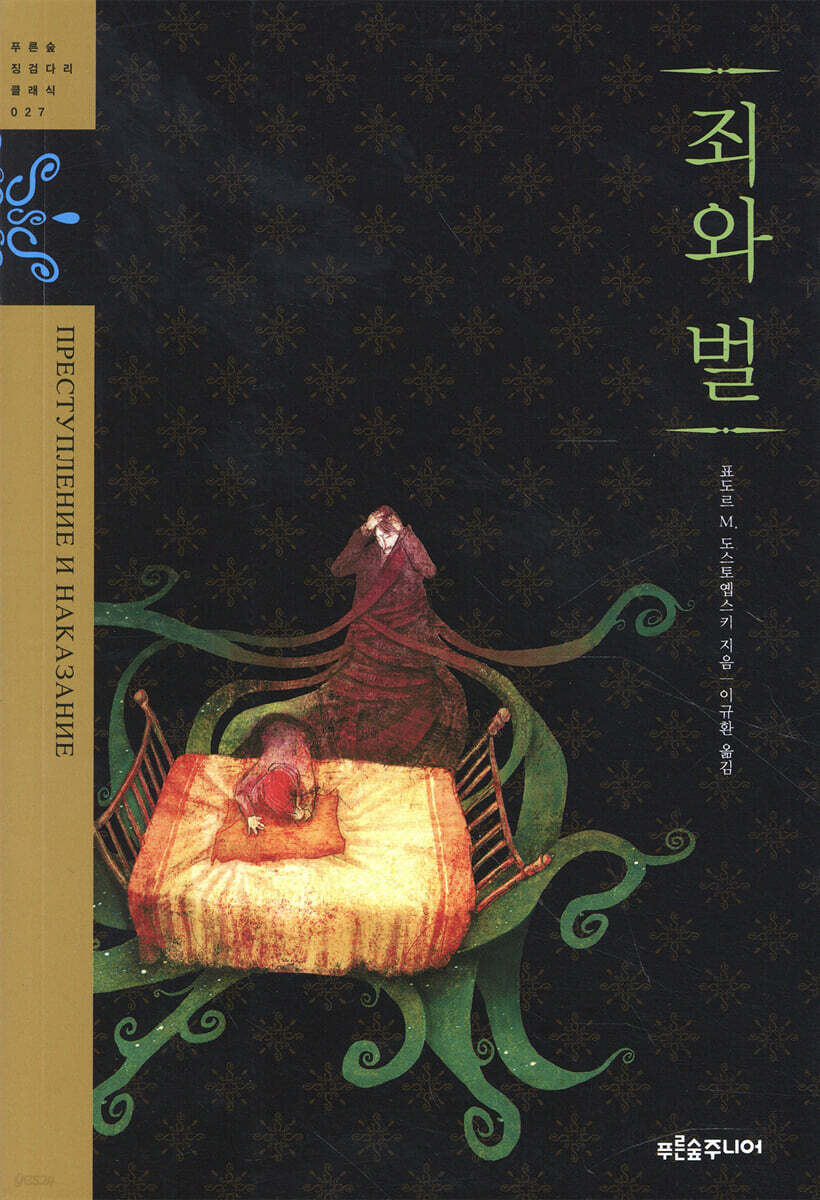
Dostoevsky, who was even called a "demon writer" for his persistent exploration of the depths of humanity, has a masterpiece called "Crime and Punishment" that contains a story of a young man's murder and his path to salvation, set in 9th-century St. Petersburg, Russia, after the abolition of serfdom.
The intellectual and arrogant protagonist Raskolnikov thought he was special compared to others.
And he kills the old pawnbroker, considering her an unnecessary being in society and someone who deserves to die.
But after actually committing the murder, he suffers from severe mental pain.
The person who brought out a glimmer of humanity in his heart was Sonya, a woman from the most despised class, and he was moved by Sonya's pure soul, confessed his sins, and repented.
Dostoevsky says that what saved the protagonist, who was on the verge of collapse, was the humanity and love within his heart.
Among Dostoevsky's works, "Crime and Punishment" is a masterpiece that is always on any must-read list.
However, due to its length, complex concepts, conventional translation, and literary style, it was not a work that was easily accessible to young readers, let alone adult readers.
This edition of "Crime and Punishment" features translations by current Korean language teachers, drawing on their own experience in the field, resulting in a more thorough and rich commentary than any other.
It also includes fun and rich tips and visual aids, providing practical assistance in learning while also providing the pleasure of reading a masterpiece.
The intellectual and arrogant protagonist Raskolnikov thought he was special compared to others.
And he kills the old pawnbroker, considering her an unnecessary being in society and someone who deserves to die.
But after actually committing the murder, he suffers from severe mental pain.
The person who brought out a glimmer of humanity in his heart was Sonya, a woman from the most despised class, and he was moved by Sonya's pure soul, confessed his sins, and repented.
Dostoevsky says that what saved the protagonist, who was on the verge of collapse, was the humanity and love within his heart.
Among Dostoevsky's works, "Crime and Punishment" is a masterpiece that is always on any must-read list.
However, due to its length, complex concepts, conventional translation, and literary style, it was not a work that was easily accessible to young readers, let alone adult readers.
This edition of "Crime and Punishment" features translations by current Korean language teachers, drawing on their own experience in the field, resulting in a more thorough and rich commentary than any other.
It also includes fun and rich tips and visual aids, providing practical assistance in learning while also providing the pleasure of reading a masterpiece.
- You can preview some of the book's contents.
Preview
index
Planning Committee Member's Comments
Chapter 1: A Dangerous Plan
Chapter 2 Mother's Letter
Chapter 3 Two Murders
Chapter 4 Nightmare
Chapter 5 False Evidence
Chapter 6 Back to the Old Woman's House
Chapter 7 The Death of Marmeladov
Chapter 8: Family Reunited
Chapter 9 Doubt
Chapter 10: The Line That Must Not Be Crossed
Chapter 11 Kissing Sonya's Feet
Chapter 12: Unexpected Embroidery
Chapter 13: Questionable Good Deeds
Chapter 14 Confession
Chapter 15 I'm Going to America
Chapter 16 Atonement
Chapter 17: Epilogue
Reading Crime and Punishment Properly
Chapter 1: A Dangerous Plan
Chapter 2 Mother's Letter
Chapter 3 Two Murders
Chapter 4 Nightmare
Chapter 5 False Evidence
Chapter 6 Back to the Old Woman's House
Chapter 7 The Death of Marmeladov
Chapter 8: Family Reunited
Chapter 9 Doubt
Chapter 10: The Line That Must Not Be Crossed
Chapter 11 Kissing Sonya's Feet
Chapter 12: Unexpected Embroidery
Chapter 13: Questionable Good Deeds
Chapter 14 Confession
Chapter 15 I'm Going to America
Chapter 16 Atonement
Chapter 17: Epilogue
Reading Crime and Punishment Properly
Publisher's Review
A novel that delves into the deepest recesses of humanity: "Crime and Punishment."
Committed murder by the tyranny of reason, and saved by the power of love
A young man's record of hardship
A new look for world-famous masterpieces
Crime and Punishment is a story about a young man's murder and his journey to salvation set in 19th-century St. Petersburg, Russia, after the abolition of serfdom.
This beloved masterpiece, beloved for centuries, has been reborn as a youth-focused piece.
Dostoevsky, who was called a 'demonic writer' for his persistent exploration of the abyss of humanity.
Among his works, 『Crime and Punishment』 is a masterpiece that is always on any must-read list.
However, due to its length, complex concepts, conventional translation, and literary style, it was not a work that was easily accessible to young readers, let alone adult readers.
However, 『Crime and Punishment』 from the 'Jinggeomdari Classic' was translated in a clean and flowing style using familiar language, which helped to alleviate the fear of classics.
Now I can move this book's name down from my must-read list to my review list.
In the end, love and faith will save us.
The protagonist of Crime and Punishment is an intelligent and arrogant college student who believes he is clearly different from most people.
And without hesitation, he regarded the old pawnbroker as a person unnecessary to society, someone who deserved to die.
However, after actually committing the murder, he suffered severe mental anguish.
Could this be because the protagonist still had a shred of humanity within him? The person who brought out that humanity was Sonya, a woman from the most despised class.
Raskolnikov is moved by Sonya's pure soul and confesses his sins, and later repents his sins thanks to Sonya's love.
What saved the protagonist, who was on the verge of collapse, was the humanity and love within his heart.
As is often the case with works that are considered masterpieces, Crime and Punishment can be read in completely different ways depending on the reader.
On the surface, Crime and Punishment is a brilliant crime novel.
From the moment an arrogant young man commits murder, inner conflict, suspicion from those around him, and unexpected situations unfold.
These contents are developed based on dialogue rather than incident, so they effectively convey psychological changes.
But if you look at it another way, 『Crime and Punishment』 is also a religious novel that embodies the author's beliefs.
The most problematic aspect of this novel is the setting in which the arrogant and intelligent protagonist is saved by Sonya, a member of the most despised lower class.
Although Sonya is a prostitute who sells her body, she is a religious person with a pure heart and strong faith.
This reveals that Dostoevsky wanted to emphasize the importance of religious faith and humanity through Crime and Punishment.
Rich commentary written directly by a current Korean language teacher
One of the strengths of 'Blue Forest Stepping Stone Classic' is the 'Reading Properly' page, a device that helps readers understand the work more deeply.
This page, which interprets the work from various angles, was written by current Korean language teachers, including Kang Hye-won (Korean language teacher at Gyeonggi Commercial High School in Seoul), Gye Deuk-seong (Korean language teacher at Sinmok High School in Seoul), Jeon Jong-ok (Korean language teacher at Yanggang Middle School in Seoul), and Song Su-jin (Korean language teacher at Hopyeong Middle School in Gyeonggi), based on their own experiences and experiences with the needs and demands of young people. As such, it is more thorough and rich than any other commentary.
In addition to providing commentary on the author and his work, we attempted a variety of approaches, including why modern youth should read masterpieces from over a century ago and what meaning they can find in them from a current perspective.
It is packed with fun and rich tips and visual aids, so it not only provides practical help in learning, but is also a pleasure to look at.
Introduction
dangerous plan
Raskolnikov, a poor college student on leave who can't even afford to eat properly.
He decides to solve his problems by murdering an old pawnbroker whom he deems unworthy of living and stealing her money.
'It's not what reason tells you to do.
This is the devil's work!'
He kills the old woman as planned, but accidentally ends up killing the old woman's younger sister who came to the scene of the murder.
And as soon as he gets home, he falls ill.
Nightmarish days
From the moment of his crime, Raskolnikov suffers from severe pangs of conscience and the feeling that everyone is suspicious of him.
'Lord, please tell me just one thing.
Do people know everything and just ignore it, or do they just not know? We have to run! We have to run! Money, money? Oh, it's on the desk over there.
Still, they might find me.
Should I go all the way to America? People don't seem to know I can walk.
But I know all about 'that thing'.
You can tell by looking at the eyes.' - From the text
Raskolnikov unknowingly commits an act that could incur the judgment of the examining magistrate Porfiry, and begins to distrust those around him, becoming irreversibly broken inside.
Then, by chance, he meets Sonya, who sells her body to support her alcoholic father, stepmother, and half-siblings.
Sonya sells her body to support her alcoholic father, stepmother, and half-siblings, but she has a deeper faith and a pure soul than anyone else.
Unable to bear the pain after his crime, Raskolnikov confesses everything to Sonya.
Then Sonya advises Raskolnikov to turn himself in.
“Get up! Go out into the streets right now and kiss the ground you have defiled.
And then he says loudly so that everyone can hear, 'I killed a man!'
Then God will make you born again.” - From the text
It was love that brought them back to life
Raskolnikov decides to turn himself in, motivated by Porfiry's urging, who is convinced that he is the culprit, his self-deprecation that he is not as extraordinary as he thought, and Sonya's love.
He is sentenced to eight years in prison and begins his exile in Siberia.
Sonya decides to stay with him forever and follows him to Siberia to become a prison guard.
But Raskolnikov still could not truly repent of his sins.
'Is my theory that strange? No.
But why does it seem so ugly to others? Is it because it's a sin? But my conscience is at ease.
If the geniuses who sought power for themselves had taken the first step beyond the law, I simply could not have endured it!' - From the text
But as time passes, Raskolnikov feels Sonya's sincere love and kneels before her.
And he realizes that it was a mistake to believe that a select few could lead the world to truth, and he repents his sins.
Then, before Sonya and Raskolnikov, “a complete resurrection to a new life shone down brightly like the morning sun.”
Committed murder by the tyranny of reason, and saved by the power of love
A young man's record of hardship
A new look for world-famous masterpieces
Crime and Punishment is a story about a young man's murder and his journey to salvation set in 19th-century St. Petersburg, Russia, after the abolition of serfdom.
This beloved masterpiece, beloved for centuries, has been reborn as a youth-focused piece.
Dostoevsky, who was called a 'demonic writer' for his persistent exploration of the abyss of humanity.
Among his works, 『Crime and Punishment』 is a masterpiece that is always on any must-read list.
However, due to its length, complex concepts, conventional translation, and literary style, it was not a work that was easily accessible to young readers, let alone adult readers.
However, 『Crime and Punishment』 from the 'Jinggeomdari Classic' was translated in a clean and flowing style using familiar language, which helped to alleviate the fear of classics.
Now I can move this book's name down from my must-read list to my review list.
In the end, love and faith will save us.
The protagonist of Crime and Punishment is an intelligent and arrogant college student who believes he is clearly different from most people.
And without hesitation, he regarded the old pawnbroker as a person unnecessary to society, someone who deserved to die.
However, after actually committing the murder, he suffered severe mental anguish.
Could this be because the protagonist still had a shred of humanity within him? The person who brought out that humanity was Sonya, a woman from the most despised class.
Raskolnikov is moved by Sonya's pure soul and confesses his sins, and later repents his sins thanks to Sonya's love.
What saved the protagonist, who was on the verge of collapse, was the humanity and love within his heart.
As is often the case with works that are considered masterpieces, Crime and Punishment can be read in completely different ways depending on the reader.
On the surface, Crime and Punishment is a brilliant crime novel.
From the moment an arrogant young man commits murder, inner conflict, suspicion from those around him, and unexpected situations unfold.
These contents are developed based on dialogue rather than incident, so they effectively convey psychological changes.
But if you look at it another way, 『Crime and Punishment』 is also a religious novel that embodies the author's beliefs.
The most problematic aspect of this novel is the setting in which the arrogant and intelligent protagonist is saved by Sonya, a member of the most despised lower class.
Although Sonya is a prostitute who sells her body, she is a religious person with a pure heart and strong faith.
This reveals that Dostoevsky wanted to emphasize the importance of religious faith and humanity through Crime and Punishment.
Rich commentary written directly by a current Korean language teacher
One of the strengths of 'Blue Forest Stepping Stone Classic' is the 'Reading Properly' page, a device that helps readers understand the work more deeply.
This page, which interprets the work from various angles, was written by current Korean language teachers, including Kang Hye-won (Korean language teacher at Gyeonggi Commercial High School in Seoul), Gye Deuk-seong (Korean language teacher at Sinmok High School in Seoul), Jeon Jong-ok (Korean language teacher at Yanggang Middle School in Seoul), and Song Su-jin (Korean language teacher at Hopyeong Middle School in Gyeonggi), based on their own experiences and experiences with the needs and demands of young people. As such, it is more thorough and rich than any other commentary.
In addition to providing commentary on the author and his work, we attempted a variety of approaches, including why modern youth should read masterpieces from over a century ago and what meaning they can find in them from a current perspective.
It is packed with fun and rich tips and visual aids, so it not only provides practical help in learning, but is also a pleasure to look at.
Introduction
dangerous plan
Raskolnikov, a poor college student on leave who can't even afford to eat properly.
He decides to solve his problems by murdering an old pawnbroker whom he deems unworthy of living and stealing her money.
'It's not what reason tells you to do.
This is the devil's work!'
He kills the old woman as planned, but accidentally ends up killing the old woman's younger sister who came to the scene of the murder.
And as soon as he gets home, he falls ill.
Nightmarish days
From the moment of his crime, Raskolnikov suffers from severe pangs of conscience and the feeling that everyone is suspicious of him.
'Lord, please tell me just one thing.
Do people know everything and just ignore it, or do they just not know? We have to run! We have to run! Money, money? Oh, it's on the desk over there.
Still, they might find me.
Should I go all the way to America? People don't seem to know I can walk.
But I know all about 'that thing'.
You can tell by looking at the eyes.' - From the text
Raskolnikov unknowingly commits an act that could incur the judgment of the examining magistrate Porfiry, and begins to distrust those around him, becoming irreversibly broken inside.
Then, by chance, he meets Sonya, who sells her body to support her alcoholic father, stepmother, and half-siblings.
Sonya sells her body to support her alcoholic father, stepmother, and half-siblings, but she has a deeper faith and a pure soul than anyone else.
Unable to bear the pain after his crime, Raskolnikov confesses everything to Sonya.
Then Sonya advises Raskolnikov to turn himself in.
“Get up! Go out into the streets right now and kiss the ground you have defiled.
And then he says loudly so that everyone can hear, 'I killed a man!'
Then God will make you born again.” - From the text
It was love that brought them back to life
Raskolnikov decides to turn himself in, motivated by Porfiry's urging, who is convinced that he is the culprit, his self-deprecation that he is not as extraordinary as he thought, and Sonya's love.
He is sentenced to eight years in prison and begins his exile in Siberia.
Sonya decides to stay with him forever and follows him to Siberia to become a prison guard.
But Raskolnikov still could not truly repent of his sins.
'Is my theory that strange? No.
But why does it seem so ugly to others? Is it because it's a sin? But my conscience is at ease.
If the geniuses who sought power for themselves had taken the first step beyond the law, I simply could not have endured it!' - From the text
But as time passes, Raskolnikov feels Sonya's sincere love and kneels before her.
And he realizes that it was a mistake to believe that a select few could lead the world to truth, and he repents his sins.
Then, before Sonya and Raskolnikov, “a complete resurrection to a new life shone down brightly like the morning sun.”
GOODS SPECIFICS
- Date of issue: December 24, 2009
- Page count, weight, size: 336 pages | 540g | 142*205*30mm
- ISBN13: 9788971848265
- ISBN10: 897184826X
You may also like
카테고리
korean


korean

![GQ KOREA Mark (Monthly): December [2025]](http://librairie.coreenne.fr/cdn/shop/files/8ef265dbbfbf186523ed75ba7319009d.jpg?v=1765340328&width=3840)


