

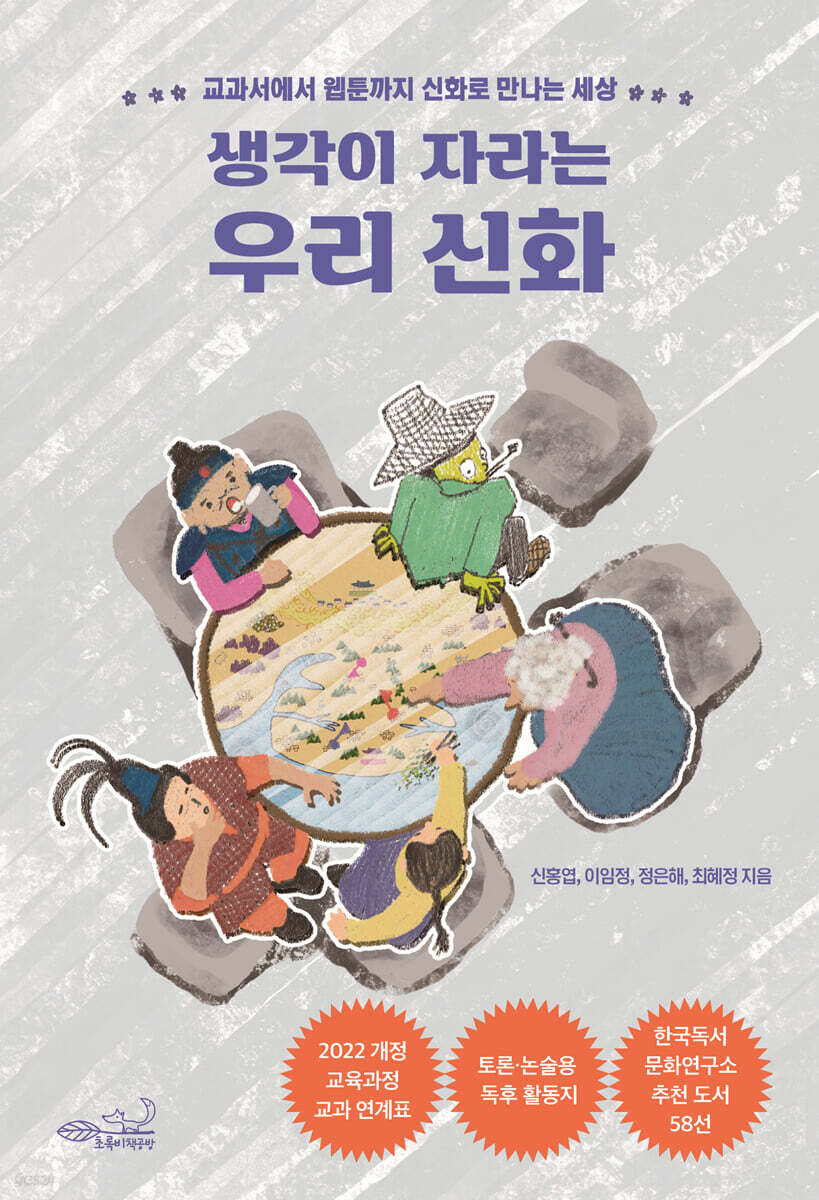
Our myth of growing thoughts
 |
Description
Book Introduction
A time to learn, discuss, and grow through K-mythology
Our Mythology Humanities Book for Youth
This is a revised edition of “Reading Our Myths to Cultivate the Power of Thought,” which has been consistently loved by readers since its publication in 2019.
This revised edition has refined the language and structure to make it more accessible to young readers, and has added new illustrations that capture Korean sentiment, further enhancing the depth and completeness of the content.
While Greek, Roman, and Nordic mythology are actively consumed as a source of global cultural content, our mythology has still been treated only as a few stories in textbooks or fragmentary old tales.
However, the recent success of webtoons, movies, Korean games, and dramas that utilize myths as motifs shows that our myths can also become a sufficient global story resource.
This book was planned to fully publicize the potential of the 'K-myth' in this context.
It contains a total of 16 stories, ranging from the story of the creation of the world, the power of goddesses, adventures of humans and gods, and epics that cross the line between the afterlife and the living world. It is structured so that readers can develop their thinking skills by asking questions and discussing them, rather than simply reading old tales.
In addition to the 58 recommended books and discussion activity sheets linked to elementary, middle, and high school subjects, the 2022 revised curriculum curriculum linkage table has been supplemented and included.
This will serve as a practical reference material reflecting the revised curriculum for not only youth but also parents and teachers.
Our Mythology Humanities Book for Youth
This is a revised edition of “Reading Our Myths to Cultivate the Power of Thought,” which has been consistently loved by readers since its publication in 2019.
This revised edition has refined the language and structure to make it more accessible to young readers, and has added new illustrations that capture Korean sentiment, further enhancing the depth and completeness of the content.
While Greek, Roman, and Nordic mythology are actively consumed as a source of global cultural content, our mythology has still been treated only as a few stories in textbooks or fragmentary old tales.
However, the recent success of webtoons, movies, Korean games, and dramas that utilize myths as motifs shows that our myths can also become a sufficient global story resource.
This book was planned to fully publicize the potential of the 'K-myth' in this context.
It contains a total of 16 stories, ranging from the story of the creation of the world, the power of goddesses, adventures of humans and gods, and epics that cross the line between the afterlife and the living world. It is structured so that readers can develop their thinking skills by asking questions and discussing them, rather than simply reading old tales.
In addition to the 58 recommended books and discussion activity sheets linked to elementary, middle, and high school subjects, the 2022 revised curriculum curriculum linkage table has been supplemented and included.
This will serve as a practical reference material reflecting the revised curriculum for not only youth but also parents and teachers.
- You can preview some of the book's contents.
Preview
index
Rereading Our Myths
Our Mythical Space Map
Part 1: The Story of the Gods Who Open the Gates of the World
The story of how the world first came into being, Genesis
The Great Star King and the Small Star King who rule the afterlife and the living world
Seolmundae Halmang, the guardian of Jeju
Part 2: A World Protected by a Goddess from Birth to Death
Baridegi, a comforting companion on the way to the afterlife
Danggeum-aegi, who raised three sons to become gods
The battle between humans and gods, the three great grandmothers of the underworld
My destiny is mine, baby
Today is the day of the four seasons that made time flow
Jacheongbi, who governs the farm with love and patience
Part 3: Heroes Who Transcended Fate and Became Gods
Mr. Hwang Woo-yang and Mrs. Mak-mak overcame adversity through faith
The guardian deity of the family that protects the peace and safety of the family
The Hallak Palace that governs human life
Guenegitto, which gives meaning to the foundation of life
Part 4: The Gods Who Control Human Birth, Aging, Illness, and Death
Kang Rim-doryeong, the messenger of the underworld
Mamashin, the heart of hospitality
Our friendly goblin, like a neighbor
2022 Revised Curriculum Curriculum Linkage Table
58 Great Books to Read Together
References
Our Mythical Space Map
Part 1: The Story of the Gods Who Open the Gates of the World
The story of how the world first came into being, Genesis
The Great Star King and the Small Star King who rule the afterlife and the living world
Seolmundae Halmang, the guardian of Jeju
Part 2: A World Protected by a Goddess from Birth to Death
Baridegi, a comforting companion on the way to the afterlife
Danggeum-aegi, who raised three sons to become gods
The battle between humans and gods, the three great grandmothers of the underworld
My destiny is mine, baby
Today is the day of the four seasons that made time flow
Jacheongbi, who governs the farm with love and patience
Part 3: Heroes Who Transcended Fate and Became Gods
Mr. Hwang Woo-yang and Mrs. Mak-mak overcame adversity through faith
The guardian deity of the family that protects the peace and safety of the family
The Hallak Palace that governs human life
Guenegitto, which gives meaning to the foundation of life
Part 4: The Gods Who Control Human Birth, Aging, Illness, and Death
Kang Rim-doryeong, the messenger of the underworld
Mamashin, the heart of hospitality
Our friendly goblin, like a neighbor
2022 Revised Curriculum Curriculum Linkage Table
58 Great Books to Read Together
References
Detailed image

Into the book
《Our Myths: A Guide to Growing Thought》 is a guide to help you understand the original text of our mythology.
By examining the cultures and rituals of the past in myths, we are guided to think about topics that we must consider today.
Additionally, this book provides 'curriculum-linked discussion and writing activities' based on the curriculum for young readers.
Through this, readers can experience the diverse ideas contained in myths and consider what values are necessary to live healthily as members of modern society.
In particular, the revised edition includes a '2022 Revised Curriculum Curriculum Linkage Table' to help readers see at a glance how reading myths helps them understand the curriculum.
(…) Recently, various cultural contents containing traditional Korean culture are receiving love from people not only on the Korean Peninsula but also around the world.
As the consumption of myths began in earnest over the past decade, the popularity of our myths continues to grow day by day.
However, it is difficult to readily answer whether our mythology is being actively addressed in the educational field.
This book contains the hope that the various archetypes of our myths will be more actively restored and preserved in the future.
We also hope that our children, who will be the protagonists of our next history, will be able to fully experience and enjoy our mythology in the educational setting.
The power of a nation is the power of its culture.
I hope that people of all ages and genders can enjoy our mythology, the root of our national spirit.
So, I hope the whole world will be filled with K-myths.
--- p.6~7
The stories we know about the creation of heaven and earth, the creation of animals and plants, the creation of humans, the creation of water and fire, and so on, are mostly found in the Book of Genesis in the Western Bible.
It is the story of how the world was created by words and how humans were created by shaping clay.
The question may arise, “So, do we also have a story about how the world first came into being?”
Of course, our country also has a story about how the world first came into being.
There are many interesting stories, such as the story of how heaven and earth were created from darkness, the story of our country's first god, the story of finding the source of water and fire, the story of how humans were created, and the story of another god who later appeared and took over the human world.
When you think of "the God who created the world," what image comes to mind? Is it an all-powerful creator god who appears as light from the pitch-black darkness, who can create heaven and earth, water and fire with a single word? However, our creation myth is fascinating because it doesn't depict creation from nothing, but rather a process in which a god appears, separates what already existed, and establishes cosmic order.
--- p.14~15
Our ancestors called any event where people gathered together and had fun 'gut'.
Good was the life and culture of our ancestors.
The reason why this kind of ritual has been reduced to a superstition is because Japanese historians distorted our culture and history.
Gangneung's Dano-gut, the East Coast's Byeolsingut, and Gyeonggi-do's Dodanggut can be considered village feasts held in each region.
Just as village feasts are not always filled with joy, our people have maintained a culture of sharing sorrow when someone passes away.
Baridegi is a goddess in a ritual that comforts those on their way to the afterlife at the moment of death.
Birth, growth, and death are the processes of life.
Of these, death is particularly difficult to accept.
It would be nice if everyone could live and die in peace, but that's not the reality.
Baridegi is the greatest of our gods, who reaches out to wounded and abandoned souls in the process of death and guides and guides them on their way to the afterlife.
--- p.60~61
It is said that a fragrant tree leaves its fragrance even on the axe used to chop it down.
The problem was solved when the heart of the Dragon King's daughter, who harbored evil, was embraced by the warm heart of the daughter of Myeongjin Kingdom.
Our gods, like Athena in Greco-Roman mythology, extend the hand of reconciliation instead of taking revenge.
And I propose that we do good things together for the human world.
Our gods do not treat evil with evil, but praise and understand the merits of others and move their hearts.
We often curse or slander others because we don't get along.
Or you think about how you can use the other person for your own benefit.
However, you must know that the harm you cause to others will eventually come back to you like a boomerang.
A wise life is not about revealing only yourself, but also having an open mind that can be with many people.
--- p.89
There is a saying called 'fated love'.
It means that from birth, you are destined to meet that person and eventually fall in love.
A love that is so inevitable that even the word 'fate' sounds romantic.
However, when the word 'fate' is used in ways like 'overcoming fate' or 'the shackles of fate', it somehow feels tragic and desperate.
Because in the end, it amounts to admitting that humans are ruled by some absolute power that they cannot reject.
So, what does fate mean to humans? It seems the ancients also pondered this question.
Jeju Island's shamanistic myth, Samgongbonpuri, is a story about this 'god of destiny.'
If you listen carefully to the story, you will see that the god of fate is not a god who determines fate, but rather a god who helps us overcome fate.
Even if there is a given fate, it is up to each individual to choose whether to accept that fate or overcome it.
--- p.93~94
If we look at the story today, not only Today, but also Jang Sang-doryeong, Mae-il, the lotus tree, and even the snake were all bound by fate and could do nothing about it.
But today, instead of remaining stuck in fate, he overcame it and even changed the lives of those who helped him.
Today, I hold a night light in one hand and a lotus flower in the other.
Today's story contains the flow of time.
Time is created by gathering moments called 'today'.
Only when we live each day cherishing it, can beautiful moments begin to accumulate.
Past time, present time, future time, today tells us that all of this time has not stopped.
Listen up.
Even now, somewhere in the Woncheon River, Today is quietly telling us that it is a precious time that cannot be wasted, protecting our beautiful four seasons.
--- p.119~120
If a couple is something that must be tied together as a set like a needle and thread, then in residential life, one set is a house and land.
Just as one cannot live on land without a house and cannot build a house without land, the god of the land, ‘Teojusin’, and the god of the house, ‘Seongjusin’, appear as a married couple.
They say that the younger generation these days doesn't really feel the need for marriage.
We don't know whether it's because they don't want to sacrifice themselves or because they give up in search of better conditions, but the images of couples in our mythology will allow us to think about what virtues are most necessary in a couple.
--- p.141
Today, people born in big cities are called 'people without a hometown.'
Hometown is not simply the land where I was born and raised, but a special place where my story is preserved.
That's why the city, which is constantly changing, also becomes a place where my story disappears, a place where I lose my hometown.
Big cities are filled with identical, square apartments, and the landscape changes rapidly with trends.
When a new city is built, people move there and the old city declines and disappears.
Ultimately, the big city remains an empty place that cannot contain our lives and stories.
People living in such a rapidly changing city can easily become increasingly indifferent to the places where they live.
However, the 'place' where people live has a huge impact on human life.
So, it's time to look back on where I live now and my life there.
--- p.192
There are laws in this world, and if you break them, you will be punished.
Likewise, in the afterlife, there is a law that reevaluates one's actions in this world and gives punishment.
The afterlife is a completely fair world.
In this world, the powerful and the rich oppress and wrong the powerless, but in the afterlife, there are no rich or poor people, and money and power do not work.
Just as death comes to everyone without exception, it is perhaps natural that the afterlife is a fair place for everyone.
(…) The story of Kangrimdo-ryeong goes back and forth between the story of the afterlife where the dead go and the story of the world where the living live.
It is called “Chasabonpuri” and has been passed down as a ritual to appease the spirits of the dead.
When reading the story of Kangrimdoryeong, one gets the illusion that this world and the afterlife are one world.
Ultimately, Kangrimdo-ryeong's actions remind us that we must acknowledge that death is also a part of life.
It is also interesting because it shows our people's funeral customs and perception of the afterlife.
Through the tangled story of Kangrimdo-ryeong, we can also see our people's ethical standards, which clearly dictate rewards and punishments.
--- p.197~198
Our ancestors regarded goblins as friendly beings, neither human nor god.
So, they hung goblin figures on the walls or pillars of their houses, or carved goblin faces into roof tiles.
This is because it was believed that goblins punished bad people and defeated evil spirits.
(…) It’s nice to have a god who plays the role of a perfectly cool hero, but it makes me happy just to know that there is a goblin god who laughs and enjoys with us and helps us.
(…) A goblin, a somewhat imperfect but loving god, a friend who shared life's joys and sorrows with us! Thanks to goblins like this, the ancients were able to maintain a smile even amidst the hardships of life.
By examining the cultures and rituals of the past in myths, we are guided to think about topics that we must consider today.
Additionally, this book provides 'curriculum-linked discussion and writing activities' based on the curriculum for young readers.
Through this, readers can experience the diverse ideas contained in myths and consider what values are necessary to live healthily as members of modern society.
In particular, the revised edition includes a '2022 Revised Curriculum Curriculum Linkage Table' to help readers see at a glance how reading myths helps them understand the curriculum.
(…) Recently, various cultural contents containing traditional Korean culture are receiving love from people not only on the Korean Peninsula but also around the world.
As the consumption of myths began in earnest over the past decade, the popularity of our myths continues to grow day by day.
However, it is difficult to readily answer whether our mythology is being actively addressed in the educational field.
This book contains the hope that the various archetypes of our myths will be more actively restored and preserved in the future.
We also hope that our children, who will be the protagonists of our next history, will be able to fully experience and enjoy our mythology in the educational setting.
The power of a nation is the power of its culture.
I hope that people of all ages and genders can enjoy our mythology, the root of our national spirit.
So, I hope the whole world will be filled with K-myths.
--- p.6~7
The stories we know about the creation of heaven and earth, the creation of animals and plants, the creation of humans, the creation of water and fire, and so on, are mostly found in the Book of Genesis in the Western Bible.
It is the story of how the world was created by words and how humans were created by shaping clay.
The question may arise, “So, do we also have a story about how the world first came into being?”
Of course, our country also has a story about how the world first came into being.
There are many interesting stories, such as the story of how heaven and earth were created from darkness, the story of our country's first god, the story of finding the source of water and fire, the story of how humans were created, and the story of another god who later appeared and took over the human world.
When you think of "the God who created the world," what image comes to mind? Is it an all-powerful creator god who appears as light from the pitch-black darkness, who can create heaven and earth, water and fire with a single word? However, our creation myth is fascinating because it doesn't depict creation from nothing, but rather a process in which a god appears, separates what already existed, and establishes cosmic order.
--- p.14~15
Our ancestors called any event where people gathered together and had fun 'gut'.
Good was the life and culture of our ancestors.
The reason why this kind of ritual has been reduced to a superstition is because Japanese historians distorted our culture and history.
Gangneung's Dano-gut, the East Coast's Byeolsingut, and Gyeonggi-do's Dodanggut can be considered village feasts held in each region.
Just as village feasts are not always filled with joy, our people have maintained a culture of sharing sorrow when someone passes away.
Baridegi is a goddess in a ritual that comforts those on their way to the afterlife at the moment of death.
Birth, growth, and death are the processes of life.
Of these, death is particularly difficult to accept.
It would be nice if everyone could live and die in peace, but that's not the reality.
Baridegi is the greatest of our gods, who reaches out to wounded and abandoned souls in the process of death and guides and guides them on their way to the afterlife.
--- p.60~61
It is said that a fragrant tree leaves its fragrance even on the axe used to chop it down.
The problem was solved when the heart of the Dragon King's daughter, who harbored evil, was embraced by the warm heart of the daughter of Myeongjin Kingdom.
Our gods, like Athena in Greco-Roman mythology, extend the hand of reconciliation instead of taking revenge.
And I propose that we do good things together for the human world.
Our gods do not treat evil with evil, but praise and understand the merits of others and move their hearts.
We often curse or slander others because we don't get along.
Or you think about how you can use the other person for your own benefit.
However, you must know that the harm you cause to others will eventually come back to you like a boomerang.
A wise life is not about revealing only yourself, but also having an open mind that can be with many people.
--- p.89
There is a saying called 'fated love'.
It means that from birth, you are destined to meet that person and eventually fall in love.
A love that is so inevitable that even the word 'fate' sounds romantic.
However, when the word 'fate' is used in ways like 'overcoming fate' or 'the shackles of fate', it somehow feels tragic and desperate.
Because in the end, it amounts to admitting that humans are ruled by some absolute power that they cannot reject.
So, what does fate mean to humans? It seems the ancients also pondered this question.
Jeju Island's shamanistic myth, Samgongbonpuri, is a story about this 'god of destiny.'
If you listen carefully to the story, you will see that the god of fate is not a god who determines fate, but rather a god who helps us overcome fate.
Even if there is a given fate, it is up to each individual to choose whether to accept that fate or overcome it.
--- p.93~94
If we look at the story today, not only Today, but also Jang Sang-doryeong, Mae-il, the lotus tree, and even the snake were all bound by fate and could do nothing about it.
But today, instead of remaining stuck in fate, he overcame it and even changed the lives of those who helped him.
Today, I hold a night light in one hand and a lotus flower in the other.
Today's story contains the flow of time.
Time is created by gathering moments called 'today'.
Only when we live each day cherishing it, can beautiful moments begin to accumulate.
Past time, present time, future time, today tells us that all of this time has not stopped.
Listen up.
Even now, somewhere in the Woncheon River, Today is quietly telling us that it is a precious time that cannot be wasted, protecting our beautiful four seasons.
--- p.119~120
If a couple is something that must be tied together as a set like a needle and thread, then in residential life, one set is a house and land.
Just as one cannot live on land without a house and cannot build a house without land, the god of the land, ‘Teojusin’, and the god of the house, ‘Seongjusin’, appear as a married couple.
They say that the younger generation these days doesn't really feel the need for marriage.
We don't know whether it's because they don't want to sacrifice themselves or because they give up in search of better conditions, but the images of couples in our mythology will allow us to think about what virtues are most necessary in a couple.
--- p.141
Today, people born in big cities are called 'people without a hometown.'
Hometown is not simply the land where I was born and raised, but a special place where my story is preserved.
That's why the city, which is constantly changing, also becomes a place where my story disappears, a place where I lose my hometown.
Big cities are filled with identical, square apartments, and the landscape changes rapidly with trends.
When a new city is built, people move there and the old city declines and disappears.
Ultimately, the big city remains an empty place that cannot contain our lives and stories.
People living in such a rapidly changing city can easily become increasingly indifferent to the places where they live.
However, the 'place' where people live has a huge impact on human life.
So, it's time to look back on where I live now and my life there.
--- p.192
There are laws in this world, and if you break them, you will be punished.
Likewise, in the afterlife, there is a law that reevaluates one's actions in this world and gives punishment.
The afterlife is a completely fair world.
In this world, the powerful and the rich oppress and wrong the powerless, but in the afterlife, there are no rich or poor people, and money and power do not work.
Just as death comes to everyone without exception, it is perhaps natural that the afterlife is a fair place for everyone.
(…) The story of Kangrimdo-ryeong goes back and forth between the story of the afterlife where the dead go and the story of the world where the living live.
It is called “Chasabonpuri” and has been passed down as a ritual to appease the spirits of the dead.
When reading the story of Kangrimdoryeong, one gets the illusion that this world and the afterlife are one world.
Ultimately, Kangrimdo-ryeong's actions remind us that we must acknowledge that death is also a part of life.
It is also interesting because it shows our people's funeral customs and perception of the afterlife.
Through the tangled story of Kangrimdo-ryeong, we can also see our people's ethical standards, which clearly dictate rewards and punishments.
--- p.197~198
Our ancestors regarded goblins as friendly beings, neither human nor god.
So, they hung goblin figures on the walls or pillars of their houses, or carved goblin faces into roof tiles.
This is because it was believed that goblins punished bad people and defeated evil spirits.
(…) It’s nice to have a god who plays the role of a perfectly cool hero, but it makes me happy just to know that there is a goblin god who laughs and enjoys with us and helps us.
(…) A goblin, a somewhat imperfect but loving god, a friend who shared life's joys and sorrows with us! Thanks to goblins like this, the ancients were able to maintain a smile even amidst the hardships of life.
--- p.235~236
Publisher's Review
The story of our gods hidden in Western mythology
Now, the era of K-myths unfolds!
In 2025, the global content industry is rapidly expanding, driven by AI, OTT platforms, and the global gaming market.
Within it, Greek, Roman, and Norse mythology are still used as powerful story resources.
Gods from Western mythology, such as Zeus, Aphrodite, Thor, and Loki, are constantly reborn in movies, dramas, and games, receiving attention and love from people all over the world.
Although our mythology has not been as well-received as Western mythology, mythological motifs have been actively appearing in K-dramas, K-webtoons, and K-games in recent years.
In particular, as global projects that combine Korean imagination and mythology, such as the animation "K-Pop Demon Hunters" currently being produced by Netflix, are promoted, "K-mythology" is also attracting attention as a new cultural content.
Published in this context, “Our Myths: The Grow of Thought” does not simply introduce our gods in an entertaining way.
Reading, questioning, and discussing myths helps develop young people's thinking and imagination.
Our gods are similar to Western gods, yet different.
The story of our gods who share the joys and sorrows of life with people.
If there is Olympus in Greek mythology, there is also a world of gods in our mythology.
However, unlike Olympus, which was cut off from the human world, the space of our mythology is a place where gods and humans live together without boundaries.
《Our Myth Where Thoughts Grow》 starts with the creation myth of the first woman to open the world, the grandmother of Seolmundae, and the king of Daebyeol and the king of Sobyeol. It contains a total of 16 colorful stories, including the stories of goddesses who carved out their own destiny, such as Baridegi, Gamunjangagi, and Jacheongbi, the legends of gods who lived with humans, such as Hwangwooyangssi, Munjeonsin, Hallakgungi, and Gwenegitto, and gods who governed the life and death of humans by traveling between the afterlife and the living world, such as Gangrimdoryeong, Mamashin, and Dokkaebi.
The gods in our mythology, like those in Greek, Roman, or Norse mythology, govern human birth and death, nature and order, and sometimes experience love and jealousy, conflict and reconciliation.
For example, 'Changsega', which sings of the beginning of the world, and 'Daebyeolwang and Sobyeolwang', which established order, are reminiscent of Zeus and Hades, while 'Nuori', which created the flow of the four seasons, and 'Jacheongbi', which governed agriculture, resemble Demeter and Horai.
Additionally, 'Samseunghalmang', who is involved in human fate, plays a similar role to 'Norn', the goddess of fate in Norse mythology.
However, unlike the protagonists of Western mythology, our gods do not reign over humans, but rather live together with them.
'Toori' and 'Jacheongbi' who set out on a long journey to help humans, 'Baridegi' and 'Gamunjangagi' who share humans' suffering, and 'Gangrimdoryeong' who goes to the afterlife to fulfill his duty are examples of human gods that are difficult to find in Western mythology.
In this way, our gods always live alongside humans, sometimes punishing them, sometimes helping them.
2022 Revised Curriculum Curriculum Linkage Table Included
A Guide to Our Myths for Youth, Parents, and Teachers
Reading mythology is not simply about appreciating old stories.
Through mythology, we can explore diverse experiences and values, including human nature, life, love, and conflict, and cultivate the ability to view the world with a critical perspective and logical thinking.
It also has educational significance in that it naturally teaches traditional culture and social norms and makes students think about what values they should have in order to live in modern society.
《Our Myths That Grow Thought》 is designed to help young people develop their own thoughts and continue conversations through essay and discussion activities and questions that expand their thinking skills after reading a myth.
This includes a table of 2022 revised curriculum subjects and 58 recommended books related to mythology, making it a useful reference material for not only youth but also parents and teachers.
Now, the era of K-myths unfolds!
In 2025, the global content industry is rapidly expanding, driven by AI, OTT platforms, and the global gaming market.
Within it, Greek, Roman, and Norse mythology are still used as powerful story resources.
Gods from Western mythology, such as Zeus, Aphrodite, Thor, and Loki, are constantly reborn in movies, dramas, and games, receiving attention and love from people all over the world.
Although our mythology has not been as well-received as Western mythology, mythological motifs have been actively appearing in K-dramas, K-webtoons, and K-games in recent years.
In particular, as global projects that combine Korean imagination and mythology, such as the animation "K-Pop Demon Hunters" currently being produced by Netflix, are promoted, "K-mythology" is also attracting attention as a new cultural content.
Published in this context, “Our Myths: The Grow of Thought” does not simply introduce our gods in an entertaining way.
Reading, questioning, and discussing myths helps develop young people's thinking and imagination.
Our gods are similar to Western gods, yet different.
The story of our gods who share the joys and sorrows of life with people.
If there is Olympus in Greek mythology, there is also a world of gods in our mythology.
However, unlike Olympus, which was cut off from the human world, the space of our mythology is a place where gods and humans live together without boundaries.
《Our Myth Where Thoughts Grow》 starts with the creation myth of the first woman to open the world, the grandmother of Seolmundae, and the king of Daebyeol and the king of Sobyeol. It contains a total of 16 colorful stories, including the stories of goddesses who carved out their own destiny, such as Baridegi, Gamunjangagi, and Jacheongbi, the legends of gods who lived with humans, such as Hwangwooyangssi, Munjeonsin, Hallakgungi, and Gwenegitto, and gods who governed the life and death of humans by traveling between the afterlife and the living world, such as Gangrimdoryeong, Mamashin, and Dokkaebi.
The gods in our mythology, like those in Greek, Roman, or Norse mythology, govern human birth and death, nature and order, and sometimes experience love and jealousy, conflict and reconciliation.
For example, 'Changsega', which sings of the beginning of the world, and 'Daebyeolwang and Sobyeolwang', which established order, are reminiscent of Zeus and Hades, while 'Nuori', which created the flow of the four seasons, and 'Jacheongbi', which governed agriculture, resemble Demeter and Horai.
Additionally, 'Samseunghalmang', who is involved in human fate, plays a similar role to 'Norn', the goddess of fate in Norse mythology.
However, unlike the protagonists of Western mythology, our gods do not reign over humans, but rather live together with them.
'Toori' and 'Jacheongbi' who set out on a long journey to help humans, 'Baridegi' and 'Gamunjangagi' who share humans' suffering, and 'Gangrimdoryeong' who goes to the afterlife to fulfill his duty are examples of human gods that are difficult to find in Western mythology.
In this way, our gods always live alongside humans, sometimes punishing them, sometimes helping them.
2022 Revised Curriculum Curriculum Linkage Table Included
A Guide to Our Myths for Youth, Parents, and Teachers
Reading mythology is not simply about appreciating old stories.
Through mythology, we can explore diverse experiences and values, including human nature, life, love, and conflict, and cultivate the ability to view the world with a critical perspective and logical thinking.
It also has educational significance in that it naturally teaches traditional culture and social norms and makes students think about what values they should have in order to live in modern society.
《Our Myths That Grow Thought》 is designed to help young people develop their own thoughts and continue conversations through essay and discussion activities and questions that expand their thinking skills after reading a myth.
This includes a table of 2022 revised curriculum subjects and 58 recommended books related to mythology, making it a useful reference material for not only youth but also parents and teachers.
GOODS SPECIFICS
- Date of issue: September 20, 2025
- Page count, weight, size: 256 pages | 340g | 140*205*15mm
- ISBN13: 9791199385344
- ISBN10: 1199385344
You may also like
카테고리
korean


korean

![GQ KOREA Mark (Monthly): December [2025]](http://librairie.coreenne.fr/cdn/shop/files/8ef265dbbfbf186523ed75ba7319009d.jpg?v=1765340328&width=3840)


