

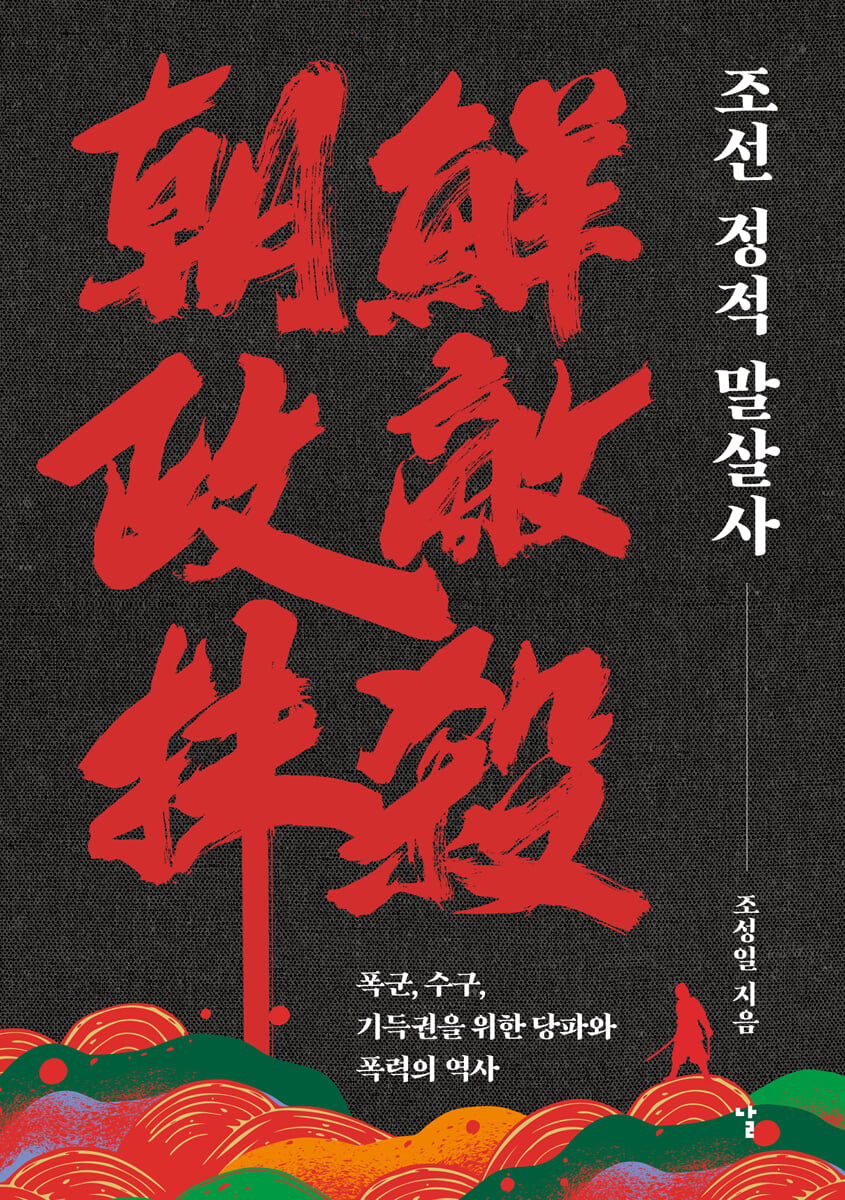
Joseon Dynasty political annihilation
 |
Description
Book Introduction
The killing of static that is still repeated today,
How did Joseon Dynasty scholars eliminate their political enemies?
A story about Joseon history that reads like a novel!
This book, "History of the Eradication of Political Politicians in Joseon," deals with the bloody historical "Sahwa (士禍)" that ran through the heart of the Joseon Dynasty.
The purges that we commonly remember by the acronym ‘Mugapgi-eul’ (Muosahwa, Gapjasahwa, Gimyosahwa, Eulsasahwa) can be roughly defined as ‘an incident in which the king joined hands with the Hun-gu faction and indiscriminately killed scholars of the Sarim faction.’
However, in this explanation, the author puts single quotation marks around the phrase 'killed indiscriminately' and asks us to think about it more deeply.
This is because we must ask ourselves, ‘What is history?’
To this question, people say things like Shin Chae-ho's "Struggle between the Self and the Non-Self" or E.
The answer often comes from a familiar definition, such as H. Carr's “uninterrupted dialogue between past and present.”
However, the author approaches the essence of what constitutes history and provides a primitive definition of history.
The essence of history is 'killing', and remembering the meaning between the lines that the subject of the passive 'killing' is 'the victor'.
“It is a sedimentary layer formed by the accumulation of killing and killing.”
Through this definition, the author eloquently asserts that there has never been a single moment in the flow of history without 'killing'.
So who is killing whom?
The powerful kill those who oppose them.
Between them, ‘power’ and ‘interest’ operate.
This could be expressed as 'static killing'.
Why does the author bring up the bloody, dark history of killing static at this point?
It is said that the law of history repeating itself still applies, so we can use it as a negative example now.
The author tells us to look at our modern history without going too far.
President Syngman Rhee did everything he could to get rid of Provisional Government President Kim Gu.
Didn't President Park Chung-hee try to bury President Kim Dae-jung in the Korea Strait without anyone knowing?
That's not all.
Well, what about now?
The author examines the four major historical events in detail with this very problem in mind.
The essence of the Four Great Purges is the bloody confrontation between the Hun-gu faction that seized power and the Sarim faction that criticized it.
However, the author says that to properly understand the story, one must understand the complex political dynamics that are intertwined like a web.
It must encompass everything from human relationships to ancestors, family, relatives, beliefs, academics, political parties, political positions, and even relationships with other families.
So this book looks at the story from this perspective.
How did Joseon Dynasty scholars eliminate their political enemies?
A story about Joseon history that reads like a novel!
This book, "History of the Eradication of Political Politicians in Joseon," deals with the bloody historical "Sahwa (士禍)" that ran through the heart of the Joseon Dynasty.
The purges that we commonly remember by the acronym ‘Mugapgi-eul’ (Muosahwa, Gapjasahwa, Gimyosahwa, Eulsasahwa) can be roughly defined as ‘an incident in which the king joined hands with the Hun-gu faction and indiscriminately killed scholars of the Sarim faction.’
However, in this explanation, the author puts single quotation marks around the phrase 'killed indiscriminately' and asks us to think about it more deeply.
This is because we must ask ourselves, ‘What is history?’
To this question, people say things like Shin Chae-ho's "Struggle between the Self and the Non-Self" or E.
The answer often comes from a familiar definition, such as H. Carr's “uninterrupted dialogue between past and present.”
However, the author approaches the essence of what constitutes history and provides a primitive definition of history.
The essence of history is 'killing', and remembering the meaning between the lines that the subject of the passive 'killing' is 'the victor'.
“It is a sedimentary layer formed by the accumulation of killing and killing.”
Through this definition, the author eloquently asserts that there has never been a single moment in the flow of history without 'killing'.
So who is killing whom?
The powerful kill those who oppose them.
Between them, ‘power’ and ‘interest’ operate.
This could be expressed as 'static killing'.
Why does the author bring up the bloody, dark history of killing static at this point?
It is said that the law of history repeating itself still applies, so we can use it as a negative example now.
The author tells us to look at our modern history without going too far.
President Syngman Rhee did everything he could to get rid of Provisional Government President Kim Gu.
Didn't President Park Chung-hee try to bury President Kim Dae-jung in the Korea Strait without anyone knowing?
That's not all.
Well, what about now?
The author examines the four major historical events in detail with this very problem in mind.
The essence of the Four Great Purges is the bloody confrontation between the Hun-gu faction that seized power and the Sarim faction that criticized it.
However, the author says that to properly understand the story, one must understand the complex political dynamics that are intertwined like a web.
It must encompass everything from human relationships to ancestors, family, relatives, beliefs, academics, political parties, political positions, and even relationships with other families.
So this book looks at the story from this perspective.
- You can preview some of the book's contents.
Preview
index
introduction
Introduction: What is Sahwa?
Chapter 1: The Rebellion of 1885
What on earth is the true identity of this 'sacho'?
Lee Geuk-don visits Yoo Ja-gwang
Yu Ja-gwang and Kim Il-son report to King Yeonsangun
Yeonsangun, see the four seasons
What does the 'Condolence Message' have to do with King Danjong?
Finally killing the Sarim scholars
Chapter 2: Gapjasahwa
“Our wages have changed!”
Who is Yeonsangun?
“Whoever spilled a glass on my clothes will be interrogated.”
Yeonsangun falls head over heels for Jang Nok-su's skirt.
Im Sa-hong reveals the full story of the deposed queen incident.
“The sin of the throne is worse than treason.”
Change the king to correct the wrongs
Chapter 3: The Mysterious Incident
The Hungu faction establishes a puppet king
King Jungjong appoints Jo Gwang-jo of the Sarim faction
The petition raised the status of the Sarim faction.
Issue a decree to select a queen
The Sarim faction actively pursues reform.
Weed out fake contributors and expel them
A leaf bearing the inscription "Juchowiwang" was discovered.
King Jungjong issues a secret edict
The Sinmumun Rebellion broke out
“Then my death is certain!”
Reform must be lightning fast to succeed.
Chapter 4: Eulsa Treaty
Namgondo goes, and Simjeongdo goes too
Kim An-ro rises to power
King Jungjong issues a secret order to execute Kim An-ro.
The Crown Prince ascends the throne and becomes King Injong
Race, dies after 7 months
Queen Munjeong, the cause of the Eulsa Massacre
The Eulsa Massacre ended with the wall writing incident.
Postscript: Ending the History of Political Retaliation
Introduction: What is Sahwa?
Chapter 1: The Rebellion of 1885
What on earth is the true identity of this 'sacho'?
Lee Geuk-don visits Yoo Ja-gwang
Yu Ja-gwang and Kim Il-son report to King Yeonsangun
Yeonsangun, see the four seasons
What does the 'Condolence Message' have to do with King Danjong?
Finally killing the Sarim scholars
Chapter 2: Gapjasahwa
“Our wages have changed!”
Who is Yeonsangun?
“Whoever spilled a glass on my clothes will be interrogated.”
Yeonsangun falls head over heels for Jang Nok-su's skirt.
Im Sa-hong reveals the full story of the deposed queen incident.
“The sin of the throne is worse than treason.”
Change the king to correct the wrongs
Chapter 3: The Mysterious Incident
The Hungu faction establishes a puppet king
King Jungjong appoints Jo Gwang-jo of the Sarim faction
The petition raised the status of the Sarim faction.
Issue a decree to select a queen
The Sarim faction actively pursues reform.
Weed out fake contributors and expel them
A leaf bearing the inscription "Juchowiwang" was discovered.
King Jungjong issues a secret edict
The Sinmumun Rebellion broke out
“Then my death is certain!”
Reform must be lightning fast to succeed.
Chapter 4: Eulsa Treaty
Namgondo goes, and Simjeongdo goes too
Kim An-ro rises to power
King Jungjong issues a secret order to execute Kim An-ro.
The Crown Prince ascends the throne and becomes King Injong
Race, dies after 7 months
Queen Munjeong, the cause of the Eulsa Massacre
The Eulsa Massacre ended with the wall writing incident.
Postscript: Ending the History of Political Retaliation
Detailed image
.jpg)
Into the book
These Sarim faction members entered politics not only during the reign of King Yeonsangun, but also during the reign of King Jungjong, symbolized by the outstanding reformer Jo Gwang-jo.
But during this process, I was not one of those who would sit still and take it.
When attacked, they counter with their own logic, but because they have too many flaws, their defensive logic is severely lacking.
Then what should we do?
In times like these, what is used is a personal attack on the opponent.
If that personal attack doesn't work, they have no other card to choose.
Other than expelling them from politics by any means necessary.
So, the Hun-gu faction creates an excuse that even the king cannot do anything about, and uses that as an excuse to launch an attack with the royal power on their back.
That was 'Sahwa'.
--- p.23
This wasn't the only bad relationship.
It was when Lee Geuk-don was the Minister of Personnel.
The Joseon Dynasty had to select Jeonrang (銓郞).
In accordance with the custom of the predecessor recommending the successor, the predecessor recommended Kim Il-son.
Usually, Jeonrang was a low-ranking official of the 5th rank, but Ijo Jeonrang was different.
Because they have the authority to appoint management.
The position of Ijo Jeonrang, a key position that recommended officials and non-officials in each department, was held by a prestigious civil servant. It was a position that was not only unlikely to be impeached, but also guaranteed promotion.
For Kim Il-son, it was a golden opportunity to dream big.
At this time, Lee Geuk-don also opposed Kim Il-son, citing his poor character.
--- p.29~30
After reading Kim Il-son's letter, King Yeonsangun became furious.
How dare you write down the mysterious secrets of your great-grandfather (Sejo) in a historical document and humiliate the royal family.
King Yeonsangun, who was impatient, gave high-grade horses to three of his special envoys and told them to send them to three places.
He said that the person who saw Kim Il-son first while guarding the crossroads should come and report.
Even if I couldn't see Kim Il-son's body, I wanted to confirm that he was being captured.
--- p.46
The lecturer Yoo Ja-gwang noticed this strange resemblance and concluded that the 'Epitaph of Condolence' subtly expressed Kim Jong-jik's resentment over the death of Danjong.
Moreover, considering that Yu Ja-gwang and Kim Jong-jik had not been on good terms with each other, this conclusion was natural.
When Kim Jong-jik became the governor of Haman County and visited the Haksa-ru there, he happened to see a signboard with a poem written by Yu Ja-gwang.
The moment he sees the signboard of the traitor who caused the 'Nam-i's Jade' incident, Kim Jong-jik feels a surge of anger that makes his blood boil.
--- p.53
Yeonsangun was a king with a certain degree of legitimacy.
He is the eldest son born to the queen mother, the first king born to the queen mother since King Danjong, who had the most perfect legitimacy in the Joseon Dynasty.
Danjong was born as the son of his father, King Munjong, who was the crown prince during the reign of King Sejong. He became the crown prince during the reign of King Munjong and then inherited the throne, so he was a king with the legitimacy of a crown prince and a grandson.
--- p.70
No matter how close you are, repeated criticism will inevitably damage your relationship of trust.
Hong Gwi-dal was gradually being pushed out of Yeonsangun's sight.
At this time, King Yeonsangun issued a decree to select a concubine, and included his granddaughter, the daughter of Hong Eon-guk (洪彦國), the son of Hong Gwi-dal.
Hong Gwi-dal told his son to tell his granddaughter, whom he was raising, that he would let her get better when she got better.
--- p.81
King Yeonsangun, overcome by emotion rather than alcohol, loses his reason and returns to Changgyeonggung Palace.
And he drags out the concubines who were leading the charge against his mother while crying.
The nobles are Jeong and Eom.
King Yeonsangun personally beat these concubines.
When his anger still remained, he called his half-brothers, Prince Anyang and Prince Bong-an, who were the sons of Lady Jeong, and ordered them to beat Lady Jeong and Lady Eom.
Anyang-gun said that he was beating someone at night without being able to see who was beating him, but Bong-an-gun noticed and was unable to lift the club.
When King Yeonsangun saw this, he ordered others to continue beating the two concubines, and eventually the two concubines died.
--- p.95
There are similar cases in our modern history.
The military coup symbolized by Park Chung-hee and Chun Doo-hwan is one of them.
If there is something wrong with a president who has legitimacy, then it is a matter of finding a legal way to correct it.
Just like President Syngman Rhee, we can make the problematic president step down of his own accord.
The next step is to elect the next president through an election as stipulated by the Constitution and laws.
Isn't that how the Jang Myun government was born?
--- p.107
Moreover, during the Joseon Dynasty, there was a system called ‘abandonment’ as a legal method.
The dictionary definition of abdication is “to pass on the throne to the legitimate prince.”
When the former king announces that he will pass the throne to the crown prince, his subjects first try to dissuade him by saying, “No, that won’t do.”
If you tell them to do that right away, it would be like inciting treason to establish another king.
So, kings sometimes stage 'abdication' movements as a means to control subjects who are shaking their royal authority.
--- p.115
But would the Hungu faction simply take the hit? It's human nature to defend when attacked, and if defense isn't enough, to attack instead.
However, it is not as if the power of the Hun-gu faction has noticeably weakened.
No matter how much the Sarim faction promoted fairness and common sense, the Hun-gu faction could not turn a blind eye to this, as it violated not only their morality but also their interests.
Eventually, the Hun-gu faction begins to counterattack.
--- p.145
Then Jo Gwang-jo said to his men, “When I die, make my coffin thin and not thick.
“It is difficult to go a long way,” he said.
After finishing writing and giving instructions, he called the landlord and said, “I wanted to repay you for staying at your house, but instead of being able to repay you, I showed you a bad side and defiled your house. I will regret it even if I die.”
--- p.166
What happened when the Sarim faction was overthrown by the Gyeomyo Incident?
All the reforms that had been done so far have become a dead letter.
That's how difficult reform is.
Therefore, reform is a difficult task to succeed in, to the point that it can be said to be accompanied by the pain of ‘skinning oneself off’, as the Chinese character ‘改革’ suggests.
Stagnant water becomes rotten, and rotten water becomes a breeding ground for all kinds of germs that threaten human life.
So, reform is a task of our time that must be done, even if it is difficult.
--- p.172
They say that power is not shared even between the rich, so from Soyun's perspective, the necessary conditions for making Prince Gyeongwon the crown prince had already been created, so naturally she would have secretly pursued this.
If you overcome your young age, you will also meet the sufficient conditions.
As time goes by, this too will be resolved.
Of course, the Crown Prince was already twenty years old at this time, and he could see his son who would become the Crown Prince, so Prince Gyeongwon might be distant from the throne.
Even so, all we have to do is tie the hands and feet of Daeyun and Kim Anro, the Crown Prince's supporters.
--- p.189
The force we should pay attention to here is 'Soyun'.
Soyun's goal became clearer.
Since Kim An-ro, who had been protecting the crown prince, had disappeared, it became easier to make Prince Gyeongwon the crown prince according to their own wishes.
However, there is a prerequisite to achieving this goal.
The existence of the Crown Prince must disappear.
--- p.192
The meaning of these words was clear.
The word 'traitor' refers to the treasonous plot of Gyerim-gun and Bongseong-gun, and it signifies that the Eulsa Massacre was not yet over.
In fact, it was customary to burn the wall posters as soon as they were discovered and hang them on a Buddhist altar so as not to cause trouble.
So, some argue that it was a deliberate plot by Queen Munjeong to drive out Yun Im and the Daeyun Sarim.
We cannot rule out the possibility of that happening.
--- p.208
When I started the book and decided on the title, I had a lot of trouble deciding whether to use the word 'static'.
But in conclusion, it seems that there is no other way to directly and honestly express the power struggle, including the Sahwa incident.
Now, I use these words in the hope that words like 'killing enemies' or 'political revenge' will never appear again in our history.
But during this process, I was not one of those who would sit still and take it.
When attacked, they counter with their own logic, but because they have too many flaws, their defensive logic is severely lacking.
Then what should we do?
In times like these, what is used is a personal attack on the opponent.
If that personal attack doesn't work, they have no other card to choose.
Other than expelling them from politics by any means necessary.
So, the Hun-gu faction creates an excuse that even the king cannot do anything about, and uses that as an excuse to launch an attack with the royal power on their back.
That was 'Sahwa'.
--- p.23
This wasn't the only bad relationship.
It was when Lee Geuk-don was the Minister of Personnel.
The Joseon Dynasty had to select Jeonrang (銓郞).
In accordance with the custom of the predecessor recommending the successor, the predecessor recommended Kim Il-son.
Usually, Jeonrang was a low-ranking official of the 5th rank, but Ijo Jeonrang was different.
Because they have the authority to appoint management.
The position of Ijo Jeonrang, a key position that recommended officials and non-officials in each department, was held by a prestigious civil servant. It was a position that was not only unlikely to be impeached, but also guaranteed promotion.
For Kim Il-son, it was a golden opportunity to dream big.
At this time, Lee Geuk-don also opposed Kim Il-son, citing his poor character.
--- p.29~30
After reading Kim Il-son's letter, King Yeonsangun became furious.
How dare you write down the mysterious secrets of your great-grandfather (Sejo) in a historical document and humiliate the royal family.
King Yeonsangun, who was impatient, gave high-grade horses to three of his special envoys and told them to send them to three places.
He said that the person who saw Kim Il-son first while guarding the crossroads should come and report.
Even if I couldn't see Kim Il-son's body, I wanted to confirm that he was being captured.
--- p.46
The lecturer Yoo Ja-gwang noticed this strange resemblance and concluded that the 'Epitaph of Condolence' subtly expressed Kim Jong-jik's resentment over the death of Danjong.
Moreover, considering that Yu Ja-gwang and Kim Jong-jik had not been on good terms with each other, this conclusion was natural.
When Kim Jong-jik became the governor of Haman County and visited the Haksa-ru there, he happened to see a signboard with a poem written by Yu Ja-gwang.
The moment he sees the signboard of the traitor who caused the 'Nam-i's Jade' incident, Kim Jong-jik feels a surge of anger that makes his blood boil.
--- p.53
Yeonsangun was a king with a certain degree of legitimacy.
He is the eldest son born to the queen mother, the first king born to the queen mother since King Danjong, who had the most perfect legitimacy in the Joseon Dynasty.
Danjong was born as the son of his father, King Munjong, who was the crown prince during the reign of King Sejong. He became the crown prince during the reign of King Munjong and then inherited the throne, so he was a king with the legitimacy of a crown prince and a grandson.
--- p.70
No matter how close you are, repeated criticism will inevitably damage your relationship of trust.
Hong Gwi-dal was gradually being pushed out of Yeonsangun's sight.
At this time, King Yeonsangun issued a decree to select a concubine, and included his granddaughter, the daughter of Hong Eon-guk (洪彦國), the son of Hong Gwi-dal.
Hong Gwi-dal told his son to tell his granddaughter, whom he was raising, that he would let her get better when she got better.
--- p.81
King Yeonsangun, overcome by emotion rather than alcohol, loses his reason and returns to Changgyeonggung Palace.
And he drags out the concubines who were leading the charge against his mother while crying.
The nobles are Jeong and Eom.
King Yeonsangun personally beat these concubines.
When his anger still remained, he called his half-brothers, Prince Anyang and Prince Bong-an, who were the sons of Lady Jeong, and ordered them to beat Lady Jeong and Lady Eom.
Anyang-gun said that he was beating someone at night without being able to see who was beating him, but Bong-an-gun noticed and was unable to lift the club.
When King Yeonsangun saw this, he ordered others to continue beating the two concubines, and eventually the two concubines died.
--- p.95
There are similar cases in our modern history.
The military coup symbolized by Park Chung-hee and Chun Doo-hwan is one of them.
If there is something wrong with a president who has legitimacy, then it is a matter of finding a legal way to correct it.
Just like President Syngman Rhee, we can make the problematic president step down of his own accord.
The next step is to elect the next president through an election as stipulated by the Constitution and laws.
Isn't that how the Jang Myun government was born?
--- p.107
Moreover, during the Joseon Dynasty, there was a system called ‘abandonment’ as a legal method.
The dictionary definition of abdication is “to pass on the throne to the legitimate prince.”
When the former king announces that he will pass the throne to the crown prince, his subjects first try to dissuade him by saying, “No, that won’t do.”
If you tell them to do that right away, it would be like inciting treason to establish another king.
So, kings sometimes stage 'abdication' movements as a means to control subjects who are shaking their royal authority.
--- p.115
But would the Hungu faction simply take the hit? It's human nature to defend when attacked, and if defense isn't enough, to attack instead.
However, it is not as if the power of the Hun-gu faction has noticeably weakened.
No matter how much the Sarim faction promoted fairness and common sense, the Hun-gu faction could not turn a blind eye to this, as it violated not only their morality but also their interests.
Eventually, the Hun-gu faction begins to counterattack.
--- p.145
Then Jo Gwang-jo said to his men, “When I die, make my coffin thin and not thick.
“It is difficult to go a long way,” he said.
After finishing writing and giving instructions, he called the landlord and said, “I wanted to repay you for staying at your house, but instead of being able to repay you, I showed you a bad side and defiled your house. I will regret it even if I die.”
--- p.166
What happened when the Sarim faction was overthrown by the Gyeomyo Incident?
All the reforms that had been done so far have become a dead letter.
That's how difficult reform is.
Therefore, reform is a difficult task to succeed in, to the point that it can be said to be accompanied by the pain of ‘skinning oneself off’, as the Chinese character ‘改革’ suggests.
Stagnant water becomes rotten, and rotten water becomes a breeding ground for all kinds of germs that threaten human life.
So, reform is a task of our time that must be done, even if it is difficult.
--- p.172
They say that power is not shared even between the rich, so from Soyun's perspective, the necessary conditions for making Prince Gyeongwon the crown prince had already been created, so naturally she would have secretly pursued this.
If you overcome your young age, you will also meet the sufficient conditions.
As time goes by, this too will be resolved.
Of course, the Crown Prince was already twenty years old at this time, and he could see his son who would become the Crown Prince, so Prince Gyeongwon might be distant from the throne.
Even so, all we have to do is tie the hands and feet of Daeyun and Kim Anro, the Crown Prince's supporters.
--- p.189
The force we should pay attention to here is 'Soyun'.
Soyun's goal became clearer.
Since Kim An-ro, who had been protecting the crown prince, had disappeared, it became easier to make Prince Gyeongwon the crown prince according to their own wishes.
However, there is a prerequisite to achieving this goal.
The existence of the Crown Prince must disappear.
--- p.192
The meaning of these words was clear.
The word 'traitor' refers to the treasonous plot of Gyerim-gun and Bongseong-gun, and it signifies that the Eulsa Massacre was not yet over.
In fact, it was customary to burn the wall posters as soon as they were discovered and hang them on a Buddhist altar so as not to cause trouble.
So, some argue that it was a deliberate plot by Queen Munjeong to drive out Yun Im and the Daeyun Sarim.
We cannot rule out the possibility of that happening.
--- p.208
When I started the book and decided on the title, I had a lot of trouble deciding whether to use the word 'static'.
But in conclusion, it seems that there is no other way to directly and honestly express the power struggle, including the Sahwa incident.
Now, I use these words in the hope that words like 'killing enemies' or 'political revenge' will never appear again in our history.
--- p.215
Publisher's Review
The Murder of a Scholar in the Year of the Ox
The first purge of Joseon, the Muo Purge (戊午士禍), occurred in 1498 (the 4th year of King Yeonsangun's reign).
It began when Lee Geuk-don (李克墩, 1435-1503), the Left State Councillor and a senior official in the Office of the Royal Secretariat that compiled the Annals of King Seongjong, discovered a manuscript written by Kim Il-son (金馹孫, 1464-1498), a historian, among a pile of manuscripts recording his misdeeds.
There was a story about Lee Geuk-don, who, during his time as governor of Jeolla Province, did not offer incense toward Hanyang, where the funeral of Queen Jeonghui, wife of King Sejo, was held, and even had a gisaeng present.
I ask to have it deleted, but it is refused.
Lee Geuk-don, who had to get rid of this traitor at all costs, goes to see the traitor Yu Ja-gwang, and the incident escalates into a bigger mess.
Here, even the personal ill-fated relationship between Lee Geuk-don, who prevented Kim Il-son from passing the state examination, and Kim Jong-jik, who removed Yu Ja-gwang's plaque from the school library, was flowing between the lines.
Anyway, this incident brought to light even the secret story of King Sejo (the story of King Sejo summoning his daughter-in-law, the issue of Queen Danjong's Soryeong), and ultimately even the [Condolence Letter of the Righteous Emperor] by Kim Jong-jik (1431-1492), Kim Il-son's teacher and a symbol of the Sarim, was summoned.
The condolence poem is a poem by Kim Jong-jik criticizing the Gye-yu Jeongnan, in which King Danjong usurped the throne from King Sejo, by comparing it to Emperor Yi of Chu of China being killed by Xiang Yu.
Yeonsangun, enraged by this situation, ends up ordering the priest to bring him the sagebrush, which he should not have done, and sees it for himself.
Then, they indiscriminately arrest all those involved, including Kim Jong-jik's disciples, and take their lives.
The Gapja Year Scholar Murder Incident
The Gapja Purge (甲子士禍) that occurred in 1504 (the 10th year of King Yeonsangun's reign) was different in nature from the Muo Purge.
If the Muosahwa was a typical attack by the Hun-gu faction against the Sarim faction, the Gapjasahwa was purely a personal revenge plot by King Yeonsangun for his biological mother.
So, in the Gapjasahwa, both the Sarim faction and the Hun-gu faction were sacrificed.
The beginning was when King Yeonsangun heard the secret surrounding the death of his biological mother, deposed Queen Yun (Queen Jeheon), from Im Sa-hong.
Yeonsangun sees his maternal grandfather's name written as 'Yun Gi-Gyeon' in the biography of his father, Seongjong.
I was suspicious and asked if I had misspelled 'Yunho'.
I was tilting my head in confusion after hearing the answer that it was written correctly.
After hearing this story at the drinking party that day, King Yeonsangun ran straight to the palace and beat to death the nobles Jeong and Eom, who were jealous of his biological mother, Lady Yun. He also went so far as to ask his grandmother, Queen Insu, “Why did you kill my mother?”
As this incident spreads like wildfire, people related to the death of his biological mother, Lady Yun, begin to be arrested.
Lee Se-jwa, who was punished for spilling a glass of alcohol at a banquet and wetting King Yeonsangun's clothes, was also exterminated from his family due to his connection to the Yun clan's assassination attempt by taking poison.
In the process, it is said that King Yeonsangun executed a total of 230 people, including the twelve officials known as the 'Twelve Gans', including Yun Pil-sang and Han Myeong-hoe, who were involved in the death of his biological mother.
The murder of a scholar in the year of Gimiyo
The Gimi Purge (己卯士禍) was an incident in 1519 in which King Jungjong, who had been forcibly(?) installed as king after dethroning King Yeonsangun for his unfilial conduct, joined hands with the Hun-gu faction and carried out a large-scale purge of the Sarim faction.
King Jungjong, the half-brother of King Yeonsangun, was enthroned by the rebels without his knowledge.
The rebels needed a puppet king they could manipulate rather than a smart king.
However, after about ten years of his accession to the throne, the deaths of the key leaders of the rebellion created a power vacuum in the Hun-gu faction.
At that time, King Jungjong, who wanted to pursue his own politics, appointed members of the Sarim faction, including Jo Gwang-jo (1482-1519), as a counterweight to the Hun-gu faction.
The Sarim faction began to implement several reform measures.
He abolished the Sogyeokseo, saying that he would eliminate the remnants of Taoism, and implemented the 'Hyeonryanggwa', saying that he would widely recruit talented people.
He widely distributed Hyangyak, saying it was for the benefit of the people.
And the Sarim faction only expressed their opinions several times, but they brought up the issue of ‘fake achievements’ that had been kept quiet by the Hun-gu faction’s cold-bloodedness.
The number of 'Jeonggukgongsin (靖國功臣),' those who contributed to the Jungjong Restoration, is 117, the largest number ever.
This is because there were many fake officials who had no merit.
The Sarim faction, including Jo Gwang-jo, finally obtained permission from King Jungjong to identify fake meritorious subjects and strip them of their merits.
However, the Hun-gu faction, which was already feeling a sense of crisis due to the Sarim faction's reform measures, launched a counterattack.
Nam Gon, Sim Jeong, Hong Gyeong-ju, and other Hun-gu faction members secretly visited King Jungjong at night and ordered him to arrest the Sarim faction.
King Jungjong, who was suffering from reform fatigue, also responded to their demands.
The Gyeomyo Incident, which began in this way, arrested all the reformist forces of the Sarim faction, including Jo Gwang-jo, and took their lives or exiled them.
The Eulsa Year Scholar Murder Incident
The Eulsa Massacre (乙巳士禍) that occurred in 1545, the year of King Myeongjong's accession to the throne, was a power struggle that arose when the Papyeong Yun clan, the maternal forces of King Jungjong's first wife, Queen Janggyeong, and his second wife, Queen Munjeong, split into factions.
When Queen Janggyeong, who gave birth to Crown Prince Ho, dies, something happens that shakes up the crown prince's position.
In particular, the issue of Prince Bokseong, the eldest son and illegitimate son of King Jungjong born to Lady Park Gyeongbin, was a hot potato.
In addition, the issue of King Jungjong's succession became complicated when Queen Munjeong gave birth to Prince Gyeongwon later.
The 'Jakseo Incident' (the incident of hanging a burnt rat) in 1527 and the 'Gajakindu Incident' (the incident of making a human head doll) in 1533 shook the Crown Prince's position.
Then, the Crown Prince's guardian, Kim An-ro (father-in-law of Princess Ho-hye, daughter of Queen Janggyeong) and his maternal uncle, Yun Im (called 'Dae-yun'), took the lead in protecting the Crown Prince.
In the meantime, King Jungjong died, and Crown Prince Injong immediately ascended to the throne.
In this situation, the struggle for the throne must stop.
But Soyun, who held onto a slim hope, did not give up.
Because his family was not in good health and he had no sons.
However, King Injong died only seven months after ascending to the throne.
Injong left a will to abdicate the throne to Grand Prince Gyeongwon.
Prince Gyeongwon ascended to the throne as King Myeongjong.
So, since Soyun's side achieved what they wanted, there should be no more bloodshed.
But that wasn't the case.
Queen Munjeong, who was appointed to the post of Suryeomcheomjeong because Grand Prince Gyeongwon was young, was burning with a desire for revenge against Daeyun, who had constantly shaken her and used her younger brothers as bait.
Queen Munjeong secretly ordered her older brothers, Yun Won-ro and Yun Won-hyeong, to unite their forces and then plot a rebellion.
The targets were Prince Gyerim, who was Yun Im's nephew (adopted son of Prince Gyeseong, the third son of King Seongjong) and Prince Bongseong, the son of Lady Hong Hui-bin.
In this way, those involved are arrested and punished on a large scale.
However, unlike other purges, the Eulsa Massacre did not end here.
In 1547, the 'Yangjae Station Wall Plaque Incident' (a wall placard criticizing Queen Munjeong) was used again to complete the purge by wiping out the Sarim faction, claiming they were remnants of the Daeyun faction.
The historical events discussed above are not dead history stuffed in the past, but rather a ‘mirror of history’ that still reflects us today.
Looking at the current conflict between the camps, which is so fierce and even cruel, it is so similar to the purge that it gives me goosebumps.
It's still repeating
Kill the static!
Jaja says.
When I started this book, I struggled with whether to use the word 'static'.
In conclusion, it seems that there is no other way to directly and honestly express the power struggle, including the Sahwa incident.
I hope that words like "killing enemies" and "political revenge" will never appear again in our history. The author, who uses these words in the wind, hopes that the dark history will end with the determination and wisdom of Gordian, who cuts the tangled knot with a single stroke.
These days, the words ‘historical evaluation’ and ‘historical judgment’ are frequently mentioned in our society.
This is a sign that something is happening in our society that is destroying fairness and justice.
Such confusion often stems from the reckless actions of those in power.
In times like these, 'history' warns us not to act rashly.
But when you're intoxicated with power, you tend to ignore warnings like these.
This is because they mistakenly believe that the sword of power they wield is the sword of historical judgment.
So the sword of history should not be used to kill anyone, but rather as a means to create the right history.
The first purge of Joseon, the Muo Purge (戊午士禍), occurred in 1498 (the 4th year of King Yeonsangun's reign).
It began when Lee Geuk-don (李克墩, 1435-1503), the Left State Councillor and a senior official in the Office of the Royal Secretariat that compiled the Annals of King Seongjong, discovered a manuscript written by Kim Il-son (金馹孫, 1464-1498), a historian, among a pile of manuscripts recording his misdeeds.
There was a story about Lee Geuk-don, who, during his time as governor of Jeolla Province, did not offer incense toward Hanyang, where the funeral of Queen Jeonghui, wife of King Sejo, was held, and even had a gisaeng present.
I ask to have it deleted, but it is refused.
Lee Geuk-don, who had to get rid of this traitor at all costs, goes to see the traitor Yu Ja-gwang, and the incident escalates into a bigger mess.
Here, even the personal ill-fated relationship between Lee Geuk-don, who prevented Kim Il-son from passing the state examination, and Kim Jong-jik, who removed Yu Ja-gwang's plaque from the school library, was flowing between the lines.
Anyway, this incident brought to light even the secret story of King Sejo (the story of King Sejo summoning his daughter-in-law, the issue of Queen Danjong's Soryeong), and ultimately even the [Condolence Letter of the Righteous Emperor] by Kim Jong-jik (1431-1492), Kim Il-son's teacher and a symbol of the Sarim, was summoned.
The condolence poem is a poem by Kim Jong-jik criticizing the Gye-yu Jeongnan, in which King Danjong usurped the throne from King Sejo, by comparing it to Emperor Yi of Chu of China being killed by Xiang Yu.
Yeonsangun, enraged by this situation, ends up ordering the priest to bring him the sagebrush, which he should not have done, and sees it for himself.
Then, they indiscriminately arrest all those involved, including Kim Jong-jik's disciples, and take their lives.
The Gapja Year Scholar Murder Incident
The Gapja Purge (甲子士禍) that occurred in 1504 (the 10th year of King Yeonsangun's reign) was different in nature from the Muo Purge.
If the Muosahwa was a typical attack by the Hun-gu faction against the Sarim faction, the Gapjasahwa was purely a personal revenge plot by King Yeonsangun for his biological mother.
So, in the Gapjasahwa, both the Sarim faction and the Hun-gu faction were sacrificed.
The beginning was when King Yeonsangun heard the secret surrounding the death of his biological mother, deposed Queen Yun (Queen Jeheon), from Im Sa-hong.
Yeonsangun sees his maternal grandfather's name written as 'Yun Gi-Gyeon' in the biography of his father, Seongjong.
I was suspicious and asked if I had misspelled 'Yunho'.
I was tilting my head in confusion after hearing the answer that it was written correctly.
After hearing this story at the drinking party that day, King Yeonsangun ran straight to the palace and beat to death the nobles Jeong and Eom, who were jealous of his biological mother, Lady Yun. He also went so far as to ask his grandmother, Queen Insu, “Why did you kill my mother?”
As this incident spreads like wildfire, people related to the death of his biological mother, Lady Yun, begin to be arrested.
Lee Se-jwa, who was punished for spilling a glass of alcohol at a banquet and wetting King Yeonsangun's clothes, was also exterminated from his family due to his connection to the Yun clan's assassination attempt by taking poison.
In the process, it is said that King Yeonsangun executed a total of 230 people, including the twelve officials known as the 'Twelve Gans', including Yun Pil-sang and Han Myeong-hoe, who were involved in the death of his biological mother.
The murder of a scholar in the year of Gimiyo
The Gimi Purge (己卯士禍) was an incident in 1519 in which King Jungjong, who had been forcibly(?) installed as king after dethroning King Yeonsangun for his unfilial conduct, joined hands with the Hun-gu faction and carried out a large-scale purge of the Sarim faction.
King Jungjong, the half-brother of King Yeonsangun, was enthroned by the rebels without his knowledge.
The rebels needed a puppet king they could manipulate rather than a smart king.
However, after about ten years of his accession to the throne, the deaths of the key leaders of the rebellion created a power vacuum in the Hun-gu faction.
At that time, King Jungjong, who wanted to pursue his own politics, appointed members of the Sarim faction, including Jo Gwang-jo (1482-1519), as a counterweight to the Hun-gu faction.
The Sarim faction began to implement several reform measures.
He abolished the Sogyeokseo, saying that he would eliminate the remnants of Taoism, and implemented the 'Hyeonryanggwa', saying that he would widely recruit talented people.
He widely distributed Hyangyak, saying it was for the benefit of the people.
And the Sarim faction only expressed their opinions several times, but they brought up the issue of ‘fake achievements’ that had been kept quiet by the Hun-gu faction’s cold-bloodedness.
The number of 'Jeonggukgongsin (靖國功臣),' those who contributed to the Jungjong Restoration, is 117, the largest number ever.
This is because there were many fake officials who had no merit.
The Sarim faction, including Jo Gwang-jo, finally obtained permission from King Jungjong to identify fake meritorious subjects and strip them of their merits.
However, the Hun-gu faction, which was already feeling a sense of crisis due to the Sarim faction's reform measures, launched a counterattack.
Nam Gon, Sim Jeong, Hong Gyeong-ju, and other Hun-gu faction members secretly visited King Jungjong at night and ordered him to arrest the Sarim faction.
King Jungjong, who was suffering from reform fatigue, also responded to their demands.
The Gyeomyo Incident, which began in this way, arrested all the reformist forces of the Sarim faction, including Jo Gwang-jo, and took their lives or exiled them.
The Eulsa Year Scholar Murder Incident
The Eulsa Massacre (乙巳士禍) that occurred in 1545, the year of King Myeongjong's accession to the throne, was a power struggle that arose when the Papyeong Yun clan, the maternal forces of King Jungjong's first wife, Queen Janggyeong, and his second wife, Queen Munjeong, split into factions.
When Queen Janggyeong, who gave birth to Crown Prince Ho, dies, something happens that shakes up the crown prince's position.
In particular, the issue of Prince Bokseong, the eldest son and illegitimate son of King Jungjong born to Lady Park Gyeongbin, was a hot potato.
In addition, the issue of King Jungjong's succession became complicated when Queen Munjeong gave birth to Prince Gyeongwon later.
The 'Jakseo Incident' (the incident of hanging a burnt rat) in 1527 and the 'Gajakindu Incident' (the incident of making a human head doll) in 1533 shook the Crown Prince's position.
Then, the Crown Prince's guardian, Kim An-ro (father-in-law of Princess Ho-hye, daughter of Queen Janggyeong) and his maternal uncle, Yun Im (called 'Dae-yun'), took the lead in protecting the Crown Prince.
In the meantime, King Jungjong died, and Crown Prince Injong immediately ascended to the throne.
In this situation, the struggle for the throne must stop.
But Soyun, who held onto a slim hope, did not give up.
Because his family was not in good health and he had no sons.
However, King Injong died only seven months after ascending to the throne.
Injong left a will to abdicate the throne to Grand Prince Gyeongwon.
Prince Gyeongwon ascended to the throne as King Myeongjong.
So, since Soyun's side achieved what they wanted, there should be no more bloodshed.
But that wasn't the case.
Queen Munjeong, who was appointed to the post of Suryeomcheomjeong because Grand Prince Gyeongwon was young, was burning with a desire for revenge against Daeyun, who had constantly shaken her and used her younger brothers as bait.
Queen Munjeong secretly ordered her older brothers, Yun Won-ro and Yun Won-hyeong, to unite their forces and then plot a rebellion.
The targets were Prince Gyerim, who was Yun Im's nephew (adopted son of Prince Gyeseong, the third son of King Seongjong) and Prince Bongseong, the son of Lady Hong Hui-bin.
In this way, those involved are arrested and punished on a large scale.
However, unlike other purges, the Eulsa Massacre did not end here.
In 1547, the 'Yangjae Station Wall Plaque Incident' (a wall placard criticizing Queen Munjeong) was used again to complete the purge by wiping out the Sarim faction, claiming they were remnants of the Daeyun faction.
The historical events discussed above are not dead history stuffed in the past, but rather a ‘mirror of history’ that still reflects us today.
Looking at the current conflict between the camps, which is so fierce and even cruel, it is so similar to the purge that it gives me goosebumps.
It's still repeating
Kill the static!
Jaja says.
When I started this book, I struggled with whether to use the word 'static'.
In conclusion, it seems that there is no other way to directly and honestly express the power struggle, including the Sahwa incident.
I hope that words like "killing enemies" and "political revenge" will never appear again in our history. The author, who uses these words in the wind, hopes that the dark history will end with the determination and wisdom of Gordian, who cuts the tangled knot with a single stroke.
These days, the words ‘historical evaluation’ and ‘historical judgment’ are frequently mentioned in our society.
This is a sign that something is happening in our society that is destroying fairness and justice.
Such confusion often stems from the reckless actions of those in power.
In times like these, 'history' warns us not to act rashly.
But when you're intoxicated with power, you tend to ignore warnings like these.
This is because they mistakenly believe that the sword of power they wield is the sword of historical judgment.
So the sword of history should not be used to kill anyone, but rather as a means to create the right history.
GOODS SPECIFICS
- Date of issue: March 15, 2025
- Page count, weight, size: 216 pages | 248g | 149*210*11mm
- ISBN13: 9791168103382
- ISBN10: 116810338X
You may also like
카테고리
korean


korean

![GQ KOREA Mark (Monthly): December [2025]](http://librairie.coreenne.fr/cdn/shop/files/8ef265dbbfbf186523ed75ba7319009d.jpg?v=1765340328&width=3840)


