

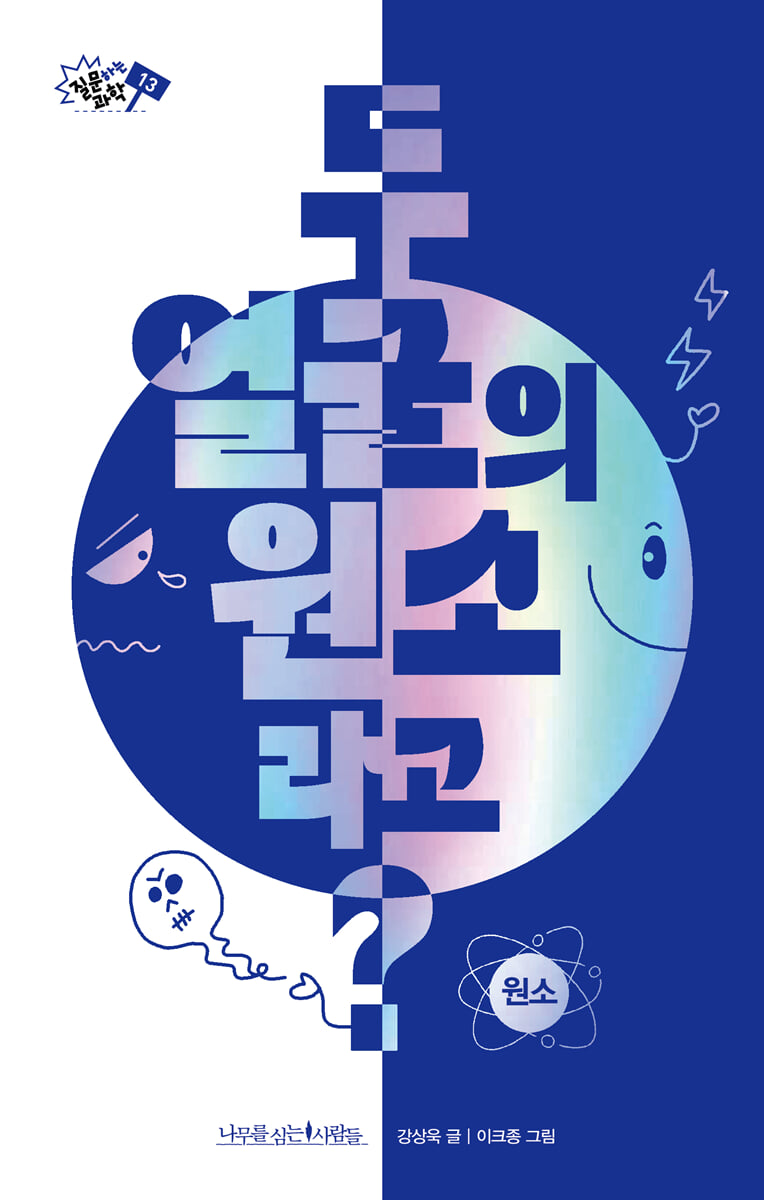
A two-faced element?
 |
Description
Book Introduction
Elements are a window to understanding the world and a key to opening the future world!
From gunpowder to the atomic bomb, from the Bronze Age to the Space Age
The world of elements that led the history of human civilization
[Questioning Science] Series Volume 13, "An Element with Two Faces?" is a science book for young adults that teaches the basic concepts of chemical elements, the basic units of matter and driving cutting-edge technological innovation, their characteristics, the history of their discovery, and how each element is utilized in real life.
Of the 118 chemical elements known to date, this book focuses on the essential elements you need to know, as well as the key elements that are driving cutting-edge industries such as energy technology, medicine, and mobile communications, which are becoming increasingly important.
It's full of new and useful information, from familiar elements like hydrogen and oxygen to newly emerging elements like lithium, germanium, and francium.
You can also learn essential chemistry knowledge in everyday life through four unfolding comics.
From gunpowder to the atomic bomb, from the Bronze Age to the Space Age
The world of elements that led the history of human civilization
[Questioning Science] Series Volume 13, "An Element with Two Faces?" is a science book for young adults that teaches the basic concepts of chemical elements, the basic units of matter and driving cutting-edge technological innovation, their characteristics, the history of their discovery, and how each element is utilized in real life.
Of the 118 chemical elements known to date, this book focuses on the essential elements you need to know, as well as the key elements that are driving cutting-edge industries such as energy technology, medicine, and mobile communications, which are becoming increasingly important.
It's full of new and useful information, from familiar elements like hydrogen and oxygen to newly emerging elements like lithium, germanium, and francium.
You can also learn essential chemistry knowledge in everyday life through four unfolding comics.
- You can preview some of the book's contents.
Preview
index
prolog
periodic table
Chapter 1: Gaining a Deeper View of the World Through Chemistry
1 Chemistry is Lego blocks?
2 Humans are made of elements?
The three elements have two faces?
4 Can chemistry solve environmental problems?
5 Who discovered oxygen? Oxygen (O)
6. What element was first discovered in urine? Phosphorus (P)
7. What happens when plants lack magnesium? Magnesium (Mg)
Chemistry in Daily Life ① Sausages are as harmful as cigarette smoke?
Chapter 2: Chemistry is the core of energy technology
8. What is the core element of battery technology? Lithium (Li).
9. Is there an element that symbolizes challenge? Sodium (Na).
10. What is the lightest element? Hydrogen (H)
11. What element was once called the "devil's copper"? Nickel (Ni).
12. Zinc, a nutrient, generates electricity? Zinc (Zn)
13 What role does boron play in nuclear fusion? Boron (B)
14. Did Hwang change the history of war? Hwang (S)
Chapter 3: Elements whose values have changed over time
15. Slows down aging? Selenium (Se)
Is silver always second?
17. What element ushered in the Bronze Age? Copper (Cu).
18. What element was considered "fake silver"? Platinum (Pt).
19 Chlorine in tap water used as a chemical weapon? Chlorine (Cl)
20 Aluminum used in high-end tableware? Aluminum (AI)
21 Why Did Napoleon Lose His Russian Expedition? (Sn)
Chemistry common sense in daily life ② Cleaning the bathroom leads to a hole!!
Chapter 4: Are heavy metals really that scary?
22. Hiding a dagger in vivid colors? Cadmium (Cd)
23 Stainless steel is a collaboration between Britain and France? Chromium (Cr)
24 Lead linked to the fall of Rome? Lead (Pb)
25. What element was used as a poison in medieval Europe? Arsenic (As)
26 Was mercury the key to alchemy? Mercury (Hg)
Chemistry in Daily Life ③ Be careful of hot Jjamppong!
Chapter 5 Elements Related to Life
27. What element is the solution to food shortages? Nitrogen (N).
28. Cesium makes you fear radiation? Cesium (Cs)
29 Are potassium and potassium the same element? Potassium (K)
30 Which country is Francium associated with? Francium (Fr)
31 Is calcium only important for bones? Calcium (Ca)
32. What element contributes to the prevention of tooth decay? Fluorine (F).
33. What element is used to diagnose thyroid cancer? Iodine (I)
34 Is gold used in cancer treatment? Gold (Au)
Chemical knowledge in daily life ④ The dangers of charcoal grilling!!
Chapter 6: Elements Driving Technological Innovation
35 Carbon, the Master of Transformation? Carbon (C)
36 Is silicon related to sand? Silicon (Si)
37. What element is named after a fairy who torments miners? Cobalt (Co)
38 What role does germanium play in optical fibers? Germanium (Ge)
39. What element is associated with high-performance speakers? Beryllium (Be).
Titanium is a symbol of strength on the inside and soft on the outside? Titanium (Ti)
periodic table
Chapter 1: Gaining a Deeper View of the World Through Chemistry
1 Chemistry is Lego blocks?
2 Humans are made of elements?
The three elements have two faces?
4 Can chemistry solve environmental problems?
5 Who discovered oxygen? Oxygen (O)
6. What element was first discovered in urine? Phosphorus (P)
7. What happens when plants lack magnesium? Magnesium (Mg)
Chemistry in Daily Life ① Sausages are as harmful as cigarette smoke?
Chapter 2: Chemistry is the core of energy technology
8. What is the core element of battery technology? Lithium (Li).
9. Is there an element that symbolizes challenge? Sodium (Na).
10. What is the lightest element? Hydrogen (H)
11. What element was once called the "devil's copper"? Nickel (Ni).
12. Zinc, a nutrient, generates electricity? Zinc (Zn)
13 What role does boron play in nuclear fusion? Boron (B)
14. Did Hwang change the history of war? Hwang (S)
Chapter 3: Elements whose values have changed over time
15. Slows down aging? Selenium (Se)
Is silver always second?
17. What element ushered in the Bronze Age? Copper (Cu).
18. What element was considered "fake silver"? Platinum (Pt).
19 Chlorine in tap water used as a chemical weapon? Chlorine (Cl)
20 Aluminum used in high-end tableware? Aluminum (AI)
21 Why Did Napoleon Lose His Russian Expedition? (Sn)
Chemistry common sense in daily life ② Cleaning the bathroom leads to a hole!!
Chapter 4: Are heavy metals really that scary?
22. Hiding a dagger in vivid colors? Cadmium (Cd)
23 Stainless steel is a collaboration between Britain and France? Chromium (Cr)
24 Lead linked to the fall of Rome? Lead (Pb)
25. What element was used as a poison in medieval Europe? Arsenic (As)
26 Was mercury the key to alchemy? Mercury (Hg)
Chemistry in Daily Life ③ Be careful of hot Jjamppong!
Chapter 5 Elements Related to Life
27. What element is the solution to food shortages? Nitrogen (N).
28. Cesium makes you fear radiation? Cesium (Cs)
29 Are potassium and potassium the same element? Potassium (K)
30 Which country is Francium associated with? Francium (Fr)
31 Is calcium only important for bones? Calcium (Ca)
32. What element contributes to the prevention of tooth decay? Fluorine (F).
33. What element is used to diagnose thyroid cancer? Iodine (I)
34 Is gold used in cancer treatment? Gold (Au)
Chemical knowledge in daily life ④ The dangers of charcoal grilling!!
Chapter 6: Elements Driving Technological Innovation
35 Carbon, the Master of Transformation? Carbon (C)
36 Is silicon related to sand? Silicon (Si)
37. What element is named after a fairy who torments miners? Cobalt (Co)
38 What role does germanium play in optical fibers? Germanium (Ge)
39. What element is associated with high-performance speakers? Beryllium (Be).
Titanium is a symbol of strength on the inside and soft on the outside? Titanium (Ti)
Detailed image

Publisher's Review
Humans are made of elements?
The Emperor changed the history of war?
What are the key elements of battery technology?
What element was called 'Devil's Copper'?
What element is the solution to food shortage?
Gold is used to treat cancer?
Fragile titanium plays a vital role in aerospace?
▶ Chemistry as Lego? Explaining the concept of elements in a familiar and understandable way.
Elements that begin with the periodic table and chemical formulas are not easy to understand.
There are quite a few teenagers who say they gave up on chemistry after memorizing the periodic table.
The author explains the world of elements using familiar Lego block toys to help young people easily understand chemical concepts.
Just as you can connect Lego pieces to make a car, a huge ship, and then take them apart to make a cool movie character, connecting one carbon block and one oxygen block creates a gas called carbon monoxide (CO), and connecting one carbon block and two oxygen blocks creates a completely different gas called carbon dioxide (CO2).
If you think of each chemical element as a piece of a Lego block, you can understand even difficult chemical formulas in an interesting way, like stacking Lego blocks. You can also learn about the process of creating new substances through the process of connecting and connecting them again to form polymers.
Because the number of substances that can be created by assembling chemical elements is nearly infinite, chemistry is called the study of infinite possibilities.
There are 118 elements discovered so far, and even with the elements already discovered, there are endless possibilities depending on how they are combined, which is what makes chemistry so fascinating.
▶ Elements have two faces? Dispelling prejudices and misconceptions about elements.
There are elements known to be beneficial or harmful to humans.
If used well, it not only sustains life but also makes our lives more affluent and convenient, but if misused or abused, it can make our bodies sick and destroy the environment.
Selenium, which was discovered but was not used for nearly 100 years due to its high toxicity to factory workers; cadmium, known as a representative carcinogen; arsenic, which was used as a poison in the Middle Ages; and cesium, which causes fear of radiation, are elements that are scary just to hear about.
However, these elements are not only harmful.
Selenium plays a very important role in slowing down the aging process of the body, and cadmium allows us to see the clear picture quality of QLED TV.
Gallium arsenide, an arsenic compound, has enabled our country to become a semiconductor powerhouse, and appropriate amounts of cesium are used in radiation therapy.
By understanding the duality of elements through this book, you can learn how to use them safely without vague fear.
▶ The Role of Chemistry in Creating a New Future
Why is understanding chemistry important? Because the discovery and combination of elements played a crucial role in the development of new civilizations.
'Bronze', which ushered in the Bronze Age, is an alloy of tin and copper, and 'gunpowder', which changed the history of war, was made from the element sulfur.
Nitrogen in fertilizers played a major role in bringing about the revolutionary change of mass food production for starving mankind.
Now, chemists are researching lithium, sodium, hydrogen, zinc, and other materials to create eco-friendly batteries that can replace fossil fuels, and electric vehicles equipped with these batteries are actually running on highways alongside gasoline and diesel cars.
Germanium, contained in optical fiber, plays a role in allowing us to download movies at the speed of light and delight our eyes and ears.
You can understand the limitless potential of elements, including solving serious environmental problems facing humanity and developing treatments for incurable diseases.
▶ Interesting episodes related to element names and the challenges faced by chemists who took risks
Francium was named after France, the home country of the scientist who discovered it, while the elements einsteinium and curium were named after scientists, and titanium was named after a Titan in Greek mythology.
Just imagining what our country's scientists will name a new element when they discover it makes my heart race.
Because as the first discoverer, he has the right to name the element.
The 118 elements known to date are not just known, but are thanks to the constant challenging spirit of scientists.
This book contains various stories of scientists who did not easily give up despite dangers such as explosions and toxicity.
Alchemist Brandt discovered phosphorus while heating and distilling urine to obtain gold, and dentist Frederick Mackay spent 30 years researching and discovered that the element fluorine, also known as fluorine, prevented cavities.
We can see that a deep interest in what is happening around us and an attitude of constantly asking why things happen that way lead to scientific advancement.
The Emperor changed the history of war?
What are the key elements of battery technology?
What element was called 'Devil's Copper'?
What element is the solution to food shortage?
Gold is used to treat cancer?
Fragile titanium plays a vital role in aerospace?
▶ Chemistry as Lego? Explaining the concept of elements in a familiar and understandable way.
Elements that begin with the periodic table and chemical formulas are not easy to understand.
There are quite a few teenagers who say they gave up on chemistry after memorizing the periodic table.
The author explains the world of elements using familiar Lego block toys to help young people easily understand chemical concepts.
Just as you can connect Lego pieces to make a car, a huge ship, and then take them apart to make a cool movie character, connecting one carbon block and one oxygen block creates a gas called carbon monoxide (CO), and connecting one carbon block and two oxygen blocks creates a completely different gas called carbon dioxide (CO2).
If you think of each chemical element as a piece of a Lego block, you can understand even difficult chemical formulas in an interesting way, like stacking Lego blocks. You can also learn about the process of creating new substances through the process of connecting and connecting them again to form polymers.
Because the number of substances that can be created by assembling chemical elements is nearly infinite, chemistry is called the study of infinite possibilities.
There are 118 elements discovered so far, and even with the elements already discovered, there are endless possibilities depending on how they are combined, which is what makes chemistry so fascinating.
▶ Elements have two faces? Dispelling prejudices and misconceptions about elements.
There are elements known to be beneficial or harmful to humans.
If used well, it not only sustains life but also makes our lives more affluent and convenient, but if misused or abused, it can make our bodies sick and destroy the environment.
Selenium, which was discovered but was not used for nearly 100 years due to its high toxicity to factory workers; cadmium, known as a representative carcinogen; arsenic, which was used as a poison in the Middle Ages; and cesium, which causes fear of radiation, are elements that are scary just to hear about.
However, these elements are not only harmful.
Selenium plays a very important role in slowing down the aging process of the body, and cadmium allows us to see the clear picture quality of QLED TV.
Gallium arsenide, an arsenic compound, has enabled our country to become a semiconductor powerhouse, and appropriate amounts of cesium are used in radiation therapy.
By understanding the duality of elements through this book, you can learn how to use them safely without vague fear.
▶ The Role of Chemistry in Creating a New Future
Why is understanding chemistry important? Because the discovery and combination of elements played a crucial role in the development of new civilizations.
'Bronze', which ushered in the Bronze Age, is an alloy of tin and copper, and 'gunpowder', which changed the history of war, was made from the element sulfur.
Nitrogen in fertilizers played a major role in bringing about the revolutionary change of mass food production for starving mankind.
Now, chemists are researching lithium, sodium, hydrogen, zinc, and other materials to create eco-friendly batteries that can replace fossil fuels, and electric vehicles equipped with these batteries are actually running on highways alongside gasoline and diesel cars.
Germanium, contained in optical fiber, plays a role in allowing us to download movies at the speed of light and delight our eyes and ears.
You can understand the limitless potential of elements, including solving serious environmental problems facing humanity and developing treatments for incurable diseases.
▶ Interesting episodes related to element names and the challenges faced by chemists who took risks
Francium was named after France, the home country of the scientist who discovered it, while the elements einsteinium and curium were named after scientists, and titanium was named after a Titan in Greek mythology.
Just imagining what our country's scientists will name a new element when they discover it makes my heart race.
Because as the first discoverer, he has the right to name the element.
The 118 elements known to date are not just known, but are thanks to the constant challenging spirit of scientists.
This book contains various stories of scientists who did not easily give up despite dangers such as explosions and toxicity.
Alchemist Brandt discovered phosphorus while heating and distilling urine to obtain gold, and dentist Frederick Mackay spent 30 years researching and discovered that the element fluorine, also known as fluorine, prevented cavities.
We can see that a deep interest in what is happening around us and an attitude of constantly asking why things happen that way lead to scientific advancement.
GOODS SPECIFICS
- Date of issue: October 30, 2024
- Page count, weight, size: 200 pages | 312g | 137*215*12mm
- ISBN13: 9791193156223
- ISBN10: 119315622X
- KC Certification: Certification Type: Conformity Confirmation
You may also like
카테고리
korean


korean

![GQ KOREA Mark (Monthly): December [2025]](http://librairie.coreenne.fr/cdn/shop/files/8ef265dbbfbf186523ed75ba7319009d.jpg?v=1765340328&width=3840)


