

Math for flirting
 |
Description
Book Introduction
For a world without blisters
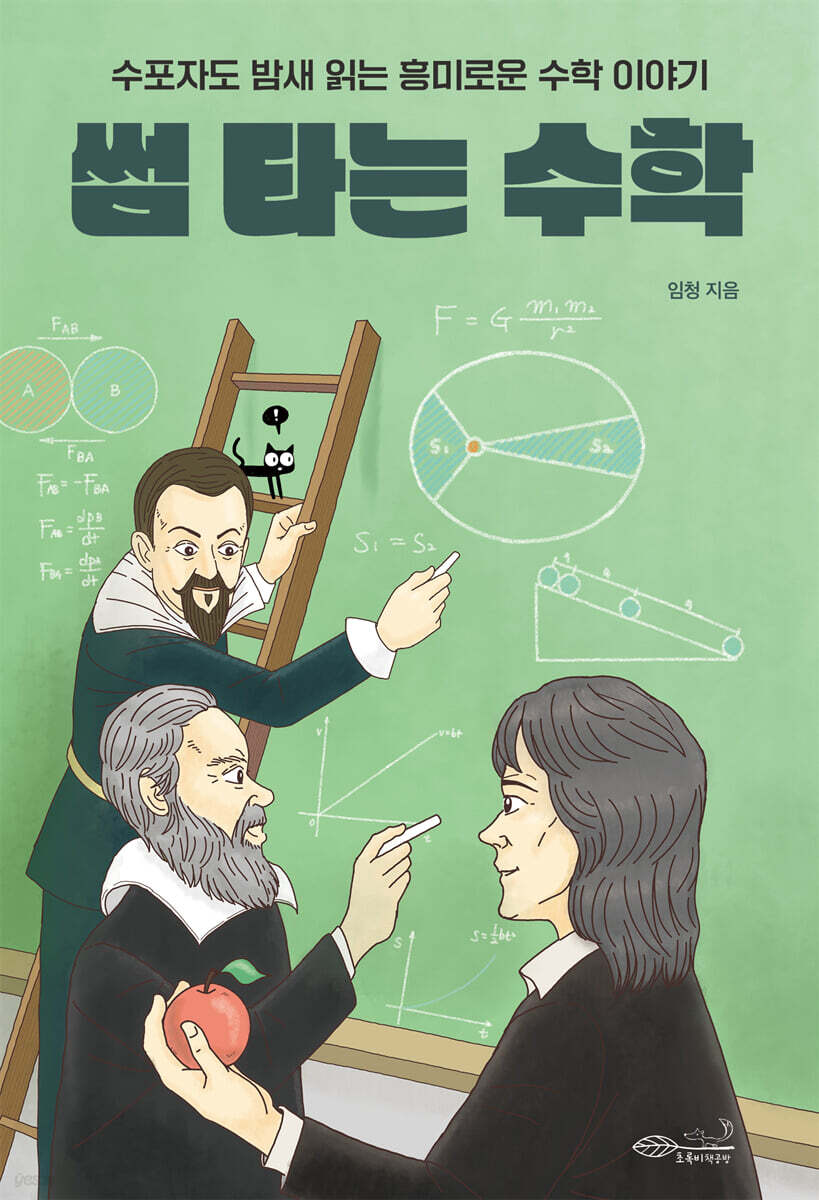
How to approach math in an interesting way, from basic to advanced.
Those of us who attended 'national school' rather than elementary school will remember the boy's cry, "I hate the Communist Party!"
For young people living in the Cold War era, the 'Communist Party' was the most fearful and terrifying thing of all.
Now that the Cold War has ended, young people have something like the Communist Party of that time.
It is 'mathematics'.
We call the teenagers who shout out “I hate math!” instead of “I hate the Communist Party!” “math dropouts.”
The author, Mr. Lim Cheong, who majored in mathematics in college and graduate school and teaches mathematics in middle school, hopes that the term "math dropout" will no longer be used and that all children will be able to study mathematics with interest.
The author teaches a variety of math classes, from basic classes for children who are slow to catch up in school math classes to advanced classes for children who love math.
The previous work, 『Math for Kids These Days』, was a book designed to help children who lack the basics of mathematics by following the middle and high school mathematics curriculum, while 『Math for Some』 is designed in a storytelling format so that children who have the basics but are hesitant to approach advanced courses can approach it in a more interesting way.
How to approach math in an interesting way, from basic to advanced.
Those of us who attended 'national school' rather than elementary school will remember the boy's cry, "I hate the Communist Party!"
For young people living in the Cold War era, the 'Communist Party' was the most fearful and terrifying thing of all.
Now that the Cold War has ended, young people have something like the Communist Party of that time.
It is 'mathematics'.
We call the teenagers who shout out “I hate math!” instead of “I hate the Communist Party!” “math dropouts.”
The author, Mr. Lim Cheong, who majored in mathematics in college and graduate school and teaches mathematics in middle school, hopes that the term "math dropout" will no longer be used and that all children will be able to study mathematics with interest.
The author teaches a variety of math classes, from basic classes for children who are slow to catch up in school math classes to advanced classes for children who love math.
The previous work, 『Math for Kids These Days』, was a book designed to help children who lack the basics of mathematics by following the middle and high school mathematics curriculum, while 『Math for Some』 is designed in a storytelling format so that children who have the basics but are hesitant to approach advanced courses can approach it in a more interesting way.
- You can preview some of the book's contents.
Preview
index
Entering
Prologue | Leonardo da Vinci Meets the Modern Age
Part 1: An Exciting First Encounter with Shapes and Equations
Hippocrates, finding the area of a curved figure
Discovering shapes that are impossible to construct
Abel's cute provocation, equation letter
The ill-fated relationship between Tartaglia and Cardano
Galois, the mathematical genius who redrawn the blueprint of equations
Toy Story, created by Steve Jobs
Descartes solved equations geometrically
Fermat's mathematical achievements discovered in letters and notes
Part 2: Line segments connect planes to form a three-dimensional object.
Zeno's Question: Who Won, the Tortoise or the Hare?
Eureka Grandpa Archimedes' method of finding area
Kepler's Orange Stacking, Not Allowing Even a Single Inch of Gaps
The volume relationship between a horn and a column as seen through Cavalieri's principle
Collaboration between three scholars reveals the movement of celestial bodies.
Part 3: Fall in love with the magic of calculus, the flower of mathematics.
A movie made with equations
Fermat, a pioneer in tangent research
Galileo's Obsession Changes the Paradigm for Motion
Newton's great discovery blossomed amidst the plague
A picture that changes depending on thoughts and perspectives
Measuring the magnitude of an earthquake with logarithms
Bernoulli Spots the Bank Interest Fraud
Prologue | Leonardo da Vinci Meets the Modern Age
Part 1: An Exciting First Encounter with Shapes and Equations
Hippocrates, finding the area of a curved figure
Discovering shapes that are impossible to construct
Abel's cute provocation, equation letter
The ill-fated relationship between Tartaglia and Cardano
Galois, the mathematical genius who redrawn the blueprint of equations
Toy Story, created by Steve Jobs
Descartes solved equations geometrically
Fermat's mathematical achievements discovered in letters and notes
Part 2: Line segments connect planes to form a three-dimensional object.
Zeno's Question: Who Won, the Tortoise or the Hare?
Eureka Grandpa Archimedes' method of finding area
Kepler's Orange Stacking, Not Allowing Even a Single Inch of Gaps
The volume relationship between a horn and a column as seen through Cavalieri's principle
Collaboration between three scholars reveals the movement of celestial bodies.
Part 3: Fall in love with the magic of calculus, the flower of mathematics.
A movie made with equations
Fermat, a pioneer in tangent research
Galileo's Obsession Changes the Paradigm for Motion
Newton's great discovery blossomed amidst the plague
A picture that changes depending on thoughts and perspectives
Measuring the magnitude of an earthquake with logarithms
Bernoulli Spots the Bank Interest Fraud
Detailed image

Into the book
Every concept in mathematics has a long history.
Today's mathematics is a beautiful achievement built up by the fierce efforts of numerous great mathematicians.
The true meaning of these achievements is hidden in the historical background, the lives of mathematicians, and their concerns.
If we examine this, we will be able to find answers to the fundamental questions we have felt while studying mathematics: 'Why do we need to learn mathematics? How did mathematics become what it is today? What is the true meaning of mathematical concepts?'
In this book, I wanted to show how mathematicians developed mathematical concepts and how they influenced later mathematicians, leading to the development of mathematics.
In the process, I wanted to explore the true meaning of mathematics and, furthermore, give readers the opportunity to experience the joy of insight into mathematics and the beauty of mathematics.
--- pp.6-7
Abel, a middle school student who loves math, wrote a letter to his math teacher.
At the end of the letter was written a very complicated cube root number.
Let's use a calculator to find out what this number means.
(※ Hint: What should I write at the end of the letter?) Abel, the main character of this quiz, is a mathematician representing Norway.
Since 2002, the Norwegian government has established the Abel Prize in his honor to commemorate the 200th anniversary of Abel's birth, and has awarded it annually to scholars who have made outstanding achievements in the field of mathematics.
The prize money is worth a whopping 1 billion won.
Since there is no Nobel Prize for mathematics, the Abel Prize, along with the Fields Medal, can be considered the Nobel Prize of mathematics.
In 2022, Professor Heo Jun became the first Korean to win the Fields Medal, bringing hope to the Korean mathematics community.
There is no Korean winner of the Abel Prize yet, but I am eagerly awaiting the next Abel Prize winner.
--- pp.48-49
In the early 19th century, a paper was delivered to Gauss.
It was a paper on the solution to Abel's error equation.
The core content of this paper was that 'the error equation cannot be solved by square roots.'
While all mathematicians were trying to find a formula for the roots of the error equation, Abel wondered if a formula existed, and eventually proved that a formula for the roots of the error equation did not exist.
Abel, who was poor at the time, wrote his thesis in a very concise manner to save paper, making it difficult for readers to understand what it was about.
Gauss, who received Abel's paper, threw it away in the trash without reading it.
Abel did not give up and sent the paper to the French Academy of Sciences again, but Cauchy, the mathematician who reviewed the paper at the time, did not consider Abel's paper very important.
Abel's teacher, seeing Abel's excellence, said, "Abel can become the world's greatest mathematician as long as he lives," but Abel did not receive proper recognition for his achievements during his lifetime.
The University of Berlin, which had belatedly discovered his excellence, sent a letter to Abel asking for a professorship, but Abel died of tuberculosis before the letter arrived.
He was 27 years old.
--- pp.65-66
A year after Abel's death, the French Academy of Sciences belatedly recognized his achievements and awarded him a prize.
But the French Academy of Sciences, blinded by Abel's achievements, missed another great paper: that of the mathematician Galois.
Galois began writing papers and submitting them to the French Academy of Sciences at the age of 18.
The first reviewer of the paper, Koshy, rejected it for publication, saying that its content was too unclear.
Galois tried again and submitted a second paper to the French Academy of Sciences, but the mathematician who reviewed the paper at the time, Fourier, died during the review process, so Galois' paper was not properly evaluated.
Even on Galois' third challenge, the mathematician Poisson, who reviewed the paper, refused to publish it, saying he did not understand its contents.
Galois's thesis focused on mathematical structure rather than the conventional method of solving equations by relying on numbers or functions, and for this purpose he established the concept of a 'Galois group'.
This broke the mold of existing research, so even the greatest mathematicians of the time would have had difficulty understanding it.
However, this concept has since become a core concept of modern algebra.
Galois was also interested in politics and was active as a member of the Republican Party.
During that time, he had a girlfriend, but Galois' friend, who was also a member of the Republican Party, was jealous and challenged him to a duel.
Galois, who knew that his opponent was better at handling guns than he was, felt that he could not avoid death, but his fiery temper compelled him to accept the duel.
And the day before the duel, Galois prepared for his death by writing a letter to his friend about his research.
And the next day, at the age of 22, he ended his short life.
--- pp.67-68
Pringles potato chips are different from other potato chip snacks in that the chips are stacked in a consistent shape inside a cylinder.
While other potato chips are made by slicing potatoes thinly, frying them, and putting them in a bag, Pringles potato chips are made in a concave, curved shape.
This makes it easier to pick up the chips with your hands, and allows them to be neatly stacked inside the cylinder, preventing them from crumbling while on the move.
There's math hidden in Pringles potato chips.
In mathematics, this potato chip shape is called a hyperbolic paraboloid.
As the name suggests, if you cut this surface in various ways, you can find hyperbolas and parabolas.
In the figure, if you cut the surface horizontally, the intersection line becomes a hyperbola, and if you cut it vertically, the intersection line becomes a parabola.
Fermat is a master of this type of curve research.
Fermat's original profession was a lawyer, but his hobby was mathematics.
(…) Fermat studied mathematics extensively, exchanging letters with his mathematician friends and leaving notes on his results.
Although he did not publish his research results in academic circles during his lifetime, his numerous mathematical achievements are recorded in letters and notes left behind after his death.
(…) The study of conic sections bore fruit with Fermat.
Fermat did not compile any papers or books during his lifetime, and only exchanged letters and notes with mathematicians remain, so the Introduction containing Fermat's research results was published after his death.
--- pp.93-97
Newton mathematically calculated, based on the laws of physics, that planets revolve in elliptical orbits with the sun at one focus.
The mathematical method used in this process is calculus, and the book that compiles the study of the orbital motion of celestial bodies, including calculus, is Mathematical Principles of Natural Philosophy (Principia).
At the time of writing this book, Newton was completely immersed in this research.
I would often take a walk in the garden, lost in thought, and when something came to mind, I would shout “Eureka!” and return to my room.
It is said that when a colleague secretly looked into Newton's room out of concern, he was writing a book standing up, not even having time to sit down at his desk.
Around the time Newton was burning with enthusiasm for his research, the world was in an uproar over the appearance of a comet.
Since ancient times, comets have been considered omens of bad luck, regardless of time or place.
However, Newton said that not only planets but also comets can trace elliptical or hyperbolic orbits with the sun at their focus.
The comet that appeared at that time was Halley's Comet, and this comet moves in an elliptical orbit with a period of approximately 76 years.
Halley's Comet is a comet that can be seen with the naked eye without a telescope.
Since it was observed in 1986, Halley's Comet will be observed again in 2061.
Through Newton's research, we can discover that the universe works mathematically.
All of nature has a mathematical structure, and science has now begun to study it using the tool of mathematics.
--- p.150
The discovery of differential calculus was not Newton's achievement alone.
Galileo intuitively observed that the area under the graph of the velocity function represents distance as the sum of thin rectangles representing instantaneous velocity.
Galileo's disciple Cavalieri attempted to develop this method by dividing it into thin pieces and finding the area or volume as an infinite sum of shapes of one dimension lower.
Mathematician Wallace developed Cavalieri's work, treated the concept of infinity analytically, and introduced the infinity symbol.
Barrow, a mathematician who was a student of Wallace and recognized Newton's talent, proved the first fundamental theorem of calculus, which states that if you differentiate the area function, which represents the area under the velocity function, you get the velocity function.
And it was Newton who put all this together.
Newton's numerous scientific achievements were built on the findings and research of numerous scholars.
Newton was able to see a wider world by learning about and mastering the lives and achievements of his predecessors.
Then, finally, I discovered calculus, which had been waiting to be discovered in the wide world.
And Newton, too, became a great giant, lending his high and strong shoulders to countless juniors and to us.
Today's mathematics is a beautiful achievement built up by the fierce efforts of numerous great mathematicians.
The true meaning of these achievements is hidden in the historical background, the lives of mathematicians, and their concerns.
If we examine this, we will be able to find answers to the fundamental questions we have felt while studying mathematics: 'Why do we need to learn mathematics? How did mathematics become what it is today? What is the true meaning of mathematical concepts?'
In this book, I wanted to show how mathematicians developed mathematical concepts and how they influenced later mathematicians, leading to the development of mathematics.
In the process, I wanted to explore the true meaning of mathematics and, furthermore, give readers the opportunity to experience the joy of insight into mathematics and the beauty of mathematics.
--- pp.6-7
Abel, a middle school student who loves math, wrote a letter to his math teacher.
At the end of the letter was written a very complicated cube root number.
Let's use a calculator to find out what this number means.
(※ Hint: What should I write at the end of the letter?) Abel, the main character of this quiz, is a mathematician representing Norway.
Since 2002, the Norwegian government has established the Abel Prize in his honor to commemorate the 200th anniversary of Abel's birth, and has awarded it annually to scholars who have made outstanding achievements in the field of mathematics.
The prize money is worth a whopping 1 billion won.
Since there is no Nobel Prize for mathematics, the Abel Prize, along with the Fields Medal, can be considered the Nobel Prize of mathematics.
In 2022, Professor Heo Jun became the first Korean to win the Fields Medal, bringing hope to the Korean mathematics community.
There is no Korean winner of the Abel Prize yet, but I am eagerly awaiting the next Abel Prize winner.
--- pp.48-49
In the early 19th century, a paper was delivered to Gauss.
It was a paper on the solution to Abel's error equation.
The core content of this paper was that 'the error equation cannot be solved by square roots.'
While all mathematicians were trying to find a formula for the roots of the error equation, Abel wondered if a formula existed, and eventually proved that a formula for the roots of the error equation did not exist.
Abel, who was poor at the time, wrote his thesis in a very concise manner to save paper, making it difficult for readers to understand what it was about.
Gauss, who received Abel's paper, threw it away in the trash without reading it.
Abel did not give up and sent the paper to the French Academy of Sciences again, but Cauchy, the mathematician who reviewed the paper at the time, did not consider Abel's paper very important.
Abel's teacher, seeing Abel's excellence, said, "Abel can become the world's greatest mathematician as long as he lives," but Abel did not receive proper recognition for his achievements during his lifetime.
The University of Berlin, which had belatedly discovered his excellence, sent a letter to Abel asking for a professorship, but Abel died of tuberculosis before the letter arrived.
He was 27 years old.
--- pp.65-66
A year after Abel's death, the French Academy of Sciences belatedly recognized his achievements and awarded him a prize.
But the French Academy of Sciences, blinded by Abel's achievements, missed another great paper: that of the mathematician Galois.
Galois began writing papers and submitting them to the French Academy of Sciences at the age of 18.
The first reviewer of the paper, Koshy, rejected it for publication, saying that its content was too unclear.
Galois tried again and submitted a second paper to the French Academy of Sciences, but the mathematician who reviewed the paper at the time, Fourier, died during the review process, so Galois' paper was not properly evaluated.
Even on Galois' third challenge, the mathematician Poisson, who reviewed the paper, refused to publish it, saying he did not understand its contents.
Galois's thesis focused on mathematical structure rather than the conventional method of solving equations by relying on numbers or functions, and for this purpose he established the concept of a 'Galois group'.
This broke the mold of existing research, so even the greatest mathematicians of the time would have had difficulty understanding it.
However, this concept has since become a core concept of modern algebra.
Galois was also interested in politics and was active as a member of the Republican Party.
During that time, he had a girlfriend, but Galois' friend, who was also a member of the Republican Party, was jealous and challenged him to a duel.
Galois, who knew that his opponent was better at handling guns than he was, felt that he could not avoid death, but his fiery temper compelled him to accept the duel.
And the day before the duel, Galois prepared for his death by writing a letter to his friend about his research.
And the next day, at the age of 22, he ended his short life.
--- pp.67-68
Pringles potato chips are different from other potato chip snacks in that the chips are stacked in a consistent shape inside a cylinder.
While other potato chips are made by slicing potatoes thinly, frying them, and putting them in a bag, Pringles potato chips are made in a concave, curved shape.
This makes it easier to pick up the chips with your hands, and allows them to be neatly stacked inside the cylinder, preventing them from crumbling while on the move.
There's math hidden in Pringles potato chips.
In mathematics, this potato chip shape is called a hyperbolic paraboloid.
As the name suggests, if you cut this surface in various ways, you can find hyperbolas and parabolas.
In the figure, if you cut the surface horizontally, the intersection line becomes a hyperbola, and if you cut it vertically, the intersection line becomes a parabola.
Fermat is a master of this type of curve research.
Fermat's original profession was a lawyer, but his hobby was mathematics.
(…) Fermat studied mathematics extensively, exchanging letters with his mathematician friends and leaving notes on his results.
Although he did not publish his research results in academic circles during his lifetime, his numerous mathematical achievements are recorded in letters and notes left behind after his death.
(…) The study of conic sections bore fruit with Fermat.
Fermat did not compile any papers or books during his lifetime, and only exchanged letters and notes with mathematicians remain, so the Introduction containing Fermat's research results was published after his death.
--- pp.93-97
Newton mathematically calculated, based on the laws of physics, that planets revolve in elliptical orbits with the sun at one focus.
The mathematical method used in this process is calculus, and the book that compiles the study of the orbital motion of celestial bodies, including calculus, is Mathematical Principles of Natural Philosophy (Principia).
At the time of writing this book, Newton was completely immersed in this research.
I would often take a walk in the garden, lost in thought, and when something came to mind, I would shout “Eureka!” and return to my room.
It is said that when a colleague secretly looked into Newton's room out of concern, he was writing a book standing up, not even having time to sit down at his desk.
Around the time Newton was burning with enthusiasm for his research, the world was in an uproar over the appearance of a comet.
Since ancient times, comets have been considered omens of bad luck, regardless of time or place.
However, Newton said that not only planets but also comets can trace elliptical or hyperbolic orbits with the sun at their focus.
The comet that appeared at that time was Halley's Comet, and this comet moves in an elliptical orbit with a period of approximately 76 years.
Halley's Comet is a comet that can be seen with the naked eye without a telescope.
Since it was observed in 1986, Halley's Comet will be observed again in 2061.
Through Newton's research, we can discover that the universe works mathematically.
All of nature has a mathematical structure, and science has now begun to study it using the tool of mathematics.
--- p.150
The discovery of differential calculus was not Newton's achievement alone.
Galileo intuitively observed that the area under the graph of the velocity function represents distance as the sum of thin rectangles representing instantaneous velocity.
Galileo's disciple Cavalieri attempted to develop this method by dividing it into thin pieces and finding the area or volume as an infinite sum of shapes of one dimension lower.
Mathematician Wallace developed Cavalieri's work, treated the concept of infinity analytically, and introduced the infinity symbol.
Barrow, a mathematician who was a student of Wallace and recognized Newton's talent, proved the first fundamental theorem of calculus, which states that if you differentiate the area function, which represents the area under the velocity function, you get the velocity function.
And it was Newton who put all this together.
Newton's numerous scientific achievements were built on the findings and research of numerous scholars.
Newton was able to see a wider world by learning about and mastering the lives and achievements of his predecessors.
Then, finally, I discovered calculus, which had been waiting to be discovered in the wide world.
And Newton, too, became a great giant, lending his high and strong shoulders to countless juniors and to us.
--- pp.200-201
Publisher's Review
From Leonardo da Vinci to Newton
A link between mathematicians who perfected modern mathematics
This book began with Newton's aphorism, "Stand on the shoulders of giants to see a wider world," which the author discovered by chance while writing his thesis in graduate school.
Newton, who developed calculus in mathematics and Newtonian mechanics in physics, is one of the greatest physicists and mathematicians in history.
All of Newton's achievements, which are referred to as the greatest giant in the history of mathematics, were not achieved solely through his ideas.
The origins of modern integration began 2,500 years ago with the method of calculating the area of a figure by the ancient Greek mathematician Archimedes, and the discovery of differentiation is linked to Galileo's study of instantaneous velocity and Fermat's study of tangent lines.
Newton was able to make the great discovery of calculus by learning and mastering the lives and achievements of mathematical giants who had already achieved great things in their respective fields.
This book shows how mathematicians, from Leonardo da Vinci to Newton, discovered mathematical concepts and how they influenced later mathematicians in developing modern mathematics.
Great discoveries come from everyday episodes.
Mathematical concepts and formulas learned from the lives of mathematicians
The author presents episodes of mathematicians as a device to make it easier to enter higher levels of mathematics beyond the basic level.
By following the great discoveries of mathematicians that began with everyday episodes, you will naturally acquire mathematical concepts and formulas.
In the letter sent by Abel, the representative Norwegian mathematician and winner of the Abel Prize, which is called the Nobel Prize of mathematics along with the Fields Medal, to his middle school math teacher, there is the 'concept of equations', and in the tragic life of Tartaglia, who was born with a natural mathematical talent but disappeared into the back alleys of history due to the betrayal of his best friend, we can learn the concept of 'square root of a negative number'.
Kepler taught us the 'relationship between density and volume' through orange boxes and wine barrels, and Cavalieri taught us the 'relationship between density and volume' through square pyramids. Galileo, Kepler, and Newton, who lived in different eras but shared a common interest in the universe, taught us the 'motion of celestial bodies'.
Just as the stories of each person come together to form history, the stories of mathematicians come together to form the history of mathematics.
Like all things in the world, all mathematical concepts have a long history.
By following its history, we can find answers to the questions of why we must learn mathematics and what its true meaning is. We can also experience the joy of insight into the world through mathematics and the beauty of mathematics hidden in everyday life.
A link between mathematicians who perfected modern mathematics
This book began with Newton's aphorism, "Stand on the shoulders of giants to see a wider world," which the author discovered by chance while writing his thesis in graduate school.
Newton, who developed calculus in mathematics and Newtonian mechanics in physics, is one of the greatest physicists and mathematicians in history.
All of Newton's achievements, which are referred to as the greatest giant in the history of mathematics, were not achieved solely through his ideas.
The origins of modern integration began 2,500 years ago with the method of calculating the area of a figure by the ancient Greek mathematician Archimedes, and the discovery of differentiation is linked to Galileo's study of instantaneous velocity and Fermat's study of tangent lines.
Newton was able to make the great discovery of calculus by learning and mastering the lives and achievements of mathematical giants who had already achieved great things in their respective fields.
This book shows how mathematicians, from Leonardo da Vinci to Newton, discovered mathematical concepts and how they influenced later mathematicians in developing modern mathematics.
Great discoveries come from everyday episodes.
Mathematical concepts and formulas learned from the lives of mathematicians
The author presents episodes of mathematicians as a device to make it easier to enter higher levels of mathematics beyond the basic level.
By following the great discoveries of mathematicians that began with everyday episodes, you will naturally acquire mathematical concepts and formulas.
In the letter sent by Abel, the representative Norwegian mathematician and winner of the Abel Prize, which is called the Nobel Prize of mathematics along with the Fields Medal, to his middle school math teacher, there is the 'concept of equations', and in the tragic life of Tartaglia, who was born with a natural mathematical talent but disappeared into the back alleys of history due to the betrayal of his best friend, we can learn the concept of 'square root of a negative number'.
Kepler taught us the 'relationship between density and volume' through orange boxes and wine barrels, and Cavalieri taught us the 'relationship between density and volume' through square pyramids. Galileo, Kepler, and Newton, who lived in different eras but shared a common interest in the universe, taught us the 'motion of celestial bodies'.
Just as the stories of each person come together to form history, the stories of mathematicians come together to form the history of mathematics.
Like all things in the world, all mathematical concepts have a long history.
By following its history, we can find answers to the questions of why we must learn mathematics and what its true meaning is. We can also experience the joy of insight into the world through mathematics and the beauty of mathematics hidden in everyday life.
GOODS SPECIFICS
- Date of issue: September 10, 2024
- Page count, weight, size: 242 pages | 314g | 140*205*15mm
- ISBN13: 9791193296592
You may also like
카테고리
korean


korean

![GQ KOREA Mark (Monthly): December [2025]](http://librairie.coreenne.fr/cdn/shop/files/8ef265dbbfbf186523ed75ba7319009d.jpg?v=1765340328&width=3840)


