

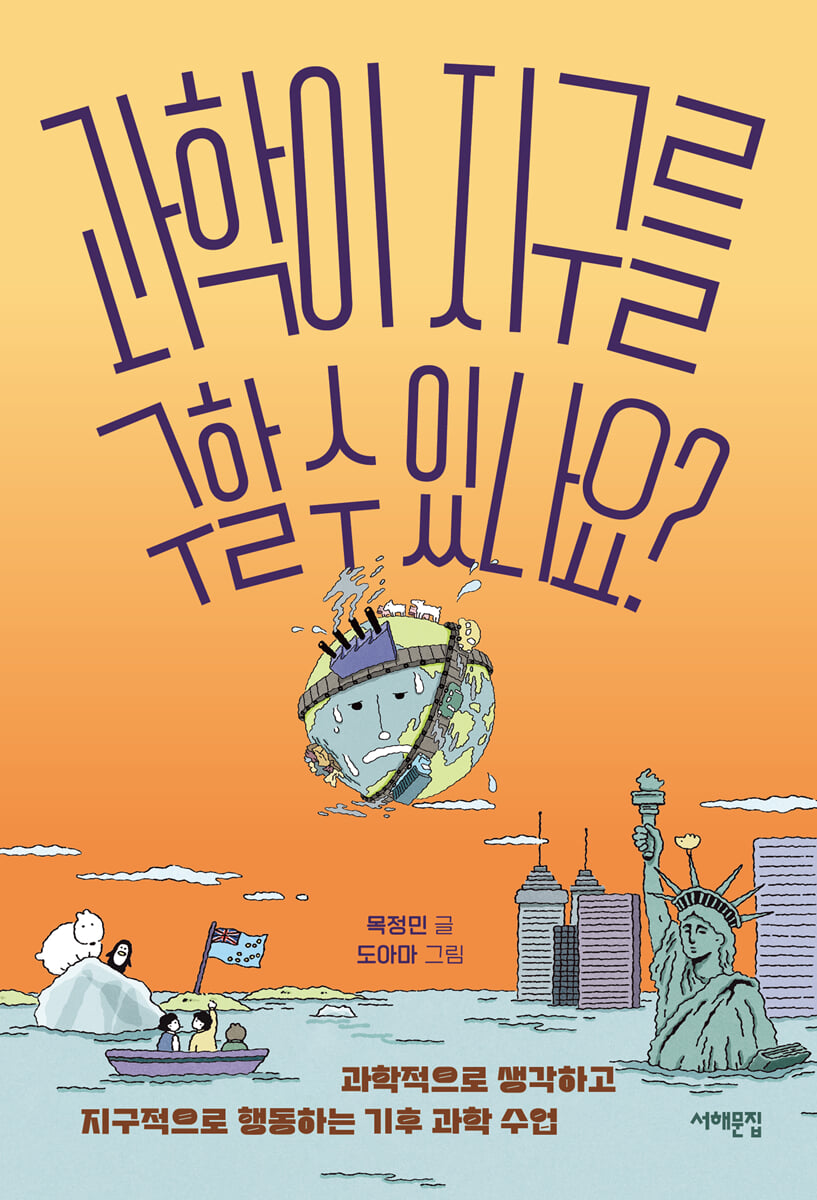
Can science save the planet?
 |
Description
Book Introduction
We will learn about the great crisis facing our planet, the stage where young people will grow and pursue their dreams.
Climate change, food and energy crises, environmental pollution, and even mass extinction.
Furthermore, we discuss what we must do to save the Earth, focusing on the role of science in driving the development of civilization so far.
On the one hand, there is despair that nothing can prevent the destruction of the Earth and the end of humanity, while on the other hand, there is a rosy outlook that science and technology will eventually solve everything.
But the attitude we should have is neither helpless pessimism nor unfounded optimism.
Among them, climate literacy is essential to properly recognize the global environmental crisis caused by humans, and the practical ability to take action to find the best solution.
In other words, "Think scientifically, act globally!" Let's create your own center with this book.
Climate change, food and energy crises, environmental pollution, and even mass extinction.
Furthermore, we discuss what we must do to save the Earth, focusing on the role of science in driving the development of civilization so far.
On the one hand, there is despair that nothing can prevent the destruction of the Earth and the end of humanity, while on the other hand, there is a rosy outlook that science and technology will eventually solve everything.
But the attitude we should have is neither helpless pessimism nor unfounded optimism.
Among them, climate literacy is essential to properly recognize the global environmental crisis caused by humans, and the practical ability to take action to find the best solution.
In other words, "Think scientifically, act globally!" Let's create your own center with this book.
- You can preview some of the book's contents.
Preview
index
★Prologue: Science Class in the Age of Climate Change
1.
Earth and Humans
250 years of accelerator pedal
Earth is out of breath
The Anthropocene: The Age of Human-Made Mass Extinction
2.
Climate change
The Earth has become too warm
Climate change is 100% human responsibility.
Floods once in 80 years, wildfires once in 100 years
Science and technology that save the Earth
# Carbon Dioxide Hunter - Carbon Capture and Storage Technology
# Earth's Fever Reliever? - Solar Geoengineering Technology
# A time capsule left behind by Earth's past - Drilling into polar ice caps
3.
energy crisis
The Shadow of the Carbon Economy
Slow-moving renewable energy development
Science and technology that save the Earth
# Dream Efficiency - Perovskite Solar Cells
# Eco-friendly production, safe storage - the path to green hydrogen
# Capture wasted electricity - Smart Grid
4.
Food crisis and environmental pollution
'Have you eaten?' is back again
The disappearance of the bee
Plastic Island, an island not on the map
Science and technology that save the Earth
# Crops created through genetic engineering - GMOs
# Factory-produced meat - alternative meat technology
# Intelligent Urban Farm - Smart Farm
# For truly eco-friendly cars - Waste battery reuse and recycling technology
# If you have to use it - bioplastic
5.
biodiversity crisis
Disappearing flora and fauna
What is biodiversity?
The asset of nature
Science and technology that save the Earth
# 'Doomsday' and the Seed Vault - Global Seed Vault
# Protecting the Web of Life - Species Restoration Technology
6.
Humans and Science
How Climate Change Changed Science
The Two Faces of Science
Blind faith and illusion
Still science
The courage to change reality
1.
Earth and Humans
250 years of accelerator pedal
Earth is out of breath
The Anthropocene: The Age of Human-Made Mass Extinction
2.
Climate change
The Earth has become too warm
Climate change is 100% human responsibility.
Floods once in 80 years, wildfires once in 100 years
Science and technology that save the Earth
# Carbon Dioxide Hunter - Carbon Capture and Storage Technology
# Earth's Fever Reliever? - Solar Geoengineering Technology
# A time capsule left behind by Earth's past - Drilling into polar ice caps
3.
energy crisis
The Shadow of the Carbon Economy
Slow-moving renewable energy development
Science and technology that save the Earth
# Dream Efficiency - Perovskite Solar Cells
# Eco-friendly production, safe storage - the path to green hydrogen
# Capture wasted electricity - Smart Grid
4.
Food crisis and environmental pollution
'Have you eaten?' is back again
The disappearance of the bee
Plastic Island, an island not on the map
Science and technology that save the Earth
# Crops created through genetic engineering - GMOs
# Factory-produced meat - alternative meat technology
# Intelligent Urban Farm - Smart Farm
# For truly eco-friendly cars - Waste battery reuse and recycling technology
# If you have to use it - bioplastic
5.
biodiversity crisis
Disappearing flora and fauna
What is biodiversity?
The asset of nature
Science and technology that save the Earth
# 'Doomsday' and the Seed Vault - Global Seed Vault
# Protecting the Web of Life - Species Restoration Technology
6.
Humans and Science
How Climate Change Changed Science
The Two Faces of Science
Blind faith and illusion
Still science
The courage to change reality
Detailed image

Publisher's Review
Climate change, food and energy crisis,
Environmental pollution and the first mass extinction in 65 million years―
A story about the Earth's crisis brought about by humanity and the science and technology that counter it.
We will learn about the great crisis facing our planet, the stage where young people will grow and pursue their dreams.
Climate change, food and energy crises, environmental pollution, and even the inevitable mass extinction of species.
Furthermore, we will discuss what we need to do to save the Earth, focusing on the role of science in driving the development of civilization so far.
In the era of climate change
science class
The changes in the global environment brought about by global warming are changing not only our daily lives but also our school textbooks.
The number of days that require summer clothes is increasing, while the number of days that require fall and winter clothes is decreasing every year.
Jeju tangerines, Daegu apples, Gimcheon grapes, Bucheon peaches… The fruit-producing region formula that our parents’ generation memorized is no longer the correct answer.
Many crops are in more dire situations.
By the time you reach your parents' age, you may only be able to taste red pepper paste tteokbokki and coffee, a global favorite, at fancy restaurants.
Climate change is making it increasingly difficult to grow pepper and coffee trees.
The seascape has also changed.
Pollock and squid, which used to come to mind when thinking of the East Sea, are now considered precious fish.
This is because their habitat is moving north due to warming water temperatures.
Sea level rise is expected to become more severe starting in the 2030s, just a few years from now.
Indonesia, whose capital Jakarta is facing the threat of flooding, is moving its capital.
Most of the white sand beaches of the Korean Peninsula, including Haeundae and Gwangalli, are destined to be submerged.
If we continue like this, future students will be studying a new world map every ten years.
The changes in the global environment brought about by human overuse of fossil fuels are not only causing climate, food, and energy crises, but are also heralding the largest mass extinction of life since the age of the dinosaurs 65 million years ago.
In response, in 2015, 195 countries around the world adopted a resolution to limit the increase in global temperature to 1.5℃ compared to pre-industrial levels (Paris Agreement).
And in 2023, the IPCC (Intergovernmental Panel on Climate Change) set a 'deadline' to achieve this goal: greenhouse gases must be halved by 2030.
In other words, the future of the Earth's environment, the stage where you will unfold your dreams, depends on the course of humanity over the next five years.
"Can Science Save the Earth?" is a story about the crisis we humans have caused on Earth and the science and technology that can help overcome it.
We're all screwed × Science will solve everything
At its core, 'think scientifically, act globally'
●A boiling earth surrounded by greenhouse gases: Can solar geoengineering and carbon capture and storage technologies be the planet's antidote to climate change?
●The Earth is reaching its limits due to the overuse of fossil fuels: Can solar cells and green hydrogen solve the energy crisis and kill two birds with one stone: providing a convenient life for humanity and protecting the Earth's environment?
●The return of the 'hungry world' due to climate change and ecosystem destruction: Can GMO and alternative meat technologies driven by genetic engineering solve the food crisis?
●Plastic Island, an island that does not exist on Earth: The Earth is suffering from non-biodegradable waste.
Could biodegradable bioplastic technology be the alternative?
● Mass extinction of plants and animals: Is the 'Global Seed Vault', a seed vault for the doomsday, really a modern-day Noah's Ark?
They say that optimists build airplanes, while pessimists build parachutes.
The world needs both positive and negative perspectives.
The same goes for global environmental issues.
On the one hand, there is a pessimistic outlook that nothing can prevent the destruction of the Earth and the end of humanity, while on the other hand, there is a rosy outlook that science and technology will solve everything.
But the attitude we should have is neither helpless pessimism nor unfounded optimism.
Among them, climate literacy is essential to properly recognize the various crises that humans have caused to the Earth's environment, and the practical ability to find the best solutions and take action.
In other words, "Think scientifically, act globally!" Let's create your own center with this book.
Environmental pollution and the first mass extinction in 65 million years―
A story about the Earth's crisis brought about by humanity and the science and technology that counter it.
We will learn about the great crisis facing our planet, the stage where young people will grow and pursue their dreams.
Climate change, food and energy crises, environmental pollution, and even the inevitable mass extinction of species.
Furthermore, we will discuss what we need to do to save the Earth, focusing on the role of science in driving the development of civilization so far.
In the era of climate change
science class
The changes in the global environment brought about by global warming are changing not only our daily lives but also our school textbooks.
The number of days that require summer clothes is increasing, while the number of days that require fall and winter clothes is decreasing every year.
Jeju tangerines, Daegu apples, Gimcheon grapes, Bucheon peaches… The fruit-producing region formula that our parents’ generation memorized is no longer the correct answer.
Many crops are in more dire situations.
By the time you reach your parents' age, you may only be able to taste red pepper paste tteokbokki and coffee, a global favorite, at fancy restaurants.
Climate change is making it increasingly difficult to grow pepper and coffee trees.
The seascape has also changed.
Pollock and squid, which used to come to mind when thinking of the East Sea, are now considered precious fish.
This is because their habitat is moving north due to warming water temperatures.
Sea level rise is expected to become more severe starting in the 2030s, just a few years from now.
Indonesia, whose capital Jakarta is facing the threat of flooding, is moving its capital.
Most of the white sand beaches of the Korean Peninsula, including Haeundae and Gwangalli, are destined to be submerged.
If we continue like this, future students will be studying a new world map every ten years.
The changes in the global environment brought about by human overuse of fossil fuels are not only causing climate, food, and energy crises, but are also heralding the largest mass extinction of life since the age of the dinosaurs 65 million years ago.
In response, in 2015, 195 countries around the world adopted a resolution to limit the increase in global temperature to 1.5℃ compared to pre-industrial levels (Paris Agreement).
And in 2023, the IPCC (Intergovernmental Panel on Climate Change) set a 'deadline' to achieve this goal: greenhouse gases must be halved by 2030.
In other words, the future of the Earth's environment, the stage where you will unfold your dreams, depends on the course of humanity over the next five years.
"Can Science Save the Earth?" is a story about the crisis we humans have caused on Earth and the science and technology that can help overcome it.
We're all screwed × Science will solve everything
At its core, 'think scientifically, act globally'
●A boiling earth surrounded by greenhouse gases: Can solar geoengineering and carbon capture and storage technologies be the planet's antidote to climate change?
●The Earth is reaching its limits due to the overuse of fossil fuels: Can solar cells and green hydrogen solve the energy crisis and kill two birds with one stone: providing a convenient life for humanity and protecting the Earth's environment?
●The return of the 'hungry world' due to climate change and ecosystem destruction: Can GMO and alternative meat technologies driven by genetic engineering solve the food crisis?
●Plastic Island, an island that does not exist on Earth: The Earth is suffering from non-biodegradable waste.
Could biodegradable bioplastic technology be the alternative?
● Mass extinction of plants and animals: Is the 'Global Seed Vault', a seed vault for the doomsday, really a modern-day Noah's Ark?
They say that optimists build airplanes, while pessimists build parachutes.
The world needs both positive and negative perspectives.
The same goes for global environmental issues.
On the one hand, there is a pessimistic outlook that nothing can prevent the destruction of the Earth and the end of humanity, while on the other hand, there is a rosy outlook that science and technology will solve everything.
But the attitude we should have is neither helpless pessimism nor unfounded optimism.
Among them, climate literacy is essential to properly recognize the various crises that humans have caused to the Earth's environment, and the practical ability to find the best solutions and take action.
In other words, "Think scientifically, act globally!" Let's create your own center with this book.
GOODS SPECIFICS
- Date of issue: September 10, 2024
- Page count, weight, size: 192 pages | 220g | 128*188*13mm
- ISBN13: 9791192988870
- ISBN10: 1192988876
You may also like
카테고리
korean


korean

![GQ KOREA Mark (Monthly): December [2025]](http://librairie.coreenne.fr/cdn/shop/files/8ef265dbbfbf186523ed75ba7319009d.jpg?v=1765340328&width=3840)


