

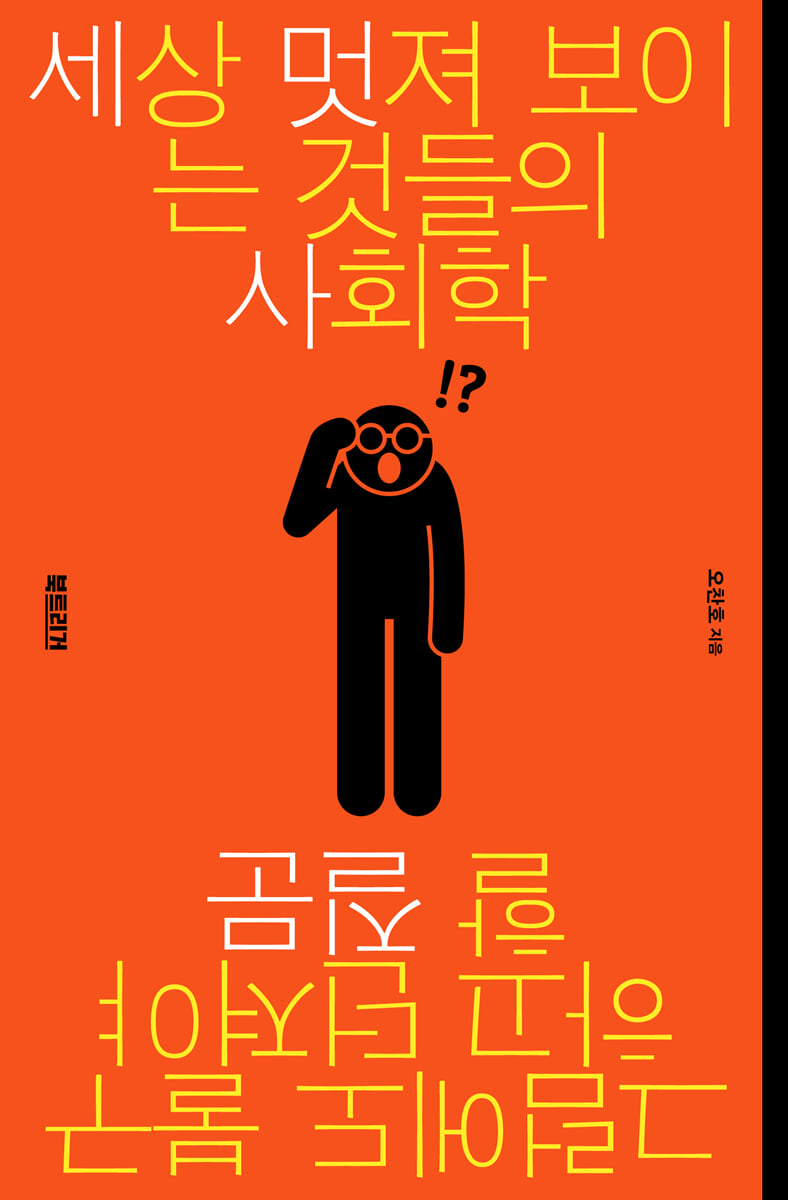
The Sociology of the World's Most Awesome Things
 |
Description
Book Introduction
“It’s convenient but inconvenient, comfortable but unpleasant, efficient but extremely dangerous!”
From birth control pills to flush toilets, apartments, air conditioning, platform work, and airplanes.
A dizzying social history unfolded by the kings of innovation.
Our lives depend on amazing innovations.
The innovative technologies and objects explored in this book—flushing toilets, plastics, smartphones, air conditioners, platform labor, airplanes—are part of the vast hamster wheel of modern civilization.
We, who live comfortable lives, cannot easily get off that smoothly spinning hamster wheel.
In the face of technologies and objects that promise to benefit the world and provide a bright future, individuals are simply overwhelmed by their convenience.
It is not just a matter of simple expectations and admiration.
Modern people's daily lives are filled with the fear of 'what would I do without this?'
"The Sociology of Things That Look Cool" is a book that examines the innovative technologies and hidden aspects of modern life through the lens of sociology.
Sociologist Chan-ho Oh, who has consistently written articles that reveal the relationship between individuals and society in a three-dimensional way by tracing the seeds of discrimination and hatred in everyday life, raises several questions using the keyword of "innovation" and examines the complex relationships among technology, society, and individuals that are intertwined like a thread.
Why is it innovation? With less inconvenience, has convenience increased? Has convenience brought about more inconvenience? Has innovation improved everyone? How has the context of inequality, discrimination, and hatred changed? The author examines the invisible, easily overlooked aspects of convenience and comfort, and points out concerns about the social frenzy surrounding "innovation."
From birth control pills to flush toilets, apartments, air conditioning, platform work, and airplanes.
A dizzying social history unfolded by the kings of innovation.
Our lives depend on amazing innovations.
The innovative technologies and objects explored in this book—flushing toilets, plastics, smartphones, air conditioners, platform labor, airplanes—are part of the vast hamster wheel of modern civilization.
We, who live comfortable lives, cannot easily get off that smoothly spinning hamster wheel.
In the face of technologies and objects that promise to benefit the world and provide a bright future, individuals are simply overwhelmed by their convenience.
It is not just a matter of simple expectations and admiration.
Modern people's daily lives are filled with the fear of 'what would I do without this?'
"The Sociology of Things That Look Cool" is a book that examines the innovative technologies and hidden aspects of modern life through the lens of sociology.
Sociologist Chan-ho Oh, who has consistently written articles that reveal the relationship between individuals and society in a three-dimensional way by tracing the seeds of discrimination and hatred in everyday life, raises several questions using the keyword of "innovation" and examines the complex relationships among technology, society, and individuals that are intertwined like a thread.
Why is it innovation? With less inconvenience, has convenience increased? Has convenience brought about more inconvenience? Has innovation improved everyone? How has the context of inequality, discrimination, and hatred changed? The author examines the invisible, easily overlooked aspects of convenience and comfort, and points out concerns about the social frenzy surrounding "innovation."
- You can preview some of the book's contents.
Preview
index
Prologue: There is no time machine.
First story: Small, but never insignificant
Chapter 1.
If you have to, you poop, but even if you have to, you can't: Can you imagine a world without flush toilets?
Chapter 2.
(Woman) Is it okay? (Man) It's okay!: Did the birth control pill liberate women?
Chapter 3.
Nature or Subordination: Is Being a Cosmetics Powerhouse Always a Good Thing?
Chapter 4.
It's become convenient, it's become terrible: If we keep working like we do now, we won't be able to reduce plastic.
Chapter 5.
Give Medication, Give Medication: Why Do I Get Addicted to Drugs When I Take Painkillers?
Second Story: Secretly Great, Digging into Everyday Life
Chapter 6.
I feel safe because I'm filmed, but I'm anxious because I'm filmed: CCTV, what's next?
Chapter 7.
Evolve, Regress: How Smartphones Change Human Thought Circuits
Chapter 8.
I'm a store owner, but I'm not: Franchises are taking over the neighborhood.
Chapter 9.
The more expensive it is, the more discriminatory it is: people are above people, the apartment landscape
Chapter 10.
When Health Becomes an Obsession: Why Gym Ads Are Rude
Third story: Incredibly fast and incredibly convenient
Chapter 11.
I'm getting cool, we're getting hot: thanks to the air conditioner, because of the air conditioner
Chapter 12.
Control your food, be controlled by it: There's an elephant in your fridge soon.
Chapter 13.
The most efficient, the most dangerous: nuclear power, not nuclear energy.
Chapter 14.
Consumers are getting better, workers are getting worse: Platform labor, the conveyor belt never stops.
Chapter 15.
There are many places to go, and the places you go are destroyed: the sky is full of airplanes
Epilogue: Innovative and Disruptive
First story: Small, but never insignificant
Chapter 1.
If you have to, you poop, but even if you have to, you can't: Can you imagine a world without flush toilets?
Chapter 2.
(Woman) Is it okay? (Man) It's okay!: Did the birth control pill liberate women?
Chapter 3.
Nature or Subordination: Is Being a Cosmetics Powerhouse Always a Good Thing?
Chapter 4.
It's become convenient, it's become terrible: If we keep working like we do now, we won't be able to reduce plastic.
Chapter 5.
Give Medication, Give Medication: Why Do I Get Addicted to Drugs When I Take Painkillers?
Second Story: Secretly Great, Digging into Everyday Life
Chapter 6.
I feel safe because I'm filmed, but I'm anxious because I'm filmed: CCTV, what's next?
Chapter 7.
Evolve, Regress: How Smartphones Change Human Thought Circuits
Chapter 8.
I'm a store owner, but I'm not: Franchises are taking over the neighborhood.
Chapter 9.
The more expensive it is, the more discriminatory it is: people are above people, the apartment landscape
Chapter 10.
When Health Becomes an Obsession: Why Gym Ads Are Rude
Third story: Incredibly fast and incredibly convenient
Chapter 11.
I'm getting cool, we're getting hot: thanks to the air conditioner, because of the air conditioner
Chapter 12.
Control your food, be controlled by it: There's an elephant in your fridge soon.
Chapter 13.
The most efficient, the most dangerous: nuclear power, not nuclear energy.
Chapter 14.
Consumers are getting better, workers are getting worse: Platform labor, the conveyor belt never stops.
Chapter 15.
There are many places to go, and the places you go are destroyed: the sky is full of airplanes
Epilogue: Innovative and Disruptive
Detailed image
.jpg)
Into the book
As we went through the Industrial Revolution and the Information Revolution, people repeated their expectations and admiration.
We say, “I wish this could be developed,” or “Wow, there’s so much out there.”
I live my life saying countless times, “The world has become a better place.”
It's thrilling to feel how one technology can make life easier right away.
Would you frown in front of something that benefits people?
This is probably why the words science, technology, and innovation are naturally entangled and floating around.
The word innovation itself is full of positive will and enthusiasm.
The English word 'innovation' exudes both freshness and exhilaration.
So it is easily defined as noble.
This leads to the idea that innovation should not be criticized.
Under this atmosphere, individuals are simply busy being grateful for the convenience.
It doesn't really ask whether it's innovative.
Questions and concerns about the convenient present do not deny technological advancement.
The intention is simply to reflect and improve.
But it is not accepted that way.
--- From "Prologue: There is no time machine"
Thanks to the birth control pill, women have become free from sex.
But because of the birth control pill, I'm still not free from sex.
As the expression, “If you just take the pill, you won’t have to worry,” has become commonplace, it has also become natural for women to take birth control pills regularly and prevent pregnancy on their own.
When a woman is worried about an unplanned pregnancy, questions like who the man is, why he didn't use contraception, and whether he wanted to have sex even though he said he was anxious because he was fertile, should be asked, but instead, the question "Why didn't you take the contraceptive pill?" appears.
But “women cannot become pregnant on their own.”
--- 「Chapter 2.
(Woman) Is it okay? (Man) It's okay!
Didn't Chico Mendes, the worker and environmental activist who was assassinated by a plantation owner while trying to raise awareness about environmental destruction in the Amazon, say this?
Environmentalism without class struggle is just gardening.
without class struggle is just gardening).
Is this radical? I won't interpret it by using the words "class" and "struggle."
The point is, it doesn't work to support inequality, praise competition, and worry about the environment.
If fighting inconvenient capitalism is uncomfortable, it's probably better to believe that all these environmental concerns are just conspiracy theories.
You can refrain from using paper cups yourself, believing that incompetent people deserve to be eliminated, but dreaming of a world without disposable products 'while doing so' is a delusion.
--- 「Chapter 4.
From "It's become convenient, it's become terrible"
The concept of "deaths of despair," proposed by Nobel Prize winner in economics Angus Deaton and Princeton University professor emeritus Anne Case, provides clues to how Korean society should address the opioid problem.
'Despair' seeks to examine what causes people to make bad choices that lead to death, or even death.
The authors focus on the lives of low-educated, white, lower-class workers.
They manage to survive when the manufacturing industry holds up, but when an economic crisis hits, they collapse helplessly.
It may sound obvious, but this obviousness is followed by 'opioid addiction'.
Not being swept away by addiction is primarily a matter of personal will, but that will shrinks in inverse proportion to the magnitude of despair.
So it's social.
In the Korean edition of the book 『Deaths of Despair and the Future of Capitalism』, which deals with the history of despair, the authors ask this question, saying that the suicide rate in Korea and the history of despair in the United States have similar backgrounds.
Are Koreans cut off from their 'social mooring'?
But I would like to ask this:
Does something like that exist?
Do you have it?
--- 「Chapter 5.
From "Give medicine, give a bottle"
Smartphones are getting smarter every year.
It was about 20 years ago that we were amazed to see a 300,000 pixel camera on our phones, but now it's 200 million pixels.
The capacity is also enormous.
There is no need to connect a cable to a computer to transfer all the data accumulated on your phone, such as photos, videos, and documents.
If you press this and that a few times, it will be automatically saved somewhere.
This neatness is sometimes interpreted as an eco-friendly behavior.
Even just looking at the photos, you can see that there is no need for paper like in the past.
I don't even collect them in thick albums.
So it would have destroyed the environment less.
Guillaume Pitron, author of How 'Likes' Are Destroying the Planet: The Geopolitics of Nations, Corporations, and the Environment Surrounding Digital Infrastructure, strongly warns that this is all an illusion.
The original title of this book is 'Digital Hell (L'Enfer numerique)', but the meaning of hell is much better expressed in the Korean version title.
Hell is made hotter by people who don't know it's hell.
--- 「Chapter 7.
From "Evolve, Regress"
So, apartments are a social problem, but for the same reason, people inevitably prefer apartments, so prices are bound to rise.
Those who are overwhelmed by sorrow are actively jumping into this vicious cycle, saying, "After experiencing it, I realized that real estate is the answer."
I agree with the idea that you need to find a smart apartment, that it should have a good brand, and that LH is absolutely not acceptable.
The apartment will laugh at this post.
Like a line from 『Concrete Utopia』 where the apartment appears in the first person.
“I am always defeated in the virtual world of discourse, but I am always victorious in the real world of material things.”
--- 「Chapter 9.
The more expensive it is, the more discrimination there is.
Exercise effectively increases the likelihood of not being lazy during the day, but that doesn't mean you're lazy on the other side.
However, society tends to give very positive evaluations to those who exercise, saying, “They are ‘people who take good care of themselves’ and ‘people who overcome pain and achieve mental victory.’”
When you transform your body through exercise, you will receive a lot of attention and praise.
It's sweet.
This sweetness crosses the line.
As the importance of exercise is highlighted, it seems that the benefits of exercise can be more freely explained to people than other benefits.
When it comes to encouraging people to exercise, we often skip over the courtesy that should exist between people.
(…) I understand the excitement of those who want to talk about the effects of exercise.
But should the testimony that exercise has cleared one's mind lead to the 'unclear' logic that those who do not exercise are not clear-minded?
--- 「Chapter 10.
From "When You Take Care of Your Health, When Health Becomes an Obsession"
When society is unequal, the determination of those who can turn on the air conditioner at any time to "not turn it on" coexists with the complaints of those who cannot turn it on no matter how hot it is.
We cannot turn back the temperature of the Earth by ignoring this essence and only highlighting air conditioning as the main culprit of global warming and by focusing on those who have the will to not turn on the air conditioning as being 'eco-friendly'.
(…) So the answer is not in the air conditioner.
The question to ask is, 'Why can't we live without air conditioning?'
Furthermore, we must clearly recognize that being insensitive to inequality will not solve anything.
Perhaps those who read this will feel frustrated and ask, 'So what do you want me to do?'
The idea is to put that stuffiness into the context of air conditioning.
This isn't to say we should destroy air conditioning, but rather to warn against overusing the term "great invention" while being obsessed with the peripheral sensation of momentary comfort, thereby losing sight of the responsible questions we must ask for future generations.
--- 「Chapter 11.
From "I'm getting cool, we're getting hot"
Protesting against injustice and hoping for improvement feels empty when you make a living through platform work.
So, there is only one choice left.
Either work or not.
Yet, this terrible reality is often disguised as 'logic' and inevitably appears in every discussion about improving the treatment of these workers.
College students and even middle school students do this.
“If you don’t like it, you can just not do it.
“Who forced you to do it?” (…) As the word innovation became more prevalent, labor became more clearly defined.
It became clear what I wanted to do and what I didn't want to do.
When a few people create a digital platform, the majority of workers are more controlled and earn more money than before.
“If you don’t like it, don’t do it!” is nothing more than a lament that ignores this structure.
No matter how innovative one side may be, the other side should not become hell.
--- 「Chapter 14.
“Consumers are getting better, workers are getting worse”
If there were no airplanes, wouldn't 'overseas' (海外) remain an unknown space far out on the sea for many people, just as the Chinese characters say?
Before the coronavirus pandemic, nearly 4.5 billion people took airplanes worldwide.
1.4 billion people travel abroad for tourism purposes, 58 percent of which travel by air.
With the world becoming increasingly interconnected, has there always been a virtuous cycle? Barcelona, with its 30 million annual visitors, is filled with signs like "Tourism kills the city" and "Tourist go home!"
A large stone near the observation deck of Park Guell, which offers a good view of Gaudi's cathedral, has become a hot topic with the words "Tourist: your luxury trip my daily misery" written on it.
One person's lucky trip is another person's daily misfortune.
We say, “I wish this could be developed,” or “Wow, there’s so much out there.”
I live my life saying countless times, “The world has become a better place.”
It's thrilling to feel how one technology can make life easier right away.
Would you frown in front of something that benefits people?
This is probably why the words science, technology, and innovation are naturally entangled and floating around.
The word innovation itself is full of positive will and enthusiasm.
The English word 'innovation' exudes both freshness and exhilaration.
So it is easily defined as noble.
This leads to the idea that innovation should not be criticized.
Under this atmosphere, individuals are simply busy being grateful for the convenience.
It doesn't really ask whether it's innovative.
Questions and concerns about the convenient present do not deny technological advancement.
The intention is simply to reflect and improve.
But it is not accepted that way.
--- From "Prologue: There is no time machine"
Thanks to the birth control pill, women have become free from sex.
But because of the birth control pill, I'm still not free from sex.
As the expression, “If you just take the pill, you won’t have to worry,” has become commonplace, it has also become natural for women to take birth control pills regularly and prevent pregnancy on their own.
When a woman is worried about an unplanned pregnancy, questions like who the man is, why he didn't use contraception, and whether he wanted to have sex even though he said he was anxious because he was fertile, should be asked, but instead, the question "Why didn't you take the contraceptive pill?" appears.
But “women cannot become pregnant on their own.”
--- 「Chapter 2.
(Woman) Is it okay? (Man) It's okay!
Didn't Chico Mendes, the worker and environmental activist who was assassinated by a plantation owner while trying to raise awareness about environmental destruction in the Amazon, say this?
Environmentalism without class struggle is just gardening.
without class struggle is just gardening).
Is this radical? I won't interpret it by using the words "class" and "struggle."
The point is, it doesn't work to support inequality, praise competition, and worry about the environment.
If fighting inconvenient capitalism is uncomfortable, it's probably better to believe that all these environmental concerns are just conspiracy theories.
You can refrain from using paper cups yourself, believing that incompetent people deserve to be eliminated, but dreaming of a world without disposable products 'while doing so' is a delusion.
--- 「Chapter 4.
From "It's become convenient, it's become terrible"
The concept of "deaths of despair," proposed by Nobel Prize winner in economics Angus Deaton and Princeton University professor emeritus Anne Case, provides clues to how Korean society should address the opioid problem.
'Despair' seeks to examine what causes people to make bad choices that lead to death, or even death.
The authors focus on the lives of low-educated, white, lower-class workers.
They manage to survive when the manufacturing industry holds up, but when an economic crisis hits, they collapse helplessly.
It may sound obvious, but this obviousness is followed by 'opioid addiction'.
Not being swept away by addiction is primarily a matter of personal will, but that will shrinks in inverse proportion to the magnitude of despair.
So it's social.
In the Korean edition of the book 『Deaths of Despair and the Future of Capitalism』, which deals with the history of despair, the authors ask this question, saying that the suicide rate in Korea and the history of despair in the United States have similar backgrounds.
Are Koreans cut off from their 'social mooring'?
But I would like to ask this:
Does something like that exist?
Do you have it?
--- 「Chapter 5.
From "Give medicine, give a bottle"
Smartphones are getting smarter every year.
It was about 20 years ago that we were amazed to see a 300,000 pixel camera on our phones, but now it's 200 million pixels.
The capacity is also enormous.
There is no need to connect a cable to a computer to transfer all the data accumulated on your phone, such as photos, videos, and documents.
If you press this and that a few times, it will be automatically saved somewhere.
This neatness is sometimes interpreted as an eco-friendly behavior.
Even just looking at the photos, you can see that there is no need for paper like in the past.
I don't even collect them in thick albums.
So it would have destroyed the environment less.
Guillaume Pitron, author of How 'Likes' Are Destroying the Planet: The Geopolitics of Nations, Corporations, and the Environment Surrounding Digital Infrastructure, strongly warns that this is all an illusion.
The original title of this book is 'Digital Hell (L'Enfer numerique)', but the meaning of hell is much better expressed in the Korean version title.
Hell is made hotter by people who don't know it's hell.
--- 「Chapter 7.
From "Evolve, Regress"
So, apartments are a social problem, but for the same reason, people inevitably prefer apartments, so prices are bound to rise.
Those who are overwhelmed by sorrow are actively jumping into this vicious cycle, saying, "After experiencing it, I realized that real estate is the answer."
I agree with the idea that you need to find a smart apartment, that it should have a good brand, and that LH is absolutely not acceptable.
The apartment will laugh at this post.
Like a line from 『Concrete Utopia』 where the apartment appears in the first person.
“I am always defeated in the virtual world of discourse, but I am always victorious in the real world of material things.”
--- 「Chapter 9.
The more expensive it is, the more discrimination there is.
Exercise effectively increases the likelihood of not being lazy during the day, but that doesn't mean you're lazy on the other side.
However, society tends to give very positive evaluations to those who exercise, saying, “They are ‘people who take good care of themselves’ and ‘people who overcome pain and achieve mental victory.’”
When you transform your body through exercise, you will receive a lot of attention and praise.
It's sweet.
This sweetness crosses the line.
As the importance of exercise is highlighted, it seems that the benefits of exercise can be more freely explained to people than other benefits.
When it comes to encouraging people to exercise, we often skip over the courtesy that should exist between people.
(…) I understand the excitement of those who want to talk about the effects of exercise.
But should the testimony that exercise has cleared one's mind lead to the 'unclear' logic that those who do not exercise are not clear-minded?
--- 「Chapter 10.
From "When You Take Care of Your Health, When Health Becomes an Obsession"
When society is unequal, the determination of those who can turn on the air conditioner at any time to "not turn it on" coexists with the complaints of those who cannot turn it on no matter how hot it is.
We cannot turn back the temperature of the Earth by ignoring this essence and only highlighting air conditioning as the main culprit of global warming and by focusing on those who have the will to not turn on the air conditioning as being 'eco-friendly'.
(…) So the answer is not in the air conditioner.
The question to ask is, 'Why can't we live without air conditioning?'
Furthermore, we must clearly recognize that being insensitive to inequality will not solve anything.
Perhaps those who read this will feel frustrated and ask, 'So what do you want me to do?'
The idea is to put that stuffiness into the context of air conditioning.
This isn't to say we should destroy air conditioning, but rather to warn against overusing the term "great invention" while being obsessed with the peripheral sensation of momentary comfort, thereby losing sight of the responsible questions we must ask for future generations.
--- 「Chapter 11.
From "I'm getting cool, we're getting hot"
Protesting against injustice and hoping for improvement feels empty when you make a living through platform work.
So, there is only one choice left.
Either work or not.
Yet, this terrible reality is often disguised as 'logic' and inevitably appears in every discussion about improving the treatment of these workers.
College students and even middle school students do this.
“If you don’t like it, you can just not do it.
“Who forced you to do it?” (…) As the word innovation became more prevalent, labor became more clearly defined.
It became clear what I wanted to do and what I didn't want to do.
When a few people create a digital platform, the majority of workers are more controlled and earn more money than before.
“If you don’t like it, don’t do it!” is nothing more than a lament that ignores this structure.
No matter how innovative one side may be, the other side should not become hell.
--- 「Chapter 14.
“Consumers are getting better, workers are getting worse”
If there were no airplanes, wouldn't 'overseas' (海外) remain an unknown space far out on the sea for many people, just as the Chinese characters say?
Before the coronavirus pandemic, nearly 4.5 billion people took airplanes worldwide.
1.4 billion people travel abroad for tourism purposes, 58 percent of which travel by air.
With the world becoming increasingly interconnected, has there always been a virtuous cycle? Barcelona, with its 30 million annual visitors, is filled with signs like "Tourism kills the city" and "Tourist go home!"
A large stone near the observation deck of Park Guell, which offers a good view of Gaudi's cathedral, has become a hot topic with the words "Tourist: your luxury trip my daily misery" written on it.
One person's lucky trip is another person's daily misfortune.
--- 「Chapter 15.
“There are many places to go, and the places you go are destroyed.”
“There are many places to go, and the places you go are destroyed.”
Publisher's Review
Are 'mankind's greatest inventions' truly great?
Are 'things that astonish the world' really that wonderful?
“Progress always wins.” (Victor Hoskins)
“Then maybe it’s time for progress to lose once in a while.” (Owen Grady)
― From the movie Jurassic World
The things covered in this book were created through countless trials, errors, coincidences, and mistakes, and have enriched human life.
From various electronic devices such as air conditioners, refrigerators, smartphones, and CCTVs, to chemical products such as contraceptives, cosmetics, painkillers, and plastics, and even relatively simple tools such as flush toilets to big science such as nuclear power plants and airplanes, these technologies that make up modern life are often described as “mankind’s greatest inventions” or “things that astonished the world.”
This is because human wisdom was fully incorporated into the initial creation process, and the before and after appearances are clearly different.
Humanity has brought many conditions of life to a new level through innovative technologies and objects.
Clearly, our present has changed at an incredible rate compared to the past.
But “it won’t be all light”.
The author points out the reality in which the words science, technology, and innovation are naturally entangled and floating around, saying, “The word ‘innovation’ itself is full of positive will and uprising.”
This leads to the idea that innovation should not be criticized.
But we already know that technology cannot perfectly solve everything.
The author worries that if we become obsessed with the peripheral sensations of momentary pleasure and overuse the expression "great invention," we will lose sight of the responsible questions we must ask for the future.
The resulting world is both extremely 'innovative' and extremely 'destructive'.
We are witnessing before our eyes the reality that plastic, the "miracle material" that served as a steadfast supporter of mass production and mass consumption, has become a source of pollution that produces waste that future generations will find difficult to handle; a world where so-called "smart" machines (smartphones) cannot filter even a single piece of nonsense news; and a reality where sophisticated-looking digital systems still use fossil fuels and destroy the Earth's environment.
This book argues that the phrase “the world has gotten better” inevitably has a darker side that we miss, and that we shouldn’t just be positive about everything just because things have gotten better than they were in the past.
It is absolutely necessary to question and ponder the convenient present.
A world overflowing with humanity's needs and desires
“What have we lost in exchange for the convenience, efficiency, and abundance we have gained?”
This book delves into the broad and complex underpinnings of how innovative technologies work, offering a three-dimensional view of the innovative tools that have shaped our comfortable present.
Part 1, ‘Small, but Never Insignificant,’ brings out useful objects that sustain modern people’s daily lives and poses various questions.
These are essential items for a trouble-free day: a flush toilet that helps clean up afterward, birth control pills that prevent accidental pregnancy, cosmetics that maintain self-esteem, painkillers that help me endure my painful yesterdays and todays, and plastics that are essential for a convenient lifestyle.
The author points out that we become insensitive to the problems that are so trivial that they are covered up as obvious, and he examines the dark side of a world addicted to convenience by using the objects we encounter all the time as subjects.
Part 2, "Secretly Great, Digging into Everyday Life," delves into the surprisingly homogeneous underbelly of a modern lifestyle often lauded as groundbreaking.
A world abundant in material civilization might seem to be overflowing with freedom and individuality, but that is not the case.
Modern people sleep in identical apartments, visit convenience stores ubiquitous across the country, use their supposedly smart smartphones to access only what everyone else is doing, and frequent the gym, toggling between feelings of superiority and inferiority based on comparisons with others.
And every single day of this life is captured on CCTV without exception.
Have our daily lives become smarter? Are our rights better protected? The author explores the terrifying laws of society hidden within our indifferent daily lives.
Finally, Part 3, “Incredibly Fast and Incredibly Convenient,” explores the hidden side of new technologies armed with efficiency and convenience.
We look back on our fast and convenient lives, stocking our refrigerators with food, surviving the hot summers with air conditioning, using electricity cheaply thanks to nuclear power plants, and traveling the world by plane. We question whether the progress of 'not giving up anything' for the sake of convenience is truly a good thing.
Each chapter provides infographics that provide an at-a-glance overview of the social situation surrounding the topic.
It presents survey results related to the issue, various statistical data, significant years, events reported in the media, and related research data in an intuitive and concise image to help readers understand.
This will not only foster a sense of complex social issues, but also provide an opportunity to see at a glance the world we have only known fragmentarily so far.
“No matter how innovative one side is,
The other side must not become hell.”
In an age where expectations and concerns about the future of innovation intersect, what we desperately need is an attitude that won't be overwhelmed by the power and speed of technology.
The author focuses on the human condition, which “creates problems that will not be solved even after thousands of years while solving problems that have plagued us for hundreds of years,” and keenly exposes the paradox of innovation that “simultaneously builds systems that make us better off and systems that make us worse off.”
A society that invented the ingenious 'flush toilet' but turns a blind eye to those who can't even poop properly while working; a contradictory reality where the 'birth control pill', which was the trigger for women's liberation, has become the basis for passing the burden of pregnancy and childbirth on to women; a world that praises the act of applying 'cosmetics' as a free expression of individuality but looks down on those who shout for the freedom not to make up; a reality where drug abuse is blamed solely on individuals while omitting the society that failed to control the addictive nature of 'painkillers' in a timely manner. This film boldly delves into the dark side of a world riding the rapids of innovation.
The book is permeated by the sensitivity of a sociologist to inequality, discrimination, and hatred.
Those labeled "innovation" all present a sleek blueprint, but peel back even a single layer and you'll find endless examples of inequality.
This is because social inequality is a fundamental contradiction that cannot be resolved overnight with a single innovative technology or product.
The emergence of "platform labor," which has brought profits to a small number of companies and investors but has left many workers in a blind spot of human rights, clearly demonstrates this.
CCTV, which has gained public trust as an excellent tool for crime prevention, is also being abused as a surveillance tool based on existing social discrimination.
This is precisely why we need to reflect on innovation and avoid being swept away by the power of technology that is recklessly encroaching upon every aspect of our lives.
“No matter how innovative one side is, the other side cannot become hell.”
Are 'things that astonish the world' really that wonderful?
“Progress always wins.” (Victor Hoskins)
“Then maybe it’s time for progress to lose once in a while.” (Owen Grady)
― From the movie Jurassic World
The things covered in this book were created through countless trials, errors, coincidences, and mistakes, and have enriched human life.
From various electronic devices such as air conditioners, refrigerators, smartphones, and CCTVs, to chemical products such as contraceptives, cosmetics, painkillers, and plastics, and even relatively simple tools such as flush toilets to big science such as nuclear power plants and airplanes, these technologies that make up modern life are often described as “mankind’s greatest inventions” or “things that astonished the world.”
This is because human wisdom was fully incorporated into the initial creation process, and the before and after appearances are clearly different.
Humanity has brought many conditions of life to a new level through innovative technologies and objects.
Clearly, our present has changed at an incredible rate compared to the past.
But “it won’t be all light”.
The author points out the reality in which the words science, technology, and innovation are naturally entangled and floating around, saying, “The word ‘innovation’ itself is full of positive will and uprising.”
This leads to the idea that innovation should not be criticized.
But we already know that technology cannot perfectly solve everything.
The author worries that if we become obsessed with the peripheral sensations of momentary pleasure and overuse the expression "great invention," we will lose sight of the responsible questions we must ask for the future.
The resulting world is both extremely 'innovative' and extremely 'destructive'.
We are witnessing before our eyes the reality that plastic, the "miracle material" that served as a steadfast supporter of mass production and mass consumption, has become a source of pollution that produces waste that future generations will find difficult to handle; a world where so-called "smart" machines (smartphones) cannot filter even a single piece of nonsense news; and a reality where sophisticated-looking digital systems still use fossil fuels and destroy the Earth's environment.
This book argues that the phrase “the world has gotten better” inevitably has a darker side that we miss, and that we shouldn’t just be positive about everything just because things have gotten better than they were in the past.
It is absolutely necessary to question and ponder the convenient present.
A world overflowing with humanity's needs and desires
“What have we lost in exchange for the convenience, efficiency, and abundance we have gained?”
This book delves into the broad and complex underpinnings of how innovative technologies work, offering a three-dimensional view of the innovative tools that have shaped our comfortable present.
Part 1, ‘Small, but Never Insignificant,’ brings out useful objects that sustain modern people’s daily lives and poses various questions.
These are essential items for a trouble-free day: a flush toilet that helps clean up afterward, birth control pills that prevent accidental pregnancy, cosmetics that maintain self-esteem, painkillers that help me endure my painful yesterdays and todays, and plastics that are essential for a convenient lifestyle.
The author points out that we become insensitive to the problems that are so trivial that they are covered up as obvious, and he examines the dark side of a world addicted to convenience by using the objects we encounter all the time as subjects.
Part 2, "Secretly Great, Digging into Everyday Life," delves into the surprisingly homogeneous underbelly of a modern lifestyle often lauded as groundbreaking.
A world abundant in material civilization might seem to be overflowing with freedom and individuality, but that is not the case.
Modern people sleep in identical apartments, visit convenience stores ubiquitous across the country, use their supposedly smart smartphones to access only what everyone else is doing, and frequent the gym, toggling between feelings of superiority and inferiority based on comparisons with others.
And every single day of this life is captured on CCTV without exception.
Have our daily lives become smarter? Are our rights better protected? The author explores the terrifying laws of society hidden within our indifferent daily lives.
Finally, Part 3, “Incredibly Fast and Incredibly Convenient,” explores the hidden side of new technologies armed with efficiency and convenience.
We look back on our fast and convenient lives, stocking our refrigerators with food, surviving the hot summers with air conditioning, using electricity cheaply thanks to nuclear power plants, and traveling the world by plane. We question whether the progress of 'not giving up anything' for the sake of convenience is truly a good thing.
Each chapter provides infographics that provide an at-a-glance overview of the social situation surrounding the topic.
It presents survey results related to the issue, various statistical data, significant years, events reported in the media, and related research data in an intuitive and concise image to help readers understand.
This will not only foster a sense of complex social issues, but also provide an opportunity to see at a glance the world we have only known fragmentarily so far.
“No matter how innovative one side is,
The other side must not become hell.”
In an age where expectations and concerns about the future of innovation intersect, what we desperately need is an attitude that won't be overwhelmed by the power and speed of technology.
The author focuses on the human condition, which “creates problems that will not be solved even after thousands of years while solving problems that have plagued us for hundreds of years,” and keenly exposes the paradox of innovation that “simultaneously builds systems that make us better off and systems that make us worse off.”
A society that invented the ingenious 'flush toilet' but turns a blind eye to those who can't even poop properly while working; a contradictory reality where the 'birth control pill', which was the trigger for women's liberation, has become the basis for passing the burden of pregnancy and childbirth on to women; a world that praises the act of applying 'cosmetics' as a free expression of individuality but looks down on those who shout for the freedom not to make up; a reality where drug abuse is blamed solely on individuals while omitting the society that failed to control the addictive nature of 'painkillers' in a timely manner. This film boldly delves into the dark side of a world riding the rapids of innovation.
The book is permeated by the sensitivity of a sociologist to inequality, discrimination, and hatred.
Those labeled "innovation" all present a sleek blueprint, but peel back even a single layer and you'll find endless examples of inequality.
This is because social inequality is a fundamental contradiction that cannot be resolved overnight with a single innovative technology or product.
The emergence of "platform labor," which has brought profits to a small number of companies and investors but has left many workers in a blind spot of human rights, clearly demonstrates this.
CCTV, which has gained public trust as an excellent tool for crime prevention, is also being abused as a surveillance tool based on existing social discrimination.
This is precisely why we need to reflect on innovation and avoid being swept away by the power of technology that is recklessly encroaching upon every aspect of our lives.
“No matter how innovative one side is, the other side cannot become hell.”
GOODS SPECIFICS
- Date of issue: July 15, 2024
- Page count, weight, size: 336 pages | 514g | 148*215*20mm
- ISBN13: 9791193378236
- ISBN10: 1193378230
You may also like
카테고리
korean


korean

![GQ KOREA Mark (Monthly): December [2025]](http://librairie.coreenne.fr/cdn/shop/files/8ef265dbbfbf186523ed75ba7319009d.jpg?v=1765340328&width=3840)


