

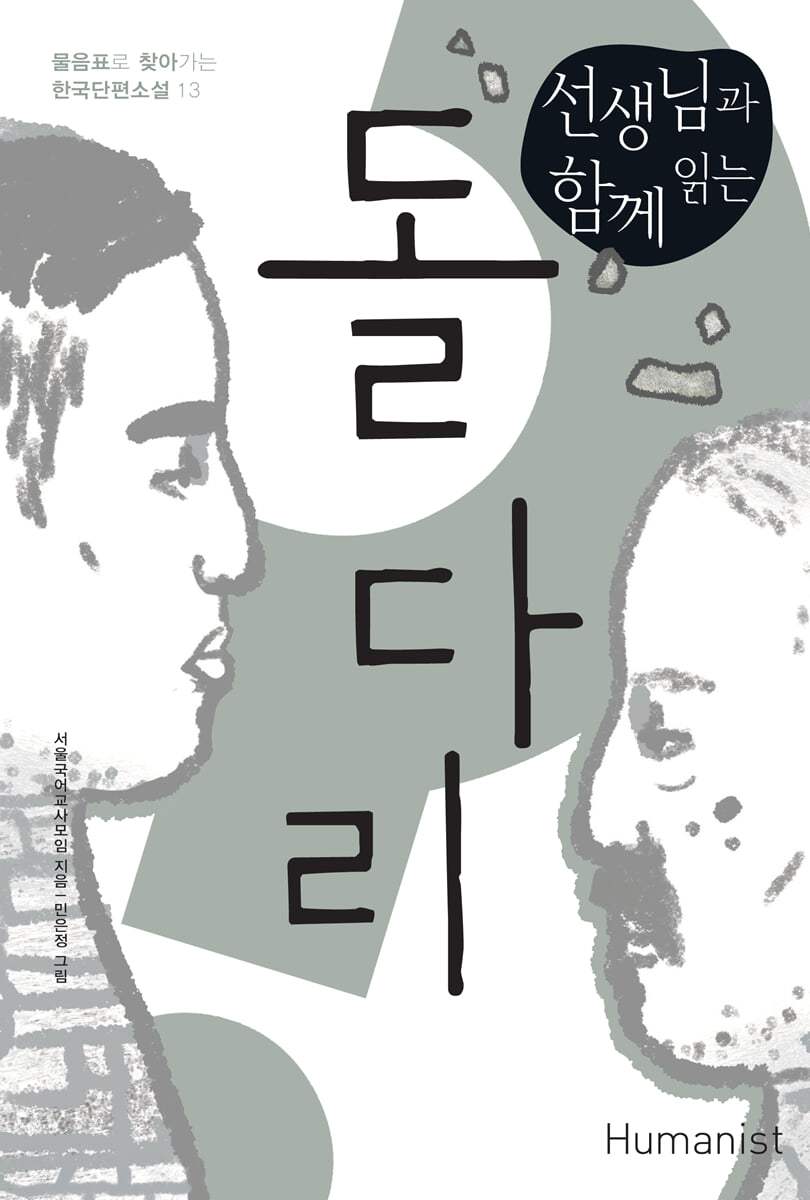
Reading Stone Bridge with a Teacher
 |
Description
Book Introduction
A guide to appreciating short stories in textbooks, planned and written by Korean language teachers.
The 'Question Marks Guide to Korean Short Stories' series
"Reading Stone Bridge with a Teacher" is the thirteenth book in the "Korean Short Stories with Question Marks" series, planned by the National Association of Korean Language Teachers and written by Korean language teachers across the country.
Published in 1941, "Stone Bridge" is a work set in the 1930s that reveals the differences in values between a generation steeped in modern capitalism and a generation striving to preserve traditional values.
"Stone Bridge" uses the themes of "land" and "stone bridge" to show the distinct difference in perception between father and son.
Although industrialization and modernization have brought about an era that values material values and efficiency, the author's awareness that traditional values must still be preserved is revealed.
Despite the differences in perception between generations due to differences in values, Lee Tae-jun leads the story in the direction of coexistence by recognizing each other's values.
This book is filled with meaningful questions raised by students after reading Lee Tae-jun's "Stone Bridge," and Korean language teachers' answers to those questions.
What role does the background of the work play, what values do the father and son have, what was the state of affairs in the 1930s like, how do the desire to pursue material things and the belief in preserving tradition meet?
These questions and their answers provide the essential information needed to fully understand the work “Stone Bridge” in an easily understandable manner.
In addition, it includes various reading materials such as Lee Tae-jun's life and literary world, the circumstances of the time when the work was written, and introductions to other works worth reading, allowing for a deeper and broader understanding of the work.
The 'Question Marks Guide to Korean Short Stories' series
"Reading Stone Bridge with a Teacher" is the thirteenth book in the "Korean Short Stories with Question Marks" series, planned by the National Association of Korean Language Teachers and written by Korean language teachers across the country.
Published in 1941, "Stone Bridge" is a work set in the 1930s that reveals the differences in values between a generation steeped in modern capitalism and a generation striving to preserve traditional values.
"Stone Bridge" uses the themes of "land" and "stone bridge" to show the distinct difference in perception between father and son.
Although industrialization and modernization have brought about an era that values material values and efficiency, the author's awareness that traditional values must still be preserved is revealed.
Despite the differences in perception between generations due to differences in values, Lee Tae-jun leads the story in the direction of coexistence by recognizing each other's values.
This book is filled with meaningful questions raised by students after reading Lee Tae-jun's "Stone Bridge," and Korean language teachers' answers to those questions.
What role does the background of the work play, what values do the father and son have, what was the state of affairs in the 1930s like, how do the desire to pursue material things and the belief in preserving tradition meet?
These questions and their answers provide the essential information needed to fully understand the work “Stone Bridge” in an easily understandable manner.
In addition, it includes various reading materials such as Lee Tae-jun's life and literary world, the circumstances of the time when the work was written, and introductions to other works worth reading, allowing for a deeper and broader understanding of the work.
- You can preview some of the book's contents.
Preview
index
Publishing the series 'Korean Short Stories with Question Marks'
preface
Reading the work: "Stone Bridge" by Lee Tae-jun
Reading Deeply: Reading "Stone Bridge" Through Questions and Answers
1.
Background in the work
Where is Sammal?
What are the fields of Neungjinon and Doksijangbat?
What are the high and low prices?
Is appendicitis a fatal disease?
Were you able to rent a bike?
2.
father and son
What kind of person is your father?
Why does father repair the stone bridge?
What kind of person is Changseop?
How did you become a doctor then?
How much money was ten thousand won at that time?
3.
Desire and Belief
Why is the title 'Stone Bridge'?
What kind of poetry is Baek Nak-cheon?
What is the author trying to say?
Reading Broadly: A Look Beyond the Work
Author Story - A Chronology of Lee Tae-jun's Life and Works, Learn More About the Author
A Tale of the Times - 1930s
Reading Together - Changing World and Value Orientation
Reader's Stories - A Literary Heritage Tour
preface
Reading the work: "Stone Bridge" by Lee Tae-jun
Reading Deeply: Reading "Stone Bridge" Through Questions and Answers
1.
Background in the work
Where is Sammal?
What are the fields of Neungjinon and Doksijangbat?
What are the high and low prices?
Is appendicitis a fatal disease?
Were you able to rent a bike?
2.
father and son
What kind of person is your father?
Why does father repair the stone bridge?
What kind of person is Changseop?
How did you become a doctor then?
How much money was ten thousand won at that time?
3.
Desire and Belief
Why is the title 'Stone Bridge'?
What kind of poetry is Baek Nak-cheon?
What is the author trying to say?
Reading Broadly: A Look Beyond the Work
Author Story - A Chronology of Lee Tae-jun's Life and Works, Learn More About the Author
A Tale of the Times - 1930s
Reading Together - Changing World and Value Orientation
Reader's Stories - A Literary Heritage Tour
Detailed image

Publisher's Review
1.
I dream of a literature class overflowing with whimsical imagination and lively questions.
The 'Korean Short Stories with Question Marks' series is a book planned and written by teachers from the National Association of Korean Language Teachers who dream of 'exciting and fun literature classes.'
It began with a reflection on literature classes designed for entrance exams and examinations, that is, literature classes that provide students with uniform and mechanical information about works, and was created with the intention of informing students about what they actually wonder about after reading the works.
Through this, we aimed to break away from one-sided literature classes that were consistent with fragmentary understanding and forced memorization, and to establish a foundation for a user-centered literature class that allows students to understand and empathize with the work.
The "Question Marks Guide to Korean Short Stories" series features short stories that have been widely read for a long time among those included in middle and high school Korean language and literature textbooks.
After reading these selected works directly to the students, I collected all the questions they had.
Among them, we selected those that were frequent, meaningful, novel, and original.
Then, the Korean language teachers looked up books and papers and answered the questions based on what they had studied.
It was explained in simple language so that students can read it easily, and pictures, photos, and reference materials were also included.
In this way, I tried to approach the more universal meaning of the work.
The 'Question Marks Guide to Korean Short Stories' series is unprecedented content that can elicit diverse and profound thoughts.
This series will not only open up a new horizon of "student-centered novel appreciation," but will also serve as a stepping stone for students to become more familiar with literary works.
2.
Read representative Korean short stories from textbooks in a single volume, deeply and broadly.
The 'Question Marks to Find Korean Short Stories' series originated from the regret over the current educational reality where students are increasingly moving away from literature due to memorization-based, problem-solving-based literature classes.
And it is being created with the will and passion of teachers who want to make literary works come alive and breathe close to students.
This book goes far beyond the fragmentary interpretation and understanding of novels found in existing textbooks or reference books.
Because it covers historical, cultural, social, and literary information in an easy and fun way based on questions that students actually ask when reading the work, it is of great help in fully understanding a single work.
This book is structured as 'reading the work - reading deeply - reading broadly'.
'Reading the Work' is literally a section that contains the entire novel.
It is composed with pictures that can stimulate fun and imagination.
'Deep Reading' is filled with meaningful questions that students have while reading the work, selected from among them, and teachers' answers to them.
It focuses on the background, characters, events, and themes related to the work itself, allowing readers to internalize the work in various ways while reading.
'Reading Broadly' allows for a broader understanding of the work by examining the elements surrounding the work, the author's life, and the circumstances of the time.
Additionally, by including the results of students reading and working on the work, we were able to get a glimpse into the thoughts of their peers on the work.
And by introducing other works with similar materials or themes through ‘linked reading,’ we were able to broaden the reading experience and the scope of literary appreciation.
I dream of a literature class overflowing with whimsical imagination and lively questions.
The 'Korean Short Stories with Question Marks' series is a book planned and written by teachers from the National Association of Korean Language Teachers who dream of 'exciting and fun literature classes.'
It began with a reflection on literature classes designed for entrance exams and examinations, that is, literature classes that provide students with uniform and mechanical information about works, and was created with the intention of informing students about what they actually wonder about after reading the works.
Through this, we aimed to break away from one-sided literature classes that were consistent with fragmentary understanding and forced memorization, and to establish a foundation for a user-centered literature class that allows students to understand and empathize with the work.
The "Question Marks Guide to Korean Short Stories" series features short stories that have been widely read for a long time among those included in middle and high school Korean language and literature textbooks.
After reading these selected works directly to the students, I collected all the questions they had.
Among them, we selected those that were frequent, meaningful, novel, and original.
Then, the Korean language teachers looked up books and papers and answered the questions based on what they had studied.
It was explained in simple language so that students can read it easily, and pictures, photos, and reference materials were also included.
In this way, I tried to approach the more universal meaning of the work.
The 'Question Marks Guide to Korean Short Stories' series is unprecedented content that can elicit diverse and profound thoughts.
This series will not only open up a new horizon of "student-centered novel appreciation," but will also serve as a stepping stone for students to become more familiar with literary works.
2.
Read representative Korean short stories from textbooks in a single volume, deeply and broadly.
The 'Question Marks to Find Korean Short Stories' series originated from the regret over the current educational reality where students are increasingly moving away from literature due to memorization-based, problem-solving-based literature classes.
And it is being created with the will and passion of teachers who want to make literary works come alive and breathe close to students.
This book goes far beyond the fragmentary interpretation and understanding of novels found in existing textbooks or reference books.
Because it covers historical, cultural, social, and literary information in an easy and fun way based on questions that students actually ask when reading the work, it is of great help in fully understanding a single work.
This book is structured as 'reading the work - reading deeply - reading broadly'.
'Reading the Work' is literally a section that contains the entire novel.
It is composed with pictures that can stimulate fun and imagination.
'Deep Reading' is filled with meaningful questions that students have while reading the work, selected from among them, and teachers' answers to them.
It focuses on the background, characters, events, and themes related to the work itself, allowing readers to internalize the work in various ways while reading.
'Reading Broadly' allows for a broader understanding of the work by examining the elements surrounding the work, the author's life, and the circumstances of the time.
Additionally, by including the results of students reading and working on the work, we were able to get a glimpse into the thoughts of their peers on the work.
And by introducing other works with similar materials or themes through ‘linked reading,’ we were able to broaden the reading experience and the scope of literary appreciation.
GOODS SPECIFICS
- Date of issue: April 29, 2024
- Page count, weight, size: 112 pages | 152*225*20mm
- ISBN13: 9791170871491
- ISBN10: 1170871496
- KC Certification: Certification Type: Conformity Confirmation
You may also like
카테고리
korean


korean

![GQ KOREA Mark (Monthly): December [2025]](http://librairie.coreenne.fr/cdn/shop/files/8ef265dbbfbf186523ed75ba7319009d.jpg?v=1765340328&width=3840)


