

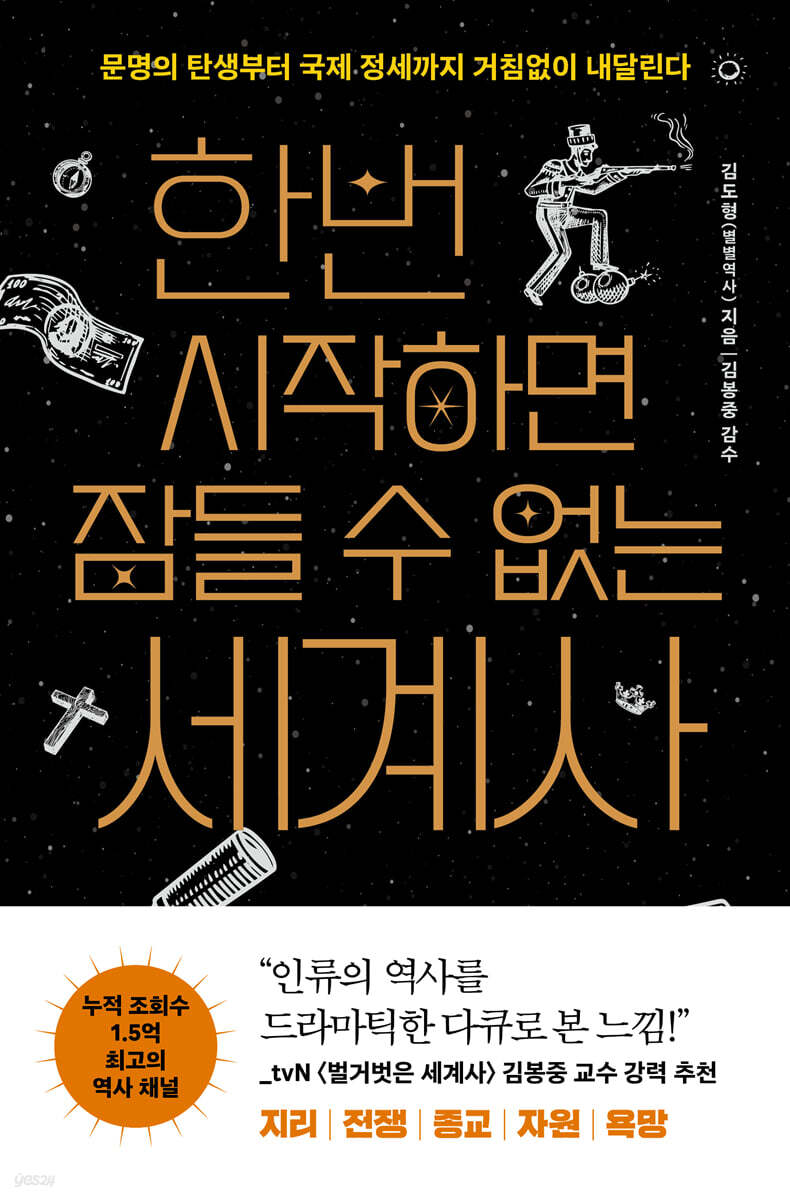
A world history that you can't fall asleep to once you start
 |
Description
Book Introduction
“If you don’t have the confidence to stay up all night, don’t open this book!”
A world history that you can't stop watching once you start
★★★ 6,000 Years of World History from a History Storyteller with 800,000 Subscribers
★★★ Includes over 100 illustrations of timelines, maps, famous paintings, and photographs.
★★★ tvN's "Naked World History" strongly recommended by Professor Kim Bong-joong
These days, the news is like a scene from world history.
From the Russo-Ukrainian War, the US-China hegemony competition, the Middle East conflict, and even the political crisis in Europe, the root of all the issues we encounter every day is ultimately 'history.'
The current chaos is an extension of the past.
So, the faster the world changes, the further and deeper we must look.
"A World History You Can't Sleep About Once You Start" is a book that will help you cultivate that eye.
This book, which weaves together the decisive moments of 6,000 years of human history, is a fascinating retelling of the flow of world history from the birth of civilization to the present day, reconstructed by Kim Do-hyung (Byeolbyeol History), a historical storyteller who has received numerous publication requests, using five keywords: war, geography, religion, resources, and desire.
His storytelling, presented with over 100 illustrations including diagrams, maps, famous paintings, and photographs, will be read with the same immersive power as a dramatic documentary.
A world history that you can't stop watching once you start
★★★ 6,000 Years of World History from a History Storyteller with 800,000 Subscribers
★★★ Includes over 100 illustrations of timelines, maps, famous paintings, and photographs.
★★★ tvN's "Naked World History" strongly recommended by Professor Kim Bong-joong
These days, the news is like a scene from world history.
From the Russo-Ukrainian War, the US-China hegemony competition, the Middle East conflict, and even the political crisis in Europe, the root of all the issues we encounter every day is ultimately 'history.'
The current chaos is an extension of the past.
So, the faster the world changes, the further and deeper we must look.
"A World History You Can't Sleep About Once You Start" is a book that will help you cultivate that eye.
This book, which weaves together the decisive moments of 6,000 years of human history, is a fascinating retelling of the flow of world history from the birth of civilization to the present day, reconstructed by Kim Do-hyung (Byeolbyeol History), a historical storyteller who has received numerous publication requests, using five keywords: war, geography, religion, resources, and desire.
His storytelling, presented with over 100 illustrations including diagrams, maps, famous paintings, and photographs, will be read with the same immersive power as a dramatic documentary.
- You can preview some of the book's contents.
Preview
index
prolog
Chapter 1.
[Geography] The Power of Geography to Determine the Fate of the World
1.
[United States] A country that became the world's most powerful nation through luck and skill.
2.
[China] A land of threat, surrounded by enemies on all sides
3.
[Russia] Why We Need to Acquire More Land Without End
Chapter 2.
[War] A Decisive Moment That Changed the Flow of Civilization
1.
[Italy] The worst mistake born of a dictator's delusions of grandeur
2.
[Japan] The Worst Choice for a Country Unable to Stop War
3.
[Israel/Palestine] The Land Grabbing War of Death That Began 4,000 Years Ago
4.
[Israel/Hamas] Why are things never going well for Israel and the Middle East?
Chapter 3.
[Religion] A key driving force that shaped social structure
1.
[UK] How did religious conflict become the foundation of democracy?
2.
[Spain] Why the World's Strongest Empire, the Spanish Empire, Sudden Collapse
3.
[India and Pakistan] A Disastrous Division in the Name of God
Chapter 4.
[Resource] A New Force Reshaping the Wealth Landscape
1.
[Netherlands] The Dutch's sudden rise to power and subsequent downfall
2.
[Africa] How do resources determine a nation's future?
Chapter 5.
[Desire] A fierce struggle over money, territory, and power.
1.
[The Mongol Empire] Why the Greatest Territory, Mongolia, Declined
2.
[North Korea] From a country that was better off than South Korea to one of the poorest countries in the world
References
Chapter 1.
[Geography] The Power of Geography to Determine the Fate of the World
1.
[United States] A country that became the world's most powerful nation through luck and skill.
2.
[China] A land of threat, surrounded by enemies on all sides
3.
[Russia] Why We Need to Acquire More Land Without End
Chapter 2.
[War] A Decisive Moment That Changed the Flow of Civilization
1.
[Italy] The worst mistake born of a dictator's delusions of grandeur
2.
[Japan] The Worst Choice for a Country Unable to Stop War
3.
[Israel/Palestine] The Land Grabbing War of Death That Began 4,000 Years Ago
4.
[Israel/Hamas] Why are things never going well for Israel and the Middle East?
Chapter 3.
[Religion] A key driving force that shaped social structure
1.
[UK] How did religious conflict become the foundation of democracy?
2.
[Spain] Why the World's Strongest Empire, the Spanish Empire, Sudden Collapse
3.
[India and Pakistan] A Disastrous Division in the Name of God
Chapter 4.
[Resource] A New Force Reshaping the Wealth Landscape
1.
[Netherlands] The Dutch's sudden rise to power and subsequent downfall
2.
[Africa] How do resources determine a nation's future?
Chapter 5.
[Desire] A fierce struggle over money, territory, and power.
1.
[The Mongol Empire] Why the Greatest Territory, Mongolia, Declined
2.
[North Korea] From a country that was better off than South Korea to one of the poorest countries in the world
References
Detailed image

Into the book
The United States was initially one of Britain's imperialist colonies.
But within a few centuries, the United States had become a nation with influence that extended beyond the American continent and into the world.
(…) The United States is the most geographically advantaged country.
First of all, the vast plains allow for agriculture on 45% of the country's land, and the area of cultivated land in the United States is 35 times the size of South Korea.
With $73.9 billion worth of corn grown annually, this means that 300 million Americans could be virtually self-sufficient without having to import food.
But an even bigger benefit is that these farmlands are right next to the rivers that run through most of the United States.
This allows food and other resources to be transported quickly across the country.
It is rich in resources such as iron ore and rare earth elements, and holds 4.4% of the world's crude oil reserves, ranking it ninth in the world.
Also, the entire country is located in the mid-latitude region, so the climate is good for living.
Most importantly, this geographically advantageous region is surrounded by a defensive barrier.
It is separated from Canada above by a forest and from Mexico below by a desert, and is bordered by the Atlantic Ocean and the Pacific Ocean to the east and west, making it difficult to invade recklessly.
So who discovered this blessed land, and how did it develop?
--- From "The United States, the country that became the strongest on Earth with the best luck and skills"
Russia's history can be seen as a history of 'securing buffer zones'.
Because they always wanted more buffer zones, that is, land, and they expanded endlessly.
In 1263, the Grand Duchy of Moscow, the predecessor of the Russian Empire, was born.
The Grand Duchy of Moscow, which had been under Mongol rule, began to dream of becoming a powerful nation after the Battle of the Ugra River in 1480, when Grand Duke Ivan III of Moscow declared independence from the Mongols and later proclaimed the title of 'Tsar'.
But the tsars of all generations could not help but be perplexed (…) because of the location of Moscow, the capital.
(…) Moscow was located in the middle of a vast plain, making it a very difficult area to defend.
(…) Far from being mountains, the surrounding area was an endless plain, and Moscow itself was a plain with an average altitude of less than 150 meters.
In short, it means that if an enemy invades, you will be pushed back quickly.
(…) They wrap their heads around it and realize that there is only one choice.
It was just securing a buffer zone, that is, rather expanding!
--- From “[Russia] Why We Must Securing Infinitely More Land”
It contains 7.5% of the world's crude oil reserves, 7.8% of its natural gas reserves, and accounts for the largest portion of the world's diamond production.
At the same time, 40% of the entire population lives in slums, and nearly 200 million children suffer from water shortages.
Where is this place? It's Africa.
(…) In fact, there was a time when Africa was strong.
The Aksum Kingdom in East Africa, which enjoyed its heyday from the 3rd to 6th centuries, prospered through trade and even built a navy, earning it the nickname of one of the "four great powers." It is said that the Mali Empire of the 14th century supplied nearly half of the gold of the Old World (Europe, Asia, and Africa) at the time.
In fact, Mansa Musa, the king of the Mali Empire, is considered the richest man in history, with experts saying that his wealth was "so vast that it cannot be estimated."
But today, half of sub-Saharan Africans survive on less than a dollar a day.
Why is Africa, with such enormous potential, still so poor?
--- From “How Resources Destroy Nations in Africa”
Iran has used the Israeli-Palestinian issue to secure the legitimacy of its Islamic regime externally, while at the same time uniting Iranians internally under the keyword of Islam.
Israel was also used to divert public discontent elsewhere.
They have faced significant public opposition due to sanctions-induced economic recession and their characteristically authoritarian rule.
But successive Iranian presidents have turned their frustration outward by criticizing Israel.
(…) Israel also uses each other to strengthen its identity and promote unity whenever the Iranian Islamic regime makes ultra-hardline statements against Israel.
But within a few centuries, the United States had become a nation with influence that extended beyond the American continent and into the world.
(…) The United States is the most geographically advantaged country.
First of all, the vast plains allow for agriculture on 45% of the country's land, and the area of cultivated land in the United States is 35 times the size of South Korea.
With $73.9 billion worth of corn grown annually, this means that 300 million Americans could be virtually self-sufficient without having to import food.
But an even bigger benefit is that these farmlands are right next to the rivers that run through most of the United States.
This allows food and other resources to be transported quickly across the country.
It is rich in resources such as iron ore and rare earth elements, and holds 4.4% of the world's crude oil reserves, ranking it ninth in the world.
Also, the entire country is located in the mid-latitude region, so the climate is good for living.
Most importantly, this geographically advantageous region is surrounded by a defensive barrier.
It is separated from Canada above by a forest and from Mexico below by a desert, and is bordered by the Atlantic Ocean and the Pacific Ocean to the east and west, making it difficult to invade recklessly.
So who discovered this blessed land, and how did it develop?
--- From "The United States, the country that became the strongest on Earth with the best luck and skills"
Russia's history can be seen as a history of 'securing buffer zones'.
Because they always wanted more buffer zones, that is, land, and they expanded endlessly.
In 1263, the Grand Duchy of Moscow, the predecessor of the Russian Empire, was born.
The Grand Duchy of Moscow, which had been under Mongol rule, began to dream of becoming a powerful nation after the Battle of the Ugra River in 1480, when Grand Duke Ivan III of Moscow declared independence from the Mongols and later proclaimed the title of 'Tsar'.
But the tsars of all generations could not help but be perplexed (…) because of the location of Moscow, the capital.
(…) Moscow was located in the middle of a vast plain, making it a very difficult area to defend.
(…) Far from being mountains, the surrounding area was an endless plain, and Moscow itself was a plain with an average altitude of less than 150 meters.
In short, it means that if an enemy invades, you will be pushed back quickly.
(…) They wrap their heads around it and realize that there is only one choice.
It was just securing a buffer zone, that is, rather expanding!
--- From “[Russia] Why We Must Securing Infinitely More Land”
It contains 7.5% of the world's crude oil reserves, 7.8% of its natural gas reserves, and accounts for the largest portion of the world's diamond production.
At the same time, 40% of the entire population lives in slums, and nearly 200 million children suffer from water shortages.
Where is this place? It's Africa.
(…) In fact, there was a time when Africa was strong.
The Aksum Kingdom in East Africa, which enjoyed its heyday from the 3rd to 6th centuries, prospered through trade and even built a navy, earning it the nickname of one of the "four great powers." It is said that the Mali Empire of the 14th century supplied nearly half of the gold of the Old World (Europe, Asia, and Africa) at the time.
In fact, Mansa Musa, the king of the Mali Empire, is considered the richest man in history, with experts saying that his wealth was "so vast that it cannot be estimated."
But today, half of sub-Saharan Africans survive on less than a dollar a day.
Why is Africa, with such enormous potential, still so poor?
--- From “How Resources Destroy Nations in Africa”
Iran has used the Israeli-Palestinian issue to secure the legitimacy of its Islamic regime externally, while at the same time uniting Iranians internally under the keyword of Islam.
Israel was also used to divert public discontent elsewhere.
They have faced significant public opposition due to sanctions-induced economic recession and their characteristically authoritarian rule.
But successive Iranian presidents have turned their frustration outward by criticizing Israel.
(…) Israel also uses each other to strengthen its identity and promote unity whenever the Iranian Islamic regime makes ultra-hardline statements against Israel.
--- From “[Israel/Hamas] Why is it that Israel and the Middle East never have a good day?”
Publisher's Review
“It felt like watching a dramatic documentary on the history of mankind!”
From the birth of civilization to the present day
6,000 Years of World History Through Decisive Events
At the center of the news that shakes the world today is always ‘history.’
Issues like the Middle East conflict, the US-China hegemony competition, and the political crisis in Europe can ultimately be fully understood when viewed within the long chain of history.
So, for us who must live in a rapidly changing world, we need the ability to see further and deeper.
In today's world where the entire world is interconnected, events outside our borders have a profound impact on me today.
"A World History You Can't Sleep About Once You Start" relentlessly advances through 6,000 years of crucial moments in human history, from the birth of civilization to the present.
As you become immersed in a story that transcends vast time and space, you will soon understand the flow of world history over thousands of years, and the grand history of humanity will be portrayed.
You will experience a complex world being organized in an instant, and your perspective on the world will change.
You will realize that Professor Kim Bong-joong's recommendation, "It feels like watching the history of mankind in a dramatic documentary," is not an exaggeration.
The best historical storytellers tell us
World history read through five keywords: geography, war, religion, resources, and desire!
This book is the first introductory book on world history by Kim Do-hyung, a "history storyteller" who has received 800,000 rave reviews for his ability to convey complex history in an easy and fun way.
He reinterprets world history through the lens of five forces that have shaped the course of human civilization: geography, war, religion, resources, and desire, and reveals the roots of the world we live in in a fascinating way.
Chapter 1 examines countries whose fate was determined by geography.
Through the United States, which became a superpower through natural circumstances, China, surrounded by enemies on all sides, and Russia, which cannot stop fighting to secure more land, this book explains how geopolitical position has determined the fate of the world.
Chapter 2 presents a panorama of the war that became a turning point in human history.
From World War II, the worst war in human history, to the Pacific War and the Middle East War that is still ongoing, it vividly depicts the decisive moments of war that still have a major impact today.
Chapter 3 deals with the history of civilization and conflict created by 'religion'.
It reveals that 'religion' was behind the British Revolution, which became the foundation of democracy, the sudden collapse of Spain, once the world's most powerful empire, and the tragic division of India and Pakistan, which were once one country.
Chapter 4 deals with the paradox that 'resources' bring both wealth and ruin.
Looking at the tragic history of the Netherlands, where natural resources that seemed like a blessing soon became a curse, and Africa, where resources actually caused suffering, allows us to understand the irony of human history even more deeply.
The last five chapters deal with the rise and fall of empires created by 'desire'.
Through the collapse of the Mongol Empire, which once dominated the world with its vast territory, and the reality of North Korea, which became the world's poorest country due to the greed of a single dictator, we examine how human 'desire' for money, territory, and power has distorted history.
Now that the entire world is connected in real time, world history is no longer a choice but a 'survival lesson.'
Past and present, we and the world are bound by a vast chain of cause and effect.
By understanding the connections across 6,000 years of history, we will have a valuable map to prepare for the coming crises and rapidly changing future.
From the birth of civilization to the present day
6,000 Years of World History Through Decisive Events
At the center of the news that shakes the world today is always ‘history.’
Issues like the Middle East conflict, the US-China hegemony competition, and the political crisis in Europe can ultimately be fully understood when viewed within the long chain of history.
So, for us who must live in a rapidly changing world, we need the ability to see further and deeper.
In today's world where the entire world is interconnected, events outside our borders have a profound impact on me today.
"A World History You Can't Sleep About Once You Start" relentlessly advances through 6,000 years of crucial moments in human history, from the birth of civilization to the present.
As you become immersed in a story that transcends vast time and space, you will soon understand the flow of world history over thousands of years, and the grand history of humanity will be portrayed.
You will experience a complex world being organized in an instant, and your perspective on the world will change.
You will realize that Professor Kim Bong-joong's recommendation, "It feels like watching the history of mankind in a dramatic documentary," is not an exaggeration.
The best historical storytellers tell us
World history read through five keywords: geography, war, religion, resources, and desire!
This book is the first introductory book on world history by Kim Do-hyung, a "history storyteller" who has received 800,000 rave reviews for his ability to convey complex history in an easy and fun way.
He reinterprets world history through the lens of five forces that have shaped the course of human civilization: geography, war, religion, resources, and desire, and reveals the roots of the world we live in in a fascinating way.
Chapter 1 examines countries whose fate was determined by geography.
Through the United States, which became a superpower through natural circumstances, China, surrounded by enemies on all sides, and Russia, which cannot stop fighting to secure more land, this book explains how geopolitical position has determined the fate of the world.
Chapter 2 presents a panorama of the war that became a turning point in human history.
From World War II, the worst war in human history, to the Pacific War and the Middle East War that is still ongoing, it vividly depicts the decisive moments of war that still have a major impact today.
Chapter 3 deals with the history of civilization and conflict created by 'religion'.
It reveals that 'religion' was behind the British Revolution, which became the foundation of democracy, the sudden collapse of Spain, once the world's most powerful empire, and the tragic division of India and Pakistan, which were once one country.
Chapter 4 deals with the paradox that 'resources' bring both wealth and ruin.
Looking at the tragic history of the Netherlands, where natural resources that seemed like a blessing soon became a curse, and Africa, where resources actually caused suffering, allows us to understand the irony of human history even more deeply.
The last five chapters deal with the rise and fall of empires created by 'desire'.
Through the collapse of the Mongol Empire, which once dominated the world with its vast territory, and the reality of North Korea, which became the world's poorest country due to the greed of a single dictator, we examine how human 'desire' for money, territory, and power has distorted history.
Now that the entire world is connected in real time, world history is no longer a choice but a 'survival lesson.'
Past and present, we and the world are bound by a vast chain of cause and effect.
By understanding the connections across 6,000 years of history, we will have a valuable map to prepare for the coming crises and rapidly changing future.
GOODS SPECIFICS
- Date of issue: December 1, 2025
- Page count, weight, size: 304 pages | 145*220*18mm
- ISBN13: 9791199491755
- ISBN10: 1199491756
You may also like
카테고리
korean


korean

![GQ KOREA Mark (Monthly): December [2025]](http://librairie.coreenne.fr/cdn/shop/files/8ef265dbbfbf186523ed75ba7319009d.jpg?v=1765340328&width=3840)


