

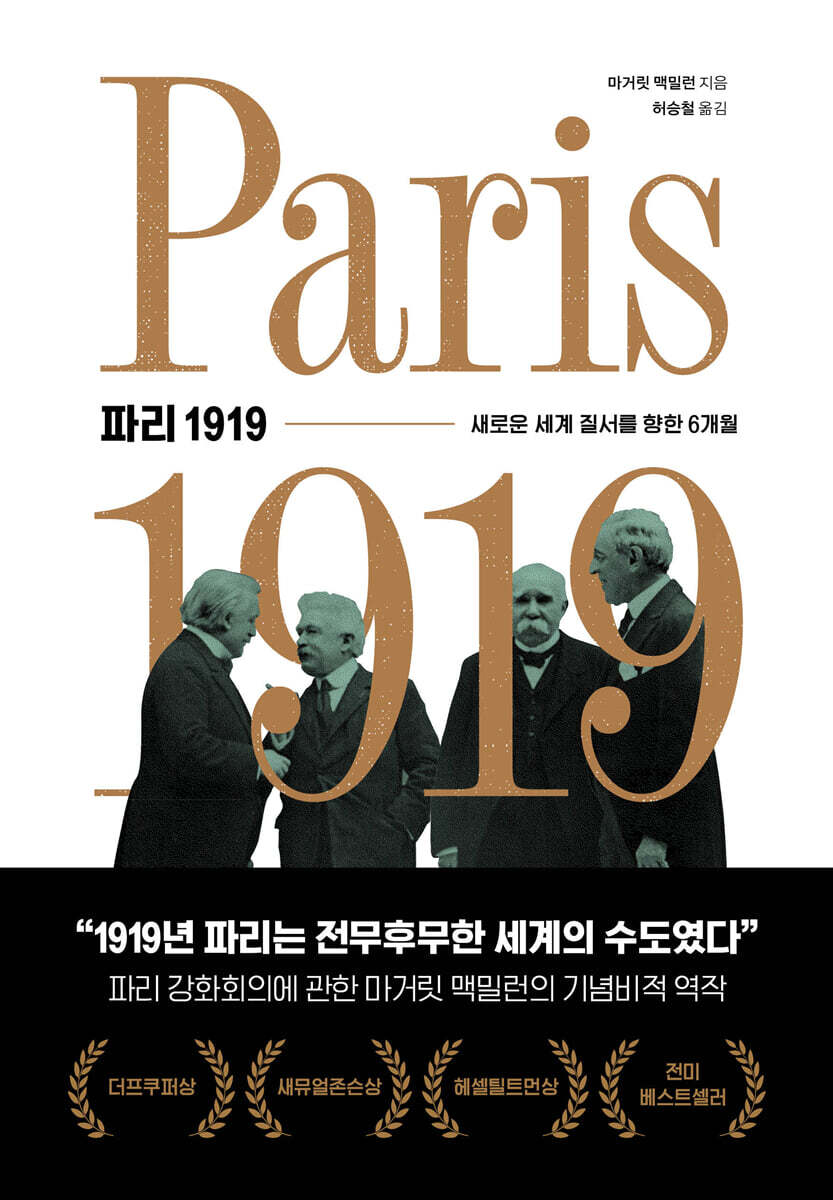
Paris 1919
 |
Description
Book Introduction
“In 1919, Paris was the world's capital like never before.”
Margaret Macmillan's monumental work on the Paris Peace Conference
In 1919, Paris was the capital of the world.
Paris became the world government, the world's supreme court, the world's parliament, the focus of fear and hope.
Officially, the Peace Conference lasted until 1920, but its first six months were the most important.
During that six-month period, the four leaders of the victorious powers—US President Wilson, French Prime Minister Clemenceau, British Prime Minister Lloyd George, and Italian Prime Minister Orlando—formed the so-called "Council of Four" to make crucial decisions for establishing a new world order and peace.
Not only them, but representatives of all kinds from all over the world gathered in Paris with countless causes and interests.
From the creation of a global security organization to the establishment of new nations, border adjustments, the promotion of human rights, and the punishment of war criminals (actually, defeated nations), a struggle unfolded to impose new order and values on the fractured world.
Margaret MacMillan, a world-renowned historian of modern and contemporary international relations, presents her masterpiece, Paris 1919, which vividly and clearly depicts these turbulent six months in Paris.
Stories told directly by the characters, including their personal history, increase comprehension and a sense of realism.
As you read the book, you will be surprised to learn how intense and colorful the Paris Peace Conference, known only as "the failed conference that led to World War II through harsh punishment of Germany," actually was, and how much influence it had in shaping the world we know today.
Margaret Macmillan's monumental work on the Paris Peace Conference
In 1919, Paris was the capital of the world.
Paris became the world government, the world's supreme court, the world's parliament, the focus of fear and hope.
Officially, the Peace Conference lasted until 1920, but its first six months were the most important.
During that six-month period, the four leaders of the victorious powers—US President Wilson, French Prime Minister Clemenceau, British Prime Minister Lloyd George, and Italian Prime Minister Orlando—formed the so-called "Council of Four" to make crucial decisions for establishing a new world order and peace.
Not only them, but representatives of all kinds from all over the world gathered in Paris with countless causes and interests.
From the creation of a global security organization to the establishment of new nations, border adjustments, the promotion of human rights, and the punishment of war criminals (actually, defeated nations), a struggle unfolded to impose new order and values on the fractured world.
Margaret MacMillan, a world-renowned historian of modern and contemporary international relations, presents her masterpiece, Paris 1919, which vividly and clearly depicts these turbulent six months in Paris.
Stories told directly by the characters, including their personal history, increase comprehension and a sense of realism.
As you read the book, you will be surprised to learn how intense and colorful the Paris Peace Conference, known only as "the failed conference that led to World War II through harsh punishment of Germany," actually was, and how much influence it had in shaping the world we know today.
- You can preview some of the book's contents.
Preview
index
map
Entering
Part 1: Preparation for Peace
Chapter 1: Woodrow Wilson Goes to Europe
Chapter 2 First Impressions
Chapter 3 Paris
Chapter 4: Lloyd George and the British Delegation
Part 2: The New World Order
Chapter 5: The Supreme Council
Chapter 6 Russia
Chapter 7: League of Nations
Chapter 8 Mandate
Part 3: The Balkan Problem Again
Chapter 9 Yugoslavia
Chapter 10 Romania
Chapter 11 Bulgaria
Chapter 12 Winter Recess
Part 4: The German Problem
Chapter 13: Punishment and Prevention
Chapter 14 German Control
Chapter 15: Writing a Bill
Chapter 16: Deadlock in Negotiations on the German Treaty
Part 5 Between East and West
Chapter 17: Poland Reborn
Chapter 18 Czech Republic and Slovakia
Chapter 19 Austria
Chapter 20 Hungary
Part 6: Anxious Spring
Chapter 21: The Council of Four
Chapter 22 Italy leaves talks
Chapter 23: Japan and Racial Equality
Chapter 24: The Sword Aimed at the Heart of China
Part 7: Lighting a Fire in the Middle East
Chapter 25: The Greatest Greek Statesman Since Pericles
Chapter 26: The End of the Ottoman Empire
Chapter 27 Arab Independence
Chapter 28 Palestine
Chapter 29: Atatürk and the Breaking of the Treaty of Sevres
Part 8 Conclusion
Chapter 30: Hall of Mirrors
In conclusion
Appendix: Woodrow Wilson's Fourteen Points for Peace
Acknowledgements
Translator's Note
References
main
Search
Entering
Part 1: Preparation for Peace
Chapter 1: Woodrow Wilson Goes to Europe
Chapter 2 First Impressions
Chapter 3 Paris
Chapter 4: Lloyd George and the British Delegation
Part 2: The New World Order
Chapter 5: The Supreme Council
Chapter 6 Russia
Chapter 7: League of Nations
Chapter 8 Mandate
Part 3: The Balkan Problem Again
Chapter 9 Yugoslavia
Chapter 10 Romania
Chapter 11 Bulgaria
Chapter 12 Winter Recess
Part 4: The German Problem
Chapter 13: Punishment and Prevention
Chapter 14 German Control
Chapter 15: Writing a Bill
Chapter 16: Deadlock in Negotiations on the German Treaty
Part 5 Between East and West
Chapter 17: Poland Reborn
Chapter 18 Czech Republic and Slovakia
Chapter 19 Austria
Chapter 20 Hungary
Part 6: Anxious Spring
Chapter 21: The Council of Four
Chapter 22 Italy leaves talks
Chapter 23: Japan and Racial Equality
Chapter 24: The Sword Aimed at the Heart of China
Part 7: Lighting a Fire in the Middle East
Chapter 25: The Greatest Greek Statesman Since Pericles
Chapter 26: The End of the Ottoman Empire
Chapter 27 Arab Independence
Chapter 28 Palestine
Chapter 29: Atatürk and the Breaking of the Treaty of Sevres
Part 8 Conclusion
Chapter 30: Hall of Mirrors
In conclusion
Appendix: Woodrow Wilson's Fourteen Points for Peace
Acknowledgements
Translator's Note
References
main
Search
Into the book
In 1919, Paris was the capital of the world.
The Peace Conference was the most important task in the world, and the mediators were the most powerful people in the world.
--- From "Entering"
In 1919, there were two realities in the world that didn't quite fit together.
One reality was in Paris, the other was on the ground where the people made their own decisions and fought their own battles.
While it is true that the arbitrators had armies and navies, moving troops was slow and difficult in places like Asia Minor and the Caucasus interior, where there were few railways, roads, or ports.
The new aircraft that appeared were not big or powerful enough to fill this gap.
Even in central Europe, where railways had already been laid, the collapse of order left locomotives and freight cars without fuel.
Henry Wilson, the brilliant British general, said to Lloyd George:
“It is of no use to criticize this or that weak country.
“The root of the evil is that the Paris Accords do not work.”
--- From "Entering"
It is tempting to compare the situation in 1919 to that in 1945, but it misrepresents reality.
There were no superpowers in 1919.
There was no Soviet Union dominating central Europe with millions of troops, nor was there an America with a massive economy and a monopoly on nuclear bombs.
In 1919 the enemy countries were not completely defeated.
In 1919, the mediators were actively engaged in the task of creating and destroying the nation, but the clay was not so hard, and the force that shaped it was not so strong.
--- From "Chapter 5, Supreme Council"
They, even the cynical Clemenceau, tried to create a better order.
They could not predict the future, and of course they could not control it.
The future was a matter of their successors.
The resurgence of war in 1939 was the result of decisions made, or not made, in the previous two decades, not of the arrangements made in 1919.
Of course, if Germany had been defeated more thoroughly, the situation might have been different.
Or if America had been as strong as it was after World War II, and if it had tried to exercise that power.
Or if Britain and France had not been weakened by the war, or if they had been so weakened that the United States had no choice but to intervene further.
If Austria-Hungary had not disappeared.
If those successor states hadn't fought each other.
If only China weren't so weak.
If only Japan had more confidence.
If the nations had accepted the League of Nations with real power.
If the world had been so thoroughly devastated by war that international relations had to be rebuilt in a completely new way.
But arbitrators had to deal with reality, not 'what ifs'.
They had to grapple with serious and difficult problems.
How can we curb the irrational passions of nationalism and religion before they cause significant damage? How can we prevent war? We still ask these questions.
--- From "Conclusion"
The regret regarding our country is that we overlooked the fact that Japan participated in the peace conference as a victorious nation and one of the five major powers, and placed vain hopes on Wilson's principle of national self-determination.
The ability to properly grasp the flow of international affairs, then and now, is very important to the survival of a nation.
I believe that when describing the March 1st Movement or China's May 4th Movement in textbooks, we need explanations that reflect the international political situation at the time, including the Paris Peace Conference, rather than a simple patriotic perspective.
When I see the borders of various countries being drawn at the Gangwha Conference based on inaccurate and falsified maps, I am reminded of our history, when the 38th parallel was drawn on a map published in National Geographic.
The Peace Conference was the most important task in the world, and the mediators were the most powerful people in the world.
--- From "Entering"
In 1919, there were two realities in the world that didn't quite fit together.
One reality was in Paris, the other was on the ground where the people made their own decisions and fought their own battles.
While it is true that the arbitrators had armies and navies, moving troops was slow and difficult in places like Asia Minor and the Caucasus interior, where there were few railways, roads, or ports.
The new aircraft that appeared were not big or powerful enough to fill this gap.
Even in central Europe, where railways had already been laid, the collapse of order left locomotives and freight cars without fuel.
Henry Wilson, the brilliant British general, said to Lloyd George:
“It is of no use to criticize this or that weak country.
“The root of the evil is that the Paris Accords do not work.”
--- From "Entering"
It is tempting to compare the situation in 1919 to that in 1945, but it misrepresents reality.
There were no superpowers in 1919.
There was no Soviet Union dominating central Europe with millions of troops, nor was there an America with a massive economy and a monopoly on nuclear bombs.
In 1919 the enemy countries were not completely defeated.
In 1919, the mediators were actively engaged in the task of creating and destroying the nation, but the clay was not so hard, and the force that shaped it was not so strong.
--- From "Chapter 5, Supreme Council"
They, even the cynical Clemenceau, tried to create a better order.
They could not predict the future, and of course they could not control it.
The future was a matter of their successors.
The resurgence of war in 1939 was the result of decisions made, or not made, in the previous two decades, not of the arrangements made in 1919.
Of course, if Germany had been defeated more thoroughly, the situation might have been different.
Or if America had been as strong as it was after World War II, and if it had tried to exercise that power.
Or if Britain and France had not been weakened by the war, or if they had been so weakened that the United States had no choice but to intervene further.
If Austria-Hungary had not disappeared.
If those successor states hadn't fought each other.
If only China weren't so weak.
If only Japan had more confidence.
If the nations had accepted the League of Nations with real power.
If the world had been so thoroughly devastated by war that international relations had to be rebuilt in a completely new way.
But arbitrators had to deal with reality, not 'what ifs'.
They had to grapple with serious and difficult problems.
How can we curb the irrational passions of nationalism and religion before they cause significant damage? How can we prevent war? We still ask these questions.
--- From "Conclusion"
The regret regarding our country is that we overlooked the fact that Japan participated in the peace conference as a victorious nation and one of the five major powers, and placed vain hopes on Wilson's principle of national self-determination.
The ability to properly grasp the flow of international affairs, then and now, is very important to the survival of a nation.
I believe that when describing the March 1st Movement or China's May 4th Movement in textbooks, we need explanations that reflect the international political situation at the time, including the Paris Peace Conference, rather than a simple patriotic perspective.
When I see the borders of various countries being drawn at the Gangwha Conference based on inaccurate and falsified maps, I am reminded of our history, when the 38th parallel was drawn on a map published in National Geographic.
--- From the Translator's Note
Publisher's Review
★★★ Winner of the Duff Cooper Award, Samuel Johnson Award, and Hessel Tiltman Award ★★★
★★★ Arthur Ross Book Award / Governor General of Canada Award Winner ★★★
★★★ National Bestseller ★★★
“In 1919, Paris was the world's capital like never before.”
Margaret Macmillan's monumental work on the Paris Peace Conference
In 1919, Paris was the capital of the world.
Paris became the world government, the world's supreme court, the world's parliament, the focus of fear and hope.
Officially, the Peace Conference lasted until 1920, but its first six months were the most important.
During that six-month period, the four leaders of the victorious powers—US President Wilson, French Prime Minister Clemenceau, British Prime Minister Lloyd George, and Italian Prime Minister Orlando—formed the so-called "Council of Four" to make crucial decisions for establishing a new world order and peace.
Not only them, but representatives of all kinds from all over the world gathered in Paris with countless causes and interests.
From the creation of a global security organization to the establishment of new nations, border adjustments, the promotion of human rights, and the punishment of war criminals (actually, defeated nations), a struggle unfolded to impose new order and values on the fractured world.
Margaret MacMillan, a world-renowned historian of modern and contemporary international relations, presents her masterpiece, Paris 1919, vividly and clearly depicting these tumultuous six months in Paris.
Stories told directly by the characters, including their personal history, increase comprehension and a sense of realism.
As you read the book, you will be surprised to learn how intense and colorful the Paris Peace Conference, known only as "the failed conference that led to World War II through harsh punishment of Germany," actually was, and how much influence it had in shaping the world we know today.
Europe's 'Belle Epoque' is over
- Background of the 1919 Paris Peace Conference
In November 1918, the Great War ended.
The lofty pride of the imperialist European powers, who had dominated the world under the pretext of a so-called "civilizing mission," was shattered.
The world's most advanced nations poured the fruits of their manpower, wealth, industry, science, and technology into a war that was so unequally powerful that it could not be stopped for four years.
It was not until the summer of 1918, with Germany's allies collapsing and new American troops pouring in, that the Allies gained the upper hand.
The war overthrew governments, humbled those in power, and turned entire societies upside down.
In Russia, the revolution of 1917 replaced the Tsarist autocracy with a system still unknown to anyone.
In the latter half of the war, the Austro-Hungarian Empire disappeared, leaving a huge vacuum in central Europe.
The Ottoman Empire, which had owned vast territories in the Middle East and occupied parts of Europe, was also virtually finished.
The German Empire is now a republic.
Old nations like Poland, Lithuania, Estonia, and Latvia, buried in history, were revived, while new nations like Yugoslavia and Czechoslovakia struggled to be born.
Those who seek to establish a new order on the ruins gather.
- The different dreams of all the representatives who flocked to the world's capitals
The Paris Peace Conference, which began in January 1919, is remembered primarily for producing the German Treaty signed at Versailles in June 1919, but much more happened than that.
Other defeated powers, such as Austria and Hungary, which were now separate countries, as well as Bulgaria and the Ottoman Empire, were also forced to sign treaties.
New borders were drawn in central Europe and the Middle East.
Above all, the most important thing was to recreate the international order.
Not only were there active movements to establish international organizations such as the League of Nations, the International Labour Organization, and the International Telegraph Union, but representatives of all sorts flocked to Paris to advocate their causes.
Petitions and petitioners from all over the world gathered in Paris demanding women's suffrage, civil rights for black people, a labor charter, Irish independence, and disarmament.
Paris that winter and spring was awash with intrigue over a Jewish homeland, a rebuilt Poland, an independent Ukraine, Kurdistan, and Armenia.
Petitions poured in from the Voters' Association, the Carpathian-Russian Committee in Paris, the Banat Serbs, the Anti-Bolshevik Russian Political Conference, and from countries already in existence and those still aspirational.
One of the strengths of this book is that it addresses these numerous needs and hopes in a concise yet clear manner.
At the same time, by meticulously examining the growth process, personality, and tendencies of each group's representative or key figure, their humanity and individuality are brought to life, and through this, their claims, activities, and successful or regrettable endings are brought to life.
Thanks to Macmillan's writing skills, what could have easily felt like a boring, table-top discussion was transformed into a thrilling drama.
A meeting of the world's four most powerful men begins.
- The agony and dilemma of the four-member council members
The Paris Peace Conference officially opened on January 18, 1919, and by January, 29 countries had sent delegations to Paris.
However, in reality, the first meeting was held on January 12, the day after British Prime Minister Lloyd George arrived in Paris, with only five major powers—France, Britain, the United States, Italy, and Japan—in attendance.
The five-nation meeting, dubbed the "Council of Ten" or the "Supreme Council," which lasted for two months, was nothing short of a signal of how small and medium-sized countries would be left out in the future.
When it was deemed too cumbersome to proceed with even this, the so-called 'Council of Four' was started in late March, with only the top four representatives from France, the United Kingdom, the United States, and Italy meeting.
While these methods clearly had the effect of increasing efficiency and progress, they also excluded delicate considerations and voices from the field.
Your four leaders had to accomplish so much in such a short time, and so many eyes were watching them, each with their own set of expectations.
This meant that whatever decision the four-person council made was bound to be met with great disappointment and opposition.
The charm of this book lies in the vivid depiction of the four leaders' fierce struggles under the burden of heavy expectations and their emotions at every moment.
Although they were the most powerful people in the world at the time, they were also human.
Their struggles to move forward, each agonizing, fighting, making concessions, wavering, and comforting, are heartbreaking, but seeing them stick only to their own interests or make arbitrary judgments and decisions without any understanding of the local situation often brings about mixed feelings of anger.
A clear summary of six months of scheming and disunity.
- Book structure and contents
Paris 1919 basically follows the flow of time, but presents the numerous issues addressed at the peace conference in a clear and concise manner, grouping them mainly by major region.
Part 1 describes the various atmospheres just before the Paris Peace Conference and introduces three leaders: U.S. President Wilson, French Prime Minister Clemenceau, and British Prime Minister Lloyd George.
Part 2 covers the procedures and mechanisms considered to establish a new international order.
In particular, Wilson placed the greatest emphasis on the creation of the League of Nations, a security organization to prevent and deter provocations by specific countries on a global scale.
From Part 3 onwards, regional issues are covered in detail and with urgency.
These are the Balkan Peninsula (Part 3), Central and Eastern Europe (Part 5), Northeast Asia (Part 6), and the Middle East (Part 7).
In particular, when the Austro-Hungarian and Ottoman Empires were defeated in World War I and began to disintegrate, a fierce battle broke out between representatives of each nation seeking to create new nations in that vast region and representatives of existing nations seeking to seize more land.
Part 4 deals with the German issue, which was a key issue at the Peace Conference.
The four leaders differed on what to do with Germany, the most important defeated nation and a rival power bordering France.
Despite France's consistent hard-line stance and the withdrawal of Italian Prime Minister Orlando during the middle of the discussion due to a disagreement, the negotiations were tumultuous, but after a grand compromise was reached, including Clemenceau's concession of French control over the Rhineland, the final text of the entire treaty, including the German clause, was finally produced in May.
For Germany, this treaty was too harsh and they showed all kinds of protests and rejections, but in the end, they agreed to sign the treaty after obtaining only minor adjustments (Part 8).
Today's world situation began at the Paris Peace Conference.
- The spark of conflict in Central and Eastern Europe and the Middle East
The Paris Peace Conference concluded with the signing of the Treaty of Versailles on June 28, 1919.
Article 231, which designated Germany as a war criminal and imposed massive reparations and various restrictions, was the most prominent and is still criticized as a failed conference. However, author Macmillan assesses that the rise of Hitler and the outbreak of World War II were due to the actions of interwar politicians and the international situation, and that the Paris Peace Conference and the four major powers cannot be held directly responsible.
Rather, the Paris Peace Conference and the four major powers should take greater responsibility for the handling of the region from Central and Eastern Europe to the Middle East.
With little knowledge of the local situation, they were left struggling with inaccurate maps and the numerous petitions from local stakeholders.
Moreover, Wilson's principle of national self-determination was plausible in name, but the reality was too complex to apply.
(Reading this book, you will realize how vain the hopes that Koreans had for national self-determination at the time were.) The borders between Central and Eastern Europe and the Middle East, artificially established at the Paris Peace Conference, actually gave rise to extreme nationalism and incited conflict and confrontation.
Moreover, they effectively approved the creation of a new state of Israel, which was completely incompatible with the principle of national self-determination, thereby fueling the conflict in the Middle East that continues to this day.
(It is significant that the story of Atatürk, the Turkish hero who resisted the decisions of the Paris Peace Conference and ultimately won, gaining independence and territory, decorates the last part of the book.) This is why this book is a must-read for leaders, politicians, and foreign affairs experts of each country today.
We have much to learn from the arrogance, confirmation bias, groupthink, and trial and error of past arbitrators.
★★★ Arthur Ross Book Award / Governor General of Canada Award Winner ★★★
★★★ National Bestseller ★★★
“In 1919, Paris was the world's capital like never before.”
Margaret Macmillan's monumental work on the Paris Peace Conference
In 1919, Paris was the capital of the world.
Paris became the world government, the world's supreme court, the world's parliament, the focus of fear and hope.
Officially, the Peace Conference lasted until 1920, but its first six months were the most important.
During that six-month period, the four leaders of the victorious powers—US President Wilson, French Prime Minister Clemenceau, British Prime Minister Lloyd George, and Italian Prime Minister Orlando—formed the so-called "Council of Four" to make crucial decisions for establishing a new world order and peace.
Not only them, but representatives of all kinds from all over the world gathered in Paris with countless causes and interests.
From the creation of a global security organization to the establishment of new nations, border adjustments, the promotion of human rights, and the punishment of war criminals (actually, defeated nations), a struggle unfolded to impose new order and values on the fractured world.
Margaret MacMillan, a world-renowned historian of modern and contemporary international relations, presents her masterpiece, Paris 1919, vividly and clearly depicting these tumultuous six months in Paris.
Stories told directly by the characters, including their personal history, increase comprehension and a sense of realism.
As you read the book, you will be surprised to learn how intense and colorful the Paris Peace Conference, known only as "the failed conference that led to World War II through harsh punishment of Germany," actually was, and how much influence it had in shaping the world we know today.
Europe's 'Belle Epoque' is over
- Background of the 1919 Paris Peace Conference
In November 1918, the Great War ended.
The lofty pride of the imperialist European powers, who had dominated the world under the pretext of a so-called "civilizing mission," was shattered.
The world's most advanced nations poured the fruits of their manpower, wealth, industry, science, and technology into a war that was so unequally powerful that it could not be stopped for four years.
It was not until the summer of 1918, with Germany's allies collapsing and new American troops pouring in, that the Allies gained the upper hand.
The war overthrew governments, humbled those in power, and turned entire societies upside down.
In Russia, the revolution of 1917 replaced the Tsarist autocracy with a system still unknown to anyone.
In the latter half of the war, the Austro-Hungarian Empire disappeared, leaving a huge vacuum in central Europe.
The Ottoman Empire, which had owned vast territories in the Middle East and occupied parts of Europe, was also virtually finished.
The German Empire is now a republic.
Old nations like Poland, Lithuania, Estonia, and Latvia, buried in history, were revived, while new nations like Yugoslavia and Czechoslovakia struggled to be born.
Those who seek to establish a new order on the ruins gather.
- The different dreams of all the representatives who flocked to the world's capitals
The Paris Peace Conference, which began in January 1919, is remembered primarily for producing the German Treaty signed at Versailles in June 1919, but much more happened than that.
Other defeated powers, such as Austria and Hungary, which were now separate countries, as well as Bulgaria and the Ottoman Empire, were also forced to sign treaties.
New borders were drawn in central Europe and the Middle East.
Above all, the most important thing was to recreate the international order.
Not only were there active movements to establish international organizations such as the League of Nations, the International Labour Organization, and the International Telegraph Union, but representatives of all sorts flocked to Paris to advocate their causes.
Petitions and petitioners from all over the world gathered in Paris demanding women's suffrage, civil rights for black people, a labor charter, Irish independence, and disarmament.
Paris that winter and spring was awash with intrigue over a Jewish homeland, a rebuilt Poland, an independent Ukraine, Kurdistan, and Armenia.
Petitions poured in from the Voters' Association, the Carpathian-Russian Committee in Paris, the Banat Serbs, the Anti-Bolshevik Russian Political Conference, and from countries already in existence and those still aspirational.
One of the strengths of this book is that it addresses these numerous needs and hopes in a concise yet clear manner.
At the same time, by meticulously examining the growth process, personality, and tendencies of each group's representative or key figure, their humanity and individuality are brought to life, and through this, their claims, activities, and successful or regrettable endings are brought to life.
Thanks to Macmillan's writing skills, what could have easily felt like a boring, table-top discussion was transformed into a thrilling drama.
A meeting of the world's four most powerful men begins.
- The agony and dilemma of the four-member council members
The Paris Peace Conference officially opened on January 18, 1919, and by January, 29 countries had sent delegations to Paris.
However, in reality, the first meeting was held on January 12, the day after British Prime Minister Lloyd George arrived in Paris, with only five major powers—France, Britain, the United States, Italy, and Japan—in attendance.
The five-nation meeting, dubbed the "Council of Ten" or the "Supreme Council," which lasted for two months, was nothing short of a signal of how small and medium-sized countries would be left out in the future.
When it was deemed too cumbersome to proceed with even this, the so-called 'Council of Four' was started in late March, with only the top four representatives from France, the United Kingdom, the United States, and Italy meeting.
While these methods clearly had the effect of increasing efficiency and progress, they also excluded delicate considerations and voices from the field.
Your four leaders had to accomplish so much in such a short time, and so many eyes were watching them, each with their own set of expectations.
This meant that whatever decision the four-person council made was bound to be met with great disappointment and opposition.
The charm of this book lies in the vivid depiction of the four leaders' fierce struggles under the burden of heavy expectations and their emotions at every moment.
Although they were the most powerful people in the world at the time, they were also human.
Their struggles to move forward, each agonizing, fighting, making concessions, wavering, and comforting, are heartbreaking, but seeing them stick only to their own interests or make arbitrary judgments and decisions without any understanding of the local situation often brings about mixed feelings of anger.
A clear summary of six months of scheming and disunity.
- Book structure and contents
Paris 1919 basically follows the flow of time, but presents the numerous issues addressed at the peace conference in a clear and concise manner, grouping them mainly by major region.
Part 1 describes the various atmospheres just before the Paris Peace Conference and introduces three leaders: U.S. President Wilson, French Prime Minister Clemenceau, and British Prime Minister Lloyd George.
Part 2 covers the procedures and mechanisms considered to establish a new international order.
In particular, Wilson placed the greatest emphasis on the creation of the League of Nations, a security organization to prevent and deter provocations by specific countries on a global scale.
From Part 3 onwards, regional issues are covered in detail and with urgency.
These are the Balkan Peninsula (Part 3), Central and Eastern Europe (Part 5), Northeast Asia (Part 6), and the Middle East (Part 7).
In particular, when the Austro-Hungarian and Ottoman Empires were defeated in World War I and began to disintegrate, a fierce battle broke out between representatives of each nation seeking to create new nations in that vast region and representatives of existing nations seeking to seize more land.
Part 4 deals with the German issue, which was a key issue at the Peace Conference.
The four leaders differed on what to do with Germany, the most important defeated nation and a rival power bordering France.
Despite France's consistent hard-line stance and the withdrawal of Italian Prime Minister Orlando during the middle of the discussion due to a disagreement, the negotiations were tumultuous, but after a grand compromise was reached, including Clemenceau's concession of French control over the Rhineland, the final text of the entire treaty, including the German clause, was finally produced in May.
For Germany, this treaty was too harsh and they showed all kinds of protests and rejections, but in the end, they agreed to sign the treaty after obtaining only minor adjustments (Part 8).
Today's world situation began at the Paris Peace Conference.
- The spark of conflict in Central and Eastern Europe and the Middle East
The Paris Peace Conference concluded with the signing of the Treaty of Versailles on June 28, 1919.
Article 231, which designated Germany as a war criminal and imposed massive reparations and various restrictions, was the most prominent and is still criticized as a failed conference. However, author Macmillan assesses that the rise of Hitler and the outbreak of World War II were due to the actions of interwar politicians and the international situation, and that the Paris Peace Conference and the four major powers cannot be held directly responsible.
Rather, the Paris Peace Conference and the four major powers should take greater responsibility for the handling of the region from Central and Eastern Europe to the Middle East.
With little knowledge of the local situation, they were left struggling with inaccurate maps and the numerous petitions from local stakeholders.
Moreover, Wilson's principle of national self-determination was plausible in name, but the reality was too complex to apply.
(Reading this book, you will realize how vain the hopes that Koreans had for national self-determination at the time were.) The borders between Central and Eastern Europe and the Middle East, artificially established at the Paris Peace Conference, actually gave rise to extreme nationalism and incited conflict and confrontation.
Moreover, they effectively approved the creation of a new state of Israel, which was completely incompatible with the principle of national self-determination, thereby fueling the conflict in the Middle East that continues to this day.
(It is significant that the story of Atatürk, the Turkish hero who resisted the decisions of the Paris Peace Conference and ultimately won, gaining independence and territory, decorates the last part of the book.) This is why this book is a must-read for leaders, politicians, and foreign affairs experts of each country today.
We have much to learn from the arrogance, confirmation bias, groupthink, and trial and error of past arbitrators.
GOODS SPECIFICS
- Date of issue: November 28, 2025
- Format: Hardcover book binding method guide
- Page count, weight, size: 972 pages | 145*210*40mm
- ISBN13: 9791194263760
- ISBN10: 1194263763
You may also like
카테고리
korean


korean

![GQ KOREA Mark (Monthly): December [2025]](http://librairie.coreenne.fr/cdn/shop/files/8ef265dbbfbf186523ed75ba7319009d.jpg?v=1765340328&width=3840)


