

A multipolar world is coming
 |
Description
Book Introduction
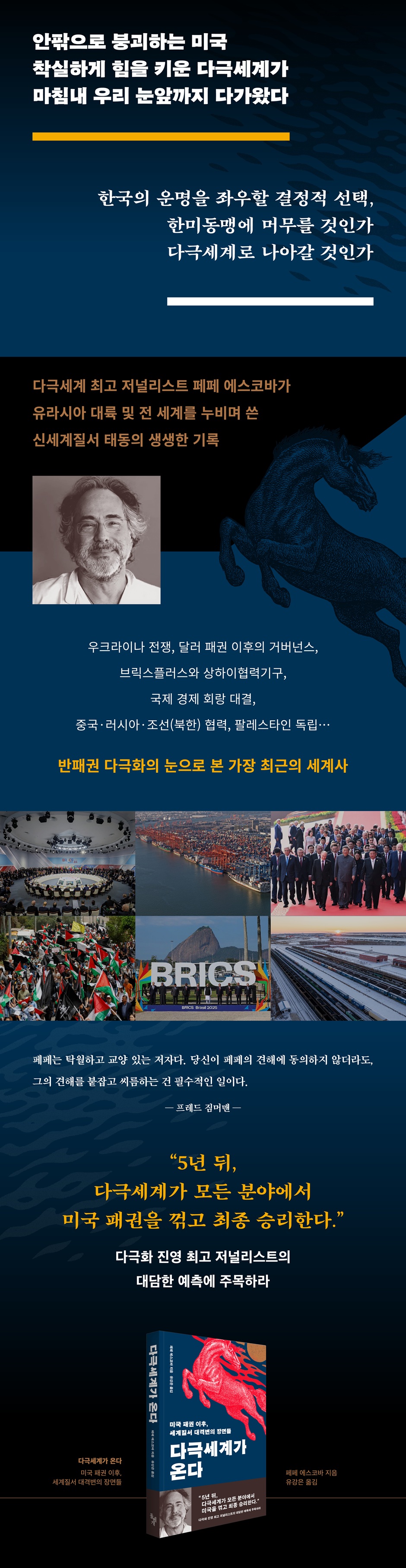
The book by Brazilian geopolitical analyst Pepe Escobar, a top journalist in the multipolar world, is finally being introduced in Korea.
The author, who has built a reputation for his vivid analysis of the world situation over the past two decades, intensely exploring American hegemony and the Global South that opposes it, has finally, in "The Coming Multipolar World," "examined the raw draft of history at a geopolitical turning point that is surging like a volcano."
This book documents the most recent world history of the 2020s through the lens of anti-hegemonic multipolarity, exploring how a multipolar world without American hegemony was prepared.
He has personally traveled across Eurasia and the world, observing, listening, and analyzing the most pressing issues in the global political landscape of our time, including the Ukrainian War, the post-dollar hegemony era, BRICS+ and the SCO, the international economic corridor competition, cooperation between China, Russia, and North Korea, and Palestinian independence.
Compared to the Western analyses of world affairs we've mostly encountered, this report presents a refreshing and interesting perspective, positioning the multipolar world as an "actor" rather than an "object of analysis," and combining specific, on-the-ground expertise with professional journalism, sometimes even going so far as to cover frontline areas.
The author points out that a multipolar world did not emerge suddenly.
The "global majority," which had been fiercely pursuing multipolarization, steadily built up its power and prepared, finally making strides toward becoming a global power in the face of the crumbling American hegemony both internally and externally.
The "Empire of Chaos" will resort to war to maintain its hegemony, but the fierce confrontation will ultimately culminate in its ultimate victory in all areas of the multipolar world (politics, economy, military, culture, etc.) around 2030.
Therefore, the author argues that the scenes of the emergence of a new world order in the early 2020s discussed in this book should be understood as "scenes of cataclysmic change" that will establish a new era's system after hegemony.
As the central axis of world history is gradually being formed in a way that is very different from our inertial perspective that defaults to a world centered on the United States, if you want to understand the core currents and trends and predict the future amidst the rapidly changing international order, whether you agree or not, you need to listen to the bold and radical story of Pepe Escobar.
Because the multipolar world is already taking root in our reality at a faster rate than we can perceive.
The author's call to "throw off the blinders of American and collective Western exceptionalism" holds significant significance in today's Korean society.
The author, who has built a reputation for his vivid analysis of the world situation over the past two decades, intensely exploring American hegemony and the Global South that opposes it, has finally, in "The Coming Multipolar World," "examined the raw draft of history at a geopolitical turning point that is surging like a volcano."
This book documents the most recent world history of the 2020s through the lens of anti-hegemonic multipolarity, exploring how a multipolar world without American hegemony was prepared.
He has personally traveled across Eurasia and the world, observing, listening, and analyzing the most pressing issues in the global political landscape of our time, including the Ukrainian War, the post-dollar hegemony era, BRICS+ and the SCO, the international economic corridor competition, cooperation between China, Russia, and North Korea, and Palestinian independence.
Compared to the Western analyses of world affairs we've mostly encountered, this report presents a refreshing and interesting perspective, positioning the multipolar world as an "actor" rather than an "object of analysis," and combining specific, on-the-ground expertise with professional journalism, sometimes even going so far as to cover frontline areas.
The author points out that a multipolar world did not emerge suddenly.
The "global majority," which had been fiercely pursuing multipolarization, steadily built up its power and prepared, finally making strides toward becoming a global power in the face of the crumbling American hegemony both internally and externally.
The "Empire of Chaos" will resort to war to maintain its hegemony, but the fierce confrontation will ultimately culminate in its ultimate victory in all areas of the multipolar world (politics, economy, military, culture, etc.) around 2030.
Therefore, the author argues that the scenes of the emergence of a new world order in the early 2020s discussed in this book should be understood as "scenes of cataclysmic change" that will establish a new era's system after hegemony.
As the central axis of world history is gradually being formed in a way that is very different from our inertial perspective that defaults to a world centered on the United States, if you want to understand the core currents and trends and predict the future amidst the rapidly changing international order, whether you agree or not, you need to listen to the bold and radical story of Pepe Escobar.
Because the multipolar world is already taking root in our reality at a faster rate than we can perceive.
The author's call to "throw off the blinders of American and collective Western exceptionalism" holds significant significance in today's Korean society.
- You can preview some of the book's contents.
Preview
index
Recommendation
introduction
Glossary of Abbreviations and Key Terms
I.
The Geopolitics of World War III and Anti-Trade
1.
Something really strange happened in Kabul
2.
The withdrawal of Nord Stream 2 and the position of Power of Siberia 2
3.
The New Communist Manifesto: Anti-Trade, Trade, Not War!
4.
A Conversation with Sergey Glazyev: A New Global Monetary and Financial System in the De-dollarization Era
5.
St. Petersburg prepares for a new economic war
6.
From Balkh to Konya: Following in Rumi's Footsteps of Spiritual Geopolitics
7.
A "fragmented world" sleepwalking into World War III
8.
The Global South's Race to Bypass Dollar Hegemony
II.
After the dollar hegemony and Pax Americana
9.
Board the New Global Currency Train: A Conversation Aboard the "Moving Multipolar World"
10.
Xi Jinping and Putin Set Out to Demolish Pax Americana
11.
Waiting for the end of the 'world'
12.
Capital of a Multipolar World: Moscow Diaries
13.
A one-on-one train heads to Shangri-La.
14.
Putin and What Really Matters on the 'Chessboard'
III.
A giant chessboard is turned upside down
15.
The US prepares for a hybrid all-out war against BRICS+.
16.
The future emerges from Greater Eurasia
17.
Watching the new barbarians from the top of Sicily
18.
The decisive war of the 21st century is not the war with China.
19.
Syria: A Story of Plunder and Resurrection
20.
Russia, Africa, China, and North Korea: Decisive Moves Across the Chessboard
IV.
Multipolar World vs. the American Empire
21.
From Bukhara to Brix: A Journey to Find Light in the Darkness of Madness
22.
Central Asia: The Battleground of the New Great Game
23.
NATO's robots versus the multipolar world's celestial horses
24.
Russia's Far East, which determines the tone of the multipolar world
25.
Chaotic Economic Corridor Wars: The Indo-Middle East-Europe Corridor and the Zangezzur Corridor
26.
Strategic partners drawing the roadmap for Belt and Road Initiatives and BRICS
27.
Eviction Notices in Four Languages: Palestine and Western 'Values'
28.
China and Russia are cruising along
Conclusion: Life in War, On the Roads of Donbas
For Korean Readers: Taming the Pretensions of the "Empire of Chaos"
Timeline: The Rise of a Multipolar New World Order
List of new words
Find a person's name
introduction
Glossary of Abbreviations and Key Terms
I.
The Geopolitics of World War III and Anti-Trade
1.
Something really strange happened in Kabul
2.
The withdrawal of Nord Stream 2 and the position of Power of Siberia 2
3.
The New Communist Manifesto: Anti-Trade, Trade, Not War!
4.
A Conversation with Sergey Glazyev: A New Global Monetary and Financial System in the De-dollarization Era
5.
St. Petersburg prepares for a new economic war
6.
From Balkh to Konya: Following in Rumi's Footsteps of Spiritual Geopolitics
7.
A "fragmented world" sleepwalking into World War III
8.
The Global South's Race to Bypass Dollar Hegemony
II.
After the dollar hegemony and Pax Americana
9.
Board the New Global Currency Train: A Conversation Aboard the "Moving Multipolar World"
10.
Xi Jinping and Putin Set Out to Demolish Pax Americana
11.
Waiting for the end of the 'world'
12.
Capital of a Multipolar World: Moscow Diaries
13.
A one-on-one train heads to Shangri-La.
14.
Putin and What Really Matters on the 'Chessboard'
III.
A giant chessboard is turned upside down
15.
The US prepares for a hybrid all-out war against BRICS+.
16.
The future emerges from Greater Eurasia
17.
Watching the new barbarians from the top of Sicily
18.
The decisive war of the 21st century is not the war with China.
19.
Syria: A Story of Plunder and Resurrection
20.
Russia, Africa, China, and North Korea: Decisive Moves Across the Chessboard
IV.
Multipolar World vs. the American Empire
21.
From Bukhara to Brix: A Journey to Find Light in the Darkness of Madness
22.
Central Asia: The Battleground of the New Great Game
23.
NATO's robots versus the multipolar world's celestial horses
24.
Russia's Far East, which determines the tone of the multipolar world
25.
Chaotic Economic Corridor Wars: The Indo-Middle East-Europe Corridor and the Zangezzur Corridor
26.
Strategic partners drawing the roadmap for Belt and Road Initiatives and BRICS
27.
Eviction Notices in Four Languages: Palestine and Western 'Values'
28.
China and Russia are cruising along
Conclusion: Life in War, On the Roads of Donbas
For Korean Readers: Taming the Pretensions of the "Empire of Chaos"
Timeline: The Rise of a Multipolar New World Order
List of new words
Find a person's name
Detailed image
Into the book
Now, let's go on a serious time travel.
To find out how we got here.
Readers will revisit Afghanistan, the sinews of the Pyrenean Empire, the wars targeting the Eurasian Economic Corridor, the long and complex road to de-dollarization, Moscow as a poignant space in a multipolar world, examples of hybrid warfare, the power of the Heartland and Siberia, and the decline of naval supremacy.
--- p.15
Let's trade, not war.
This is the slogan that will become the motto of Xi Jinping and Pax Sinica.
The crucial point is that Beijing does not seek to replace Pax Americana.
Pax Americana has always relied on the Pentagon's various forms of gunboat diplomacy.
The declaration subtly reinforced Beijing's lack of interest in becoming a "new hegemon."
What matters most to Beijing is removing the constraints the outside world can impose on China's internal decisions, especially its unique political structure.
This is why the historical resolution released in Beijing last week can be interpreted as a new Communist Manifesto.
The key author is undoubtedly Xi Jinping.
Whether or not this declaration constitutes an ideal roadmap for a society far wealthier, better educated, and more relentlessly complex than the Deng Xiaoping era, the old world order is now finished.
Everything will start again from the beginning.
--- p.49
New York financial circles unofficially acknowledge that the US dollar will be "swept away."
Because if a new currency is pegged to gold, the US dollar will become nothing more than a worthless fiat currency.
This is because the Bretton Woods system no longer has a gold backing, and like the FTX cryptocurrency, it has no intrinsic value.
Vast swathes of the non-Western world are now paying close attention to the push for a new currency other than the US dollar.
This will eventually culminate in a new gold standard that will completely replace the US dollar.
Regardless of what toxic substances that massive, dysfunctional nuclear rogue state produces, BRICS+ economic dominance will be a reality in about seven years.
There's not much left.
First, let's start with the 'new currency'.
--- p.99~101
Certainly, China and Russia have established a comprehensive strategic partnership.
Both countries will be committed to a serious geopolitical and geoeconomic response to the "predatory empire" in the long term.
This is the new world that was born in Moscow this week.
Putin defined this as a new anti-colonial policy.
This new world is designed as a patchwork of multipolar systems.
We will never turn a blind eye to the destruction of any remnant of Pax Americana.
--- p.122~123
In Ukraine, neoconservatives sought to provoke Moscow into deploying secret weapons other than hypersonic missiles.
Because Washington could easily prepare for an all-out war.
All these elaborate plans failed miserably.
But the inevitable result still remains.
Neoconservatives firmly believe that millions of Europeans can be used as cannon fodder, as was done in World War I and World War II.
Whose turn will be next? The Poles? The Estonians? The Latvians? The Lithuanians? Or maybe the Germans? They're going to fight over the corpses of Europeans (including Russians) who fell victim to that old Mackinderean Anglo-Saxon seizure of power.
While Europe's fifth-column faction too readily "trusts" the United States to protect them, few understand who blew up Nord Stream 1 and 2 with the tacit approval of the German chancellor's irritated face.
The point is that the hegemon cannot tolerate a sovereign and self-sufficient Europe.
They only want to be dependent vassals, hostages of the seas controlled by the United States.
--- p.158
A credible path forward is for Moscow to propose security treaties with Russia to individual European countries, rather than negotiating with NATO.
With this treaty, they would no longer need to belong to NATO.
Participating countries that sign a security treaty will have their security guaranteed and will also face less pressure from Washington.
Most relevant European countries are likely to accept this, but the European hyenas, the Poles and the Baltic Chihuahuas, will not.
At the same time, China could offer peace treaties to Japan, South Korea, and the Philippines.
As a result, a significant portion of the US 'base empire' may disappear.
The problem, once again, is that the vassal states have neither the authority nor the power to enforce the peace agreements.
The golden rule has not yet been met.
The first thing a vassal state that wants to be treated as a sovereign state must do is close down the core branches of the 'base empire' and expel the US military.
--- p.200~201
Shoigu was welcomed like a rock star in Pyongyang.
He also had a direct meeting with Kim Jong-un, Chairman of the State Affairs Commission of North Korea.
Such mutual friendship will ultimately pave the way for North Korea to move toward a multipolar world and increase its chances of joining multilateral organizations.
I am confident that the organization will be an expanded version of the Eurasian Economic Union.
This could begin with a free trade agreement between the Eurasian Economic Union and North Korea, as was the case with Vietnam and Cuba.
As the leading power in the Eurasian Economic Union, Russia can ignore the so-called sanctions against North Korea.
Moscow's key priorities are the development of the Far East, increased integration with the two Korean Peninsula states, and the Northern Sea Route, or the Arctic Silk Road.
Therefore, North Korea is a natural partner.
Russia's top diplomatic power is working hard to ease the pressure on North Korea.
Strategically, this is a real game changer.
Imagine a scenario where the entire Asia-Pacific paradigm is turned upside down by adding the Russian-Chinese strategic partnership to the sophisticated and massive industrial-military complex of North Korea.
--- p.205
In the context of a new Great Game that is becoming increasingly more intense by the day, it is not surprising that some diplomatic factions in the Heartland are increasingly interested in closer integration of Central Asia into BRICS Plus.
The issue is expected to be discussed at the BRICS summit in South Africa.
The strategic formula is 'Russia + Central Asia + South Asia + Africa + Latin America'.
In short, it is another example of “global globe” integration.
It all starts with Kazakhstan becoming the first Heartland country to join BRICS Plus.
After that, the entire world becomes a stage for the return of the revitalized Heartland.
Transportation, logistics, energy, trade, manufacturing, investment, information technology, culture, and “people-to-people exchange” will be activated.
In particular, the human exchange mentioned last is an important aspect that is central to the spirit of the Silk Road, past and present.
--- p.233
Anyone who has interacted with business executives in the splendid forum halls of Far Eastern Federal University, set against the backdrop of the four-kilometer-long suspension bridge spanning the Eastern Bosphorus Strait to Russky Island, has already sensed the "strategic priorities."
The development potential of this region, which can be called Russia's Asia (a key node in the Asia-Pacific), is astonishing.
There are 2,800 investment projects in progress, and 646 are already in operation.
Several internationally recognized advanced economic zones were created, and the Free Port of Vladivostok, home to hundreds of small and medium-sized enterprises, was expanded.
All preparations are complete.
For the West as a whole, and even for the rest of the world, the magic Russia has wrought in the Far East cannot be understood without experiencing it firsthand.
What Global South visitors experienced in Vladivostok (where the West was virtually absent from the forum) was a sustainable development project in full swing.
Not only India and China, but also the ASEAN (Laos, Myanmar, and the Philippines) and Arab world representatives fully understood the situation.
--- p.243~244
Brix 10 continues to listen to the scene.
The current task of the new Great Game is to organize the expulsion of the hegemon from West Asia.
This is as much a technological challenge as it is a civilizational challenge.
The Washington-Tel Aviv continuum is now a prisoner of its own free will.
This is not Hotel California.
You can't check out whenever you want, and you'll be pushed out sooner or later.
It could happen in a relatively respectable way (think Kabul, a remix of Saigon), or, if things get dire, it could be a naval version of Apocalypse Now.
As expensive iron bathtubs become underwater coral reefs and the troops deployed by the US Central Command and its Africa Command disappear.
Genocide, directly participated in by the hegemonic power, only accelerated its own gradual and inevitable exclusion from the majority of the Global South.
--- p.270
Trump 2.0 may or may not escalate the war in Ukraine.
There may or may not be a more destructive attack on Iran.
A serious attempt at regime change could occur in Venezuela (almost certainly).
Trump 2.0, after all, has the solid backing of the Zionist oligarchs (who are in the realm of privileged psycho killers).
It will be a very difficult journey.
We must not allow the empire of chaos to stare us in the face, to sink into complete dementia and allow it to undermine stability in Africa, West Asia, the Caribbean, and everywhere else in the world, just as al-Qaeda in Syria has done (an old rascal from al-Qaeda will soon be welcomed to the Oval Office).
Are China, Russia, and the "global majority" truly ready? It's time for auspicious oaths.
To find out how we got here.
Readers will revisit Afghanistan, the sinews of the Pyrenean Empire, the wars targeting the Eurasian Economic Corridor, the long and complex road to de-dollarization, Moscow as a poignant space in a multipolar world, examples of hybrid warfare, the power of the Heartland and Siberia, and the decline of naval supremacy.
--- p.15
Let's trade, not war.
This is the slogan that will become the motto of Xi Jinping and Pax Sinica.
The crucial point is that Beijing does not seek to replace Pax Americana.
Pax Americana has always relied on the Pentagon's various forms of gunboat diplomacy.
The declaration subtly reinforced Beijing's lack of interest in becoming a "new hegemon."
What matters most to Beijing is removing the constraints the outside world can impose on China's internal decisions, especially its unique political structure.
This is why the historical resolution released in Beijing last week can be interpreted as a new Communist Manifesto.
The key author is undoubtedly Xi Jinping.
Whether or not this declaration constitutes an ideal roadmap for a society far wealthier, better educated, and more relentlessly complex than the Deng Xiaoping era, the old world order is now finished.
Everything will start again from the beginning.
--- p.49
New York financial circles unofficially acknowledge that the US dollar will be "swept away."
Because if a new currency is pegged to gold, the US dollar will become nothing more than a worthless fiat currency.
This is because the Bretton Woods system no longer has a gold backing, and like the FTX cryptocurrency, it has no intrinsic value.
Vast swathes of the non-Western world are now paying close attention to the push for a new currency other than the US dollar.
This will eventually culminate in a new gold standard that will completely replace the US dollar.
Regardless of what toxic substances that massive, dysfunctional nuclear rogue state produces, BRICS+ economic dominance will be a reality in about seven years.
There's not much left.
First, let's start with the 'new currency'.
--- p.99~101
Certainly, China and Russia have established a comprehensive strategic partnership.
Both countries will be committed to a serious geopolitical and geoeconomic response to the "predatory empire" in the long term.
This is the new world that was born in Moscow this week.
Putin defined this as a new anti-colonial policy.
This new world is designed as a patchwork of multipolar systems.
We will never turn a blind eye to the destruction of any remnant of Pax Americana.
--- p.122~123
In Ukraine, neoconservatives sought to provoke Moscow into deploying secret weapons other than hypersonic missiles.
Because Washington could easily prepare for an all-out war.
All these elaborate plans failed miserably.
But the inevitable result still remains.
Neoconservatives firmly believe that millions of Europeans can be used as cannon fodder, as was done in World War I and World War II.
Whose turn will be next? The Poles? The Estonians? The Latvians? The Lithuanians? Or maybe the Germans? They're going to fight over the corpses of Europeans (including Russians) who fell victim to that old Mackinderean Anglo-Saxon seizure of power.
While Europe's fifth-column faction too readily "trusts" the United States to protect them, few understand who blew up Nord Stream 1 and 2 with the tacit approval of the German chancellor's irritated face.
The point is that the hegemon cannot tolerate a sovereign and self-sufficient Europe.
They only want to be dependent vassals, hostages of the seas controlled by the United States.
--- p.158
A credible path forward is for Moscow to propose security treaties with Russia to individual European countries, rather than negotiating with NATO.
With this treaty, they would no longer need to belong to NATO.
Participating countries that sign a security treaty will have their security guaranteed and will also face less pressure from Washington.
Most relevant European countries are likely to accept this, but the European hyenas, the Poles and the Baltic Chihuahuas, will not.
At the same time, China could offer peace treaties to Japan, South Korea, and the Philippines.
As a result, a significant portion of the US 'base empire' may disappear.
The problem, once again, is that the vassal states have neither the authority nor the power to enforce the peace agreements.
The golden rule has not yet been met.
The first thing a vassal state that wants to be treated as a sovereign state must do is close down the core branches of the 'base empire' and expel the US military.
--- p.200~201
Shoigu was welcomed like a rock star in Pyongyang.
He also had a direct meeting with Kim Jong-un, Chairman of the State Affairs Commission of North Korea.
Such mutual friendship will ultimately pave the way for North Korea to move toward a multipolar world and increase its chances of joining multilateral organizations.
I am confident that the organization will be an expanded version of the Eurasian Economic Union.
This could begin with a free trade agreement between the Eurasian Economic Union and North Korea, as was the case with Vietnam and Cuba.
As the leading power in the Eurasian Economic Union, Russia can ignore the so-called sanctions against North Korea.
Moscow's key priorities are the development of the Far East, increased integration with the two Korean Peninsula states, and the Northern Sea Route, or the Arctic Silk Road.
Therefore, North Korea is a natural partner.
Russia's top diplomatic power is working hard to ease the pressure on North Korea.
Strategically, this is a real game changer.
Imagine a scenario where the entire Asia-Pacific paradigm is turned upside down by adding the Russian-Chinese strategic partnership to the sophisticated and massive industrial-military complex of North Korea.
--- p.205
In the context of a new Great Game that is becoming increasingly more intense by the day, it is not surprising that some diplomatic factions in the Heartland are increasingly interested in closer integration of Central Asia into BRICS Plus.
The issue is expected to be discussed at the BRICS summit in South Africa.
The strategic formula is 'Russia + Central Asia + South Asia + Africa + Latin America'.
In short, it is another example of “global globe” integration.
It all starts with Kazakhstan becoming the first Heartland country to join BRICS Plus.
After that, the entire world becomes a stage for the return of the revitalized Heartland.
Transportation, logistics, energy, trade, manufacturing, investment, information technology, culture, and “people-to-people exchange” will be activated.
In particular, the human exchange mentioned last is an important aspect that is central to the spirit of the Silk Road, past and present.
--- p.233
Anyone who has interacted with business executives in the splendid forum halls of Far Eastern Federal University, set against the backdrop of the four-kilometer-long suspension bridge spanning the Eastern Bosphorus Strait to Russky Island, has already sensed the "strategic priorities."
The development potential of this region, which can be called Russia's Asia (a key node in the Asia-Pacific), is astonishing.
There are 2,800 investment projects in progress, and 646 are already in operation.
Several internationally recognized advanced economic zones were created, and the Free Port of Vladivostok, home to hundreds of small and medium-sized enterprises, was expanded.
All preparations are complete.
For the West as a whole, and even for the rest of the world, the magic Russia has wrought in the Far East cannot be understood without experiencing it firsthand.
What Global South visitors experienced in Vladivostok (where the West was virtually absent from the forum) was a sustainable development project in full swing.
Not only India and China, but also the ASEAN (Laos, Myanmar, and the Philippines) and Arab world representatives fully understood the situation.
--- p.243~244
Brix 10 continues to listen to the scene.
The current task of the new Great Game is to organize the expulsion of the hegemon from West Asia.
This is as much a technological challenge as it is a civilizational challenge.
The Washington-Tel Aviv continuum is now a prisoner of its own free will.
This is not Hotel California.
You can't check out whenever you want, and you'll be pushed out sooner or later.
It could happen in a relatively respectable way (think Kabul, a remix of Saigon), or, if things get dire, it could be a naval version of Apocalypse Now.
As expensive iron bathtubs become underwater coral reefs and the troops deployed by the US Central Command and its Africa Command disappear.
Genocide, directly participated in by the hegemonic power, only accelerated its own gradual and inevitable exclusion from the majority of the Global South.
--- p.270
Trump 2.0 may or may not escalate the war in Ukraine.
There may or may not be a more destructive attack on Iran.
A serious attempt at regime change could occur in Venezuela (almost certainly).
Trump 2.0, after all, has the solid backing of the Zionist oligarchs (who are in the realm of privileged psycho killers).
It will be a very difficult journey.
We must not allow the empire of chaos to stare us in the face, to sink into complete dementia and allow it to undermine stability in Africa, West Asia, the Caribbean, and everywhere else in the world, just as al-Qaeda in Syria has done (an old rascal from al-Qaeda will soon be welcomed to the Oval Office).
Are China, Russia, and the "global majority" truly ready? It's time for auspicious oaths.
--- p.306~307
Publisher's Review
The multipolar world wasn't surprised by Trump 2.0.
In the midst of the world situation in 2025, there was a 'tariff war' waged by the Trump administration in the United States.
While most allies bowed their heads, many countries did not comply and responded in various ways, with leading countries in the so-called "multipolar world," such as China, India, and Brazil, responding particularly strongly.
In particular, China achieved a virtual victory by nullifying most of the US measures through the US-China summit in November, demonstrating once again that the ‘world’ is changing.
The world in which America's 'unipolar hegemony' has disintegrated is now generally referred to as a 'multipolar world.'
Its members include various countries and powers around the world, represented by organizations such as BRICS and also called the 'Global South'.
It is also expressed as a 'global majority' of 7 billion people, in contrast to the 1 billion people represented by the United States, the collective West, its allies, and the pro-American elites of each country.
To them, America was, in fact, 'always America.'
While the implications may have been quite different for its allies, whether it was Obama and Biden's "pro-NATO" stance or Trump's "America First" stance, in a multipolar world, the United States is always a competitive and hostile power that dominates and reigns.
So, for the past 20 years or so of the 21st century, the multipolar world has been shouting “NO KINGS.”
So there was nothing surprising about Trump 2.0.
More importantly, and in contrast to the decline of the United States—a decline marked by financial crises, military failures, mounting budget deficits, loss of productive capacity, and social unrest like guns, drugs, and polarization—the multipolar world has been steadily and rapidly increasing its power across all sectors for over a decade.
Ultimately, by 2023, the five BRICS countries will economically overtake the US-led G7 (based on PPP), and by 2025, the gap will further widen.
This book is a compilation of selected articles written between 2021 and 2024 by Brazilian journalist Pepe Escobar, a leading geopolitical analyst in the multipolar world camp.
In this book, he examines the advancement of a multipolar world from a so-called "internal perspective," the perspective and logic advocated by the multipolar camp itself.
Although it was visualized in 2025, the explosive advancement of a multipolar world was actually being prepared as early as the early 2020s.
So, the 'period of preparation' for the post-American hegemony period is the 'scene of a great upheaval in the world order.'
This book is appropriately presented to Korea at a time when there is a growing need to examine the multipolar world's strategies, goals, and realities from its own perspective, rather than through the eyes of the United States and the collective West.
Rewriting the “Giant Chessboard”
A vivid record of the birth of a new world order.
Pepe begins this book with the story of Afghanistan, where the "war on terror," America's 21st-century national policy encompassing Bush, Obama, Trump, and Biden, ultimately failed, and concludes with a report on a visit to the front lines in the Donbas region, where the US, NATO, and Ukraine are being militarily defeated by Russia (the Korean edition includes an additional article evaluating Trump 2.0 and the world situation in 2025).
In fact, the nature of the two wars triggered by the United States is a representative example of the end of the “rules-based world order” that has existed so far, or in other words, the practical superiority of a multipolar world (p. 14).
As the Pashtuns and Novorossiya demonstrate, the global majority is now starting to re-set the “grand chessboard.”
The era in which the United States dominated the world with its overwhelming military and economic power after World War II, dominating the “giant chessboard,” is now over.
Through a variety of topics, materials, and field visits, the author meticulously records and analyzes the various aspects of a multipolar world in fierce competition with unipolar hegemony.
Among them, the four topics he paid particular attention to were as follows:
① BRICS+, SCO, Eurasian Economic Union, and Belt and Road Initiative: "Separate Yet Together"
BRICS+, the Shanghai Cooperation Organization (SCO), the Eurasian Economic Union (EAEU), and the Belt and Road Initiative (BRI) are spaces where various forces driving change in the current world order have gathered 'separately yet together.'
Their solidarity, intersection, and cooperation are becoming increasingly powerful.
Their scope is expanding to encompass all areas of society, including politics, economy, military, and culture, and they are gradually "integrating" and "converging." BRICS+ and the SCO are expected to draw closer together in the near future (p. 219), ultimately leading to a fair and rational "new United Nations."
In this book, the author demonstrates his unique expertise by covering vivid on-site coverage of various multilateral meetings and events, exploring the convergence of a multipolar world and its specific realities.
What the author particularly focuses on is the establishment of a comprehensive strategic partnership between China and Russia.
The author characterizes the Xi Jinping-Putin summit in Moscow in March 2023 as “a Yalta meeting of a new era toward a multipolar world” that pledged to dismantle “the remnants of Pax Americana” (p. 118).
China's "Chinese Dream" and Russia's "Eurasian Initiative" share a significant commonality in that they both aim to build a multipolar world, that is, to democratize the world order and establish sovereignty-centered international relations. Based on this, they pledged to "unwaveringly" and "unity" to drive "major changes not seen in 100 years," and indeed, they are moving forward accordingly.
The author notes that 'Global South' clearly supports and is co-creating their basic concept as a "partner," and that there is widespread support and participation, particularly from Africa.
This creates a qualitative difference from the US and the Western-centric colonialist and racist Pax Americana order.
The term 'Global South', which has been used to refer to the so-called non-Western, developing countries, and the 'Third World', actually refers to the members of the multipolar world itself.
The countries of Asia (including East, West, and Central Asia), Africa, and Latin America are currently at the center of the Global South.
As the Global South continues to grow, Asia expands to connect to Europe and becomes "Eurasia," and more and more people within the Western collective agree on a multipolar world order, the term "Global Globe" is now being used.
The era has arrived where the 'global majority' is soon to become the global south and the global globe.
BRICS Plus, which has now expanded to 20 countries (10 member countries and 10 partner countries), is operating as a global political, economic, and cultural partnership governance on the largest scale.
The Shanghai Cooperation Organization, led by China and centered around Eurasia, is rapidly strengthening in political, military, and economic terms, while the Eurasian Economic Union, led by Russia, is functioning as a broad economic and political corridor, particularly connecting Central Asia and the Far East.
All of these things come together to form a platform and infrastructure that connects us, and this is what we now call the Belt and Road Initiative, the so-called "New Silk Road." (It should not be viewed simply as a Chinese investment project.)
The authors state that their goal is “No War Make Trade” (p. 144).
The aspirations of a multipolar world are 'development, peace, sovereignty, cooperation, and practice.'
(Of course, the elites of the hegemonic powers interpret this as “the greatest geopolitical and geoeconomic threat.”)
② Path to establishing de-dollarization governance
These days, serious discussions are being held about the crisis of dollar hegemony that has persisted for 80 years since the end of World War II.
Although much of the detailed information is being reported, even this tends to rely heavily on scholars and financial officials in the United States, the "source of the dollar."
While such information may be detailed about Wall Street or capitalist finance, it fundamentally blinds us to the strategies and logic of those driving the "dollarless world economy" that is fundamentally creating such a situation.
In this book, the author envisions a path toward establishing post-dollar governance with new perspectives and information that transcend the Western-centric discussion of the "post-dollar order."
In particular, the author has detailed exchanges with Sergey Glazyev, the current Minister of Integration and Macroeconomics of the Eurasian Economic Union, about the so-called R5 (Renminbi, Ruble, Rupee, Real, Rand).
It covers the concept and progress of a 'new means of payment' (it remains to be seen whether it will develop into a reserve currency in the future) for the BRICS countries, which all use the BRICS countries' currencies with English names starting with the letter R.
The starting point of de-dollarization governance is the U.S. policy of weaponizing the dollar and, through it, plundering foreign exchange from other countries in the form of sanctions.
The recently much-discussed Triffin Dilemma and the Miran Report strategy are, in effect, a revelation of the dollar's limitations as a reserve currency.
The new currency aims to build governance as an independent economic system that fits their economic reality, escaping the damage caused by the dollar. At the same time, it is a system that is suitable for the new real-world-centered economic system of the multipolar world that “combines the advantages of centralized strategic planning and a market economy, state control of currency and physical infrastructure, and the advantages of entrepreneurship” that is superior to the inefficient financial economic system centered on the United States.
The post-dollar global economic governance plan first proceeds with a thorough process of conducting mutual economic exchanges in each country's own currency (drastically reducing the use of the dollar). In the second stage, a new price formation system (means of payment) that does not reference the dollar will be devised. In the third stage, the creation of a reserve currency based on the principles of transparency, fairness, good faith, and efficiency will be implemented (pp. 52-55).
The four core issues that permeate every stage are gold and key resources, GDP based on actual production capacity, digital integration (e.g., stablecoins), and mutual trust and reciprocity based on sovereignty.
The BRICS countries are already well on track to conduct their trade based on their own currencies, and the United States is reacting with something close to “panic” (p. 306).
This alone would inevitably put the dollar's reserve currency status at risk, which could lead to the collapse of the U.S. economy, which is suffering from an astronomical fiscal deficit.
So, is it possible to establish "post-dollar governance"? The author predicts that while there will be many trials and errors, the future is bright.
This is because the national economies of the multipolar world countries are growing substantially, and above all, expansion through mutual trust and connectivity is becoming increasingly powerful.
All of this takes place within the context of an “overwhelming alliance of major producers” “based on human interaction” (p. 237).
③ Competition between Central Asia, West Asia, and the International Economic Corridor
The author also pays great attention to Central Asia.
Central Asia, familiarly known by the name 'stan' meaning land or country, was the core of the 'Silk Road' and contributed greatly to the formation and development of ancient civilizations, and also formed the core of the so-called 'heartland' in the Western-centered geopolitical structure.
Although it suffered from relatively delayed development and hardship during the 500 years of Western maritime power-centered period, it is beginning to receive attention as an important region again in the current period when historical transformation is being discussed.
Central Asia, with its vast territory and numerous key resources, dreams of revival as it becomes connected to the world.
The International South-North Transport Corridor (INSTC), which connects Russia and India over a distance of 7,200 kilometers, bypassing the Suez Canal with Central Asia as its core, is a representative example (p. 13).
This comes amidst a fierce competition to connect international economic corridors, which the author has dubbed “pipelinestan.”
It's a story we're not familiar with, but one that's increasingly taking center stage in international news.
The author, through his unique research and analysis, has compiled stories intertwined with various corridors where the multipolar world, the United States, and the collective West are fiercely clashing, and Central Asian countries are responding with their unique "multifaceted diplomacy."
Ultimately, without passing through this region, the connection between Eurasia, Africa, and Europe would be impossible.
It cannot be denied that this is a crucial region that will determine the success or failure of new geopolitics and geoeconomics.
If the basic strategy of China, Russia, and the multipolar world is 'connection,' the basic strategy of the United States and the collective West is 'division.'
While the multipolar world approaches regional sovereignty with the utmost respect, the United States provides multifaceted support to pro-Western "color revolutions" and anti-government "extremist terrorists."
The author asserts that although fierce competition continues, the ultimate direction is bound to be a multipolar world.
Ultimately, “for Central Asians, the collective West is alien to their worldview, and Central Asia will never connect economic prosperity with liberal democracy” (p. 232).
It should also not be overlooked that the starting point of the Belt and Road Initiative was Astana, Kazakhstan.
West Asia, currently the world's top oil-producing region and a region of intense conflict between Israel and the Arab world, cannot be left out.
The core is the “axis of resistance” that opposes the United States and Israel (among them, Iran is also a very important country in terms of the “international economic corridor”).
With the Palestinian conflict exposing the true face of Western "human rights", the region's key challenge is to banish American and Israeli violence.
This is a civilized and technological task, and above all, it must be achieved through “non-confrontation” based on “infinite patience” (p. 271).
The genocide in Palestine inevitably led to the isolation and exclusion of the hegemonic power, and its chain reaction is expected to drive the preceding outcome.
④ Strategic cooperation between North Korea, China, and Russia
Last September, the watchtower commemorating the 80th anniversary of the victory of the War of Resistance Against Japanese Aggression and the World Anti-Fascist War in Beijing, China, shocked the world.
This was because it was a measure of the strength of political solidarity between China, Russia, and North Korea and the speed of future cooperation.
The author is paying close attention to their collaboration, describing it as “a true game changer that will change the Asia-Pacific paradigm” (p. 205).
It is pointed out that this is a comprehensive strategic partnership leading the multipolar world paradigm.
In particular, the author has recently focused on the development of the so-called "Russian Far East," that is, economic cooperation in the border region of the three countries.
This is because it is a place where “the fairly sophisticated and massive industrial-military complex of North Korea” meets Russia, the leading country in the Eurasian Economic Union, and China, the initiator of the Belt and Road Initiative (p. 204), and because it is a place where “cooperation between nuclear powers with high political stability” is guaranteed amid the “permanent war” of the United States and the West, it can promote stable and rapid growth in a region with certain security.
This is easy to understand when you consider that the Power of Siberia gas pipeline, which connects to this region and replaces the Nord Stream gas pipeline that was interrupted by the Ukrainian war, is expected to surpass it in the future (p. 40; from China's perspective, such continental development and connections also have a security effect of neutralizing the threat of a "maritime blockade").
The logistics, production, and resource economic corridor linking the Tumen River, Siberia, and the Arctic Sea Route is currently set in relatively underdeveloped regions, but the potential for development of this project, which combines “strategic priorities” and “cutting-edge technologies” within the context of a “de-Westernization movement,” is “amazing” (p. 243).
The author personally visited Vladivostok and recorded his experience of its dynamic potential in his report.
For reference, this book refers to North Korea by its official name, the Democratic People's Republic of Korea (North Korea).
This is the author's intention and an example of a multipolar world.
The hegemonic ideas and counterattacks of American think tanks
What are the chances of this happening?
Of course, the new order does not come by itself.
The most powerful obstacle is the will of the United States to hegemony, which has always been unwavering in its wars, from “neoconservatives” to “liberals” to “prioritarians.”
The recent Venezuelan crisis, NATO's nuclear alliance in Asia, and the strategy of turning allies into outposts are leading to the possibility of a world war initiated by the United States.
However, the author predicts that these American attempts will not succeed.
This is because the United States has declined militarily since the 2000s due to its failure to develop substantial missile technology (p. 157), and has lost its real economic production capacity due to its obsession with profits in the post-industrial financial economy (p. 190).
They may mobilize all their capabilities to wage a hybrid war, blockade "hostile nations" and cooperation with them through sanctions, exploit allies, and establish a "pro-American regime" or overthrow an "anti-American regime" through conflict and intelligence operations. However, they cannot avoid their own fundamental contradictions.
(However, this does not mean that we can completely rule out the possibility of a direct nuclear war with an 'enemy' as a last resort.) Rather, as it becomes clear that the power of the United States is not what it used to be, the possibility of 'vassal state rebellions' repeating and alliances being broken up increases.
The key 'golden rule' at this time is for the allies to "close down the empire's core branches and expel the US military" as befitting "independent sovereign states" (p. 201).
In conclusion, a multipolar world must be contained, and the United States must be destroyed.
There is no such overwhelming power gap as there was in the past.
So the truth that 'offense is inherently more difficult than defense' holds true.
Moreover, time is increasingly on the side of a multipolar world.
The strategy of a multipolar world should be to “lead the hegemon to its own collapse” and “euthanize hegemony” with “tremendous strategic patience” without “interfering with the enemy who repeatedly shoots himself in the knee” (p. 273).
“No matter what toxic substances the giant, dysfunctional nuclear rogue state produces, the victory of BRICS Plus will become a reality by 2030” (p. 101).
“Even if you don’t agree,
“It is essential to grapple with Pepe’s views.”
In his recommendation, Fred Zimmerman encourages readers to “grab his views and wrestle with them, even if you don’t agree with them.”
Korean society is generally accustomed to viewing the world through the lens of the United States and considering its own course of action as an ally.
From the perspective of a multipolar world, this can actually be said to be a rather biased framework of perception.
But the world is already changing.
That's why, in order to see the world from a new perspective, we need to actively engage with 'uncomfortable stories.'
The perspectives, logic and information provided by Pepe Escobar are very useful in that regard.
This is because the multipolar world, which is increasingly expanding its territory, thinks and acts according to its own logic that is completely different from that of the West.
It is easy to condemn their thinking as “biased,” “totalitarian,” or “anti-democratic.”
However, the conclusion that such an approach would likely lead to is a persistent (either extreme or conciliatory) view of the world from the side of the United States and the West, and a confrontation with a multipolar world.
So, “it is difficult to understand the inevitable changes and respond effectively.”
In times of crisis, when the world we've believed in is revealing its limitations and heading toward decline, it's necessary to actively absorb stories from the other side, reflect on ourselves, and pursue reflective growth.
This is why the author's bold predictions work positively for us.
A decisive choice that will determine Korea's fate
Will we remain in the ROK-US alliance?
Will we move towards a multipolar world?
As confirmed in the recent "Korea-U.S. Tariff and Security Fact Sheet," Korea still binds itself to the U.S. hegemonic order and conforms to it, using the ROK-U.S. alliance as a pretext.
The reality before our eyes, the 'exploitation and mobilization of allies' of the United States, paradoxically confirms once again the impoverished situation of the collapsing 'empire'. However, in this situation, calling ourselves a 'vassal of the empire', enduring economic damage, and further jumping into security disputes with neighboring countries (aka America's enemies) is a dangerous act that will lead to 'treason' and 'national ruin' for us.
So what is the alternative?
We need to open our eyes wide and look at the world again.
A multipolar world far larger than the United States is already upon us.
If we break free from the framework of America's alliances and look at the world, we find countless new possibilities.
We must boldly, independently, and confidently move toward a multipolar world.
In his “A Letter to Korean Readers,” the author said, “I would like to write a ‘warp travelogue’ with my Korean friends about the ever-hopeful Asia and Eurasia gradually breaking away from the collective West and creating a new future.”
This book offers us new knowledge and a spirited perspective as we face a turning point in world history, where the chaos of hegemonic collapse intersects with the possibility of a multipolar, multicentric world order.
“Lost time cannot be made up for.
If “the one who runs fast now will be in the lead later” (p. 150), then isn’t the direction we should be heading clear?
In the midst of the world situation in 2025, there was a 'tariff war' waged by the Trump administration in the United States.
While most allies bowed their heads, many countries did not comply and responded in various ways, with leading countries in the so-called "multipolar world," such as China, India, and Brazil, responding particularly strongly.
In particular, China achieved a virtual victory by nullifying most of the US measures through the US-China summit in November, demonstrating once again that the ‘world’ is changing.
The world in which America's 'unipolar hegemony' has disintegrated is now generally referred to as a 'multipolar world.'
Its members include various countries and powers around the world, represented by organizations such as BRICS and also called the 'Global South'.
It is also expressed as a 'global majority' of 7 billion people, in contrast to the 1 billion people represented by the United States, the collective West, its allies, and the pro-American elites of each country.
To them, America was, in fact, 'always America.'
While the implications may have been quite different for its allies, whether it was Obama and Biden's "pro-NATO" stance or Trump's "America First" stance, in a multipolar world, the United States is always a competitive and hostile power that dominates and reigns.
So, for the past 20 years or so of the 21st century, the multipolar world has been shouting “NO KINGS.”
So there was nothing surprising about Trump 2.0.
More importantly, and in contrast to the decline of the United States—a decline marked by financial crises, military failures, mounting budget deficits, loss of productive capacity, and social unrest like guns, drugs, and polarization—the multipolar world has been steadily and rapidly increasing its power across all sectors for over a decade.
Ultimately, by 2023, the five BRICS countries will economically overtake the US-led G7 (based on PPP), and by 2025, the gap will further widen.
This book is a compilation of selected articles written between 2021 and 2024 by Brazilian journalist Pepe Escobar, a leading geopolitical analyst in the multipolar world camp.
In this book, he examines the advancement of a multipolar world from a so-called "internal perspective," the perspective and logic advocated by the multipolar camp itself.
Although it was visualized in 2025, the explosive advancement of a multipolar world was actually being prepared as early as the early 2020s.
So, the 'period of preparation' for the post-American hegemony period is the 'scene of a great upheaval in the world order.'
This book is appropriately presented to Korea at a time when there is a growing need to examine the multipolar world's strategies, goals, and realities from its own perspective, rather than through the eyes of the United States and the collective West.
Rewriting the “Giant Chessboard”
A vivid record of the birth of a new world order.
Pepe begins this book with the story of Afghanistan, where the "war on terror," America's 21st-century national policy encompassing Bush, Obama, Trump, and Biden, ultimately failed, and concludes with a report on a visit to the front lines in the Donbas region, where the US, NATO, and Ukraine are being militarily defeated by Russia (the Korean edition includes an additional article evaluating Trump 2.0 and the world situation in 2025).
In fact, the nature of the two wars triggered by the United States is a representative example of the end of the “rules-based world order” that has existed so far, or in other words, the practical superiority of a multipolar world (p. 14).
As the Pashtuns and Novorossiya demonstrate, the global majority is now starting to re-set the “grand chessboard.”
The era in which the United States dominated the world with its overwhelming military and economic power after World War II, dominating the “giant chessboard,” is now over.
Through a variety of topics, materials, and field visits, the author meticulously records and analyzes the various aspects of a multipolar world in fierce competition with unipolar hegemony.
Among them, the four topics he paid particular attention to were as follows:
① BRICS+, SCO, Eurasian Economic Union, and Belt and Road Initiative: "Separate Yet Together"
BRICS+, the Shanghai Cooperation Organization (SCO), the Eurasian Economic Union (EAEU), and the Belt and Road Initiative (BRI) are spaces where various forces driving change in the current world order have gathered 'separately yet together.'
Their solidarity, intersection, and cooperation are becoming increasingly powerful.
Their scope is expanding to encompass all areas of society, including politics, economy, military, and culture, and they are gradually "integrating" and "converging." BRICS+ and the SCO are expected to draw closer together in the near future (p. 219), ultimately leading to a fair and rational "new United Nations."
In this book, the author demonstrates his unique expertise by covering vivid on-site coverage of various multilateral meetings and events, exploring the convergence of a multipolar world and its specific realities.
What the author particularly focuses on is the establishment of a comprehensive strategic partnership between China and Russia.
The author characterizes the Xi Jinping-Putin summit in Moscow in March 2023 as “a Yalta meeting of a new era toward a multipolar world” that pledged to dismantle “the remnants of Pax Americana” (p. 118).
China's "Chinese Dream" and Russia's "Eurasian Initiative" share a significant commonality in that they both aim to build a multipolar world, that is, to democratize the world order and establish sovereignty-centered international relations. Based on this, they pledged to "unwaveringly" and "unity" to drive "major changes not seen in 100 years," and indeed, they are moving forward accordingly.
The author notes that 'Global South' clearly supports and is co-creating their basic concept as a "partner," and that there is widespread support and participation, particularly from Africa.
This creates a qualitative difference from the US and the Western-centric colonialist and racist Pax Americana order.
The term 'Global South', which has been used to refer to the so-called non-Western, developing countries, and the 'Third World', actually refers to the members of the multipolar world itself.
The countries of Asia (including East, West, and Central Asia), Africa, and Latin America are currently at the center of the Global South.
As the Global South continues to grow, Asia expands to connect to Europe and becomes "Eurasia," and more and more people within the Western collective agree on a multipolar world order, the term "Global Globe" is now being used.
The era has arrived where the 'global majority' is soon to become the global south and the global globe.
BRICS Plus, which has now expanded to 20 countries (10 member countries and 10 partner countries), is operating as a global political, economic, and cultural partnership governance on the largest scale.
The Shanghai Cooperation Organization, led by China and centered around Eurasia, is rapidly strengthening in political, military, and economic terms, while the Eurasian Economic Union, led by Russia, is functioning as a broad economic and political corridor, particularly connecting Central Asia and the Far East.
All of these things come together to form a platform and infrastructure that connects us, and this is what we now call the Belt and Road Initiative, the so-called "New Silk Road." (It should not be viewed simply as a Chinese investment project.)
The authors state that their goal is “No War Make Trade” (p. 144).
The aspirations of a multipolar world are 'development, peace, sovereignty, cooperation, and practice.'
(Of course, the elites of the hegemonic powers interpret this as “the greatest geopolitical and geoeconomic threat.”)
② Path to establishing de-dollarization governance
These days, serious discussions are being held about the crisis of dollar hegemony that has persisted for 80 years since the end of World War II.
Although much of the detailed information is being reported, even this tends to rely heavily on scholars and financial officials in the United States, the "source of the dollar."
While such information may be detailed about Wall Street or capitalist finance, it fundamentally blinds us to the strategies and logic of those driving the "dollarless world economy" that is fundamentally creating such a situation.
In this book, the author envisions a path toward establishing post-dollar governance with new perspectives and information that transcend the Western-centric discussion of the "post-dollar order."
In particular, the author has detailed exchanges with Sergey Glazyev, the current Minister of Integration and Macroeconomics of the Eurasian Economic Union, about the so-called R5 (Renminbi, Ruble, Rupee, Real, Rand).
It covers the concept and progress of a 'new means of payment' (it remains to be seen whether it will develop into a reserve currency in the future) for the BRICS countries, which all use the BRICS countries' currencies with English names starting with the letter R.
The starting point of de-dollarization governance is the U.S. policy of weaponizing the dollar and, through it, plundering foreign exchange from other countries in the form of sanctions.
The recently much-discussed Triffin Dilemma and the Miran Report strategy are, in effect, a revelation of the dollar's limitations as a reserve currency.
The new currency aims to build governance as an independent economic system that fits their economic reality, escaping the damage caused by the dollar. At the same time, it is a system that is suitable for the new real-world-centered economic system of the multipolar world that “combines the advantages of centralized strategic planning and a market economy, state control of currency and physical infrastructure, and the advantages of entrepreneurship” that is superior to the inefficient financial economic system centered on the United States.
The post-dollar global economic governance plan first proceeds with a thorough process of conducting mutual economic exchanges in each country's own currency (drastically reducing the use of the dollar). In the second stage, a new price formation system (means of payment) that does not reference the dollar will be devised. In the third stage, the creation of a reserve currency based on the principles of transparency, fairness, good faith, and efficiency will be implemented (pp. 52-55).
The four core issues that permeate every stage are gold and key resources, GDP based on actual production capacity, digital integration (e.g., stablecoins), and mutual trust and reciprocity based on sovereignty.
The BRICS countries are already well on track to conduct their trade based on their own currencies, and the United States is reacting with something close to “panic” (p. 306).
This alone would inevitably put the dollar's reserve currency status at risk, which could lead to the collapse of the U.S. economy, which is suffering from an astronomical fiscal deficit.
So, is it possible to establish "post-dollar governance"? The author predicts that while there will be many trials and errors, the future is bright.
This is because the national economies of the multipolar world countries are growing substantially, and above all, expansion through mutual trust and connectivity is becoming increasingly powerful.
All of this takes place within the context of an “overwhelming alliance of major producers” “based on human interaction” (p. 237).
③ Competition between Central Asia, West Asia, and the International Economic Corridor
The author also pays great attention to Central Asia.
Central Asia, familiarly known by the name 'stan' meaning land or country, was the core of the 'Silk Road' and contributed greatly to the formation and development of ancient civilizations, and also formed the core of the so-called 'heartland' in the Western-centered geopolitical structure.
Although it suffered from relatively delayed development and hardship during the 500 years of Western maritime power-centered period, it is beginning to receive attention as an important region again in the current period when historical transformation is being discussed.
Central Asia, with its vast territory and numerous key resources, dreams of revival as it becomes connected to the world.
The International South-North Transport Corridor (INSTC), which connects Russia and India over a distance of 7,200 kilometers, bypassing the Suez Canal with Central Asia as its core, is a representative example (p. 13).
This comes amidst a fierce competition to connect international economic corridors, which the author has dubbed “pipelinestan.”
It's a story we're not familiar with, but one that's increasingly taking center stage in international news.
The author, through his unique research and analysis, has compiled stories intertwined with various corridors where the multipolar world, the United States, and the collective West are fiercely clashing, and Central Asian countries are responding with their unique "multifaceted diplomacy."
Ultimately, without passing through this region, the connection between Eurasia, Africa, and Europe would be impossible.
It cannot be denied that this is a crucial region that will determine the success or failure of new geopolitics and geoeconomics.
If the basic strategy of China, Russia, and the multipolar world is 'connection,' the basic strategy of the United States and the collective West is 'division.'
While the multipolar world approaches regional sovereignty with the utmost respect, the United States provides multifaceted support to pro-Western "color revolutions" and anti-government "extremist terrorists."
The author asserts that although fierce competition continues, the ultimate direction is bound to be a multipolar world.
Ultimately, “for Central Asians, the collective West is alien to their worldview, and Central Asia will never connect economic prosperity with liberal democracy” (p. 232).
It should also not be overlooked that the starting point of the Belt and Road Initiative was Astana, Kazakhstan.
West Asia, currently the world's top oil-producing region and a region of intense conflict between Israel and the Arab world, cannot be left out.
The core is the “axis of resistance” that opposes the United States and Israel (among them, Iran is also a very important country in terms of the “international economic corridor”).
With the Palestinian conflict exposing the true face of Western "human rights", the region's key challenge is to banish American and Israeli violence.
This is a civilized and technological task, and above all, it must be achieved through “non-confrontation” based on “infinite patience” (p. 271).
The genocide in Palestine inevitably led to the isolation and exclusion of the hegemonic power, and its chain reaction is expected to drive the preceding outcome.
④ Strategic cooperation between North Korea, China, and Russia
Last September, the watchtower commemorating the 80th anniversary of the victory of the War of Resistance Against Japanese Aggression and the World Anti-Fascist War in Beijing, China, shocked the world.
This was because it was a measure of the strength of political solidarity between China, Russia, and North Korea and the speed of future cooperation.
The author is paying close attention to their collaboration, describing it as “a true game changer that will change the Asia-Pacific paradigm” (p. 205).
It is pointed out that this is a comprehensive strategic partnership leading the multipolar world paradigm.
In particular, the author has recently focused on the development of the so-called "Russian Far East," that is, economic cooperation in the border region of the three countries.
This is because it is a place where “the fairly sophisticated and massive industrial-military complex of North Korea” meets Russia, the leading country in the Eurasian Economic Union, and China, the initiator of the Belt and Road Initiative (p. 204), and because it is a place where “cooperation between nuclear powers with high political stability” is guaranteed amid the “permanent war” of the United States and the West, it can promote stable and rapid growth in a region with certain security.
This is easy to understand when you consider that the Power of Siberia gas pipeline, which connects to this region and replaces the Nord Stream gas pipeline that was interrupted by the Ukrainian war, is expected to surpass it in the future (p. 40; from China's perspective, such continental development and connections also have a security effect of neutralizing the threat of a "maritime blockade").
The logistics, production, and resource economic corridor linking the Tumen River, Siberia, and the Arctic Sea Route is currently set in relatively underdeveloped regions, but the potential for development of this project, which combines “strategic priorities” and “cutting-edge technologies” within the context of a “de-Westernization movement,” is “amazing” (p. 243).
The author personally visited Vladivostok and recorded his experience of its dynamic potential in his report.
For reference, this book refers to North Korea by its official name, the Democratic People's Republic of Korea (North Korea).
This is the author's intention and an example of a multipolar world.
The hegemonic ideas and counterattacks of American think tanks
What are the chances of this happening?
Of course, the new order does not come by itself.
The most powerful obstacle is the will of the United States to hegemony, which has always been unwavering in its wars, from “neoconservatives” to “liberals” to “prioritarians.”
The recent Venezuelan crisis, NATO's nuclear alliance in Asia, and the strategy of turning allies into outposts are leading to the possibility of a world war initiated by the United States.
However, the author predicts that these American attempts will not succeed.
This is because the United States has declined militarily since the 2000s due to its failure to develop substantial missile technology (p. 157), and has lost its real economic production capacity due to its obsession with profits in the post-industrial financial economy (p. 190).
They may mobilize all their capabilities to wage a hybrid war, blockade "hostile nations" and cooperation with them through sanctions, exploit allies, and establish a "pro-American regime" or overthrow an "anti-American regime" through conflict and intelligence operations. However, they cannot avoid their own fundamental contradictions.
(However, this does not mean that we can completely rule out the possibility of a direct nuclear war with an 'enemy' as a last resort.) Rather, as it becomes clear that the power of the United States is not what it used to be, the possibility of 'vassal state rebellions' repeating and alliances being broken up increases.
The key 'golden rule' at this time is for the allies to "close down the empire's core branches and expel the US military" as befitting "independent sovereign states" (p. 201).
In conclusion, a multipolar world must be contained, and the United States must be destroyed.
There is no such overwhelming power gap as there was in the past.
So the truth that 'offense is inherently more difficult than defense' holds true.
Moreover, time is increasingly on the side of a multipolar world.
The strategy of a multipolar world should be to “lead the hegemon to its own collapse” and “euthanize hegemony” with “tremendous strategic patience” without “interfering with the enemy who repeatedly shoots himself in the knee” (p. 273).
“No matter what toxic substances the giant, dysfunctional nuclear rogue state produces, the victory of BRICS Plus will become a reality by 2030” (p. 101).
“Even if you don’t agree,
“It is essential to grapple with Pepe’s views.”
In his recommendation, Fred Zimmerman encourages readers to “grab his views and wrestle with them, even if you don’t agree with them.”
Korean society is generally accustomed to viewing the world through the lens of the United States and considering its own course of action as an ally.
From the perspective of a multipolar world, this can actually be said to be a rather biased framework of perception.
But the world is already changing.
That's why, in order to see the world from a new perspective, we need to actively engage with 'uncomfortable stories.'
The perspectives, logic and information provided by Pepe Escobar are very useful in that regard.
This is because the multipolar world, which is increasingly expanding its territory, thinks and acts according to its own logic that is completely different from that of the West.
It is easy to condemn their thinking as “biased,” “totalitarian,” or “anti-democratic.”
However, the conclusion that such an approach would likely lead to is a persistent (either extreme or conciliatory) view of the world from the side of the United States and the West, and a confrontation with a multipolar world.
So, “it is difficult to understand the inevitable changes and respond effectively.”
In times of crisis, when the world we've believed in is revealing its limitations and heading toward decline, it's necessary to actively absorb stories from the other side, reflect on ourselves, and pursue reflective growth.
This is why the author's bold predictions work positively for us.
A decisive choice that will determine Korea's fate
Will we remain in the ROK-US alliance?
Will we move towards a multipolar world?
As confirmed in the recent "Korea-U.S. Tariff and Security Fact Sheet," Korea still binds itself to the U.S. hegemonic order and conforms to it, using the ROK-U.S. alliance as a pretext.
The reality before our eyes, the 'exploitation and mobilization of allies' of the United States, paradoxically confirms once again the impoverished situation of the collapsing 'empire'. However, in this situation, calling ourselves a 'vassal of the empire', enduring economic damage, and further jumping into security disputes with neighboring countries (aka America's enemies) is a dangerous act that will lead to 'treason' and 'national ruin' for us.
So what is the alternative?
We need to open our eyes wide and look at the world again.
A multipolar world far larger than the United States is already upon us.
If we break free from the framework of America's alliances and look at the world, we find countless new possibilities.
We must boldly, independently, and confidently move toward a multipolar world.
In his “A Letter to Korean Readers,” the author said, “I would like to write a ‘warp travelogue’ with my Korean friends about the ever-hopeful Asia and Eurasia gradually breaking away from the collective West and creating a new future.”
This book offers us new knowledge and a spirited perspective as we face a turning point in world history, where the chaos of hegemonic collapse intersects with the possibility of a multipolar, multicentric world order.
“Lost time cannot be made up for.
If “the one who runs fast now will be in the lead later” (p. 150), then isn’t the direction we should be heading clear?
GOODS SPECIFICS
- Date of issue: November 26, 2025
- Page count, weight, size: 316 pages | 127*200*30mm
- ISBN13: 9791194442592
- ISBN10: 1194442595
You may also like
카테고리
korean


korean

![GQ KOREA Mark (Monthly): December [2025]](http://librairie.coreenne.fr/cdn/shop/files/8ef265dbbfbf186523ed75ba7319009d.jpg?v=1765340328&width=3840)


