

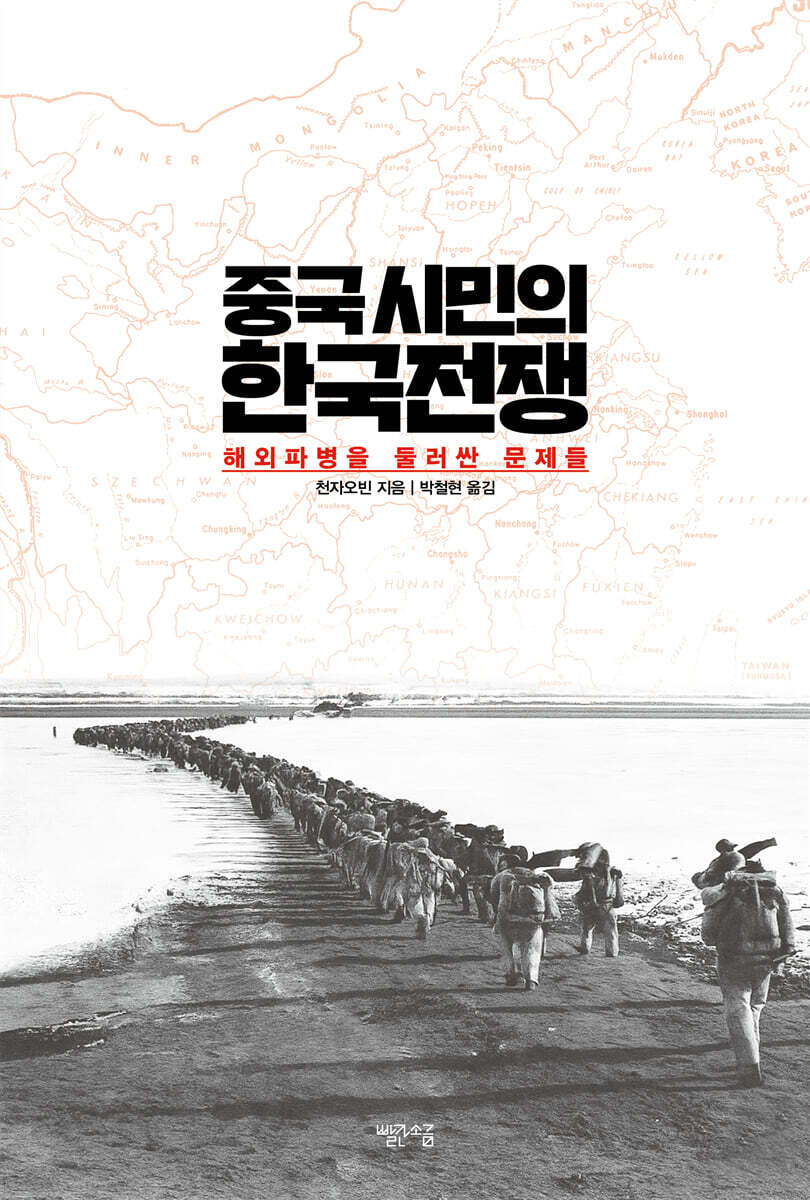
Chinese citizens' Korean War
 |
Description
Book Introduction
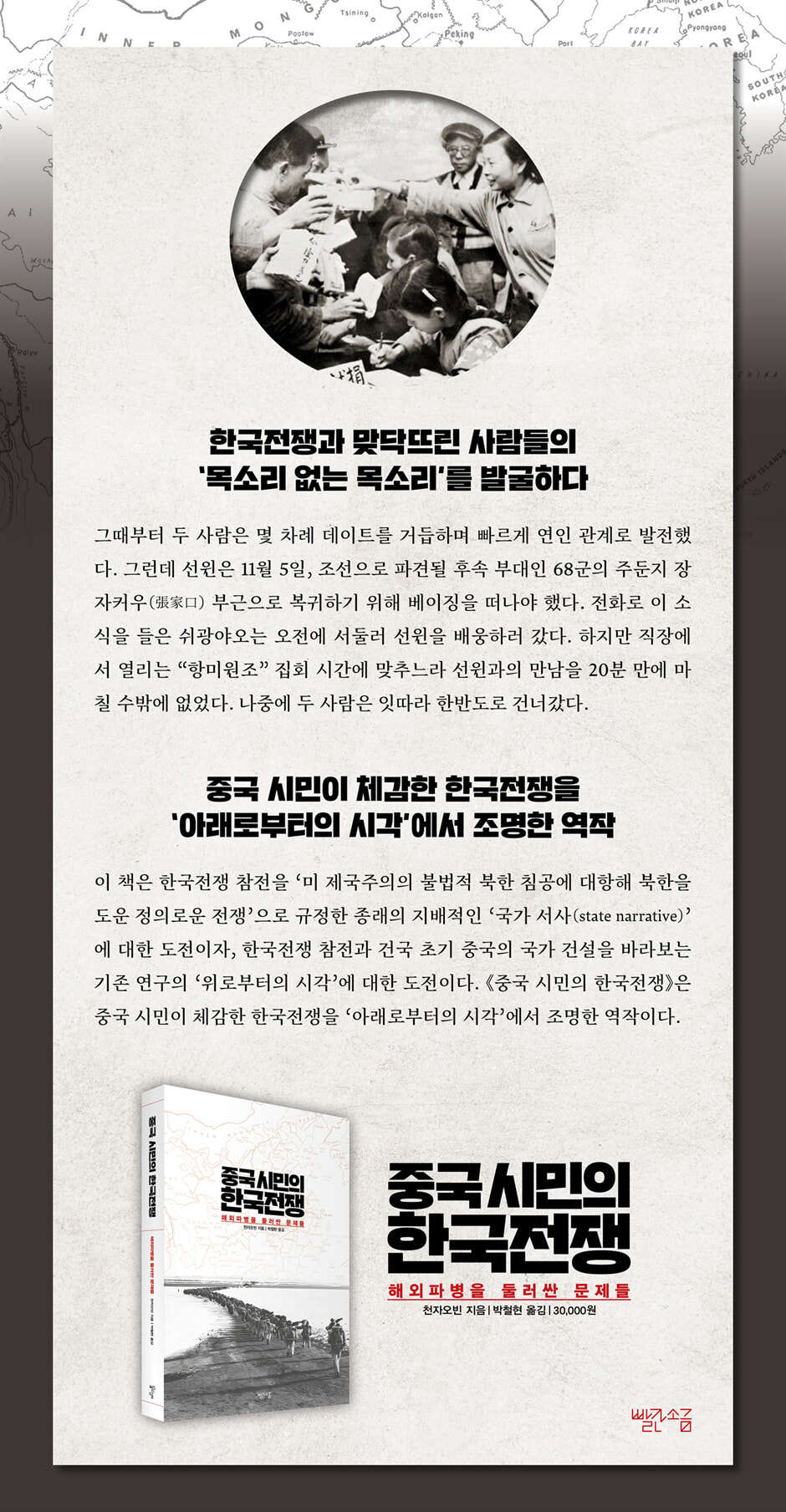
Unearthing the "voiceless voices" of Chinese citizens confronted by the Korean War
The Korean War, which broke out on June 25, 1950, was a “peripheral incident” that could have a significant impact on modern China.
Several issues concerning war and peace, including whether to send military forces to this war, have emerged as a major issue in Chinese society.
This book is an attempt to restore the “voiceless voices” of citizens throughout China during the eight months preceding and following the outbreak of the Korean War, focusing on the month and a half following it.
That is, it restores in a multi-layered way the emotions of fear and expectation, opposition and support, confusion and reconciliation that various classes of Chinese people—intellectuals, workers, farmers, merchants, industrialists, students, soldiers and their families—actually experienced before and after the outbreak of the Korean War.
In particular, it uncovers vivid voices of citizens, such as economic anxiety, fear of the atomic bomb, war avoidance, and doubts about alliances, which were rarely addressed in existing studies from the perspective of “Mao Zedong’s Korean War.”
The theme of this book is that, regardless of time or place, when military forces are dispatched overseas at the request of an ally or quasi-ally, problems arise within that society that affect politics, economy, society, and civic life.
In short, these are the legitimacy of exercising the right to collective self-defense, the infringement of individual freedom and rights under the pretext of a state of emergency, the pressure that the strengthening of defense capabilities places on peaceful industries and the daily lives of citizens, and the issue of conscription and life and death.
These problems were a serious concern for Chinese citizens at the time as well.
Especially in the international situation of the Sino-Soviet Treaty of Friendship and Alliance, Chinese citizens had to face a real crisis from a different position from those in power.
By focusing on ordinary citizens rather than those in power, this book addresses important issues that have been overlooked.
The Korean War, which broke out on June 25, 1950, was a “peripheral incident” that could have a significant impact on modern China.
Several issues concerning war and peace, including whether to send military forces to this war, have emerged as a major issue in Chinese society.
This book is an attempt to restore the “voiceless voices” of citizens throughout China during the eight months preceding and following the outbreak of the Korean War, focusing on the month and a half following it.
That is, it restores in a multi-layered way the emotions of fear and expectation, opposition and support, confusion and reconciliation that various classes of Chinese people—intellectuals, workers, farmers, merchants, industrialists, students, soldiers and their families—actually experienced before and after the outbreak of the Korean War.
In particular, it uncovers vivid voices of citizens, such as economic anxiety, fear of the atomic bomb, war avoidance, and doubts about alliances, which were rarely addressed in existing studies from the perspective of “Mao Zedong’s Korean War.”
The theme of this book is that, regardless of time or place, when military forces are dispatched overseas at the request of an ally or quasi-ally, problems arise within that society that affect politics, economy, society, and civic life.
In short, these are the legitimacy of exercising the right to collective self-defense, the infringement of individual freedom and rights under the pretext of a state of emergency, the pressure that the strengthening of defense capabilities places on peaceful industries and the daily lives of citizens, and the issue of conscription and life and death.
These problems were a serious concern for Chinese citizens at the time as well.
Especially in the international situation of the Sino-Soviet Treaty of Friendship and Alliance, Chinese citizens had to face a real crisis from a different position from those in power.
By focusing on ordinary citizens rather than those in power, this book addresses important issues that have been overlooked.
- You can preview some of the book's contents.
Preview
index
To Korean readers
In publishing the book
introduction
Part 1: Involvement or Neglect - Under the Dark Clouds
Entering
Chapter 1: North China Region
Chapter 2: The East China Region
Chapter 3: Northeastern Region - Shenyang, Jinzhou, and Rehe
Chapter 4: The Sinan Region - Chongqing and Guizhou
Coming out
Part 2: Intellectuals - Overseas Troop Deployment, Atomic Bombs, Alliances, and Taxes
Entering
Chapter 1 Political Spectrum
Chapter 2: The Atomic Bomb Problem - The Case of Zuckerberg
Chapter 3: Pro-American, anti-Soviet
Chapter 4 Taxation and Alliances - In the Case of Relief
Coming out
Part 3: Commerce and Industry - Tianjin, Shanghai, and Hong Kong
Entering
Chapter 1: The Hinterland
Chapter 2 Tianjin
Chapter 3: Long Yiren and its Surroundings
Chapter 4 Hong Kong
Coming out
Part 4: Workers and Farmers - Overseas Deployment, Rear Support, and Regime Change
Entering
Chapter 1: North China Region
Chapter 2: Hwadong Region
Chapter 3: Dongbei Region
Chapter 4 The Fate of the Cow
Coming out
Part 5: Soldiers - Anti-American sentiment, restoration, and conscientious objection
Entering
Chapter 1: Anti-American sentiment
Chapter 2: Hope for Restoration - Marriage and Farming
Chapter 3 Refusal of Restoration
Chapter 4 Desertion
Chapter 5 Conscientious Objection to Military Service
Coming out
Part 6: Xu Guangyao's War - Views on Occupation and Life and Death
Entering
Chapter 1: Views on Occupation
Chapter 2 Conflict
Chapter 3: Views on Life and Death
Coming out
Part 7: The Transition of the Nation - Change of Attitude, Economic Sanctions.
Military service
Entering
Chapter 1: Changing Attitudes
Chapter 2: Commerce and Industry
Chapter 3: War
Coming out
conclusion
Translator's Note
List of first appearances
Search
In publishing the book
introduction
Part 1: Involvement or Neglect - Under the Dark Clouds
Entering
Chapter 1: North China Region
Chapter 2: The East China Region
Chapter 3: Northeastern Region - Shenyang, Jinzhou, and Rehe
Chapter 4: The Sinan Region - Chongqing and Guizhou
Coming out
Part 2: Intellectuals - Overseas Troop Deployment, Atomic Bombs, Alliances, and Taxes
Entering
Chapter 1 Political Spectrum
Chapter 2: The Atomic Bomb Problem - The Case of Zuckerberg
Chapter 3: Pro-American, anti-Soviet
Chapter 4 Taxation and Alliances - In the Case of Relief
Coming out
Part 3: Commerce and Industry - Tianjin, Shanghai, and Hong Kong
Entering
Chapter 1: The Hinterland
Chapter 2 Tianjin
Chapter 3: Long Yiren and its Surroundings
Chapter 4 Hong Kong
Coming out
Part 4: Workers and Farmers - Overseas Deployment, Rear Support, and Regime Change
Entering
Chapter 1: North China Region
Chapter 2: Hwadong Region
Chapter 3: Dongbei Region
Chapter 4 The Fate of the Cow
Coming out
Part 5: Soldiers - Anti-American sentiment, restoration, and conscientious objection
Entering
Chapter 1: Anti-American sentiment
Chapter 2: Hope for Restoration - Marriage and Farming
Chapter 3 Refusal of Restoration
Chapter 4 Desertion
Chapter 5 Conscientious Objection to Military Service
Coming out
Part 6: Xu Guangyao's War - Views on Occupation and Life and Death
Entering
Chapter 1: Views on Occupation
Chapter 2 Conflict
Chapter 3: Views on Life and Death
Coming out
Part 7: The Transition of the Nation - Change of Attitude, Economic Sanctions.
Military service
Entering
Chapter 1: Changing Attitudes
Chapter 2: Commerce and Industry
Chapter 3: War
Coming out
conclusion
Translator's Note
List of first appearances
Search
Detailed image
Into the book
The man had no idea that the next day the People's Volunteer Army would engage in full-scale battles with UN forces in Korea, or that ten days later he would be forced to choose to go to the front lines.
The reason he chose this area, with its concentration of diplomatic facilities, for his walk may have been because he was drawn to the exotic atmosphere of the area.
However, after entering through the west entrance of Dongzhaominxiang, no one showed much interest in the American Consulate General on the right.
He visited the exhibition of the gallows used to execute Li Dazhao at the Palace Museum 20 days ago.
However, there is no trace in his diary of Li Dazhao recalling the fact that he was arrested by Zhang Zuolin's subordinates while passing by the Soviet embassy.
That night, the man's attention was solely focused on love.
--- p.25
Since southern Korea was under American influence, Syngman Rhee's defeat meant the defeat of the United States.
If no response is taken, America's prestige within the capitalist bloc will plummet, making it impossible for the United States to unite other capitalist countries in the future.
So the United States provided military support to Syngman Rhee.
If Syngman Rhee fails to win and the United States becomes enraged and the situation escalates, World War III could break out.
Conversely, if North Korea is defeated, the Korean People's Army will inevitably retreat to our Dongbei region.
If our country were to disarm at this time, the principle of mutual cooperation among socialist countries would be undermined.
If we don't disarm, the United States will use that as an excuse to advance into our Dongbei region.
Our government will have no choice but to counterattack, which will escalate the scale of the war and ultimately lead to World War III.
--- p.40-41
“My mother loves me very much because I am the youngest daughter.
So, you are against going to Joseon.
But my mother's love cannot stand in the way of my love for my country.
For the sake of countless mothers and siblings, I sincerely hope to join the support group.”
--- p.91
Zuckerberg also noted in this book the passage where he pointed to the “Soviet factor” as the real reason for the atomic bombing.
He excerpted the following sentence:
“Although it is not revealed in the papers of Dr. Compton and Mr. Stimson, the real reason for the Allied plan to bring Japan to its knees was the Soviet intervention in Manchuria.” He also quoted part of the report on the U.S. Strategic Bombing Survey regarding the end-of-war operations in Japan in his diary entry on November 14.
“All detailed investigations and the testimony of surviving Japanese leaders indicate that Japan would have surrendered by December 31, 1945, even without the use of the atomic bomb, without the entry of the Soviet Union, and without the American amphibious landings.” Zuckerberg also cited an article in the August 15, 1945, New York Times.
“CHENNAULT HOLDS SOVIET FORCED END; Russia's Entry Decided War With Japan Despite Atomic Bomb, Air General Says” included an article by our Rome-based correspondent on this matter.
According to the article, “General Claire Chenault’s opinion was that the Soviet Union’s entry into the war was the decisive blow and that Japan would have surrendered even without the atomic bomb.”
--- pp.112-113
In their view, it was easy to do business when the US was in China.
There weren't as many regulations as there are now.
They believed that if a war broke out, financial conditions would worsen due to credit cuts and financial controls, and ultimately, the entire industry would suffer.
After the support troops crossed over to Joseon, there was a movement to hoard cotton and cotton yarn in the market, and some merchants lost their will to do business and showed a passive attitude towards sales.
Some small businessmen and property owners were worried that they would be unable to do business in the cities due to the effects of the war, and that if they returned to the countryside, their land and homes would be confiscated through land reform, leaving them in a state of confusion.
--- p.166
Merchants and clerks are reluctant to do rear support work.
In the original city, there was no separate means of livelihood, so if the burden of rear support was placed on the urban poor, the remaining families would not be able to make a living.
In fact, in the three rounds of mobilization of rear support, different methods were tried in each city.
For example, in Jiamusi, applicants were initially selected by lottery, but all of the successful applicants were rejected.
In the second and third mobilizations, gardens were allocated to each village, and the merchants in question paid to hire workers.
However, with the exception of a few poor people, most of the employed people were temporary helpers for the self-employed, unemployed single people, people of unknown identities, and those who were on the run to avoid criticism or prosecution by the government.
There were many cases where they deserted midway or demanded early return using illness as an excuse.
Among the three mobilizations, 222 people escaped or returned early, accounting for 22% of the total.
In Fujin County, a lottery system was used, and all winning merchants were required to pay money to hire a representative.
Most of these agents were thugs.
--- p.248
Trapped in the mountains, the troops had nothing to eat for six days, and sometimes had to endure starvation by eating small amounts of horse fodder to sustain themselves.
There was not even any water to drink, so when I was thirsty, I had no choice but to lick the moisture that seeped out between the rock walls of the cave.
In such circumstances, starvation was common, and I heard of a story where all the soldiers in a cave starved to death.
However, when food was supplied through the enemy blockade, sometimes I could eat a whole can of beef.
--- p.334
Ever since I heard the news that I was leaving college, I've been feeling a mix of anxiety and anger, and I'm very upset.
Mentally depressed, with no energy for eating or walking.
I need some stimulation, but what could be the stimulation?
Even if I write a letter, there is nothing to write about, and even if I argue, there is nowhere to go.
I briefly think about the object of my unrequited love, but it is neither interesting nor helpful.
In the afternoon, I was absorbed in organizing my vocabulary, and as I wrote and organized, my mind finally felt at peace.
--- p.407
However, Mao Zedong and Jiang Dongsun did not agree on political system and foreign policy.
Zhang Dongsun argued that a new democratic system should be established by taking advantage of the strengths of both the United States and the Soviet Union.
But Mao Zedong said, “Mr. Jiang Dongsun, the new democracy you speak of is ultimately nothing more than American-style democracy.
In Western politics, there is a division between the ruling party and the opposition party, but the revolutionary government that will be established in China in the future is a joint achievement of the Communist Party and a third party.
He dismissed it, saying, “Why should one oppose oneself?”
According to the recollections of another person who accompanied the meeting at the time, during the process of establishing the new regime, Mao Zedong “demanded that the democratic parties stand on the position of the people, keep pace with the Chinese Communist Party, and cooperate sincerely, and not break away from it, create an ‘opposition faction,’ or take a ‘middle line.’”
The reason he chose this area, with its concentration of diplomatic facilities, for his walk may have been because he was drawn to the exotic atmosphere of the area.
However, after entering through the west entrance of Dongzhaominxiang, no one showed much interest in the American Consulate General on the right.
He visited the exhibition of the gallows used to execute Li Dazhao at the Palace Museum 20 days ago.
However, there is no trace in his diary of Li Dazhao recalling the fact that he was arrested by Zhang Zuolin's subordinates while passing by the Soviet embassy.
That night, the man's attention was solely focused on love.
--- p.25
Since southern Korea was under American influence, Syngman Rhee's defeat meant the defeat of the United States.
If no response is taken, America's prestige within the capitalist bloc will plummet, making it impossible for the United States to unite other capitalist countries in the future.
So the United States provided military support to Syngman Rhee.
If Syngman Rhee fails to win and the United States becomes enraged and the situation escalates, World War III could break out.
Conversely, if North Korea is defeated, the Korean People's Army will inevitably retreat to our Dongbei region.
If our country were to disarm at this time, the principle of mutual cooperation among socialist countries would be undermined.
If we don't disarm, the United States will use that as an excuse to advance into our Dongbei region.
Our government will have no choice but to counterattack, which will escalate the scale of the war and ultimately lead to World War III.
--- p.40-41
“My mother loves me very much because I am the youngest daughter.
So, you are against going to Joseon.
But my mother's love cannot stand in the way of my love for my country.
For the sake of countless mothers and siblings, I sincerely hope to join the support group.”
--- p.91
Zuckerberg also noted in this book the passage where he pointed to the “Soviet factor” as the real reason for the atomic bombing.
He excerpted the following sentence:
“Although it is not revealed in the papers of Dr. Compton and Mr. Stimson, the real reason for the Allied plan to bring Japan to its knees was the Soviet intervention in Manchuria.” He also quoted part of the report on the U.S. Strategic Bombing Survey regarding the end-of-war operations in Japan in his diary entry on November 14.
“All detailed investigations and the testimony of surviving Japanese leaders indicate that Japan would have surrendered by December 31, 1945, even without the use of the atomic bomb, without the entry of the Soviet Union, and without the American amphibious landings.” Zuckerberg also cited an article in the August 15, 1945, New York Times.
“CHENNAULT HOLDS SOVIET FORCED END; Russia's Entry Decided War With Japan Despite Atomic Bomb, Air General Says” included an article by our Rome-based correspondent on this matter.
According to the article, “General Claire Chenault’s opinion was that the Soviet Union’s entry into the war was the decisive blow and that Japan would have surrendered even without the atomic bomb.”
--- pp.112-113
In their view, it was easy to do business when the US was in China.
There weren't as many regulations as there are now.
They believed that if a war broke out, financial conditions would worsen due to credit cuts and financial controls, and ultimately, the entire industry would suffer.
After the support troops crossed over to Joseon, there was a movement to hoard cotton and cotton yarn in the market, and some merchants lost their will to do business and showed a passive attitude towards sales.
Some small businessmen and property owners were worried that they would be unable to do business in the cities due to the effects of the war, and that if they returned to the countryside, their land and homes would be confiscated through land reform, leaving them in a state of confusion.
--- p.166
Merchants and clerks are reluctant to do rear support work.
In the original city, there was no separate means of livelihood, so if the burden of rear support was placed on the urban poor, the remaining families would not be able to make a living.
In fact, in the three rounds of mobilization of rear support, different methods were tried in each city.
For example, in Jiamusi, applicants were initially selected by lottery, but all of the successful applicants were rejected.
In the second and third mobilizations, gardens were allocated to each village, and the merchants in question paid to hire workers.
However, with the exception of a few poor people, most of the employed people were temporary helpers for the self-employed, unemployed single people, people of unknown identities, and those who were on the run to avoid criticism or prosecution by the government.
There were many cases where they deserted midway or demanded early return using illness as an excuse.
Among the three mobilizations, 222 people escaped or returned early, accounting for 22% of the total.
In Fujin County, a lottery system was used, and all winning merchants were required to pay money to hire a representative.
Most of these agents were thugs.
--- p.248
Trapped in the mountains, the troops had nothing to eat for six days, and sometimes had to endure starvation by eating small amounts of horse fodder to sustain themselves.
There was not even any water to drink, so when I was thirsty, I had no choice but to lick the moisture that seeped out between the rock walls of the cave.
In such circumstances, starvation was common, and I heard of a story where all the soldiers in a cave starved to death.
However, when food was supplied through the enemy blockade, sometimes I could eat a whole can of beef.
--- p.334
Ever since I heard the news that I was leaving college, I've been feeling a mix of anxiety and anger, and I'm very upset.
Mentally depressed, with no energy for eating or walking.
I need some stimulation, but what could be the stimulation?
Even if I write a letter, there is nothing to write about, and even if I argue, there is nowhere to go.
I briefly think about the object of my unrequited love, but it is neither interesting nor helpful.
In the afternoon, I was absorbed in organizing my vocabulary, and as I wrote and organized, my mind finally felt at peace.
--- p.407
However, Mao Zedong and Jiang Dongsun did not agree on political system and foreign policy.
Zhang Dongsun argued that a new democratic system should be established by taking advantage of the strengths of both the United States and the Soviet Union.
But Mao Zedong said, “Mr. Jiang Dongsun, the new democracy you speak of is ultimately nothing more than American-style democracy.
In Western politics, there is a division between the ruling party and the opposition party, but the revolutionary government that will be established in China in the future is a joint achievement of the Communist Party and a third party.
He dismissed it, saying, “Why should one oppose oneself?”
According to the recollections of another person who accompanied the meeting at the time, during the process of establishing the new regime, Mao Zedong “demanded that the democratic parties stand on the position of the people, keep pace with the Chinese Communist Party, and cooperate sincerely, and not break away from it, create an ‘opposition faction,’ or take a ‘middle line.’”
--- p.485
Publisher's Review
Unearthing the "voiceless voices" of Chinese citizens confronted by the Korean War
The Korean War, which broke out on June 25, 1950, was a “peripheral incident” that could have a significant impact on modern China.
Several issues concerning war and peace, including whether to send military forces to this war, have emerged as a major issue in Chinese society.
From a Mao Zedong-centered perspective, October 19, 1950, when the first group of the Chinese People's Volunteer Army began crossing the Yalu River, and October 25, when the first campaign began, are turning points in the sense that "the die was cast."
However, ordinary citizens at the time did not immediately recognize the military intervention.
This is because military actions were initially carried out covertly.
From late October, when “anti-American aid to Korea” propaganda articles began to fill the newspaper pages, through November 5, when a joint declaration by various political parties calling for support for the “Resist America, Aid Korea” movement was announced, Chinese citizens were exposed to reports of the participation of support units in the war and various “Resist America, Aid Korea” mobilization rallies.
From then until early December, there was a strong expectation of peace, so the large-scale deployment of troops was half-believed, but gradually accepted as fact.
This book is an attempt to restore the “voiceless voices” of citizens throughout China during the eight months preceding and following the outbreak of the Korean War, focusing on the month and a half following it.
That is, it restores in a multi-layered way the emotions of fear and expectation, opposition and support, confusion and reconciliation that various classes of Chinese people—intellectuals, workers, farmers, merchants, industrialists, students, soldiers and their families—actually experienced before and after the outbreak of the Korean War.
In particular, it uncovers vivid voices of citizens, such as economic anxiety, fear of the atomic bomb, war avoidance, and doubts about alliances, which were rarely addressed in existing studies from the perspective of “Mao Zedong’s Korean War.”
A masterpiece illuminated from a 'perspective from below'
"The Korean War for Chinese Citizens" is a controversial work that directly overturns the history of China's participation in the Korean War, which has been described primarily through the decision-making process of Mao Zedong, the Chinese Communist Party leadership, and the military and diplomatic elite.
Author Chen Zhaobin points out that existing studies of the Korean War have focused solely on the "national will," "the government's judgment," and "the leader's determination," which has resulted in the inner lives of ordinary Chinese citizens, who were the first to experience the war, suffered the most direct impact on their lives, and faced the most realistic concerns, being erased from history.
In other words, “During the Korean War, the existence of Chinese citizens was erased once during the policy-making process of the supreme leader, Mao Zedong, and then erased again in subsequent research.”
This book fills this gap by reconstructing, in a multilayered way, the real experiences of fear and anticipation, opposition and support, confusion and reconciliation experienced by various segments of China—intellectuals, workers, peasants, merchants, industrialists, students, soldiers, and their families—from the outbreak of the war onward.
In particular, it uncovers vivid voices of citizens' economic anxiety, fear of the atomic bomb, war avoidance, and doubts about alliances, which were rarely addressed in past studies of China's Cold War and diplomatic history.
Part One deals with the anxiety and shock that spread across Chinese society immediately after the outbreak of the war, showing that ordinary citizens were trembling with fears of World War III and the possibility of the atomic bomb being dropped, regardless of the central government's decisions.
In particular, merchants and urban workers were concerned about the economic impact of the deployment, and their daily lives were shaken by the fear of soaring food and necessities prices, instability in factory operations, and expanded conscription.
Part II traces how various segments of Chinese society interpreted and accepted the war under these economic and political pressures.
Commercial and industrial managers were wary of the possibility of a full-scale conflict with the United States and were reluctant to expand the war, while local civilians were deeply pessimistic about the disaster the war would bring upon their lives.
On the surface, it appeared to be in line with the government's official position, but in reality, real anxieties about survival, economy, and safety were swaying citizens' judgment.
The third part, which follows, shows the impact of the war on the daily lives and mindsets of the younger generation through the responses of educational institutions and the youth.
Students expressed a range of emotions, from the concern that "getting involved will only lead to losses" to the fear that a prolonged war will destroy their studies, career paths, and family finances.
The gap between government propaganda surrounding the war and the actual public sentiment also became more evident during this period.
Part 4 highlights the experiences of frontline soldiers and their families who participated in the war.
The young men who received the conscription notice were overcome with mixed emotions, and their families were filled with anxiety bordering on mourning for their sons who were being sent off to war.
This chapter meticulously exposes the tension between what the state calls a "just war" and the "fear of loss" and "crisis of livelihood" felt by individuals.
Part V shows how China's social networks and community structures functioned in the context of war.
The complex multi-layered nature of Chinese society is clearly revealed through inter-regional migration, market instability, supply chain disruptions, and regionally varying perceptions of war.
War was not a single 'national event', but a multifaceted reality experienced in completely different ways depending on region and class.
Part 6 focuses on the life of an intellectual named Xu Guangyao, offering a profound insight into how war shakes up an individual's professional calling and outlook on life and death.
He had fought in the war as a child soldier and grew up to be a cultural officer and aspiring writer, but when the Korean War broke out, he once again experienced a severe conflict between his "creative path" and his "duty as a party member and military officer."
The two inner voices recorded in his diary and the trauma stemming from his war memories vividly show the rift that war creates within a person.
Finally, Part 7, as if to summarize this, organizes the multi-layered and often contradictory emotional world of Chinese citizens' views on the war.
Citizens' diverse reactions are intertwined: voices supporting war, a desire to avoid it, a clash between state propaganda and individual realistic judgment, doubts about alliances, and anxiety about changes in the international situation.
This chapter emphasizes that the Korean War should not be understood simply as a strategic choice of the state, but rather as a collection of social experiences embodying the fears, hopes, calculations, and ethical concerns of each citizen.
Unlike previous studies, this book focuses its analysis on ‘citizens’ rather than the state.
The author focuses on the circumstances in which Chinese citizens of various 'occupations' and 'regions' acted with diverse thoughts and emotions (affects) such as 'pro-American' and 'anti-American', as well as 'inflammation', 'opposition', and 'avoidance' regarding the war.
Based on primary sources, we uncover specific responses from Chinese citizens through examples from major regional cities such as Beijing, Tianjin, Qingdao, Nanjing, Shanghai, Fuzhou, Wuhan, Chongqing, Guangzhou, Hong Kong, Shenyang, and Changchun.
What effect will these efforts have? They will challenge existing research.
This book challenges the dominant "state narrative" that defines China's participation in the Korean War as a "just war that helped North Korea against the illegal invasion of North Korea by American imperialism," and challenges the "top-down perspective" of existing research on China's participation in the Korean War and its early state-building.
"The Korean War for Chinese Citizens" is a masterpiece that illuminates the Korean War as experienced by Chinese citizens from a "bottom-up perspective."
The war of Xu Guangyao, a soldier and writer
"The Korean War for Chinese Citizens," a multi-layered account of how Chinese citizens experienced and accepted the Korean War, focuses on the psychological conflicts and moments of choice the war left on individuals through the inner self and life story of one person in Part 6.
The protagonist of this chapter, Xu Guangyao, is a boy soldier who fought in battles and later grew up to become a cultural officer and an aspiring writer.
The diary and records he left behind are valuable materials that show the traces the war left on the life, thoughts, and professional calling of an intellectual.
Born in 1925 to a middle-class peasant family in Hebei, Xu Guangyao joined the Eighth Route Army immediately after the Lugouqiao Bridge Incident and witnessed countless brutal battles and the deaths of his comrades from a young age.
Nevertheless, he discovered his literary talent between wars and dreamed of becoming a writer, seeking his own path by submitting short stories to newspapers.
During his time stationed in Tianjin in 1949, he also completed a novel based on the military's large-scale purge operations.
In the early summer of 1950, he heard news of the establishment of the Central Literary Research Institute, and his hope of becoming a full-time writer came closer.
But with the outbreak of the Korean War, his life begins to unravel again.
Within the military, the atmosphere surrounding frontline support and dispatch to the rear was intensifying, and he was deeply conflicted over whether he should wait to enter the literary research institute to fulfill his "calling as a writer" or participate in the Korean War to fulfill his "duty as a communist."
In Xu Guangyao's diary, this conflict is vividly recorded in two inner voices.
One was the feeling that I could not miss the opportunity to embark on the long-awaited path of scholarship and creativity, and the other was a sense of duty to experience the internationalist spirit of the Korean people on the front lines and fulfill my responsibilities as a soldier.
He kept telling himself, “Don’t make decisions based on impulse,” but no decision brought any relief.
What weighed heavily on him was the horrific memories of war he experienced as a child soldier.
He wrote that as a child, he long recalled nightmares of his comrades being swept away in an instant by bombing raids during battle, “soldiers being swept away like hail.”
This trauma brought back emotions he had wanted to avoid before deciding whether to participate in the Korean War, and it left a subtle and profound mark on his judgment.
Part 6, through the experiences of Xu Guangyao, deeply captures the challenges the Korean War posed to a Chinese intellectual—the conflict between calling and duty, the psychological scars left by the war, and the way the upheaval of the times shook the course of life—through the voice of one human being.
At the same time, it provides an important window into understanding where individual citizens were concerned and how they responded within the structural narrative of the war.
Empirically restoring citizens' sentiments based on the "Internal Reference" of the "Shinwha News Agency"
The greatest strength of this book is that it is a study thoroughly based on empirical data.
The author analyzes the "Internal Reference" of the "Xinhua News Agency," an internal publication of the state news agency that collects and reports on public opinion and situations to assist the policy-making of central and local leadership agencies; materials from the Party Archives of the Ministry of Foreign Affairs of China (National Archives); policy reports left by local governments; vivid records of urban and rural areas in the 1950s; activity documents from Peking University and various organizations; and, above all, personal diaries and memoirs left by citizens at the time.
In particular, 『Internal Reference』, unlike publicly available materials, is a primary source that records the reactions of citizens in local and urban areas at the time, and is a valuable historical document that shows “how the war was experienced.”
Based on these internal sources, the author reconstructs, layer by layer, the logic citizens of each class used on the issue of troop deployment, how they expressed their fear of war, and how they reacted to the leadership's propaganda.
The author also uses his own research experience—decades of effort to visit public archives in Hong Kong, Beijing, Chongqing, Changchun, and elsewhere, not missing even a single record—to rearrange citizens' "fragmentary statements" into a single structure.
The history of emotions and movements constructed in this way is a method rarely attempted in existing studies of the Korean War, and it shows anew how the everyday nature of war, individual choices, and social emotions are connected to the historical process.
What is the author's ultimate argument based on this empirical research? The book's central thesis is that, regardless of time or place, deploying military forces overseas at the request of an ally or quasi-ally creates problems within that society, affecting politics, the economy, society, and civic life.
In short, these are the legitimacy of exercising the right to collective self-defense, the infringement of individual freedom and rights under the pretext of a state of emergency, the pressure that the strengthening of defense capabilities places on peaceful industries and the daily lives of citizens, and the issue of conscription and life and death.
These problems were a serious concern for Chinese citizens at the time as well.
Especially in the international situation of the Sino-Soviet Treaty of Friendship and Alliance, Chinese citizens had to face a real crisis from a different position from those in power.
By focusing on ordinary citizens rather than those in power, this book addresses important issues that have been overlooked.
The Korean War, which broke out on June 25, 1950, was a “peripheral incident” that could have a significant impact on modern China.
Several issues concerning war and peace, including whether to send military forces to this war, have emerged as a major issue in Chinese society.
From a Mao Zedong-centered perspective, October 19, 1950, when the first group of the Chinese People's Volunteer Army began crossing the Yalu River, and October 25, when the first campaign began, are turning points in the sense that "the die was cast."
However, ordinary citizens at the time did not immediately recognize the military intervention.
This is because military actions were initially carried out covertly.
From late October, when “anti-American aid to Korea” propaganda articles began to fill the newspaper pages, through November 5, when a joint declaration by various political parties calling for support for the “Resist America, Aid Korea” movement was announced, Chinese citizens were exposed to reports of the participation of support units in the war and various “Resist America, Aid Korea” mobilization rallies.
From then until early December, there was a strong expectation of peace, so the large-scale deployment of troops was half-believed, but gradually accepted as fact.
This book is an attempt to restore the “voiceless voices” of citizens throughout China during the eight months preceding and following the outbreak of the Korean War, focusing on the month and a half following it.
That is, it restores in a multi-layered way the emotions of fear and expectation, opposition and support, confusion and reconciliation that various classes of Chinese people—intellectuals, workers, farmers, merchants, industrialists, students, soldiers and their families—actually experienced before and after the outbreak of the Korean War.
In particular, it uncovers vivid voices of citizens, such as economic anxiety, fear of the atomic bomb, war avoidance, and doubts about alliances, which were rarely addressed in existing studies from the perspective of “Mao Zedong’s Korean War.”
A masterpiece illuminated from a 'perspective from below'
"The Korean War for Chinese Citizens" is a controversial work that directly overturns the history of China's participation in the Korean War, which has been described primarily through the decision-making process of Mao Zedong, the Chinese Communist Party leadership, and the military and diplomatic elite.
Author Chen Zhaobin points out that existing studies of the Korean War have focused solely on the "national will," "the government's judgment," and "the leader's determination," which has resulted in the inner lives of ordinary Chinese citizens, who were the first to experience the war, suffered the most direct impact on their lives, and faced the most realistic concerns, being erased from history.
In other words, “During the Korean War, the existence of Chinese citizens was erased once during the policy-making process of the supreme leader, Mao Zedong, and then erased again in subsequent research.”
This book fills this gap by reconstructing, in a multilayered way, the real experiences of fear and anticipation, opposition and support, confusion and reconciliation experienced by various segments of China—intellectuals, workers, peasants, merchants, industrialists, students, soldiers, and their families—from the outbreak of the war onward.
In particular, it uncovers vivid voices of citizens' economic anxiety, fear of the atomic bomb, war avoidance, and doubts about alliances, which were rarely addressed in past studies of China's Cold War and diplomatic history.
Part One deals with the anxiety and shock that spread across Chinese society immediately after the outbreak of the war, showing that ordinary citizens were trembling with fears of World War III and the possibility of the atomic bomb being dropped, regardless of the central government's decisions.
In particular, merchants and urban workers were concerned about the economic impact of the deployment, and their daily lives were shaken by the fear of soaring food and necessities prices, instability in factory operations, and expanded conscription.
Part II traces how various segments of Chinese society interpreted and accepted the war under these economic and political pressures.
Commercial and industrial managers were wary of the possibility of a full-scale conflict with the United States and were reluctant to expand the war, while local civilians were deeply pessimistic about the disaster the war would bring upon their lives.
On the surface, it appeared to be in line with the government's official position, but in reality, real anxieties about survival, economy, and safety were swaying citizens' judgment.
The third part, which follows, shows the impact of the war on the daily lives and mindsets of the younger generation through the responses of educational institutions and the youth.
Students expressed a range of emotions, from the concern that "getting involved will only lead to losses" to the fear that a prolonged war will destroy their studies, career paths, and family finances.
The gap between government propaganda surrounding the war and the actual public sentiment also became more evident during this period.
Part 4 highlights the experiences of frontline soldiers and their families who participated in the war.
The young men who received the conscription notice were overcome with mixed emotions, and their families were filled with anxiety bordering on mourning for their sons who were being sent off to war.
This chapter meticulously exposes the tension between what the state calls a "just war" and the "fear of loss" and "crisis of livelihood" felt by individuals.
Part V shows how China's social networks and community structures functioned in the context of war.
The complex multi-layered nature of Chinese society is clearly revealed through inter-regional migration, market instability, supply chain disruptions, and regionally varying perceptions of war.
War was not a single 'national event', but a multifaceted reality experienced in completely different ways depending on region and class.
Part 6 focuses on the life of an intellectual named Xu Guangyao, offering a profound insight into how war shakes up an individual's professional calling and outlook on life and death.
He had fought in the war as a child soldier and grew up to be a cultural officer and aspiring writer, but when the Korean War broke out, he once again experienced a severe conflict between his "creative path" and his "duty as a party member and military officer."
The two inner voices recorded in his diary and the trauma stemming from his war memories vividly show the rift that war creates within a person.
Finally, Part 7, as if to summarize this, organizes the multi-layered and often contradictory emotional world of Chinese citizens' views on the war.
Citizens' diverse reactions are intertwined: voices supporting war, a desire to avoid it, a clash between state propaganda and individual realistic judgment, doubts about alliances, and anxiety about changes in the international situation.
This chapter emphasizes that the Korean War should not be understood simply as a strategic choice of the state, but rather as a collection of social experiences embodying the fears, hopes, calculations, and ethical concerns of each citizen.
Unlike previous studies, this book focuses its analysis on ‘citizens’ rather than the state.
The author focuses on the circumstances in which Chinese citizens of various 'occupations' and 'regions' acted with diverse thoughts and emotions (affects) such as 'pro-American' and 'anti-American', as well as 'inflammation', 'opposition', and 'avoidance' regarding the war.
Based on primary sources, we uncover specific responses from Chinese citizens through examples from major regional cities such as Beijing, Tianjin, Qingdao, Nanjing, Shanghai, Fuzhou, Wuhan, Chongqing, Guangzhou, Hong Kong, Shenyang, and Changchun.
What effect will these efforts have? They will challenge existing research.
This book challenges the dominant "state narrative" that defines China's participation in the Korean War as a "just war that helped North Korea against the illegal invasion of North Korea by American imperialism," and challenges the "top-down perspective" of existing research on China's participation in the Korean War and its early state-building.
"The Korean War for Chinese Citizens" is a masterpiece that illuminates the Korean War as experienced by Chinese citizens from a "bottom-up perspective."
The war of Xu Guangyao, a soldier and writer
"The Korean War for Chinese Citizens," a multi-layered account of how Chinese citizens experienced and accepted the Korean War, focuses on the psychological conflicts and moments of choice the war left on individuals through the inner self and life story of one person in Part 6.
The protagonist of this chapter, Xu Guangyao, is a boy soldier who fought in battles and later grew up to become a cultural officer and an aspiring writer.
The diary and records he left behind are valuable materials that show the traces the war left on the life, thoughts, and professional calling of an intellectual.
Born in 1925 to a middle-class peasant family in Hebei, Xu Guangyao joined the Eighth Route Army immediately after the Lugouqiao Bridge Incident and witnessed countless brutal battles and the deaths of his comrades from a young age.
Nevertheless, he discovered his literary talent between wars and dreamed of becoming a writer, seeking his own path by submitting short stories to newspapers.
During his time stationed in Tianjin in 1949, he also completed a novel based on the military's large-scale purge operations.
In the early summer of 1950, he heard news of the establishment of the Central Literary Research Institute, and his hope of becoming a full-time writer came closer.
But with the outbreak of the Korean War, his life begins to unravel again.
Within the military, the atmosphere surrounding frontline support and dispatch to the rear was intensifying, and he was deeply conflicted over whether he should wait to enter the literary research institute to fulfill his "calling as a writer" or participate in the Korean War to fulfill his "duty as a communist."
In Xu Guangyao's diary, this conflict is vividly recorded in two inner voices.
One was the feeling that I could not miss the opportunity to embark on the long-awaited path of scholarship and creativity, and the other was a sense of duty to experience the internationalist spirit of the Korean people on the front lines and fulfill my responsibilities as a soldier.
He kept telling himself, “Don’t make decisions based on impulse,” but no decision brought any relief.
What weighed heavily on him was the horrific memories of war he experienced as a child soldier.
He wrote that as a child, he long recalled nightmares of his comrades being swept away in an instant by bombing raids during battle, “soldiers being swept away like hail.”
This trauma brought back emotions he had wanted to avoid before deciding whether to participate in the Korean War, and it left a subtle and profound mark on his judgment.
Part 6, through the experiences of Xu Guangyao, deeply captures the challenges the Korean War posed to a Chinese intellectual—the conflict between calling and duty, the psychological scars left by the war, and the way the upheaval of the times shook the course of life—through the voice of one human being.
At the same time, it provides an important window into understanding where individual citizens were concerned and how they responded within the structural narrative of the war.
Empirically restoring citizens' sentiments based on the "Internal Reference" of the "Shinwha News Agency"
The greatest strength of this book is that it is a study thoroughly based on empirical data.
The author analyzes the "Internal Reference" of the "Xinhua News Agency," an internal publication of the state news agency that collects and reports on public opinion and situations to assist the policy-making of central and local leadership agencies; materials from the Party Archives of the Ministry of Foreign Affairs of China (National Archives); policy reports left by local governments; vivid records of urban and rural areas in the 1950s; activity documents from Peking University and various organizations; and, above all, personal diaries and memoirs left by citizens at the time.
In particular, 『Internal Reference』, unlike publicly available materials, is a primary source that records the reactions of citizens in local and urban areas at the time, and is a valuable historical document that shows “how the war was experienced.”
Based on these internal sources, the author reconstructs, layer by layer, the logic citizens of each class used on the issue of troop deployment, how they expressed their fear of war, and how they reacted to the leadership's propaganda.
The author also uses his own research experience—decades of effort to visit public archives in Hong Kong, Beijing, Chongqing, Changchun, and elsewhere, not missing even a single record—to rearrange citizens' "fragmentary statements" into a single structure.
The history of emotions and movements constructed in this way is a method rarely attempted in existing studies of the Korean War, and it shows anew how the everyday nature of war, individual choices, and social emotions are connected to the historical process.
What is the author's ultimate argument based on this empirical research? The book's central thesis is that, regardless of time or place, deploying military forces overseas at the request of an ally or quasi-ally creates problems within that society, affecting politics, the economy, society, and civic life.
In short, these are the legitimacy of exercising the right to collective self-defense, the infringement of individual freedom and rights under the pretext of a state of emergency, the pressure that the strengthening of defense capabilities places on peaceful industries and the daily lives of citizens, and the issue of conscription and life and death.
These problems were a serious concern for Chinese citizens at the time as well.
Especially in the international situation of the Sino-Soviet Treaty of Friendship and Alliance, Chinese citizens had to face a real crisis from a different position from those in power.
By focusing on ordinary citizens rather than those in power, this book addresses important issues that have been overlooked.
GOODS SPECIFICS
- Date of issue: November 26, 2025
- Page count, weight, size: 508 pages | 152*225*245mm
- ISBN13: 9791191383621
You may also like
카테고리
korean


korean

![GQ KOREA Mark (Monthly): December [2025]](http://librairie.coreenne.fr/cdn/shop/files/8ef265dbbfbf186523ed75ba7319009d.jpg?v=1765340328&width=3840)


