

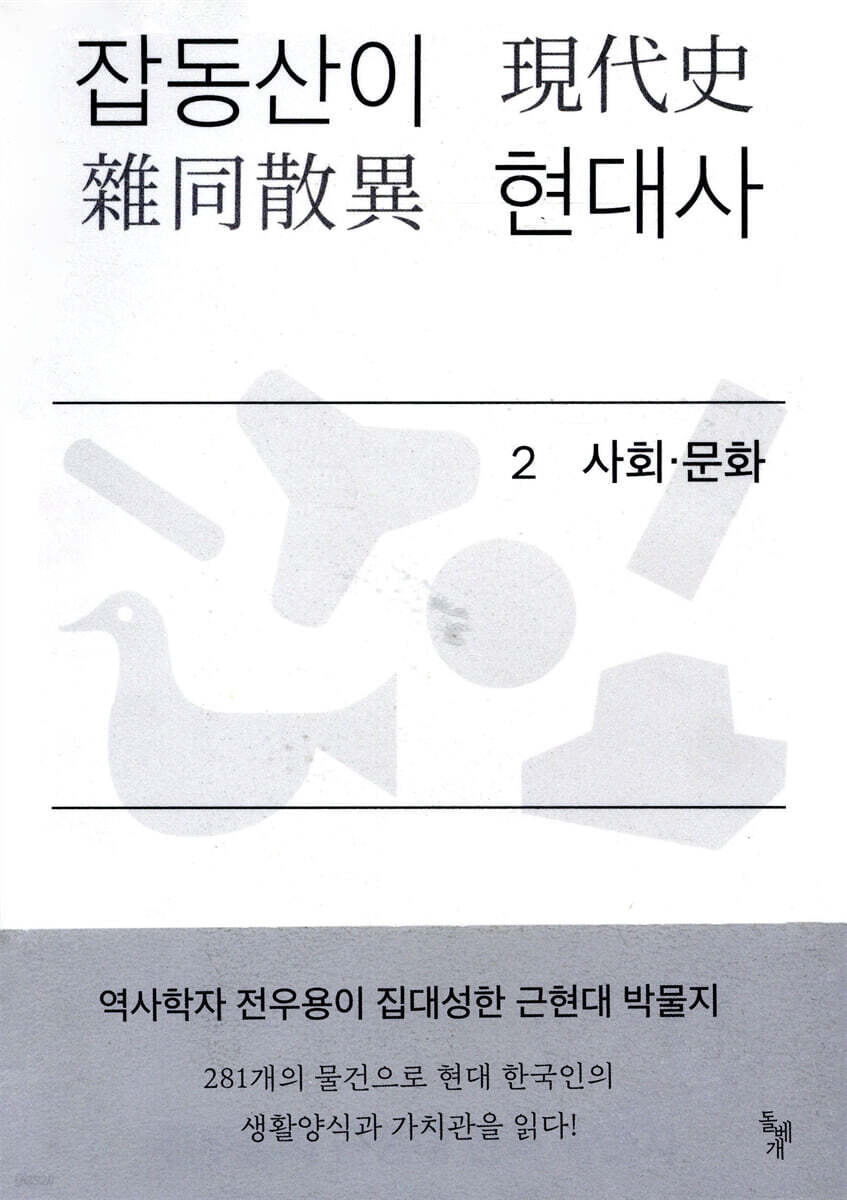
Miscellaneous Real Estate Modern History 2 Social and Cultural
 |
Description
Book Introduction
『Japdongsan-i』 is a miscellaneous work written by An Jeong-bok in the late Joseon Dynasty, and is an encyclopedic book that organizes the historical records and various knowledge of the time.
Afterwards, 'japdongsan-i' was used to mean 'various useless miscellaneous items', which is the origin of the word 'japdongsani'.
Jeon Woo-yong's "The Modern History of Miscellaneous Objects" tells the story of how familiar and trivial objects entered this land and changed our lives.
The manuscript, which is over 5,000 pages long, was divided into three volumes: Volume 1, ‘Daily Life’, Volume 2, ‘Society and Culture’, and Volume 3, ‘Politics and Economy’.
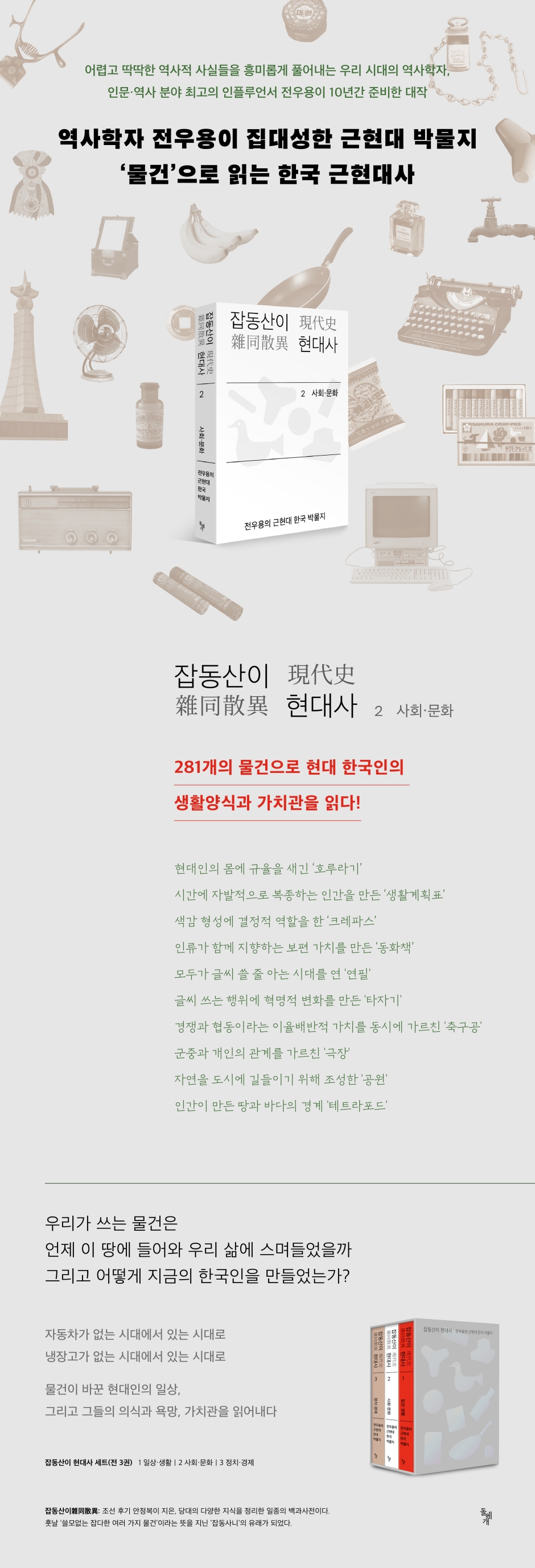
Read about modern and contemporary Korean history through 281 items, ranging from trivial things like everyday food and ordinary objects to buildings, facilities, and documents.
This book explains the history and origins of the goods and depicts the changes in Korean life as a result.
Not only can we look at Korean history from a new perspective through various objects, but by following the history and stories of these objects, we can gain insight into the behavior, habits, and spirit of Koreans, as well as their lifestyles and the history of their evolution.
Afterwards, 'japdongsan-i' was used to mean 'various useless miscellaneous items', which is the origin of the word 'japdongsani'.
Jeon Woo-yong's "The Modern History of Miscellaneous Objects" tells the story of how familiar and trivial objects entered this land and changed our lives.
The manuscript, which is over 5,000 pages long, was divided into three volumes: Volume 1, ‘Daily Life’, Volume 2, ‘Society and Culture’, and Volume 3, ‘Politics and Economy’.
Read about modern and contemporary Korean history through 281 items, ranging from trivial things like everyday food and ordinary objects to buildings, facilities, and documents.
This book explains the history and origins of the goods and depicts the changes in Korean life as a result.
Not only can we look at Korean history from a new perspective through various objects, but by following the history and stories of these objects, we can gain insight into the behavior, habits, and spirit of Koreans, as well as their lifestyles and the history of their evolution.
- You can preview some of the book's contents.
Preview
index
At the beginning of the book
Chapter 1.
Learn and enjoy
1.
Hangul, the unifying character of modern Koreans
2.
Modern Life Guide│Calendar
3.
Carving Discipline into the Body of Modern Man│Horouragi
4.
Humans who voluntarily submit to time│Life plan
5.
The Size of the Modern World│Dictionary
6.
Everyone's Treasure│Cultural Heritage
7.
Where Modern Socialization Begins│Kindergarten
8.
The Museum Where Imperial Citizens and Colonial Natives Were Made
9.
The Birthplace of Modernity│Bookstore
10.
Standards of Right and Wrong│Textbook
11.
Teaching Universal Human Values│Children's Books
12.
Declaring the Age of Humanity│Biographies of Great People
13.
Modern people's favorite portrait│banknote
14.
Bringing Imagination to Life│Comics
15.
An era where everyone can write│Pencil
16.
From written letters to typed letters│Typewriter
17.
Color Standard│Crayons
18.
The Object That Shapes Modern Koreans' Lives│CSAT Exam Papers
19.
Monitoring school life│Transcript
20.
Between the Truth and the Fact│Camera
21.
Teaching Music to Children│Punggeum
22.
Living with Music│Graphphone
23.
Popular song accompaniment instrument│Guitar
24.
Creating illusions with reality│Projector
25.
The Religious Landscape of Contemporary Korea│The Cross
26.
Changing one's view of life and death│Crematorium
Chapter 2.
Hang out and communicate
27.
Opening the Information Age│Newspaper
28.
Identity Card in a Merit-Based Society│Diploma
29.
Mediating expressionless conversations│Telephone
30.
A Telephone Connection Stronger than Blood │ Phone Book
31.
Eliminate the wait│Mobile phone
32.
The Conflict Between Competition and Cooperation│Soccer Ball
33.
Teaching the Relationship Between the Crowd and the Individual│Theater
34.
Experience the excitement│Stadium
35.
Opening an era where money is status│Tickets
36.
Playing cards imbued with the spirit of 'Money God'│Hwatu
37.
Modern aristocratic play│Golf clubs
38.
The Birthplace of Korean Hospitality Culture│Yojeong
39.
Businesses that trade in sex│Brothels
40.
Sounds You Can Ignore│Radio
41.
One person's voice to tens of thousands│Megaphone
42.
Machines that control people│Traffic lights
43.
Machines that play with humans│Arcade machines
44.
Machines that trade with humans│Vending machines
45.
Machines that monitor the sky│Radar
46.
Human-like machines│robots
Chapter 3.
Create and remodel
47.
Knowing Heaven's Will in Advance│Weather Observation Equipment
48.
Converting sensations into mechanical numbers│Thermometer
49.
Symbol of the Electric Age│Telephone Pole
50.
The most abundant substance produced by modern people│Waste
51.
Materials that fill modern living spaces│Plastic
52.
Prison that imprisons nature│Dam
53.
A hole in nature│Tunnel
54.
Precise power distribution map│Intellectual map
55.
Shared Vision of the Future│Blueprint
56.
The material that covered the world│Cement
57.
Riverside where nature has been erased│Gangmorae
58.
The boundary between land and sea│Tetrapod
59.
Colors of Modern Architecture│Paint
60.
A symbol of development supremacy│Bulldozer
61.
The square where public opinion and the public are formed
62.
Community Memory│Monument
63.
Modern statues│Statues
64.
The Tower of Babel of Capital│Skyscraper
65.
Nature tamed by the city│Park
66.
Trees that resemble livestock│Street trees
Chapter 4.
Ride and come and go
67.
The thing that modern people ride most often│Elevators
68.
Creating a Human Accustomed to Wheels│Bicycle
69.
The object that opened the modern era│Automobiles
70.
The most inefficient space│Parking lots
71.
The material that covers modern roads│Asphalt
72.
Messages that dominate the cityscape│Signboards
73.
Reduce the ability to distinguish between heaven and earth│Road sign
74.
Increase time spent outside the home│Public restrooms
75.
The illusion that the world moves even when sitting still│Train
76.
Force unwanted close contact│City buses
77.
Compressing Time│Highway
78.
Making putting out fires someone else's problem│Fire truck
79.
The Hidden Contributor to Modern Urban Life│Handcarts
80.
The desire to climb a mountain│Cable car
81.
The night sky spread out over the ground│Neon signs
82.
The Underworld Conquered by Humans│Subway
83.
Flying Man│Airplane
84.
God's messenger working in the sky│Helicopter
85.
Bird's Eye or God's Eye? │ Drone
References
Items covered in the book
Chapter 1.
Learn and enjoy
1.
Hangul, the unifying character of modern Koreans
2.
Modern Life Guide│Calendar
3.
Carving Discipline into the Body of Modern Man│Horouragi
4.
Humans who voluntarily submit to time│Life plan
5.
The Size of the Modern World│Dictionary
6.
Everyone's Treasure│Cultural Heritage
7.
Where Modern Socialization Begins│Kindergarten
8.
The Museum Where Imperial Citizens and Colonial Natives Were Made
9.
The Birthplace of Modernity│Bookstore
10.
Standards of Right and Wrong│Textbook
11.
Teaching Universal Human Values│Children's Books
12.
Declaring the Age of Humanity│Biographies of Great People
13.
Modern people's favorite portrait│banknote
14.
Bringing Imagination to Life│Comics
15.
An era where everyone can write│Pencil
16.
From written letters to typed letters│Typewriter
17.
Color Standard│Crayons
18.
The Object That Shapes Modern Koreans' Lives│CSAT Exam Papers
19.
Monitoring school life│Transcript
20.
Between the Truth and the Fact│Camera
21.
Teaching Music to Children│Punggeum
22.
Living with Music│Graphphone
23.
Popular song accompaniment instrument│Guitar
24.
Creating illusions with reality│Projector
25.
The Religious Landscape of Contemporary Korea│The Cross
26.
Changing one's view of life and death│Crematorium
Chapter 2.
Hang out and communicate
27.
Opening the Information Age│Newspaper
28.
Identity Card in a Merit-Based Society│Diploma
29.
Mediating expressionless conversations│Telephone
30.
A Telephone Connection Stronger than Blood │ Phone Book
31.
Eliminate the wait│Mobile phone
32.
The Conflict Between Competition and Cooperation│Soccer Ball
33.
Teaching the Relationship Between the Crowd and the Individual│Theater
34.
Experience the excitement│Stadium
35.
Opening an era where money is status│Tickets
36.
Playing cards imbued with the spirit of 'Money God'│Hwatu
37.
Modern aristocratic play│Golf clubs
38.
The Birthplace of Korean Hospitality Culture│Yojeong
39.
Businesses that trade in sex│Brothels
40.
Sounds You Can Ignore│Radio
41.
One person's voice to tens of thousands│Megaphone
42.
Machines that control people│Traffic lights
43.
Machines that play with humans│Arcade machines
44.
Machines that trade with humans│Vending machines
45.
Machines that monitor the sky│Radar
46.
Human-like machines│robots
Chapter 3.
Create and remodel
47.
Knowing Heaven's Will in Advance│Weather Observation Equipment
48.
Converting sensations into mechanical numbers│Thermometer
49.
Symbol of the Electric Age│Telephone Pole
50.
The most abundant substance produced by modern people│Waste
51.
Materials that fill modern living spaces│Plastic
52.
Prison that imprisons nature│Dam
53.
A hole in nature│Tunnel
54.
Precise power distribution map│Intellectual map
55.
Shared Vision of the Future│Blueprint
56.
The material that covered the world│Cement
57.
Riverside where nature has been erased│Gangmorae
58.
The boundary between land and sea│Tetrapod
59.
Colors of Modern Architecture│Paint
60.
A symbol of development supremacy│Bulldozer
61.
The square where public opinion and the public are formed
62.
Community Memory│Monument
63.
Modern statues│Statues
64.
The Tower of Babel of Capital│Skyscraper
65.
Nature tamed by the city│Park
66.
Trees that resemble livestock│Street trees
Chapter 4.
Ride and come and go
67.
The thing that modern people ride most often│Elevators
68.
Creating a Human Accustomed to Wheels│Bicycle
69.
The object that opened the modern era│Automobiles
70.
The most inefficient space│Parking lots
71.
The material that covers modern roads│Asphalt
72.
Messages that dominate the cityscape│Signboards
73.
Reduce the ability to distinguish between heaven and earth│Road sign
74.
Increase time spent outside the home│Public restrooms
75.
The illusion that the world moves even when sitting still│Train
76.
Force unwanted close contact│City buses
77.
Compressing Time│Highway
78.
Making putting out fires someone else's problem│Fire truck
79.
The Hidden Contributor to Modern Urban Life│Handcarts
80.
The desire to climb a mountain│Cable car
81.
The night sky spread out over the ground│Neon signs
82.
The Underworld Conquered by Humans│Subway
83.
Flying Man│Airplane
84.
God's messenger working in the sky│Helicopter
85.
Bird's Eye or God's Eye? │ Drone
References
Items covered in the book
Detailed image
Publisher's Review
■ The lives of Koreans and modern and contemporary Korean history, captured in a single small object
『The Miscellaneous Realm of Modern History』 deals with the history of 'objects' that have shaped the lives and consciousness of modern Koreans, but its content and narrative do not fall into the realm of micro-historical materialism.
We seek to understand how the objects introduced into our society over the course of modern and contemporary Korean history interacted with Koreans to shape their lifestyles and values.
The objects that entered our lives under the conditions of mass production, mass consumption, and technological innovation driven by Westernization, colonialism, and the Industrial Revolution fundamentally changed the lives of Koreans.
As the author says, the transition from an era without electric lights to an era with them, and from an era without refrigerators to an era with them, is as significant as any other historical turning point.
The material conditions of things have not only shaped the habits and spirit of modern people, but also determined and established their institutions and customs.
By examining the theme of this book, the modern and contemporary history of objects, we can see what modern Koreans think and how they live, and why their social systems and customs are the way they are.
"Odds and Ends in Modern History" examines when and in what phase of modern and contemporary history "objects" entered Korean society and influenced the lives and consciousness of Koreans, and how these objects interacted with Korean history.
Therefore, ‘Modern and Contemporary History of Objects’ is the author’s unique method and perspective for reading ‘Modern and Contemporary History of Korea.’
The author unfolds the life of Koreans, immersed in a small object, and reveals modern and contemporary Korean history.
■■ 『Multi-purpose Real Estate: Modern History』 Volume 2 - A Look at the Education, Culture, Social Relations, Space, and Environment of Modern Koreans
Volume 2 (Society and Culture) consists of 85 items in 4 chapters, examining the education, culture, social relations, space, and environment of modern Koreans.
Chapter 1, “Learning and Enjoying,” deals with education and culture.
Although 'kindergarten' is practically compulsory education today and can be said to be the place where modern people's socialization began, it initially started as an early education institution for children from wealthy families.
'Fairy tale books' are objects that have greatly contributed to creating universal values that all of humanity strives for.
The advent of the pencil ushered in an era in which everyone could write, and the introduction of the typewriter brought about a revolutionary change in the act of writing.
The 'whistle' is widely used in educational settings and has played a major role in instilling discipline in the bodies of modern people, and the 'life schedule' has played a significant role in transforming people into people who recognize the rules of others as autonomous and voluntarily submit to the rules of time.
Chapter 2, “Communicating and Getting Along,” examines how modern Koreans communicated and got along with one another, that is, the objects that influenced the formation of social relationships.
The situation of many people wanting to buy a 'telephone' but having few phones available for installation persisted for a long time, and until the late 1970s, they were so rare that they had to be bought and sold for a premium.
In a time when telephone penetration was low, the 'phone book' could be said to be a directory of the rich.
The 'soccer ball' improved children's physical control, taught them to embrace the contradictory values of competition and cooperation, and taught them to compromise for better results.
Chapter 3, “Creating and Remodeling,” examines items such as “telephone pole,” “square,” “dam,” “tunnel,” “skyscraper,” “cement,” “paint,” and “bulldozer,” and looks back at how modern Koreans have remodeled the natural environment to create spaces in which to live.
And in Chapter 4, “Traveling Back and forth,” we look at various transportation methods, from the most frequently used means of transportation, the “elevator,” to the “car,” the “train,” and even the emergence of the “drones,” and learn about how we freely traveled and enjoyed these spaces.
In line with modern Korean history, this paper examines the changing patterns of Korean behavior and habits that emerged during the compressed growth process after liberation.
■ When did Monday blues start in Koreans?
“Have a Monday night!” These days, Generation Z uses the new word “Monday night” to express “overcome the Monday blues and cheer up.”
In English-speaking countries, there are expressions such as 'Monday blues' and 'Sunday syndrome' to refer to 'Monday blues.'
Looking at it this way, it is clear that Monday blues is a universal phenomenon.
But since when did we become accustomed to the 'rest on weekends' and 'work again on Monday' system?
On April 13, 1894, according to the lunar calendar, King Gojong summoned his officials who had returned from China as envoys to the palace, listened to their reports, and praised their hard work.
This was the last time the Dongjisa Temple was held, a ritual that had been repeated annually for over 500 years.
The basic mission of the Dongjisa was to obtain the power of the Chinese emperor.
The calendar was a special book that only the Emperor, the representative of heaven, had the copyright to. It was a book that discovered the regularities of the movement of celestial bodies and organized the concept of time to fit the rhythm of human life.
Rather than the material relationship of tribute and gifts, the spiritual relationship of receiving and exchanging books was the core of the medieval East Asian Sino-Korean system, and the use of Chinese era names and the dispatch of envoys were ceremonies that declared Joseon's recognition of the Sino-Korean system.
A month later, the Sino-Japanese War broke out.
The following month, the Gabo Reforms began, and by the end of that year, the king himself read the Declaration of Independence, declaring his intention to break away from the Chinese system.
On November 17, 1895, the Joseon Dynasty changed its calendar to the solar calendar and set the era name as Geonyang.
Geonyang literally means ‘establishing the solar calendar.’
From this time on, the weekday system and the names of each day of the week were formalized in our country.
The names of the seven days of the week were first used in the Official Gazette of April 1, 1895, and in 1898 the government of the Korean Empire designated the days on which the Emperor would meet with high-ranking officials according to the days of the week.
Until then, the rule was to change the car once every five days.
The schedules of the emperor and high-ranking officials tend to regulate the schedules of lower-ranking officials.
We have entered an era where it is impossible to hold public office without knowing the days of the week.
After the revision of the calendar, the word 'calendar' began to be used instead of 'book calendar'.
Koreans probably developed Monday blues around the time the calendar was introduced. However, the calendars of that time looked different from today's calendars, which display a month's worth of dates on a single page, organized by day of the week.
The dates of the 365 days of the year were written on one side of the paper.
A 13-page calendar with a cover page listing one month's worth of dates on one side of the paper has been in circulation among the public since the mid-1950s.
While wall calendars have become almost useless these days, the calendars in our smartphones still strongly regulate modern life.
The calendar is the most basic guide to life for modern people who have a seven-day life cycle.
■ Modern Koreans spend their childhood preparing for the College Scholastic Ability Test (CSAT), and their middle age worrying about their children's CSAT.
How did the "CSAT" become such a defining factor in the lives of modern Koreans? After liberation, the general public demanded the establishment of universities and the rapid increase in the number of university graduates.
Contrary to the ideal of an ivory tower, Korean universities have been close to being state institutions from the beginning.
After the Korean War, as the remnants of the caste system completely disappeared and awareness of the utility of university education spread, the obsession with sending at least one child to university, even if it meant selling land or cattle, permeated society.
The author examines the general theory of how universities demonstrated their utility by communicating with the secular world and how they were organized as institutions subject to state supervision during the formation of the modern nation-state.
And we look back at how it has been applied and changed in Korean history, and reflect on the characteristics of modern Koreans who spend their childhood preparing for the CSAT and their middle age worrying about their children's CSAT.
The origin of the term 'report card' also draws attention.
Originally, Naeshin (內申) is a Japanese-style Chinese character word meaning 'a secret report that must not be disclosed to the outside world.'
It is not a top secret document, but it means that it is a document that should not be seen by anyone outside the command and reporting chain.
The Japanese also referred to the process of transmitting information about students from lower-level schools to higher-level schools as "naeshin," and the term "naeshin grades" in particular meant confidential information about the student's grades.
Around 1920, due to the severe entrance exam crisis, Japanese educational authorities began to reflect internal grades in entrance exams.
As the competition for entrance exams grew, and dissatisfaction grew over the fact that a difference of 1 or 2 points could determine success or failure, some of the burden on graders was shifted to teachers at lower-level schools.
However, this led to widespread ‘college entrance exam fraud.’
Nevertheless, the 'internal grades' system was useful in blocking students with subversive ideas from advancing to higher levels of education and becoming 'intellectuals'.
After liberation, the school grade system was abolished, but it was revived in 1981 under the pretext of reducing the burden of university entrance exams.
However, the problems with the internal grading system and the controversy surrounding it remain unchanged.
■ What kind of objects have created humans and the times we live in? What kind of objects will create what kind of times in the future?
This book seeks to understand the people who change as they use things, and the era they create.
Just a dozen years ago, people memorized dozens of phone numbers and hundreds of pop song lyrics.
With just a map, there was no road you couldn't drive on.
But now, we can't memorize phone numbers because our cell phones have built-in phonebooks, and when we go to a karaoke room, we can't remember the lyrics because they come out.
I can't even imagine going on a new trip without navigation.
Because 'things' have diminished the will to remember or understand.
Because we spend most of our days interacting with objects, as the characteristics of objects change, the characteristics of the people who use them and the times inevitably change as well.
A person who experiences market life once every five days at most cannot have the same sense as a person who lives with the market on his smartphone.
In this situation, it is natural that the number of ‘market-oriented people’ is increasing.
Examining the origins and history of objects is an interesting and curious activity in itself, but it also helps us understand who we are as people.
In that sense, the history of the "useless miscellaneous items" can be a useful way to understand ourselves and gauge the coming era.
『The Miscellaneous Realm of Modern History』 deals with the history of 'objects' that have shaped the lives and consciousness of modern Koreans, but its content and narrative do not fall into the realm of micro-historical materialism.
We seek to understand how the objects introduced into our society over the course of modern and contemporary Korean history interacted with Koreans to shape their lifestyles and values.
The objects that entered our lives under the conditions of mass production, mass consumption, and technological innovation driven by Westernization, colonialism, and the Industrial Revolution fundamentally changed the lives of Koreans.
As the author says, the transition from an era without electric lights to an era with them, and from an era without refrigerators to an era with them, is as significant as any other historical turning point.
The material conditions of things have not only shaped the habits and spirit of modern people, but also determined and established their institutions and customs.
By examining the theme of this book, the modern and contemporary history of objects, we can see what modern Koreans think and how they live, and why their social systems and customs are the way they are.
"Odds and Ends in Modern History" examines when and in what phase of modern and contemporary history "objects" entered Korean society and influenced the lives and consciousness of Koreans, and how these objects interacted with Korean history.
Therefore, ‘Modern and Contemporary History of Objects’ is the author’s unique method and perspective for reading ‘Modern and Contemporary History of Korea.’
The author unfolds the life of Koreans, immersed in a small object, and reveals modern and contemporary Korean history.
■■ 『Multi-purpose Real Estate: Modern History』 Volume 2 - A Look at the Education, Culture, Social Relations, Space, and Environment of Modern Koreans
Volume 2 (Society and Culture) consists of 85 items in 4 chapters, examining the education, culture, social relations, space, and environment of modern Koreans.
Chapter 1, “Learning and Enjoying,” deals with education and culture.
Although 'kindergarten' is practically compulsory education today and can be said to be the place where modern people's socialization began, it initially started as an early education institution for children from wealthy families.
'Fairy tale books' are objects that have greatly contributed to creating universal values that all of humanity strives for.
The advent of the pencil ushered in an era in which everyone could write, and the introduction of the typewriter brought about a revolutionary change in the act of writing.
The 'whistle' is widely used in educational settings and has played a major role in instilling discipline in the bodies of modern people, and the 'life schedule' has played a significant role in transforming people into people who recognize the rules of others as autonomous and voluntarily submit to the rules of time.
Chapter 2, “Communicating and Getting Along,” examines how modern Koreans communicated and got along with one another, that is, the objects that influenced the formation of social relationships.
The situation of many people wanting to buy a 'telephone' but having few phones available for installation persisted for a long time, and until the late 1970s, they were so rare that they had to be bought and sold for a premium.
In a time when telephone penetration was low, the 'phone book' could be said to be a directory of the rich.
The 'soccer ball' improved children's physical control, taught them to embrace the contradictory values of competition and cooperation, and taught them to compromise for better results.
Chapter 3, “Creating and Remodeling,” examines items such as “telephone pole,” “square,” “dam,” “tunnel,” “skyscraper,” “cement,” “paint,” and “bulldozer,” and looks back at how modern Koreans have remodeled the natural environment to create spaces in which to live.
And in Chapter 4, “Traveling Back and forth,” we look at various transportation methods, from the most frequently used means of transportation, the “elevator,” to the “car,” the “train,” and even the emergence of the “drones,” and learn about how we freely traveled and enjoyed these spaces.
In line with modern Korean history, this paper examines the changing patterns of Korean behavior and habits that emerged during the compressed growth process after liberation.
■ When did Monday blues start in Koreans?
“Have a Monday night!” These days, Generation Z uses the new word “Monday night” to express “overcome the Monday blues and cheer up.”
In English-speaking countries, there are expressions such as 'Monday blues' and 'Sunday syndrome' to refer to 'Monday blues.'
Looking at it this way, it is clear that Monday blues is a universal phenomenon.
But since when did we become accustomed to the 'rest on weekends' and 'work again on Monday' system?
On April 13, 1894, according to the lunar calendar, King Gojong summoned his officials who had returned from China as envoys to the palace, listened to their reports, and praised their hard work.
This was the last time the Dongjisa Temple was held, a ritual that had been repeated annually for over 500 years.
The basic mission of the Dongjisa was to obtain the power of the Chinese emperor.
The calendar was a special book that only the Emperor, the representative of heaven, had the copyright to. It was a book that discovered the regularities of the movement of celestial bodies and organized the concept of time to fit the rhythm of human life.
Rather than the material relationship of tribute and gifts, the spiritual relationship of receiving and exchanging books was the core of the medieval East Asian Sino-Korean system, and the use of Chinese era names and the dispatch of envoys were ceremonies that declared Joseon's recognition of the Sino-Korean system.
A month later, the Sino-Japanese War broke out.
The following month, the Gabo Reforms began, and by the end of that year, the king himself read the Declaration of Independence, declaring his intention to break away from the Chinese system.
On November 17, 1895, the Joseon Dynasty changed its calendar to the solar calendar and set the era name as Geonyang.
Geonyang literally means ‘establishing the solar calendar.’
From this time on, the weekday system and the names of each day of the week were formalized in our country.
The names of the seven days of the week were first used in the Official Gazette of April 1, 1895, and in 1898 the government of the Korean Empire designated the days on which the Emperor would meet with high-ranking officials according to the days of the week.
Until then, the rule was to change the car once every five days.
The schedules of the emperor and high-ranking officials tend to regulate the schedules of lower-ranking officials.
We have entered an era where it is impossible to hold public office without knowing the days of the week.
After the revision of the calendar, the word 'calendar' began to be used instead of 'book calendar'.
Koreans probably developed Monday blues around the time the calendar was introduced. However, the calendars of that time looked different from today's calendars, which display a month's worth of dates on a single page, organized by day of the week.
The dates of the 365 days of the year were written on one side of the paper.
A 13-page calendar with a cover page listing one month's worth of dates on one side of the paper has been in circulation among the public since the mid-1950s.
While wall calendars have become almost useless these days, the calendars in our smartphones still strongly regulate modern life.
The calendar is the most basic guide to life for modern people who have a seven-day life cycle.
■ Modern Koreans spend their childhood preparing for the College Scholastic Ability Test (CSAT), and their middle age worrying about their children's CSAT.
How did the "CSAT" become such a defining factor in the lives of modern Koreans? After liberation, the general public demanded the establishment of universities and the rapid increase in the number of university graduates.
Contrary to the ideal of an ivory tower, Korean universities have been close to being state institutions from the beginning.
After the Korean War, as the remnants of the caste system completely disappeared and awareness of the utility of university education spread, the obsession with sending at least one child to university, even if it meant selling land or cattle, permeated society.
The author examines the general theory of how universities demonstrated their utility by communicating with the secular world and how they were organized as institutions subject to state supervision during the formation of the modern nation-state.
And we look back at how it has been applied and changed in Korean history, and reflect on the characteristics of modern Koreans who spend their childhood preparing for the CSAT and their middle age worrying about their children's CSAT.
The origin of the term 'report card' also draws attention.
Originally, Naeshin (內申) is a Japanese-style Chinese character word meaning 'a secret report that must not be disclosed to the outside world.'
It is not a top secret document, but it means that it is a document that should not be seen by anyone outside the command and reporting chain.
The Japanese also referred to the process of transmitting information about students from lower-level schools to higher-level schools as "naeshin," and the term "naeshin grades" in particular meant confidential information about the student's grades.
Around 1920, due to the severe entrance exam crisis, Japanese educational authorities began to reflect internal grades in entrance exams.
As the competition for entrance exams grew, and dissatisfaction grew over the fact that a difference of 1 or 2 points could determine success or failure, some of the burden on graders was shifted to teachers at lower-level schools.
However, this led to widespread ‘college entrance exam fraud.’
Nevertheless, the 'internal grades' system was useful in blocking students with subversive ideas from advancing to higher levels of education and becoming 'intellectuals'.
After liberation, the school grade system was abolished, but it was revived in 1981 under the pretext of reducing the burden of university entrance exams.
However, the problems with the internal grading system and the controversy surrounding it remain unchanged.
■ What kind of objects have created humans and the times we live in? What kind of objects will create what kind of times in the future?
This book seeks to understand the people who change as they use things, and the era they create.
Just a dozen years ago, people memorized dozens of phone numbers and hundreds of pop song lyrics.
With just a map, there was no road you couldn't drive on.
But now, we can't memorize phone numbers because our cell phones have built-in phonebooks, and when we go to a karaoke room, we can't remember the lyrics because they come out.
I can't even imagine going on a new trip without navigation.
Because 'things' have diminished the will to remember or understand.
Because we spend most of our days interacting with objects, as the characteristics of objects change, the characteristics of the people who use them and the times inevitably change as well.
A person who experiences market life once every five days at most cannot have the same sense as a person who lives with the market on his smartphone.
In this situation, it is natural that the number of ‘market-oriented people’ is increasing.
Examining the origins and history of objects is an interesting and curious activity in itself, but it also helps us understand who we are as people.
In that sense, the history of the "useless miscellaneous items" can be a useful way to understand ourselves and gauge the coming era.
GOODS SPECIFICS
- Date of issue: December 8, 2023
- Page count, weight, size: 500 pages | 678g | 150*215*25mm
- ISBN13: 9791192836430
- ISBN10: 119283643X
You may also like
카테고리
korean


korean

![GQ KOREA Mark (Monthly): December [2025]](http://librairie.coreenne.fr/cdn/shop/files/8ef265dbbfbf186523ed75ba7319009d.jpg?v=1765340328&width=3840)


