

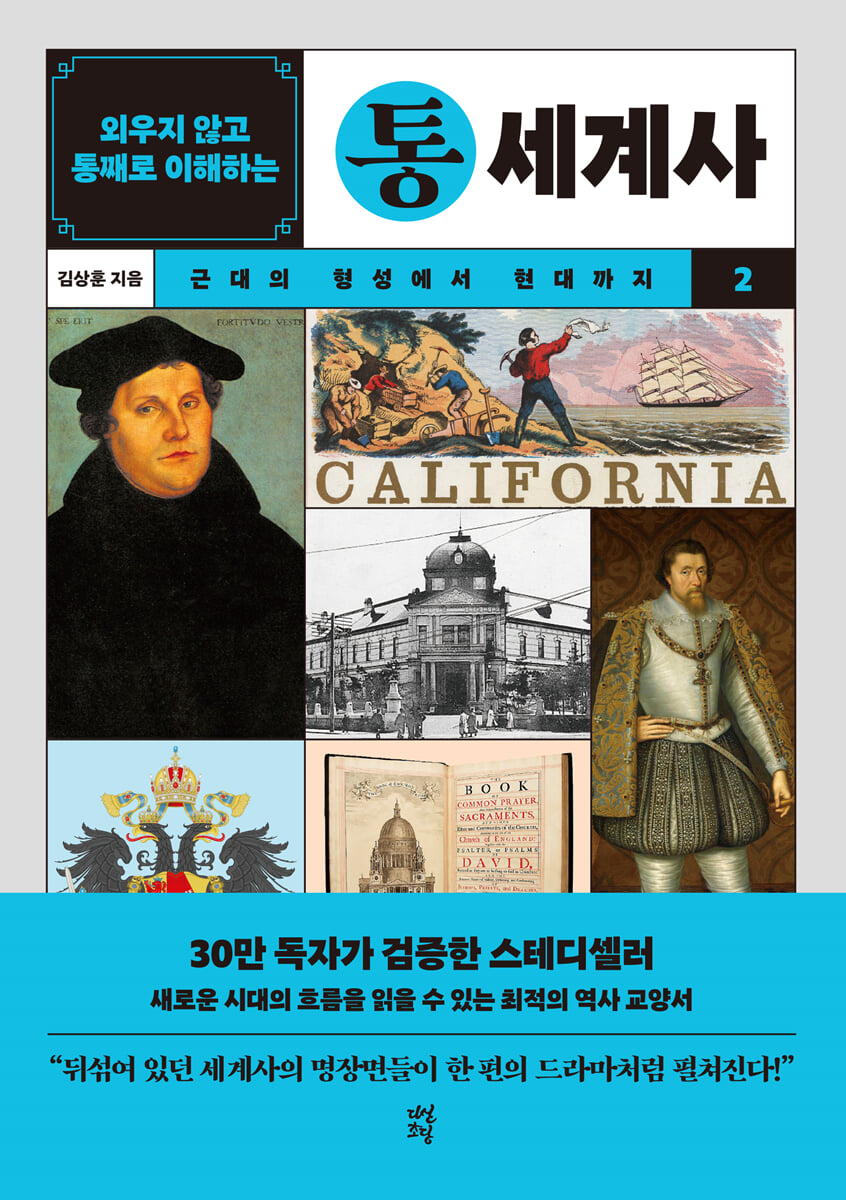
Understanding World History 2: A Complete Guide to Understanding Without Memorizing
 |
Description
Book Introduction
A steady seller verified by 300,000 readers
Living history for all generations, from youth to adults
A world history class that sticks in your head without having to memorize it!
The reason why people find history difficult to study or their grades drop when it becomes even slightly difficult is because they have only encountered history as a subject to memorize.
The knowledge gained by memorizing history disappears the moment you close the book.
What matters is context.
If you can understand the flow of history, you will be able to speak about history fluently without getting confused or forgetting anything.
This book helps you grasp the context of history through storytelling, so you can remember it in its entirety without having to memorize it.
Moreover, it is the only domestic history book that combines world history, Korean history, Eastern history, and Western history without distinction, allowing one to build a broad general knowledge of integrated human history.
The author writes in a concise and clear style typical of a journalist, and explains all the difficult historical terms in an easy-to-understand way so that anyone, from teenagers to adults, can read it.
For those who have always believed they had to memorize history, this book will help them experience the joy of history and provide an opportunity to build their knowledge, turning history, which had been their weakness, into their strength.
Living history for all generations, from youth to adults
A world history class that sticks in your head without having to memorize it!
The reason why people find history difficult to study or their grades drop when it becomes even slightly difficult is because they have only encountered history as a subject to memorize.
The knowledge gained by memorizing history disappears the moment you close the book.
What matters is context.
If you can understand the flow of history, you will be able to speak about history fluently without getting confused or forgetting anything.
This book helps you grasp the context of history through storytelling, so you can remember it in its entirety without having to memorize it.
Moreover, it is the only domestic history book that combines world history, Korean history, Eastern history, and Western history without distinction, allowing one to build a broad general knowledge of integrated human history.
The author writes in a concise and clear style typical of a journalist, and explains all the difficult historical terms in an easy-to-understand way so that anyone, from teenagers to adults, can read it.
For those who have always believed they had to memorize history, this book will help them experience the joy of history and provide an opportunity to build their knowledge, turning history, which had been their weakness, into their strength.
- You can preview some of the book's contents.
Preview
index
Chapter 11: The East and West Seas Open
Around 1400-1500
Chapter 12: The End of the Middle Ages
Around 1500-1600
Chapter 13: The Launch of Civil Society
Around 1600-1700
Chapter 14: The Modern Revolution Breaks Out
Around 1700-1800
Chapter 15: The Age of Freedom and Revolution
Around 1800-1850
Chapter 16: Expanding Imperialism
Around 1850-1900
Chapter 17: War Destroys the World
Around 1900-1950
Chapter 18: The Cold War and Reconciliation
Around 1950-2010
Around 1400-1500
Chapter 12: The End of the Middle Ages
Around 1500-1600
Chapter 13: The Launch of Civil Society
Around 1600-1700
Chapter 14: The Modern Revolution Breaks Out
Around 1700-1800
Chapter 15: The Age of Freedom and Revolution
Around 1800-1850
Chapter 16: Expanding Imperialism
Around 1850-1900
Chapter 17: War Destroys the World
Around 1900-1950
Chapter 18: The Cold War and Reconciliation
Around 1950-2010
Detailed image

Into the book
Westerners call the 15th century the Age of Discovery.
It probably means that European countries discovered a continent and people that had never before appeared in history.
But this statement contains a Eurocentric view of history.
Think about it.
Even before the Portuguese discovered the Cape of Good Hope in South Africa, indigenous people were living there.
Even before Spain discovered Cuba and Haiti, the indigenous people were living there, developing their own unique culture.
In short, it was not European countries that discovered Africa and America, but rather continents that had existed before that time and only began interacting with the world during the Age of Exploration.
The story is that since history was developing, it was destined to be revealed naturally by this time, even if Europe had not discovered it.
---From Chapter 11 [The East and West Seas Open]
Two years have passed since the end of the Korean War.
In 1955, countries emerged that broke away from both left and right ideologies and created independent forces.
They are the third world countries that have not joined the ranks of developed countries.
That's right, the newly independent nations of Asia and Africa gathered at the Bandung Conference and announced the Ten Principles for Peace.
These countries declared neutrality and pacifism, opposing the Cold War between the great powers.
Our country was unable to participate because it was an ally of the United States and was greatly influenced by the United States.
The repercussions of the Bandung Conference were huge.
Although they are a weak third world country, they are powerful because they are united.
Although the Cold War system was becoming stronger, the Third World acted independently without belonging to either side.
Although it wasn't direct, it indirectly played a role in cracking the Cold War system.
It probably means that European countries discovered a continent and people that had never before appeared in history.
But this statement contains a Eurocentric view of history.
Think about it.
Even before the Portuguese discovered the Cape of Good Hope in South Africa, indigenous people were living there.
Even before Spain discovered Cuba and Haiti, the indigenous people were living there, developing their own unique culture.
In short, it was not European countries that discovered Africa and America, but rather continents that had existed before that time and only began interacting with the world during the Age of Exploration.
The story is that since history was developing, it was destined to be revealed naturally by this time, even if Europe had not discovered it.
---From Chapter 11 [The East and West Seas Open]
Two years have passed since the end of the Korean War.
In 1955, countries emerged that broke away from both left and right ideologies and created independent forces.
They are the third world countries that have not joined the ranks of developed countries.
That's right, the newly independent nations of Asia and Africa gathered at the Bandung Conference and announced the Ten Principles for Peace.
These countries declared neutrality and pacifism, opposing the Cold War between the great powers.
Our country was unable to participate because it was an ally of the United States and was greatly influenced by the United States.
The repercussions of the Bandung Conference were huge.
Although they are a weak third world country, they are powerful because they are united.
Although the Cold War system was becoming stronger, the Third World acted independently without belonging to either side.
Although it wasn't direct, it indirectly played a role in cracking the Cold War system.
---From Chapter 18 [Cold War and Reconciliation]
Publisher's Review
We've returned with a new and improved look.
The 2023 revised edition of the history bestseller!
The 'Comprehensive History' series is an introductory history book series that began with the publication of 'Comprehensive History' in 2009.
This series became a bestseller as soon as it was published and was loved by many readers.
Everyone was captivated by the narrative style that allowed them to naturally understand history as a whole, rather than just memorizing it separately.
In particular, with the publication of 『Tongguk History』, which covers our history, in 2012, it has established itself as the representative introductory book to Korean history for both adults and youth.
The reason that 『World History』 was able to become a representative book in the field of history is thanks to the author's intense thought and effort for the readers.
The author wrote this book by dissecting the contents of approximately 70 historical books on the market over a three-year period and then reorganizing them into chronological order to address the problems of existing history books.
He also focused on analyzing the similarities and differences between historical events that occurred in the East, the West, and Korea, and on discovering laws of historical development within them.
There are many history books on the market, but it is rare to find a book like 『Comprehensive History』 that covers such a vast amount of material and can be read by everyone from elementary school students to adults, and this is precisely why.
This revised edition has been published with a new design that takes into account the readers' convenience while maintaining the strengths of the original.
The need to know history is increasing day by day.
With curriculum revisions strengthening historical education for young people, and historical disputes emerging as international and domestic issues, historical literacy is emerging as an essential skill.
In this reality, 『World History』 provides a vivid and easy-to-understand introduction to history that both adults and youth must know.
Additionally, it describes historical facts neutrally without bias toward either side, while at the same time adding various opinions to help readers develop their own view of history.
If you want to master the history of the Korean Peninsula from ancient times to the present, this book will be a great guide.
Storytelling narrative that makes history easy
Abundant maps and photographs that can be viewed and understood immediately
When writing 『A Comprehensive History of the World』, the author put the most effort into unraveling history through storytelling.
When you approach history through stories, you can store world history in your head without having to go through the trouble of memorizing institutions, people, and years.
Especially for those who hesitate due to the entry barrier or give up halfway through, it can solve the problem of studying history, as it allows them to read and understand it easily and enjoyably, as if watching a movie or drama.
Additionally, each chapter is largely divided into a 'cover story' and a 'continental story'. The 'cover story' selects important topics that must be known in that chapter and organizes related events first.
You can grasp the core of world history by reading only the cover stories in the two volumes of 『Comprehensive World History』.
Additionally, 'Continental Stories' covers the development of each continent and the events that occurred during that time, all in conjunction with the contents of the 'Cover Story'.
Through this, we can understand how history developed organically on each continent.
Additionally, the section titled 'Reading History by Dr. Tong' at the end of the chapter covers various perspectives on historical events and in-depth knowledge of politics, society, and institutions not covered in the main text.
Furthermore, the reading material was enriched by comparing the stories of great Eastern and Western heroes who changed history, such as Alexander the Great, Genghis Khan, Zhu Yuanzhang, and Yi Seong-gye.
『World History』 contains visual aids such as maps and photos that can be understood immediately after seeing them, making explanations easy and fun.
When you encounter content that is difficult to understand through text alone, such as unfamiliar relics, systems, place names, or movements, you can understand world history without obstacles through visual aids that help you understand it at a glance.
In particular, the maps and diagrams, organized into one section, concisely contain the key information, making them ideal for efficient preparation for all history exams, including the CSAT.
Why study Eastern and Western history separately?
Now understand all history as a single thread.
The author was inspired to write this series while talking about history with his third-grade son.
When my son asked, “What foreign countries were established when Goryeo was established?” I was unable to answer.
If you think about it, during our school days we learned Korean history, Eastern history, and Western history separately.
Because of this, we do not know what countries existed in Europe during the Three Kingdoms period, or what the actual level of other countries was during the reign of King Sejong, when science and technology were said to have been remarkably advanced.
Not only were there no questions related to Korean history and world history, but even the teachers were different.
Recently, as awareness of the problem of half-baked study of history has grown, the proportion of integrated curriculum questions and essay tests has increased, and the number of tests that ask for an understanding of the mutual influence of Korean history, Eastern history, and Western history has increased.
『A Comprehensive History』 is an introductory history book that recognizes this problem early on and combines Eastern and Western history into one.
What we can realize through a unified history is that, although the timing may differ slightly from country to country, there are universal laws that are common to the process of civilization development, and these laws are linked to surrounding events.
So combining all of history doesn't mean you have more to remember.
Rather, by learning about the macroscopic flow of human history, you can view the entire history of any place and find its context at once.
For those who wish to gain insight into the world through history, 『A Comprehensive History of the World』 will be of great help.
The 2023 revised edition of the history bestseller!
The 'Comprehensive History' series is an introductory history book series that began with the publication of 'Comprehensive History' in 2009.
This series became a bestseller as soon as it was published and was loved by many readers.
Everyone was captivated by the narrative style that allowed them to naturally understand history as a whole, rather than just memorizing it separately.
In particular, with the publication of 『Tongguk History』, which covers our history, in 2012, it has established itself as the representative introductory book to Korean history for both adults and youth.
The reason that 『World History』 was able to become a representative book in the field of history is thanks to the author's intense thought and effort for the readers.
The author wrote this book by dissecting the contents of approximately 70 historical books on the market over a three-year period and then reorganizing them into chronological order to address the problems of existing history books.
He also focused on analyzing the similarities and differences between historical events that occurred in the East, the West, and Korea, and on discovering laws of historical development within them.
There are many history books on the market, but it is rare to find a book like 『Comprehensive History』 that covers such a vast amount of material and can be read by everyone from elementary school students to adults, and this is precisely why.
This revised edition has been published with a new design that takes into account the readers' convenience while maintaining the strengths of the original.
The need to know history is increasing day by day.
With curriculum revisions strengthening historical education for young people, and historical disputes emerging as international and domestic issues, historical literacy is emerging as an essential skill.
In this reality, 『World History』 provides a vivid and easy-to-understand introduction to history that both adults and youth must know.
Additionally, it describes historical facts neutrally without bias toward either side, while at the same time adding various opinions to help readers develop their own view of history.
If you want to master the history of the Korean Peninsula from ancient times to the present, this book will be a great guide.
Storytelling narrative that makes history easy
Abundant maps and photographs that can be viewed and understood immediately
When writing 『A Comprehensive History of the World』, the author put the most effort into unraveling history through storytelling.
When you approach history through stories, you can store world history in your head without having to go through the trouble of memorizing institutions, people, and years.
Especially for those who hesitate due to the entry barrier or give up halfway through, it can solve the problem of studying history, as it allows them to read and understand it easily and enjoyably, as if watching a movie or drama.
Additionally, each chapter is largely divided into a 'cover story' and a 'continental story'. The 'cover story' selects important topics that must be known in that chapter and organizes related events first.
You can grasp the core of world history by reading only the cover stories in the two volumes of 『Comprehensive World History』.
Additionally, 'Continental Stories' covers the development of each continent and the events that occurred during that time, all in conjunction with the contents of the 'Cover Story'.
Through this, we can understand how history developed organically on each continent.
Additionally, the section titled 'Reading History by Dr. Tong' at the end of the chapter covers various perspectives on historical events and in-depth knowledge of politics, society, and institutions not covered in the main text.
Furthermore, the reading material was enriched by comparing the stories of great Eastern and Western heroes who changed history, such as Alexander the Great, Genghis Khan, Zhu Yuanzhang, and Yi Seong-gye.
『World History』 contains visual aids such as maps and photos that can be understood immediately after seeing them, making explanations easy and fun.
When you encounter content that is difficult to understand through text alone, such as unfamiliar relics, systems, place names, or movements, you can understand world history without obstacles through visual aids that help you understand it at a glance.
In particular, the maps and diagrams, organized into one section, concisely contain the key information, making them ideal for efficient preparation for all history exams, including the CSAT.
Why study Eastern and Western history separately?
Now understand all history as a single thread.
The author was inspired to write this series while talking about history with his third-grade son.
When my son asked, “What foreign countries were established when Goryeo was established?” I was unable to answer.
If you think about it, during our school days we learned Korean history, Eastern history, and Western history separately.
Because of this, we do not know what countries existed in Europe during the Three Kingdoms period, or what the actual level of other countries was during the reign of King Sejong, when science and technology were said to have been remarkably advanced.
Not only were there no questions related to Korean history and world history, but even the teachers were different.
Recently, as awareness of the problem of half-baked study of history has grown, the proportion of integrated curriculum questions and essay tests has increased, and the number of tests that ask for an understanding of the mutual influence of Korean history, Eastern history, and Western history has increased.
『A Comprehensive History』 is an introductory history book that recognizes this problem early on and combines Eastern and Western history into one.
What we can realize through a unified history is that, although the timing may differ slightly from country to country, there are universal laws that are common to the process of civilization development, and these laws are linked to surrounding events.
So combining all of history doesn't mean you have more to remember.
Rather, by learning about the macroscopic flow of human history, you can view the entire history of any place and find its context at once.
For those who wish to gain insight into the world through history, 『A Comprehensive History of the World』 will be of great help.
GOODS SPECIFICS
- Date of issue: September 21, 2023
- Page count, weight, size: 540 pages | 728g | 148*210*32mm
- ISBN13: 9791130646312
- ISBN10: 1130646319
You may also like
카테고리
korean


korean

![GQ KOREA Mark (Monthly): December [2025]](http://librairie.coreenne.fr/cdn/shop/files/8ef265dbbfbf186523ed75ba7319009d.jpg?v=1765340328&width=3840)


