

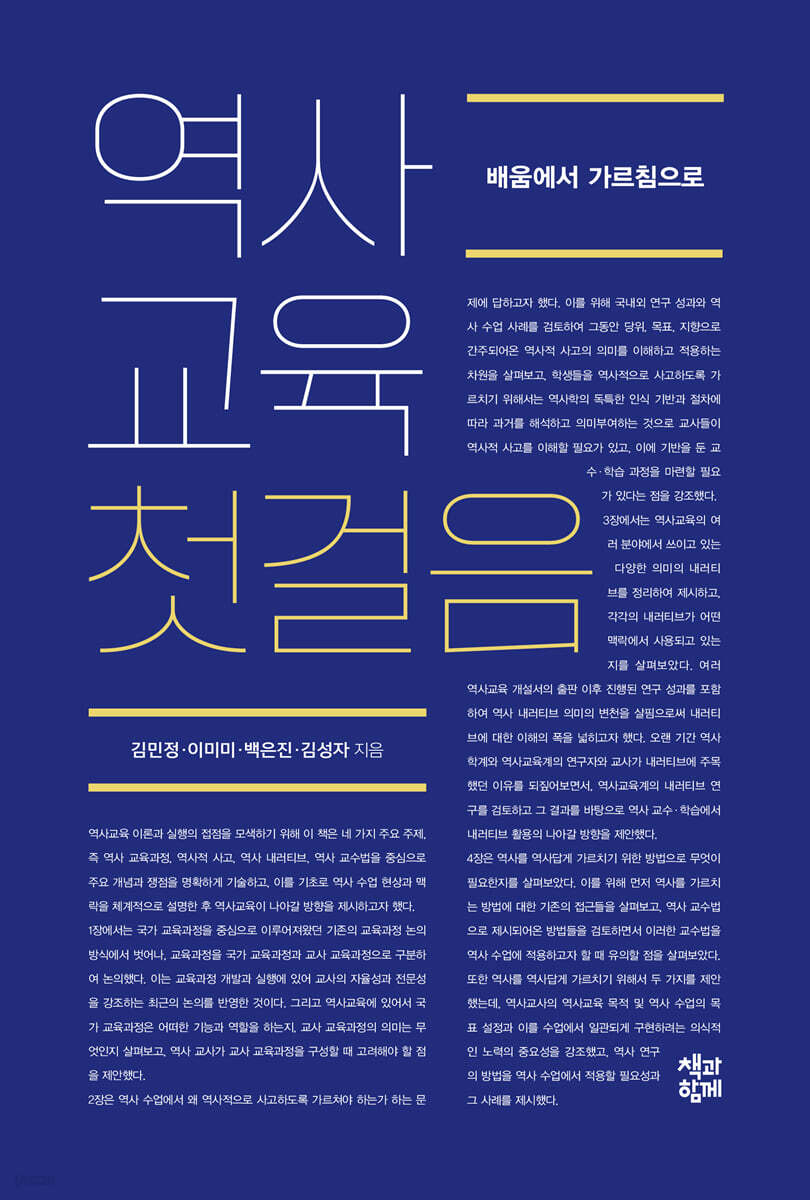
First Steps in History Education
 |
Description
Book Introduction
To create a ‘history class worthy of being called history’
For practical understanding and application of history education theory
It was designed to help prospective teachers analytically understand classroom practice and history education research through the lens of history education theory, and to systematically plan and implement history classes.
We examined how history education theory can be applied to classes through practical examples and tried to concretize history education theory in the context of school settings.
To this end, we aim to clearly present key concepts and issues centered on the history curriculum, historical thinking, historical narrative, and history teaching methods, systematically explain the phenomenon and context of history classes by including numerous recent domestic and international research results and field application cases of core concepts of history education, and then suggest the direction in which history education should proceed.
Furthermore, we included 'Activity: From a Learning Perspective' to ensure that prospective teachers have properly understood the theoretical issues of each chapter, and concluded with 'Activity: From a Teaching Perspective' to consider how to apply the core concepts of each chapter in the classroom from the perspective of teaching students.
Through 'Activities: From a Teaching Perspective' in each chapter, which consists of unit composition, lesson planning for one class period, performance assessment plan, and learning activity plan, readers will be able to experience various forms of teaching activity planning carried out by teachers in the field.
Furthermore, I hope that students will grow into teachers and researchers who can productively consume and reconstruct historical education theories through the process of designing and reflecting on their own classes.
For practical understanding and application of history education theory
It was designed to help prospective teachers analytically understand classroom practice and history education research through the lens of history education theory, and to systematically plan and implement history classes.
We examined how history education theory can be applied to classes through practical examples and tried to concretize history education theory in the context of school settings.
To this end, we aim to clearly present key concepts and issues centered on the history curriculum, historical thinking, historical narrative, and history teaching methods, systematically explain the phenomenon and context of history classes by including numerous recent domestic and international research results and field application cases of core concepts of history education, and then suggest the direction in which history education should proceed.
Furthermore, we included 'Activity: From a Learning Perspective' to ensure that prospective teachers have properly understood the theoretical issues of each chapter, and concluded with 'Activity: From a Teaching Perspective' to consider how to apply the core concepts of each chapter in the classroom from the perspective of teaching students.
Through 'Activities: From a Teaching Perspective' in each chapter, which consists of unit composition, lesson planning for one class period, performance assessment plan, and learning activity plan, readers will be able to experience various forms of teaching activity planning carried out by teachers in the field.
Furthermore, I hope that students will grow into teachers and researchers who can productively consume and reconstruct historical education theories through the process of designing and reflecting on their own classes.
- You can preview some of the book's contents.
Preview
index
preface
Chapter 1: The History Curriculum: Who Constructs What and How?
1.
Entering
2.
Meaning and level of curriculum
3.
History National Curriculum and Teacher Training Curriculum
4.
Composition of the History Teacher Training Curriculum
5.
Going out
Chapter 2 Historical Thinking: Why is it important to teach students to think historically?
1.
Entering
2.
The meaning of historical thinking
3.
How to Teach Historical Thinking: A Review of Previous Studies
4.
History classes that embody historical thinking
5.
Going out
Chapter 3: Historical Narratives: Why Narratives in History Education?
1.
Entering
2.
The meaning of narrative
3.
Narrative Studies and the Teaching and Learning of History
4.
Using Narratives in History Lesson Planning, Implementation, and Evaluation
5.
Going out
Chapter 4: Teaching History: What to Consider to Teach History Like History
1.
Entering
2.
The meaning of teaching history
3.
Classification and Application of History Teaching Methods
4.
Consideration for teaching history properly
5.
Going out
main
References
Source of included papers
Search
Chapter 1: The History Curriculum: Who Constructs What and How?
1.
Entering
2.
Meaning and level of curriculum
3.
History National Curriculum and Teacher Training Curriculum
4.
Composition of the History Teacher Training Curriculum
5.
Going out
Chapter 2 Historical Thinking: Why is it important to teach students to think historically?
1.
Entering
2.
The meaning of historical thinking
3.
How to Teach Historical Thinking: A Review of Previous Studies
4.
History classes that embody historical thinking
5.
Going out
Chapter 3: Historical Narratives: Why Narratives in History Education?
1.
Entering
2.
The meaning of narrative
3.
Narrative Studies and the Teaching and Learning of History
4.
Using Narratives in History Lesson Planning, Implementation, and Evaluation
5.
Going out
Chapter 4: Teaching History: What to Consider to Teach History Like History
1.
Entering
2.
The meaning of teaching history
3.
Classification and Application of History Teaching Methods
4.
Consideration for teaching history properly
5.
Going out
main
References
Source of included papers
Search
Publisher's Review
To create a ‘history class worthy of being called history’
For practical understanding and application of history education theory
This book was designed to help prospective teachers analytically understand classroom practice and historical education research through the lens of historical education theory, and to systematically plan and implement history classes.
The authors, who are both history education researchers and teacher educators, hope to convey the message through this book that understanding the theory of history education can contribute to thinking about how to teach history in a way that is truly historical.
Many people have believed that history education theory is something to be memorized and then promptly forgotten for the secondary school teacher certification exam, that it is of no practical use in history classes, and that it is far from an attempt to recognize the current state and problems of history education and find alternatives.
The authors, while keenly accepting these problems and criticisms, examined how history education theory could be applied to classes, focusing on real-world examples, and endeavored to concretize history education theory within the context of school settings.
To explore the intersection between history education theory and practice, this book clearly describes key concepts and issues centered on four major topics: history curriculum, historical thinking, historical narrative, and history teaching methods. Based on this, it systematically explains the phenomenon and context of history classes and then suggests the direction in which history education should proceed.
Clear explanations, latest research findings, and practical application examples
A new guide and workbook for history educators
The specific narrative direction and characteristics of this book are as follows.
First, this book aims to present the key concepts of history education clearly and in detail.
Based on the research achievements of the domestic history education community, which has developed rapidly since the 1990s, an introductory book on history education was published, and it was used as a textbook for history education subjects, a textbook for teacher training exams, and an introductory book for history education research at teacher training institutions including teacher training colleges.
Based on the experiences and opinions of those in academia and education who have utilized introductory textbooks on history education, this book aims to minimize the parts that cause confusion in the description of core concepts of history education and supplement the parts that require clear and systematic explanation, thereby explaining the core concepts so that prospective teachers and researchers can clearly understand and utilize their meaning.
Second, this book includes recent research results published domestically and internationally since the publication of the previous introductory book.
It has already been over ten years since the last introductory book in the field of history education was published.
During this time, many changes have also occurred in historical education research.
The number of researchers studying history education has also increased, and research results on new fields and topics have accumulated.
This book faithfully reflects not only domestic research achievements but also recent international research findings, thereby suggesting the direction in which history education should proceed in the midst of changing educational discourse.
Third, this book includes practical examples of the application of core concepts in history education.
History education theory is persuasive when it explains the school environment and helps us understand complex issues.
Therefore, this book has attempted to explicitly present how the core concepts of history education are implemented in the field and how they can help in understanding the field.
To this end, at the beginning of each chapter, we introduced the key content or concepts focused on in each chapter using examples from the educational field.
Additionally, we included 'Activity: From a Learning Perspective' to allow prospective teachers to check for themselves whether they have properly understood the theoretical issues of each chapter, and concluded with 'Activity: From a Teaching Perspective' to consider how to apply the core concepts of each chapter in the classroom from the perspective of teaching students.
Through 'Activities: From a Teaching Perspective' in each chapter, which consists of unit composition, lesson planning for one class period, performance assessment plan, and learning activity plan, readers will be able to experience various forms of teaching activity planning carried out by teachers in the field.
Furthermore, we hope that readers of this book will, through these activities, not only gain a thorough understanding of the theoretical issues in each field, but also grow into teachers and researchers who can productively consume and reconstruct historical education theory in the process of designing and reflecting on their own classes.
Book structure
Chapter 1: The History Curriculum: Who Constructs What and How?
Breaking away from the existing curriculum discussion method that was centered around the national curriculum, the curriculum was discussed by dividing it into the national curriculum and the teacher training curriculum.
This reflects recent discussions that emphasize teachers' autonomy and expertise in curriculum development and implementation.
In addition, we examined the functions and roles of the national curriculum in history education, the significance of the teacher education curriculum, and suggested points that history teachers should consider when developing teacher education curriculum.
Chapter 2 Historical Thinking: Why is it important to teach students to think historically?
I wanted to answer the question of why we should teach historical thinking in history classes.
To this end, we reviewed domestic and international research achievements and history class cases to examine the level of understanding and application of the meaning of historical thinking, which has been regarded as a duty, goal, and direction, and emphasized that in order to teach students to think historically, teachers need to understand historical thinking as interpreting and giving meaning to the past according to the unique cognitive foundation and procedure of history, and that it is necessary to establish a teaching and learning process based on this.
Chapter 3: Historical Narratives: Why Narratives in History Education?
We organized and presented various narratives used in various fields of history education and examined the context in which each narrative is used.
By examining the evolution of the meaning of historical narratives, including the results of research conducted since the publication of several introductory historical education textbooks, we aimed to broaden our understanding of narratives.
By reflecting on the reasons why researchers and teachers in the fields of history and history education have long focused on narrative, we reviewed narrative research in the field of history education and, based on the results, proposed future directions for the use of narrative in history teaching and learning.
Chapter 4: Teaching History: What to Consider to Teach History Like History
We looked at what is needed to teach history in a way that is worthy of being called history.
To this end, we first examined existing approaches to teaching history, reviewed the methods proposed as history teaching methods, and examined points to keep in mind when applying these teaching methods to history classes.
In addition, two suggestions were made to teach history in a way that is worthy of being called history. They emphasized the importance of history teachers setting the purpose of history education and the goals of history classes and making a conscious effort to consistently implement these in class. They also presented the necessity of applying historical research methods in history classes and presented examples of such applications.
For practical understanding and application of history education theory
This book was designed to help prospective teachers analytically understand classroom practice and historical education research through the lens of historical education theory, and to systematically plan and implement history classes.
The authors, who are both history education researchers and teacher educators, hope to convey the message through this book that understanding the theory of history education can contribute to thinking about how to teach history in a way that is truly historical.
Many people have believed that history education theory is something to be memorized and then promptly forgotten for the secondary school teacher certification exam, that it is of no practical use in history classes, and that it is far from an attempt to recognize the current state and problems of history education and find alternatives.
The authors, while keenly accepting these problems and criticisms, examined how history education theory could be applied to classes, focusing on real-world examples, and endeavored to concretize history education theory within the context of school settings.
To explore the intersection between history education theory and practice, this book clearly describes key concepts and issues centered on four major topics: history curriculum, historical thinking, historical narrative, and history teaching methods. Based on this, it systematically explains the phenomenon and context of history classes and then suggests the direction in which history education should proceed.
Clear explanations, latest research findings, and practical application examples
A new guide and workbook for history educators
The specific narrative direction and characteristics of this book are as follows.
First, this book aims to present the key concepts of history education clearly and in detail.
Based on the research achievements of the domestic history education community, which has developed rapidly since the 1990s, an introductory book on history education was published, and it was used as a textbook for history education subjects, a textbook for teacher training exams, and an introductory book for history education research at teacher training institutions including teacher training colleges.
Based on the experiences and opinions of those in academia and education who have utilized introductory textbooks on history education, this book aims to minimize the parts that cause confusion in the description of core concepts of history education and supplement the parts that require clear and systematic explanation, thereby explaining the core concepts so that prospective teachers and researchers can clearly understand and utilize their meaning.
Second, this book includes recent research results published domestically and internationally since the publication of the previous introductory book.
It has already been over ten years since the last introductory book in the field of history education was published.
During this time, many changes have also occurred in historical education research.
The number of researchers studying history education has also increased, and research results on new fields and topics have accumulated.
This book faithfully reflects not only domestic research achievements but also recent international research findings, thereby suggesting the direction in which history education should proceed in the midst of changing educational discourse.
Third, this book includes practical examples of the application of core concepts in history education.
History education theory is persuasive when it explains the school environment and helps us understand complex issues.
Therefore, this book has attempted to explicitly present how the core concepts of history education are implemented in the field and how they can help in understanding the field.
To this end, at the beginning of each chapter, we introduced the key content or concepts focused on in each chapter using examples from the educational field.
Additionally, we included 'Activity: From a Learning Perspective' to allow prospective teachers to check for themselves whether they have properly understood the theoretical issues of each chapter, and concluded with 'Activity: From a Teaching Perspective' to consider how to apply the core concepts of each chapter in the classroom from the perspective of teaching students.
Through 'Activities: From a Teaching Perspective' in each chapter, which consists of unit composition, lesson planning for one class period, performance assessment plan, and learning activity plan, readers will be able to experience various forms of teaching activity planning carried out by teachers in the field.
Furthermore, we hope that readers of this book will, through these activities, not only gain a thorough understanding of the theoretical issues in each field, but also grow into teachers and researchers who can productively consume and reconstruct historical education theory in the process of designing and reflecting on their own classes.
Book structure
Chapter 1: The History Curriculum: Who Constructs What and How?
Breaking away from the existing curriculum discussion method that was centered around the national curriculum, the curriculum was discussed by dividing it into the national curriculum and the teacher training curriculum.
This reflects recent discussions that emphasize teachers' autonomy and expertise in curriculum development and implementation.
In addition, we examined the functions and roles of the national curriculum in history education, the significance of the teacher education curriculum, and suggested points that history teachers should consider when developing teacher education curriculum.
Chapter 2 Historical Thinking: Why is it important to teach students to think historically?
I wanted to answer the question of why we should teach historical thinking in history classes.
To this end, we reviewed domestic and international research achievements and history class cases to examine the level of understanding and application of the meaning of historical thinking, which has been regarded as a duty, goal, and direction, and emphasized that in order to teach students to think historically, teachers need to understand historical thinking as interpreting and giving meaning to the past according to the unique cognitive foundation and procedure of history, and that it is necessary to establish a teaching and learning process based on this.
Chapter 3: Historical Narratives: Why Narratives in History Education?
We organized and presented various narratives used in various fields of history education and examined the context in which each narrative is used.
By examining the evolution of the meaning of historical narratives, including the results of research conducted since the publication of several introductory historical education textbooks, we aimed to broaden our understanding of narratives.
By reflecting on the reasons why researchers and teachers in the fields of history and history education have long focused on narrative, we reviewed narrative research in the field of history education and, based on the results, proposed future directions for the use of narrative in history teaching and learning.
Chapter 4: Teaching History: What to Consider to Teach History Like History
We looked at what is needed to teach history in a way that is worthy of being called history.
To this end, we first examined existing approaches to teaching history, reviewed the methods proposed as history teaching methods, and examined points to keep in mind when applying these teaching methods to history classes.
In addition, two suggestions were made to teach history in a way that is worthy of being called history. They emphasized the importance of history teachers setting the purpose of history education and the goals of history classes and making a conscious effort to consistently implement these in class. They also presented the necessity of applying historical research methods in history classes and presented examples of such applications.
GOODS SPECIFICS
- Date of issue: July 12, 2022
- Page count, weight, size: 304 pages | 530g | 152*225*19mm
- ISBN13: 9791191432688
- ISBN10: 1191432688
You may also like
카테고리
korean


korean

![GQ KOREA Mark (Monthly): December [2025]](http://librairie.coreenne.fr/cdn/shop/files/8ef265dbbfbf186523ed75ba7319009d.jpg?v=1765340328&width=3840)


