

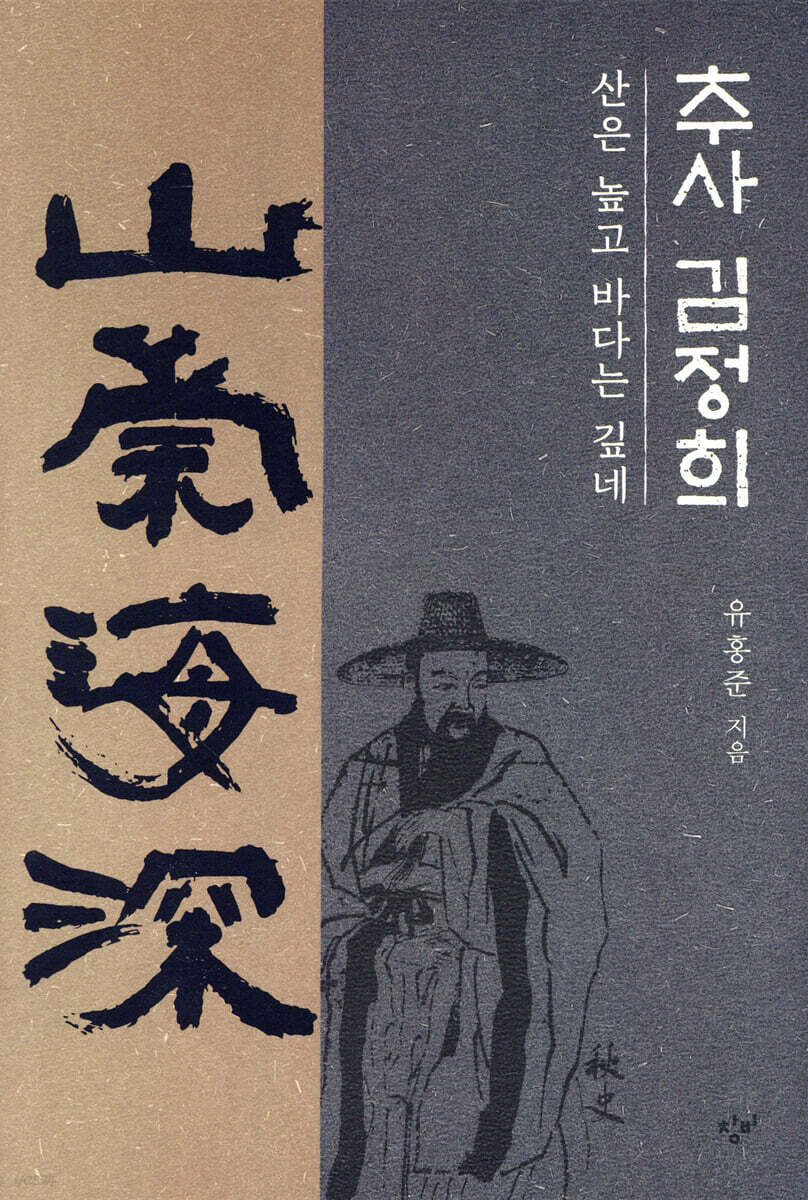
Chusa Kim Jeong-hui
 |
Description
Book Introduction
Chusa Kim Jeong-hui, Joseon's greatest genius, revived by Yu Hong-jun's eloquence. If Europe has Da Vinci, the 'original Korean Wave' that captivated China and Japan 200 years ago, we have Chusa Kim Jeong-hui! Professor Yoo Hong-jun, author of the unrivaled best-selling "My Cultural Heritage Tour" series, a representative Korean humanities book, has published "Chusa Kim Jeong-hui: The Mountain is High and the Sea is Deep," which contains the life and art of Chusa Kim Jeong-hui based on extensive data and extensive research. This is to shed new light on Chusa Kim Jeong-hui, a giant in Korean cultural history who has not been properly evaluated as much as our cultural heritage. This is a masterpiece that will change the perception of Chusa, which is still discussed at a fragmentary level, even as new research on him is pouring in, and his works are being continuously designated as national treasures and constantly being re-evaluated. This book, written in a biographical format that follows the protagonist's life from birth to his later years, comprehensively portrays Chusa's life, art, and scholarship, which have been fragmentarily understood until now. Born into a noble family, Chusa rose to prominence, creating a sensation throughout East Asia. However, his journey through exile twice and the death of his wife, as well as his maturing both personally and artistically, unfolds in an interesting way, like a historical novel. The in-depth understanding of Chusa's scholarship embedded within it is as solid as any academic book. As the author says, it is a well-written general education book that 'becomes academic when read by a specialist and literature when read by a general reader.' The 280 or so illustrations included in the book are another strength of this book. Not only are there representative works such as 『Sehando』 and 『Bul-i-seon-ran』, but also recently designated treasures such as 『Chimgye』, 『Dae-pang-go-hoe』, and 『Chaho-hogong』, and the details of their production are included, so you can truly feel the world of Chusa's art just by reading along with the illustrations, and you can learn at a glance the flow of Chusa's art, including the evolution of Chusa's style. As we follow the life of Chusa Kim Jeong-hui, a peerless genius who left a significant mark in various fields, whether as a scholar, artist, or politician, we are introduced to the cultural and turbulent history of the late Joseon Dynasty beyond the horizon of art history. Beyond "Sehando" and "Chusache," Encountering the Reality of Chusa's Art When we think of Chusa Kim Jeong-hui, we often think of Chusa style, but not many people can explain what Chusa style is. This is because the shapes of the letters called Chusa font are all different. The handwriting is perfectly neat, written to set an example for his four-year-old son, but the poem, which contains the loneliness of old age, is filled with a sense of sadness and emptiness. Even though they are the same characters, the signboard of 『Muryangsujeon』 of Daedunsa Temple, written just before exile, is full of oil like ‘Nanjawansu’, and the signboard of 『Muryangsujeon』 of Eunhaesa Temple, written during exile, is full of bone strength like ‘Kalguksu noodles’. Therefore, in order to understand Chusa's unique handwriting, that is, Chusa style, we must first understand the life experiences and conditions under which Chusa wrote his handwriting. This is true not only in calligraphy but also in other fields. Without knowing about Chusa's interactions with the Yeongyeong academic world, it is impossible to understand why the foundation of Chusa's scholarship lies in Confucian classics, textual criticism, and epigraphy, and without understanding the hardships Chusa endured in life, it is difficult to understand why his artistic world changed so drastically. In that respect, this book, which emphasizes Chusa's human and artistic aspects through the form of biographical literature, is the easiest and most certain way to understand Chusa's scholarship and art. Professor Yoo Hong-jun's exceptional writing ability, which blends historical facts with humor and emotion, shines through in this book, and the process of Chusa perfecting his art amidst the ups and downs of life is reminiscent of a historical drama. If you follow the author's guide through Chusa's life, you will be able to see the reality of Chusa's scholarship at a glance. How did a prickly genius become a great artist? This book explains Chusa's life in 10 chapters. Chapter 1 depicts his childhood as the eldest son of the Wolseongwi family, a royal family's in-laws, and when he was expected to be a child prodigy. Chapter 2 contains the moving moment when Chusa, who had just passed the state examination for civil service examination, visited Yeongyeong with his father and socialized with famous figures of the time, such as Ong Bang-gang and Wan Won. Chapter 3, 'A Feast of Learning and Arts', covers the period from Chusa's return from Yanjing to just before he passed the state examination. It covers the process of introducing textual criticism and epigraphy, which were the new trends of Qing Dynasty scholarship, through continuous exchanges with Yanjing academic circles and applying them to the realities of Joseon. Here, the story of Chusa discovering and interpreting ancient Joseon inscriptions, such as the Bukhansan Jinheungwang Sunsu Stele and the Mujangsa Stele, is depicted in an interesting way. Chapters 4 and 5 depict Chusa passing the state examination at the young age of 34, and becoming an internationally renowned figure in scholarship and art with his outstanding skills, becoming a leading figure in the 'Wandang Wind'. Until this time, he had often been hated for his arrogant and sharp tongue, and in terms of art and scholarship, he had only copied or slightly modified Chinese styles. It was the nine-year exile to Jeju Island that allowed Chusa to achieve a major change in his outlook on life and develop his own unique artistic world. Chapter 6, ‘Drawing the Sehando’ and Chapter 7, ‘Singing of Daffodils’, are stories from this time, vividly depicting Chusa’s lonely days, isolated behind a zelkova fence and fighting the pain of constant illness. Chapter 8 covers the period of his life in Gangsang, when Chusa, after being released from exile, settled in a new home near present-day Yongsan and began producing numerous masterpieces. 『Janseowanseokru』, which is considered one of the best masterpieces of Chusa's calligraphy, and 『Bul-i-seon-ran』, which is considered to be almost a new work, are both products of this period. Even in this difficult situation, a shocking incident strikes Chusa, who was enjoying reading and calligraphy. He was exiled to the cold land of Bukcheong after becoming embroiled in a political strife surrounding his old friend Kwon Don-in. Chapter 9 calmly traces the daily life of Chusa, who lived in a birch tree hut during his exile in Bukcheong, but did not lose his mind as he socialized with friends, taught his students, visited historical sites, and composed poetry and calligraphy. The last ten chapters contain the process by which Chusa, who was released from exile and moved to a thatched cottage in Gwacheon, realized the value of ordinariness and universality and the virtue of tolerance in his ordinary daily life, and brought both his life and art to a mature state. Ultimately, Chusa completed his own artistic world through the arduous process of life, and thus became a great artist representing our cultural history. A must-know for all Koreans: the pride of our cultural history, Chusa Kim Jeong-hui. Although Chusa is known simply as a famous calligrapher, he was in fact an international scholar and curator who was active on the world stage in various fields such as calligraphy, classics, epigraphy, textual criticism, poetry, tea ceremony, and art appreciation. In terms of scholarship, Chusa brought in Qing Dynasty textual criticism and epigraphy, which were the new academic trends of the time, and applied them to the reality of Joseon. He also passed on the achievements he had made in Joseon to Yanjing through intense efforts of localization and indigenization, and was evaluated as the greatest intellectual who encompassed both Joseon and Chinese academic circles. In relation to this, Fujitsuka Chikashi (藤塚?), a representative Japanese oriental philosopher who served as a professor at Keijo Imperial University, said, “The leading figure in the study of Qing Dynasty studies is Chusa Kim Jeong-hui.” In terms of art, the domestic and international status that Chusa held at the time was truly astonishing. There is no need to mention his calligraphy, which first brought about the Korean Wave in China and Japan 200 years ago, and his painting skills have also been solidified to the point where they can be compared to those of Jeong Seon and Kim Hong-do. Regardless of whether it was Joseon, Qing, or Japan, there was a long line of writers and scholars who wanted to obtain Chusa's writings and calligraphy. The painting “Munbokdo,” which depicts the scene where the Qing literati Jeong Jo-gyeong meets and greets Chusa, is a clear example of how great Chusa’s international popularity was at the time. In this way, Chusa's life, which was rare for a Korean to have achieved great success and popularity by expanding his scholarship and art on the world stage, makes us feel both love and pride for our culture. Just as the "Travelogue" series has awakened pride in our cultural heritage over the past several decades, this book, "Chusa Kim Jeong-hui," will also serve as a valuable guide to properly understanding Chusa Kim Jeong-hui, a great figure representing Korean cultural history. "Dapsagi": Professor Yoo Hong-jun's 30 Years of Studying Chusa Chusa Kim Jeong-hui, a researcher of Joseon Dynasty calligraphy and painting, was a mountain that Yu Hong-jun had long wanted to overcome. He entered the doctoral program at Sungkyunkwan University in 1988 and chose the study of Chusa Kim Jeong-hui as his research topic. In 2002, he compiled the results of his research and published 『Wandang Biography』 (3 volumes). Since then, he has lectured on the topic of Chusa whenever he had the chance, spreading the scholarship and art of Chusa Kim Jeong-hui to the public. And in 2018, the author, concluding his 30-year challenge to Chusa Kim Jeong-hui, brought back the 『Wandang Biography』, which had gone out of print in 2006. All errors that caused controversy after publication were corrected, and newly discovered works and contents were added. By boldly removing professional and academic stories, the book has been significantly reduced in length, and its unique, easy-going and pleasant style of speaking has been added, transforming it into a light-hearted popular book. This book, 『Chusa Kim Jeong-hui』, which was born in this way, is a masterpiece that explains Chusa's scholarship and art in an easy-to-understand way, focusing on his turbulent life from birth to his later years. As the saying goes, “A masterpiece is a masterpiece, and a master is a master,” the Chusa Kim Jeong-hui interpreted by Yu Hong-jun is clearly read differently. |
- You can preview some of the book's contents.
Preview
index
The preface states, "There is no one who does not know Chusa, but there is also no one who knows him."
Chapter 1: The Wolseongwi Family's Volunteer Son
Chapter 2: 60 Days of Emotional Love
Chapter 3: A Study of Arts and Culture
Chapter 4: Success and Family
Chapter 5: The Wind of Wandang that Takes the World by Storm
Chapter 6: Drawing the Sehando
Chapter 7: Singing the Narcissus
Chapter 8: In the Seventy-Nine Seconds of the River
Chapter 9: Under the Cold Sky of Bukcheong
Chapter 10: Going between Gwajichodang and Bongeunsa Temple
The final chapter: “The mountains are high and the sea is deep.”
From the later 『Wandang Pyeongjeon』 to 『Chusa Kim Jeong-hui』
Chapter 1: The Wolseongwi Family's Volunteer Son
Chapter 2: 60 Days of Emotional Love
Chapter 3: A Study of Arts and Culture
Chapter 4: Success and Family
Chapter 5: The Wind of Wandang that Takes the World by Storm
Chapter 6: Drawing the Sehando
Chapter 7: Singing the Narcissus
Chapter 8: In the Seventy-Nine Seconds of the River
Chapter 9: Under the Cold Sky of Bukcheong
Chapter 10: Going between Gwajichodang and Bongeunsa Temple
The final chapter: “The mountains are high and the sea is deep.”
From the later 『Wandang Pyeongjeon』 to 『Chusa Kim Jeong-hui』
Detailed image
.jpg)
GOODS SPECIFICS
- Date of issue: April 20, 2018
- Page count, weight, size: 600 pages | 958g | 149*221*31mm
- ISBN13: 9788936475604
- ISBN10: 8936475606
You may also like
카테고리
korean


korean

![GQ KOREA Mark (Monthly): December [2025]](http://librairie.coreenne.fr/cdn/shop/files/8ef265dbbfbf186523ed75ba7319009d.jpg?v=1765340328&width=3840)


