

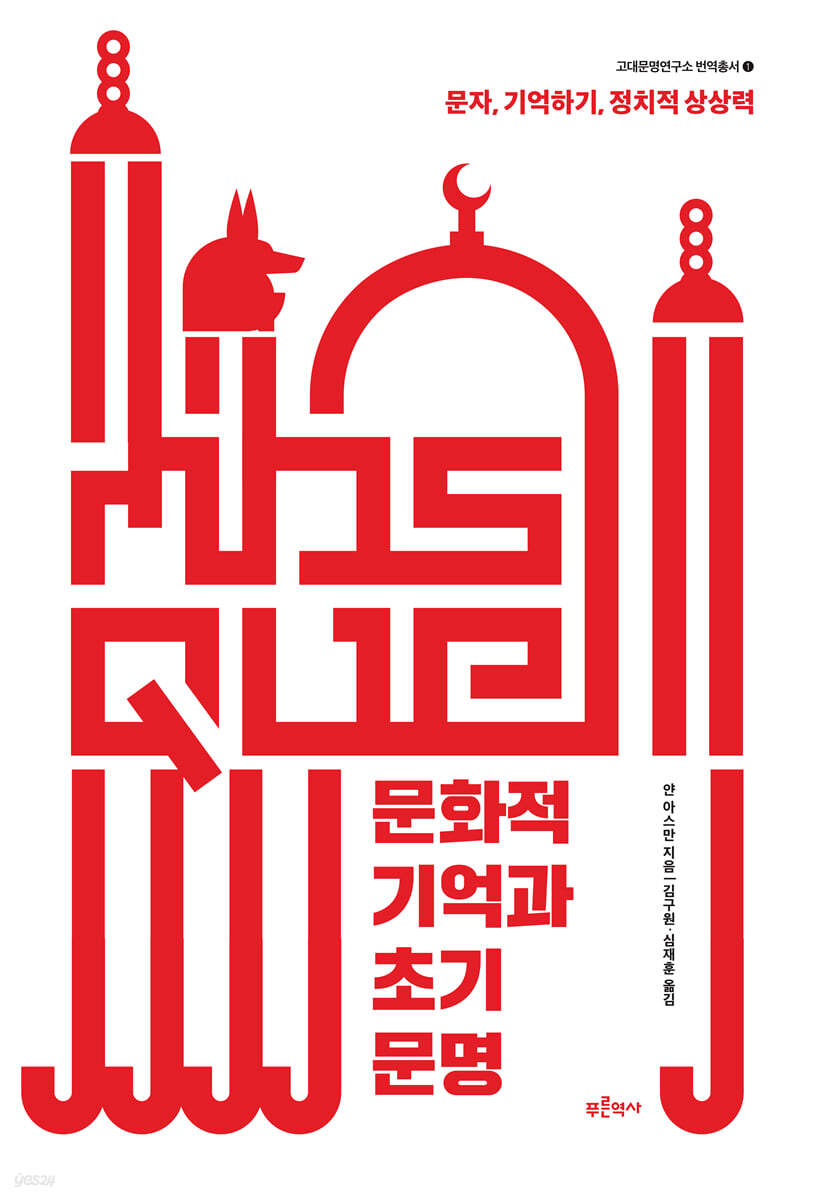
Cultural Memory and Early Civilizations
 |
Description
Book Introduction
Jan Assmann, a scholar who provided intellectual stimulation across the humanities
Presenting a new paradigm for cultural history awareness
Academic achievements that transcend history
The name of Professor Jan Assmann, a German Egyptologist, cultural historian, and religious scholar, is probably unfamiliar to many.
But since the 1980s, few scholars have provided intellectual stimulation across the humanities like Professor Assmann.
He was an exemplary practitioner of interdisciplinary research across the humanities and social sciences, and published 25 books throughout his life, leaving a significant mark on the field of history.
His death on February 19, 2024, at the age of 85, sparked a flood of obituaries in many countries, a testament to his scholarly stature.
Even if the core theory of cultural memory is limited to the field of history, it is contributing to expanding its scope by creating cracks in empirical research that focuses on authenticity.
Presenting a new paradigm for cultural history awareness
Academic achievements that transcend history
The name of Professor Jan Assmann, a German Egyptologist, cultural historian, and religious scholar, is probably unfamiliar to many.
But since the 1980s, few scholars have provided intellectual stimulation across the humanities like Professor Assmann.
He was an exemplary practitioner of interdisciplinary research across the humanities and social sciences, and published 25 books throughout his life, leaving a significant mark on the field of history.
His death on February 19, 2024, at the age of 85, sparked a flood of obituaries in many countries, a testament to his scholarly stature.
Even if the core theory of cultural memory is limited to the field of history, it is contributing to expanding its scope by creating cracks in empirical research that focuses on authenticity.
- You can preview some of the book's contents.
Preview
index
Translator's Preface
Author's Preface (1992)
Author's Preface (2010)
introduction
Part 1 Theoretical Basis
Chapter 1: Culture of Memory: Preliminary Considerations
1.
Mnemonics and Memory Culture
2.
Referring to the past
3.
The Social Construction of the Past: Maurice Alvax
4.
Forms of collective memory
5.
Cultural Memory Options: 'Hot' and 'Cold' Memories
Chapter 2 | Literacy Culture
1.
From ceremonial continuity to literary continuity
2.
Canon - Clarifying the Concept
Chapter 3: Cultural Identity and Political Imagination
1.
Identity, Consciousness, Reflection
2.
Nation formation as a promotion of the basic structure of group identity
Part 2 Case Studies: Preliminary Considerations
Chapter 4 │ Egypt
1.
Basic features of Egyptian writing culture
2.
A temple of the late dynasty as a 'canon'
Chapter 5: Israel and the Invention of Religion
1.
Religion as a means of resistance
2.
Religion as Memory: Deuteronomy as a Framework for Cultural Memory
Chapter 6: The Birth of History from the Spirit of Law
1.
Symbolizing History Under the Signs of Punishment and Salvation
2.
Theologizing History Under the Sign of the Theology of Will
From 'Charismatic Event' to 'Charismatic History'
Chapter 7: Greece and Disciplinary Thinking
1.
The consequences of Greece and literacy
2.
Homer and the Formation of the Greek People
3.
Hypolepsis: Writing Culture and the Evolution of Ideas in Greece
Conclusion: Cultural Memory Summary
ㆍExplanation: Cultural Memory and Early Civilization and Ancient China and Korea
ㆍNote
ㆍReferences
ㆍSearch
Author's Preface (1992)
Author's Preface (2010)
introduction
Part 1 Theoretical Basis
Chapter 1: Culture of Memory: Preliminary Considerations
1.
Mnemonics and Memory Culture
2.
Referring to the past
3.
The Social Construction of the Past: Maurice Alvax
4.
Forms of collective memory
5.
Cultural Memory Options: 'Hot' and 'Cold' Memories
Chapter 2 | Literacy Culture
1.
From ceremonial continuity to literary continuity
2.
Canon - Clarifying the Concept
Chapter 3: Cultural Identity and Political Imagination
1.
Identity, Consciousness, Reflection
2.
Nation formation as a promotion of the basic structure of group identity
Part 2 Case Studies: Preliminary Considerations
Chapter 4 │ Egypt
1.
Basic features of Egyptian writing culture
2.
A temple of the late dynasty as a 'canon'
Chapter 5: Israel and the Invention of Religion
1.
Religion as a means of resistance
2.
Religion as Memory: Deuteronomy as a Framework for Cultural Memory
Chapter 6: The Birth of History from the Spirit of Law
1.
Symbolizing History Under the Signs of Punishment and Salvation
2.
Theologizing History Under the Sign of the Theology of Will
From 'Charismatic Event' to 'Charismatic History'
Chapter 7: Greece and Disciplinary Thinking
1.
The consequences of Greece and literacy
2.
Homer and the Formation of the Greek People
3.
Hypolepsis: Writing Culture and the Evolution of Ideas in Greece
Conclusion: Cultural Memory Summary
ㆍExplanation: Cultural Memory and Early Civilization and Ancient China and Korea
ㆍNote
ㆍReferences
ㆍSearch
Into the book
I like to call the canon the "conscious memory" of society, in order to contrast it with the much more fluid "streams of tradition" of early civilizations and the autonomous memory of "post-canonical" cultures—an era when literary transmission lost its binding force.
Society maintains its identity from generation to generation by creating a culture based on memories and having a self-image.
Many societies do this in completely different ways, which is a key focus of this book.
--- p.26
A single term that encompasses all functional concepts such as tradition formation, past invocation, political identity and imagination.
That term is 'cultural memory'.
It is 'cultural' because it can only be realized institutionally and artificially.
Also, in relation to social communication, it is 'memory' because it functions in the same way that personal memory functions in relation to consciousness.
--- p.33
There are many other factors that make us aware of the difference between old and new, many of which are nonverbal.
Any significant break in tradition (continuity) can create a past whenever it signifies the creation of a new beginning.
Phenomena like the Renaissance or the Reformation always take shape by appealing to the past.
Civilizations develop, produce, and build the future by rediscovering the past.
--- p.43
Egyptian officials had their tombs prepared and had their biographies inscribed there, not as memoirs but as pre-written eulogies.
As the first and most widespread form of memory culture, this kind of memory of the dead clearly demonstrates the existence of a phenomenon that cannot be addressed simply through the conventional concept of 'tradition'.
--- p.45
Despite the fact that it is always individuals who “have” memories, memories are created collectively.
This is precisely why the term collective memory should not be read as a metaphor, since groups themselves do not “have” memories, but groups determine the memories of their members.
Even the most personal recollections occur only through communication and social interaction.
--- p.47
Social groups that form communities of memory preserve their past through two factors: uniqueness and durability.
Through the memory forms they create themselves, they externally emphasize differences that they do not internally value much.
It also forms a sense of identity over time, so that remembered facts are always sorted and balanced according to consistency, similarity, and continuity.
--- p.51
Another element of collective memory that is closely related to the group is its reconstructive nature.
Memory cannot preserve the past as it is, and “in every society at any time, only that which can be reconstructed within the frame of reference of that time is preserved as memory.” In this regard, according to philosopher Hans Blumenberg, “there are no pure facts in memory.”
--- p.52
While history recognizes only differences and discontinuities, collective memory focuses on similarities and continuities.
Collective memory looks at the group from within.
So at every stage we strive to have an image of the past that we can identify ourselves with, and we exclude any major changes.
History, on the other hand, regards such periods of unchanging change as 'empty' interludes and leaves them out of its narrative.
--- p.54
A common factor in the various ancient and modern uses of the word 'canon' is its immutability.
In whatever sense it is used, it provides a firm reference point by providing unity, rigor, and consistency, while excluding arbitrariness, chance, and fragmentation.
Constancy is achieved through the guidance of abstract rules and norms or concrete models—people, works of art, literature.
--- p.145
The early church, after centuries of hesitation, especially with the proliferation of apocalyptic literature, finally made binding decisions about what should and should not be accepted as Scripture.
This transformed the canon into a closed and unchanging collection of texts with supreme authority.
--- p.146
A historical line can and must be drawn as a value judgment that distinguishes between the canonical and the apocryphal, separating the essential from the non-essential.
This divides orthodoxy and heresy, and such a distinction creates a relationship between friends and enemies, not between us and them.
As these guidelines are no longer limited to objects and situations but extend to people, such decisions become linked to questions of existence itself, and are now matters of life and death.
--- p.149
The 20th century saw a variety of re-economies: nationalist fascist and Marxist-Leninist concepts, the post-war resurgence of anti-communism and anti-nationalism in a Roman- and Western-centric 'West', various fundamentalisms (Christian, Jewish, Islamic, etc.), and mass movements and countermovements that emerged from specific minority identities and historical work, such as feminism, Black Studies, and LGBTQ+ rights.
It seems we can never escape the network of normative and formative values.
Therefore, the historian's task can no longer be considered as dismantling or "weakening" the barriers of scripture.
Instead, we analyze the structure of those barriers to reveal the processes by which they are normatively and formatively established.
--- p.154
A sense of social belonging, also called 'social identity', relies on shared knowledge and shared memories.
That knowledge and memory are expressed through a common language.
In other words, it is communicated through a common system of symbols.
--- p.168
The core of the maxims is the practice of solidarity, that is, enabling “every cell to be in harmony with the other parts of the organism.”
It is associated with values and norms, with rules that lead to functional coexistence and with self-evident truths that form the basis of successful communication.
--- p.171
Perhaps the most striking example of these symptoms of “nation, state formation, and grandeur” are the pyramids of the Fourth Dynasty of Egypt (c. 2600 BCE).
Egyptologist Wolfgang Hellk writes, “…through this common task, the Egyptian state finally emerged as an organized entity in which everyone had his or her place.”
--- p.250
Being a cultural transmitter is a huge burden.
Only those who are personally prosperous and free from the burden of life's immediate challenges can afford it.
This approach to culture was common to all ancient societies.
The lower classes could become part of the culture only if they were its objects.
Doing good and caring for the needy were central principles in Egyptian, Near Eastern, and even Biblical ethics.
--- p.180
As the restrictive structure of culture deepens, its status changes to that of religion.
This shift occurs in cases of tribalism and nationalism, not elitism (although there are also typical upper-class religions).
The religious element of this differentially elevated identity lies in the claim of exclusivity that underpins the consciousness of 'us'.
This element begins to dominate every individual and every aspect of that individual.
--- p.188
Egypt had no written scriptures, but it had temples to replace them.
These temples should be considered a form of canonization.
They all followed the same planar layout and were filled with inscriptions, codifying traditions in a monumental form.
Their high walls also provide a barrier to the outside world, visually corresponding precisely to the 'Iron Wall', which metaphorically represented the function of Jewish law.
The walls of Egyptian temples contain not only rituals, images, and texts, but also practical instructions for life.
--- p.191
The writing systems of early civilizations, the writing and mnemonics of Israel and Greece, and the mnemonics of the Indian Brahmans represent such cultural technologies.
Even in Neo-Assyria (934–609 BC), which acquired its cultural character only through its initial military achievements, empire-building was linked to cultural institutions.
That is, the Assyrians are believed to have invented the palace library known as the Ashurbanipal Library, the importance of which cannot be overstated.
--- p.192
Concerning the temple of Hathor at Dendera, “The great plan of the temple, together with the history of the city, is engraved on the wall in its proper place.
It is known that “the blueprint perfectly contains the wisdom of our ancestors, and nothing should be added to or taken away from it.”… We can see that the concepts of books and temples are not far apart.
In fact, the temple is nothing more than a three-dimensional monumental replacement of a book with the characteristics of a typical scripture.
--- p.213
Imhotep, the designer of the tomb of Djoser, the second pharaoh of the Third Dynasty, and the inventor of stone architecture and the first pyramid form, not only appears in the records of his contemporaries but also survives in cultural memory, achieving divine glory.
--- p.214
Egyptian texts condemned foreigners for their impurity, and in fact kept them away from temples or any sacred ceremonies.
Set was created as a foreign god and was insultingly nicknamed “the god of Media”, making him a “demigod.”
Foreigners who served these gods were also nicknamed “the wicked ones.”
--- p.216
It was an 'encyclopedia' in the true sense of the word, something never seen in the temples of previous times.
The text itself has acquired encyclopedic proportions, with the number of characters exploding from about 700 to 7,000.
Each temple developed its own writing system.
It is based on the pictorial symbolism inherent in the hieroglyphic writing system.
--- p.218
The temple was, from the Egyptian perspective, the earthly embodiment of the Book of Heaven.
That is, as a building it embodied the divine plan, the inscriptions and images of the temple were engraved in stone throughout the heavenly library, and its ceremonies were according to the divine ordinances.
As a 'memory sublimated into architecture', that is, as a visualization of historical consciousness, the temple connected the present with the mythical primordial origins.
By transcribing the divine script, the temple simultaneously became a 'model of the world', and the world was built on the same principles.
--- p.222
The first signs of a shift toward monotheism appeared in the 9th century BC.
There appears to have been a Puritan reformation under King Asa (died about 875 B.C.), which was continued by his son Jehoshaphat, who persecuted the priests of Baal, and by the prophet Elijah.
This is where the 'Only Yahweh Movement' began.
In the centuries that followed, the movement waged a fierce struggle not only against the resurgent worship of Baal, but also against the continued practice of polytheism.
--- p.245
As the concept of God's people was established, not only were countless Egyptians subjected to the ten plagues and death, but some Jewish sects also suffered harsh punishments for their habitual sins and stubbornness.
From the beginning, it was clear that the qualification to become a son of God was not a hereditary matter of blood ties, lineage, or birthright.
A sharp line was drawn between national and religious identity, that is, between Israelis and “true” Israelis.
Thus, the Exodus tradition, as a 'memory image', has made vivid all the confrontations that have appeared in history, and continues to do so today.
--- p.254
In China, it was customary for new dynasties to recount the history of the preceding dynasty to legitimize themselves.
This narrative was supposed to show that the previous dynasty had initially received the Mandate of Heaven and carried it out, but that it gradually deviated from the path and the Mandate of Heaven inevitably passed to a new dynasty.
Here too, the past proceeded under the sign of sin.
--- p.303
Periodic public readings of the covenant text helped to maintain its memory.
Even treaties between secular states had to be regularly read before the contracting parties.
This custom continues in Deuteronomy, where Moses commands that the Torah be read publicly every seven years.
--- p.305
He expressed his strong rejection of Alexander, giving the Spartans, who were skeptical, a lesson:
“There exists a Greek world, with the same blood and language, with common temples and rites, with the same customs.” This sense of belonging provided the assurance that “there will be no agreement with Persia as long as there is a single Athenian still living.”
In other words, they were ready to give their lives for the 'Greek world'.
--- p.326
As Homer did for Greek literature, the Torah served as the "scripture within the scripture," the crystallizing core of the Hebrew scriptures.
And just as the Homeric tradition functioned as a process of nation-building in Greece, so did the Torah in Israel.
The fixation of text was accompanied by a new awareness of national and cultural belonging.
--- p.334
The scriptures carry with them the obligation to remember the text.
At that time, cultural mnemonics became the basis of religion, and sacrificial rituals were replaced by worship of God's sacred word.
The command “Remember!” expressed two equally binding obligations.
The first was the law of the covenant, which had to be obeyed in every detail under all circumstances.
The second is the history of transmitting and justifying these laws.
It was through history that the law acquired its true meaning.
Society maintains its identity from generation to generation by creating a culture based on memories and having a self-image.
Many societies do this in completely different ways, which is a key focus of this book.
--- p.26
A single term that encompasses all functional concepts such as tradition formation, past invocation, political identity and imagination.
That term is 'cultural memory'.
It is 'cultural' because it can only be realized institutionally and artificially.
Also, in relation to social communication, it is 'memory' because it functions in the same way that personal memory functions in relation to consciousness.
--- p.33
There are many other factors that make us aware of the difference between old and new, many of which are nonverbal.
Any significant break in tradition (continuity) can create a past whenever it signifies the creation of a new beginning.
Phenomena like the Renaissance or the Reformation always take shape by appealing to the past.
Civilizations develop, produce, and build the future by rediscovering the past.
--- p.43
Egyptian officials had their tombs prepared and had their biographies inscribed there, not as memoirs but as pre-written eulogies.
As the first and most widespread form of memory culture, this kind of memory of the dead clearly demonstrates the existence of a phenomenon that cannot be addressed simply through the conventional concept of 'tradition'.
--- p.45
Despite the fact that it is always individuals who “have” memories, memories are created collectively.
This is precisely why the term collective memory should not be read as a metaphor, since groups themselves do not “have” memories, but groups determine the memories of their members.
Even the most personal recollections occur only through communication and social interaction.
--- p.47
Social groups that form communities of memory preserve their past through two factors: uniqueness and durability.
Through the memory forms they create themselves, they externally emphasize differences that they do not internally value much.
It also forms a sense of identity over time, so that remembered facts are always sorted and balanced according to consistency, similarity, and continuity.
--- p.51
Another element of collective memory that is closely related to the group is its reconstructive nature.
Memory cannot preserve the past as it is, and “in every society at any time, only that which can be reconstructed within the frame of reference of that time is preserved as memory.” In this regard, according to philosopher Hans Blumenberg, “there are no pure facts in memory.”
--- p.52
While history recognizes only differences and discontinuities, collective memory focuses on similarities and continuities.
Collective memory looks at the group from within.
So at every stage we strive to have an image of the past that we can identify ourselves with, and we exclude any major changes.
History, on the other hand, regards such periods of unchanging change as 'empty' interludes and leaves them out of its narrative.
--- p.54
A common factor in the various ancient and modern uses of the word 'canon' is its immutability.
In whatever sense it is used, it provides a firm reference point by providing unity, rigor, and consistency, while excluding arbitrariness, chance, and fragmentation.
Constancy is achieved through the guidance of abstract rules and norms or concrete models—people, works of art, literature.
--- p.145
The early church, after centuries of hesitation, especially with the proliferation of apocalyptic literature, finally made binding decisions about what should and should not be accepted as Scripture.
This transformed the canon into a closed and unchanging collection of texts with supreme authority.
--- p.146
A historical line can and must be drawn as a value judgment that distinguishes between the canonical and the apocryphal, separating the essential from the non-essential.
This divides orthodoxy and heresy, and such a distinction creates a relationship between friends and enemies, not between us and them.
As these guidelines are no longer limited to objects and situations but extend to people, such decisions become linked to questions of existence itself, and are now matters of life and death.
--- p.149
The 20th century saw a variety of re-economies: nationalist fascist and Marxist-Leninist concepts, the post-war resurgence of anti-communism and anti-nationalism in a Roman- and Western-centric 'West', various fundamentalisms (Christian, Jewish, Islamic, etc.), and mass movements and countermovements that emerged from specific minority identities and historical work, such as feminism, Black Studies, and LGBTQ+ rights.
It seems we can never escape the network of normative and formative values.
Therefore, the historian's task can no longer be considered as dismantling or "weakening" the barriers of scripture.
Instead, we analyze the structure of those barriers to reveal the processes by which they are normatively and formatively established.
--- p.154
A sense of social belonging, also called 'social identity', relies on shared knowledge and shared memories.
That knowledge and memory are expressed through a common language.
In other words, it is communicated through a common system of symbols.
--- p.168
The core of the maxims is the practice of solidarity, that is, enabling “every cell to be in harmony with the other parts of the organism.”
It is associated with values and norms, with rules that lead to functional coexistence and with self-evident truths that form the basis of successful communication.
--- p.171
Perhaps the most striking example of these symptoms of “nation, state formation, and grandeur” are the pyramids of the Fourth Dynasty of Egypt (c. 2600 BCE).
Egyptologist Wolfgang Hellk writes, “…through this common task, the Egyptian state finally emerged as an organized entity in which everyone had his or her place.”
--- p.250
Being a cultural transmitter is a huge burden.
Only those who are personally prosperous and free from the burden of life's immediate challenges can afford it.
This approach to culture was common to all ancient societies.
The lower classes could become part of the culture only if they were its objects.
Doing good and caring for the needy were central principles in Egyptian, Near Eastern, and even Biblical ethics.
--- p.180
As the restrictive structure of culture deepens, its status changes to that of religion.
This shift occurs in cases of tribalism and nationalism, not elitism (although there are also typical upper-class religions).
The religious element of this differentially elevated identity lies in the claim of exclusivity that underpins the consciousness of 'us'.
This element begins to dominate every individual and every aspect of that individual.
--- p.188
Egypt had no written scriptures, but it had temples to replace them.
These temples should be considered a form of canonization.
They all followed the same planar layout and were filled with inscriptions, codifying traditions in a monumental form.
Their high walls also provide a barrier to the outside world, visually corresponding precisely to the 'Iron Wall', which metaphorically represented the function of Jewish law.
The walls of Egyptian temples contain not only rituals, images, and texts, but also practical instructions for life.
--- p.191
The writing systems of early civilizations, the writing and mnemonics of Israel and Greece, and the mnemonics of the Indian Brahmans represent such cultural technologies.
Even in Neo-Assyria (934–609 BC), which acquired its cultural character only through its initial military achievements, empire-building was linked to cultural institutions.
That is, the Assyrians are believed to have invented the palace library known as the Ashurbanipal Library, the importance of which cannot be overstated.
--- p.192
Concerning the temple of Hathor at Dendera, “The great plan of the temple, together with the history of the city, is engraved on the wall in its proper place.
It is known that “the blueprint perfectly contains the wisdom of our ancestors, and nothing should be added to or taken away from it.”… We can see that the concepts of books and temples are not far apart.
In fact, the temple is nothing more than a three-dimensional monumental replacement of a book with the characteristics of a typical scripture.
--- p.213
Imhotep, the designer of the tomb of Djoser, the second pharaoh of the Third Dynasty, and the inventor of stone architecture and the first pyramid form, not only appears in the records of his contemporaries but also survives in cultural memory, achieving divine glory.
--- p.214
Egyptian texts condemned foreigners for their impurity, and in fact kept them away from temples or any sacred ceremonies.
Set was created as a foreign god and was insultingly nicknamed “the god of Media”, making him a “demigod.”
Foreigners who served these gods were also nicknamed “the wicked ones.”
--- p.216
It was an 'encyclopedia' in the true sense of the word, something never seen in the temples of previous times.
The text itself has acquired encyclopedic proportions, with the number of characters exploding from about 700 to 7,000.
Each temple developed its own writing system.
It is based on the pictorial symbolism inherent in the hieroglyphic writing system.
--- p.218
The temple was, from the Egyptian perspective, the earthly embodiment of the Book of Heaven.
That is, as a building it embodied the divine plan, the inscriptions and images of the temple were engraved in stone throughout the heavenly library, and its ceremonies were according to the divine ordinances.
As a 'memory sublimated into architecture', that is, as a visualization of historical consciousness, the temple connected the present with the mythical primordial origins.
By transcribing the divine script, the temple simultaneously became a 'model of the world', and the world was built on the same principles.
--- p.222
The first signs of a shift toward monotheism appeared in the 9th century BC.
There appears to have been a Puritan reformation under King Asa (died about 875 B.C.), which was continued by his son Jehoshaphat, who persecuted the priests of Baal, and by the prophet Elijah.
This is where the 'Only Yahweh Movement' began.
In the centuries that followed, the movement waged a fierce struggle not only against the resurgent worship of Baal, but also against the continued practice of polytheism.
--- p.245
As the concept of God's people was established, not only were countless Egyptians subjected to the ten plagues and death, but some Jewish sects also suffered harsh punishments for their habitual sins and stubbornness.
From the beginning, it was clear that the qualification to become a son of God was not a hereditary matter of blood ties, lineage, or birthright.
A sharp line was drawn between national and religious identity, that is, between Israelis and “true” Israelis.
Thus, the Exodus tradition, as a 'memory image', has made vivid all the confrontations that have appeared in history, and continues to do so today.
--- p.254
In China, it was customary for new dynasties to recount the history of the preceding dynasty to legitimize themselves.
This narrative was supposed to show that the previous dynasty had initially received the Mandate of Heaven and carried it out, but that it gradually deviated from the path and the Mandate of Heaven inevitably passed to a new dynasty.
Here too, the past proceeded under the sign of sin.
--- p.303
Periodic public readings of the covenant text helped to maintain its memory.
Even treaties between secular states had to be regularly read before the contracting parties.
This custom continues in Deuteronomy, where Moses commands that the Torah be read publicly every seven years.
--- p.305
He expressed his strong rejection of Alexander, giving the Spartans, who were skeptical, a lesson:
“There exists a Greek world, with the same blood and language, with common temples and rites, with the same customs.” This sense of belonging provided the assurance that “there will be no agreement with Persia as long as there is a single Athenian still living.”
In other words, they were ready to give their lives for the 'Greek world'.
--- p.326
As Homer did for Greek literature, the Torah served as the "scripture within the scripture," the crystallizing core of the Hebrew scriptures.
And just as the Homeric tradition functioned as a process of nation-building in Greece, so did the Torah in Israel.
The fixation of text was accompanied by a new awareness of national and cultural belonging.
--- p.334
The scriptures carry with them the obligation to remember the text.
At that time, cultural mnemonics became the basis of religion, and sacrificial rituals were replaced by worship of God's sacred word.
The command “Remember!” expressed two equally binding obligations.
The first was the law of the covenant, which had to be obeyed in every detail under all circumstances.
The second is the history of transmitting and justifying these laws.
It was through history that the law acquired its true meaning.
--- p.356
Publisher's Review
encompassing tradition and the past, or history and mythology
Cultural memory is literally a culturally created memory.
It contains the group's expectations and hopes for the present and future.
This book examines what it is specifically, the mechanisms by which it has been formed, developed, mutated, forgotten, and regenerated since ancient times, what functions it has performed, and what influence it has had on the development of key ancient civilizations.
Above all, Assmann proposes “cultural memory” as a concept encompassing all of the various cultural elements that led to the formation and development of early civilizations, including what we call tradition, past or historical consciousness, mythical worldview, and self-awareness.
Furthermore, we reinterpret such cultural elements, which are closely related to the rise and fall of ancient civilizations, from the perspective of cultural memory, beyond the dichotomous framework of history/mythology.
As many researchers at home and abroad pursue various aspects of cultural memory in modern and contemporary cases rather than ancient ones, his theory is actually applied across time.
The history of civilization from the establishment to the maintenance and development of the canon (scriptures)
Assmann divides the “collective memory” proposed by Maurice Ahlbax into “communicative memory” and “cultural memory.”
Unlike communicative memory, which is a shared memory among contemporaries who have lived together for no more than 80 years, cultural memory is a constructive memory that dates back thousands of years using various mnemonics and contains hopes for the present and the future.
Cultural memory, which cannot preserve the past as it was, is merely remembered history without distinction between myth and history.
Assmann emphasizes the role of letters and writing culture in the interconnected structure of these cultural memories.
Early writing served as a document for everyday life for hundreds of years, producing literary works of various genres.
After some of these were recognized for their importance and established as classics, a complex interplay of political, cultural, and religious factors led to the emergence of scriptures that could not be altered even a single stroke.
The latter part of the book argues that the different ways in which the scriptures of each ancient civilization were formed, maintained, and developed gave rise to unique cultural memories and identities, which had a profound impact on their rise and fall.
A framework for historical interpretation that transcends time and region
However, the scriptures do not necessarily have to be literature.
Assmann also focuses on the re-evolution of key driving forces of the 20th century, such as nationalism, Marxism-Leninism, anti-communism, and feminism.
Many societies have created and internalized such scriptures in different ways, creating a culture of memory in different ways and maintaining different identities.
What new picture emerges when we revisit Korean history and Korean national identity through the lens of cultural memory? Is the textbook-style epic of Gojoseon, a blend of history and myth and legend, the epitome of cultural memory? How can we understand the complex and linear ancient history that began with Gojoseon and encompassed various political entities from Manchuria to the Korean Peninsula, ultimately leading to Unified Silla? What is the interconnected structure of cultural memory that enabled the linear ancient history, from Iryeon's "Samguk Yusa" through Shin Chae-ho's national history, to be completed in the late 20th century? Was there a canon of cultural memory that drove the Korean national identity that contributed to Korea's economic and cultural development in the 21st century? If so, what was it?
A memory research foundation that demonstrates the maturity of our academic community
The book's structure, divided into Part 1: theoretical reflections and Part 2: case studies, is unique and the writing style is difficult to understand.
However, the publication of this translation, which was produced by experts in ancient Near Eastern and ancient Chinese history, demonstrates the maturity of our academic community, although it may be late.
In fact, his theory of cultural memory was first introduced in Korea in earnest by Western historians in the early 2000s.
Afterwards, Professor Byun Hak-su of Kyungpook National University translated and published Jan Assmann's "Moses the Egyptian: Egyptian Memory Engraved in Western Monotheism" (Greenbee, 2010) and his wife Alaida Assmann's "Spaces of Memory: Forms and Transformations of Cultural Memory" (Greenbee, 2011).
Now that this original book has been translated and published, it is a welcome gift to our historical community, providing a more solid foundation for memory research.
Cultural memory is literally a culturally created memory.
It contains the group's expectations and hopes for the present and future.
This book examines what it is specifically, the mechanisms by which it has been formed, developed, mutated, forgotten, and regenerated since ancient times, what functions it has performed, and what influence it has had on the development of key ancient civilizations.
Above all, Assmann proposes “cultural memory” as a concept encompassing all of the various cultural elements that led to the formation and development of early civilizations, including what we call tradition, past or historical consciousness, mythical worldview, and self-awareness.
Furthermore, we reinterpret such cultural elements, which are closely related to the rise and fall of ancient civilizations, from the perspective of cultural memory, beyond the dichotomous framework of history/mythology.
As many researchers at home and abroad pursue various aspects of cultural memory in modern and contemporary cases rather than ancient ones, his theory is actually applied across time.
The history of civilization from the establishment to the maintenance and development of the canon (scriptures)
Assmann divides the “collective memory” proposed by Maurice Ahlbax into “communicative memory” and “cultural memory.”
Unlike communicative memory, which is a shared memory among contemporaries who have lived together for no more than 80 years, cultural memory is a constructive memory that dates back thousands of years using various mnemonics and contains hopes for the present and the future.
Cultural memory, which cannot preserve the past as it was, is merely remembered history without distinction between myth and history.
Assmann emphasizes the role of letters and writing culture in the interconnected structure of these cultural memories.
Early writing served as a document for everyday life for hundreds of years, producing literary works of various genres.
After some of these were recognized for their importance and established as classics, a complex interplay of political, cultural, and religious factors led to the emergence of scriptures that could not be altered even a single stroke.
The latter part of the book argues that the different ways in which the scriptures of each ancient civilization were formed, maintained, and developed gave rise to unique cultural memories and identities, which had a profound impact on their rise and fall.
A framework for historical interpretation that transcends time and region
However, the scriptures do not necessarily have to be literature.
Assmann also focuses on the re-evolution of key driving forces of the 20th century, such as nationalism, Marxism-Leninism, anti-communism, and feminism.
Many societies have created and internalized such scriptures in different ways, creating a culture of memory in different ways and maintaining different identities.
What new picture emerges when we revisit Korean history and Korean national identity through the lens of cultural memory? Is the textbook-style epic of Gojoseon, a blend of history and myth and legend, the epitome of cultural memory? How can we understand the complex and linear ancient history that began with Gojoseon and encompassed various political entities from Manchuria to the Korean Peninsula, ultimately leading to Unified Silla? What is the interconnected structure of cultural memory that enabled the linear ancient history, from Iryeon's "Samguk Yusa" through Shin Chae-ho's national history, to be completed in the late 20th century? Was there a canon of cultural memory that drove the Korean national identity that contributed to Korea's economic and cultural development in the 21st century? If so, what was it?
A memory research foundation that demonstrates the maturity of our academic community
The book's structure, divided into Part 1: theoretical reflections and Part 2: case studies, is unique and the writing style is difficult to understand.
However, the publication of this translation, which was produced by experts in ancient Near Eastern and ancient Chinese history, demonstrates the maturity of our academic community, although it may be late.
In fact, his theory of cultural memory was first introduced in Korea in earnest by Western historians in the early 2000s.
Afterwards, Professor Byun Hak-su of Kyungpook National University translated and published Jan Assmann's "Moses the Egyptian: Egyptian Memory Engraved in Western Monotheism" (Greenbee, 2010) and his wife Alaida Assmann's "Spaces of Memory: Forms and Transformations of Cultural Memory" (Greenbee, 2011).
Now that this original book has been translated and published, it is a welcome gift to our historical community, providing a more solid foundation for memory research.
GOODS SPECIFICS
- Date of issue: June 9, 2025
- Page count, weight, size: 496 pages | 732g | 152*224*25mm
- ISBN13: 9791156122951
- ISBN10: 1156122953
You may also like
카테고리
korean


korean

![GQ KOREA Mark (Monthly): December [2025]](http://librairie.coreenne.fr/cdn/shop/files/8ef265dbbfbf186523ed75ba7319009d.jpg?v=1765340328&width=3840)


