

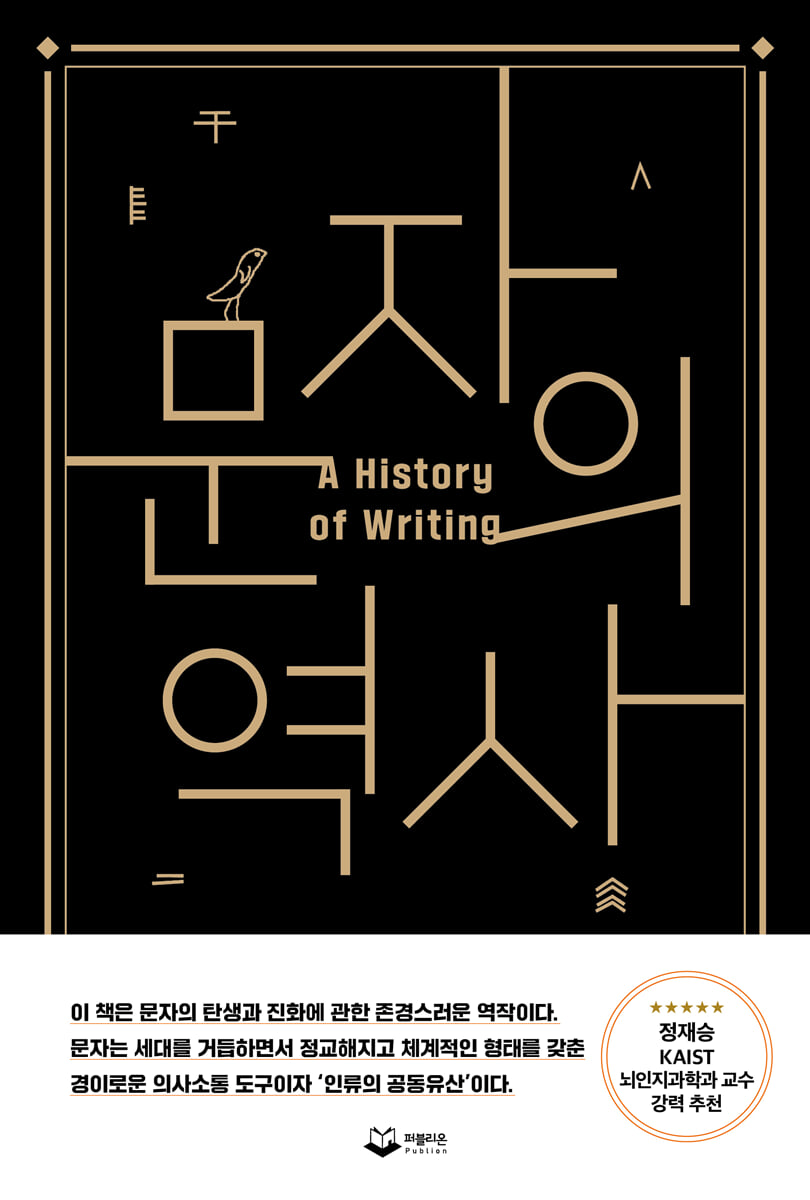
History of writing
 |
Description
Book Introduction
From the first writing system used by the ancient Sumerians
Even the text in the digital technology era
The history of mankind has developed along with writing!
Tracing the origins and development of writing, from ancient marks on stones and bones to modern computer and internet language.
Beginning with the first steps in storing information (knots, tick marks, pictographs), we will explore how a full-fledged writing system emerged in Mesopotamia in the fourth millennium BC, how the Phoenician alphabet arose and its influence on the Greek alphabet, Egyptian hieroglyphs, the Arabic script of the Middle East, the scripts of East Asia such as Hanja (Chinese), Hangul (Korean), and Kana (Japanese), and how the scripts used in pre-Columbian America were formed.
He also meticulously analyzed everything related to writing, from manuscripts in the Western European Middle Ages, the process by which printing led to technological innovation, to spelling conventions in the 19th and 20th centuries.
'Writing', a symbol that visually expresses human language, is the ultimate tool for conveying human knowledge, a cultural medium of society, a democratic means of expression for informing the public, and a part of art called calligraphy.
In this way, we can confirm the development of human civilization through the history of writing, which cannot be considered separately from the lives of civilized people (humans).
Even the text in the digital technology era
The history of mankind has developed along with writing!
Tracing the origins and development of writing, from ancient marks on stones and bones to modern computer and internet language.
Beginning with the first steps in storing information (knots, tick marks, pictographs), we will explore how a full-fledged writing system emerged in Mesopotamia in the fourth millennium BC, how the Phoenician alphabet arose and its influence on the Greek alphabet, Egyptian hieroglyphs, the Arabic script of the Middle East, the scripts of East Asia such as Hanja (Chinese), Hangul (Korean), and Kana (Japanese), and how the scripts used in pre-Columbian America were formed.
He also meticulously analyzed everything related to writing, from manuscripts in the Western European Middle Ages, the process by which printing led to technological innovation, to spelling conventions in the 19th and 20th centuries.
'Writing', a symbol that visually expresses human language, is the ultimate tool for conveying human knowledge, a cultural medium of society, a democratic means of expression for informing the public, and a part of art called calligraphy.
In this way, we can confirm the development of human civilization through the history of writing, which cannot be considered separately from the lives of civilized people (humans).
- You can preview some of the book's contents.
Preview
index
Recommendation_Jeong Jae-seung (Professor, Department of Brain and Cognitive Sciences, KAIST) 4
Introduction 10
PART 1 From Engraving to Tablet
Knot Letter 22
Engraving 24
Pictograph 26
Scale bar 30
Other memory-recall devices and signal messages 31
Visual Symbol 33
Sign 36
Phonetic Writing and the First Tablets 41
PART 2 Talking Pictures
Egyptian script 54
Cuneiform 69
Proto-Elamite script 81
Indus script 84
PART 3 Speaking Writing Systems
Byblos Syllabic 99
Anatolian syllabary 103
Aegean and Cypriot syllabaries 107
116 Circular Alphabet of Egypt and Canaan
Phoenician alphabet 126
Aramaic script 130
Indic scripts of India and Southeast Asia 145
PART 4 From Alpha to Omega
Greek alphabet 168
Meroetic and Coptic scripts 183
Etruscan script 188
Latin letters 194
Iberian script 203
Gothic letters 207
Rune 208
Five Senses Character 215
Slavic script 219
PART 5: The 'Rebirth' of East Asian Characters
Chinese characters 231
Vietnamese characters 254
Korean characters 256
Japanese characters 266
PART 6 Mesoamerica and the Andes
AD 293
Zapotec script 299
Epi · Olmec script 301
Mayan script 303
Other characters 313
Mistecca Character 314
Aztec script 315
Andean script 318
PART 7 Parchment Keyboard
Greece 328
Latin in the Middle Ages 333
Insula 346
Punctuation 355
Paper 360
Print 362
388 letters inspired by the Latin alphabet
PART 8 THE FUTURE OF LETTERS
Two-layer language 408
Spelling and Spelling Reform 412
Shorthand, Symbols, and 'Visual Language' 424
The Future of Text 428
Translator's Note 438
Notes 440 | References 458 | Index 467
Introduction 10
PART 1 From Engraving to Tablet
Knot Letter 22
Engraving 24
Pictograph 26
Scale bar 30
Other memory-recall devices and signal messages 31
Visual Symbol 33
Sign 36
Phonetic Writing and the First Tablets 41
PART 2 Talking Pictures
Egyptian script 54
Cuneiform 69
Proto-Elamite script 81
Indus script 84
PART 3 Speaking Writing Systems
Byblos Syllabic 99
Anatolian syllabary 103
Aegean and Cypriot syllabaries 107
116 Circular Alphabet of Egypt and Canaan
Phoenician alphabet 126
Aramaic script 130
Indic scripts of India and Southeast Asia 145
PART 4 From Alpha to Omega
Greek alphabet 168
Meroetic and Coptic scripts 183
Etruscan script 188
Latin letters 194
Iberian script 203
Gothic letters 207
Rune 208
Five Senses Character 215
Slavic script 219
PART 5: The 'Rebirth' of East Asian Characters
Chinese characters 231
Vietnamese characters 254
Korean characters 256
Japanese characters 266
PART 6 Mesoamerica and the Andes
AD 293
Zapotec script 299
Epi · Olmec script 301
Mayan script 303
Other characters 313
Mistecca Character 314
Aztec script 315
Andean script 318
PART 7 Parchment Keyboard
Greece 328
Latin in the Middle Ages 333
Insula 346
Punctuation 355
Paper 360
Print 362
388 letters inspired by the Latin alphabet
PART 8 THE FUTURE OF LETTERS
Two-layer language 408
Spelling and Spelling Reform 412
Shorthand, Symbols, and 'Visual Language' 424
The Future of Text 428
Translator's Note 438
Notes 440 | References 458 | Index 467
Detailed image

Into the book
Even before the development of fully formed writing systems, we humans stored information using colorful visual symbols and mnemonics to aid memory.
Rock art is a repository of universal symbols, such as human-like figures, flora and fauna, the sun, stars and comets, and indescribable geometric patterns.
Most of these visual symbols are visual representations of common phenomena in the physical world.
At the same time, mnemonics that aid memory were also used in linguistic contexts.
For example, various objects were used as tools for remembering words, including knot records, pictographs, bones and sticks with notches engraved on them, sticks with pictures of messages, devices for manipulating strings to produce sounds, and colored pebbles.
Over the millennia, visual symbols and these associations have become increasingly intimately connected in specific social settings.
Finally, the two were combined to form one 'graphic mnemonics'.
---From "Chapter 1 - From Engraving to Tablet"
Another fascinating feature of Egyptian hieroglyphs is the use of quantifiers, or symbolic identifiers.
(It was only later that the symbolic identifier called determiner appeared in other writing systems.) Determiners differed markedly from phonetic complements in that they identified sounds, not meanings.
A determiner was a word symbol, a logogram that was attached to the end of a phonetic symbol, that is, a sound symbol.
In English, determiners are added to help us determine the exact meaning of a word, especially when the sound of the word is ambiguous, such as in the homonyms Bill and bill.
Because determiners should be as clear as possible, most determiners were pictographs rather than logograms.
---From "Chapter 2 - Talking Pictures"
The Canaanite proto-alphabet, which emerged later in the mid-Bronze Age, was also pictographic, linear, and consonantal, with each symbol representing a single consonant.
The newly invented writing systems in the trading centers of Egypt, Babylon, Anatolia, and the Aegean were simple and flexible to write, and thus spread and developed rapidly.
If the Egyptian scribes were the main characters who distilled the alphabet, the Canaanite scribes were the main characters who spread the alphabet widely.
The oldest alphabetic characters in Canaan are found on the Gezer Jar, excavated in Israel, and are thought to date back to the 16th century BC.
---From "Chapter 3 - Speaking Writing System"
The list of letters of the Greek alphabet was fairly complete from the beginning.
However, the task of writing in the early Greek alphabet was quite 'primitive'.
Because there was no standardized spelling for a very long time.
There was no distinction between uppercase and lowercase letters, and no punctuation or spaces.
Each region also followed its own unique customs, and some even used their own invented characters.
Inscriptions written in early Greek were written from right to left, like Semitic languages, and the direction of writing changed with each line, 'like an ox plowing a field' (boustrophedon).
However, around the 6th century BC, most scribes preferred to always write from left to right, regardless of line breaks.
Eventually, this method replaced all others.
---From "Chapter 4 - From Alpha to Omega"
In his proclamation of 1446, Sejong wrote:
“[Hangul] clearly distinguishes between voiceless and voiced sounds, and can record music and songs.
[Hangul] is good for practical use.
“The sound of the wind, the chirping of birds, the crowing of a rooster, and the barking of a dog can all be accurately described [in Korean].” This is almost certainly true.
Korean consonants were created based on five points of articulation: bilabial (lips), dental (teeth), alveolar (gums), velar (soft palate), and glottal (throat).
However, the shape of the three vowels is 'metaphysically' composed of the sky (round dot), the earth (horizontal line), and man (vertical line).
By rationalizing this new writing system philosophically, it superficially satisfied Korean scholars who were demanding a Chinese conceptualization to give authority to the Hangul system.
Therefore, in Hangul, consonants and vowels are distinguished not only visually but also conceptually.
---From "Chapter 5 - The Rebirth of East Asian Characters"
The first evidence of a complete writing system in Mesoamerica comes from the Zapotec people.
They are a people who occupied a vast area in southern Mexico, from the Valley of Oaxaca to the Isthmus of Tehuantepec.
Around 600 BCE, local leaders at the Monte Alban fort and nearby centers in the Oaxaca Valley erected stone monuments to publicize their victories and to boast of the captives they captured, tortured, and sacrificed.
It is particularly noteworthy that the monument records the names of the defeated rivals and their tribes, as well as the dates on which they were defeated in battle or sacrificed.
Zapoteca scribes wrote on paper made from native plants, adding color to it, and during the colonial period, they also used paper imported from Spain.
Among the documents they left behind are account books (which likely recorded tribute), genealogies, and maps showing the Zapotec territory.
Most of the inscriptions seem to record 'the number of prisoners taken by a particular warrior on a particular day in a particular city.'
---From "Chapter 6 - Mesoamerica and the Andes"
Papyrus, the preferred writing medium in ancient times, was too expensive.
Therefore, since only a very small number of people could afford to buy written books, relatively few people bought and read long works.
However, in the 2nd century AD, parchment was circulated in large quantities.
Moreover, because parchment was cheap, book production increased significantly.
However, parchment had been around for centuries.
For example, in 190 BC, Eumenes II (reigned 197–158 BC), ruler of the Kingdom of Pergamum in Asia Minor (present-day western Turkey), encouraged his engineers to perfect the technique of drying thin sheep and goat skins in hopes of building a library to rival the Library of Alexandria in Egypt.
The name of the final product created through this process, 'parchment', is derived from 'Pergamum', the place where it was invented.
---From "Chapter 7 - Parchment Keyboard"
As recent studies have shown, the very act of expressing personal feelings in writing can help combat depression, strengthen the immune system, and lower blood pressure.
Didn't Aristotle also argue that 'sickness of the soul' can be expressed in writing?
Pioneer 10, a spacecraft that has crossed the solar system, responds to text commands received from a computer on Earth.
As we venture beyond our traditional limitations, writing, however imperfect, becomes an essential means of expressing the human species.
But the impulse to leave traces of a certain type of thought in artifacts is a characteristic not only of us today, but also of our ancestors who lived tens of thousands of years ago.
If writing continues to provide wonderful assistance to humanity in various forms, it will define and create a 'new human race'.
Whatever form letters take in the future, they will remain central to human life, empowering and enabling us to remember.
As an Egyptian scribe said about 4,000 years ago, “When a person dies, his body becomes dust, and everything connected with him crumbles to dust.
“What makes him memorable are the letters.”
Rock art is a repository of universal symbols, such as human-like figures, flora and fauna, the sun, stars and comets, and indescribable geometric patterns.
Most of these visual symbols are visual representations of common phenomena in the physical world.
At the same time, mnemonics that aid memory were also used in linguistic contexts.
For example, various objects were used as tools for remembering words, including knot records, pictographs, bones and sticks with notches engraved on them, sticks with pictures of messages, devices for manipulating strings to produce sounds, and colored pebbles.
Over the millennia, visual symbols and these associations have become increasingly intimately connected in specific social settings.
Finally, the two were combined to form one 'graphic mnemonics'.
---From "Chapter 1 - From Engraving to Tablet"
Another fascinating feature of Egyptian hieroglyphs is the use of quantifiers, or symbolic identifiers.
(It was only later that the symbolic identifier called determiner appeared in other writing systems.) Determiners differed markedly from phonetic complements in that they identified sounds, not meanings.
A determiner was a word symbol, a logogram that was attached to the end of a phonetic symbol, that is, a sound symbol.
In English, determiners are added to help us determine the exact meaning of a word, especially when the sound of the word is ambiguous, such as in the homonyms Bill and bill.
Because determiners should be as clear as possible, most determiners were pictographs rather than logograms.
---From "Chapter 2 - Talking Pictures"
The Canaanite proto-alphabet, which emerged later in the mid-Bronze Age, was also pictographic, linear, and consonantal, with each symbol representing a single consonant.
The newly invented writing systems in the trading centers of Egypt, Babylon, Anatolia, and the Aegean were simple and flexible to write, and thus spread and developed rapidly.
If the Egyptian scribes were the main characters who distilled the alphabet, the Canaanite scribes were the main characters who spread the alphabet widely.
The oldest alphabetic characters in Canaan are found on the Gezer Jar, excavated in Israel, and are thought to date back to the 16th century BC.
---From "Chapter 3 - Speaking Writing System"
The list of letters of the Greek alphabet was fairly complete from the beginning.
However, the task of writing in the early Greek alphabet was quite 'primitive'.
Because there was no standardized spelling for a very long time.
There was no distinction between uppercase and lowercase letters, and no punctuation or spaces.
Each region also followed its own unique customs, and some even used their own invented characters.
Inscriptions written in early Greek were written from right to left, like Semitic languages, and the direction of writing changed with each line, 'like an ox plowing a field' (boustrophedon).
However, around the 6th century BC, most scribes preferred to always write from left to right, regardless of line breaks.
Eventually, this method replaced all others.
---From "Chapter 4 - From Alpha to Omega"
In his proclamation of 1446, Sejong wrote:
“[Hangul] clearly distinguishes between voiceless and voiced sounds, and can record music and songs.
[Hangul] is good for practical use.
“The sound of the wind, the chirping of birds, the crowing of a rooster, and the barking of a dog can all be accurately described [in Korean].” This is almost certainly true.
Korean consonants were created based on five points of articulation: bilabial (lips), dental (teeth), alveolar (gums), velar (soft palate), and glottal (throat).
However, the shape of the three vowels is 'metaphysically' composed of the sky (round dot), the earth (horizontal line), and man (vertical line).
By rationalizing this new writing system philosophically, it superficially satisfied Korean scholars who were demanding a Chinese conceptualization to give authority to the Hangul system.
Therefore, in Hangul, consonants and vowels are distinguished not only visually but also conceptually.
---From "Chapter 5 - The Rebirth of East Asian Characters"
The first evidence of a complete writing system in Mesoamerica comes from the Zapotec people.
They are a people who occupied a vast area in southern Mexico, from the Valley of Oaxaca to the Isthmus of Tehuantepec.
Around 600 BCE, local leaders at the Monte Alban fort and nearby centers in the Oaxaca Valley erected stone monuments to publicize their victories and to boast of the captives they captured, tortured, and sacrificed.
It is particularly noteworthy that the monument records the names of the defeated rivals and their tribes, as well as the dates on which they were defeated in battle or sacrificed.
Zapoteca scribes wrote on paper made from native plants, adding color to it, and during the colonial period, they also used paper imported from Spain.
Among the documents they left behind are account books (which likely recorded tribute), genealogies, and maps showing the Zapotec territory.
Most of the inscriptions seem to record 'the number of prisoners taken by a particular warrior on a particular day in a particular city.'
---From "Chapter 6 - Mesoamerica and the Andes"
Papyrus, the preferred writing medium in ancient times, was too expensive.
Therefore, since only a very small number of people could afford to buy written books, relatively few people bought and read long works.
However, in the 2nd century AD, parchment was circulated in large quantities.
Moreover, because parchment was cheap, book production increased significantly.
However, parchment had been around for centuries.
For example, in 190 BC, Eumenes II (reigned 197–158 BC), ruler of the Kingdom of Pergamum in Asia Minor (present-day western Turkey), encouraged his engineers to perfect the technique of drying thin sheep and goat skins in hopes of building a library to rival the Library of Alexandria in Egypt.
The name of the final product created through this process, 'parchment', is derived from 'Pergamum', the place where it was invented.
---From "Chapter 7 - Parchment Keyboard"
As recent studies have shown, the very act of expressing personal feelings in writing can help combat depression, strengthen the immune system, and lower blood pressure.
Didn't Aristotle also argue that 'sickness of the soul' can be expressed in writing?
Pioneer 10, a spacecraft that has crossed the solar system, responds to text commands received from a computer on Earth.
As we venture beyond our traditional limitations, writing, however imperfect, becomes an essential means of expressing the human species.
But the impulse to leave traces of a certain type of thought in artifacts is a characteristic not only of us today, but also of our ancestors who lived tens of thousands of years ago.
If writing continues to provide wonderful assistance to humanity in various forms, it will define and create a 'new human race'.
Whatever form letters take in the future, they will remain central to human life, empowering and enabling us to remember.
As an Egyptian scribe said about 4,000 years ago, “When a person dies, his body becomes dust, and everything connected with him crumbles to dust.
“What makes him memorable are the letters.”
---From "Chapter 8 - The Future of Letters"
Publisher's Review
The history of civilization over the past 6,000 years is a history of accumulation created by writing!
Since the time of Homo erectus, humans are thought to have differentiated themselves from other creatures by building societies based on language.
The globalized society that distinguishes today's Homo sapiens sapiens is a society based more on letters than ever before.
What was once a specialized domain used by only a few thousand people has now become a tool used by 5 billion people, or about 85 percent of the world's population.
In other words, all modern societies are built on the foundation of writing.
The author has studied ancient writing, philology, and linguistics, and has spent over 30 years tracing the process by which "imperfect writing," in which visual images such as signs and symbols were carved on various substrates such as soft clay around 8000 BC, evolved into "perfect writing," in which visual symbols capable of communication were written on paper or electronic surfaces.
《A History of Writing》 shows that the records left by our ancestors on tablets excavated from ancient ruins and inscriptions on monuments became crucial tools in shaping civilization, and that thanks to writing, the intellectual achievements of one generation were passed on and accumulated to the next, forming the amazing human civilization we know today.
It offers fascinating insights into the history of writing, exploring the origins, form, function, and temporal evolution of the world's major writing systems and fonts, and provides a compass for assessing how writing has impacted human life and how it may evolve in the future.
Letters are not 'invented', but are the product of imitation and borrowing!
No one person 'invented' writing.
All writing systems are derived from earlier prototypes or systems.
In short, it is the idea of depicting human speech in pictures, the plan to concretize that idea, and the pictorial symbols used in the process are borrowed and modified or adapted to reflect other people's language use and social needs.
The writing system conceived in Sumer, where human civilization began, developed into Egyptian hieroglyphs, Mesopotamian cuneiform, and the Indus script. The Greek alphabet, which was created by borrowing the Phoenician alphabet and then modifying the writing system to suit the needs of the indigenous language, spread throughout the world thanks to the powerful influence that Greece had on the military (Alexander the Great), economy, and culture.
Arabic script in the Middle East, Chinese characters, Hangul, and Kana in East Asia, and Mesoamerican script across the Atlantic have also created scripts that can 'optimally' reproduce their own sounds through imitation and borrowing.
In this book, which covers scripts from all over the world, not just a few regions, the author's obsession with tracing the imitations and borrowings is like reading a detective novel, and the process of finding unexpected similarities between Mesoamerican script and Sumerian script is surprising and fascinating.
Moreover, by covering a wide range of things related to writing, including spelling, punctuation, typefaces (fonts), spelling reform, writing instruments, printing and publishing, shorthand, typewriters and keyboards, and writing systems based on electronic communication such as computers and smartphones, it shows that writing will remain central to human life, regardless of the form it takes in the future.
The development process of characters by period and region
Includes 176 vivid illustrations!
《The History of Letters》 contains 176 interesting illustrations of various types, providing even more vivid visual information.
It includes traces of Neanderthals carving into bird bones at regular intervals, cave paintings understood as pictorial communication, the Phaistos Disc, the first European document and the world's first printing plate using movable type, the Rosetta Stone, a eulogy commemorating Ptolemy V with three types of script: Egyptian hieroglyphs, Egyptian demotic script, and Greek, the world's oldest music-related document (lyrics and performance methods), clay tablets used as accounting books in Sumer, methods of interpreting ancient script, traces of Egyptian hieroglyphs that have been transformed into the current alphabet, a family tree of regional scripts, printed matter showing changes in typography, and an aluminum plate on the Pioneer 10 spacecraft launched in 1972 that was engraved with the spacecraft's departure point, departure date, and the people (men and women) who created the plate at the suggestion of astronomer Carl Sagan. This allows us to look back on the past and present of mankind, which has changed and developed alongside writing, and to predict the future.
“When a person dies, his body becomes dust,
Everything related to him crumbles to dust.
“What makes him memorable are the letters.”
- An Egyptian scribe about 4,000 years ago
Since the time of Homo erectus, humans are thought to have differentiated themselves from other creatures by building societies based on language.
The globalized society that distinguishes today's Homo sapiens sapiens is a society based more on letters than ever before.
What was once a specialized domain used by only a few thousand people has now become a tool used by 5 billion people, or about 85 percent of the world's population.
In other words, all modern societies are built on the foundation of writing.
The author has studied ancient writing, philology, and linguistics, and has spent over 30 years tracing the process by which "imperfect writing," in which visual images such as signs and symbols were carved on various substrates such as soft clay around 8000 BC, evolved into "perfect writing," in which visual symbols capable of communication were written on paper or electronic surfaces.
《A History of Writing》 shows that the records left by our ancestors on tablets excavated from ancient ruins and inscriptions on monuments became crucial tools in shaping civilization, and that thanks to writing, the intellectual achievements of one generation were passed on and accumulated to the next, forming the amazing human civilization we know today.
It offers fascinating insights into the history of writing, exploring the origins, form, function, and temporal evolution of the world's major writing systems and fonts, and provides a compass for assessing how writing has impacted human life and how it may evolve in the future.
Letters are not 'invented', but are the product of imitation and borrowing!
No one person 'invented' writing.
All writing systems are derived from earlier prototypes or systems.
In short, it is the idea of depicting human speech in pictures, the plan to concretize that idea, and the pictorial symbols used in the process are borrowed and modified or adapted to reflect other people's language use and social needs.
The writing system conceived in Sumer, where human civilization began, developed into Egyptian hieroglyphs, Mesopotamian cuneiform, and the Indus script. The Greek alphabet, which was created by borrowing the Phoenician alphabet and then modifying the writing system to suit the needs of the indigenous language, spread throughout the world thanks to the powerful influence that Greece had on the military (Alexander the Great), economy, and culture.
Arabic script in the Middle East, Chinese characters, Hangul, and Kana in East Asia, and Mesoamerican script across the Atlantic have also created scripts that can 'optimally' reproduce their own sounds through imitation and borrowing.
In this book, which covers scripts from all over the world, not just a few regions, the author's obsession with tracing the imitations and borrowings is like reading a detective novel, and the process of finding unexpected similarities between Mesoamerican script and Sumerian script is surprising and fascinating.
Moreover, by covering a wide range of things related to writing, including spelling, punctuation, typefaces (fonts), spelling reform, writing instruments, printing and publishing, shorthand, typewriters and keyboards, and writing systems based on electronic communication such as computers and smartphones, it shows that writing will remain central to human life, regardless of the form it takes in the future.
The development process of characters by period and region
Includes 176 vivid illustrations!
《The History of Letters》 contains 176 interesting illustrations of various types, providing even more vivid visual information.
It includes traces of Neanderthals carving into bird bones at regular intervals, cave paintings understood as pictorial communication, the Phaistos Disc, the first European document and the world's first printing plate using movable type, the Rosetta Stone, a eulogy commemorating Ptolemy V with three types of script: Egyptian hieroglyphs, Egyptian demotic script, and Greek, the world's oldest music-related document (lyrics and performance methods), clay tablets used as accounting books in Sumer, methods of interpreting ancient script, traces of Egyptian hieroglyphs that have been transformed into the current alphabet, a family tree of regional scripts, printed matter showing changes in typography, and an aluminum plate on the Pioneer 10 spacecraft launched in 1972 that was engraved with the spacecraft's departure point, departure date, and the people (men and women) who created the plate at the suggestion of astronomer Carl Sagan. This allows us to look back on the past and present of mankind, which has changed and developed alongside writing, and to predict the future.
“When a person dies, his body becomes dust,
Everything related to him crumbles to dust.
“What makes him memorable are the letters.”
- An Egyptian scribe about 4,000 years ago
GOODS SPECIFICS
- Date of issue: November 1, 2024
- Page count, weight, size: 472 pages | 624g | 152*225*22mm
- ISBN13: 9791191587715
- ISBN10: 1191587711
You may also like
카테고리
korean


korean

![GQ KOREA Mark (Monthly): December [2025]](http://librairie.coreenne.fr/cdn/shop/files/8ef265dbbfbf186523ed75ba7319009d.jpg?v=1765340328&width=3840)


