

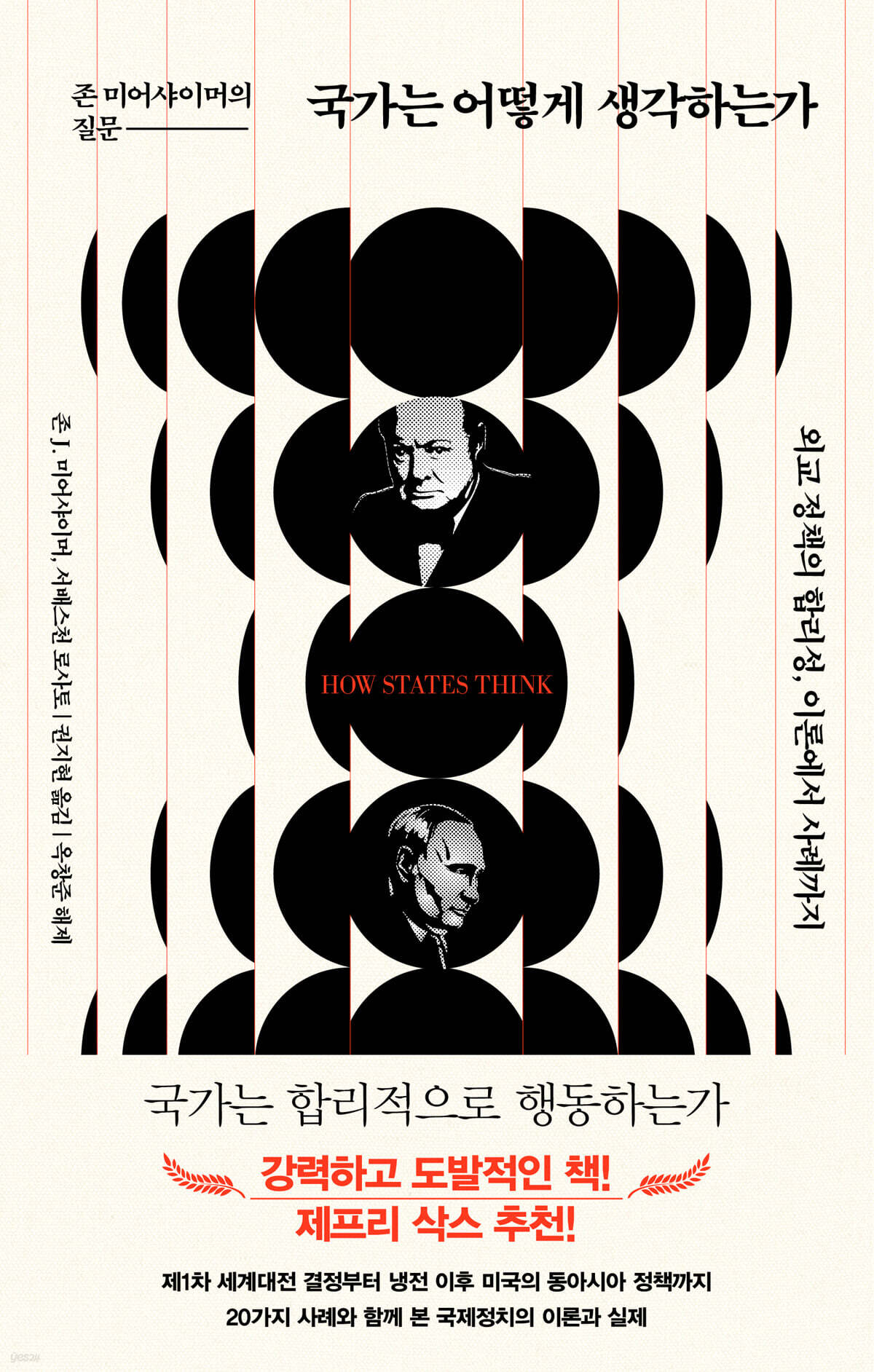
What does the country think?
 |
Description
Book Introduction
- A word from MD
-
If nations are rational, why do wars occur?When Russia invaded Ukraine, he also pointed out 'Putin's irrational judgment' as the cause of the war.
In other wars, the blame is also placed on the wrong decisions of irrational leaders.
But is the state rational? John Mearsheimer offers a different perspective on the rationality of the state.
July 30, 2024. Social and Political PD Son Min-gyu
A powerful and provocative book! Recommended by Jeffrey Sachs!
The latest work by world-renowned scholar John Mearsheimer.
This book offers a groundbreaking examination of a fundamental question at the heart of international politics: "Do states act rationally?"
Furthermore, it provides theoretical and empirical analysis of how a nation's "grand strategy" and "crisis response strategy" are determined, how leaders and policymakers think, and how they develop policies for dealing with other nations.
Was America's post-Cold War NATO expansion strategy rational? Were Germany's decision to start World War I rational? Were Japan's decision to attack Pearl Harbor during World War II rational? What about the US invasion of Cuba in the 1960s and the Soviet invasion of Czechoslovakia? What about Russia's invasion of Ukraine in 2022?
Covering 20 historical cases, from World War I to post-Cold War US policy in East Asia, this book broadens the horizons of international relations understanding not only for policymakers but also for frontline officials, politicians, the military, civil society, and even students of international politics and general readers.
Especially in today's South Korean reality, where geopolitical chaos and diplomatic controversies surrounding the Korean Peninsula are intensifying due to the US-China conflict, cooperation between South Korea, the US, and Japan, and the close ties between North Korea, China, and Russia, this book will awaken invaluable reflection and a sober understanding of reality.
The latest work by world-renowned scholar John Mearsheimer.
This book offers a groundbreaking examination of a fundamental question at the heart of international politics: "Do states act rationally?"
Furthermore, it provides theoretical and empirical analysis of how a nation's "grand strategy" and "crisis response strategy" are determined, how leaders and policymakers think, and how they develop policies for dealing with other nations.
Was America's post-Cold War NATO expansion strategy rational? Were Germany's decision to start World War I rational? Were Japan's decision to attack Pearl Harbor during World War II rational? What about the US invasion of Cuba in the 1960s and the Soviet invasion of Czechoslovakia? What about Russia's invasion of Ukraine in 2022?
Covering 20 historical cases, from World War I to post-Cold War US policy in East Asia, this book broadens the horizons of international relations understanding not only for policymakers but also for frontline officials, politicians, the military, civil society, and even students of international politics and general readers.
Especially in today's South Korean reality, where geopolitical chaos and diplomatic controversies surrounding the Korean Peninsula are intensifying due to the US-China conflict, cooperation between South Korea, the US, and Japan, and the close ties between North Korea, China, and Russia, this book will awaken invaluable reflection and a sober understanding of reality.
- You can preview some of the book's contents.
Preview
index
preface
Chapter 1: The "Rational Actor" Hypothesis: Theoretical Framework: "Rational actors exist in international politics."
What is Rationality in International Politics: Strategic Rationality and Uncertainty
Individual Rationality | Group Rationality
Are States Truly Rational Actors? Defining 'Strategic Rationality'
Two Keys to Rationality: "Reliable Theory" and "Deliberation" | Maximizing Expected Utility
Are States Always Rational?: An Assessment of 'Strategic Rationality'
Everyday Rationality vs. Irrationality | Mental Shortcuts
What is the primary goal of a rational state: goal rationality?
The structure and roadmap of this book
Chapter 2: Strategic Rationality and Uncertainty: How to Understand an Uncertain World
Two Dimensions of Strategic Rationality: Individual Policymakers and Nations
Individual Rationality | Group Rationality
How to Understand the Real World: A Certain World, a Dangerous World, and an Uncertain World
When Uncertainty Comes to the forefront: Four Cases of Serious Information Deficiencies
U.S. policy toward Europe after World War II | U.S. policy toward East Asia after the Cold War | Japanese policy before the attack on Pearl Harbor | U.S. policy during the Cuban Missile Crisis
Chapter 3: Defining Strategic Rationality: Is It Based on Reliable Theory? Has It Been Deliberated?
Theories of International Politics: Reliable vs. Unreliable Theories
The virtues of theory in an uncertain world | Theory and policy | What is a reliable theory? | List of reliable theories: liberal and realist | What is an unreliable theory? | List of unreliable theories: from the clash of civilizations to the bandwagon theory | Non-theoretical thinking: data-driven or emotion-driven
Individual Rationality: Rational Policymakers Are Theory-Oriented
The Rationality of the State: Integration and Deliberation of Perspectives
Process vs. Outcome: Rationality is about process.
Chapter 4 Other Definitions of Rationality: Focusing on Rational Choice Theory and Political Psychology
Expected Utility Maximization: A Critique of Rational Choice Theorists
How to Define Rationality | The Absence of a Definition of Individual Rationality | An Inadequate Definition of Individual Rationality | The Absence of a Definition of State Rationality
Political Psychology: Is Irrationality Prevalent in International Politics?
An inadequate definition of irrationality
Analogy and Heuristics: A Critique of Political Psychologists
Chapter 5: Rationality and Grand Strategy: Five Cases of Grand Strategy Decisions in International Politics
Determining Germany's response to the Triple Entente before World War I
Japan's decision on how to deal with the Soviet Union before World War II
Decisions on how to respond to the Nazi threat in France before World War II
America's decision to expand NATO after the Cold War
America's decision to pursue liberal hegemony after the Cold War
Chapter 6: Rationality and Crisis Management: Five Cases of Crisis Response Decisions in International Politics + Two Cases of War-Worsening Decisions
Germany's decision to start World War I in 1914
Japan's decision to attack Pearl Harbor in 1941
Germany's decision to invade the Soviet Union in 1941
The United States' decision to resolve the Cuban Missile Crisis in 1962
The Soviet Union's decision to invade Czechoslovakia in 1968
America's decision to expand the Korean and Vietnam Wars
Chapter 7: Irrational State Behavior: Four Cases of Strategic Irrationality
Germany's Risk Strategy Decisions Before World War I
Britain's irresponsible strategic decisions before World War II
America's decision to invade Cuba
America's decision to invade Iraq
Chapter 8: Goal Rationality: How Does the State Think?
Definition of goal rationality
Practice of goal rationality
Prioritize survival | Threat to survival | Ignore survival
Epilogue: Rationality in International Politics
Unraveling: Misconceptions and Facts About Realist Theorist Mearsheimer
main
Chapter 1: The "Rational Actor" Hypothesis: Theoretical Framework: "Rational actors exist in international politics."
What is Rationality in International Politics: Strategic Rationality and Uncertainty
Individual Rationality | Group Rationality
Are States Truly Rational Actors? Defining 'Strategic Rationality'
Two Keys to Rationality: "Reliable Theory" and "Deliberation" | Maximizing Expected Utility
Are States Always Rational?: An Assessment of 'Strategic Rationality'
Everyday Rationality vs. Irrationality | Mental Shortcuts
What is the primary goal of a rational state: goal rationality?
The structure and roadmap of this book
Chapter 2: Strategic Rationality and Uncertainty: How to Understand an Uncertain World
Two Dimensions of Strategic Rationality: Individual Policymakers and Nations
Individual Rationality | Group Rationality
How to Understand the Real World: A Certain World, a Dangerous World, and an Uncertain World
When Uncertainty Comes to the forefront: Four Cases of Serious Information Deficiencies
U.S. policy toward Europe after World War II | U.S. policy toward East Asia after the Cold War | Japanese policy before the attack on Pearl Harbor | U.S. policy during the Cuban Missile Crisis
Chapter 3: Defining Strategic Rationality: Is It Based on Reliable Theory? Has It Been Deliberated?
Theories of International Politics: Reliable vs. Unreliable Theories
The virtues of theory in an uncertain world | Theory and policy | What is a reliable theory? | List of reliable theories: liberal and realist | What is an unreliable theory? | List of unreliable theories: from the clash of civilizations to the bandwagon theory | Non-theoretical thinking: data-driven or emotion-driven
Individual Rationality: Rational Policymakers Are Theory-Oriented
The Rationality of the State: Integration and Deliberation of Perspectives
Process vs. Outcome: Rationality is about process.
Chapter 4 Other Definitions of Rationality: Focusing on Rational Choice Theory and Political Psychology
Expected Utility Maximization: A Critique of Rational Choice Theorists
How to Define Rationality | The Absence of a Definition of Individual Rationality | An Inadequate Definition of Individual Rationality | The Absence of a Definition of State Rationality
Political Psychology: Is Irrationality Prevalent in International Politics?
An inadequate definition of irrationality
Analogy and Heuristics: A Critique of Political Psychologists
Chapter 5: Rationality and Grand Strategy: Five Cases of Grand Strategy Decisions in International Politics
Determining Germany's response to the Triple Entente before World War I
Japan's decision on how to deal with the Soviet Union before World War II
Decisions on how to respond to the Nazi threat in France before World War II
America's decision to expand NATO after the Cold War
America's decision to pursue liberal hegemony after the Cold War
Chapter 6: Rationality and Crisis Management: Five Cases of Crisis Response Decisions in International Politics + Two Cases of War-Worsening Decisions
Germany's decision to start World War I in 1914
Japan's decision to attack Pearl Harbor in 1941
Germany's decision to invade the Soviet Union in 1941
The United States' decision to resolve the Cuban Missile Crisis in 1962
The Soviet Union's decision to invade Czechoslovakia in 1968
America's decision to expand the Korean and Vietnam Wars
Chapter 7: Irrational State Behavior: Four Cases of Strategic Irrationality
Germany's Risk Strategy Decisions Before World War I
Britain's irresponsible strategic decisions before World War II
America's decision to invade Cuba
America's decision to invade Iraq
Chapter 8: Goal Rationality: How Does the State Think?
Definition of goal rationality
Practice of goal rationality
Prioritize survival | Threat to survival | Ignore survival
Epilogue: Rationality in International Politics
Unraveling: Misconceptions and Facts About Realist Theorist Mearsheimer
main
Detailed image

Into the book
As is commonly believed, it cannot be said that if something is rational, it will succeed, and if it is irrational, it will fail.
Rationality has nothing to do with results.
Even 'rational' actors often fail to achieve their goals.
It's not because we have foolish thoughts, but because unexpected or uncontrollable factors arise.
Also, many people think that if something is rational, it is moral.
Because rationality and morality are considered to be the characteristics of discerning thinking.
But this is also a mistake.
Even reasonable policies can violate widely accepted norms of behavior and, even worse, be grossly unjust.
--- p.7
A consensus among Russian leaders about the inherent dangers of Ukraine's relationship with the West was reflected in a 2008 report by William Burns, then the U.S. ambassador to Russia.
The report warned:
“Ukraine’s NATO membership is the clearest red line in the eyes of the Russian elite (not just Putin).
In over two and a half years of conversations with leading Russian figures, from the idiots hiding in the dark corners of the Kremlin to Putin's sharpest liberal critics, I have never met anyone who thought Ukraine's NATO membership wasn't a direct threat to Russia's interests.
(…) I don’t think there is any way to get the Russians to swallow this pill quietly.”
--- p.11
International relations are formed in an uncertain world.
Policymakers lack access to a wealth of information about the issues they face, and the data they do have is not always reliable.
(…) uncertainty increases when evaluating other countries, whether friendly or enemy.
It is difficult to assess another nation's military assets, objectives, intentions, and strategies, especially when that nation conceals or misrepresents its capabilities and thinking.
As this information gap accumulates, policymakers often have limited knowledge about how their country will interact with others and what the outcomes will be.
What makes this problem even more complicated is that unexpected factors can sometimes emerge and escalate the situation.
--- p.60
With the defeat of Germany, the main culprit in both World Wars, a power vacuum emerged in the heart of the European continent.
(…) American policymakers had no idea how the situation in Europe would change.
It was also unclear to what extent Germany would recover from the war.
The Allies divided Germany into four occupation zones.
Would Germany be permanently divided, or would it be reunified? If so, when would it happen? Would Germany be neutral? If not, with whom would it ally? What about the Soviet Union? Could its economy fully recover? If it were to rebuild, would the Soviet Union remain an ally? Or would it at least maintain friendly relations with the United States and Western Europe? There was no way to predict the economic prospects of Britain and France.
It was impossible to judge whether either country intended to maintain its colonial empire, nor to predict its impact on European politics.
Moreover, the domestic political situation in France and Italy, especially the role of their powerful communist parties, was shrouded in doubt.
--- p.64
Many policymakers in the United States believed that Japan posed a major threat to American interests in East Asia.
But by the late 1990s, it became clear that those predictions were wrong and that China would emerge as America's main competitor.
But a lack of reliable information about China's outlook and thinking has made it difficult for American policy elites to assess the Chinese threat and formulate countermeasures.
American policymakers who needed to formulate a strategy had three options.
If it chooses isolationism, the United States will ignore balance-of-power politics and withdraw its troops from East Asia.
Of course, economic and political engagement with countries in the region, including China, will continue.
The second option is inclusion.
To support China's economic growth, support its political liberalization, and eventually lead China to join international organizations.
In the hope that China will become a responsible stakeholder in the US-led international order.
The third option is containment.
This would limit China's economic growth while expanding America's allies in East Asia and maintaining a military presence in the region.
--- p.68
Japan, a long-time empire in East Asia, expanded its empire onto the continent in 1931 when it conquered Manchuria.
In 1937, it invaded northern China and three years later occupied northern Indochina.
By July 1941, southern Indochina was under their control.
At this point, the United States and its partners, the United Kingdom and the Netherlands, imposed a ban on exports of oil and petroleum products to Japan.
Because Japan was heavily dependent on imports of these products, the embargo threatened to strangle the Japanese economy to the point where it could not afford the costs of the ongoing war in China.
Japanese policymakers concluded that if their country was to maintain its great power status and preserve its empire, they had to find a way to end the embargo.
They had four strategies to solve the oil problem.
First, Japan must negotiate with the United States to reach a mutually acceptable lifting of the embargo.
Second, the United States must grant all of Japan's demands and regain oil.
Third, Japan would advance its military south to occupy the oil-rich Dutch East Indies.
Fourth, attack the East Indies oil fields and Pearl Harbor in the United States simultaneously.
--- p.69
Like economic policy, American foreign policy is based on theories that have been widely disseminated in academia since the Cold War.
The United States adopted a liberal hegemonic policy after the end of great power competition and the world became unipolar.
This policy was based on the 'Big Three' of 'liberal' international relations theory.
These are ‘liberal institutionalism theory’, ‘economic interdependence theory’, and ‘democratic peace theory’.
America's goals were to increase membership in international organizations created in the West during the Cold War, foster an open world economy, and spread democracy around the world.
--- p.84
Take, for example, the expansion of the North Atlantic Treaty Organization (NATO), a major policy issue in the 1990s.
Former US Under Secretary of State Strobe Talbot, a leading proponent of NATO's expansion eastward, argued that NATO's expansion would be a force for the rule of law within and among Europe's emerging democracies.
And this, he said, “will contribute to peace by promoting and strengthening the values of democracy and free markets.”
However, George Kennan, the architect of the containment policy after World War II, opposed NATO expansion based on the theory of 'realism'.
“I think this is the starting point of a new Cold War.
Russia will be quite hostile, and this will also affect Russian policy.
I think this is a tragic mistake.
There is absolutely no reason for that.
Because no country is threatening another.” Simply put, policy making is essentially a theoretical exercise.
--- p.85
Germany's decision to launch a great power war in July 1914 was based on sound realist theory.
Key German leaders embraced the logic of a preventive war with the aim of securing European hegemony while it was still possible.
(…) Chancellor Bethmann also expressed concern that the Russian threat was “approaching us like an increasingly terrifying nightmare,” and concluded that it was appropriate for Germany to go to war without delay.
(…) German Foreign Minister Gottlieb von Jago had a similar view.
“Russia will be ready to fight in a few years.
If that happens, they will crush us with their military force and build the Baltic Fleet and strategic railways.
Meanwhile, we will continue to become weaker.
(…) I do not want a preventive war, but if it breaks out on its own, we must not avoid it.” (…) “If not now, while the armies of France and Russia are not yet fully expanded, we will never have another opportunity to strike them properly.” German policymakers had developed a credible theory that a preventive war could be won.
At the heart of the theory was the perception that Germany would have to fight two all-out wars.
To the west, we have to wage war against France, and perhaps even Britain, and to the east, we have to deal with Russia.
--- p.216
American thinking about the Cuban Missile Crisis was based on two very different theories.
The first theory called for the use of military force to eliminate nuclear weapons and their delivery systems, while the second suggested subtle coercion as the best strategy for returning to the previous state.
The first theory, that of the proponents of war, was that the United States, with its superiority in strategic nuclear weapons and conventional weapons in the region, could eliminate Soviet weapons and prevent the Soviets from escalating the war in the Caribbean or Europe.
On the other hand, those who supported the second theory, that of coercion, feared that the US use of force would lead the Soviet Union to respond militarily in Cuba, Berlin, and perhaps even against the US mainland.
In either case, the specter of nuclear war loomed.
So they believed that an implicit, constant threat of force, combined with careful diplomacy, could produce a deal acceptable to both sides.
It is often said that US policy decisions were influenced by a third theory: nuclear brinkmanship involving overt military threats and diplomatic pressure, but there is no evidence that such aggressive coercion was ever considered.
The debate among American leaders centered solely on the use of force versus subtle coercion.
--- p.242
The Bush Doctrine was based on a combination of credible and unreliable theories.
The democratic peace theory—that democratic states do not support terrorism against other democratic states and do not need to acquire nuclear weapons to defend themselves against other democratic states—is a credible theory.
The Bush administration's "shock and awe" theory was no different.
However, both the theory of forced democracy promotion and the domino theory were unreliable.
Historical records show that all attempts to impose democracy on other countries have ended in failure.
(…) The decision to invade Iraq was not only based on two discredited theories, but was also lacking in deliberation during the policy-making process.
President Bush decided to go to war to bring democracy to the Middle East, but he did not participate deeply in related discussions within the administration.
National Security Advisor Condoleezza Rice and her deputy, Stephen Hadley, who are supposed to be the ones carrying out the president's wishes, were not very involved in the discussions.
Instead, the decision-making process was divided into two factions and a fight broke out.
--- p.292
When a country has many goals, there is always the possibility that those goals will conflict with each other.
Then we can ask this question:
What's a reasonable way to differentiate goals? There's one unwavering rule here.
Survival is the first goal, and all other goals should be subordinate to it.
It is clear logic and evidence that if a nation cannot survive as a nation first, it cannot achieve any other goals.
(…) An actor who does not want to survive or places survival below other goals is irrational.
--- p.306
The same goes for Britain's foreign policy during World War II.
In the 1930s, ideological reasons—a deep-seated antipathy to communism—played a significant role in Britain's rejection of an alliance with the Soviet Union.
Even though it was necessary to form an alliance with the Soviet Union to check Nazi Germany.
But when France collapsed in 1940, Britain's thinking changed.
As Germany took over half of Western Europe, Britain's survival began to be threatened, and Britain put aside its anti-communist sentiments and formed an alliance with the Soviet Union to confront Germany.
This logic was also revealed in Winston Churchill's famous speech.
“If Hitler were to invade Hell, I would at least have a favorable word for the devil in the House of Commons.” Survival triumphed over ideology.
Rationality has nothing to do with results.
Even 'rational' actors often fail to achieve their goals.
It's not because we have foolish thoughts, but because unexpected or uncontrollable factors arise.
Also, many people think that if something is rational, it is moral.
Because rationality and morality are considered to be the characteristics of discerning thinking.
But this is also a mistake.
Even reasonable policies can violate widely accepted norms of behavior and, even worse, be grossly unjust.
--- p.7
A consensus among Russian leaders about the inherent dangers of Ukraine's relationship with the West was reflected in a 2008 report by William Burns, then the U.S. ambassador to Russia.
The report warned:
“Ukraine’s NATO membership is the clearest red line in the eyes of the Russian elite (not just Putin).
In over two and a half years of conversations with leading Russian figures, from the idiots hiding in the dark corners of the Kremlin to Putin's sharpest liberal critics, I have never met anyone who thought Ukraine's NATO membership wasn't a direct threat to Russia's interests.
(…) I don’t think there is any way to get the Russians to swallow this pill quietly.”
--- p.11
International relations are formed in an uncertain world.
Policymakers lack access to a wealth of information about the issues they face, and the data they do have is not always reliable.
(…) uncertainty increases when evaluating other countries, whether friendly or enemy.
It is difficult to assess another nation's military assets, objectives, intentions, and strategies, especially when that nation conceals or misrepresents its capabilities and thinking.
As this information gap accumulates, policymakers often have limited knowledge about how their country will interact with others and what the outcomes will be.
What makes this problem even more complicated is that unexpected factors can sometimes emerge and escalate the situation.
--- p.60
With the defeat of Germany, the main culprit in both World Wars, a power vacuum emerged in the heart of the European continent.
(…) American policymakers had no idea how the situation in Europe would change.
It was also unclear to what extent Germany would recover from the war.
The Allies divided Germany into four occupation zones.
Would Germany be permanently divided, or would it be reunified? If so, when would it happen? Would Germany be neutral? If not, with whom would it ally? What about the Soviet Union? Could its economy fully recover? If it were to rebuild, would the Soviet Union remain an ally? Or would it at least maintain friendly relations with the United States and Western Europe? There was no way to predict the economic prospects of Britain and France.
It was impossible to judge whether either country intended to maintain its colonial empire, nor to predict its impact on European politics.
Moreover, the domestic political situation in France and Italy, especially the role of their powerful communist parties, was shrouded in doubt.
--- p.64
Many policymakers in the United States believed that Japan posed a major threat to American interests in East Asia.
But by the late 1990s, it became clear that those predictions were wrong and that China would emerge as America's main competitor.
But a lack of reliable information about China's outlook and thinking has made it difficult for American policy elites to assess the Chinese threat and formulate countermeasures.
American policymakers who needed to formulate a strategy had three options.
If it chooses isolationism, the United States will ignore balance-of-power politics and withdraw its troops from East Asia.
Of course, economic and political engagement with countries in the region, including China, will continue.
The second option is inclusion.
To support China's economic growth, support its political liberalization, and eventually lead China to join international organizations.
In the hope that China will become a responsible stakeholder in the US-led international order.
The third option is containment.
This would limit China's economic growth while expanding America's allies in East Asia and maintaining a military presence in the region.
--- p.68
Japan, a long-time empire in East Asia, expanded its empire onto the continent in 1931 when it conquered Manchuria.
In 1937, it invaded northern China and three years later occupied northern Indochina.
By July 1941, southern Indochina was under their control.
At this point, the United States and its partners, the United Kingdom and the Netherlands, imposed a ban on exports of oil and petroleum products to Japan.
Because Japan was heavily dependent on imports of these products, the embargo threatened to strangle the Japanese economy to the point where it could not afford the costs of the ongoing war in China.
Japanese policymakers concluded that if their country was to maintain its great power status and preserve its empire, they had to find a way to end the embargo.
They had four strategies to solve the oil problem.
First, Japan must negotiate with the United States to reach a mutually acceptable lifting of the embargo.
Second, the United States must grant all of Japan's demands and regain oil.
Third, Japan would advance its military south to occupy the oil-rich Dutch East Indies.
Fourth, attack the East Indies oil fields and Pearl Harbor in the United States simultaneously.
--- p.69
Like economic policy, American foreign policy is based on theories that have been widely disseminated in academia since the Cold War.
The United States adopted a liberal hegemonic policy after the end of great power competition and the world became unipolar.
This policy was based on the 'Big Three' of 'liberal' international relations theory.
These are ‘liberal institutionalism theory’, ‘economic interdependence theory’, and ‘democratic peace theory’.
America's goals were to increase membership in international organizations created in the West during the Cold War, foster an open world economy, and spread democracy around the world.
--- p.84
Take, for example, the expansion of the North Atlantic Treaty Organization (NATO), a major policy issue in the 1990s.
Former US Under Secretary of State Strobe Talbot, a leading proponent of NATO's expansion eastward, argued that NATO's expansion would be a force for the rule of law within and among Europe's emerging democracies.
And this, he said, “will contribute to peace by promoting and strengthening the values of democracy and free markets.”
However, George Kennan, the architect of the containment policy after World War II, opposed NATO expansion based on the theory of 'realism'.
“I think this is the starting point of a new Cold War.
Russia will be quite hostile, and this will also affect Russian policy.
I think this is a tragic mistake.
There is absolutely no reason for that.
Because no country is threatening another.” Simply put, policy making is essentially a theoretical exercise.
--- p.85
Germany's decision to launch a great power war in July 1914 was based on sound realist theory.
Key German leaders embraced the logic of a preventive war with the aim of securing European hegemony while it was still possible.
(…) Chancellor Bethmann also expressed concern that the Russian threat was “approaching us like an increasingly terrifying nightmare,” and concluded that it was appropriate for Germany to go to war without delay.
(…) German Foreign Minister Gottlieb von Jago had a similar view.
“Russia will be ready to fight in a few years.
If that happens, they will crush us with their military force and build the Baltic Fleet and strategic railways.
Meanwhile, we will continue to become weaker.
(…) I do not want a preventive war, but if it breaks out on its own, we must not avoid it.” (…) “If not now, while the armies of France and Russia are not yet fully expanded, we will never have another opportunity to strike them properly.” German policymakers had developed a credible theory that a preventive war could be won.
At the heart of the theory was the perception that Germany would have to fight two all-out wars.
To the west, we have to wage war against France, and perhaps even Britain, and to the east, we have to deal with Russia.
--- p.216
American thinking about the Cuban Missile Crisis was based on two very different theories.
The first theory called for the use of military force to eliminate nuclear weapons and their delivery systems, while the second suggested subtle coercion as the best strategy for returning to the previous state.
The first theory, that of the proponents of war, was that the United States, with its superiority in strategic nuclear weapons and conventional weapons in the region, could eliminate Soviet weapons and prevent the Soviets from escalating the war in the Caribbean or Europe.
On the other hand, those who supported the second theory, that of coercion, feared that the US use of force would lead the Soviet Union to respond militarily in Cuba, Berlin, and perhaps even against the US mainland.
In either case, the specter of nuclear war loomed.
So they believed that an implicit, constant threat of force, combined with careful diplomacy, could produce a deal acceptable to both sides.
It is often said that US policy decisions were influenced by a third theory: nuclear brinkmanship involving overt military threats and diplomatic pressure, but there is no evidence that such aggressive coercion was ever considered.
The debate among American leaders centered solely on the use of force versus subtle coercion.
--- p.242
The Bush Doctrine was based on a combination of credible and unreliable theories.
The democratic peace theory—that democratic states do not support terrorism against other democratic states and do not need to acquire nuclear weapons to defend themselves against other democratic states—is a credible theory.
The Bush administration's "shock and awe" theory was no different.
However, both the theory of forced democracy promotion and the domino theory were unreliable.
Historical records show that all attempts to impose democracy on other countries have ended in failure.
(…) The decision to invade Iraq was not only based on two discredited theories, but was also lacking in deliberation during the policy-making process.
President Bush decided to go to war to bring democracy to the Middle East, but he did not participate deeply in related discussions within the administration.
National Security Advisor Condoleezza Rice and her deputy, Stephen Hadley, who are supposed to be the ones carrying out the president's wishes, were not very involved in the discussions.
Instead, the decision-making process was divided into two factions and a fight broke out.
--- p.292
When a country has many goals, there is always the possibility that those goals will conflict with each other.
Then we can ask this question:
What's a reasonable way to differentiate goals? There's one unwavering rule here.
Survival is the first goal, and all other goals should be subordinate to it.
It is clear logic and evidence that if a nation cannot survive as a nation first, it cannot achieve any other goals.
(…) An actor who does not want to survive or places survival below other goals is irrational.
--- p.306
The same goes for Britain's foreign policy during World War II.
In the 1930s, ideological reasons—a deep-seated antipathy to communism—played a significant role in Britain's rejection of an alliance with the Soviet Union.
Even though it was necessary to form an alliance with the Soviet Union to check Nazi Germany.
But when France collapsed in 1940, Britain's thinking changed.
As Germany took over half of Western Europe, Britain's survival began to be threatened, and Britain put aside its anti-communist sentiments and formed an alliance with the Soviet Union to confront Germany.
This logic was also revealed in Winston Churchill's famous speech.
“If Hitler were to invade Hell, I would at least have a favorable word for the devil in the House of Commons.” Survival triumphed over ideology.
--- p.310
Publisher's Review
A critique of international politics by world-renowned scholar John Mearsheimer?
A powerful and provocative book!
Recommended by Jeffrey Sachs!
“A powerful and important essay that urges foreign policymakers to think rationally and understand the rational perspectives of other countries.” _ Jeffrey Sachs, Professor, Columbia University
A groundbreaking examination of the core questions of international politics,
“Does the state act rationally?”
Another masterpiece by John Mearsheimer, a world-renowned scholar in international politics and diplomacy and author of "The Tragedy of Great Power Politics" and "The Grand Illusion of American Diplomacy." In "How Nations Think," Mearsheimer offers a groundbreaking examination of the fundamental question at the heart of international politics: "Do nations act rationally?" (co-written with his student, Professor Sebastian Rosato).
The authors argue for their position on the "rationality of the state" by examining whether past and present world leaders, including George W. Bush, Vladimir Putin, and Adolf Hitler, have acted rationally in the context of significant historical events from the two world wars to the Cold War and the post-Cold War era.
Was America's post-Cold War NATO expansion strategy rational? Were Germany's decision to start World War I and Japan's decision to attack Pearl Harbor during World War II rational? What about the US invasion of Cuba in the 1960s and the Soviet invasion of Czechoslovakia? And what about Russia's invasion of Ukraine in 2022?
This book theoretically and empirically demonstrates how a nation's "grand strategy" and "crisis response strategy" are determined, and how leaders and policymakers think and develop policies for dealing with other nations.
To this end, we first ask what ‘rationality (of the state)’ is and whether the state is truly a ‘rational actor’ and then theoretically argue for this.
And we examine what conditions are necessary for a nation to act rationally in an international political arena where uncertainty is so great.
Finally, to empirically demonstrate the rationality of the state, we systematically analyze and examine historical instances in which the state acted rationally or irrationally, based on specific and vivid data.
Misconceptions and facts about the 'realist' theorist Mearsheimer,
Who is Mearsheimer—and again, how to read him?
Mearsheimer, currently a professor emeritus at the University of Chicago, graduated from West Point in 1970, served as an officer in the U.S. Air Force for five years, and received his doctorate in political science from Cornell University in 1980.
After serving as a researcher at the Brookings Institution and the Harvard University Center for International Affairs, he became a professor at the University of Chicago in 1982 and has written extensively on security issues and international politics.
His books have been translated and published in numerous languages around the world, and he has written numerous columns for publications such as the New York Times and the Los Angeles Times on topics such as the Bosnian crisis, nuclear proliferation, U.S. policy toward India, Arab-Israeli issues, the invasion of Iraq, and the war in Ukraine.
He was elected a member of the American Academy of Arts and Sciences in 2003.
It was his masterpiece, The Tragedy of Great Power International Politics (2001, Korean edition 2004), that truly brought Mearsheimer's name to Korean society.
This book was introduced through a translation by international politics scholar Lee Chun-geun, who said that he translated the book to show the stark reality of international politics to Koreans, who are accustomed to viewing international politics from a moral perspective.
Lee Chun-geun saw the anti-American and pro-Chinese sentiments that emerged in some parts of Korean society, particularly in the early 2000s, as vivid evidence of a moral and emotional perspective on international politics.
He then criticized the reconciliation policy represented by the Sunshine Policy as idealistic and singled out maintaining the alliance with the United States as the grand strategy that South Korea must pursue.
For Lee Chun-geun, a South Korean "realist" international relations scholar, Mearsheimer's logic provided a good external authority and means for criticizing the Kim Dae-jung and Roh Moo-hyun administrations' North Korea policies and diplomatic strategies.
Mearsheimer had long believed that a US-China conflict was inevitable, and this resonated deeply with Korean society, which was already struggling between the US and China amid the ongoing US-led financial crisis and China's rise internationally.
Mearsheimer, in his outlook on the international politics of the great powers of the 21st century, cited the emergence of China as a potential hegemon in East Asia as the worst-case scenario facing the United States.
Mearsheimer lamented that the US policy at the time was simply to integrate China into the global economy and make it a country content with the "status quo."
In Mearsheimer's view, this was a thoroughly wrong policy.
This was because a wealthy China would more quickly transform into an aggressive nation seeking regional hegemony, rather than maintaining the status quo.
This was not some sinister plot by the Chinese Communist Party, nor was it because the Chinese leadership had any particularly sinister intentions.
China's future may be tragic in that it leads to conflict with the United States, but it is simply the natural path for all great powers.
In the 2010s, Mearsheimer visited Korea several times and directly advised Korea on its diplomatic choices.
He emphasized strengthening the alliance with the United States and cooperation with Japan as realistic means for South Korea to counter China's rise as a great power.
Mearsheimer also highly praised George Kennan's containment strategy against the Soviet Union during the Cold War, and cited Kennan's containment strategy as the theoretical basis for his own policy toward China.
Mearsheimer's actions also show some similarities with the strategic plans of Kim Tae-hyo, who was in charge of national security policy in succession under the Lee Myung-bak and Yoon Seok-yeol administrations.
Kim Tae-hyo was deeply influenced by Mearsheimer's worldview while pursuing his doctorate at the University of Chicago.
He too accepted the logic that the nation's survival should be pursued through the pursuit of power rather than through the rhetoric of peace.
But there are also clear differences.
Mearsheimer's advice was that since the United States and China were bound to confront each other in the future, if Korea wanted to avoid being dominated by the nearby great power, it would be better to use the United States and Japan to check China.
However, this is also the perspective of someone looking at the Korean Peninsula issue from the outside.
To implement this not from a perspective from across the ocean but in the realities of East Asia, we need to ask ourselves more thoroughly about how the nation should think and act, including its grand strategy.
However, the foreign policy of the current government, in which Kim Tae-hyo, a self-proclaimed "disciple of Mearsheimer," is the First Vice Director of the National Security Office, goes beyond a simple policy of containing China.
The current administration differs from Mearsheimer in that it views North Korea, China, and Russia as countries that do not share our values, while viewing Japan and the United States as civilizational “value allies” that share our liberal democracy.
This can be said to be a crucial difference from Mearsheimer, who completely excludes the intervention of liberal values and argues that problems must be solved only through power dynamics.
The policy of calling for a "northward march of freedom" is not so much Mearsheimer-like as it is more like the American liberals and neoconservatives that Mearsheimer sought to criticize.
Mearsheimer criticized American political culture for being too "liberal" and failing to properly see the realities of international politics.
Mearsheimer's stark diagnosis was that the United States had wasted its national power by forcibly trying to transform non-liberal countries into liberal ones based on flawed liberal theory, and that even now, it is pursuing the futile goal of "protecting liberalism" while forgetting its primary goal of preventing China's rise in East Asia.
In particular, regarding Russia's invasion of Ukraine in 2022, Mearsheimer criticized the American and Western perspectives that view the war as "Putin's war," and questioned NATO's eastward expansion policy that has continued since the end of the Cold War.
Mearsheimer emphasizes in several lectures and articles that the United States ignored Russia's repeated warnings that Ukraine's NATO membership posed an "existential threat" to Russia and pushed ahead with it.
His argument that Putin is not responsible for the war of aggression is sparking controversy not only in the United States but also around the world.
Regardless of whether one agrees with Mearsheimer's logic, what is clear is that while he criticizes the liberal approach within the United States, he consistently insists that containing China is the primary goal of international political strategy.
This can be said to be an aspect befitting a realist theorist.
Even then, the state was rational!
Because it was based on a credible theory and went through a deliberation process by discerning policy makers,
"How Nations Think" begins by overturning the common perception of Russia's invasion of Ukraine based on Mearsheimer's theoretical system.
In the West, Putin is currently seen as an "irrational" figure who waged a war that was difficult to win and, furthermore, undermined the international norm against war. However, in this book, the authors challenge that perception.
In the highly uncertain world of international politics, a decision can be considered rational if it meets only two conditions: it is based on a credible theory and it undergoes a careful decision-making process (deliberation). (Rationality is about the process, not the outcome.)
By these two criteria, Russia's invasion of Ukraine was a perfectly rational decision.
Putin responded based on a credible theory called the "balance of power theory."
Russia took preemptive action by mobilizing its military force to counter the changing international situation that was unfavorable to the country before the situation worsened further.
And Russia's response was the result of a thorough deliberation process, with free and active discussion among various policymakers within the country.
In this way, this book refutes, one by one, the many historical examples we often consider "irrational," showing that they were in fact rational decisions for the countries at the time.
The world of international politics, where many nations participate, is a world of limited information and great uncertainty. Therefore, countries struggling to survive in it are forced to make rational decisions.
That is why countries usually act rationally.
This applies even when a nation is devising a grand strategy for international politics or responding to a crisis.
Examples of such cases include five cases of national "grand strategy" decisions, five cases of major "crisis response" decisions, and two cases of "war escalation" decisions presented in this book.
Conversely, we also examine four instances where the state actually made 'irrational decisions'.
* Five examples of national 'grand strategy' decisions
① Determining Germany's response to the Triple Entente before World War I
② Determining Japan's response to the Soviet Union before World War II
③ Deciding on France's response to the Nazi threat before World War II
④ The US decision to expand NATO after the Cold War
⑤ America's decision to pursue liberal hegemony after the Cold War
* Five examples of key 'crisis response' decisions
① Germany's decision to start World War I in 1914
② Japan's decision to attack Pearl Harbor in 1941
③ Germany's decision to invade the Soviet Union in 1941
④ The U.S. decision to resolve the Cuban Missile Crisis in 1962
⑤ The Soviet Union's decision to invade Czechoslovakia in 1968
* Two examples of 'war escalation' decisions
① The U.S. decision to expand the Korean War
② America's decision to expand the Vietnam War
* Four examples of 'irrational decisions'
① Germany's risk strategy decision before World War I
② Britain's irresponsible strategic decisions before World War II
③ America's decision to invade Cuba
④ America's decision to invade Iraq
This book, which moves freely between theory and case studies, examines the "insides of the state" from the perspective of "micropolitics," tracing step by step how the state thinks and acts.
While the authors' analyses are interesting in themselves, ultimately, what we, living in this moment, should pay attention to in this book is the problem of "us."
Do we truly have a credible theory of international politics, a proper deliberative process, and discerning leaders?
The cases presented in this book are mostly 'great powers' that can directly carry out grand strategies.
However, unlike the powerful countries that are ‘doing’ international politics, middle-power or weak countries like Korea are still ‘being subjected to’ international politics.
In this case, international politics is likely to be an extension of domestic politics and will inevitably unfold amidst a more intense power struggle.
Nonetheless, the framework presented in this book can be fully utilized to evaluate and understand Korea's diplomatic choices.
This book will be a more engaging read if you consider the historical examples presented while reflecting on how the current administration and past Korean governments strategically selected credible theories and how leaders, including the president, and the heads of governments engaged in active deliberation processes.
A powerful and provocative book!
Recommended by Jeffrey Sachs!
“A powerful and important essay that urges foreign policymakers to think rationally and understand the rational perspectives of other countries.” _ Jeffrey Sachs, Professor, Columbia University
A groundbreaking examination of the core questions of international politics,
“Does the state act rationally?”
Another masterpiece by John Mearsheimer, a world-renowned scholar in international politics and diplomacy and author of "The Tragedy of Great Power Politics" and "The Grand Illusion of American Diplomacy." In "How Nations Think," Mearsheimer offers a groundbreaking examination of the fundamental question at the heart of international politics: "Do nations act rationally?" (co-written with his student, Professor Sebastian Rosato).
The authors argue for their position on the "rationality of the state" by examining whether past and present world leaders, including George W. Bush, Vladimir Putin, and Adolf Hitler, have acted rationally in the context of significant historical events from the two world wars to the Cold War and the post-Cold War era.
Was America's post-Cold War NATO expansion strategy rational? Were Germany's decision to start World War I and Japan's decision to attack Pearl Harbor during World War II rational? What about the US invasion of Cuba in the 1960s and the Soviet invasion of Czechoslovakia? And what about Russia's invasion of Ukraine in 2022?
This book theoretically and empirically demonstrates how a nation's "grand strategy" and "crisis response strategy" are determined, and how leaders and policymakers think and develop policies for dealing with other nations.
To this end, we first ask what ‘rationality (of the state)’ is and whether the state is truly a ‘rational actor’ and then theoretically argue for this.
And we examine what conditions are necessary for a nation to act rationally in an international political arena where uncertainty is so great.
Finally, to empirically demonstrate the rationality of the state, we systematically analyze and examine historical instances in which the state acted rationally or irrationally, based on specific and vivid data.
Misconceptions and facts about the 'realist' theorist Mearsheimer,
Who is Mearsheimer—and again, how to read him?
Mearsheimer, currently a professor emeritus at the University of Chicago, graduated from West Point in 1970, served as an officer in the U.S. Air Force for five years, and received his doctorate in political science from Cornell University in 1980.
After serving as a researcher at the Brookings Institution and the Harvard University Center for International Affairs, he became a professor at the University of Chicago in 1982 and has written extensively on security issues and international politics.
His books have been translated and published in numerous languages around the world, and he has written numerous columns for publications such as the New York Times and the Los Angeles Times on topics such as the Bosnian crisis, nuclear proliferation, U.S. policy toward India, Arab-Israeli issues, the invasion of Iraq, and the war in Ukraine.
He was elected a member of the American Academy of Arts and Sciences in 2003.
It was his masterpiece, The Tragedy of Great Power International Politics (2001, Korean edition 2004), that truly brought Mearsheimer's name to Korean society.
This book was introduced through a translation by international politics scholar Lee Chun-geun, who said that he translated the book to show the stark reality of international politics to Koreans, who are accustomed to viewing international politics from a moral perspective.
Lee Chun-geun saw the anti-American and pro-Chinese sentiments that emerged in some parts of Korean society, particularly in the early 2000s, as vivid evidence of a moral and emotional perspective on international politics.
He then criticized the reconciliation policy represented by the Sunshine Policy as idealistic and singled out maintaining the alliance with the United States as the grand strategy that South Korea must pursue.
For Lee Chun-geun, a South Korean "realist" international relations scholar, Mearsheimer's logic provided a good external authority and means for criticizing the Kim Dae-jung and Roh Moo-hyun administrations' North Korea policies and diplomatic strategies.
Mearsheimer had long believed that a US-China conflict was inevitable, and this resonated deeply with Korean society, which was already struggling between the US and China amid the ongoing US-led financial crisis and China's rise internationally.
Mearsheimer, in his outlook on the international politics of the great powers of the 21st century, cited the emergence of China as a potential hegemon in East Asia as the worst-case scenario facing the United States.
Mearsheimer lamented that the US policy at the time was simply to integrate China into the global economy and make it a country content with the "status quo."
In Mearsheimer's view, this was a thoroughly wrong policy.
This was because a wealthy China would more quickly transform into an aggressive nation seeking regional hegemony, rather than maintaining the status quo.
This was not some sinister plot by the Chinese Communist Party, nor was it because the Chinese leadership had any particularly sinister intentions.
China's future may be tragic in that it leads to conflict with the United States, but it is simply the natural path for all great powers.
In the 2010s, Mearsheimer visited Korea several times and directly advised Korea on its diplomatic choices.
He emphasized strengthening the alliance with the United States and cooperation with Japan as realistic means for South Korea to counter China's rise as a great power.
Mearsheimer also highly praised George Kennan's containment strategy against the Soviet Union during the Cold War, and cited Kennan's containment strategy as the theoretical basis for his own policy toward China.
Mearsheimer's actions also show some similarities with the strategic plans of Kim Tae-hyo, who was in charge of national security policy in succession under the Lee Myung-bak and Yoon Seok-yeol administrations.
Kim Tae-hyo was deeply influenced by Mearsheimer's worldview while pursuing his doctorate at the University of Chicago.
He too accepted the logic that the nation's survival should be pursued through the pursuit of power rather than through the rhetoric of peace.
But there are also clear differences.
Mearsheimer's advice was that since the United States and China were bound to confront each other in the future, if Korea wanted to avoid being dominated by the nearby great power, it would be better to use the United States and Japan to check China.
However, this is also the perspective of someone looking at the Korean Peninsula issue from the outside.
To implement this not from a perspective from across the ocean but in the realities of East Asia, we need to ask ourselves more thoroughly about how the nation should think and act, including its grand strategy.
However, the foreign policy of the current government, in which Kim Tae-hyo, a self-proclaimed "disciple of Mearsheimer," is the First Vice Director of the National Security Office, goes beyond a simple policy of containing China.
The current administration differs from Mearsheimer in that it views North Korea, China, and Russia as countries that do not share our values, while viewing Japan and the United States as civilizational “value allies” that share our liberal democracy.
This can be said to be a crucial difference from Mearsheimer, who completely excludes the intervention of liberal values and argues that problems must be solved only through power dynamics.
The policy of calling for a "northward march of freedom" is not so much Mearsheimer-like as it is more like the American liberals and neoconservatives that Mearsheimer sought to criticize.
Mearsheimer criticized American political culture for being too "liberal" and failing to properly see the realities of international politics.
Mearsheimer's stark diagnosis was that the United States had wasted its national power by forcibly trying to transform non-liberal countries into liberal ones based on flawed liberal theory, and that even now, it is pursuing the futile goal of "protecting liberalism" while forgetting its primary goal of preventing China's rise in East Asia.
In particular, regarding Russia's invasion of Ukraine in 2022, Mearsheimer criticized the American and Western perspectives that view the war as "Putin's war," and questioned NATO's eastward expansion policy that has continued since the end of the Cold War.
Mearsheimer emphasizes in several lectures and articles that the United States ignored Russia's repeated warnings that Ukraine's NATO membership posed an "existential threat" to Russia and pushed ahead with it.
His argument that Putin is not responsible for the war of aggression is sparking controversy not only in the United States but also around the world.
Regardless of whether one agrees with Mearsheimer's logic, what is clear is that while he criticizes the liberal approach within the United States, he consistently insists that containing China is the primary goal of international political strategy.
This can be said to be an aspect befitting a realist theorist.
Even then, the state was rational!
Because it was based on a credible theory and went through a deliberation process by discerning policy makers,
"How Nations Think" begins by overturning the common perception of Russia's invasion of Ukraine based on Mearsheimer's theoretical system.
In the West, Putin is currently seen as an "irrational" figure who waged a war that was difficult to win and, furthermore, undermined the international norm against war. However, in this book, the authors challenge that perception.
In the highly uncertain world of international politics, a decision can be considered rational if it meets only two conditions: it is based on a credible theory and it undergoes a careful decision-making process (deliberation). (Rationality is about the process, not the outcome.)
By these two criteria, Russia's invasion of Ukraine was a perfectly rational decision.
Putin responded based on a credible theory called the "balance of power theory."
Russia took preemptive action by mobilizing its military force to counter the changing international situation that was unfavorable to the country before the situation worsened further.
And Russia's response was the result of a thorough deliberation process, with free and active discussion among various policymakers within the country.
In this way, this book refutes, one by one, the many historical examples we often consider "irrational," showing that they were in fact rational decisions for the countries at the time.
The world of international politics, where many nations participate, is a world of limited information and great uncertainty. Therefore, countries struggling to survive in it are forced to make rational decisions.
That is why countries usually act rationally.
This applies even when a nation is devising a grand strategy for international politics or responding to a crisis.
Examples of such cases include five cases of national "grand strategy" decisions, five cases of major "crisis response" decisions, and two cases of "war escalation" decisions presented in this book.
Conversely, we also examine four instances where the state actually made 'irrational decisions'.
* Five examples of national 'grand strategy' decisions
① Determining Germany's response to the Triple Entente before World War I
② Determining Japan's response to the Soviet Union before World War II
③ Deciding on France's response to the Nazi threat before World War II
④ The US decision to expand NATO after the Cold War
⑤ America's decision to pursue liberal hegemony after the Cold War
* Five examples of key 'crisis response' decisions
① Germany's decision to start World War I in 1914
② Japan's decision to attack Pearl Harbor in 1941
③ Germany's decision to invade the Soviet Union in 1941
④ The U.S. decision to resolve the Cuban Missile Crisis in 1962
⑤ The Soviet Union's decision to invade Czechoslovakia in 1968
* Two examples of 'war escalation' decisions
① The U.S. decision to expand the Korean War
② America's decision to expand the Vietnam War
* Four examples of 'irrational decisions'
① Germany's risk strategy decision before World War I
② Britain's irresponsible strategic decisions before World War II
③ America's decision to invade Cuba
④ America's decision to invade Iraq
This book, which moves freely between theory and case studies, examines the "insides of the state" from the perspective of "micropolitics," tracing step by step how the state thinks and acts.
While the authors' analyses are interesting in themselves, ultimately, what we, living in this moment, should pay attention to in this book is the problem of "us."
Do we truly have a credible theory of international politics, a proper deliberative process, and discerning leaders?
The cases presented in this book are mostly 'great powers' that can directly carry out grand strategies.
However, unlike the powerful countries that are ‘doing’ international politics, middle-power or weak countries like Korea are still ‘being subjected to’ international politics.
In this case, international politics is likely to be an extension of domestic politics and will inevitably unfold amidst a more intense power struggle.
Nonetheless, the framework presented in this book can be fully utilized to evaluate and understand Korea's diplomatic choices.
This book will be a more engaging read if you consider the historical examples presented while reflecting on how the current administration and past Korean governments strategically selected credible theories and how leaders, including the president, and the heads of governments engaged in active deliberation processes.
GOODS SPECIFICS
- Date of issue: July 10, 2024
- Page count, weight, size: 400 pages | 538g | 140*220*25mm
- ISBN13: 9791192988764
- ISBN10: 1192988760
You may also like
카테고리
korean


korean

![GQ KOREA Mark (Monthly): December [2025]](http://librairie.coreenne.fr/cdn/shop/files/8ef265dbbfbf186523ed75ba7319009d.jpg?v=1765340328&width=3840)


