

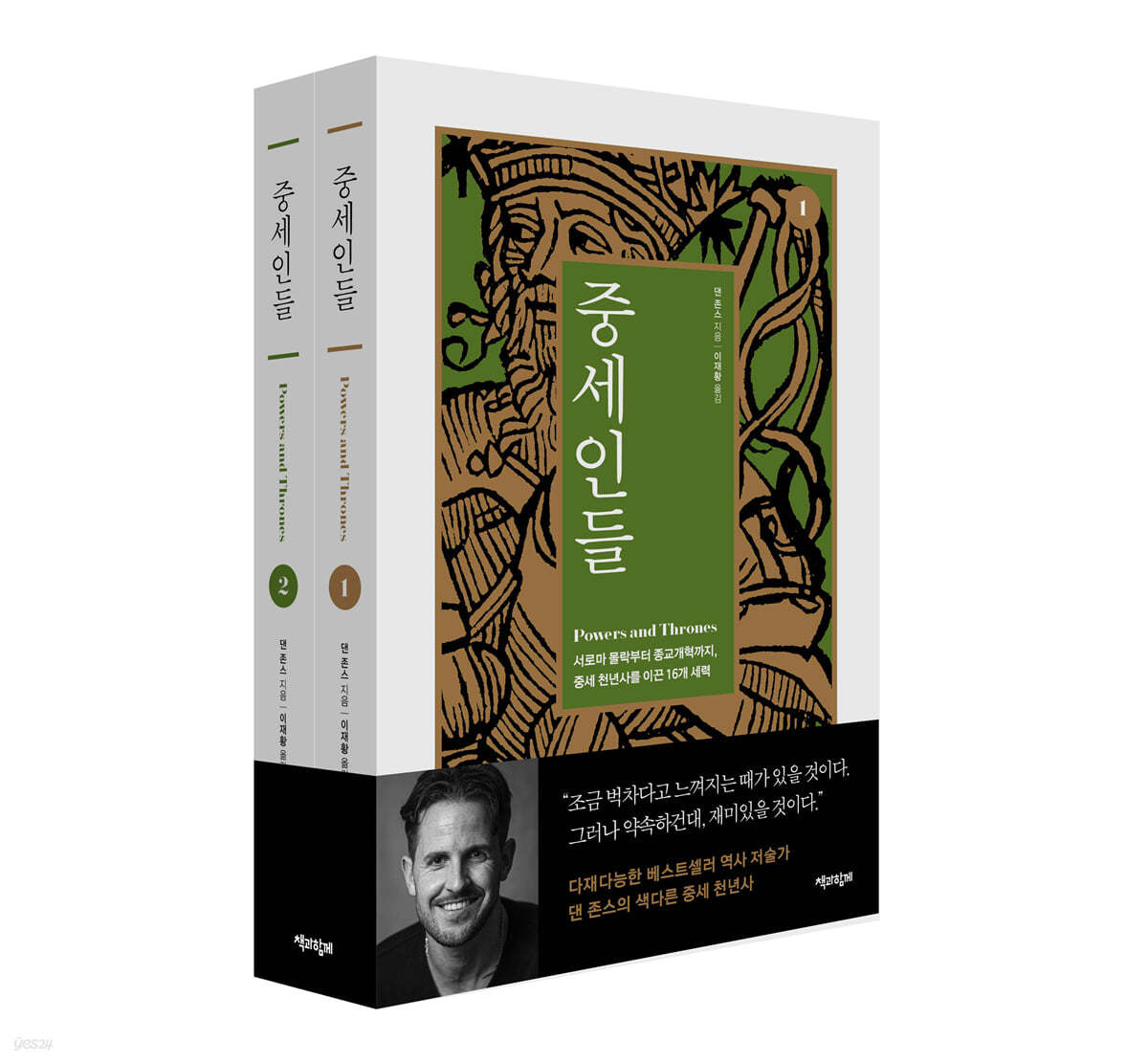
medieval people
 |
Description
Book Introduction
Who were the people who moved the Western Middle Ages?
A unique medieval millennium from versatile bestselling historical author Dan Jones.
For a long time, the Western Middle Ages were considered a period awkwardly sandwiched between antiquity and modernity, a "dark age" dominated by barbarism.
However, as the movement to find the true face of the Middle Ages has become active in recent times, prejudice is largely disappearing.
Now it is time to fully enjoy medieval history.
Dan Jones, who has studied medieval history for many years and published numerous books, vividly unfolds over a thousand years of history, following the activities and rise and fall of various forces that symbolize the Middle Ages, including the Romans, Franks, Arabians, and Mongols, as well as ascetics, knights, and architects.
Beginning with the Sack of Rome in 410 and ending with the Sack of Rome in 1527, the refreshingly symmetrical plot and compelling storytelling of a bestselling author are truly compelling.
On top of that, key themes such as the fall of Rome, the migration of barbarians, the rise of the Islamic empire, the Mongol superpower, the spread of plagues that killed millions, and the Reformation are interwoven in a concise style, completing the grand puzzle of medieval history.
Furthermore, it offers brilliant insights by discovering connections between the Middle Ages and the present day, including climate change, mass migration, pandemics, and technological change.
A unique medieval millennium from versatile bestselling historical author Dan Jones.
For a long time, the Western Middle Ages were considered a period awkwardly sandwiched between antiquity and modernity, a "dark age" dominated by barbarism.
However, as the movement to find the true face of the Middle Ages has become active in recent times, prejudice is largely disappearing.
Now it is time to fully enjoy medieval history.
Dan Jones, who has studied medieval history for many years and published numerous books, vividly unfolds over a thousand years of history, following the activities and rise and fall of various forces that symbolize the Middle Ages, including the Romans, Franks, Arabians, and Mongols, as well as ascetics, knights, and architects.
Beginning with the Sack of Rome in 410 and ending with the Sack of Rome in 1527, the refreshingly symmetrical plot and compelling storytelling of a bestselling author are truly compelling.
On top of that, key themes such as the fall of Rome, the migration of barbarians, the rise of the Islamic empire, the Mongol superpower, the spread of plagues that killed millions, and the Reformation are interwoven in a concise style, completing the grand puzzle of medieval history.
Furthermore, it offers brilliant insights by discovering connections between the Middle Ages and the present day, including climate change, mass migration, pandemics, and technological change.
- You can preview some of the book's contents.
Preview
index
preface
Part 1: The Empire | c. 410 to c. 750
Chapter 1 The Romans
Climate and Conquest | "They Create a Wasteland and Call It Peace" | Citizens and Strangers | Souls for Sale | Romanization | From Polytheism to Monotheism | Legacy
Chapter 2: The Strangers
"The Most Fearsome Warriors" | Early Victory | The Return of the Storm | The Rise of the Tyrant | From Attila to Odoacer | The End
Chapter 3: The Eastern Romans
Justinian and Theodora | The Code and Heresy | Riots and Reform | Defeat of the Vandals | 'The Teaching of God' | Everything Collapses | After Justinian
Chapter 4: The Arabians
The Birth of Faith | The 'Rightly Guided' Khalifa | Fitnah | The Umayyad Dynasty | The Rise of the Black Flag
Part II: Dominion | c. 750 to c. 1215
Chapter 5 The Franks
The Merovingian and Carolingian Dynasties | The 'Father of Europe' | From King to Emperor | The Division of the Empire | The Coming of the Norse | From Norse to Norman
Chapter 6: The Practitioners
From the Desert to the Mountaintop | The Road to Apotheosis | The Road to Heaven | Compostela and Cluny III | The New Puritanism
Chapter 7: The Knights
The Spear and the Stirrup | 'El Cid' | Roland and Arthur | Stranger than Fiction | The Legacy of the Knight
Chapter 8 The Crusaders
Urban II | First Crusade | Kingdom of Heaven | Second Coming | 'Abomination' | Enemies Within | Crusades Everywhere
Part 3: Resurrection | c. 1215 to c. 1347
Chapter 9 The Mongols
Genghis Khan | The March of the Khans | Among the 'Tatars' | The Division of the Empire | The End of the Khans
Chapter 10: Merchants
Depression and Boom | The Rise of the Republic | White Gold | Money and Power | Dick Whittington
Chapter 11 Scholars
The Word of God | Translation and the Renaissance | The Rise of the University | The Medieval "Awakening"
Chapter 12: The Builders
The Conquest of Wales | The Fortresses of Europe | Between Heaven and Earth | Lincoln Cathedral | From Spire to Dome
Part IV: The Revolution | c. 1348 to c. 1527
Chapter 13: The Survivors
Ice and Germs | After the Flood | 'Worms in the Soil' | Bloody Summer | "Get Out, Traitors! Get Out!"
Chapter 14: The Renewers
The First Humanist | The Good, the Bad, and the Loveable | 'All-Purpose Genius' | The Golden Age
Chapter 15: The Navigators
Adult, Norse, Navigator | Christopher Columbo | To India and Beyond | The Completion of the Week
Chapter 16: Protestants
The Indulgence Scandal | The Ninety-Five Theses | The Verdict of the Kings | 'A Band of Thieves' | The Sack of Rome
Translator's Note
main
References
Source of the illustration
Search
Part 1: The Empire | c. 410 to c. 750
Chapter 1 The Romans
Climate and Conquest | "They Create a Wasteland and Call It Peace" | Citizens and Strangers | Souls for Sale | Romanization | From Polytheism to Monotheism | Legacy
Chapter 2: The Strangers
"The Most Fearsome Warriors" | Early Victory | The Return of the Storm | The Rise of the Tyrant | From Attila to Odoacer | The End
Chapter 3: The Eastern Romans
Justinian and Theodora | The Code and Heresy | Riots and Reform | Defeat of the Vandals | 'The Teaching of God' | Everything Collapses | After Justinian
Chapter 4: The Arabians
The Birth of Faith | The 'Rightly Guided' Khalifa | Fitnah | The Umayyad Dynasty | The Rise of the Black Flag
Part II: Dominion | c. 750 to c. 1215
Chapter 5 The Franks
The Merovingian and Carolingian Dynasties | The 'Father of Europe' | From King to Emperor | The Division of the Empire | The Coming of the Norse | From Norse to Norman
Chapter 6: The Practitioners
From the Desert to the Mountaintop | The Road to Apotheosis | The Road to Heaven | Compostela and Cluny III | The New Puritanism
Chapter 7: The Knights
The Spear and the Stirrup | 'El Cid' | Roland and Arthur | Stranger than Fiction | The Legacy of the Knight
Chapter 8 The Crusaders
Urban II | First Crusade | Kingdom of Heaven | Second Coming | 'Abomination' | Enemies Within | Crusades Everywhere
Part 3: Resurrection | c. 1215 to c. 1347
Chapter 9 The Mongols
Genghis Khan | The March of the Khans | Among the 'Tatars' | The Division of the Empire | The End of the Khans
Chapter 10: Merchants
Depression and Boom | The Rise of the Republic | White Gold | Money and Power | Dick Whittington
Chapter 11 Scholars
The Word of God | Translation and the Renaissance | The Rise of the University | The Medieval "Awakening"
Chapter 12: The Builders
The Conquest of Wales | The Fortresses of Europe | Between Heaven and Earth | Lincoln Cathedral | From Spire to Dome
Part IV: The Revolution | c. 1348 to c. 1527
Chapter 13: The Survivors
Ice and Germs | After the Flood | 'Worms in the Soil' | Bloody Summer | "Get Out, Traitors! Get Out!"
Chapter 14: The Renewers
The First Humanist | The Good, the Bad, and the Loveable | 'All-Purpose Genius' | The Golden Age
Chapter 15: The Navigators
Adult, Norse, Navigator | Christopher Columbo | To India and Beyond | The Completion of the Week
Chapter 16: Protestants
The Indulgence Scandal | The Ninety-Five Theses | The Verdict of the Kings | 'A Band of Thieves' | The Sack of Rome
Translator's Note
main
References
Source of the illustration
Search
Into the book
It will sweep across continents and centuries, sometimes at terrifying speeds.
You will meet countless men and women, from Attila the Hun to Joan of Arc.
And you will be recklessly diving into at least ten fields of history (from war and law to art and literature).
I'm going to ask some big questions too.
What happened in the Middle Ages? Who ruled? What did power look like? What were the major forces that shaped people's lives? And how did the Middle Ages shape (if at all) the world we know today?
--- p.14~15, from the “Preface”
By the end of the 5th century, the Roman Empire in the West ceased to exist.
The 18th-century historian Edward Gibbon wrote:
“It was a revolution that will be remembered forever, and it is still felt by the nations of the earth.” The decline and fall of the Western Roman Empire is a historical phenomenon that historians have dealt with for hundreds of years.
Because the Roman legacy remains in language, landscape, law and culture, even to this day.
And if Rome still has relevance to us in the 21st century, its influence must have been even greater in the Middle Ages.
--- p.26, from “Chapter 1: The Romans”
The hundred years or so after the Huns crossed the Volga in 370 AD were truly strange and turbulent times.
The overwhelming forces of climate change and human migration have turned everything upside down and set it in motion.
It was in addition to the usual, arbitrary, and accidental forces of history: chance, ambition, and individual action.
Life could have been baffling to people at the time, so it is perhaps not surprising that writers of the 4th to 6th centuries resorted to metaphors that later became popular throughout the medieval West.
This is the 'Wheel of Fortune' metaphor.
--- p.111, from “Chapter 2: Strangers”
Although exact figures will never be known, this dreadful disease likely killed millions, perhaps even tens of millions, of people.
…the Justinian Plague did not change the world in and of itself.
But it was an important part of a larger story of change, reform, reorganization, and competition for leadership that took place between the 520s, when the previous chapter of this book ended, and the 620s, when the next chapter begins.
…this period, marked by the first global pandemic and the subsequent global climate shock, shaped the political realities and thought patterns that would shape the Mediterranean world for nearly a millennium.
--- p.116~117, from “Chapter 3: Eastern Romans”
One of the most important and enduring facts of the Middle Ages was that the Islamic world in the East and the Christian world in the West became increasingly ignorant and hostile to one another.
This kind of appearance would not apply to the period we are dealing with now.
The Umayyad dynasty invested in and was directly involved not only in West Asia but also in the affairs of the Western Mediterranean.
This so-called civilizational bifurcation is a favorite refrain among the far right and various extremists around the world today.
It arose at least in part from events that date back to the 8th century.
--- p.214, from “Chapter 4: The Arabs”
To accomplish this remarkable feat of storing and organizing the medieval 'big data', the scribes of Aachen developed a new typeface known as 'Carolingian Minuscule'.
The typeface is very legible, well-spaced, and unusually liberal in its use of capitals and punctuation for the time, and was designed with the intention of producing a manuscript that could be read by any typeface anywhere in the vast Carolingian realm.
Just as today, certain fonts and coding languages are designed to be readable across all mainstream computers and smartphones.
--- p.243, from “Chapter 5: The Franks”
Cluny had been armed with a rare degree of 'soft' power that transcended political boundaries for generations.
And Cluny's organization ushered in a more general monastic explosion, recharging and reforming the cultural life of Christendom, transforming not only religious ritual but also education, architecture, art, and music.
A classic example of all this is Cluny itself.
--- p.278~279, from “Chapter 6 Practitioners”
In 792-793, Charlemagne made a law requiring all cavalry to carry spears capable of stabbing rather than throwing javelins at the enemy.
This proved so effective that spear-wielding cavalry became an increasingly important part of Western medieval armies over the next two centuries.
The Latin word for such a person was m?les, and in Old German it was kneht.
In the 11th century, the word entered Old English as cnihtas, from which the English word knight, meaning 'knight', is derived.
--- p.327~328, from “Chapter 7 Knights”
The Crusaders, who had been besieging Jerusalem for about a month, broke through two of the city walls on Friday, July 15th.
They rushed in and slaughtered the city, just as they had done in Antioch a year earlier.
Even Christian historians could not hide their fear.
They depicted scenes that seemed to suggest the end of days.
Governor Addaulah made a deal and fled.
Afterwards, the warrior pilgrims, who had endured much during the four-year expedition, rushed to Jerusalem and committed barbaric plunder and massacre wherever they came across.
Raymond of Aguiler wrote:
“Some pagans were mercifully beheaded.
Some people were shot by arrows or fell from towers.
Another person was tortured for a long time and burned to death in a fierce fire.
Heads, hands, and feet were strewn in heaps across houses and streets.
“Very truly men and knights were running about over the corpses.” … Unexpectedly, Urban II’s reckless plan to attack the Eastern Roman Empire and Jerusalem was successful.
The 'Franks' advanced into the East.
They stayed there for nearly 200 years.
--- p.389~390, from “Chapter 8: The Crusaders”
In less than 200 years, the Mongols had run rampant across the eastern steppes, dominated the entire Eurasian world, then ruptured from within, briefly reunited, and then disintegrated again.
Their story is truly bizarre, and perhaps one of the most brutal in all of the Middle Ages.
The Mongol method of conquest, pioneered and perfected by Genghis Khan and skillfully emulated by Temür, foreshadowed the tyranny of terror of the 20th century.
Millions of civilians were senselessly murdered to serve the personal ambitions of authoritarian rulers and their unrealistic goal of spreading their ideology worldwide.
Along with their egregious bloodshed and brutality, which cannot be simply dismissed by historical antinomianism, the Mongols also profoundly changed the face of the world.
Both good and bad.
…their reorganization of Central Asia, Persia, and Kyiursia was as ruthless as any imperialist expansion of the 19th century.
But like the colonial scramble of the 19th century, the Mongols' brutal rise on the world map nonetheless opened up global trade and information networks, which ushered in a new era in Western history.
--- p.479~481, from “Chapter 9: The Mongols”
The problem of moving money was one of the top priorities for medieval financiers.
Through the invention of a cashless account transfer system based on the so-called 'bill of exchange'.
To use a crude metaphor, it was like a medieval traveler's check, promising the bearer a certain amount of money at a destination far from the place of issue, and sometimes in a different currency.
The Knights Templar pioneered its use in the 12th and 13th centuries.
It was a document that allowed pilgrims heading to the East to borrow money from the Knights Templar's facilities in the Holy Land, using their property and assets in their homeland as collateral.
Italian bankers used this extensively.
There was ample reason.
This kind of financial instrument is trivial to us today.
But in the Middle Ages this was truly revolutionary.
Not only was it a safe way to transfer credit over long distances, it also protected against stamp and password fraud.
--- p.508, from “Chapter 10 Merchants”
Within the traditional centers of study (monasteries and cathedral schools), the 12th century saw an explosive increase in the number of books produced.
Many of these were meticulously worked-out Latin editions of ancient texts.
These included the Christian Bible, the works of the Church Fathers, the liturgical books used in the Church, and the works of early medieval geniuses Boethius, Isidore of Seville, and the Venerable Bede.
But alongside these now appeared the works of Aristotle, Euclid, Galen, and Proclus.
The works of Roman poets like Virgil, Ovid, Lucan, and Terence, and orators like Cicero, Cato, and Seneca, of course, did not need translation.
However, interest in them was revived, and their works were transcribed and studied by medieval grammarians.
These grammarians analyzed classical Latin and created specialized linguistic handbooks based on their findings.
--- p.555, from “Chapter 11 Scholars”
The 13th and 14th centuries were the golden age of monumental architecture in the West.
During this time, some of the most iconic buildings in world history were erected.
These were designed by civil and military architects and built by stonemasons who explored new ways to overcome gravity and raise spires and towers high into the sky.
They tell a story of wealth, power, piety, and sovereignty all intertwined.
Many of the castles, Gothic cathedrals and pleasure quarters built during this period still remain and serve as popular tourist attractions.
The silhouette has become virtually synonymous with the Middle Ages.
No study of medieval power would be complete without mention of this glorious stone age.
--- p.581, from “Chapter 12: The Builders”
The Black Death was by no means a one-time event.
Even from a simple mechanics perspective, the same is true.
It was a long and drawn-out pandemic that killed nearly half the population of Europe and claimed similar victims elsewhere, casting a shadow over the public imagination for decades.
And it brought about rapid changes in the West's population, political and social structures, attitudes and ideas.
Although this epidemic was in some sense a temporary and rare disaster, like a "black swan," it exposed the weaknesses and vulnerabilities of 14th-century Western society and directly or indirectly stimulated the survivors to seek changes in the world in which they (by some miracle) clung.
The Black Death was not limited to the harvester's sickle.
It was also a new broom.
It swept away the 14th century.
And after it's been swept away, it can't be the same as before.
--- p.634, from “Chapter 13: Survivors”
Tercharima, which is inextricably linked to Dante and best suited to Italians, is a structure in which rhymes alternate with each other.
The pattern continues as 'ABA, BCB, CDC, DED…', usually leading to a rhyming final couplet.
Dante is the first major poet known to have worked on tercharima, which enjoyed great popularity throughout the Middle Ages and beyond.
Although not entirely suitable for English (which has fewer rhyming words than Italian), this form was used by Geoffrey Chaucer, the Tudor poets Thomas Wyatt and John Milton, and many 19th-century Romantic writers such as George Byron, Percy Shelley, and Alfred Tennyson.
There's a strong argument to be made that it has influenced some of the more articulate rappers of the 20th and 21st centuries, like the Notorious B.I.G., Jay-Z, Lauryn Hill, Eminem, MF Doom, Kendrick Lamar, and others.
However, I have yet to find an example of a rapper using strict tercharama throughout the entire song.
--- p.665, from “Chapter 14: Renewers”
Columbus was given specific orders not to treat the natives cruelly, but he did not listen.
He demanded gold as tribute from them, kidnapped them and enslaved them, and built fortresses on their land.
At one point, in a letter to the 'Catholic Princes', he advised that the best strategy for achieving economic success in the new lands was to enslave the local population en masse and force them to convert to Christianity.
Ferdinand and Isabella were not very enthusiastic about such harsh tactics.
But in the end it didn't matter.
Colombo's brutal cynicism has grounded the harsh realities of almost every colonial undertaking in history.
Cruelty and inhumanity were the handmaids of imperialist expansion.
There was no reason why 'New World' should be different.
--- p.737, from “Chapter 15: The Navigators”
The printing press played a central role in the Reformation.
This was a revolution that tore apart the Roman Church in the 16th century.
First, printers like Gutenberg provided the tools that plunged the papacy into a crisis of ethics and systematic corruption.
And the printing press enabled dissent against the established order to spread across Europe at breakneck speed.
As a result, medieval Europe was plunged into religious and political turmoil as a new movement (Protestantism) took hold within just a few decades, posing the first serious challenge to the Catholic faith in a thousand years.
Describing the Reformation is the last thing we must do before we conclude our story of the Middle Ages.
The journey begins in the Mainz workshop of the struggling goldsmith Johannes Gutenberg, continues in the streets outside the Vatican, and leads to the Second Sack of Rome, which ushered in a new era.
You will meet countless men and women, from Attila the Hun to Joan of Arc.
And you will be recklessly diving into at least ten fields of history (from war and law to art and literature).
I'm going to ask some big questions too.
What happened in the Middle Ages? Who ruled? What did power look like? What were the major forces that shaped people's lives? And how did the Middle Ages shape (if at all) the world we know today?
--- p.14~15, from the “Preface”
By the end of the 5th century, the Roman Empire in the West ceased to exist.
The 18th-century historian Edward Gibbon wrote:
“It was a revolution that will be remembered forever, and it is still felt by the nations of the earth.” The decline and fall of the Western Roman Empire is a historical phenomenon that historians have dealt with for hundreds of years.
Because the Roman legacy remains in language, landscape, law and culture, even to this day.
And if Rome still has relevance to us in the 21st century, its influence must have been even greater in the Middle Ages.
--- p.26, from “Chapter 1: The Romans”
The hundred years or so after the Huns crossed the Volga in 370 AD were truly strange and turbulent times.
The overwhelming forces of climate change and human migration have turned everything upside down and set it in motion.
It was in addition to the usual, arbitrary, and accidental forces of history: chance, ambition, and individual action.
Life could have been baffling to people at the time, so it is perhaps not surprising that writers of the 4th to 6th centuries resorted to metaphors that later became popular throughout the medieval West.
This is the 'Wheel of Fortune' metaphor.
--- p.111, from “Chapter 2: Strangers”
Although exact figures will never be known, this dreadful disease likely killed millions, perhaps even tens of millions, of people.
…the Justinian Plague did not change the world in and of itself.
But it was an important part of a larger story of change, reform, reorganization, and competition for leadership that took place between the 520s, when the previous chapter of this book ended, and the 620s, when the next chapter begins.
…this period, marked by the first global pandemic and the subsequent global climate shock, shaped the political realities and thought patterns that would shape the Mediterranean world for nearly a millennium.
--- p.116~117, from “Chapter 3: Eastern Romans”
One of the most important and enduring facts of the Middle Ages was that the Islamic world in the East and the Christian world in the West became increasingly ignorant and hostile to one another.
This kind of appearance would not apply to the period we are dealing with now.
The Umayyad dynasty invested in and was directly involved not only in West Asia but also in the affairs of the Western Mediterranean.
This so-called civilizational bifurcation is a favorite refrain among the far right and various extremists around the world today.
It arose at least in part from events that date back to the 8th century.
--- p.214, from “Chapter 4: The Arabs”
To accomplish this remarkable feat of storing and organizing the medieval 'big data', the scribes of Aachen developed a new typeface known as 'Carolingian Minuscule'.
The typeface is very legible, well-spaced, and unusually liberal in its use of capitals and punctuation for the time, and was designed with the intention of producing a manuscript that could be read by any typeface anywhere in the vast Carolingian realm.
Just as today, certain fonts and coding languages are designed to be readable across all mainstream computers and smartphones.
--- p.243, from “Chapter 5: The Franks”
Cluny had been armed with a rare degree of 'soft' power that transcended political boundaries for generations.
And Cluny's organization ushered in a more general monastic explosion, recharging and reforming the cultural life of Christendom, transforming not only religious ritual but also education, architecture, art, and music.
A classic example of all this is Cluny itself.
--- p.278~279, from “Chapter 6 Practitioners”
In 792-793, Charlemagne made a law requiring all cavalry to carry spears capable of stabbing rather than throwing javelins at the enemy.
This proved so effective that spear-wielding cavalry became an increasingly important part of Western medieval armies over the next two centuries.
The Latin word for such a person was m?les, and in Old German it was kneht.
In the 11th century, the word entered Old English as cnihtas, from which the English word knight, meaning 'knight', is derived.
--- p.327~328, from “Chapter 7 Knights”
The Crusaders, who had been besieging Jerusalem for about a month, broke through two of the city walls on Friday, July 15th.
They rushed in and slaughtered the city, just as they had done in Antioch a year earlier.
Even Christian historians could not hide their fear.
They depicted scenes that seemed to suggest the end of days.
Governor Addaulah made a deal and fled.
Afterwards, the warrior pilgrims, who had endured much during the four-year expedition, rushed to Jerusalem and committed barbaric plunder and massacre wherever they came across.
Raymond of Aguiler wrote:
“Some pagans were mercifully beheaded.
Some people were shot by arrows or fell from towers.
Another person was tortured for a long time and burned to death in a fierce fire.
Heads, hands, and feet were strewn in heaps across houses and streets.
“Very truly men and knights were running about over the corpses.” … Unexpectedly, Urban II’s reckless plan to attack the Eastern Roman Empire and Jerusalem was successful.
The 'Franks' advanced into the East.
They stayed there for nearly 200 years.
--- p.389~390, from “Chapter 8: The Crusaders”
In less than 200 years, the Mongols had run rampant across the eastern steppes, dominated the entire Eurasian world, then ruptured from within, briefly reunited, and then disintegrated again.
Their story is truly bizarre, and perhaps one of the most brutal in all of the Middle Ages.
The Mongol method of conquest, pioneered and perfected by Genghis Khan and skillfully emulated by Temür, foreshadowed the tyranny of terror of the 20th century.
Millions of civilians were senselessly murdered to serve the personal ambitions of authoritarian rulers and their unrealistic goal of spreading their ideology worldwide.
Along with their egregious bloodshed and brutality, which cannot be simply dismissed by historical antinomianism, the Mongols also profoundly changed the face of the world.
Both good and bad.
…their reorganization of Central Asia, Persia, and Kyiursia was as ruthless as any imperialist expansion of the 19th century.
But like the colonial scramble of the 19th century, the Mongols' brutal rise on the world map nonetheless opened up global trade and information networks, which ushered in a new era in Western history.
--- p.479~481, from “Chapter 9: The Mongols”
The problem of moving money was one of the top priorities for medieval financiers.
Through the invention of a cashless account transfer system based on the so-called 'bill of exchange'.
To use a crude metaphor, it was like a medieval traveler's check, promising the bearer a certain amount of money at a destination far from the place of issue, and sometimes in a different currency.
The Knights Templar pioneered its use in the 12th and 13th centuries.
It was a document that allowed pilgrims heading to the East to borrow money from the Knights Templar's facilities in the Holy Land, using their property and assets in their homeland as collateral.
Italian bankers used this extensively.
There was ample reason.
This kind of financial instrument is trivial to us today.
But in the Middle Ages this was truly revolutionary.
Not only was it a safe way to transfer credit over long distances, it also protected against stamp and password fraud.
--- p.508, from “Chapter 10 Merchants”
Within the traditional centers of study (monasteries and cathedral schools), the 12th century saw an explosive increase in the number of books produced.
Many of these were meticulously worked-out Latin editions of ancient texts.
These included the Christian Bible, the works of the Church Fathers, the liturgical books used in the Church, and the works of early medieval geniuses Boethius, Isidore of Seville, and the Venerable Bede.
But alongside these now appeared the works of Aristotle, Euclid, Galen, and Proclus.
The works of Roman poets like Virgil, Ovid, Lucan, and Terence, and orators like Cicero, Cato, and Seneca, of course, did not need translation.
However, interest in them was revived, and their works were transcribed and studied by medieval grammarians.
These grammarians analyzed classical Latin and created specialized linguistic handbooks based on their findings.
--- p.555, from “Chapter 11 Scholars”
The 13th and 14th centuries were the golden age of monumental architecture in the West.
During this time, some of the most iconic buildings in world history were erected.
These were designed by civil and military architects and built by stonemasons who explored new ways to overcome gravity and raise spires and towers high into the sky.
They tell a story of wealth, power, piety, and sovereignty all intertwined.
Many of the castles, Gothic cathedrals and pleasure quarters built during this period still remain and serve as popular tourist attractions.
The silhouette has become virtually synonymous with the Middle Ages.
No study of medieval power would be complete without mention of this glorious stone age.
--- p.581, from “Chapter 12: The Builders”
The Black Death was by no means a one-time event.
Even from a simple mechanics perspective, the same is true.
It was a long and drawn-out pandemic that killed nearly half the population of Europe and claimed similar victims elsewhere, casting a shadow over the public imagination for decades.
And it brought about rapid changes in the West's population, political and social structures, attitudes and ideas.
Although this epidemic was in some sense a temporary and rare disaster, like a "black swan," it exposed the weaknesses and vulnerabilities of 14th-century Western society and directly or indirectly stimulated the survivors to seek changes in the world in which they (by some miracle) clung.
The Black Death was not limited to the harvester's sickle.
It was also a new broom.
It swept away the 14th century.
And after it's been swept away, it can't be the same as before.
--- p.634, from “Chapter 13: Survivors”
Tercharima, which is inextricably linked to Dante and best suited to Italians, is a structure in which rhymes alternate with each other.
The pattern continues as 'ABA, BCB, CDC, DED…', usually leading to a rhyming final couplet.
Dante is the first major poet known to have worked on tercharima, which enjoyed great popularity throughout the Middle Ages and beyond.
Although not entirely suitable for English (which has fewer rhyming words than Italian), this form was used by Geoffrey Chaucer, the Tudor poets Thomas Wyatt and John Milton, and many 19th-century Romantic writers such as George Byron, Percy Shelley, and Alfred Tennyson.
There's a strong argument to be made that it has influenced some of the more articulate rappers of the 20th and 21st centuries, like the Notorious B.I.G., Jay-Z, Lauryn Hill, Eminem, MF Doom, Kendrick Lamar, and others.
However, I have yet to find an example of a rapper using strict tercharama throughout the entire song.
--- p.665, from “Chapter 14: Renewers”
Columbus was given specific orders not to treat the natives cruelly, but he did not listen.
He demanded gold as tribute from them, kidnapped them and enslaved them, and built fortresses on their land.
At one point, in a letter to the 'Catholic Princes', he advised that the best strategy for achieving economic success in the new lands was to enslave the local population en masse and force them to convert to Christianity.
Ferdinand and Isabella were not very enthusiastic about such harsh tactics.
But in the end it didn't matter.
Colombo's brutal cynicism has grounded the harsh realities of almost every colonial undertaking in history.
Cruelty and inhumanity were the handmaids of imperialist expansion.
There was no reason why 'New World' should be different.
--- p.737, from “Chapter 15: The Navigators”
The printing press played a central role in the Reformation.
This was a revolution that tore apart the Roman Church in the 16th century.
First, printers like Gutenberg provided the tools that plunged the papacy into a crisis of ethics and systematic corruption.
And the printing press enabled dissent against the established order to spread across Europe at breakneck speed.
As a result, medieval Europe was plunged into religious and political turmoil as a new movement (Protestantism) took hold within just a few decades, posing the first serious challenge to the Catholic faith in a thousand years.
Describing the Reformation is the last thing we must do before we conclude our story of the Middle Ages.
The journey begins in the Mainz workshop of the struggling goldsmith Johannes Gutenberg, continues in the streets outside the Vatican, and leads to the Second Sack of Rome, which ushered in a new era.
--- p.754, from “Chapter 16 Protestants”
Publisher's Review
Containing a vast and long history
A Millennial History of the Western Middle Ages as Drawn Through the Flow of Power
Dan Jones, the author of this book, a bestselling British history writer and a multifaceted figure across media, has garnered attention for his keen insight and compelling storytelling, and is considered a pioneer in rekindling interest in medieval history in Britain, having sold over a million copies.
Having focused on the key dynasties and powers that shaped the Middle Ages, he has gone further and compiled their stories into a comprehensive account of Western medieval history, which he has compiled into this book, “Medieval People.”
The history of the Western Middle Ages, previously considered merely a "dark age" or an ambiguous "intermediate period" between ancient and modern times, is transformed into a fascinating story that unfolds over a period of over 1,000 years, spanning a vast space spanning not only Europe but also Asia, Africa, and other continents.
What he focuses on is none other than the flow of power.
It traces, in general chronological order, the forces that led medieval history and the legacy they left us.
If we remember that history is ultimately a series of stories created by humans, this is an excellent narrative method.
Dan Jones vividly unfolds history, moving across more than a dozen fields that make up medieval history, from war and law to art and literature.
Yet, the story is enriched by carefully blending historical anecdotes and the flow of events and characters that define the era.
In particular, it clearly shows the nature of medieval history through a fresh composition that is symmetrical from the beginning to the end, starting with the Sack of Rome in 410, which symbolizes the fall of the Western Roman Empire, and ending with the Sack of Rome in 1527, which symbolizes the decline of papal authority during the Reformation.
For beginners unfamiliar with medieval history, this is an introductory book that provides a glimpse into the major trends of medieval history. For history enthusiasts, this is a profound history book that allows them to rediscover the essence of history through detailed episodes and the author's brilliant insights.
Following the rise and fall of the 16 powers
A composition that allows you to see the millennium of medieval history at a glance
So, what were the core forces that drove the Middle Ages? This book, divided into four parts and 16 chapters, examines a total of 16 forces.
Looking inside, there are six nations or peoples, such as Romans, Franks, Arabians, and Mongols, and the remaining ten are people with certain professions or who are devoted to certain things, such as monks, knights, and scholars.
Just looking at this composition, we can guess the flow of the 1,000 years of the Middle Ages and what types of people led the history of this period.
Part 1 begins with the story of the Romans, who dominated the ancient world, and confirms their legacy.
Around the 5th century, the Western Roman Empire finally collapsed and the Middle Ages began. Let's take a look at the powers that emerged after Rome.
The 'foreigners' who overthrew Rome and laid the foundation for Europe, the 'Eastern Romans' who renovated Eastern Rome, and the 'Arabs' who founded the early Islamic Empire.
The story takes place roughly from the early 5th century to the mid-8th century.
Part 2 begins in the era of the 'Franks'.
They established a Christian empire in the West, but it soon collapsed, and Europe experienced ups and downs as it split into several dynasties.
It examines the rise of the two axes of a new form of cultural 'soft' power that emerged around that time: the 'executors' and the 'knights', and traces the activities of the 'crusaders', born from the fusion of these two types of thinking.
Part 3 begins with the surprising emergence of the Mongols, who established a new superpower around the 12th century.
They briefly ruled over half the world, and millions were sacrificed in the process.
Against the backdrop of this dramatic shift in world geopolitics, we also examine other powers that emerged during this period, also known as the "High Age" of the Middle Ages.
We also meet the 'merchants' who enriched themselves and the world with new financial techniques, the 'scholars' who revived ancient wisdom and founded universities, and the 'builders' who built cities, cathedrals, and castles.
Part 4 begins with the global pandemic that swept through East and West around the 14th century and the chaos experienced by its 'survivors'.
Next, we look at those who rebuilt the world and ushered in a new era.
Meet the 'renovators' of the Renaissance and travel with the great 'voyagers' who set out in search of a new world and finally reached it.
Finally, we examine how 'Protestants' brought about the Reformation through the advancement of communication technology.
How are we connected to the Middle Ages today?
Discovering the essence of history through a keen eye
Dan Jones gives new meaning to the seemingly endless stories of medieval history by discovering fascinating intersections between the present and history.
In particular, it vividly shows how medieval history has influenced our lives today.
Therefore, Rome is not simply an ancient, imposing military power, but the source of Roman law, language, and the Christian faith that would later dominate Europe, and the invasions of the Germanic tribes are depicted not as the acts of barbaric hordes, but as a process by which the political framework of Western Europe was established.
Moreover, the Arab conquests not only hindered the spread of Christianity, but were also the source of the religious divisions that plague East and West to this day, and the rise of the Vikings provided the first link between Europe and North America, and by founding Normandy, they revealed themselves to be a catalyst for future Anglo-French relations.
It's also fun to compare the Middle Ages to the present day through various modern figures and episodes, such as Brexit, Elon Musk's naming, and Kendrick Lamar's music.
In addition, we pay attention not only to historical links but also to variables that change history.
That is, it emphasizes that natural variables such as climate change and epidemics, which still have a tremendous impact on our lives today, and the mass migration and technological changes triggered by these, also played an important role in medieval history.
This allows us to realize that the factors that drive our lives today, surrounded by global warming, the coronavirus pandemic, and refugee issues, are essentially similar to those that drove the lives of medieval people, and provides an opportunity to reflect on the essence of history.
A Millennial History of the Western Middle Ages as Drawn Through the Flow of Power
Dan Jones, the author of this book, a bestselling British history writer and a multifaceted figure across media, has garnered attention for his keen insight and compelling storytelling, and is considered a pioneer in rekindling interest in medieval history in Britain, having sold over a million copies.
Having focused on the key dynasties and powers that shaped the Middle Ages, he has gone further and compiled their stories into a comprehensive account of Western medieval history, which he has compiled into this book, “Medieval People.”
The history of the Western Middle Ages, previously considered merely a "dark age" or an ambiguous "intermediate period" between ancient and modern times, is transformed into a fascinating story that unfolds over a period of over 1,000 years, spanning a vast space spanning not only Europe but also Asia, Africa, and other continents.
What he focuses on is none other than the flow of power.
It traces, in general chronological order, the forces that led medieval history and the legacy they left us.
If we remember that history is ultimately a series of stories created by humans, this is an excellent narrative method.
Dan Jones vividly unfolds history, moving across more than a dozen fields that make up medieval history, from war and law to art and literature.
Yet, the story is enriched by carefully blending historical anecdotes and the flow of events and characters that define the era.
In particular, it clearly shows the nature of medieval history through a fresh composition that is symmetrical from the beginning to the end, starting with the Sack of Rome in 410, which symbolizes the fall of the Western Roman Empire, and ending with the Sack of Rome in 1527, which symbolizes the decline of papal authority during the Reformation.
For beginners unfamiliar with medieval history, this is an introductory book that provides a glimpse into the major trends of medieval history. For history enthusiasts, this is a profound history book that allows them to rediscover the essence of history through detailed episodes and the author's brilliant insights.
Following the rise and fall of the 16 powers
A composition that allows you to see the millennium of medieval history at a glance
So, what were the core forces that drove the Middle Ages? This book, divided into four parts and 16 chapters, examines a total of 16 forces.
Looking inside, there are six nations or peoples, such as Romans, Franks, Arabians, and Mongols, and the remaining ten are people with certain professions or who are devoted to certain things, such as monks, knights, and scholars.
Just looking at this composition, we can guess the flow of the 1,000 years of the Middle Ages and what types of people led the history of this period.
Part 1 begins with the story of the Romans, who dominated the ancient world, and confirms their legacy.
Around the 5th century, the Western Roman Empire finally collapsed and the Middle Ages began. Let's take a look at the powers that emerged after Rome.
The 'foreigners' who overthrew Rome and laid the foundation for Europe, the 'Eastern Romans' who renovated Eastern Rome, and the 'Arabs' who founded the early Islamic Empire.
The story takes place roughly from the early 5th century to the mid-8th century.
Part 2 begins in the era of the 'Franks'.
They established a Christian empire in the West, but it soon collapsed, and Europe experienced ups and downs as it split into several dynasties.
It examines the rise of the two axes of a new form of cultural 'soft' power that emerged around that time: the 'executors' and the 'knights', and traces the activities of the 'crusaders', born from the fusion of these two types of thinking.
Part 3 begins with the surprising emergence of the Mongols, who established a new superpower around the 12th century.
They briefly ruled over half the world, and millions were sacrificed in the process.
Against the backdrop of this dramatic shift in world geopolitics, we also examine other powers that emerged during this period, also known as the "High Age" of the Middle Ages.
We also meet the 'merchants' who enriched themselves and the world with new financial techniques, the 'scholars' who revived ancient wisdom and founded universities, and the 'builders' who built cities, cathedrals, and castles.
Part 4 begins with the global pandemic that swept through East and West around the 14th century and the chaos experienced by its 'survivors'.
Next, we look at those who rebuilt the world and ushered in a new era.
Meet the 'renovators' of the Renaissance and travel with the great 'voyagers' who set out in search of a new world and finally reached it.
Finally, we examine how 'Protestants' brought about the Reformation through the advancement of communication technology.
How are we connected to the Middle Ages today?
Discovering the essence of history through a keen eye
Dan Jones gives new meaning to the seemingly endless stories of medieval history by discovering fascinating intersections between the present and history.
In particular, it vividly shows how medieval history has influenced our lives today.
Therefore, Rome is not simply an ancient, imposing military power, but the source of Roman law, language, and the Christian faith that would later dominate Europe, and the invasions of the Germanic tribes are depicted not as the acts of barbaric hordes, but as a process by which the political framework of Western Europe was established.
Moreover, the Arab conquests not only hindered the spread of Christianity, but were also the source of the religious divisions that plague East and West to this day, and the rise of the Vikings provided the first link between Europe and North America, and by founding Normandy, they revealed themselves to be a catalyst for future Anglo-French relations.
It's also fun to compare the Middle Ages to the present day through various modern figures and episodes, such as Brexit, Elon Musk's naming, and Kendrick Lamar's music.
In addition, we pay attention not only to historical links but also to variables that change history.
That is, it emphasizes that natural variables such as climate change and epidemics, which still have a tremendous impact on our lives today, and the mass migration and technological changes triggered by these, also played an important role in medieval history.
This allows us to realize that the factors that drive our lives today, surrounded by global warming, the coronavirus pandemic, and refugee issues, are essentially similar to those that drove the lives of medieval people, and provides an opportunity to reflect on the essence of history.
GOODS SPECIFICS
- Date of issue: October 30, 2023
- Page count, weight, size: 904 pages | 1,320g | 152*225*44mm
- ISBN13: 9791192913438
- ISBN10: 1192913434
You may also like
카테고리
korean


korean

![GQ KOREA Mark (Monthly): December [2025]](http://librairie.coreenne.fr/cdn/shop/files/8ef265dbbfbf186523ed75ba7319009d.jpg?v=1765340328&width=3840)


