

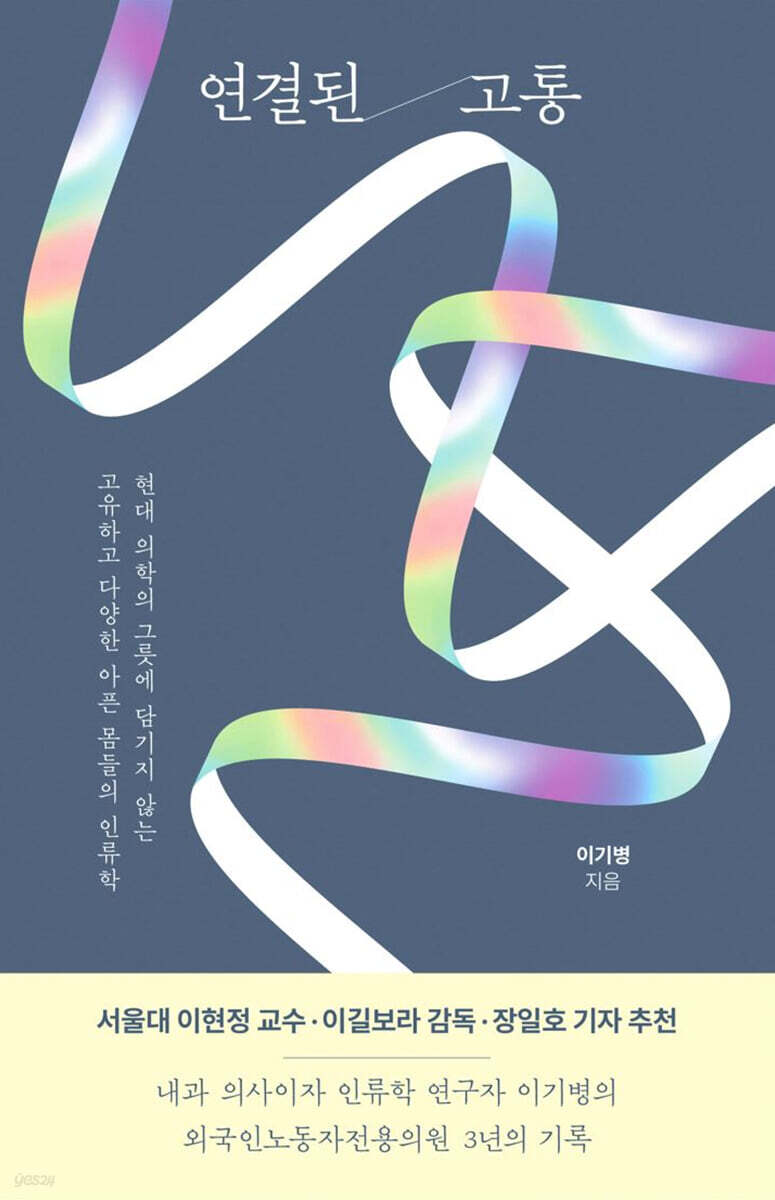
Connected pain
 |
Description
Book Introduction
“Someone has to stand on the edge.”
A three-year record of Lee Ki-byeong, an internist and anthropologist, working at a hospital exclusively for foreign workers. During his time in public health, internist Lee Gi-byeong worked at the Foreign Workers' Hospital (hereafter, Foreign Workers' Hospital) in Garibong-dong, Guro-gu, Seoul for three years. As a doctor who has just completed his specialist training, he encounters diverse and unique afflictions there and experiences the language and cultural barriers. It was frustrating to think of the hardships and ups and downs of that time as simply the result of 'immaturity'. He was worried that he could provide better treatment and care, and finally discovered a new path called anthropology. "Connected Pain" is a book written by Lee Ki-byeong, a practicing internist and medical anthropologist, about the joys and sorrows he experienced while grappling with patients he met at a nursing home. In an age of dichotomies between health and unhealth, body and mind, life and death, and me and you, this book interprets and restores sick bodies that cannot be contained within a single medical category from an anthropological perspective. Considering that the Foreign Workers' Hospital has now closed (2004-2017) and is now only a historical document, this can be said to be the first and only record containing the stories of the Foreign Workers' Hospital and the foreign workers who visited it. |
- You can preview some of the book's contents.
Preview
index
Recommendation
Preface - Records of the World, Big and Small, That Must Not Be Forgotten
1 The Truth About Thyroid Hormones
: The purpose of reproduction is to grasp the essence.
2 Alcohol and Heart Failure
: The river of no return is not crossed in one go.
3 A young man with HIV and his fiancé
: The impact of stigma on treatment
4 Ohm and Heterotopia
: For them, shelter was a place outside the place.
5 Back pain, constipation, and fainting
: What is good medical care?
6 Are illness and death punishments?
: About suffering, the only truth that permeates life and death
7 Dichotomy of Pain
: On the gap and relationship between body and mind
Conclusion - Someone Has to Stand at the Edge
References
Preface - Records of the World, Big and Small, That Must Not Be Forgotten
1 The Truth About Thyroid Hormones
: The purpose of reproduction is to grasp the essence.
2 Alcohol and Heart Failure
: The river of no return is not crossed in one go.
3 A young man with HIV and his fiancé
: The impact of stigma on treatment
4 Ohm and Heterotopia
: For them, shelter was a place outside the place.
5 Back pain, constipation, and fainting
: What is good medical care?
6 Are illness and death punishments?
: About suffering, the only truth that permeates life and death
7 Dichotomy of Pain
: On the gap and relationship between body and mind
Conclusion - Someone Has to Stand at the Edge
References
Detailed image

Into the book
We imagine that pain and suffering are solely personal, but in reality, they are likely to be performed on the layers of the culture, society, and history to which we belong.
--- p.15
This book is a record of the joys and sorrows I experienced while struggling with the patients I met at the Oedo Hospital for three years.
Considering that the Foreign Workers' Hospital has now closed and become history, I feel a tinge of anxiety that the records of the countless foreign workers who visited the small hospital in Garibong-dong, Seoul, and the records of that world, big and small, that must not be forgotten, may end here in this book.
However, I would like to make it clear that the purpose of this article is not to record and close, but to open an entrance so that their stories can be remembered and recalled without being forgotten.
--- pp.16~17
What is most important is that the patient knew the disease better than the doctor.
It was as if the patient's body was 'speaking' more accurately than the diagnostic system of modern medicine.
--- p.49
Living with an illness certainly has its share of suffering.
The family members who watch it from the side also suffer.
The patient loses something he or she used to enjoy without any worries and is left with something he or she never wanted.
But as this relationship of exchange, which is not easily agreed upon, continues, he learns what it is to live with illness and pain.
Perhaps this is the only way to understand and interpret the meaning of the suffering that life gives us, and to overcome it.
--- p.51
He didn't make excuses like, "I drank a little."
However, he said he didn't drink it every day.
And he kept repeating, “I’m sorry.”
I was about to tell you that you did nothing wrong to me, but I stopped myself.
Because it was clear that it would not be comforting.
He was fighting so hard that I felt I had to join in on his struggles somewhere.
--- p.68
The patient, who had been hesitating for a moment, stopped me.
I looked back at him.
His slightly nervous eyes were looking at me.
“There’s one more thing I’d like to check,” he continued slowly.
“Can I get an HIV test today?”
When I heard the word HIV, I flinched, but tried not to show it and asked back.
“So, what you’re saying is, you want to know whether or not you have the HIV virus?”
--- p.90
The profession of medicine has its contradictions.
As the Bible says, "Those who are well have no need of a physician," so the profession of medicine is inevitably sustained by the ill health and suffering of people.
However, the purpose of medicine, which is maintained through suffering, is to eradicate suffering and create a healthy society.
The strange thing is that even ordinary people like me, who burn the fuel of suffering and seek to eradicate it, feel a sense of mission and reward in this contradictory profession (of course, this is not always the case).
--- p.91
In biomedical clinical settings, where time and resources are limited even when only the essentials are addressed, the biosocial perspective is likely to always end up as a redundant discussion.
But in the real world, the way people's problems are solved is always based on social characteristics.
It is medicine that cures the disease, but what is really important is the money needed to purchase the medicine and the person who has to take the medicine.
--- p.122
There are people who refuse to leave the shelter, but there are also people who insist on entering the shelter even after being told that scabies is spreading.
I was wondering.
Is it because I don't really know what scabies mites are?
Or is there some other reason I don't know about?
Is there some kind of secret that the shelter holds?
What kind of place is that?
--- pp.134~135
Since it was a rare day with not many patients, I was able to spend a relatively long time talking to them.
As I later discovered while studying anthropology in graduate school, I was unintentionally conducting a kind of anthropological fieldwork.
As the interview progressed, they began to talk among themselves rather than answer my questions.
It didn't take long for me to realize that I was getting more information from listening to their chatter and conversations than from asking my questions.
--- p.137
There are certainly people like the ones in my story who have had the experience of going from hospital to hospital or department to department due to pain of unknown cause or a physical abnormality that is difficult to describe precisely.
However, no significant results were achieved.
In a clinic where time is always limited, you may have seen the distorted expressions on the faces of medical staff when they inevitably list symptoms that seem completely unrelated to the patient.
--- p.180
It was a Monday.
As work hours were coming to an end and my eyes were starting to get tired from looking at the monitor, a middle-aged man who looked to be in his late 50s entered the examination room.
His speech was clearly that of a Korean of Chinese descent, and his work clothes had some stains here and there, but overall he was neatly dressed.
However, his face was so pale that any doctor could tell at first glance that he was a man.
“I keep coughing for a long time, and sometimes I find blood in my cough.”
His story was concise, but his symptoms were anything but mild.
--- p.190
I was not convinced.
When you work, there are bound to be moments when you feel uneasy, like you've missed something important, and that day was one of them.
The back of my neck felt cold.
After the consultation, I was left alone in the hospital to review the records and circumstances.
Because in these moments, it's helpful to look at the situation from the beginning, without being pressed for time.
When you lose your way, you have to retrace your steps, even if it's just for a moment.
Suddenly, I thought of the patient's cough and opened the X-ray.
After staring at the photo for over five minutes, I finally realized what a mistake I had made.
--- p.196
The only meaningful thing I could do during the short time I spent with him was not to diagnose his illness or pronounce his death, but perhaps to understand his suffering and participate in it.
Maybe that was the essence and the whole thing.
--- p.209
Not a normal, normal patient, but a strange patient.
He's a good patient, and this is where the huge paradox begins.
What do you mean, a normal patient?
Yet the dichotomy is simple.
Because a person holding a hammer only sees nails.
Once I've nailed down that my body is tired and this person is a strange patient, the rest of the information is significantly bleached or erased.
There is less room for inventory.
While the dichotomy surrounding this patient has thankfully ceased to be a delusion due to the self-evident findings of the examination, the effects of these preconceptions may still be ongoing, dividing the familiar from the unfamiliar, the acceptable from the unusual, in our hidden daily lives.
--- p.223
This book is merely a recollection of the small events that took place in a small clinic in Garibong-dong, but didn't they say that when one person comes, a whole world comes?
The foreign workers who visited me are part of our history, having lived in this land and endured pain.
I hope this account will provide some insight into some of the immense suffering that exists in the world we live in, or at least provide some room for interpretation.
So I hope that someone can intervene in that suffering or alleviate it, and that someone else's cultural, psychological, social, and physical suffering can be alleviated, even if only for a moment.
--- p.15
This book is a record of the joys and sorrows I experienced while struggling with the patients I met at the Oedo Hospital for three years.
Considering that the Foreign Workers' Hospital has now closed and become history, I feel a tinge of anxiety that the records of the countless foreign workers who visited the small hospital in Garibong-dong, Seoul, and the records of that world, big and small, that must not be forgotten, may end here in this book.
However, I would like to make it clear that the purpose of this article is not to record and close, but to open an entrance so that their stories can be remembered and recalled without being forgotten.
--- pp.16~17
What is most important is that the patient knew the disease better than the doctor.
It was as if the patient's body was 'speaking' more accurately than the diagnostic system of modern medicine.
--- p.49
Living with an illness certainly has its share of suffering.
The family members who watch it from the side also suffer.
The patient loses something he or she used to enjoy without any worries and is left with something he or she never wanted.
But as this relationship of exchange, which is not easily agreed upon, continues, he learns what it is to live with illness and pain.
Perhaps this is the only way to understand and interpret the meaning of the suffering that life gives us, and to overcome it.
--- p.51
He didn't make excuses like, "I drank a little."
However, he said he didn't drink it every day.
And he kept repeating, “I’m sorry.”
I was about to tell you that you did nothing wrong to me, but I stopped myself.
Because it was clear that it would not be comforting.
He was fighting so hard that I felt I had to join in on his struggles somewhere.
--- p.68
The patient, who had been hesitating for a moment, stopped me.
I looked back at him.
His slightly nervous eyes were looking at me.
“There’s one more thing I’d like to check,” he continued slowly.
“Can I get an HIV test today?”
When I heard the word HIV, I flinched, but tried not to show it and asked back.
“So, what you’re saying is, you want to know whether or not you have the HIV virus?”
--- p.90
The profession of medicine has its contradictions.
As the Bible says, "Those who are well have no need of a physician," so the profession of medicine is inevitably sustained by the ill health and suffering of people.
However, the purpose of medicine, which is maintained through suffering, is to eradicate suffering and create a healthy society.
The strange thing is that even ordinary people like me, who burn the fuel of suffering and seek to eradicate it, feel a sense of mission and reward in this contradictory profession (of course, this is not always the case).
--- p.91
In biomedical clinical settings, where time and resources are limited even when only the essentials are addressed, the biosocial perspective is likely to always end up as a redundant discussion.
But in the real world, the way people's problems are solved is always based on social characteristics.
It is medicine that cures the disease, but what is really important is the money needed to purchase the medicine and the person who has to take the medicine.
--- p.122
There are people who refuse to leave the shelter, but there are also people who insist on entering the shelter even after being told that scabies is spreading.
I was wondering.
Is it because I don't really know what scabies mites are?
Or is there some other reason I don't know about?
Is there some kind of secret that the shelter holds?
What kind of place is that?
--- pp.134~135
Since it was a rare day with not many patients, I was able to spend a relatively long time talking to them.
As I later discovered while studying anthropology in graduate school, I was unintentionally conducting a kind of anthropological fieldwork.
As the interview progressed, they began to talk among themselves rather than answer my questions.
It didn't take long for me to realize that I was getting more information from listening to their chatter and conversations than from asking my questions.
--- p.137
There are certainly people like the ones in my story who have had the experience of going from hospital to hospital or department to department due to pain of unknown cause or a physical abnormality that is difficult to describe precisely.
However, no significant results were achieved.
In a clinic where time is always limited, you may have seen the distorted expressions on the faces of medical staff when they inevitably list symptoms that seem completely unrelated to the patient.
--- p.180
It was a Monday.
As work hours were coming to an end and my eyes were starting to get tired from looking at the monitor, a middle-aged man who looked to be in his late 50s entered the examination room.
His speech was clearly that of a Korean of Chinese descent, and his work clothes had some stains here and there, but overall he was neatly dressed.
However, his face was so pale that any doctor could tell at first glance that he was a man.
“I keep coughing for a long time, and sometimes I find blood in my cough.”
His story was concise, but his symptoms were anything but mild.
--- p.190
I was not convinced.
When you work, there are bound to be moments when you feel uneasy, like you've missed something important, and that day was one of them.
The back of my neck felt cold.
After the consultation, I was left alone in the hospital to review the records and circumstances.
Because in these moments, it's helpful to look at the situation from the beginning, without being pressed for time.
When you lose your way, you have to retrace your steps, even if it's just for a moment.
Suddenly, I thought of the patient's cough and opened the X-ray.
After staring at the photo for over five minutes, I finally realized what a mistake I had made.
--- p.196
The only meaningful thing I could do during the short time I spent with him was not to diagnose his illness or pronounce his death, but perhaps to understand his suffering and participate in it.
Maybe that was the essence and the whole thing.
--- p.209
Not a normal, normal patient, but a strange patient.
He's a good patient, and this is where the huge paradox begins.
What do you mean, a normal patient?
Yet the dichotomy is simple.
Because a person holding a hammer only sees nails.
Once I've nailed down that my body is tired and this person is a strange patient, the rest of the information is significantly bleached or erased.
There is less room for inventory.
While the dichotomy surrounding this patient has thankfully ceased to be a delusion due to the self-evident findings of the examination, the effects of these preconceptions may still be ongoing, dividing the familiar from the unfamiliar, the acceptable from the unusual, in our hidden daily lives.
--- p.223
This book is merely a recollection of the small events that took place in a small clinic in Garibong-dong, but didn't they say that when one person comes, a whole world comes?
The foreign workers who visited me are part of our history, having lived in this land and endured pain.
I hope this account will provide some insight into some of the immense suffering that exists in the world we live in, or at least provide some room for interpretation.
So I hope that someone can intervene in that suffering or alleviate it, and that someone else's cultural, psychological, social, and physical suffering can be alleviated, even if only for a moment.
--- p.259
Publisher's Review
“He is excellent both as a doctor and as an anthropologist,
“His most brilliant work comes from the borderline between physician and anthropologist.”
- Lee Hyeon-jeong, Professor of Anthropology, Seoul National University
“It carefully uncovers the need and utility of care that modern medicine has overlooked.”
- Jang Il-ho, reporter and author of "A Visit from Sadness"
“Someone has to stand on the edge.”
A three-year record of Lee Ki-byeong, an internist and anthropologist, working at a hospital exclusively for foreign workers.
During his time in public health, internist Lee Gi-byeong worked at the Foreign Workers' Hospital (hereafter, Foreign Workers' Hospital) in Garibong-dong, Guro-gu, Seoul for three years.
As a doctor who has just completed his specialist training, he encounters diverse and unique afflictions there and experiences the language and cultural barriers.
It was frustrating to think of the hardships and ups and downs of that time as simply the result of 'immaturity'.
He was worried that he could provide better treatment and care, and finally discovered a new path called anthropology.
The diagnostic and treatment system in medicine operates according to established protocols based on the etiology that leads to a specific disease when specific symptoms appear.
Medicine has advanced toward maximizing rationality and efficiency, leading to a healthy life for all of humanity, but at the same time, it has become increasingly distant from the individual patient's disease narrative.
Science was more important than stories, and visible, hard evidence was more important than hidden context.
"Connected Pain" is a book written by Lee Ki-byeong, a practicing internist and medical anthropologist, about the joys and sorrows he experienced while grappling with patients he met at a nursing home.
In an age of dichotomies between health and unhealth, body and mind, life and death, and me and you, this book interprets and restores sick bodies that cannot be contained within a single medical category from an anthropological perspective.
Working as an infectious disease doctor in the COVID-19 era, restoring old records in my spare time was a tedious and lonely task, but after revising and polishing it several times, I finally published the book after four years of writing.
Considering that the Foreign Workers' Hospital has now closed (2004-2017) and is now only a historical document, this book can be said to be the first and only record containing the stories of the Foreign Workers' Hospital and the foreign workers who visited it.
“On top of the medical territory in my head, where research and treatment were arduous, a new anthropological worldview took up residence and competed with it. Only then, empowered by that growing pain, was I able to reinterpret and recreate the three years I spent as a foreign doctor, a time that had seemed inaccessible.
“Now that I look back, I confess that those three years were painful memories of reflection, hesitation, and frustration, but also, as life sometimes shows, there were also days of joy and gratitude.” - From the preface
Pain and suffering are not personal;
It is performed on the levels of history, culture, and society.
From 2011, for three years, the author treated patients from diverse cultures across ten countries, from Ethiopia in Africa to Southeast Asia and ethnic Koreans in China, at the Oeno Hospital.
In the process, he encounters a series of difficulties he has never experienced with foreign patients.
The first was a problem of communication.
Imagine yourself sitting as a patient in a doctor's office in a foreign country.
Even if you know the language there, you can't help but sweat.
If you are not fluent in the language, it will be even more difficult and embarrassing.
The book features the case of a young man from Côte d'Ivoire who was practically completely incommunicado (Chapter 7: The Dichotomy of Pain). He came to the clinic unable to speak Korean, English, or French (Côte d'Ivoire was then a French colony).
As a result, the various 'misunderstandings' that arose during the process of treating him, who was thought to only speak the local language of the region where he lived, felt somehow familiar.
Although it is an extreme case, it clearly shows how difficult it is to fully convey my story in the clinic.
Even if we speak the same language, communication is not enough.
This is especially true in relationships such as 'doctor and patient' where background knowledge is not equal.
Second, there was the difficulty of having to differentiate between various diseases that originated in environments different from those in Korea.
The author felt bewildered by the (uniform) cases of ethnic Koreans in China who, when asked “What hurts you?”, reported not one or two major symptoms, but eight or nine different ones.
Because I had only received training in 'biomedical science', which narrows down specific symptoms to the organs and diseases that are the cause of the symptoms and ultimately leads to a diagnosis, I was unable to easily adapt to this situation.
However, the author, who confirmed through anthropological literature that the causes of their suffering may be largely historical, cultural, and social, begins to feel a sense of liberation as well as a heavy sense of 'meaning'.
This is because I realized that patients' illnesses have a 'narrative' that cannot be compressed into a single diagnosis, and that understanding the 'historical, social, and cultural' background is necessary to understand what narratives are necessary for better diagnosis and treatment.
The author finally realizes that “we imagine that pain and suffering are solely personal, but in reality, they are likely to be performed on the levels of the culture, society, and history to which we belong.”
“The illness narrative is like a ‘representation’ that returns to the patient the voice of the body that is trapped in the grand paradigm and coded categories of modern medicine.
At the same time, it is the oldest rhetoric of our body, helping us to approach the essence anew by communicating and interpreting the meaning of that pain to those around us and to our therapists and doctors.” - p. 52
Faces of Pain Seen from the Borders of Medicine and Anthropology
Records of the world, big and small, that have lost their voices and must not be forgotten.
After working as a doctor and later as a foreign medical doctor, the author became skeptical of the limitations of 'medical care in the clinic' and entered anthropology.
Although he says, “Just because you studied and got a degree doesn’t mean you know medicine (and anthropology),” he doesn’t hesitate to stand on the border between medicine and anthropology.
The stories seen from that border are sometimes touching, sometimes joyful, and sometimes heartbreaking.
Modern medicine has developed a system of universal disease categories and methods for diagnosing and treating them.
As medical diagnostic systems become more sophisticated and treatments become more advanced, human lifespans increase and the scope of suffering decreases.
Effectively and efficiently.
However, the more accuracy, speed, efficiency, and effectiveness are emphasized, the more human life becomes encrypted as a 'disease code,' and the historical, cultural, and social voice that the sick body tried to express through pain or symptoms is censored and cut out, flattened into a mere digital code.
In other words, that voice is the patient's 'narrative'.
The book presents cases where a patient's body "spoke" more accurately than the medical diagnostic system (Chapter 1: The Truth About Thyroid Hormones).
The story of a patient with alcoholic dilated cardiomyopathy, or heart failure caused by alcohol (Chapter 2: Alcohol and Heart Failure), highlights the need to consider something before attributing a situation or outcome to a single person.
In the era of medicalization, where everyday life is reorganized into the medical language of “health” and “unhealth,” disease and metaphor become intertwined.
For example, the diagnosis of 'alcoholism' given to a 'foreign worker' patient conjures up images of a certain sense of caution, threat, lethargic daily life, and potential violence.
This discriminatory gaze and stigma may have served as factors that worsened his illness, thus demonstrating in detail that 'the river of no return is not something you can cross alone.'
My experience of persistently and tenaciously trying to persuade a young man living with HIV to seek treatment (Chapter 3: A Young Man with HIV and His Fiancé) led me to reexamine the impact of stigma on treatment from all angles.
The author reflects on the fact that, as a doctor, he has only viewed patients as 'objects of treatment', and frankly confesses that in the field of treatment, the 'social' perspective is often a redundant discussion.
The part where the story of the spread of the infectious disease 'scabies' in the shelter on the upper floor of the hospital for foreign workers (Chapter 4, Scabies and Heterotopia) connects anthropologist Marc Auger's 'non-place' and Michel Foucault's 'heterotopia' is the most philosophical scene in this book.
The concept that the author puts so much effort into raising in the book is 'dichotomy'.
The author points out that while the 'dichotomy' at the core of modern thought easily divides the world we live in into life and death, body and mind, subject and object, individual and society, actual life is not divided like that, and dichotomous diagrams often cause cognitive dissonance or make problem solving difficult.
The author constantly questions the inevitable dichotomies inherent in medicine.
In medicine, for example, death is considered an enemy to be driven out, or at least delayed, for the sake of life.
However, he points out that life and death are located in a completely continuous time series that cannot be considered separately.
The author tells the story of a patient who seems to be indifferent to death (Chapter 6: Are Illness or Death Punishments) that the only topic that shows that life and death are connected is 'pain.'
Furthermore, through the case of a patient who suffered from both chronic inflammation and depression (Chapter 7 Dichotomy of Pain), we critically reconstruct the time when we were obsessed with the dichotomy that tried to separate physical pain from mental pain.
“We must persistently examine whether the ‘dichotomy’ that has defined our lives and illnesses is reducing suffering or, in fact, intensifying it.
As I have discussed throughout this book, our suffering is interconnected in many layers.
“The suffering of body and mind, life and death, self and others, individual and social are all like this.” - p. 251
Friendly medical knowledge and intense anthropological interpretation
Now, I compare my pain to theirs.
When you encounter the faces in the book, these questions naturally come to mind.
What is the ability to listen to what your body is telling you?
Can body and mind, life and death, be completely separated?
Are illness and death entirely the responsibility of the individual?
What is care, and is good care possible?
Rather than providing clear answers to weighty questions that cannot be addressed lightly, this book encourages readers to imagine and examine new possibilities.
This book bridges the gap between friendly medical knowledge and intense anthropological interpretation, transporting us into a world of new stories previously unavailable.
As I read the book, I felt as if I was quietly sitting in a corner of a narrow clinic in Garibong-dong.
Sometimes, I feel like a doctor, unable to contact the patient, and I feel anxious and worried as I keep calling. Sometimes, I feel like a patient, and I feel sad and upset at the doctor's indifference and inability to listen to me sincerely.
The lives of foreign workers as 'patients' are not much different from ours.
As we read the book, we come to see our own suffering parallel to theirs.
In an era where voices of suffering erupt from home and abroad without a single day of interruption.
This book tells us that the pain of losing one's voice after being arbitrarily judged by someone else may one day be mine.
In that sense, this book, "Connected Pain," is a stepping stone that helps us cross the era of suffering together.
It is a solid stepping stone that teaches us, step by step, the simple fact that small efforts to interpret and alleviate someone's suffering ultimately benefit ourselves.
“I hope this record has provided some insight into the immense suffering that exists in the world we live in, or at least offered some room for interpretation.
So I hope that it will be easy for someone to intervene in that pain or alleviate that pain, and that someone else's cultural, psychological, social, and physical pain can be reduced, even if only for a moment.” - From the closing remarks
“His most brilliant work comes from the borderline between physician and anthropologist.”
- Lee Hyeon-jeong, Professor of Anthropology, Seoul National University
“It carefully uncovers the need and utility of care that modern medicine has overlooked.”
- Jang Il-ho, reporter and author of "A Visit from Sadness"
“Someone has to stand on the edge.”
A three-year record of Lee Ki-byeong, an internist and anthropologist, working at a hospital exclusively for foreign workers.
During his time in public health, internist Lee Gi-byeong worked at the Foreign Workers' Hospital (hereafter, Foreign Workers' Hospital) in Garibong-dong, Guro-gu, Seoul for three years.
As a doctor who has just completed his specialist training, he encounters diverse and unique afflictions there and experiences the language and cultural barriers.
It was frustrating to think of the hardships and ups and downs of that time as simply the result of 'immaturity'.
He was worried that he could provide better treatment and care, and finally discovered a new path called anthropology.
The diagnostic and treatment system in medicine operates according to established protocols based on the etiology that leads to a specific disease when specific symptoms appear.
Medicine has advanced toward maximizing rationality and efficiency, leading to a healthy life for all of humanity, but at the same time, it has become increasingly distant from the individual patient's disease narrative.
Science was more important than stories, and visible, hard evidence was more important than hidden context.
"Connected Pain" is a book written by Lee Ki-byeong, a practicing internist and medical anthropologist, about the joys and sorrows he experienced while grappling with patients he met at a nursing home.
In an age of dichotomies between health and unhealth, body and mind, life and death, and me and you, this book interprets and restores sick bodies that cannot be contained within a single medical category from an anthropological perspective.
Working as an infectious disease doctor in the COVID-19 era, restoring old records in my spare time was a tedious and lonely task, but after revising and polishing it several times, I finally published the book after four years of writing.
Considering that the Foreign Workers' Hospital has now closed (2004-2017) and is now only a historical document, this book can be said to be the first and only record containing the stories of the Foreign Workers' Hospital and the foreign workers who visited it.
“On top of the medical territory in my head, where research and treatment were arduous, a new anthropological worldview took up residence and competed with it. Only then, empowered by that growing pain, was I able to reinterpret and recreate the three years I spent as a foreign doctor, a time that had seemed inaccessible.
“Now that I look back, I confess that those three years were painful memories of reflection, hesitation, and frustration, but also, as life sometimes shows, there were also days of joy and gratitude.” - From the preface
Pain and suffering are not personal;
It is performed on the levels of history, culture, and society.
From 2011, for three years, the author treated patients from diverse cultures across ten countries, from Ethiopia in Africa to Southeast Asia and ethnic Koreans in China, at the Oeno Hospital.
In the process, he encounters a series of difficulties he has never experienced with foreign patients.
The first was a problem of communication.
Imagine yourself sitting as a patient in a doctor's office in a foreign country.
Even if you know the language there, you can't help but sweat.
If you are not fluent in the language, it will be even more difficult and embarrassing.
The book features the case of a young man from Côte d'Ivoire who was practically completely incommunicado (Chapter 7: The Dichotomy of Pain). He came to the clinic unable to speak Korean, English, or French (Côte d'Ivoire was then a French colony).
As a result, the various 'misunderstandings' that arose during the process of treating him, who was thought to only speak the local language of the region where he lived, felt somehow familiar.
Although it is an extreme case, it clearly shows how difficult it is to fully convey my story in the clinic.
Even if we speak the same language, communication is not enough.
This is especially true in relationships such as 'doctor and patient' where background knowledge is not equal.
Second, there was the difficulty of having to differentiate between various diseases that originated in environments different from those in Korea.
The author felt bewildered by the (uniform) cases of ethnic Koreans in China who, when asked “What hurts you?”, reported not one or two major symptoms, but eight or nine different ones.
Because I had only received training in 'biomedical science', which narrows down specific symptoms to the organs and diseases that are the cause of the symptoms and ultimately leads to a diagnosis, I was unable to easily adapt to this situation.
However, the author, who confirmed through anthropological literature that the causes of their suffering may be largely historical, cultural, and social, begins to feel a sense of liberation as well as a heavy sense of 'meaning'.
This is because I realized that patients' illnesses have a 'narrative' that cannot be compressed into a single diagnosis, and that understanding the 'historical, social, and cultural' background is necessary to understand what narratives are necessary for better diagnosis and treatment.
The author finally realizes that “we imagine that pain and suffering are solely personal, but in reality, they are likely to be performed on the levels of the culture, society, and history to which we belong.”
“The illness narrative is like a ‘representation’ that returns to the patient the voice of the body that is trapped in the grand paradigm and coded categories of modern medicine.
At the same time, it is the oldest rhetoric of our body, helping us to approach the essence anew by communicating and interpreting the meaning of that pain to those around us and to our therapists and doctors.” - p. 52
Faces of Pain Seen from the Borders of Medicine and Anthropology
Records of the world, big and small, that have lost their voices and must not be forgotten.
After working as a doctor and later as a foreign medical doctor, the author became skeptical of the limitations of 'medical care in the clinic' and entered anthropology.
Although he says, “Just because you studied and got a degree doesn’t mean you know medicine (and anthropology),” he doesn’t hesitate to stand on the border between medicine and anthropology.
The stories seen from that border are sometimes touching, sometimes joyful, and sometimes heartbreaking.
Modern medicine has developed a system of universal disease categories and methods for diagnosing and treating them.
As medical diagnostic systems become more sophisticated and treatments become more advanced, human lifespans increase and the scope of suffering decreases.
Effectively and efficiently.
However, the more accuracy, speed, efficiency, and effectiveness are emphasized, the more human life becomes encrypted as a 'disease code,' and the historical, cultural, and social voice that the sick body tried to express through pain or symptoms is censored and cut out, flattened into a mere digital code.
In other words, that voice is the patient's 'narrative'.
The book presents cases where a patient's body "spoke" more accurately than the medical diagnostic system (Chapter 1: The Truth About Thyroid Hormones).
The story of a patient with alcoholic dilated cardiomyopathy, or heart failure caused by alcohol (Chapter 2: Alcohol and Heart Failure), highlights the need to consider something before attributing a situation or outcome to a single person.
In the era of medicalization, where everyday life is reorganized into the medical language of “health” and “unhealth,” disease and metaphor become intertwined.
For example, the diagnosis of 'alcoholism' given to a 'foreign worker' patient conjures up images of a certain sense of caution, threat, lethargic daily life, and potential violence.
This discriminatory gaze and stigma may have served as factors that worsened his illness, thus demonstrating in detail that 'the river of no return is not something you can cross alone.'
My experience of persistently and tenaciously trying to persuade a young man living with HIV to seek treatment (Chapter 3: A Young Man with HIV and His Fiancé) led me to reexamine the impact of stigma on treatment from all angles.
The author reflects on the fact that, as a doctor, he has only viewed patients as 'objects of treatment', and frankly confesses that in the field of treatment, the 'social' perspective is often a redundant discussion.
The part where the story of the spread of the infectious disease 'scabies' in the shelter on the upper floor of the hospital for foreign workers (Chapter 4, Scabies and Heterotopia) connects anthropologist Marc Auger's 'non-place' and Michel Foucault's 'heterotopia' is the most philosophical scene in this book.
The concept that the author puts so much effort into raising in the book is 'dichotomy'.
The author points out that while the 'dichotomy' at the core of modern thought easily divides the world we live in into life and death, body and mind, subject and object, individual and society, actual life is not divided like that, and dichotomous diagrams often cause cognitive dissonance or make problem solving difficult.
The author constantly questions the inevitable dichotomies inherent in medicine.
In medicine, for example, death is considered an enemy to be driven out, or at least delayed, for the sake of life.
However, he points out that life and death are located in a completely continuous time series that cannot be considered separately.
The author tells the story of a patient who seems to be indifferent to death (Chapter 6: Are Illness or Death Punishments) that the only topic that shows that life and death are connected is 'pain.'
Furthermore, through the case of a patient who suffered from both chronic inflammation and depression (Chapter 7 Dichotomy of Pain), we critically reconstruct the time when we were obsessed with the dichotomy that tried to separate physical pain from mental pain.
“We must persistently examine whether the ‘dichotomy’ that has defined our lives and illnesses is reducing suffering or, in fact, intensifying it.
As I have discussed throughout this book, our suffering is interconnected in many layers.
“The suffering of body and mind, life and death, self and others, individual and social are all like this.” - p. 251
Friendly medical knowledge and intense anthropological interpretation
Now, I compare my pain to theirs.
When you encounter the faces in the book, these questions naturally come to mind.
What is the ability to listen to what your body is telling you?
Can body and mind, life and death, be completely separated?
Are illness and death entirely the responsibility of the individual?
What is care, and is good care possible?
Rather than providing clear answers to weighty questions that cannot be addressed lightly, this book encourages readers to imagine and examine new possibilities.
This book bridges the gap between friendly medical knowledge and intense anthropological interpretation, transporting us into a world of new stories previously unavailable.
As I read the book, I felt as if I was quietly sitting in a corner of a narrow clinic in Garibong-dong.
Sometimes, I feel like a doctor, unable to contact the patient, and I feel anxious and worried as I keep calling. Sometimes, I feel like a patient, and I feel sad and upset at the doctor's indifference and inability to listen to me sincerely.
The lives of foreign workers as 'patients' are not much different from ours.
As we read the book, we come to see our own suffering parallel to theirs.
In an era where voices of suffering erupt from home and abroad without a single day of interruption.
This book tells us that the pain of losing one's voice after being arbitrarily judged by someone else may one day be mine.
In that sense, this book, "Connected Pain," is a stepping stone that helps us cross the era of suffering together.
It is a solid stepping stone that teaches us, step by step, the simple fact that small efforts to interpret and alleviate someone's suffering ultimately benefit ourselves.
“I hope this record has provided some insight into the immense suffering that exists in the world we live in, or at least offered some room for interpretation.
So I hope that it will be easy for someone to intervene in that pain or alleviate that pain, and that someone else's cultural, psychological, social, and physical pain can be reduced, even if only for a moment.” - From the closing remarks
GOODS SPECIFICS
- Date of issue: February 24, 2023
- Page count, weight, size: 266 pages | 338g | 130*200*17mm
- ISBN13: 9791192465043
- ISBN10: 1192465040
You may also like
카테고리
korean


korean

![GQ KOREA Mark (Monthly): December [2025]](http://librairie.coreenne.fr/cdn/shop/files/8ef265dbbfbf186523ed75ba7319009d.jpg?v=1765340328&width=3840)


