

Korean history of twists and turns
 |
Description
Book Introduction
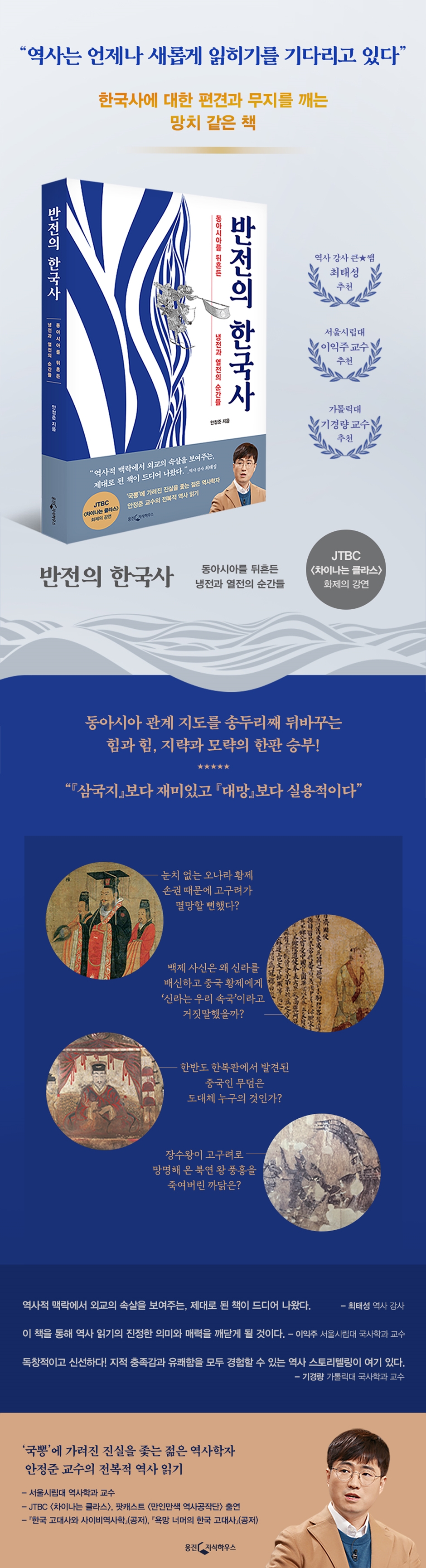
A young historian pursuing the truth hidden behind 'nationalism' Professor Ahn Jung-jun's Subversive Reading of History JTBC's "China Class" Hot Topic Lecture There is no good diplomacy in the world, past or present! The breathtaking diplomatic battle over hegemony on the Korean Peninsula during the Three Kingdoms period Why is it that, compared to the histories of other countries, we find our own history so difficult to grasp? Is it because textbooks, fragmented by era and region for exam purposes, remind us of those? Or is it because we're tired of knowledge and information being uniformly interpreted and distorted within the dichotomous framework of good and evil, winners and losers, patriotism and treason? "Korean History of Reversal" depicts the different faces of our history, placed at the center of the East Asian international stage, beyond the fragmented knowledge and crude causal relationships centered on national history. There are no friendly three kingdoms, no honest and equal diplomacy, no descendants of the great Korean people. In a world of constantly shifting power dynamics, the story is filled with bloody battles, intrigues, and schemes for survival and profit, with unexpected twists and shocking endings that will keep you on the edge of your seat. By breaking away from the chronological order of major events or the forced logic full of "nationalism," and following the intricately intertwined choices and coincidences of various characters, you can escape the trap of anti-intellectualism and gain a keen insight into human affairs and the world. |
- You can preview some of the book's contents.
Preview
index
Part 1: The Tragic Romance Between Sun Quan of Wu and Goguryeo
Chapter 1: Why Did Sun Quan Reach Out to Liaodong? (15)
Chapter 2: The Fateful Encounter between Goguryeo and Wu (25)
Chapter 3: Sun Quan's Shattered Dream 32
Part 2: The Baekje Envoy's Shameless Lie
Chapter 1: The Golden Age of International Fraud 43
Chapter 2: Why Did the Baekje Envoy Lie? (53)
Epilogue: How Do Sources Lie? 66
Part 3: The Secret of the Chinese Tombs on the Korean Peninsula
Chapter 1: People Who Flee to Goguryeo 75
Chapter 2: Goguryeo's Immigrant Attraction Operations 90
Part 4: King Jangsu of Goguryeo assassinates King Punghong of Northern Yan
Chapter 1: The Rise of the Ambitious Feng Hong 101
Chapter 2: Goguryeo Captures the King of Northern Yan (110)
Chapter 3: King Jangsu's Determination Prevents Catastrophe (124)
Epilogue: The "Ghost" of Fenghong, the Destroyer of Baekje in Hanseong 135
Part 5: The Eternal Stranger, the Two Faces of the Prophet
Chapter 1: The Eternal Shackles of a Foreigner 145
Chapter 2: The Rise and Fall of a Superstar 157
Chapter 3: The Decline and Fate of the Empire 174
Epilogue: The Attempted Poisoning of a Goguryeo Slave That Shocked the Tang Dynasty 186
Part 6: The Balhae Royal Family's Sibling Conflict Spreads into a Great War in East Asia
Chapter 1: The Brotherly Feud That Exploded 193
Chapter 2: The East Asian War Born of Revenge 205
Part 7: Who is the true master of Goryeo?
Chapter 1: Hong Bok-won, the Beginning of a Tough Relationship 223
Chapter 2: Hong Cha-gu, the Birth of a Real Monster 239
Chapter 3: The Hong Clan and the Goryeo Royal Family Confront Each Other (256)
Chapter 4: The Goryeo Royal Family's Counterattack 275
Chapter 1: Why Did Sun Quan Reach Out to Liaodong? (15)
Chapter 2: The Fateful Encounter between Goguryeo and Wu (25)
Chapter 3: Sun Quan's Shattered Dream 32
Part 2: The Baekje Envoy's Shameless Lie
Chapter 1: The Golden Age of International Fraud 43
Chapter 2: Why Did the Baekje Envoy Lie? (53)
Epilogue: How Do Sources Lie? 66
Part 3: The Secret of the Chinese Tombs on the Korean Peninsula
Chapter 1: People Who Flee to Goguryeo 75
Chapter 2: Goguryeo's Immigrant Attraction Operations 90
Part 4: King Jangsu of Goguryeo assassinates King Punghong of Northern Yan
Chapter 1: The Rise of the Ambitious Feng Hong 101
Chapter 2: Goguryeo Captures the King of Northern Yan (110)
Chapter 3: King Jangsu's Determination Prevents Catastrophe (124)
Epilogue: The "Ghost" of Fenghong, the Destroyer of Baekje in Hanseong 135
Part 5: The Eternal Stranger, the Two Faces of the Prophet
Chapter 1: The Eternal Shackles of a Foreigner 145
Chapter 2: The Rise and Fall of a Superstar 157
Chapter 3: The Decline and Fate of the Empire 174
Epilogue: The Attempted Poisoning of a Goguryeo Slave That Shocked the Tang Dynasty 186
Part 6: The Balhae Royal Family's Sibling Conflict Spreads into a Great War in East Asia
Chapter 1: The Brotherly Feud That Exploded 193
Chapter 2: The East Asian War Born of Revenge 205
Part 7: Who is the true master of Goryeo?
Chapter 1: Hong Bok-won, the Beginning of a Tough Relationship 223
Chapter 2: Hong Cha-gu, the Birth of a Real Monster 239
Chapter 3: The Hong Clan and the Goryeo Royal Family Confront Each Other (256)
Chapter 4: The Goryeo Royal Family's Counterattack 275
Detailed image
Into the book
In history, there is no separate nationality.
Rather, it is important to note that blind nationalism and a misguided historical perception that seeks to strongly distinguish between “the other side and us” are the causes of the current historical conflicts in East Asia.
What we need at this point is to cultivate the ability to critically reflect, that is, to look at various values and ideologies objectively.
--- p.8
Sun Quan's reckless 'romance' not only returned as a cruel blade of betrayal to himself, but also drove his opponents, the Gongsun clan and Goguryeo, to the brink of destruction or annihilation.
In short, Sun Quan became a 'king of destruction' who unintentionally destroyed everything.
So, let's not force good and evil or cause and effect into this heartbreaking tragic romance.
All we need to do is coolly look back on these historical events and gain insight into the fierce self-interests and underlying desires hidden behind the smiles of the current leaders of East Asia.
--- p.39
The study of history does not stop at simply reading historical sources as they are.
If we believe only the historical records without examining the international situation at the time and the various diplomatic actions behind them, the boasts and exaggerations of the Japanese king as seen in the preface to the Songshu can also be used as evidence for the Imna Japan theory.
This is precisely why we must carefully approach the records of Baekje's advance into the Liao Dynasty in order to uncover the truth about ancient international relations.
--- p.71
Gao Xianzhi was at the center of a historical battle between several countries for hegemony in Central Asia in the 8th century, and shared the same fate as the Tang Empire.
The numerous incidents surrounding him, from the appointment of a commander-in-chief to his death after being falsely accused, a descendant of Goguryeo, who was destroyed by the Tang Dynasty, to his twisted life, are truly ironic and dramatic.
--- p.185
King Mu's aggressive diplomatic actions are still a source of considerable controversy today.
It is clear that the Tang Dynasty used the presence of their younger brother, Daemunye, with sinister intentions, but the process by which King Mu, inflamed with rage, responded excessively and drove his own country and surrounding powers to the catastrophe of war, cannot be considered a wise decision in retrospect.
Although they ultimately won, if it had not been for a series of lucky breaks, it could have easily resulted in a jeopardizing outcome for the fate of the royal family and the nation in the early days of its founding.
--- p.218
Since the 13th century, the great tectonic shifts in East Asia have occurred regardless of Goryeo's will.
When the world empire of the Mongols emerged and various forces emerged under its rule that threatened the national existence of Goryeo, how did the Goryeo royal family respond?
Did he simply remember the glory of the past and helplessly fall while clinging to the illusion of being the king of a country, or did he try to overcome the crisis head-on by gaining another position through collusion with a great empire instead of the original position he had maintained until then?
The dramatic choice made by the Goryeo royal family at the time holds considerable implications for our current situation, where we are often forced to make difficult choices or walk a tightrope between powerful nations.
Rather, it is important to note that blind nationalism and a misguided historical perception that seeks to strongly distinguish between “the other side and us” are the causes of the current historical conflicts in East Asia.
What we need at this point is to cultivate the ability to critically reflect, that is, to look at various values and ideologies objectively.
--- p.8
Sun Quan's reckless 'romance' not only returned as a cruel blade of betrayal to himself, but also drove his opponents, the Gongsun clan and Goguryeo, to the brink of destruction or annihilation.
In short, Sun Quan became a 'king of destruction' who unintentionally destroyed everything.
So, let's not force good and evil or cause and effect into this heartbreaking tragic romance.
All we need to do is coolly look back on these historical events and gain insight into the fierce self-interests and underlying desires hidden behind the smiles of the current leaders of East Asia.
--- p.39
The study of history does not stop at simply reading historical sources as they are.
If we believe only the historical records without examining the international situation at the time and the various diplomatic actions behind them, the boasts and exaggerations of the Japanese king as seen in the preface to the Songshu can also be used as evidence for the Imna Japan theory.
This is precisely why we must carefully approach the records of Baekje's advance into the Liao Dynasty in order to uncover the truth about ancient international relations.
--- p.71
Gao Xianzhi was at the center of a historical battle between several countries for hegemony in Central Asia in the 8th century, and shared the same fate as the Tang Empire.
The numerous incidents surrounding him, from the appointment of a commander-in-chief to his death after being falsely accused, a descendant of Goguryeo, who was destroyed by the Tang Dynasty, to his twisted life, are truly ironic and dramatic.
--- p.185
King Mu's aggressive diplomatic actions are still a source of considerable controversy today.
It is clear that the Tang Dynasty used the presence of their younger brother, Daemunye, with sinister intentions, but the process by which King Mu, inflamed with rage, responded excessively and drove his own country and surrounding powers to the catastrophe of war, cannot be considered a wise decision in retrospect.
Although they ultimately won, if it had not been for a series of lucky breaks, it could have easily resulted in a jeopardizing outcome for the fate of the royal family and the nation in the early days of its founding.
--- p.218
Since the 13th century, the great tectonic shifts in East Asia have occurred regardless of Goryeo's will.
When the world empire of the Mongols emerged and various forces emerged under its rule that threatened the national existence of Goryeo, how did the Goryeo royal family respond?
Did he simply remember the glory of the past and helplessly fall while clinging to the illusion of being the king of a country, or did he try to overcome the crisis head-on by gaining another position through collusion with a great empire instead of the original position he had maintained until then?
The dramatic choice made by the Goryeo royal family at the time holds considerable implications for our current situation, where we are often forced to make difficult choices or walk a tightrope between powerful nations.
--- p.287-288
Publisher's Review
Connected world, with flow and context
A New Look at Korean History
Russia recently invaded Ukraine.
Ukraine, which lost Crimea to Russia eight years ago, is now defenseless against this invasion.
Amid conflicting opinions among NATO member states, Ukraine has yet to receive the Western support it had hoped for.
In the end, Ukraine's appeal for peace, lacking both power and allies, was not enough to stop the Russian tanks.
The problem is that Russia's invasion of Ukraine could affect the situation in Northeast Asia.
While the US's attention is focused on Ukraine, wouldn't North Korea launch missiles or resume nuclear testing? If that causes the US to escalate pressure on North Korea, wouldn't China then seize the opportunity to attack Taiwan? The world we live in is deeply interconnected.
Especially given our country's geographical location between major powers, diplomacy has often determined the nation's fate.
Nevertheless, the national history we learn is written in chronological order from the past to the present, focusing on a specific space called the Korean Peninsula and a specific people called the Korean people.
In this context, 『Korean History of Reversal』 presents a "new Korean history" that focuses on the relationships between various contemporary regions and countries, including our country, on the stage of East Asia.
Beyond Borders and Isms
Focusing on Relationships in East Asia
Even though we belong to a global community today, we tend to separate ourselves from the outside world when it comes to writing and reading history.
For example, the story of Goguryeo's near-destruction in the 3rd century due to the invasion of the Wei dynasty's Guanqiu Jian is so well known that it is even included in textbooks, but not many people know that this incident was related to the Three Kingdoms of China at the time: Wei, Shu, and Wu.
In fact, the death of Zhuge Liang, the prime minister of Shu, and the reckless diplomatic maneuvers of Sun Quan, the emperor of Wu, led to the Wei Dynasty's invasion of Goguryeo, a mere emerging power on the Liaodong border. (☞See "Part 1: The Tragic Romance of Sun Quan and Goguryeo")
When we look at Korean history within the geographical and historical category of East Asia, we can discover new aspects that were previously obscured by nationalism and statism.
As an example, consider the relationship between the Mongol Empire and Goryeo, which is discussed in this book.
At that time, Goryeo was in the midst of a great upheaval in world history.
The Mongol Empire conquered Central Asia and Eastern Europe, establishing itself as a powerful ruler of the Eurasian continent.
In this context, was it truly the only viable option to unconditionally oppose the Mongol Empire? The Goryeo royal family even had to check the Mongol generals and some Goryeo people who, using the Mongol Empire's power, interfered in Goryeo's internal affairs and pursued their own selfish interests.
In this way, the fact that the Goryeo king first stepped forward and declared himself a vassal state of the Mongol Empire was not a surrender of autonomy, but rather a strategic choice to stabilize the political situation by elevating the status of the Goryeo royal family within East Asia at the time and countering various forces that threatened the nation's existence.
(☞See “Part 7: Who is the Real Owner of Goryeo?”)
Clearing away misunderstandings and desires
Meet our true history
Historical narratives that focus on relationships also help us understand the background and nature of today's historical disputes.
This book shows that we must be wary of blindly believing historical records based on the theory of Japan's Imna Japan and the theory of Baekje's expansion into Liaoxi without examining the international situation and the various diplomatic actions of the time.
In fact, in the first half of the 6th century, Baekje envoys used their fluent Chinese and diplomatic skills to falsely declare that "Silla was a vassal state of Baekje" and obtain high titles and gifts from the Chinese emperor. This false testimony is recorded in one of the ancient historical records, the "Yangjikgongdo."
(☞See “Part 2: The Shameless Lies of the Baekje Envoy”) Believing this at face value is no different from a future historian believing North Korea’s Kim Jong-un’s threatening remarks toward the United States and judging that North Korea was a country with national power comparable to that of the United States.
History is a discipline that relies on records, but records can change depending on who wrote them and with what intention. When reading records, the desire to interpret them according to current needs can interfere and distort the truth.
"Korean History of Reversal" presents our history from an objective and balanced perspective, free from various values and ideologies, based on the latest research findings.
More interesting than 『Romance of the Three Kingdoms』 and more practical than 『Great Expectation』
Exciting historical storytelling
Another charm of 『Korean History of Reversal』 is that it is alive with literary fun.
This book avoids the dry, year-by-year narrative of changes in macroeconomic forces, such as political culture or socioeconomic structures.
Instead, it focuses on the complex interaction of individual choices, circumstances, and coincidences that lead to unexpected twists and shocking endings.
It is full of exciting stories about how a single wrong choice can change the fate of a community and how sibling rivalry escalates into a war in East Asia.
The usefulness of history today lies in understanding the various phenomena and conflicts occurring around us today by exploring human nature and the tendencies of the society formed by those people.
This book offers helpful lessons and insights on everything from personal conduct to national strategy, through a colorful story of characters with diverse personalities who join forces to uphold loyalty and honor, or who engage in desperate struggles for power and survival.
A New Look at Korean History
Russia recently invaded Ukraine.
Ukraine, which lost Crimea to Russia eight years ago, is now defenseless against this invasion.
Amid conflicting opinions among NATO member states, Ukraine has yet to receive the Western support it had hoped for.
In the end, Ukraine's appeal for peace, lacking both power and allies, was not enough to stop the Russian tanks.
The problem is that Russia's invasion of Ukraine could affect the situation in Northeast Asia.
While the US's attention is focused on Ukraine, wouldn't North Korea launch missiles or resume nuclear testing? If that causes the US to escalate pressure on North Korea, wouldn't China then seize the opportunity to attack Taiwan? The world we live in is deeply interconnected.
Especially given our country's geographical location between major powers, diplomacy has often determined the nation's fate.
Nevertheless, the national history we learn is written in chronological order from the past to the present, focusing on a specific space called the Korean Peninsula and a specific people called the Korean people.
In this context, 『Korean History of Reversal』 presents a "new Korean history" that focuses on the relationships between various contemporary regions and countries, including our country, on the stage of East Asia.
Beyond Borders and Isms
Focusing on Relationships in East Asia
Even though we belong to a global community today, we tend to separate ourselves from the outside world when it comes to writing and reading history.
For example, the story of Goguryeo's near-destruction in the 3rd century due to the invasion of the Wei dynasty's Guanqiu Jian is so well known that it is even included in textbooks, but not many people know that this incident was related to the Three Kingdoms of China at the time: Wei, Shu, and Wu.
In fact, the death of Zhuge Liang, the prime minister of Shu, and the reckless diplomatic maneuvers of Sun Quan, the emperor of Wu, led to the Wei Dynasty's invasion of Goguryeo, a mere emerging power on the Liaodong border. (☞See "Part 1: The Tragic Romance of Sun Quan and Goguryeo")
When we look at Korean history within the geographical and historical category of East Asia, we can discover new aspects that were previously obscured by nationalism and statism.
As an example, consider the relationship between the Mongol Empire and Goryeo, which is discussed in this book.
At that time, Goryeo was in the midst of a great upheaval in world history.
The Mongol Empire conquered Central Asia and Eastern Europe, establishing itself as a powerful ruler of the Eurasian continent.
In this context, was it truly the only viable option to unconditionally oppose the Mongol Empire? The Goryeo royal family even had to check the Mongol generals and some Goryeo people who, using the Mongol Empire's power, interfered in Goryeo's internal affairs and pursued their own selfish interests.
In this way, the fact that the Goryeo king first stepped forward and declared himself a vassal state of the Mongol Empire was not a surrender of autonomy, but rather a strategic choice to stabilize the political situation by elevating the status of the Goryeo royal family within East Asia at the time and countering various forces that threatened the nation's existence.
(☞See “Part 7: Who is the Real Owner of Goryeo?”)
Clearing away misunderstandings and desires
Meet our true history
Historical narratives that focus on relationships also help us understand the background and nature of today's historical disputes.
This book shows that we must be wary of blindly believing historical records based on the theory of Japan's Imna Japan and the theory of Baekje's expansion into Liaoxi without examining the international situation and the various diplomatic actions of the time.
In fact, in the first half of the 6th century, Baekje envoys used their fluent Chinese and diplomatic skills to falsely declare that "Silla was a vassal state of Baekje" and obtain high titles and gifts from the Chinese emperor. This false testimony is recorded in one of the ancient historical records, the "Yangjikgongdo."
(☞See “Part 2: The Shameless Lies of the Baekje Envoy”) Believing this at face value is no different from a future historian believing North Korea’s Kim Jong-un’s threatening remarks toward the United States and judging that North Korea was a country with national power comparable to that of the United States.
History is a discipline that relies on records, but records can change depending on who wrote them and with what intention. When reading records, the desire to interpret them according to current needs can interfere and distort the truth.
"Korean History of Reversal" presents our history from an objective and balanced perspective, free from various values and ideologies, based on the latest research findings.
More interesting than 『Romance of the Three Kingdoms』 and more practical than 『Great Expectation』
Exciting historical storytelling
Another charm of 『Korean History of Reversal』 is that it is alive with literary fun.
This book avoids the dry, year-by-year narrative of changes in macroeconomic forces, such as political culture or socioeconomic structures.
Instead, it focuses on the complex interaction of individual choices, circumstances, and coincidences that lead to unexpected twists and shocking endings.
It is full of exciting stories about how a single wrong choice can change the fate of a community and how sibling rivalry escalates into a war in East Asia.
The usefulness of history today lies in understanding the various phenomena and conflicts occurring around us today by exploring human nature and the tendencies of the society formed by those people.
This book offers helpful lessons and insights on everything from personal conduct to national strategy, through a colorful story of characters with diverse personalities who join forces to uphold loyalty and honor, or who engage in desperate struggles for power and survival.
GOODS SPECIFICS
- Publication date: February 24, 2022
- Page count, weight, size: 292 pages | 488g | 145*215*24mm
- ISBN13: 9788901258195
- ISBN10: 8901258196
You may also like
카테고리
korean


korean

![GQ KOREA Mark (Monthly): December [2025]](http://librairie.coreenne.fr/cdn/shop/files/8ef265dbbfbf186523ed75ba7319009d.jpg?v=1765340328&width=3840)


