

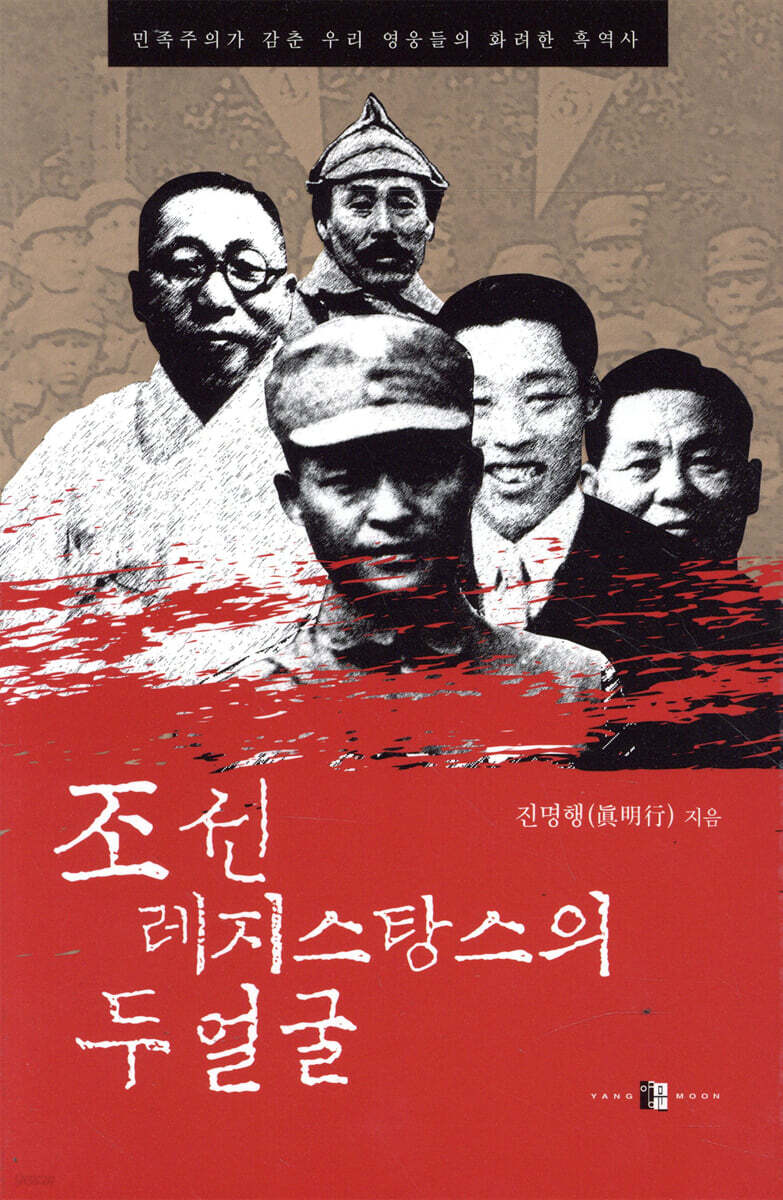
The Two Faces of the Joseon Resistance
 |
Description
Book Introduction
Is it true that Emperor Gojong dispatched a secret envoy to The Hague to appeal for Korea's independence? Is the conventional view that the three Hague envoys were martyrs or patriots correct? However, a new counterargument is being presented, claiming that Emperor Gojong's royal decree was forged, that he sent fake letters to foreign emperors, and then impersonated them as special envoys.
A new book has been published containing these new perspectives.
It is Jin Myeong-haeng's 『The Two Faces of Joseon Resistance』.
In this book, the author analyzes primary sources such as Japanese official documents to show that the three major anti-Japanese armed struggles we know of during the Japanese colonial period were in fact small-scale battles with minimal results, and that the Battle of Daejeonjaryeong was a fictitious victory without any real substance.
The Manchurian independence fighters, who were treated with such utmost respect that even the president's remains were brought to the scene, were in fact people who not only plundered and harassed their fellow countrymen, but also attacked and killed each other in a fight for territory and power, and reported on the authorities. This exposes the corruption hidden behind their heroic appearance.
This kind of perspective is difficult to find in existing research or books.
A new book has been published containing these new perspectives.
It is Jin Myeong-haeng's 『The Two Faces of Joseon Resistance』.
In this book, the author analyzes primary sources such as Japanese official documents to show that the three major anti-Japanese armed struggles we know of during the Japanese colonial period were in fact small-scale battles with minimal results, and that the Battle of Daejeonjaryeong was a fictitious victory without any real substance.
The Manchurian independence fighters, who were treated with such utmost respect that even the president's remains were brought to the scene, were in fact people who not only plundered and harassed their fellow countrymen, but also attacked and killed each other in a fight for territory and power, and reported on the authorities. This exposes the corruption hidden behind their heroic appearance.
This kind of perspective is difficult to find in existing research or books.
index
prolog
Recommendation
1.
On the day Joseon fell, no one cried.
2.
Queen Min, the Mother of the Nation reincarnated in a musical
3.
A group of bandits disguised as volunteer soldiers in the late Joseon Dynasty
4.
Was the Donghak Peasant Revolution a proletarian revolution?
5.
People impersonating Hague envoys
6.
The True Face of Historical Distortion: The Battle of Cheongsanri
7.
Kim Jwa-jin, the star of the independence movement, called the devil king by his compatriots
8.
The fiction of the Battle of Bongodong
9.
Hong Beom-do, a hero created by the National Assembly
10.
The Shanghai Provisional Government, which traded loans using the independence army as collateral
11.
The Jayu City Massacre and Hong Beom-do's Betrayal
12.
"Your Excellency, Do-yoon, arrest the military government of the robber group."
13.
An Jung-geun, an emperorist who pursued a Japan-centered Eastern order
14.
The spirit of Ahn Jung-geun, stained by anti-Japanese fashion and marketing
15.
The Shanghai Provisional Government, a sham government-in-exile
16.
Kim Won-bong, who was abandoned by everyone in pursuit of money and status
17.
The film "The Age of Shadows" distorts the struggle of the Uiyoldan.
18.
Kim Gu, the embodiment of power and desire
19.
Yeo Woon-hyung, who took the path of conversion and betrayal
20.
Cho Bong-am, a communist disguised as a victim
21.
Lee Bong-chang, the drunkard who came to get a job and left with a bomb
22.
The Reality of Kim Il-sung's Anti-Japanese Armed Struggle in Manchuria
23.
For whom did the late Joseon Dynasty army exist?
24.
The Battle of Daesanzi Ridge fabricated by the Provisional Government
25.
The guardians of Mount Taihang, the Korean Volunteer Corps
Epilogue
Recommendation
1.
On the day Joseon fell, no one cried.
2.
Queen Min, the Mother of the Nation reincarnated in a musical
3.
A group of bandits disguised as volunteer soldiers in the late Joseon Dynasty
4.
Was the Donghak Peasant Revolution a proletarian revolution?
5.
People impersonating Hague envoys
6.
The True Face of Historical Distortion: The Battle of Cheongsanri
7.
Kim Jwa-jin, the star of the independence movement, called the devil king by his compatriots
8.
The fiction of the Battle of Bongodong
9.
Hong Beom-do, a hero created by the National Assembly
10.
The Shanghai Provisional Government, which traded loans using the independence army as collateral
11.
The Jayu City Massacre and Hong Beom-do's Betrayal
12.
"Your Excellency, Do-yoon, arrest the military government of the robber group."
13.
An Jung-geun, an emperorist who pursued a Japan-centered Eastern order
14.
The spirit of Ahn Jung-geun, stained by anti-Japanese fashion and marketing
15.
The Shanghai Provisional Government, a sham government-in-exile
16.
Kim Won-bong, who was abandoned by everyone in pursuit of money and status
17.
The film "The Age of Shadows" distorts the struggle of the Uiyoldan.
18.
Kim Gu, the embodiment of power and desire
19.
Yeo Woon-hyung, who took the path of conversion and betrayal
20.
Cho Bong-am, a communist disguised as a victim
21.
Lee Bong-chang, the drunkard who came to get a job and left with a bomb
22.
The Reality of Kim Il-sung's Anti-Japanese Armed Struggle in Manchuria
23.
For whom did the late Joseon Dynasty army exist?
24.
The Battle of Daesanzi Ridge fabricated by the Provisional Government
25.
The guardians of Mount Taihang, the Korean Volunteer Corps
Epilogue
Into the book
“The longevity of history” is nothing more than the product of ignorance, the delusion of pure blood that we are a single ethnic group, and the fabrication of a 5,000-year long history by forcibly dragging a mythical imagination into the realm of history.
In a country founded with nothing but bare hands, without resources or money, the only thing to put forward would have been the ideological energy of 'spirit'.
--- p.5
History centered on one's own country inevitably becomes a narrative that elevates "us" and belittles "others."
In particular, the public sense of victimization against Japan provided a justification for exaggerating and distorting the meager record of the armed independence movement, which had been extinct since the 1920s.
Many people still remember Kim Gu as the unrivaled symbol of the Shanghai Provisional Government, who killed 3,000 Japanese soldiers in the Battle of Cheongsan-ri and achieved a great victory in the Battle of Bongodong.
And because that memory is immutable and sacred, no one dares to doubt whether it is truly true.
While widespread distortions are being perpetrated across all areas of film, media, broadcasting, books, and culture based on this inviolability, it shows a shallow aspect of the state where, in some cases, people are dragged down from the podium by the collar and dismissed from their positions simply for expressing differing opinions on life during the Japanese colonial period or comfort women.
--- p.8
With the country in such disarray, what kind of person was Gojong? Hwang Hyeon writes in his "Maecheon Diary," "Gojong would light a bright lamp and play until dawn, only falling asleep around 4 or 7 a.m., waking up at 3 or 4 p.m."
King Gojong and Empress Myeongseong were party animals, spending their days eating and drinking until dawn, and were obsessed with increasing the treasury to raise the necessary funds.
As if selling official magic wasn't enough, they later even sold the right to mint Baekdong coins indiscriminately, causing the value of Joseon's currency to plummet, causing the monetary order to become extremely disordered and the economy to be devastated.
--- p.26
Empress Myeongseong's squandering of the national treasury was a very serious matter.
It is said that the gifts and money given to embassies and influential figures of each country to gain diplomatic support from the great powers were enormous.
It is also well known that he was so obsessed with the crown prince that he spent astronomical amounts of money trying to treat his illnesses and fortunes.
--- p.32
I wonder if it is worth praising later generations by elevating the anti-Japanese volunteer movement and awarding medals to the act of roaming the villages with armed men, looting, and engaging in a fight with the pursuing government troops.
Some might argue that a certain degree of coercion and nuisance from neighboring villages is unavoidable in order to carry out guerrilla warfare.
However, it is clear that this country is not in its right mind when it sees them not only embellishing and distorting the past of a person who has never raided a Japanese military base or attacked a diplomatic facility or government agency, but also building a shrine to him and deifying him.
--- p.54
It is clear that the Donghak Peasant Revolution was initially an armed uprising by peasants who could no longer endure the tyranny of local lords.
However, as its influence spread like wildfire throughout the country, it can be seen that the Daewongun, who was pathologically obsessed with power, colluded with them and it turned into a kind of coup.
For this reason, the nature of the Donghak Peasant Revolution was neither revolutionary nor modern, but it was simply a rebellion, and today, for political reasons, its evaluation is overly exaggerated and embellished.
--- p.64
What is more serious is that the seal stamped on this personal letter delivered to the Russian Emperor, which stated that “Lee Jun, Lee Sang-seol, and Lee Wi-jong are to be dispatched as commissioners to the Hague Peace Conference,” is also fake.
In other words, this personal letter stored in the Russian State Archive is a forged letter.
--- p.76
Even before the small-scale guerrilla wars such as the Battle of Cheongsan-ri and the Battle of Bongodong, they continued to distort facts and achievements and boast about their “great victory” and maintain a history of mental victory.
In particular, the distortion of the Battle of Cheongsanri is severe.
This battle is a fictional story that was neither a deliberate joint operation between independence fighters, nor an ambush and annihilation operation, nor did it inflict significant damage on the Japanese army.
Even in the case of the Battle of Eorangchon, known as the greatest victory of the Battle of Cheongsanri, our records state that it was a great victory in which 300 people, including the enemy regimental commander, were killed or injured, but in reality, only one Japanese non-commissioned officer and two soldiers were killed.
--- p.85
When the German-Soviet War broke out in 1941, Hong Beom-do volunteered to fight in the war, and he also contributed an article to the Lenin Banner urging young Koryo people to join the war, saying, “Let’s go out, let’s fight, let’s win.”
When he died in 1943, instead of being called an independence activist, obituaries published described him as a leader of the Korean guerrilla movement, a member of the Lenin-Stalin Party, and a man loyal to the Motherland (the Soviet Union) and the Bolshevik Party.
--- p.122
If you look at how absurd our country's independence movement historical materials are, it says that Kim Sang-ok killed several people, including Superintendent Kurida Kiyoshi of the Jongno Police Station, during a shootout while escaping. However, Superintendent Kurida was not killed, but only injured, and was later promoted to Superintendent and even received a medal from the police chief.
Why do our historians always lie and say that people who are not dead are dead?
--- p.174
Kim Gu did not tolerate anyone who contradicted his opinions.
Even if we look at the incident on May 22, 1945, when he beat and assaulted Shin Gi-eon, who was in conflict with the Provisional Government, inside the Provisional Government building and expelled him from the government, or the incident on March 12, 1946, after liberation, when he got into an argument with Syngman Rhee and was enraged when Syngman Rhee called him a terrorist, he knocked Syngman Rhee down and climbed on his shoulders, we can see that, contrary to his gentle portrait with a Buddha-like smile, Kim Gu was a man who could not control his anger.
--- p.191
In 2020, Fyodor Cherchizhsky (Korean name Lee Hwi-seong), a senior research fellow at Kookmin University, returned to the starting point when he unearthed former Soviet diplomatic documents stored in the State Archives of the Russian Federation.
This document records a conversation between Kim Il-sung and Dmitry Polyansky, a member of the Politburo of the Communist Party of the Soviet Union and Vice Chairman of the Cabinet, who visited North Korea in September 1968.
According to this document, Kim Il-sung intervened in the 1956 South Korean presidential election, when candidate Cho Bong-am asked North Korea for help, and Kim Il-sung convened a meeting of the Workers' Party Politburo to establish the Progressive Party and provide political funds for Cho Bong-am.
In a country founded with nothing but bare hands, without resources or money, the only thing to put forward would have been the ideological energy of 'spirit'.
--- p.5
History centered on one's own country inevitably becomes a narrative that elevates "us" and belittles "others."
In particular, the public sense of victimization against Japan provided a justification for exaggerating and distorting the meager record of the armed independence movement, which had been extinct since the 1920s.
Many people still remember Kim Gu as the unrivaled symbol of the Shanghai Provisional Government, who killed 3,000 Japanese soldiers in the Battle of Cheongsan-ri and achieved a great victory in the Battle of Bongodong.
And because that memory is immutable and sacred, no one dares to doubt whether it is truly true.
While widespread distortions are being perpetrated across all areas of film, media, broadcasting, books, and culture based on this inviolability, it shows a shallow aspect of the state where, in some cases, people are dragged down from the podium by the collar and dismissed from their positions simply for expressing differing opinions on life during the Japanese colonial period or comfort women.
--- p.8
With the country in such disarray, what kind of person was Gojong? Hwang Hyeon writes in his "Maecheon Diary," "Gojong would light a bright lamp and play until dawn, only falling asleep around 4 or 7 a.m., waking up at 3 or 4 p.m."
King Gojong and Empress Myeongseong were party animals, spending their days eating and drinking until dawn, and were obsessed with increasing the treasury to raise the necessary funds.
As if selling official magic wasn't enough, they later even sold the right to mint Baekdong coins indiscriminately, causing the value of Joseon's currency to plummet, causing the monetary order to become extremely disordered and the economy to be devastated.
--- p.26
Empress Myeongseong's squandering of the national treasury was a very serious matter.
It is said that the gifts and money given to embassies and influential figures of each country to gain diplomatic support from the great powers were enormous.
It is also well known that he was so obsessed with the crown prince that he spent astronomical amounts of money trying to treat his illnesses and fortunes.
--- p.32
I wonder if it is worth praising later generations by elevating the anti-Japanese volunteer movement and awarding medals to the act of roaming the villages with armed men, looting, and engaging in a fight with the pursuing government troops.
Some might argue that a certain degree of coercion and nuisance from neighboring villages is unavoidable in order to carry out guerrilla warfare.
However, it is clear that this country is not in its right mind when it sees them not only embellishing and distorting the past of a person who has never raided a Japanese military base or attacked a diplomatic facility or government agency, but also building a shrine to him and deifying him.
--- p.54
It is clear that the Donghak Peasant Revolution was initially an armed uprising by peasants who could no longer endure the tyranny of local lords.
However, as its influence spread like wildfire throughout the country, it can be seen that the Daewongun, who was pathologically obsessed with power, colluded with them and it turned into a kind of coup.
For this reason, the nature of the Donghak Peasant Revolution was neither revolutionary nor modern, but it was simply a rebellion, and today, for political reasons, its evaluation is overly exaggerated and embellished.
--- p.64
What is more serious is that the seal stamped on this personal letter delivered to the Russian Emperor, which stated that “Lee Jun, Lee Sang-seol, and Lee Wi-jong are to be dispatched as commissioners to the Hague Peace Conference,” is also fake.
In other words, this personal letter stored in the Russian State Archive is a forged letter.
--- p.76
Even before the small-scale guerrilla wars such as the Battle of Cheongsan-ri and the Battle of Bongodong, they continued to distort facts and achievements and boast about their “great victory” and maintain a history of mental victory.
In particular, the distortion of the Battle of Cheongsanri is severe.
This battle is a fictional story that was neither a deliberate joint operation between independence fighters, nor an ambush and annihilation operation, nor did it inflict significant damage on the Japanese army.
Even in the case of the Battle of Eorangchon, known as the greatest victory of the Battle of Cheongsanri, our records state that it was a great victory in which 300 people, including the enemy regimental commander, were killed or injured, but in reality, only one Japanese non-commissioned officer and two soldiers were killed.
--- p.85
When the German-Soviet War broke out in 1941, Hong Beom-do volunteered to fight in the war, and he also contributed an article to the Lenin Banner urging young Koryo people to join the war, saying, “Let’s go out, let’s fight, let’s win.”
When he died in 1943, instead of being called an independence activist, obituaries published described him as a leader of the Korean guerrilla movement, a member of the Lenin-Stalin Party, and a man loyal to the Motherland (the Soviet Union) and the Bolshevik Party.
--- p.122
If you look at how absurd our country's independence movement historical materials are, it says that Kim Sang-ok killed several people, including Superintendent Kurida Kiyoshi of the Jongno Police Station, during a shootout while escaping. However, Superintendent Kurida was not killed, but only injured, and was later promoted to Superintendent and even received a medal from the police chief.
Why do our historians always lie and say that people who are not dead are dead?
--- p.174
Kim Gu did not tolerate anyone who contradicted his opinions.
Even if we look at the incident on May 22, 1945, when he beat and assaulted Shin Gi-eon, who was in conflict with the Provisional Government, inside the Provisional Government building and expelled him from the government, or the incident on March 12, 1946, after liberation, when he got into an argument with Syngman Rhee and was enraged when Syngman Rhee called him a terrorist, he knocked Syngman Rhee down and climbed on his shoulders, we can see that, contrary to his gentle portrait with a Buddha-like smile, Kim Gu was a man who could not control his anger.
--- p.191
In 2020, Fyodor Cherchizhsky (Korean name Lee Hwi-seong), a senior research fellow at Kookmin University, returned to the starting point when he unearthed former Soviet diplomatic documents stored in the State Archives of the Russian Federation.
This document records a conversation between Kim Il-sung and Dmitry Polyansky, a member of the Politburo of the Communist Party of the Soviet Union and Vice Chairman of the Cabinet, who visited North Korea in September 1968.
According to this document, Kim Il-sung intervened in the 1956 South Korean presidential election, when candidate Cho Bong-am asked North Korea for help, and Kim Il-sung convened a meeting of the Workers' Party Politburo to establish the Progressive Party and provide political funds for Cho Bong-am.
--- p.216
Publisher's Review
Looking back at modern and contemporary human history, nationalism has always been behind major incidents that resulted in large-scale casualties.
Examples include the two World Wars, the Holocaust, the communist revolutions in China and Vietnam, and the Korean War.
Some rationalize our nationalism as victim nationalism, but as Lee Young-hoon points out, while our nationalism and Japan's nationalism differ only in their orientation and goals, they are both antagonistic and complicit in that they both inherently possess exclusive violence.
The boycott of Japanese products in 2020 is a prime example.
The terrorist attack on a Japanese vehicle and the violence against Japanese tourists may be extreme examples, but no one can say for sure when and by what factor this will lead to the madness of the entire country.
It is undeniable that during the Syngman Rhee and Park Chung-hee eras, the state promoted and utilized nationalism to counter communist forces and unite national strength.
Nationalism originates from the nepotism of asking, "Are we strangers?"
On a small scale, it begins to sprout from a sense of solidarity based on regional ties, blood ties, or school ties, and when this expands to a nation, the people disappear and the nation takes their place.
If you look at the preamble of our Constitution, the words “long history and tradition” appear first.
And then it is full of anachronistic and old-fashioned words like inheritance of the law and spirit, brotherhood, and national unity.
The more these words are emphasized, the more individual freedom, individuality, and diversity of thought are destroyed, and the logic of the whole, such as the nation or the state, overwhelms the individual.
It has become very common in our country for all the media to rise up, cut corners, and bury people like a swarm of bees whenever the topic of comfort women comes up.
We live in a world where discussion has disappeared and silence is enforced under the grand narrative.
The author's concerns begin here.
History is a discipline that records and studies what facts are, but as we begin to emphasize values and evaluations over facts, we are raising the question of whether our history has become too fixated on the embellished techniques of self-praise that are riddled with lies.
The author directly targets nationalism, which has taken root like an incurable tumor, as the source of the problem.
We are bringing out on stage all the facts that we have intentionally excluded and omitted about historical figures and events that we have learned about in traditional schools, and asking what is true.
Examples include the two World Wars, the Holocaust, the communist revolutions in China and Vietnam, and the Korean War.
Some rationalize our nationalism as victim nationalism, but as Lee Young-hoon points out, while our nationalism and Japan's nationalism differ only in their orientation and goals, they are both antagonistic and complicit in that they both inherently possess exclusive violence.
The boycott of Japanese products in 2020 is a prime example.
The terrorist attack on a Japanese vehicle and the violence against Japanese tourists may be extreme examples, but no one can say for sure when and by what factor this will lead to the madness of the entire country.
It is undeniable that during the Syngman Rhee and Park Chung-hee eras, the state promoted and utilized nationalism to counter communist forces and unite national strength.
Nationalism originates from the nepotism of asking, "Are we strangers?"
On a small scale, it begins to sprout from a sense of solidarity based on regional ties, blood ties, or school ties, and when this expands to a nation, the people disappear and the nation takes their place.
If you look at the preamble of our Constitution, the words “long history and tradition” appear first.
And then it is full of anachronistic and old-fashioned words like inheritance of the law and spirit, brotherhood, and national unity.
The more these words are emphasized, the more individual freedom, individuality, and diversity of thought are destroyed, and the logic of the whole, such as the nation or the state, overwhelms the individual.
It has become very common in our country for all the media to rise up, cut corners, and bury people like a swarm of bees whenever the topic of comfort women comes up.
We live in a world where discussion has disappeared and silence is enforced under the grand narrative.
The author's concerns begin here.
History is a discipline that records and studies what facts are, but as we begin to emphasize values and evaluations over facts, we are raising the question of whether our history has become too fixated on the embellished techniques of self-praise that are riddled with lies.
The author directly targets nationalism, which has taken root like an incurable tumor, as the source of the problem.
We are bringing out on stage all the facts that we have intentionally excluded and omitted about historical figures and events that we have learned about in traditional schools, and asking what is true.
GOODS SPECIFICS
- Publication date: November 15, 2021
- Page count, weight, size: 300 pages | 562g | 152*230*20mm
- ISBN13: 9788994025841
- ISBN10: 8994025847
You may also like
카테고리
korean


korean

![GQ KOREA Mark (Monthly): December [2025]](http://librairie.coreenne.fr/cdn/shop/files/8ef265dbbfbf186523ed75ba7319009d.jpg?v=1765340328&width=3840)


