

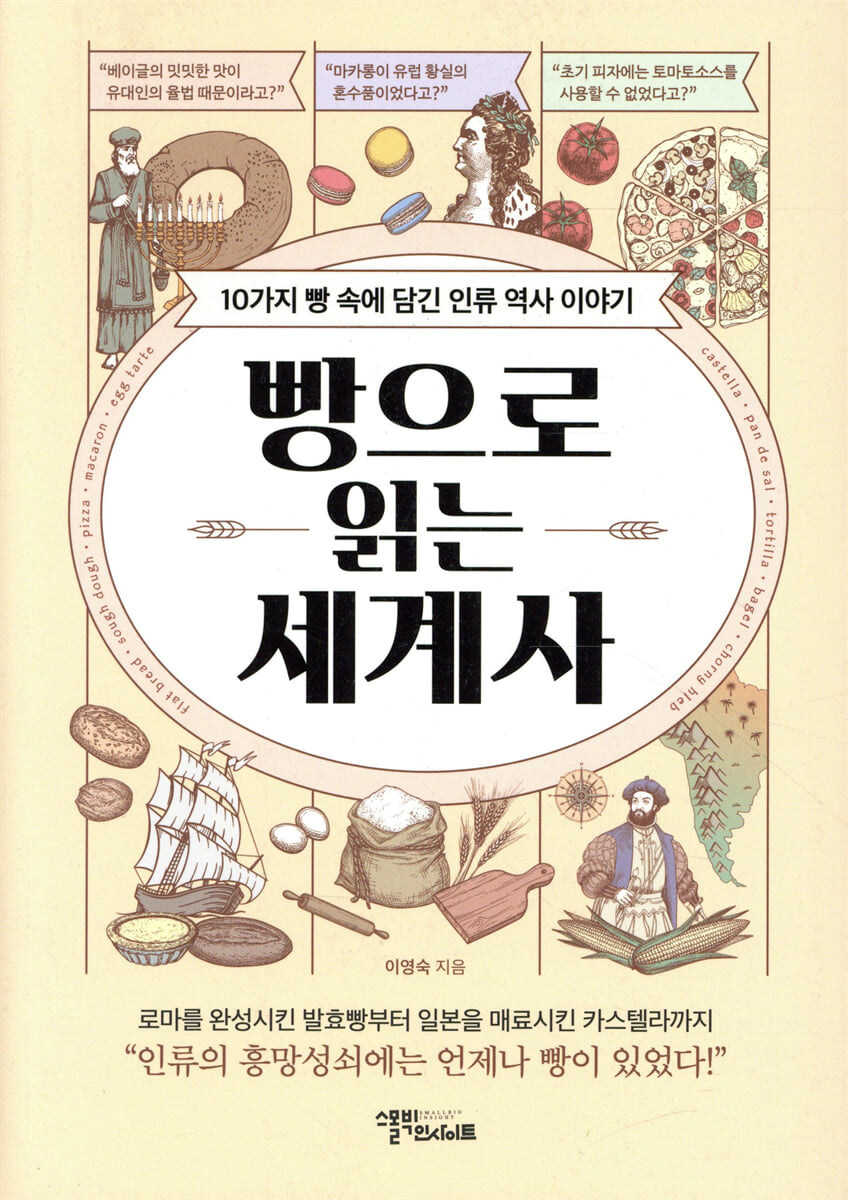
World History Through Bread
 |
Description
Book Introduction
“Reading the decisive moments in human history through bread!”
The history of mankind is a history with bread.
This is because humans have developed civilization by constantly striving to obtain bread.
This can be seen just by looking at the Mesopotamian region where mankind's first civilization arose.
The Sumerians, the first to cultivate agriculture, cultivated wheat and made flatbread, which resulted in a population increase and the formation of cities, leading to the development of laws, institutions, and culture.
This book examines the evolution of human history through the story of bread, which is deeply involved in our lives.
However, it is completely different from other history books that require you to understand listed historical events like a puzzle.
We've designed this book to help you understand the history and culture associated with each of the 10 popular, yet historically significant breads by examining how they were made and spread around the world.
As you read through the ten bread stories mentioned in this book, you will be able to shed your prejudice against world history, which has always felt boring and rigid, and immerse yourself in the fascinating charm of world history.
The history of mankind is a history with bread.
This is because humans have developed civilization by constantly striving to obtain bread.
This can be seen just by looking at the Mesopotamian region where mankind's first civilization arose.
The Sumerians, the first to cultivate agriculture, cultivated wheat and made flatbread, which resulted in a population increase and the formation of cities, leading to the development of laws, institutions, and culture.
This book examines the evolution of human history through the story of bread, which is deeply involved in our lives.
However, it is completely different from other history books that require you to understand listed historical events like a puzzle.
We've designed this book to help you understand the history and culture associated with each of the 10 popular, yet historically significant breads by examining how they were made and spread around the world.
As you read through the ten bread stories mentioned in this book, you will be able to shed your prejudice against world history, which has always felt boring and rigid, and immerse yourself in the fascinating charm of world history.
- You can preview some of the book's contents.
Preview
index
Chapter 1 Flatbread
Bread making began with the dawn of human civilization.
-Ancient bread baked flat over an open fire
-The fertile crescent region where civilization arose
- Sumer, the land where history began
-The Sumerians who created the first writing system in human history
-A student's day written in cuneiform
-The Code of Hammurabi, which governed the lives of the Babylonians
-The era of Jesus when bread was familiar
-Lavasi, listed as a World Intangible Cultural Heritage
-I, chapati, paratha
-India's independence brought chaos
-Three countries divided from one
Chapter 2 Sourdough
-Fermented bread created by nature
-The wages of pyramid construction workers are bread and beer.
-Fermented bread dough that needs to be risen
Baking bread in the Middle Ages was a arduous process.
-Benefits of mass production of dried yeast
-The scientist who made bread and milk easy to eat
3-piece pizza
The Roman Empire, which contributed to the globalization of bread
-Bread and Circuses That Blinded the Romans
Pompeii, a time capsule of ancient Rome
The History of Italian Bread Discovered in Volcanic Ash
-Early pizzas could not use tomato sauce.
- Margherita Pizza, named after an Italian queen
-American Immigration History and Pizza
Chapter 4 Macarons
-The standard for judging quality is 'Macaron's feet'
-The French Revolution contributed to the popularization of macarons
The Medici family that upgraded French court culture
-The queen who received more love from her father-in-law than from her husband
-Catherine, who established five kings
-Bartholomew's Massacre
-Marie de Medici, the greatest heiress in Europe
-The ambition of a woman left in Rubens' painting
-European food culture spread through marriage
-Catherine, Marie, and Macarons
Chapter 5 Egg Tart
Egg tarts, a representative Macanese dish
- Bread made with leftover egg yolks
-Hong Kong style vs. Macau style
Portugal, which opened the Age of Exploration
-A new sea route for gold, pepper, and the cross
Sagres Castle, the forward base of the Portuguese maritime empire
- Prince Henry the Navigator's Conquest of the Dark Seas
-The sea route to India opens.
Macau, Asia's trading hub
Portuguese-style return vs. British-style return
Chapter 6 Castella
-Spanish bread brought by Portuguese missionaries
-Unification of Japan and the Portuguese
-Japan, adept at magnetization
-The Tokugawa shogunate and the persecution of Catholics
-Dejima, the window to the West
The secret of the Netherlands surviving Japan's isolationist policy
Castella is served on the ancestral rite table in Jeju Island.
-Western civilization transmitted by correspondents and envoys
-Eat sulgogi and drink yangtangguk at the club
Chapter 7: Pandesal
Pandesal, the Philippine national bread that is cheaper than rice
-Spanish breads in the Philippines
Portugal and Spain, which divided the world by a single line
-Magellan failed to circumnavigate the world.
Magellan, recognized as a hero, not an invader
-The Spanish invasion and the birth of the Philippines
-The goal is not to travel around the world, but to find spices.
Manila, the pearl of the Orient, overflowing with gold and silver
-The colonial masters changed by the Spanish-American War
Chapter 8 Tortillas
- Tortilla, the master of transformation
-Mesoamerican civilization created by corn
-A disease more terrifying than a gun
- A raider who came to find the golden city of El Dorado
-Guns, germs, myths, division
-Malinche, the mother of the mestizo
Spain dominates the world's silver market
-Mexico's popular resistance and independence movement
Chapter 9 Bagels
Ashkenazi Jews and Bagels
-Jewish law and kosher food
-Russia's policy of discrimination against Jews
-Pogroms that fueled Jewish immigration
-The Rothschild family and the Russo-Japanese War
-There is no tsar in America.
-The Jews who took over America
-Bagels, a symbol of New York
10 sheets of black bread
-Farmer's Bread, Chorni Holep
-Black bread soaked in beer and soup
-The samovar, the hearth that brings the family together
-Kvass, Russia's national drink
-Black bread that stopped Peter the Great's invasion of Europe
-Hitler and Stalin, born of greed and need
-Hitler surrendered to the determination of the citizens of Leningrad
The Battle of Stalingrad, which shattered the myth of German invincibility.
-The soldiers' sorrow contained in the song
Bread making began with the dawn of human civilization.
-Ancient bread baked flat over an open fire
-The fertile crescent region where civilization arose
- Sumer, the land where history began
-The Sumerians who created the first writing system in human history
-A student's day written in cuneiform
-The Code of Hammurabi, which governed the lives of the Babylonians
-The era of Jesus when bread was familiar
-Lavasi, listed as a World Intangible Cultural Heritage
-I, chapati, paratha
-India's independence brought chaos
-Three countries divided from one
Chapter 2 Sourdough
-Fermented bread created by nature
-The wages of pyramid construction workers are bread and beer.
-Fermented bread dough that needs to be risen
Baking bread in the Middle Ages was a arduous process.
-Benefits of mass production of dried yeast
-The scientist who made bread and milk easy to eat
3-piece pizza
The Roman Empire, which contributed to the globalization of bread
-Bread and Circuses That Blinded the Romans
Pompeii, a time capsule of ancient Rome
The History of Italian Bread Discovered in Volcanic Ash
-Early pizzas could not use tomato sauce.
- Margherita Pizza, named after an Italian queen
-American Immigration History and Pizza
Chapter 4 Macarons
-The standard for judging quality is 'Macaron's feet'
-The French Revolution contributed to the popularization of macarons
The Medici family that upgraded French court culture
-The queen who received more love from her father-in-law than from her husband
-Catherine, who established five kings
-Bartholomew's Massacre
-Marie de Medici, the greatest heiress in Europe
-The ambition of a woman left in Rubens' painting
-European food culture spread through marriage
-Catherine, Marie, and Macarons
Chapter 5 Egg Tart
Egg tarts, a representative Macanese dish
- Bread made with leftover egg yolks
-Hong Kong style vs. Macau style
Portugal, which opened the Age of Exploration
-A new sea route for gold, pepper, and the cross
Sagres Castle, the forward base of the Portuguese maritime empire
- Prince Henry the Navigator's Conquest of the Dark Seas
-The sea route to India opens.
Macau, Asia's trading hub
Portuguese-style return vs. British-style return
Chapter 6 Castella
-Spanish bread brought by Portuguese missionaries
-Unification of Japan and the Portuguese
-Japan, adept at magnetization
-The Tokugawa shogunate and the persecution of Catholics
-Dejima, the window to the West
The secret of the Netherlands surviving Japan's isolationist policy
Castella is served on the ancestral rite table in Jeju Island.
-Western civilization transmitted by correspondents and envoys
-Eat sulgogi and drink yangtangguk at the club
Chapter 7: Pandesal
Pandesal, the Philippine national bread that is cheaper than rice
-Spanish breads in the Philippines
Portugal and Spain, which divided the world by a single line
-Magellan failed to circumnavigate the world.
Magellan, recognized as a hero, not an invader
-The Spanish invasion and the birth of the Philippines
-The goal is not to travel around the world, but to find spices.
Manila, the pearl of the Orient, overflowing with gold and silver
-The colonial masters changed by the Spanish-American War
Chapter 8 Tortillas
- Tortilla, the master of transformation
-Mesoamerican civilization created by corn
-A disease more terrifying than a gun
- A raider who came to find the golden city of El Dorado
-Guns, germs, myths, division
-Malinche, the mother of the mestizo
Spain dominates the world's silver market
-Mexico's popular resistance and independence movement
Chapter 9 Bagels
Ashkenazi Jews and Bagels
-Jewish law and kosher food
-Russia's policy of discrimination against Jews
-Pogroms that fueled Jewish immigration
-The Rothschild family and the Russo-Japanese War
-There is no tsar in America.
-The Jews who took over America
-Bagels, a symbol of New York
10 sheets of black bread
-Farmer's Bread, Chorni Holep
-Black bread soaked in beer and soup
-The samovar, the hearth that brings the family together
-Kvass, Russia's national drink
-Black bread that stopped Peter the Great's invasion of Europe
-Hitler and Stalin, born of greed and need
-Hitler surrendered to the determination of the citizens of Leningrad
The Battle of Stalingrad, which shattered the myth of German invincibility.
-The soldiers' sorrow contained in the song
Into the book
Even before humans cultivated grains, they made bread from wild grains.
Wild wheat is thought to have originated in a region called the Transcaucasus, which is now Türkiye and neighboring countries.
Of course, yeast was not used in bread at all at that time.
It was a flat bread shaped like a pancake, the so-called ‘flatbread’.
Afterwards, the wheat produced in this region gradually crossed over to Egypt through the highlands of Southwest Asia, where it went through a fermentation process to create soft, puffy bread.
--- p.16
Ancient Egypt was a class society with the pharaoh at the top, so there were differences in bread distribution.
Pharaoh was given 1,000 loaves of bread a day, and the number of loaves received varied depending on rank.
Additionally, the workers mobilized to build the pyramids were paid bread and beer in return for their labor.
This is why a bakery and a brewery were located right next to the pyramid construction site.
--- p.46
Ancient Rome had a great influence on bread's spread throughout the world as it is today.
Before the ancient Roman era, bread was limited to the Mesopotamian and Egyptian regions.
Then, in ancient Greece, all meals consisted of bread and 'other things' served with it.
And with the prosperity of the Roman Empire, bread spread throughout Europe and the Mediterranean coast, including North Africa.
During the Roman era, not only architecture and art, but also food culture, including bread, developed rapidly.
--- p.64
Before Catherine, heiress of the Medici family, known as one of the wealthiest families in Italy, became queen of France, there were no sweets or forks in France.
The macaron, widely known today as France's representative luxury confectionery, was originally from Italy, and its recipe was made known in the 16th century by Italian chefs that Catherine brought with her to France when she married.
New table culture and dining etiquette, such as the use of forks and napkins, were also established as French dining culture by her.
--- p.94
Japanese Castella originated from Castella introduced by the Portuguese in the late 16th century, but the Japanese adapted it and adopted it in their own style.
Originally, in Spain and Portugal, milk and butter were used to make castella, but in Japan at the time, milk and butter were rare, so eggs and corn syrup were added.
And because stoves were rare, they chose to steam in a pot.
As a result, the original Portuguese 'Castella' became the softer and sweeter Japanese 'Castella'.
--- p.142
Tortilla, a traditional Mexican bread, is a staple food for Mexicans.
The reason tortillas are widely used in Mexican food is because corn, the ingredient, is abundant.
Corn is the staple grain of the Mesoamericans.
French historian Fernand Braudel argues that the Aztec and Mayan civilizations in Mexico were able to flourish because they had an abundant food resource called corn, which allowed for seven crops per year.
--- p.186
The reason bagels, which were mainly eaten by Eastern European Jews, were able to spread throughout the world, including the United States, was because of the discriminatory policies against Jews in Imperial Russia and the former Soviet Union.
In the late 19th century, Russia began to classify Jews as foreigners and began to discriminate against and persecute them.
As a result, Jews living in Russia immigrated to the United States in large numbers to escape persecution.
Jews who settled in New York City amassed wealth through their own networks and gained enormous influence within the United States.
Along with him, the bagels they enjoyed became popular and became a bread that could be tasted anywhere in the world.
Wild wheat is thought to have originated in a region called the Transcaucasus, which is now Türkiye and neighboring countries.
Of course, yeast was not used in bread at all at that time.
It was a flat bread shaped like a pancake, the so-called ‘flatbread’.
Afterwards, the wheat produced in this region gradually crossed over to Egypt through the highlands of Southwest Asia, where it went through a fermentation process to create soft, puffy bread.
--- p.16
Ancient Egypt was a class society with the pharaoh at the top, so there were differences in bread distribution.
Pharaoh was given 1,000 loaves of bread a day, and the number of loaves received varied depending on rank.
Additionally, the workers mobilized to build the pyramids were paid bread and beer in return for their labor.
This is why a bakery and a brewery were located right next to the pyramid construction site.
--- p.46
Ancient Rome had a great influence on bread's spread throughout the world as it is today.
Before the ancient Roman era, bread was limited to the Mesopotamian and Egyptian regions.
Then, in ancient Greece, all meals consisted of bread and 'other things' served with it.
And with the prosperity of the Roman Empire, bread spread throughout Europe and the Mediterranean coast, including North Africa.
During the Roman era, not only architecture and art, but also food culture, including bread, developed rapidly.
--- p.64
Before Catherine, heiress of the Medici family, known as one of the wealthiest families in Italy, became queen of France, there were no sweets or forks in France.
The macaron, widely known today as France's representative luxury confectionery, was originally from Italy, and its recipe was made known in the 16th century by Italian chefs that Catherine brought with her to France when she married.
New table culture and dining etiquette, such as the use of forks and napkins, were also established as French dining culture by her.
--- p.94
Japanese Castella originated from Castella introduced by the Portuguese in the late 16th century, but the Japanese adapted it and adopted it in their own style.
Originally, in Spain and Portugal, milk and butter were used to make castella, but in Japan at the time, milk and butter were rare, so eggs and corn syrup were added.
And because stoves were rare, they chose to steam in a pot.
As a result, the original Portuguese 'Castella' became the softer and sweeter Japanese 'Castella'.
--- p.142
Tortilla, a traditional Mexican bread, is a staple food for Mexicans.
The reason tortillas are widely used in Mexican food is because corn, the ingredient, is abundant.
Corn is the staple grain of the Mesoamericans.
French historian Fernand Braudel argues that the Aztec and Mayan civilizations in Mexico were able to flourish because they had an abundant food resource called corn, which allowed for seven crops per year.
--- p.186
The reason bagels, which were mainly eaten by Eastern European Jews, were able to spread throughout the world, including the United States, was because of the discriminatory policies against Jews in Imperial Russia and the former Soviet Union.
In the late 19th century, Russia began to classify Jews as foreigners and began to discriminate against and persecute them.
As a result, Jews living in Russia immigrated to the United States in large numbers to escape persecution.
Jews who settled in New York City amassed wealth through their own networks and gained enormous influence within the United States.
Along with him, the bagels they enjoyed became popular and became a bread that could be tasted anywhere in the world.
--- p.223
Publisher's Review
“The wages of pyramid construction workers were bread and beer?”
“Was the failure of Russia’s invasion of Europe due to black bread?”
“Even Japan’s isolationist policy couldn’t stop Castella?”
A fun and easy way to learn about world history through friendly bread stories!
When did humans begin eating bread? The oldest trace of bread discovered so far is a charred piece of bread found in a house site in Jordan, dating back approximately 14,000 years.
The Sumerian civilization in Mesopotamia, where humans first began farming and developed civilization, began about 8,000 years ago, so it can be said that humans were making and eating bread long before they developed civilization.
The history of bread is long and has a deep and inseparable connection with humanity.
This book contains content that allows us to glimpse various scenes of human history through stories about bread.
If you are a reader who has always found world history difficult due to the sheer number of historical events, this book will be a great opportunity to understand world history in an easy and enjoyable way.
An exciting world history story contained in 10 kinds of bread!
There are ten different types of bread in this book.
These breads are breads that we commonly encounter in our daily lives and have been with us for a long time throughout human history.
Through the story of how these breads were created and became popular, we can read about the exciting changes in world history contained within them.
For example, we learn about the class structure of ancient Egypt through the story of the Egyptians who first made leavened bread, the relationship between asceticism and diet in medieval Europe through the story of Italian pizza, and the history of Italian immigration to the United States in the 19th century.
Also, by talking about how macarons were transmitted from Italy to France, we can see that the development of European food culture is related to the wedding culture of European royal families.
In addition, we look at the history of European powers' invasion of the Americas and Asia through the stories of Mexican tortillas, Portuguese egg tarts, and Japanese castella.
Stories related to bread like this are a great way to understand the flow of world history in an easy and fun way.
This book will provide you with an exciting new perspective on world history.
A new world history from a bestselling history author!
The author of this book, Lee Young-sook, has consistently worked to explain world history in an easy and fun way using materials closely related to our lives.
In particular, world history books written on topics such as food, clothing, and architecture are widely read by both teenagers and adults and have long been bestsellers.
The author says that even world history, which is a complex web of events and accidents, can be approached easily and enjoyably if we use commonly encountered materials to explain it well.
This book is the result of the author's accumulated efforts and know-how, newly written.
As you read the ten bread stories mentioned in this book, you will find yourself immersed in the fascinating world history.
“Was the failure of Russia’s invasion of Europe due to black bread?”
“Even Japan’s isolationist policy couldn’t stop Castella?”
A fun and easy way to learn about world history through friendly bread stories!
When did humans begin eating bread? The oldest trace of bread discovered so far is a charred piece of bread found in a house site in Jordan, dating back approximately 14,000 years.
The Sumerian civilization in Mesopotamia, where humans first began farming and developed civilization, began about 8,000 years ago, so it can be said that humans were making and eating bread long before they developed civilization.
The history of bread is long and has a deep and inseparable connection with humanity.
This book contains content that allows us to glimpse various scenes of human history through stories about bread.
If you are a reader who has always found world history difficult due to the sheer number of historical events, this book will be a great opportunity to understand world history in an easy and enjoyable way.
An exciting world history story contained in 10 kinds of bread!
There are ten different types of bread in this book.
These breads are breads that we commonly encounter in our daily lives and have been with us for a long time throughout human history.
Through the story of how these breads were created and became popular, we can read about the exciting changes in world history contained within them.
For example, we learn about the class structure of ancient Egypt through the story of the Egyptians who first made leavened bread, the relationship between asceticism and diet in medieval Europe through the story of Italian pizza, and the history of Italian immigration to the United States in the 19th century.
Also, by talking about how macarons were transmitted from Italy to France, we can see that the development of European food culture is related to the wedding culture of European royal families.
In addition, we look at the history of European powers' invasion of the Americas and Asia through the stories of Mexican tortillas, Portuguese egg tarts, and Japanese castella.
Stories related to bread like this are a great way to understand the flow of world history in an easy and fun way.
This book will provide you with an exciting new perspective on world history.
A new world history from a bestselling history author!
The author of this book, Lee Young-sook, has consistently worked to explain world history in an easy and fun way using materials closely related to our lives.
In particular, world history books written on topics such as food, clothing, and architecture are widely read by both teenagers and adults and have long been bestsellers.
The author says that even world history, which is a complex web of events and accidents, can be approached easily and enjoyably if we use commonly encountered materials to explain it well.
This book is the result of the author's accumulated efforts and know-how, newly written.
As you read the ten bread stories mentioned in this book, you will find yourself immersed in the fascinating world history.
GOODS SPECIFICS
- Publication date: October 11, 2021
- Page count, weight, size: 248 pages | 356g | 148*210*20mm
- ISBN13: 9791191731071
- ISBN10: 1191731073
You may also like
카테고리
korean


korean

![GQ KOREA Mark (Monthly): December [2025]](http://librairie.coreenne.fr/cdn/shop/files/8ef265dbbfbf186523ed75ba7319009d.jpg?v=1765340328&width=3840)


