

Western History: Medieval Times 2: Learn from Comics
 |
Description
Book Introduction
Do we really know the Middle Ages?
From video games like The Witcher, Dark Souls, and Diablo, to dramas like Game of Thrones and The Last Kingdom, to animations and webtoons… we can often see parts of the Middle Ages, from knights in armor.
Various television programs and games deal with the theme of the Middle Ages, but only from a fantasy perspective.
While there are positive aspects to using the Middle Ages as a subject for mass media and entertainment, such as attracting more people to the Middle Ages, is it okay to view the Middle Ages as merely a romantic fantasy? Do we truly understand the Middle Ages?
The Middle Ages have also been used politically by modern politicians.
The United States also cited the Crusades in 2003 when it threatened to wage a holy war against Iraq after the 9/11 attacks.
The term "Crusades" was used to give modern warfare a justification.
The Crusades were actually used as a pretext to increase royal authority, collect taxes, and establish the authority of the church, and they were nothing more than justifications for the massacre of non-Christian Jews and Arabs.
From video games like The Witcher, Dark Souls, and Diablo, to dramas like Game of Thrones and The Last Kingdom, to animations and webtoons… we can often see parts of the Middle Ages, from knights in armor.
Various television programs and games deal with the theme of the Middle Ages, but only from a fantasy perspective.
While there are positive aspects to using the Middle Ages as a subject for mass media and entertainment, such as attracting more people to the Middle Ages, is it okay to view the Middle Ages as merely a romantic fantasy? Do we truly understand the Middle Ages?
The Middle Ages have also been used politically by modern politicians.
The United States also cited the Crusades in 2003 when it threatened to wage a holy war against Iraq after the 9/11 attacks.
The term "Crusades" was used to give modern warfare a justification.
The Crusades were actually used as a pretext to increase royal authority, collect taxes, and establish the authority of the church, and they were nothing more than justifications for the massacre of non-Christian Jews and Arabs.
- You can preview some of the book's contents.
Preview
Publisher's Review
The crusades, which evolved from the pilgrimage movement
When talking about the Middle Ages, the keywords that cannot be left out are ‘feudalism’, ‘Christianity’, and ‘the Crusades’.
This book contains the 'Crusades'.
Europe, which had begun to establish its system and foundation through feudalism and Christianity, fell into a state of panic as the first millennium approached, due to the 'Day of Judgment' mentioned in the Bible.
But as was the case with the second millennium, nothing happened, and European society quickly regained stability.
Cities tore down their old churches and built magnificent cathedrals, and soon pilgrimages to the Holy Land became popular.
This was because they believed that in order to go to heaven, they had to be forgiven of the sins they committed during their lifetime before they died.
Jerusalem, the center of pilgrimage, was under Islamic rule at the time, and while Islam did not block Christian pilgrimages, it did not welcome them either.
However, when the Christian cities around Jerusalem were taken over by Islamic forces, this gave rise to the Crusades, who wore clothing embroidered with crosses, and the Crusades began with the goal of recapturing the Holy Land.
Afterwards, the Crusades became a war in which the interests of the Pope, who sought to expand the papacy, the King of France, who sought to be recognized as a true Christian king, the feudal lords and knights who were developing new territories, the merchants who wanted to monopolize the profits of Mediterranean trade, and the peasants who wanted to gain freedom of status were intertwined.
A time travel to the Middle Ages along the Crusades
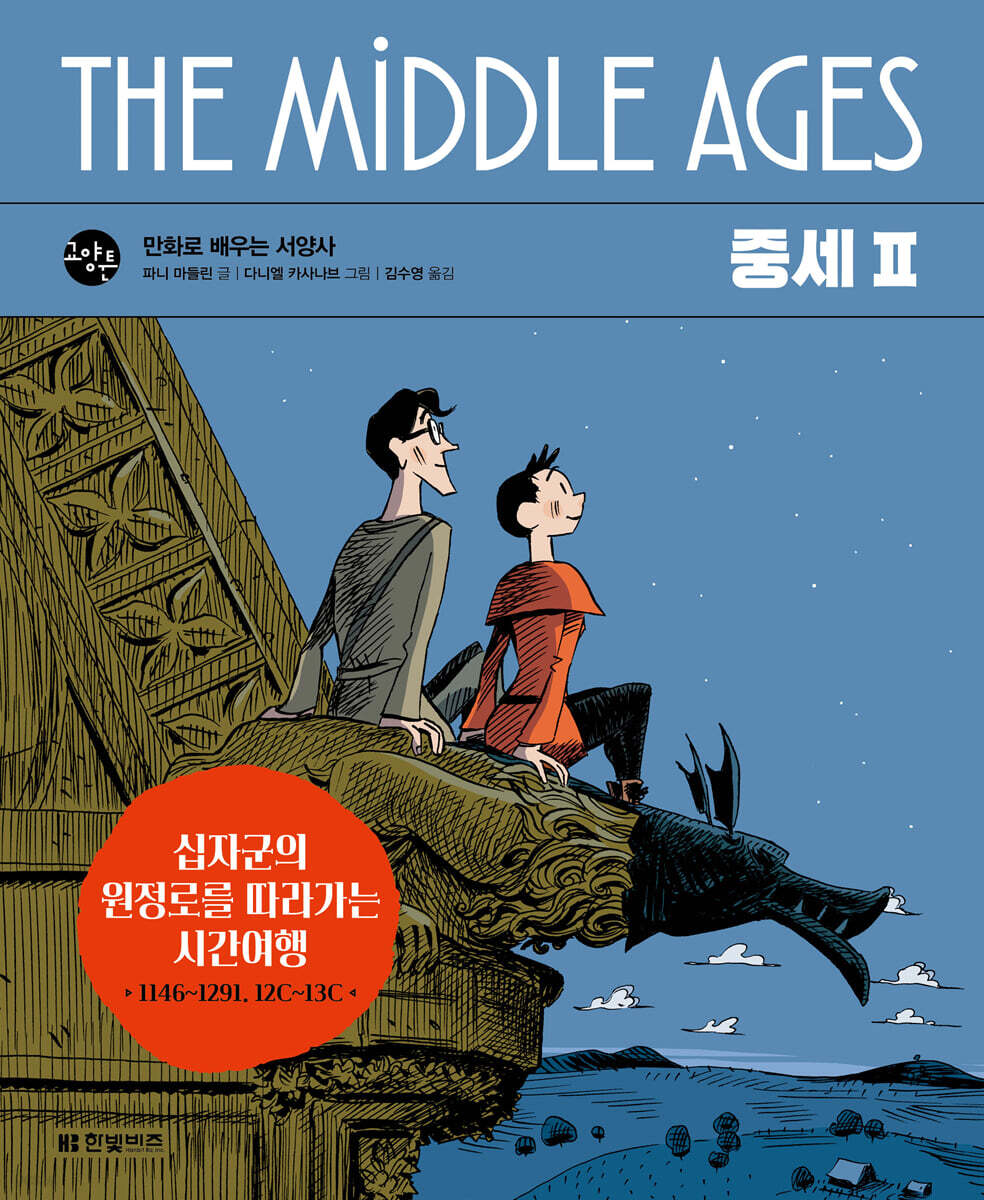
Two protagonists, passionate about the Crusades and Game of Thrones, embark on a journey to experience the Holy Land in the 12th and 13th centuries.
On this journey, which follows the footsteps of the Crusades rather than the legend of the Holy Grail, the two protagonists travel back and forth through centuries and meet interesting characters.
They tour the 12th and 13th centuries like travelers on a pilgrimage to the true Middle Ages.
As they travel, the two encounter monks who steal and sell relics, farmers who work hard to pay heavy taxes to their lords, soldiers who are used as tools in the Crusades, the Knights Templar, Arabs and Jews living in France who are accused of heresy, and religious figures who use the Crusades to establish their authority, and they learn about the Middle Ages.
After completing their time travel, the two conclude that it is important to view the Middle Ages objectively, not simply in a romantic or fantastical way, but rather in the diverse people who fiercely endured that time and the diverse human figures that could be seen even then, that the splendid cathedrals were not simply for tourist viewing, but were built to establish the authority of the royal family and the church, and that the Crusades were events that justified the sacrifice and massacre of many people under the pretext of a holy war.
When talking about the Middle Ages, the keywords that cannot be left out are ‘feudalism’, ‘Christianity’, and ‘the Crusades’.
This book contains the 'Crusades'.
Europe, which had begun to establish its system and foundation through feudalism and Christianity, fell into a state of panic as the first millennium approached, due to the 'Day of Judgment' mentioned in the Bible.
But as was the case with the second millennium, nothing happened, and European society quickly regained stability.
Cities tore down their old churches and built magnificent cathedrals, and soon pilgrimages to the Holy Land became popular.
This was because they believed that in order to go to heaven, they had to be forgiven of the sins they committed during their lifetime before they died.
Jerusalem, the center of pilgrimage, was under Islamic rule at the time, and while Islam did not block Christian pilgrimages, it did not welcome them either.
However, when the Christian cities around Jerusalem were taken over by Islamic forces, this gave rise to the Crusades, who wore clothing embroidered with crosses, and the Crusades began with the goal of recapturing the Holy Land.
Afterwards, the Crusades became a war in which the interests of the Pope, who sought to expand the papacy, the King of France, who sought to be recognized as a true Christian king, the feudal lords and knights who were developing new territories, the merchants who wanted to monopolize the profits of Mediterranean trade, and the peasants who wanted to gain freedom of status were intertwined.
A time travel to the Middle Ages along the Crusades
Two protagonists, passionate about the Crusades and Game of Thrones, embark on a journey to experience the Holy Land in the 12th and 13th centuries.
On this journey, which follows the footsteps of the Crusades rather than the legend of the Holy Grail, the two protagonists travel back and forth through centuries and meet interesting characters.
They tour the 12th and 13th centuries like travelers on a pilgrimage to the true Middle Ages.
As they travel, the two encounter monks who steal and sell relics, farmers who work hard to pay heavy taxes to their lords, soldiers who are used as tools in the Crusades, the Knights Templar, Arabs and Jews living in France who are accused of heresy, and religious figures who use the Crusades to establish their authority, and they learn about the Middle Ages.
After completing their time travel, the two conclude that it is important to view the Middle Ages objectively, not simply in a romantic or fantastical way, but rather in the diverse people who fiercely endured that time and the diverse human figures that could be seen even then, that the splendid cathedrals were not simply for tourist viewing, but were built to establish the authority of the royal family and the church, and that the Crusades were events that justified the sacrifice and massacre of many people under the pretext of a holy war.
GOODS SPECIFICS
- Publication date: April 23, 2021
- Page count, weight, size: 168 pages | 742g | 210*256*15mm
- ISBN13: 9791157845026
- ISBN10: 1157845029
You may also like
카테고리
korean


korean

![GQ KOREA Mark (Monthly): December [2025]](http://librairie.coreenne.fr/cdn/shop/files/8ef265dbbfbf186523ed75ba7319009d.jpg?v=1765340328&width=3840)


