

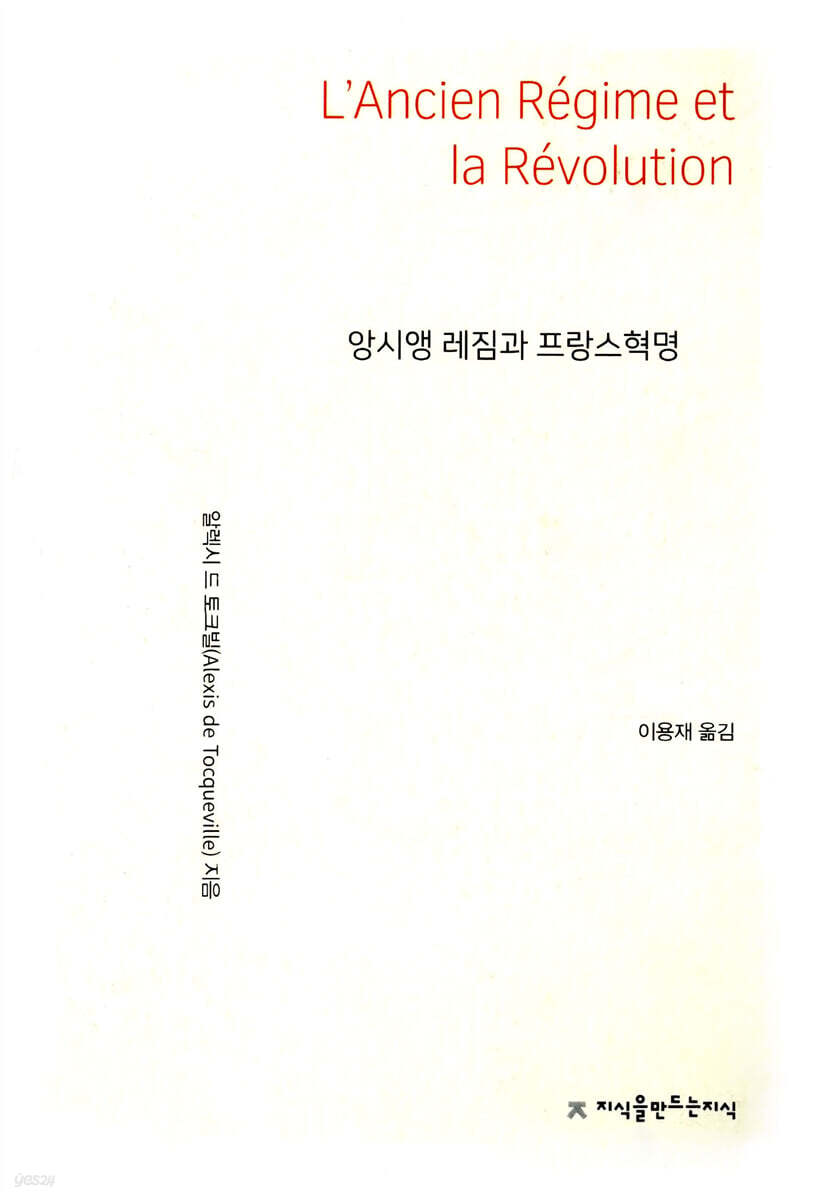
The Ancien Régime and the French Revolution
 |
Description
Book Introduction
This is the immortal masterpiece of Alexis de Tocqueville, who received public attention with “Democracy in America,” and systematically records the state of the Ancien Régime and the development of the French Revolution.
Drawing on documents collected from across France, this book examines the Ancien Régime closely and evaluates the enormous social upheaval it sparked, the French Revolution.
Through this, we attempted to trace the antagonistic relationship between freedom and equality, which are the basic principles of modern society, and to explore the possibility of equality within freedom.
This classic work provides a vivid glimpse into the society of the time, a perspective not found in existing writings, while also providing a perspective that allows us to look into the future through the lens of past history, through the appropriate harmony of a historian's insight into the past and a thinker's perspective on the present.
Drawing on documents collected from across France, this book examines the Ancien Régime closely and evaluates the enormous social upheaval it sparked, the French Revolution.
Through this, we attempted to trace the antagonistic relationship between freedom and equality, which are the basic principles of modern society, and to explore the possibility of equality within freedom.
This classic work provides a vivid glimpse into the society of the time, a perspective not found in existing writings, while also providing a perspective that allows us to look into the future through the lens of past history, through the appropriate harmony of a historian's insight into the past and a thinker's perspective on the present.
index
introduction
Part 1
Chapter 1: Conflicting Judgments About the Revolution When It Occurred
Chapter 2: In what ways was the ultimate and fundamental purpose of the Great Revolution not, as commonly believed, to destroy religious authority and weaken political power?
Chapter 3: How did the French Revolution become both a political and a religious revolution, and why?
Chapter 4: How did most of Europe come to have the same institutions, and why were they destroyed almost everywhere?
Chapter 5: What are the unique achievements of the French Revolution?
Part 2
Chapter 1: Why were feudal levies considered more severe in France than elsewhere?
Chapter 2: In what ways is administrative centralization an institution of the ancien régime, rather than, as is often said, a product of the Great Revolution or the Empire?
Chapter 3: How What Is Called Administrative Supervision Today Is an Institution of the Ancien Régime
Chapter 4: In what ways are administrative trials and civil servant immunity institutions of the ancien regime?
Chapter 5: How Centralization Could Position Itself in the Heart of Old Powers and Push Them Out Without Destroying Them
Chapter 6: Administrative Customs of the Ancien Régime
Chapter 7 How France Became the Country in Europe Where the Capital Overwhelmed the Provinces and Where It Absorbed the Entire Territory
Chapter 8: In what ways has France become the country where people are most alike?
Chapter 9: How People So Similar Came to Become More Strange and Indifferent to One Another
Chapter 10: How the Destruction of Political Liberty and the Separation of Classes Produced Almost All the Abuses That Collapsed the Ancien Régime
Chapter 11: On the Types of Freedom Appearing in the Ancien Régime and Their Influence on the Great Revolution
Chapter 12: How, Despite the Advances of Civilization, the Condition of the French Peasant Was Sometimes Worse in the Eighteenth Century Than in the Thirteenth
Part 3
Chapter 1: How did writers become key political figures in the mid-18th century, and what were the consequences?
Chapter 2: How did anti-religious sentiment become a common and dominant passion in 18th-century France, and what influence did it have on the character of the Revolution?
Chapter 3: How the French Wanted Reform Before They Wanted Freedom
Chapter 4: In what ways was the reign of Louis XVI the most prosperous of the old monarchies, and how this very prosperity hastened the Revolution.
Chapter 5: How Trying to Alleviate the People's Suffering Only Infuriated Them
Chapter 6: Some Government Practices That Helped Complete the Revolutionary Education of the People
Chapter 7: How a Great Administrative Revolution Preceded a Political Revolution, and What Were the Results?
Chapter 8: How the Great Revolution arose naturally from previous events.
Appendix to the provinces of the Order, especially Languedoc
Tocqueville's commentary
Alexis de Tocqueville and the Old Regime and the French Revolution / Georges Lefebvre
Ancien Régime administrative map
Search
commentary
About the author
Author's chronology
About the translator
Part 1
Chapter 1: Conflicting Judgments About the Revolution When It Occurred
Chapter 2: In what ways was the ultimate and fundamental purpose of the Great Revolution not, as commonly believed, to destroy religious authority and weaken political power?
Chapter 3: How did the French Revolution become both a political and a religious revolution, and why?
Chapter 4: How did most of Europe come to have the same institutions, and why were they destroyed almost everywhere?
Chapter 5: What are the unique achievements of the French Revolution?
Part 2
Chapter 1: Why were feudal levies considered more severe in France than elsewhere?
Chapter 2: In what ways is administrative centralization an institution of the ancien régime, rather than, as is often said, a product of the Great Revolution or the Empire?
Chapter 3: How What Is Called Administrative Supervision Today Is an Institution of the Ancien Régime
Chapter 4: In what ways are administrative trials and civil servant immunity institutions of the ancien regime?
Chapter 5: How Centralization Could Position Itself in the Heart of Old Powers and Push Them Out Without Destroying Them
Chapter 6: Administrative Customs of the Ancien Régime
Chapter 7 How France Became the Country in Europe Where the Capital Overwhelmed the Provinces and Where It Absorbed the Entire Territory
Chapter 8: In what ways has France become the country where people are most alike?
Chapter 9: How People So Similar Came to Become More Strange and Indifferent to One Another
Chapter 10: How the Destruction of Political Liberty and the Separation of Classes Produced Almost All the Abuses That Collapsed the Ancien Régime
Chapter 11: On the Types of Freedom Appearing in the Ancien Régime and Their Influence on the Great Revolution
Chapter 12: How, Despite the Advances of Civilization, the Condition of the French Peasant Was Sometimes Worse in the Eighteenth Century Than in the Thirteenth
Part 3
Chapter 1: How did writers become key political figures in the mid-18th century, and what were the consequences?
Chapter 2: How did anti-religious sentiment become a common and dominant passion in 18th-century France, and what influence did it have on the character of the Revolution?
Chapter 3: How the French Wanted Reform Before They Wanted Freedom
Chapter 4: In what ways was the reign of Louis XVI the most prosperous of the old monarchies, and how this very prosperity hastened the Revolution.
Chapter 5: How Trying to Alleviate the People's Suffering Only Infuriated Them
Chapter 6: Some Government Practices That Helped Complete the Revolutionary Education of the People
Chapter 7: How a Great Administrative Revolution Preceded a Political Revolution, and What Were the Results?
Chapter 8: How the Great Revolution arose naturally from previous events.
Appendix to the provinces of the Order, especially Languedoc
Tocqueville's commentary
Alexis de Tocqueville and the Old Regime and the French Revolution / Georges Lefebvre
Ancien Régime administrative map
Search
commentary
About the author
Author's chronology
About the translator
Into the book
Only freedom can save citizens from the worship of money and the tangled web of personal affairs, and ensure that they are always aware that their country is beside them or above them.
Only freedom can sometimes replace the love of comfort with a more intense and noble passion, can awaken ambition for loftier ends beyond the acquisition of wealth, and can provide the light by which human virtues and vices can be discerned.
---p.
15
Some people persistently yearn for freedom despite all kinds of adversity and danger.
What they seek in freedom is not the material gain it will bring.
They consider freedom to be very precious and essential to human happiness.
For them, there can be no other value that can compensate for the loss of freedom.
On the other hand, as some people seek prosperity, they become weary of freedom.
They allow their freedom to be taken away without any resistance, for fear that the comfort they enjoy will be damaged even in the slightest.
What do they need to remain truly free? It goes without saying that it's a genuine desire to be free.
But don't ask me to analyze this sublime taste.
It's a matter of feeling before logic.
In short, it is a privilege that only those with great character and grace from God can enjoy.
Those who possess a lowly soul and do not receive God's grace will never enjoy it.
---pp.
295~296
Revolutions do not necessarily occur only when things are getting worse.
It often happens that people who have tolerated the most oppressive governments without complaint, as if they felt nothing at all, rebel violently against the government the moment the pressure is eased.
Therefore, a system destroyed by revolution is usually better than the one that immediately preceded it.
And history teaches us that the most dangerous moment for a corrupt government is usually when it begins to reform itself.
After a long period of tyranny, a monarch who seeks to improve the lot of his citizens will require extraordinary political skill to retain his throne.
Tyranny, once accepted as inevitable and tolerated, becomes an oppression that is difficult to endure as soon as the possibility of escape from it arises in people's minds.
Because when some of the evils are corrected, the evils that remain uncorrected become more intolerable.
In short, the less pain people experience, the more sensitive they become.
---pp.
308~309
Readers who carefully examine 18th-century France while reading this book will see two important passions developing and growing at that time.
Of course, these two passions did not necessarily exist or had the same goals.
One is deeper and more ancient: a fierce and unquenchable hatred of inequality.
Everyone is born with a natural hatred for inequality, having personally seen and experienced it.
Thus, the French have long maintained a persistent and irresistible will to uproot the remnants of medieval institutions and to build in their place a society in which all men are homogeneous and in conditions as equal as possible.
The other, newer and less entrenched, is the desire to live not only equally but also freely.
Only freedom can sometimes replace the love of comfort with a more intense and noble passion, can awaken ambition for loftier ends beyond the acquisition of wealth, and can provide the light by which human virtues and vices can be discerned.
---p.
15
Some people persistently yearn for freedom despite all kinds of adversity and danger.
What they seek in freedom is not the material gain it will bring.
They consider freedom to be very precious and essential to human happiness.
For them, there can be no other value that can compensate for the loss of freedom.
On the other hand, as some people seek prosperity, they become weary of freedom.
They allow their freedom to be taken away without any resistance, for fear that the comfort they enjoy will be damaged even in the slightest.
What do they need to remain truly free? It goes without saying that it's a genuine desire to be free.
But don't ask me to analyze this sublime taste.
It's a matter of feeling before logic.
In short, it is a privilege that only those with great character and grace from God can enjoy.
Those who possess a lowly soul and do not receive God's grace will never enjoy it.
---pp.
295~296
Revolutions do not necessarily occur only when things are getting worse.
It often happens that people who have tolerated the most oppressive governments without complaint, as if they felt nothing at all, rebel violently against the government the moment the pressure is eased.
Therefore, a system destroyed by revolution is usually better than the one that immediately preceded it.
And history teaches us that the most dangerous moment for a corrupt government is usually when it begins to reform itself.
After a long period of tyranny, a monarch who seeks to improve the lot of his citizens will require extraordinary political skill to retain his throne.
Tyranny, once accepted as inevitable and tolerated, becomes an oppression that is difficult to endure as soon as the possibility of escape from it arises in people's minds.
Because when some of the evils are corrected, the evils that remain uncorrected become more intolerable.
In short, the less pain people experience, the more sensitive they become.
---pp.
308~309
Readers who carefully examine 18th-century France while reading this book will see two important passions developing and growing at that time.
Of course, these two passions did not necessarily exist or had the same goals.
One is deeper and more ancient: a fierce and unquenchable hatred of inequality.
Everyone is born with a natural hatred for inequality, having personally seen and experienced it.
Thus, the French have long maintained a persistent and irresistible will to uproot the remnants of medieval institutions and to build in their place a society in which all men are homogeneous and in conditions as equal as possible.
The other, newer and less entrenched, is the desire to live not only equally but also freely.
---p.
357
357
Publisher's Review
A month before the February Revolution broke out in France in 1848, there was a noble politician who foresaw the coming fury of revolution, warning in parliament that if the ruling class did not reform itself, the popular anger would soon explode.
He predicted that the severe social unrest caused by political inequality and the polarization of rich and poor would eventually lead to another French Revolution.
He is Alexis de Tocqueville.
According to Tocqueville, members of modern society have an ambivalent attitude toward equality.
It is the 'valiant and just passion for equality' that leads the weak to the ranks of the strong, and the 'depraved taste for equality' that causes the weak to bring the strong down to their level.
Tocqueville examines the trends of modern democratic society from this perspective, and unfortunately, he sees the second attribute as one that tends to become more deeply ingrained in people's minds than the first.
Materialism and individualism, born of a "depraved taste for equality," lead people to willingly give up their freedom for comfort, thereby expanding political power, while also corroding the public spirit and fostering political apathy.
As the people try to elect leaders who are advantageous to their own interests, politics becomes an arena for partisan struggles, and the quality of politicians declines.
Tocqueville's argument is that when anyone takes advantage of the people's political apathy and steps forward to represent their voice, a dictatorship disguised as democracy will emerge.
He finds the cure to eradicate these harms and abuses in the restoration of 'political freedom.'
Only political freedom can rescue the members of a community from personal apathy and political indifference and lead them into a public world filled with virtue and responsibility.
According to "The Old Regime and the French Revolution," written from this perspective, the French Revolution promoted democratic consciousness among the people and gave them the appearance of sovereignty by putting forward the principle of freedom in opposition to the absolute monarchy and feudal aristocracy. This equalization of political power inevitably led to social equalization.
However, the French Revolution failed to establish freedom due to the people's excessive desire and passion for equality.
His diagnosis is that the old principles of authority, which had been overthrown and seemed to have disappeared in the early days of the revolution, were revived and ultimately brought about Napoleon's military dictatorship.
This book goes beyond a simple chronological overview of the state of the ancien régime and the unfolding of the revolution.
Tocqueville dedicated four years to writing this book, visiting archives in Paris and the provinces, meticulously examining writings, official documents, minutes, petitions, etc. of the time, and even going on a field trip to Germany to compare and study the political structure of the Ancien Régime.
Therefore, it is a classic that allows us to vividly see aspects of society at the time that could not be seen in existing writings, and at the same time, it provides a perspective that allows us to look into the future through past history, with the historian's insight into the past and the thinker's perspective contemplating the present in an appropriate harmony.
He predicted that the severe social unrest caused by political inequality and the polarization of rich and poor would eventually lead to another French Revolution.
He is Alexis de Tocqueville.
According to Tocqueville, members of modern society have an ambivalent attitude toward equality.
It is the 'valiant and just passion for equality' that leads the weak to the ranks of the strong, and the 'depraved taste for equality' that causes the weak to bring the strong down to their level.
Tocqueville examines the trends of modern democratic society from this perspective, and unfortunately, he sees the second attribute as one that tends to become more deeply ingrained in people's minds than the first.
Materialism and individualism, born of a "depraved taste for equality," lead people to willingly give up their freedom for comfort, thereby expanding political power, while also corroding the public spirit and fostering political apathy.
As the people try to elect leaders who are advantageous to their own interests, politics becomes an arena for partisan struggles, and the quality of politicians declines.
Tocqueville's argument is that when anyone takes advantage of the people's political apathy and steps forward to represent their voice, a dictatorship disguised as democracy will emerge.
He finds the cure to eradicate these harms and abuses in the restoration of 'political freedom.'
Only political freedom can rescue the members of a community from personal apathy and political indifference and lead them into a public world filled with virtue and responsibility.
According to "The Old Regime and the French Revolution," written from this perspective, the French Revolution promoted democratic consciousness among the people and gave them the appearance of sovereignty by putting forward the principle of freedom in opposition to the absolute monarchy and feudal aristocracy. This equalization of political power inevitably led to social equalization.
However, the French Revolution failed to establish freedom due to the people's excessive desire and passion for equality.
His diagnosis is that the old principles of authority, which had been overthrown and seemed to have disappeared in the early days of the revolution, were revived and ultimately brought about Napoleon's military dictatorship.
This book goes beyond a simple chronological overview of the state of the ancien régime and the unfolding of the revolution.
Tocqueville dedicated four years to writing this book, visiting archives in Paris and the provinces, meticulously examining writings, official documents, minutes, petitions, etc. of the time, and even going on a field trip to Germany to compare and study the political structure of the Ancien Régime.
Therefore, it is a classic that allows us to vividly see aspects of society at the time that could not be seen in existing writings, and at the same time, it provides a perspective that allows us to look into the future through past history, with the historian's insight into the past and the thinker's perspective contemplating the present in an appropriate harmony.
GOODS SPECIFICS
- Date of issue: April 10, 2013
- Page count, weight, size: 540 pages | 128*188*35mm
- ISBN13: 9788966807673
- ISBN10: 8966807674
You may also like
카테고리
korean


korean

![GQ KOREA Mark (Monthly): December [2025]](http://librairie.coreenne.fr/cdn/shop/files/8ef265dbbfbf186523ed75ba7319009d.jpg?v=1765340328&width=3840)


