

Sejong as seen by 10 Joseon politicians
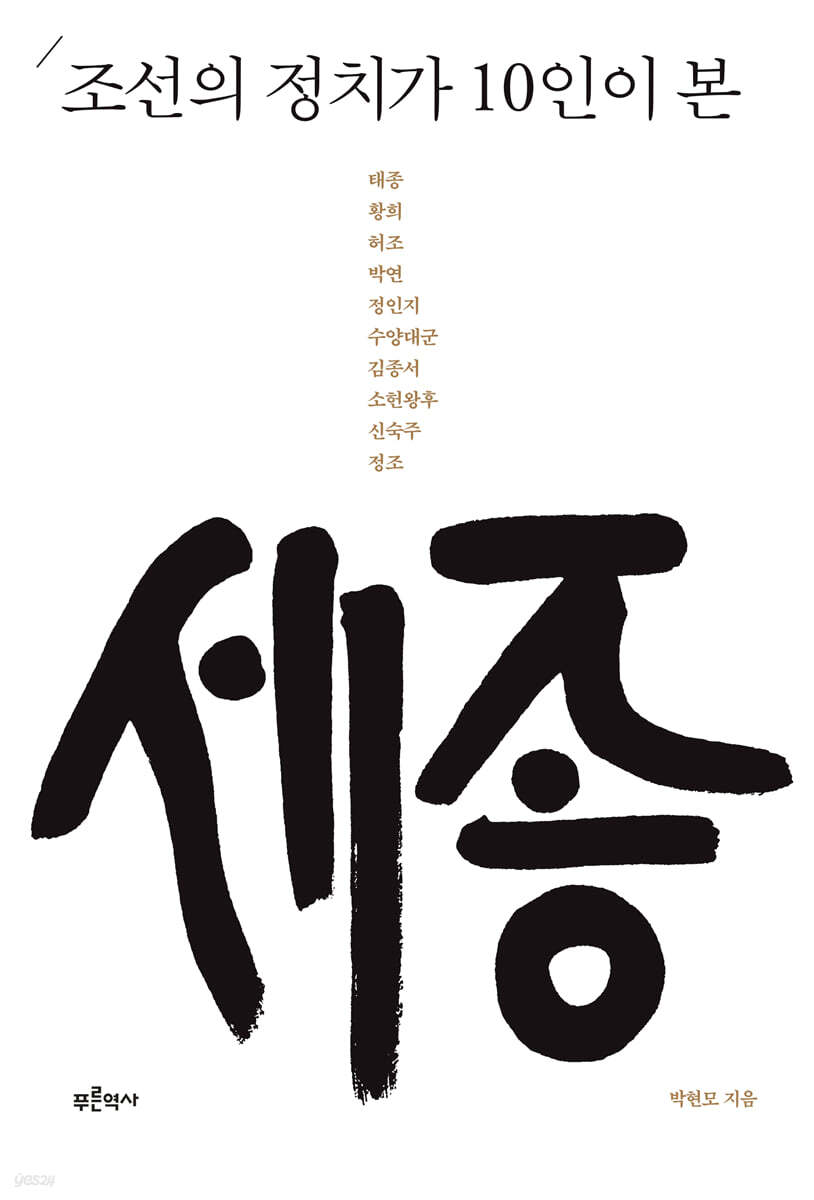 |
Description
Book Introduction
Let’s take away the flowery adjectives used to describe Sejong,
A book that vividly portrays the true face of 'Politician Sejong' through historical records and testimonies.
Sejong, the saintly king representing Joseon.
However, the adjectives 'great monarch' and 'outstanding leader' alone are not enough to describe his entire politics.
This book, “Sejong as Seen by 10 Joseon Politicians,” portrays the true nature of “Sejong the Politician,” who laid the foundation for the 500-year Joseon Dynasty.
In 『Sejong, Marching Outside the Annals』(2007), the author portrayed Sejong through the perspectives of Hwang Hui, Kim Jong-seo, Jeong In-ji, and Shin Suk-ju. In this book, the author not only adds the voice of Sejong's wife, Queen Soheon, but also precisely restores the peculiarities of Sejong's politics as viewed by kings such as Taejong and Jeongjo, thereby getting closer to the multifaceted reality of the virtuous king Sejong.
Through this, the author sought to go beyond the portrait of an idealized monarch and approach the 'essence of Sejong's politics', which contained both the light and dark sides of human conflict, strategy, and judgment.
A book that vividly portrays the true face of 'Politician Sejong' through historical records and testimonies.
Sejong, the saintly king representing Joseon.
However, the adjectives 'great monarch' and 'outstanding leader' alone are not enough to describe his entire politics.
This book, “Sejong as Seen by 10 Joseon Politicians,” portrays the true nature of “Sejong the Politician,” who laid the foundation for the 500-year Joseon Dynasty.
In 『Sejong, Marching Outside the Annals』(2007), the author portrayed Sejong through the perspectives of Hwang Hui, Kim Jong-seo, Jeong In-ji, and Shin Suk-ju. In this book, the author not only adds the voice of Sejong's wife, Queen Soheon, but also precisely restores the peculiarities of Sejong's politics as viewed by kings such as Taejong and Jeongjo, thereby getting closer to the multifaceted reality of the virtuous king Sejong.
Through this, the author sought to go beyond the portrait of an idealized monarch and approach the 'essence of Sejong's politics', which contained both the light and dark sides of human conflict, strategy, and judgment.
- You can preview some of the book's contents.
Preview
index
Drawing Sejong
Introduction
│To meet Sejong again
ㆍSejong as seen by Taejong
│The King's Conditions and Sejong's Political Vision
ㆍSejong as seen by Hwang Hui 1
The Conquest of Tsushima Island and Offensive Security Policy
ㆍSejong as seen by Hwang Hui 2
I Want to Live in Joseon - The Mass Naturalization Phenomenon During the Sejong Era
ㆍSejong as seen by Heo Jo 1
Politics of Care for the Socially Underprivileged
ㆍSejong as seen by Heo Jo 2
The Achilles' heel of Sejong's politics: the issue of succession to the throne.
ㆍSejong as seen by Park Yeon
Find Joseon's Hwang Jong-eum
ㆍSejong as seen by Jeong In-ji
│Beyond academic chauvinism
ㆍSejong as seen by Prince Suyang
│For whom is this country?
ㆍKim Jong-seo's view of King Sejong
│A Great Debate on the Conquest of Pajeogang
ㆍSejong seen from Queen Soheon's perspective
A person with utmost sincerity who impresses those around him
ㆍSejong as seen by Shin Suk-ju
Two Paths Within the Think Tank Jiphyeonjeon
ㆍSejong as seen by King Jeongjo
│Entrust, prepare, and seize the opportunity.
Epilogue
Search
Introduction
│To meet Sejong again
ㆍSejong as seen by Taejong
│The King's Conditions and Sejong's Political Vision
ㆍSejong as seen by Hwang Hui 1
The Conquest of Tsushima Island and Offensive Security Policy
ㆍSejong as seen by Hwang Hui 2
I Want to Live in Joseon - The Mass Naturalization Phenomenon During the Sejong Era
ㆍSejong as seen by Heo Jo 1
Politics of Care for the Socially Underprivileged
ㆍSejong as seen by Heo Jo 2
The Achilles' heel of Sejong's politics: the issue of succession to the throne.
ㆍSejong as seen by Park Yeon
Find Joseon's Hwang Jong-eum
ㆍSejong as seen by Jeong In-ji
│Beyond academic chauvinism
ㆍSejong as seen by Prince Suyang
│For whom is this country?
ㆍKim Jong-seo's view of King Sejong
│A Great Debate on the Conquest of Pajeogang
ㆍSejong seen from Queen Soheon's perspective
A person with utmost sincerity who impresses those around him
ㆍSejong as seen by Shin Suk-ju
Two Paths Within the Think Tank Jiphyeonjeon
ㆍSejong as seen by King Jeongjo
│Entrust, prepare, and seize the opportunity.
Epilogue
Search
Into the book
“Do not ask about sins committed before the pardon.”
“I am afraid that the punishment may have lost its way and the lamentations of the resentful may have damaged the harmony,” he said, and issued an amnesty for the entire country. He also said that no one should be held accountable for wrongdoings committed before the amnesty.
As the proverb goes, "A stone that was lifted to catch a rat is put down again for fear of breaking the jar," the king tried to protect the authority of the country and also save talented people by not mechanically applying laws.
--- p.94
If you carefully examine the talents that Hwang Hee and others have selected from here and there, you will find that there is not a single person without flaws.
Prime Minister Hwang Hee himself was a problematic person.
However, if we examine whether he is a 'public official necessary for the country' rather than his 'personal morality', a different conclusion is often reached.
--- p.111
King Sejong called Jiphyeonjeon “the place where the nation’s talents gather.”
Research takes a long time, and only mature and refined data is considered “useful for the country.”
--- p.282
He (Sejong) did not express any opinion until the moment his father-in-law, Sim On, died.
Even when our family was ruined overnight due to Kang Sang-in's false confession, he didn't say a word.
Even when Park Eun-i insisted on deposing the queen, saying, "We cannot have a sinner's daughter as queen," he remained silent.
--- p.249
To overcome this obstacle, Sejong listened to the opinions of his subjects, but constantly demanded that they speak frankly.
“All officials, great and small, should speak out freely and without hesitation about my mistakes and the wrongdoings of my government, and about the good and bad of the people, so as to live up to my utmost thoughts of fearing Heaven and caring for the people.”
“I am afraid that the punishment may have lost its way and the lamentations of the resentful may have damaged the harmony,” he said, and issued an amnesty for the entire country. He also said that no one should be held accountable for wrongdoings committed before the amnesty.
As the proverb goes, "A stone that was lifted to catch a rat is put down again for fear of breaking the jar," the king tried to protect the authority of the country and also save talented people by not mechanically applying laws.
--- p.94
If you carefully examine the talents that Hwang Hee and others have selected from here and there, you will find that there is not a single person without flaws.
Prime Minister Hwang Hee himself was a problematic person.
However, if we examine whether he is a 'public official necessary for the country' rather than his 'personal morality', a different conclusion is often reached.
--- p.111
King Sejong called Jiphyeonjeon “the place where the nation’s talents gather.”
Research takes a long time, and only mature and refined data is considered “useful for the country.”
--- p.282
He (Sejong) did not express any opinion until the moment his father-in-law, Sim On, died.
Even when our family was ruined overnight due to Kang Sang-in's false confession, he didn't say a word.
Even when Park Eun-i insisted on deposing the queen, saying, "We cannot have a sinner's daughter as queen," he remained silent.
--- p.249
To overcome this obstacle, Sejong listened to the opinions of his subjects, but constantly demanded that they speak frankly.
“All officials, great and small, should speak out freely and without hesitation about my mistakes and the wrongdoings of my government, and about the good and bad of the people, so as to live up to my utmost thoughts of fearing Heaven and caring for the people.”
--- p.315
Publisher's Review
A political docudrama that reconstructs historical records
The author cites a vast amount of historical materials, including the Annals of the Joseon Dynasty, the Complete Works of Yulgok, the Compilation of Yeonryeo Silgisul, the Akhak Gwebeom, and the Bohanjae Collection, and maintains a thoroughly historical-centered structure by specifying the sources for each sentence.
As the author says, he put all his effort into meticulously reconstructing the material, as if he were rearranging it with scissors and glue (page 10).
But this book is not just about reading the materials.
The scenes in the historical records are vividly brought to life “as if on a live broadcast,” and even the characters’ facial expressions, conflicts, and speech patterns are vividly presented before the readers’ eyes.
This is a three-dimensional historical narrative that exquisitely combines the author's inner strength and imagination, having read the Annals of King Sejong over 20 times.
'Sejong's Leadership' as Testified by Politicians
In this book, Sejong is reconstructed not as a single person, but as a political being seen through the eyes of several people.
ㆍJeong In-ji 'fiercely' portrays the pride of King Sejong, who wanted to compete with China in knowledge.
ㆍShin Suk-ju, who deposed Danjong and sided with Sejo, recalls the ‘good fence’ of Sejong, but also faces the harshness of politics.
ㆍWhat was Sejong's view on talent as seen by Hwang Hee, the 'HR executive'?
We reveal the faces of the talents selected and protected by Hwang Hee himself, the greatest beneficiary of Sejong's talent management that covered up public corruption.
ㆍThe Sejong observed by Kim Jong-seo was a meticulous strategist.
Kim Jong-seo analyzes the strange behavior of suddenly leaving for a hot spring while working hard to make Baekdu Mountain our territory with a desperate heart that says, “Even if it is a remote village, we cannot abandon the land our ancestors have protected” (p. 226).
ㆍHeo Jo vividly depicts Sejong's embarrassed expression as he deals with sex scandals such as the Yu Gam-dong incident and the Crown Princess's homosexuality.
This passage also allows us to read King Sejong's political judgment that the incident should be covered up because digging deeper would bring more harm than good.
As we follow each character's narration, we soon come across the politics of Sejong and the other side of the Sejong era.
Sejong practiced the 'politics of listening' by being careful with his words and keeping his ears open, especially as he was wary of the repercussions that a single word from the monarch could have.
The passage mentioning the example of Yuwen Shigeup of the Tang Dynasty, and expressing caution against flattery and excessive praise, provides many implications for today's leaders.
What is good politics? Asked through the bare-faced Sejong.
This book illuminates not only Sejong's brilliant achievements, but also his limitations and mistakes, such as the lack of succession to the throne, the exhaustion of the anti-Buddhist debate, and his excessive sense of disconnection from the Goryeo Dynasty.
The author seeks to bring Sejong down from the acclaim of being "the greatest monarch in history" and to present criteria for distinguishing between good and bad politics.
Through this, we invite readers on a journey to find a ‘Korean model of good politics.’
It is a book that is easy to read, but not something you can just read through, and it offers many new insights into 21st century Korea.
The author cites a vast amount of historical materials, including the Annals of the Joseon Dynasty, the Complete Works of Yulgok, the Compilation of Yeonryeo Silgisul, the Akhak Gwebeom, and the Bohanjae Collection, and maintains a thoroughly historical-centered structure by specifying the sources for each sentence.
As the author says, he put all his effort into meticulously reconstructing the material, as if he were rearranging it with scissors and glue (page 10).
But this book is not just about reading the materials.
The scenes in the historical records are vividly brought to life “as if on a live broadcast,” and even the characters’ facial expressions, conflicts, and speech patterns are vividly presented before the readers’ eyes.
This is a three-dimensional historical narrative that exquisitely combines the author's inner strength and imagination, having read the Annals of King Sejong over 20 times.
'Sejong's Leadership' as Testified by Politicians
In this book, Sejong is reconstructed not as a single person, but as a political being seen through the eyes of several people.
ㆍJeong In-ji 'fiercely' portrays the pride of King Sejong, who wanted to compete with China in knowledge.
ㆍShin Suk-ju, who deposed Danjong and sided with Sejo, recalls the ‘good fence’ of Sejong, but also faces the harshness of politics.
ㆍWhat was Sejong's view on talent as seen by Hwang Hee, the 'HR executive'?
We reveal the faces of the talents selected and protected by Hwang Hee himself, the greatest beneficiary of Sejong's talent management that covered up public corruption.
ㆍThe Sejong observed by Kim Jong-seo was a meticulous strategist.
Kim Jong-seo analyzes the strange behavior of suddenly leaving for a hot spring while working hard to make Baekdu Mountain our territory with a desperate heart that says, “Even if it is a remote village, we cannot abandon the land our ancestors have protected” (p. 226).
ㆍHeo Jo vividly depicts Sejong's embarrassed expression as he deals with sex scandals such as the Yu Gam-dong incident and the Crown Princess's homosexuality.
This passage also allows us to read King Sejong's political judgment that the incident should be covered up because digging deeper would bring more harm than good.
As we follow each character's narration, we soon come across the politics of Sejong and the other side of the Sejong era.
Sejong practiced the 'politics of listening' by being careful with his words and keeping his ears open, especially as he was wary of the repercussions that a single word from the monarch could have.
The passage mentioning the example of Yuwen Shigeup of the Tang Dynasty, and expressing caution against flattery and excessive praise, provides many implications for today's leaders.
What is good politics? Asked through the bare-faced Sejong.
This book illuminates not only Sejong's brilliant achievements, but also his limitations and mistakes, such as the lack of succession to the throne, the exhaustion of the anti-Buddhist debate, and his excessive sense of disconnection from the Goryeo Dynasty.
The author seeks to bring Sejong down from the acclaim of being "the greatest monarch in history" and to present criteria for distinguishing between good and bad politics.
Through this, we invite readers on a journey to find a ‘Korean model of good politics.’
It is a book that is easy to read, but not something you can just read through, and it offers many new insights into 21st century Korea.
GOODS SPECIFICS
- Date of issue: July 29, 2025
- Page count, weight, size: 324 pages | 286g | 152*224*18mm
- ISBN13: 9791156122975
- ISBN10: 115612297X
You may also like
카테고리
korean


korean

![GQ KOREA Mark (Monthly): December [2025]](http://librairie.coreenne.fr/cdn/shop/files/8ef265dbbfbf186523ed75ba7319009d.jpg?v=1765340328&width=3840)


