

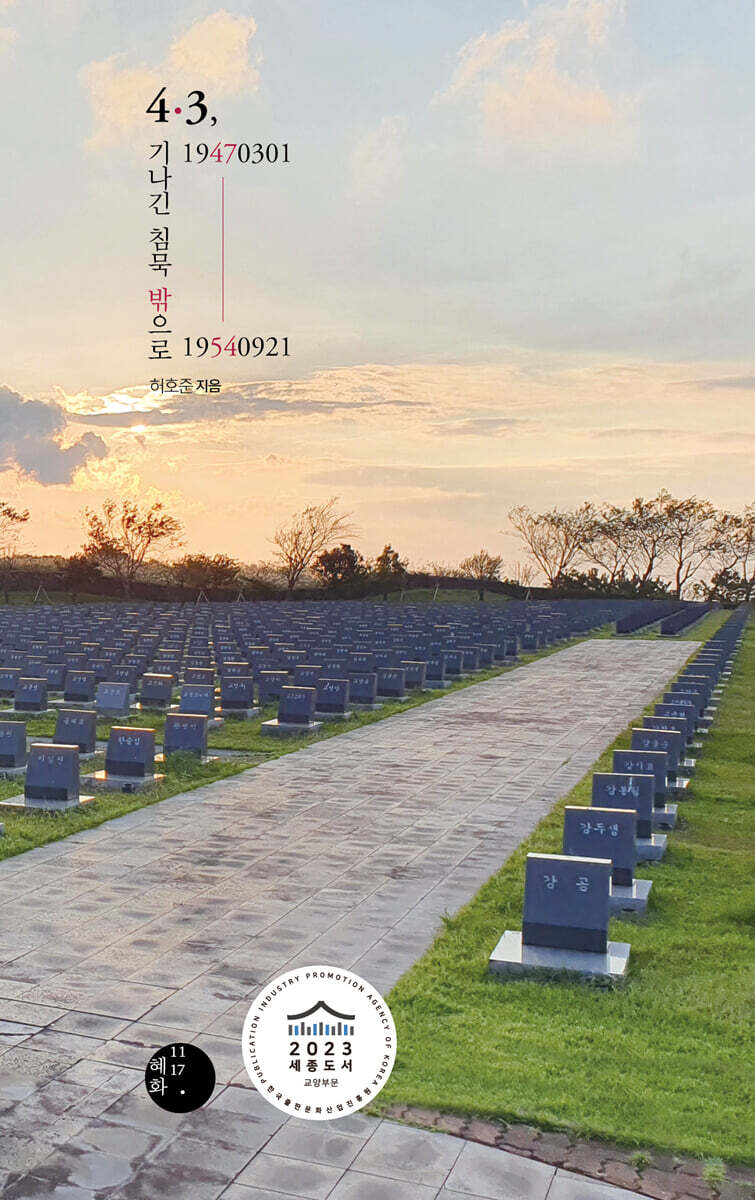
4.3, 19470301-19540921
 |
Description
Book Introduction
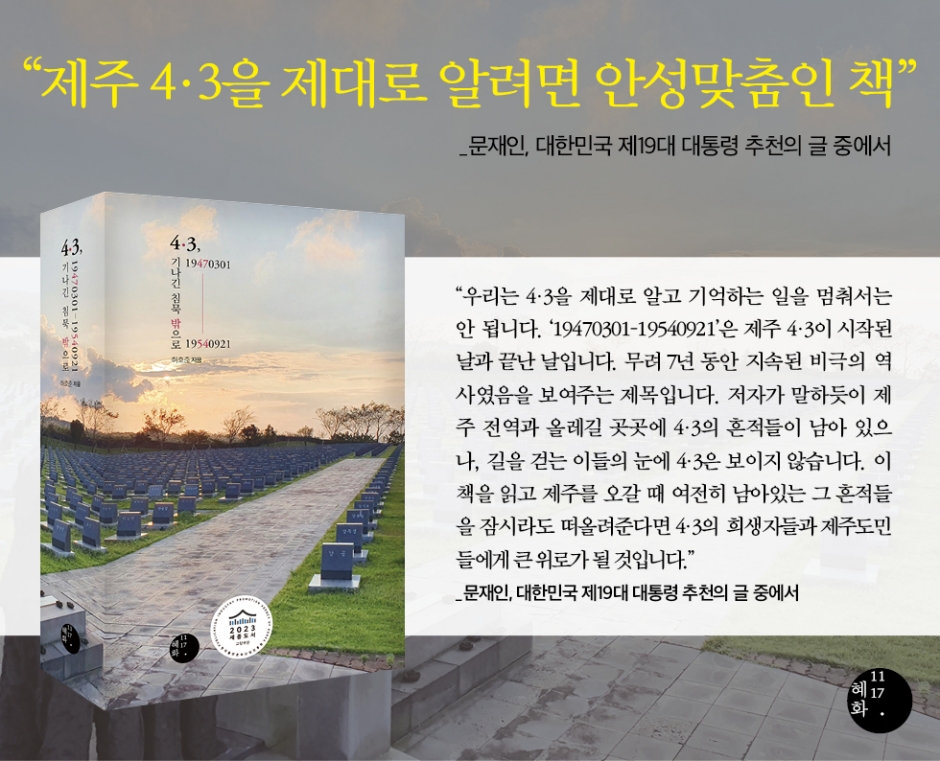
4/3, a fateful encounter 30 years ago The result of one person's persistent pursuit of the April 3 Incident, a lifelong journey as a journalist and researcher. Acquiring a window that allows you to properly view April 3rd, a very useful guide! For the author, who was born and raised in Jeju, the April 3rd Incident was nothing more than a vague old story during his school days. As an adult and a journalist, he recalls that he encountered the April 3rd Incident as if it were fate. It's already been 30 years. For over 30 years, he has covered and published countless articles related to the April 3rd Incident, and conducted numerous interviews with survivors and their families. Going a step further, the author viewed the April 3 Incident not only within Jeju but also within its historical context, and also devoted effort to tracing its relationship with the United States. His reporting and records laid the foundation for uncovering the truth about the April 3rd Incident and restoring the honor of the victims. By contributing to widely informing the public about the true nature of the April 3rd Incident, he demonstrated the true role that a journalist can and must play in this era. April 3rd also affected his life. He regarded the April 3rd Incident as his destiny, and did not stop at his role as a reporter and recorder. He focused on the role and responsibility of the United States and the significance of the April 3rd Incident in world history, and thus pursued his path as a researcher who made the April 3rd Incident an academic topic by earning a doctorate in political science. This book is the culmination and condensation of the author's 30-plus years of research as a journalist and researcher into the truth and meaning of the April 3rd Incident. Through this book, we now have a window through which to properly view the April 3rd Incident, and at the same time, a very useful guide. The 75th anniversary commemoration ceremony will be held in Jeju on April 3, 2023. How should we approach the memorial service held every spring? This book will be the starting point of your journey to find the answer. |
- You can preview some of the book's contents.
Preview
index
· April 3rd in photos
· Publishing a book
· Preface
1.
History: 2,762 days from that day
The whirlwind of the Pacific War engulfed Jeju Island | The spirit of unity and struggle that flows through Jeju's history | Dreaming of a liberated, autonomous island | The imposition of the US military government, the beginning of chaos | Economic hardship, food shortages, and infectious diseases: dark clouds forming a triangle | March 1st: Gunshots that shook Jeju, a general strike by the enraged people | The incompetence of the US military government, the tyranny of the police and right-wingers, torture and terrorism | The US blockade policy: turning South Korea into an anti-communist outpost! | Oppression and a series of torture-related deaths: igniting an armed uprising | April 3, 1948: A critical explosion, beacon fires burning on every mountain peak | The failure of the May 10 elections in Jeju Island, a prelude to a powerful suppression operation | Jeju Island reduced to ashes, the people of Jeju Island called communists | 2,762 days from March 1, 1947 to September 21, 1954
2.
Unfinished history: From that day to today
Half a Century of Repression and Taboo | The June Struggle of 1987: The Beginning of the Journey to Unravel the Truth | 2007 Excavation of Remains at Jeju International Airport: Victims Unveiled | President Roh Moo-hyun Officially Apologizes for State Power's Mistakes | President Moon Jae-in: "The April 3 Incident is an Indisputable Historical Fact" | 2021: Comprehensive Revision of the April 3 Special Act | Restoration of Honor for April 3 Inmates, in the Name of Retrial | Slow but Progressive History: The Unstoppable Path to Unraveling the Truth
3.
Traces 1: Those Days on the Olle Trail
Olle Course 1, Mother's Silver Ring Buried at the Site of the Massacre at Seongsan Ilchulbong Peak | Olle Course 8, 'A Prayer to Remember the April 3rd Incident' at Jungmun Cathedral | Olle Course 10, The Sad History of the Japanese Colonial Period, the Dark Side of the April 3rd Incident at Every Crossroads | Olle Course 14, The Story of Unknown Grandmother Jin A-young | Olle Course 17, Passing Jeju International Airport to Gwandeokjeong | Olle Course 18, Distillery Prison Camp and the Bloody Sea of Goneul-dong | Olle Course 21, The Epicenter of the Haenyeo Struggle Becomes a Massacre Site
4.
The Lens of the United States and the Cold War
The Face of America: What Does Jeju Island Mean to Them? | South Korea, an Ideological Battleground | The US-Soviet Debate Surrounding Jeju, a Geopolitical Critical Spot | The US Military Government's Operational Plan: "US Forces Will Not Intervene," But | The Failure of the May 10th Election: A US Destroyer Dispatched to Jeju | Are They Free from Responsibility for the "Mass Massacre of Civilians"? | "Soviet Submarines Appeared in Jeju": The Reason for This False Report? | The Communication Between Syngman Rhee and Muccio Surrounding the Jeju Island Suppression | The US's Continued Interest in Jeju Island
5.
Those Who Left · April 3rd Diaspora
My brother went north | "We have to leave Jeju no matter what," the land they chose was Japan again | "They're arresting Korean smugglers every day" | "Don't come back, even if you die," the grandmother's last words to her eldest son | "I don't want to bow to those who killed my mother," the story of changing her name and living in Japan | "The memories are so vivid, I've never forgotten them," the Koreans in Japan still angry
6.
Anti-Western Confectionery Movement and First Confrontation with the US Military Government in Jeju Island
The temptation of sweet Western snacks | The bait of Joseon's exploitation, candy | Give me rice instead of drops! | The cost of importing Western snacks for the US military government: 105,000 seoks of white rice | The Jeju student-led anti-Western snack movement | The Jeju youth student protests and the disbandment of the US military government | He who participated in the anti-Western snack movement escaped death and went to Japan.
7.
Witnesses, the first moments, the people who were there
The March 1st Incident, the victims that day | The youngest victim, Heo Du-yong from Orari, a neighborhood junior, saw and heard that day | Park Jae-ok, holding a child, a primary school student who saw her collapse | A son who lost his father cannot forget the father who begged for his life | Oh Young-soo from Arari, the last memory of a father | 'They' were at every scene, witness testimony | Self-defense? The truth-finding team's announcement is far from the truth | The sluggish truth-finding investigation leads to the March 10 general strike | The impact of the March 1st Incident and the March 10 general strike
8.
Traces 2: Memories of the concentration camp and massacre remaining at Jeongbang Falls
The crimson blood flowing at Jeongbang Falls | Jeongbang Falls, a site of torture and massacre | The coast where painter Lee Jung-seob strolled, a death camp | Between "release" and "large" release, a trial that wasn't a trial | Losing parents above Jeongbang Falls | A family that fled into the mountains was captured by punitive forces and imprisoned in a concentration camp | "I saw it clearly: the bodies strewn across Jeongbang Falls."
9.
That Day, There: January 17, 1949, Bukchon-ri
One day, one village, 300 people, massacre | Burning houses, people heading to the schoolyard | Terror filling the playground | Soldiers pushing with poles, the line between life and death | Blood-red ground shining like glass | Schoolyard again, a village burning like the setting sun | The road back home | A movement to collect one sweet potato, a handful of rice of love | Who are the "they" who took these lives?
10.
Trace 3: Red camellia flowers scattered on the snow of Mt. Halla
That winter, her 12-year-old self's Hallasan Mountain | A girl climbing Hallasan Mountain in the middle of the night | The sudden onset of hardship | Family members labeled as fugitives, father shot | "Please save me! Please save me!", mother's last struggle | Escape after escape, concentration camp, reunited younger sibling | Countless memories that follow one another, the torture of time | Hallasan Mountain for an 11-year-old boy living in Namwon-myeon | "Peace will come in a week," following his uncles to Hallasan Mountain | Surviving with bolero, climbing the mountain at 11 and coming down at 12 | A 20-year-old Hannam-ri youth who endured Hallasan with the leaves of a dokkori snail | 15 years in prison in a concentration camp, narrowly avoiding death and returning home after 7 and a half years
11.
Massacre: Dying in place of a family that fled
Massacre, Dying in Place | 4.3 Witness Appearing at National Assembly Audit: “Are You Saying the Person Who Shot My Family Was a Police Officer?” | Families Forced to Pay the Price of Escape | Miraculously Surviving, Suffering from Lifelong Trauma | “Please Save Even One Child,” the Parents of Hadori Said and Left | “Please Save Me, Please Save Me,” the Younger Siblings Pleaded | The Older Brother Who Fled After Being Tortured by the Police, the Remaining Family Members Who Became Fugitives | Massacre of Fugitive Families, State Violence
12.
Women, Beyond Silence, Out into the World
Beyond Silence, Truth Comes Out into the World | The Tragedy of Bihakdongsan, That Woman | A Mother Who Lost Her Baby in Her Arms on the Way to Prison | The Scene of Harshness and Inhumanity Witnessed by a Pregnant Woman | A Woman Who Lost Her Husband and Became a Widow, Fleeing the Punitive Forces to the Mountains and a Concentration Camp | A Daughter-in-Law Who Gave Birth in a Concentration Camp, Her Mother-in-Law Taken to the Mainland Because Her Name Was Changed | A 12-Year-Old Girl, Tortured | Women, the Survivors' Strategies for Survival | Starvation, Anything They Can Eat | A Life Built on Maid Service, Farming, Material Goods, and the Military | "Sal-am-si-nan-sa-at-ju"
13.
Who will call our names?
Diverging Perspectives on April 3 | An Unnamed History | A History of Resistance Against Oppression and April 3 | Island Communities: Their Special Meaning | April 3, Correcting Names and Declaring Names
· Epilogue
· Appendix
-Full text of the President of the Republic of Korea's April 3rd speech
-Jeju April 3rd Key Chronology
-References
· Publishing a book
· Preface
1.
History: 2,762 days from that day
The whirlwind of the Pacific War engulfed Jeju Island | The spirit of unity and struggle that flows through Jeju's history | Dreaming of a liberated, autonomous island | The imposition of the US military government, the beginning of chaos | Economic hardship, food shortages, and infectious diseases: dark clouds forming a triangle | March 1st: Gunshots that shook Jeju, a general strike by the enraged people | The incompetence of the US military government, the tyranny of the police and right-wingers, torture and terrorism | The US blockade policy: turning South Korea into an anti-communist outpost! | Oppression and a series of torture-related deaths: igniting an armed uprising | April 3, 1948: A critical explosion, beacon fires burning on every mountain peak | The failure of the May 10 elections in Jeju Island, a prelude to a powerful suppression operation | Jeju Island reduced to ashes, the people of Jeju Island called communists | 2,762 days from March 1, 1947 to September 21, 1954
2.
Unfinished history: From that day to today
Half a Century of Repression and Taboo | The June Struggle of 1987: The Beginning of the Journey to Unravel the Truth | 2007 Excavation of Remains at Jeju International Airport: Victims Unveiled | President Roh Moo-hyun Officially Apologizes for State Power's Mistakes | President Moon Jae-in: "The April 3 Incident is an Indisputable Historical Fact" | 2021: Comprehensive Revision of the April 3 Special Act | Restoration of Honor for April 3 Inmates, in the Name of Retrial | Slow but Progressive History: The Unstoppable Path to Unraveling the Truth
3.
Traces 1: Those Days on the Olle Trail
Olle Course 1, Mother's Silver Ring Buried at the Site of the Massacre at Seongsan Ilchulbong Peak | Olle Course 8, 'A Prayer to Remember the April 3rd Incident' at Jungmun Cathedral | Olle Course 10, The Sad History of the Japanese Colonial Period, the Dark Side of the April 3rd Incident at Every Crossroads | Olle Course 14, The Story of Unknown Grandmother Jin A-young | Olle Course 17, Passing Jeju International Airport to Gwandeokjeong | Olle Course 18, Distillery Prison Camp and the Bloody Sea of Goneul-dong | Olle Course 21, The Epicenter of the Haenyeo Struggle Becomes a Massacre Site
4.
The Lens of the United States and the Cold War
The Face of America: What Does Jeju Island Mean to Them? | South Korea, an Ideological Battleground | The US-Soviet Debate Surrounding Jeju, a Geopolitical Critical Spot | The US Military Government's Operational Plan: "US Forces Will Not Intervene," But | The Failure of the May 10th Election: A US Destroyer Dispatched to Jeju | Are They Free from Responsibility for the "Mass Massacre of Civilians"? | "Soviet Submarines Appeared in Jeju": The Reason for This False Report? | The Communication Between Syngman Rhee and Muccio Surrounding the Jeju Island Suppression | The US's Continued Interest in Jeju Island
5.
Those Who Left · April 3rd Diaspora
My brother went north | "We have to leave Jeju no matter what," the land they chose was Japan again | "They're arresting Korean smugglers every day" | "Don't come back, even if you die," the grandmother's last words to her eldest son | "I don't want to bow to those who killed my mother," the story of changing her name and living in Japan | "The memories are so vivid, I've never forgotten them," the Koreans in Japan still angry
6.
Anti-Western Confectionery Movement and First Confrontation with the US Military Government in Jeju Island
The temptation of sweet Western snacks | The bait of Joseon's exploitation, candy | Give me rice instead of drops! | The cost of importing Western snacks for the US military government: 105,000 seoks of white rice | The Jeju student-led anti-Western snack movement | The Jeju youth student protests and the disbandment of the US military government | He who participated in the anti-Western snack movement escaped death and went to Japan.
7.
Witnesses, the first moments, the people who were there
The March 1st Incident, the victims that day | The youngest victim, Heo Du-yong from Orari, a neighborhood junior, saw and heard that day | Park Jae-ok, holding a child, a primary school student who saw her collapse | A son who lost his father cannot forget the father who begged for his life | Oh Young-soo from Arari, the last memory of a father | 'They' were at every scene, witness testimony | Self-defense? The truth-finding team's announcement is far from the truth | The sluggish truth-finding investigation leads to the March 10 general strike | The impact of the March 1st Incident and the March 10 general strike
8.
Traces 2: Memories of the concentration camp and massacre remaining at Jeongbang Falls
The crimson blood flowing at Jeongbang Falls | Jeongbang Falls, a site of torture and massacre | The coast where painter Lee Jung-seob strolled, a death camp | Between "release" and "large" release, a trial that wasn't a trial | Losing parents above Jeongbang Falls | A family that fled into the mountains was captured by punitive forces and imprisoned in a concentration camp | "I saw it clearly: the bodies strewn across Jeongbang Falls."
9.
That Day, There: January 17, 1949, Bukchon-ri
One day, one village, 300 people, massacre | Burning houses, people heading to the schoolyard | Terror filling the playground | Soldiers pushing with poles, the line between life and death | Blood-red ground shining like glass | Schoolyard again, a village burning like the setting sun | The road back home | A movement to collect one sweet potato, a handful of rice of love | Who are the "they" who took these lives?
10.
Trace 3: Red camellia flowers scattered on the snow of Mt. Halla
That winter, her 12-year-old self's Hallasan Mountain | A girl climbing Hallasan Mountain in the middle of the night | The sudden onset of hardship | Family members labeled as fugitives, father shot | "Please save me! Please save me!", mother's last struggle | Escape after escape, concentration camp, reunited younger sibling | Countless memories that follow one another, the torture of time | Hallasan Mountain for an 11-year-old boy living in Namwon-myeon | "Peace will come in a week," following his uncles to Hallasan Mountain | Surviving with bolero, climbing the mountain at 11 and coming down at 12 | A 20-year-old Hannam-ri youth who endured Hallasan with the leaves of a dokkori snail | 15 years in prison in a concentration camp, narrowly avoiding death and returning home after 7 and a half years
11.
Massacre: Dying in place of a family that fled
Massacre, Dying in Place | 4.3 Witness Appearing at National Assembly Audit: “Are You Saying the Person Who Shot My Family Was a Police Officer?” | Families Forced to Pay the Price of Escape | Miraculously Surviving, Suffering from Lifelong Trauma | “Please Save Even One Child,” the Parents of Hadori Said and Left | “Please Save Me, Please Save Me,” the Younger Siblings Pleaded | The Older Brother Who Fled After Being Tortured by the Police, the Remaining Family Members Who Became Fugitives | Massacre of Fugitive Families, State Violence
12.
Women, Beyond Silence, Out into the World
Beyond Silence, Truth Comes Out into the World | The Tragedy of Bihakdongsan, That Woman | A Mother Who Lost Her Baby in Her Arms on the Way to Prison | The Scene of Harshness and Inhumanity Witnessed by a Pregnant Woman | A Woman Who Lost Her Husband and Became a Widow, Fleeing the Punitive Forces to the Mountains and a Concentration Camp | A Daughter-in-Law Who Gave Birth in a Concentration Camp, Her Mother-in-Law Taken to the Mainland Because Her Name Was Changed | A 12-Year-Old Girl, Tortured | Women, the Survivors' Strategies for Survival | Starvation, Anything They Can Eat | A Life Built on Maid Service, Farming, Material Goods, and the Military | "Sal-am-si-nan-sa-at-ju"
13.
Who will call our names?
Diverging Perspectives on April 3 | An Unnamed History | A History of Resistance Against Oppression and April 3 | Island Communities: Their Special Meaning | April 3, Correcting Names and Declaring Names
· Epilogue
· Appendix
-Full text of the President of the Republic of Korea's April 3rd speech
-Jeju April 3rd Key Chronology
-References
Detailed image
Publisher's Review
2,762 days from March 1, 1947 to September 21, 1954,
April 3rd, an unforgettable tragedy in modern Korean history
How much do we know about April 3rd?
The title of this book is A Strange Combination of Numbers.
『4·3, 19470301-19540921』.
The first and last days of April 3rd.
The 'Special Act on the Investigation of the Truth of the Jeju April 3 Incident and Restoration of Honor of the Victims' defines April 3 as follows.
“The incidents that occurred between March 1, 1947, and April 3, 1948, and the armed conflicts that occurred on Jeju Island and the suppression thereof until September 21, 1954, in which residents were sacrificed.”
Every year when spring comes, a memorial ceremony is held in Jeju on April 3rd.
However, the April 3rd Incident was something that could not even be spoken of for a long time, so it was rare for people to know much about its history.
Some say it happened on April 3rd, while others say it happened over a month or two, or at most a year or two.
Some people are trying to apply the standards of ideology and thought to this, while others say that it was the absurd death of people who knew nothing.
At 2:45 p.m. on March 1, 1947, 38 gunshots rang out at Gwandeokjeong Plaza in Jeju Island.
Six people were killed and many others injured by police gunfire.
Just before that, a child was knocked over by the hooves of a mounted policeman's horse.
People continued to protest against the police who were just trying to pass by.
Just before that, the 28th anniversary of the March 1st Independence Movement Day in Jeju Island was held at the nearby Jeju Buk Elementary School.
People representing about 10 percent of Jeju Island's entire population gathered here to hold a rally and then marched to the square in front of Gwandeokjeong.
Every moment in history is the result of accumulated time.
April 3rd is no exception.
The gunshots that rang out in Gwandeokjeong Square instantly plunged Jeju, which was surrounded by a tense atmosphere that seemed ready to explode at any moment, into chaos.
Where does that tension come from?
It was right after liberation.
Japan, which had occupied this land, had withdrawn, but the government had not yet been established.
Under the US military government, the American flag was raised instead of the Japanese flag, and peace had not yet arrived.
Those who had left for various places during the Japanese colonial period returned to their hometown of Jeju.
The population has grown rapidly.
Most of the manufacturing companies that supported the economy ceased operations around the time of the Pacific War.
The barley crop suffered its worst ever failure.
Here, cholera swept through the island.
The US military government, which regarded them as liberation forces, joined hands with pro-Japanese police officers and traitors.
The public was terribly angry.
It was at that very moment that gunshots rang out in Gwandeokjeong Square.
The public's anger quickly flared up.
On March 10th, without anyone saying anything, a general strike broke out across Jeju Island.
On March 1st, they demanded punishment for the person who fired the shot and those responsible.
However, the US military government did not respond to this.
Their response was, unexpectedly, to paint Jeju Island in red.
And what followed was fear and terror.
The newly appointed governor was a right-wing extremist, and right-wing groups led by him were active throughout Jeju Island, carrying out large-scale arrests and torture of residents.
Jeju society was in extreme chaos, and the patience of Jeju residents was reaching a critical point due to the invasion of external forces.
It was the era of the Cold War.
Before the establishment of the government, the United States was in the southern part of the Korean Peninsula, and the Soviet Union was in the northern part.
The Korean Peninsula was the only region in the world where American and Soviet occupation forces faced each other directly, and was considered a battleground between East and West.
South Korea became an anti-communist outpost, and the United States focused all of its policies on preventing Soviet expansion and communization of South Korea.
The election day for the establishment of a separate government in South Korea was approaching.
Those in power began to push Jeju, the red island they had painted, further to the extreme.
Torture-related deaths occurred one after another, and the barely liberated country was heading toward division and national disintegration.
On April 3rd, beacon fires were lit all over Jeju Island's mountains.
It was the signal for the armed uprising of the people of Jeju Island.
The Jeju regional elections were a failure, and the US military government did not sit idly by.
After that, the Syngman Rhee government, which came to power through a single-member election, painted Jeju Island red and implemented a scorched-earth operation and martial law.
Jeju Island has become an island of death.
The entire island was completely isolated.
This tragedy finally came to an end on September 21, 1954, with the lifting of the ban on climbing Mt. Halla.
It was 2,762 days.
With this, the April 3rd incident seemed to have ended, but it was not the end.
For about half a century after that, April 3rd was a taboo history.
Survivors, who were often branded as rioters or communists, were unable to speak out about their experiences, and the families of the victims suffered from a red complex, branded as the families of rioters and communists.
The state power monopolized the April 3rd discourse, and its history was completely sealed.
So, we have forgotten for a long time the history that clearly existed but we should not have known about.
From the beginning to the end of April 3,
From its background to its subsequent history and its significance in world history
From the history of the Jeju land struggle to the traces left in Jeju today.
Through all of this cross-cultural teaching, I finally achieved it.
Now, now, now, the road to April 3rd has finally appeared!
If you want to know about April 3rd, this is the book you must read first!
This book directly confronts the historical background, causes, and progression of the April 3rd Incident in order to accurately capture the true nature of the incident, which we either did not know about or thought we knew about but were vague about.
This book's raison d'être is to inform the world of the truth about the April 3rd Incident, which is not a thing of the past but an ongoing event, and the significance of April 3rd in modern Korean history. Furthermore, it expands the perspective of viewing April 3rd not simply as something that happened in the Jeju region or on the Korean Peninsula, but as a product of the Cold War within world history.
The flow of this book moves thoroughly toward this goal.
The first chapter is history.
The book begins by examining the circumstances surrounding the April 3rd Incident, which occurred in the context of the period of Japanese colonial rule, the liberation, and the establishment of the Republic of Korea, the internal and external circumstances surrounding Jeju Island, and why such a tragedy occurred on Jeju Island in the context of world history. The following chapters are an unfinished history that covers the period from that day to this very moment.
How did the state conceal the April 3rd Incident? How did it treat those who spoke of the April 3rd Incident? How did the April 3rd Incident reappear before us in step with the journey of democratization? Who in politics have publicized and respected the April 3rd Incident? What kind of history did they create, and how has that history been minimized, distorted, and denigrated?
How have the victims who lost their lives in tragedy revealed themselves each time?
This glimpse into the past 75 years of history is nothing less than a call and a demand for us to move beyond a retrospective of the past and do what we must do today.
This book also positions the April 3rd Incident as an extension of the history of resistance by the people of Jeju Island, including the "Haenyeo Struggle," which is considered the largest women's anti-Japanese movement on the Korean Peninsula during the Japanese colonial period, and the "Anti-Western Confectionery Movement" by Jeju youth students, which was recorded as the first confrontation with the US military government.
By explaining the history of April 3rd along the origins of these struggles, the meaning of April 3rd, which had been described simply and uniformly, is given a multi-layered meaning.
History leaves traces.
Traces of the not-so-distant April 3rd Incident remain in the beautiful scenery and all over Jeju Island.
The road once stained with blood, the site of a brutal massacre, is now bustling with visitors seeking the Olle Trail, the waterfalls, and the scenery of Mt. Halla.
However, by covering those days on that very same road and land, it allows us to experience what kind of historical scene that road was today.
This book also raises the serious question of responsibility of the United States, one of the axes of the Cold War.
Although the April 3rd Incident occurred in Jeju, it is not Jeju's history alone.
From March 1, 1947, through April 3, 1948, to September 21, 1954, the Korean Peninsula was an 'ideological battlefield' and an extreme battleground of the Cold War system.
At a time when conflicts in world history were sharply clashing, Jeju was the very battleground, and that is how the April 3 Incident began.
This book, which focuses on the significance of the April 3 Incident, gathers together all sorts of scattered historical materials, including US military intelligence reports and US counterintelligence materials from the time, US State Department reports from high-ranking US officials involved in the situation on the Korean Peninsula at the time, and domestic and foreign press articles, to very specifically and precisely reveal the circumstances of US intervention at the time and the reality of their incompetence and irresponsible response.
This goes beyond the narrow understanding of the April 3rd Incident, which was seen as merely a part of the ideological confrontation between the left and right within modern Korean history, and clearly reveals the meaning that this tragedy that occurred in Jeju was a result of the Cold War system at the center of world history.
The history of April 3 is the history of individual victims.
Witnesses of Gwandeokjeong Square, survivors of the massacre,
Those who left Jeju to escape death, those who had to die in place of their families who fled,
Women who experienced tragedy firsthand, but who overcame the ruins and built the island…
Through interviews with over 100 surviving victims and their bereaved families,
Records of that day that I heard directly!
April 3rd is Jeju's history, a chapter in Korea's modern history, and a tragedy created by the Cold War system.
At the same time, the April 3rd Incident is the history of a 12-year-old girl and an 11-year-old boy who had to watch the deaths of their parents and siblings right before their eyes, and who wandered through the cold valleys of Mount Halla to survive.
A month of torture by electricity is the story of a girl who was reported by someone to have had an affair with her brother who had fled to the mountains, and the life of a newborn who lost his entire family overnight flows within it.
History sometimes requires a broad, macroscopic perspective, but to truly grasp the reality, we need to closely examine the lives of individuals who lived through that time, a day in the life of that very place.
The foundation of this book is based on the testimonies of these surviving victims.
In order to reveal the true nature of the April 3rd Incident, the author meets with those who were boys and girls at the time of the April 3rd Incident, witnesses at Gwandeokjeong Square on March 1, 1947, which ignited the flames of the April 3rd Incident, a day in Bukchon-ri on January 17, 1949, when the largest-scale massacre occurred, the April 3rd Diaspora who had no choice but to leave their hometown of Jeju due to the April 3rd Incident, and the bereaved families of those who had to die in place of their families who fled (massacre), and conveys what they saw, heard, and experienced in its entirety.
Sometimes it is so heartbreaking that you want to turn away, and sometimes the pain they endured is so vivid that it is difficult to contain your pain. However, this book does not stop at revealing the tragedy of the tragedy by displaying their suffering. It testifies to today's readers through the voices of those involved that the truth of April 3rd is the sum total of individual lives that can easily be obscured under the grand name of history.
Furthermore, by describing how women who endured the April 3rd Incident more than anyone else restored and revived the devastated land of Jeju and took control of their own lives, this book pays tribute to the lives of those who look back on their own lives as “salamsi nan salatju.”
Through these testimonies, we discover the lives of individual individuals, individuals who can easily be overlooked within the vast entity of history.
Another significant benefit of this book is that it makes us face the fact that the acts of not properly reflecting on this history, minimizing and forgetting its meaning, judging it with hasty ideological standards, and furthermore, the distortion and denigration of April 3rd that appear even today when forgotten under the calculation of political advantage or disadvantage are not directed at one of the countless incidents in dry history, but are disrespectful and insulting to those very specific individuals who had to experience and endure it with their whole bodies, and inflict indelible wounds.
The title of the last chapter of this book is “Jeongmyeong (正名).”
April 3rd does not even have an official name yet.
The fact that it does not have a name in itself clearly shows the challenges of today created by the various differing opinions surrounding April 3.
The challenge isn't just in the name.
There is still a long way to go before the victims' honor is fully restored and the truth is revealed.
After a long and winding journey, compensation for the victims of the April 3 Incident has begun to be paid, but this is not the end.
Rather than offering answers or making arguments, this book reaches out to readers and invites them to explore the future direction together.
In other words, this book is a proposal and a welcome gift that urges a new advance, using today, this moment, as a springboard.
The launch of the Promotion Committee in February 2023 to register the April 3rd Records as UNESCO World Heritage can also be considered part of the preparations.
4/3, a fateful encounter 30 years ago
The result of one person's persistent pursuit of the April 3 Incident, a lifelong journey as a journalist and researcher.
Acquiring a window that allows you to properly view April 3rd, a very useful guide!
For the author, who was born and raised in Jeju, the April 3rd Incident was nothing more than a vague old story during his school days.
As an adult and a journalist, he recalls that he encountered the April 3rd Incident as if it were fate.
It's already been 30 years.
For over 30 years, he has covered and published countless articles related to the April 3rd Incident, and conducted numerous interviews with survivors and their families.
Going a step further, the author viewed the April 3 Incident not only within Jeju but also within its historical context, and also devoted effort to tracing its relationship with the United States.
His reporting and records laid the foundation for uncovering the truth about the April 3rd Incident and restoring the honor of the victims. By contributing to widely informing the public about the true nature of the April 3rd Incident, he demonstrated the true role that a journalist can and must play in this era.
April 3rd also affected his life.
He regarded the April 3rd Incident as his destiny, and did not stop at his role as a reporter and recorder. He focused on the role and responsibility of the United States and the significance of the April 3rd Incident in world history, and thus pursued his path as a researcher who made the April 3rd Incident an academic topic by earning a doctorate in political science.
This book is the culmination and condensation of the author's 30-plus years of research as a journalist and researcher into the truth and meaning of the April 3rd Incident. Through this book, we now have a window through which to properly view the April 3rd Incident, and at the same time, a very useful guide.
The 75th anniversary commemoration ceremony will be held in Jeju on April 3, 2023.
How should we approach the memorial service held every spring?
This book will be the starting point of your journey to find the answer.
April 3rd, an unforgettable tragedy in modern Korean history
How much do we know about April 3rd?
The title of this book is A Strange Combination of Numbers.
『4·3, 19470301-19540921』.
The first and last days of April 3rd.
The 'Special Act on the Investigation of the Truth of the Jeju April 3 Incident and Restoration of Honor of the Victims' defines April 3 as follows.
“The incidents that occurred between March 1, 1947, and April 3, 1948, and the armed conflicts that occurred on Jeju Island and the suppression thereof until September 21, 1954, in which residents were sacrificed.”
Every year when spring comes, a memorial ceremony is held in Jeju on April 3rd.
However, the April 3rd Incident was something that could not even be spoken of for a long time, so it was rare for people to know much about its history.
Some say it happened on April 3rd, while others say it happened over a month or two, or at most a year or two.
Some people are trying to apply the standards of ideology and thought to this, while others say that it was the absurd death of people who knew nothing.
At 2:45 p.m. on March 1, 1947, 38 gunshots rang out at Gwandeokjeong Plaza in Jeju Island.
Six people were killed and many others injured by police gunfire.
Just before that, a child was knocked over by the hooves of a mounted policeman's horse.
People continued to protest against the police who were just trying to pass by.
Just before that, the 28th anniversary of the March 1st Independence Movement Day in Jeju Island was held at the nearby Jeju Buk Elementary School.
People representing about 10 percent of Jeju Island's entire population gathered here to hold a rally and then marched to the square in front of Gwandeokjeong.
Every moment in history is the result of accumulated time.
April 3rd is no exception.
The gunshots that rang out in Gwandeokjeong Square instantly plunged Jeju, which was surrounded by a tense atmosphere that seemed ready to explode at any moment, into chaos.
Where does that tension come from?
It was right after liberation.
Japan, which had occupied this land, had withdrawn, but the government had not yet been established.
Under the US military government, the American flag was raised instead of the Japanese flag, and peace had not yet arrived.
Those who had left for various places during the Japanese colonial period returned to their hometown of Jeju.
The population has grown rapidly.
Most of the manufacturing companies that supported the economy ceased operations around the time of the Pacific War.
The barley crop suffered its worst ever failure.
Here, cholera swept through the island.
The US military government, which regarded them as liberation forces, joined hands with pro-Japanese police officers and traitors.
The public was terribly angry.
It was at that very moment that gunshots rang out in Gwandeokjeong Square.
The public's anger quickly flared up.
On March 10th, without anyone saying anything, a general strike broke out across Jeju Island.
On March 1st, they demanded punishment for the person who fired the shot and those responsible.
However, the US military government did not respond to this.
Their response was, unexpectedly, to paint Jeju Island in red.
And what followed was fear and terror.
The newly appointed governor was a right-wing extremist, and right-wing groups led by him were active throughout Jeju Island, carrying out large-scale arrests and torture of residents.
Jeju society was in extreme chaos, and the patience of Jeju residents was reaching a critical point due to the invasion of external forces.
It was the era of the Cold War.
Before the establishment of the government, the United States was in the southern part of the Korean Peninsula, and the Soviet Union was in the northern part.
The Korean Peninsula was the only region in the world where American and Soviet occupation forces faced each other directly, and was considered a battleground between East and West.
South Korea became an anti-communist outpost, and the United States focused all of its policies on preventing Soviet expansion and communization of South Korea.
The election day for the establishment of a separate government in South Korea was approaching.
Those in power began to push Jeju, the red island they had painted, further to the extreme.
Torture-related deaths occurred one after another, and the barely liberated country was heading toward division and national disintegration.
On April 3rd, beacon fires were lit all over Jeju Island's mountains.
It was the signal for the armed uprising of the people of Jeju Island.
The Jeju regional elections were a failure, and the US military government did not sit idly by.
After that, the Syngman Rhee government, which came to power through a single-member election, painted Jeju Island red and implemented a scorched-earth operation and martial law.
Jeju Island has become an island of death.
The entire island was completely isolated.
This tragedy finally came to an end on September 21, 1954, with the lifting of the ban on climbing Mt. Halla.
It was 2,762 days.
With this, the April 3rd incident seemed to have ended, but it was not the end.
For about half a century after that, April 3rd was a taboo history.
Survivors, who were often branded as rioters or communists, were unable to speak out about their experiences, and the families of the victims suffered from a red complex, branded as the families of rioters and communists.
The state power monopolized the April 3rd discourse, and its history was completely sealed.
So, we have forgotten for a long time the history that clearly existed but we should not have known about.
From the beginning to the end of April 3,
From its background to its subsequent history and its significance in world history
From the history of the Jeju land struggle to the traces left in Jeju today.
Through all of this cross-cultural teaching, I finally achieved it.
Now, now, now, the road to April 3rd has finally appeared!
If you want to know about April 3rd, this is the book you must read first!
This book directly confronts the historical background, causes, and progression of the April 3rd Incident in order to accurately capture the true nature of the incident, which we either did not know about or thought we knew about but were vague about.
This book's raison d'être is to inform the world of the truth about the April 3rd Incident, which is not a thing of the past but an ongoing event, and the significance of April 3rd in modern Korean history. Furthermore, it expands the perspective of viewing April 3rd not simply as something that happened in the Jeju region or on the Korean Peninsula, but as a product of the Cold War within world history.
The flow of this book moves thoroughly toward this goal.
The first chapter is history.
The book begins by examining the circumstances surrounding the April 3rd Incident, which occurred in the context of the period of Japanese colonial rule, the liberation, and the establishment of the Republic of Korea, the internal and external circumstances surrounding Jeju Island, and why such a tragedy occurred on Jeju Island in the context of world history. The following chapters are an unfinished history that covers the period from that day to this very moment.
How did the state conceal the April 3rd Incident? How did it treat those who spoke of the April 3rd Incident? How did the April 3rd Incident reappear before us in step with the journey of democratization? Who in politics have publicized and respected the April 3rd Incident? What kind of history did they create, and how has that history been minimized, distorted, and denigrated?
How have the victims who lost their lives in tragedy revealed themselves each time?
This glimpse into the past 75 years of history is nothing less than a call and a demand for us to move beyond a retrospective of the past and do what we must do today.
This book also positions the April 3rd Incident as an extension of the history of resistance by the people of Jeju Island, including the "Haenyeo Struggle," which is considered the largest women's anti-Japanese movement on the Korean Peninsula during the Japanese colonial period, and the "Anti-Western Confectionery Movement" by Jeju youth students, which was recorded as the first confrontation with the US military government.
By explaining the history of April 3rd along the origins of these struggles, the meaning of April 3rd, which had been described simply and uniformly, is given a multi-layered meaning.
History leaves traces.
Traces of the not-so-distant April 3rd Incident remain in the beautiful scenery and all over Jeju Island.
The road once stained with blood, the site of a brutal massacre, is now bustling with visitors seeking the Olle Trail, the waterfalls, and the scenery of Mt. Halla.
However, by covering those days on that very same road and land, it allows us to experience what kind of historical scene that road was today.
This book also raises the serious question of responsibility of the United States, one of the axes of the Cold War.
Although the April 3rd Incident occurred in Jeju, it is not Jeju's history alone.
From March 1, 1947, through April 3, 1948, to September 21, 1954, the Korean Peninsula was an 'ideological battlefield' and an extreme battleground of the Cold War system.
At a time when conflicts in world history were sharply clashing, Jeju was the very battleground, and that is how the April 3 Incident began.
This book, which focuses on the significance of the April 3 Incident, gathers together all sorts of scattered historical materials, including US military intelligence reports and US counterintelligence materials from the time, US State Department reports from high-ranking US officials involved in the situation on the Korean Peninsula at the time, and domestic and foreign press articles, to very specifically and precisely reveal the circumstances of US intervention at the time and the reality of their incompetence and irresponsible response.
This goes beyond the narrow understanding of the April 3rd Incident, which was seen as merely a part of the ideological confrontation between the left and right within modern Korean history, and clearly reveals the meaning that this tragedy that occurred in Jeju was a result of the Cold War system at the center of world history.
The history of April 3 is the history of individual victims.
Witnesses of Gwandeokjeong Square, survivors of the massacre,
Those who left Jeju to escape death, those who had to die in place of their families who fled,
Women who experienced tragedy firsthand, but who overcame the ruins and built the island…
Through interviews with over 100 surviving victims and their bereaved families,
Records of that day that I heard directly!
April 3rd is Jeju's history, a chapter in Korea's modern history, and a tragedy created by the Cold War system.
At the same time, the April 3rd Incident is the history of a 12-year-old girl and an 11-year-old boy who had to watch the deaths of their parents and siblings right before their eyes, and who wandered through the cold valleys of Mount Halla to survive.
A month of torture by electricity is the story of a girl who was reported by someone to have had an affair with her brother who had fled to the mountains, and the life of a newborn who lost his entire family overnight flows within it.
History sometimes requires a broad, macroscopic perspective, but to truly grasp the reality, we need to closely examine the lives of individuals who lived through that time, a day in the life of that very place.
The foundation of this book is based on the testimonies of these surviving victims.
In order to reveal the true nature of the April 3rd Incident, the author meets with those who were boys and girls at the time of the April 3rd Incident, witnesses at Gwandeokjeong Square on March 1, 1947, which ignited the flames of the April 3rd Incident, a day in Bukchon-ri on January 17, 1949, when the largest-scale massacre occurred, the April 3rd Diaspora who had no choice but to leave their hometown of Jeju due to the April 3rd Incident, and the bereaved families of those who had to die in place of their families who fled (massacre), and conveys what they saw, heard, and experienced in its entirety.
Sometimes it is so heartbreaking that you want to turn away, and sometimes the pain they endured is so vivid that it is difficult to contain your pain. However, this book does not stop at revealing the tragedy of the tragedy by displaying their suffering. It testifies to today's readers through the voices of those involved that the truth of April 3rd is the sum total of individual lives that can easily be obscured under the grand name of history.
Furthermore, by describing how women who endured the April 3rd Incident more than anyone else restored and revived the devastated land of Jeju and took control of their own lives, this book pays tribute to the lives of those who look back on their own lives as “salamsi nan salatju.”
Through these testimonies, we discover the lives of individual individuals, individuals who can easily be overlooked within the vast entity of history.
Another significant benefit of this book is that it makes us face the fact that the acts of not properly reflecting on this history, minimizing and forgetting its meaning, judging it with hasty ideological standards, and furthermore, the distortion and denigration of April 3rd that appear even today when forgotten under the calculation of political advantage or disadvantage are not directed at one of the countless incidents in dry history, but are disrespectful and insulting to those very specific individuals who had to experience and endure it with their whole bodies, and inflict indelible wounds.
The title of the last chapter of this book is “Jeongmyeong (正名).”
April 3rd does not even have an official name yet.
The fact that it does not have a name in itself clearly shows the challenges of today created by the various differing opinions surrounding April 3.
The challenge isn't just in the name.
There is still a long way to go before the victims' honor is fully restored and the truth is revealed.
After a long and winding journey, compensation for the victims of the April 3 Incident has begun to be paid, but this is not the end.
Rather than offering answers or making arguments, this book reaches out to readers and invites them to explore the future direction together.
In other words, this book is a proposal and a welcome gift that urges a new advance, using today, this moment, as a springboard.
The launch of the Promotion Committee in February 2023 to register the April 3rd Records as UNESCO World Heritage can also be considered part of the preparations.
4/3, a fateful encounter 30 years ago
The result of one person's persistent pursuit of the April 3 Incident, a lifelong journey as a journalist and researcher.
Acquiring a window that allows you to properly view April 3rd, a very useful guide!
For the author, who was born and raised in Jeju, the April 3rd Incident was nothing more than a vague old story during his school days.
As an adult and a journalist, he recalls that he encountered the April 3rd Incident as if it were fate.
It's already been 30 years.
For over 30 years, he has covered and published countless articles related to the April 3rd Incident, and conducted numerous interviews with survivors and their families.
Going a step further, the author viewed the April 3 Incident not only within Jeju but also within its historical context, and also devoted effort to tracing its relationship with the United States.
His reporting and records laid the foundation for uncovering the truth about the April 3rd Incident and restoring the honor of the victims. By contributing to widely informing the public about the true nature of the April 3rd Incident, he demonstrated the true role that a journalist can and must play in this era.
April 3rd also affected his life.
He regarded the April 3rd Incident as his destiny, and did not stop at his role as a reporter and recorder. He focused on the role and responsibility of the United States and the significance of the April 3rd Incident in world history, and thus pursued his path as a researcher who made the April 3rd Incident an academic topic by earning a doctorate in political science.
This book is the culmination and condensation of the author's 30-plus years of research as a journalist and researcher into the truth and meaning of the April 3rd Incident. Through this book, we now have a window through which to properly view the April 3rd Incident, and at the same time, a very useful guide.
The 75th anniversary commemoration ceremony will be held in Jeju on April 3, 2023.
How should we approach the memorial service held every spring?
This book will be the starting point of your journey to find the answer.
GOODS SPECIFICS
- Date of issue: April 3, 2023
- Format: Hardcover book binding method guide
- Page count, weight, size: 400 pages | 510g | 115*183*35mm
- ISBN13: 9791191133080
- ISBN10: 1191133087
You may also like
카테고리
korean


korean

![GQ KOREA Mark (Monthly): December [2025]](http://librairie.coreenne.fr/cdn/shop/files/8ef265dbbfbf186523ed75ba7319009d.jpg?v=1765340328&width=3840)


