

A refreshing summary of world history
 |
Description
Book Introduction
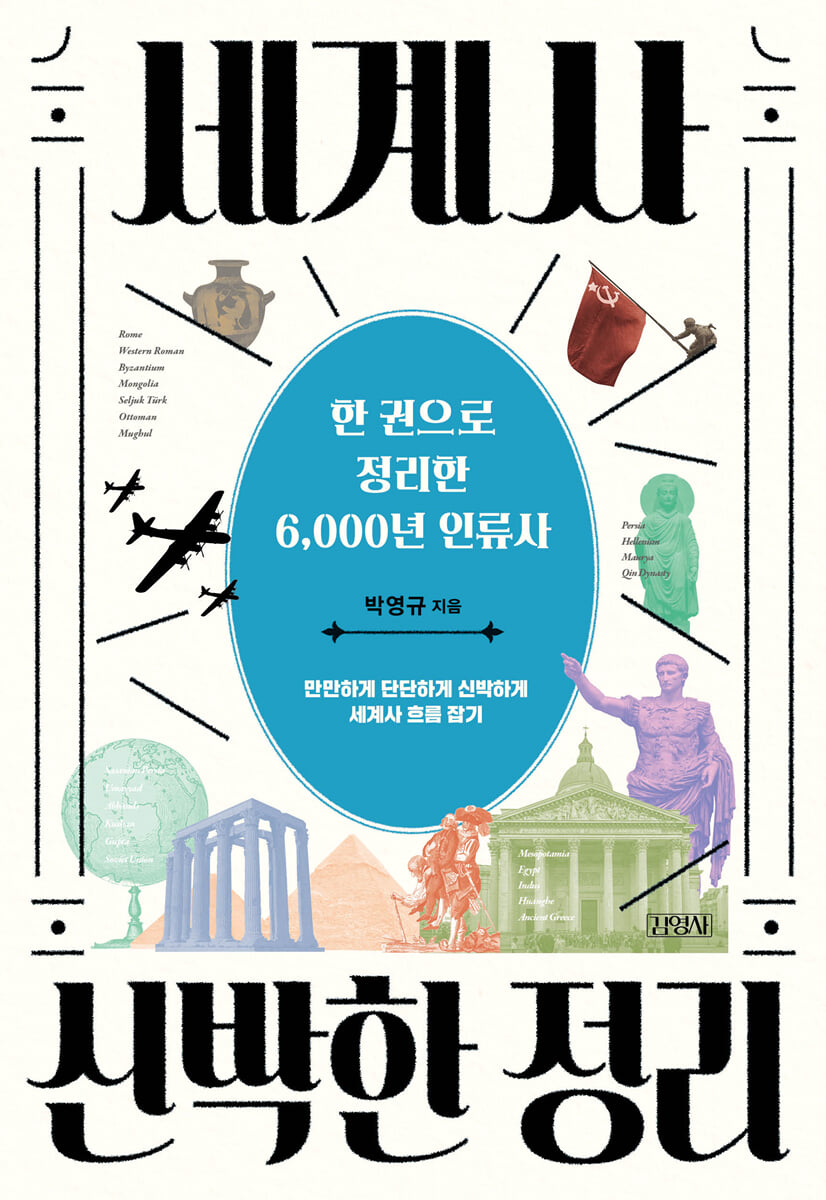
An introduction to world history by Park Young-gyu, the author of the 3 million best-selling Siloksa.
Balanced commentary! Insights that cut through the flow! Sharp summaries!
There is no organization more simple and innovative than this.
World history is vast, but where should you begin? Are there any introductory books recommended for those just beginning their studies? Park Young-gyu, a pioneer in popularizing history and a bestseller with 3 million readers, has compiled 6,000 years of human history, from the world's four great civilizations to the 21st century knowledge age, into a single volume.
《A Refreshing Summary of World History》 not only points out the key points, such as the formation of civilizations, major dynasties and empires, and the events and figures that created turning points in history, but also goes beyond European and Chinese history to present a balanced account of world history.
It covers the history of the Middle East, Mongolia, Islam, India, and the surrounding areas, providing a fascinating and knowledgeable overview of the entire flow of world history.
This is the shortest world history for those who are short on time. It is the perfect introduction to world history for those who want to quickly and completely master world history, as you can pick and choose the parts you want to read.
Balanced commentary! Insights that cut through the flow! Sharp summaries!
There is no organization more simple and innovative than this.
World history is vast, but where should you begin? Are there any introductory books recommended for those just beginning their studies? Park Young-gyu, a pioneer in popularizing history and a bestseller with 3 million readers, has compiled 6,000 years of human history, from the world's four great civilizations to the 21st century knowledge age, into a single volume.
《A Refreshing Summary of World History》 not only points out the key points, such as the formation of civilizations, major dynasties and empires, and the events and figures that created turning points in history, but also goes beyond European and Chinese history to present a balanced account of world history.
It covers the history of the Middle East, Mongolia, Islam, India, and the surrounding areas, providing a fascinating and knowledgeable overview of the entire flow of world history.
This is the shortest world history for those who are short on time. It is the perfect introduction to world history for those who want to quickly and completely master world history, as you can pick and choose the parts you want to read.
- You can preview some of the book's contents.
Preview
index
I hope that the author's writing will serve as an opportunity to overcome the half-baked world history.
Chapter 1: Human civilization began with the agricultural era
Unrecorded History: 4 Million Years of Prehistory
Our ancestors who lived in the gathering age
The emergence, combination, and expansion of human civilization
People who created the Mesopotamian civilization
The 31 dynasties that shaped Egyptian civilization
The Veiled Indus Civilization
Chinese civilization and the three dynasties of Xia, Shang, and Zhou
Greek civilization, the foundation of European civilization
Chapter 2: The First Great Empires of the East and the West
: From the 5th century BC to the 3rd century BC
Persia, the first nation to build a great empire
The Hellenistic Empire that encompassed Europe, Asia, and Africa
Maurya, India's first great empire
The first great empire on the Chinese mainland, the Qin
Chapter 3: China's Great Empires from the Han to the Yuan
: From the 2nd century BC to the 14th century
The new ruler of mainland China, the Han Dynasty
China in Chaos: The Wei, Jin, Southern and Northern Dynasties
The Sui Dynasty, which unified China again after 400 years
The 300 Years of the Tang Dynasty, the Renaissance of Chinese Culture
The Age of Division: The Conflict Between the Liao, Song, and Jin Dynasties
The Mongol Empire that conquered the Eurasian continent
Korean history of this era
Japanese history of this era
Chapter 4: Rome, the True Ruler of the Mediterranean
: From the 1st century BC to the 5th century BC
Caesar, who ushered in the era of one-man rule
Octavian, the first emperor of the Roman Empire
The Chaos of the Foundation-Building Period, from Tiberius to Nero
A transition period toward stability: the Flavian Dynasty
The golden age of prosperity, the era of the Five Sage Emperors
The Pangs of the Power Struggle: The Severan Dynasty and the Age of the Soldier Emperors
Temporary reconstruction of Rome, Emperor Diocletian
The twilight of the great empire
The Roots of Western Culture: Judaism and Christianity
Chapter 5: 1,000 Years of the Eastern Roman Byzantine Empire
: From the 5th century to the 15th century
Eastern Rome before the fall of Western Rome
Dreaming of rebuilding a great empire
Swept by chaos and coups
The frenzy of iconoclasm and the return of the Western Roman Emperor
The heyday of the Byzantine Empire
Years of Fall
The Crusades
The Fall of the Thousand-Year Kingdom
Western Europe during the Eastern Roman period, the Middle Ages of Christianity and feudalism
Chapter 6: The Resurgent Empires of the Middle East
: From the 3rd century BC to the 15th century BC
The Sassanid Dynasty, which revived the Persian Empire
Islam, the new ruler of the Middle East
Orthodox Caliphate Period
The Umayyad dynasty, which began the hereditary caliphate system
500 years of the Abbasid Dynasty
Islamic kingdoms during the Abbasid Dynasty
The rise of the Ottoman Empire
Chapter 7: The Resurgence of the Indian Empire and the Islamic Dynasties
: From the 2nd century BC to the 15th century BC
The Kushan Dynasty, which laid the foundation for the revival of the great empire
The Gupta Dynasty, which revived the great Indian Empire
Other dynasties of South India
Islamic dynasties established in India
Chapter 8: The Great Upheaval of the East and the West
: From the 15th to the 17th century
The winds of change blowing through Europe
Japan's growth and rapid changes in China's situation
The Ottoman Empire, which reigned as the strongest power in the Mediterranean
India's new rulers, the Mughal Empire
Chapter 9: The Industrial Revolution and Imperialism
: From the 18th to the 19th century
Three major events that transformed the Western world
Napoleon and the flames of revolution that swept through Europe
The West, wielding the flag of imperialism, and the Asian empire in decline
Collapsing China, Rising Japan
Korean history of the 18th and 19th centuries
Chapter 10: World War II, the Cold War, and the 21st Century
Balkan Wars and World War I
The emergence of the Soviet Union
The Great Depression and World War II
The commercial era and the Cold War system
The Korean War: A Mini-World War Born from the Cold War
Another product of the Cold War, the Vietnam War
The dissolution of the Soviet Union and the complete end of the Cold War system
The creation of the WTO and the rise of OEM
The 21st century has entered the knowledge age.
References
Search
Image source
Chapter 1: Human civilization began with the agricultural era
Unrecorded History: 4 Million Years of Prehistory
Our ancestors who lived in the gathering age
The emergence, combination, and expansion of human civilization
People who created the Mesopotamian civilization
The 31 dynasties that shaped Egyptian civilization
The Veiled Indus Civilization
Chinese civilization and the three dynasties of Xia, Shang, and Zhou
Greek civilization, the foundation of European civilization
Chapter 2: The First Great Empires of the East and the West
: From the 5th century BC to the 3rd century BC
Persia, the first nation to build a great empire
The Hellenistic Empire that encompassed Europe, Asia, and Africa
Maurya, India's first great empire
The first great empire on the Chinese mainland, the Qin
Chapter 3: China's Great Empires from the Han to the Yuan
: From the 2nd century BC to the 14th century
The new ruler of mainland China, the Han Dynasty
China in Chaos: The Wei, Jin, Southern and Northern Dynasties
The Sui Dynasty, which unified China again after 400 years
The 300 Years of the Tang Dynasty, the Renaissance of Chinese Culture
The Age of Division: The Conflict Between the Liao, Song, and Jin Dynasties
The Mongol Empire that conquered the Eurasian continent
Korean history of this era
Japanese history of this era
Chapter 4: Rome, the True Ruler of the Mediterranean
: From the 1st century BC to the 5th century BC
Caesar, who ushered in the era of one-man rule
Octavian, the first emperor of the Roman Empire
The Chaos of the Foundation-Building Period, from Tiberius to Nero
A transition period toward stability: the Flavian Dynasty
The golden age of prosperity, the era of the Five Sage Emperors
The Pangs of the Power Struggle: The Severan Dynasty and the Age of the Soldier Emperors
Temporary reconstruction of Rome, Emperor Diocletian
The twilight of the great empire
The Roots of Western Culture: Judaism and Christianity
Chapter 5: 1,000 Years of the Eastern Roman Byzantine Empire
: From the 5th century to the 15th century
Eastern Rome before the fall of Western Rome
Dreaming of rebuilding a great empire
Swept by chaos and coups
The frenzy of iconoclasm and the return of the Western Roman Emperor
The heyday of the Byzantine Empire
Years of Fall
The Crusades
The Fall of the Thousand-Year Kingdom
Western Europe during the Eastern Roman period, the Middle Ages of Christianity and feudalism
Chapter 6: The Resurgent Empires of the Middle East
: From the 3rd century BC to the 15th century BC
The Sassanid Dynasty, which revived the Persian Empire
Islam, the new ruler of the Middle East
Orthodox Caliphate Period
The Umayyad dynasty, which began the hereditary caliphate system
500 years of the Abbasid Dynasty
Islamic kingdoms during the Abbasid Dynasty
The rise of the Ottoman Empire
Chapter 7: The Resurgence of the Indian Empire and the Islamic Dynasties
: From the 2nd century BC to the 15th century BC
The Kushan Dynasty, which laid the foundation for the revival of the great empire
The Gupta Dynasty, which revived the great Indian Empire
Other dynasties of South India
Islamic dynasties established in India
Chapter 8: The Great Upheaval of the East and the West
: From the 15th to the 17th century
The winds of change blowing through Europe
Japan's growth and rapid changes in China's situation
The Ottoman Empire, which reigned as the strongest power in the Mediterranean
India's new rulers, the Mughal Empire
Chapter 9: The Industrial Revolution and Imperialism
: From the 18th to the 19th century
Three major events that transformed the Western world
Napoleon and the flames of revolution that swept through Europe
The West, wielding the flag of imperialism, and the Asian empire in decline
Collapsing China, Rising Japan
Korean history of the 18th and 19th centuries
Chapter 10: World War II, the Cold War, and the 21st Century
Balkan Wars and World War I
The emergence of the Soviet Union
The Great Depression and World War II
The commercial era and the Cold War system
The Korean War: A Mini-World War Born from the Cold War
Another product of the Cold War, the Vietnam War
The dissolution of the Soviet Union and the complete end of the Cold War system
The creation of the WTO and the rise of OEM
The 21st century has entered the knowledge age.
References
Search
Image source
Detailed image

Into the book
Most world history books on the market focus on European and Chinese history, and even when they do cover European history, they focus on Western Europe.
For this reason, European medieval history is biased towards Western Europe, and the history of the contemporary Eastern Roman Empire is rarely covered.
East Asian history also only covers China, with Japan and Korea receiving very little attention.
Among the four central axes that make up human history, the history of the Middle East and India is described in a truly superficial manner.
"A Fresh Look at World History" boldly breaks down this biased framework of world history, not only equally covering the history of Europe, the Middle East, India, and China, but also strives to include the surrounding areas as much as possible.
---From the author's writings
Mesopotamian and Egyptian civilizations, known as the first civilizations of mankind, laid the foundation for the birth of Greek civilization.
These two civilizations flowed into the Mediterranean, merged, and were reborn as a new, more advanced civilization.
The new civilization arose on the islands of the Aegean Sea, a small sea of the Mediterranean Sea surrounded by the Greek peninsula, Asia Minor, and Egypt.
In particular, Crete, the largest island in the Aegean Sea, was the first to develop civilization.
The reason a new civilization arose in Crete was because it was an island where the Egyptian and Mesopotamian civilizations combined and served as a gateway to the Aegean Sea.
---From "Greek Civilization, the Foundation of European Civilization"
The third great empire to be formed after the Hellenistic Empire was the Indian subcontinent.
The first country in Indian history to lay the foundation for an empire was the Kingdom of Magadha.
Before the Magadha Kingdom, there was a period of 16 great kingdoms in the Indian subcontinent, a kind of warring states period, and Magadha was one of these 16 kingdoms.
_
---From "India's First Great Empire, Maurya"
While great empires were built in China starting with the Jin Dynasty and continuing through the Han, Sui, Tang, Song, and Yuan Dynasties, Korean history progressed from Gojoseon through the Three Kingdoms Period and the North-South States Period to Goryeo.
Just as the expansion of Greek and Roman power in Western history led to the downfall and colonization of countries surrounding the Mediterranean, the Middle East, and India, the formation of great empires like the Qin and Han in China also brought about tremendous change and misfortune in Asian countries.
---From "Korean History of This Era"
After the end of the iconoclasm, the Byzantine Empire finally overcame its long period of chaos and entered a period of great prosperity.
The golden age of the Byzantine Empire began with the reign of Michael III, son of Theophilus.
Michael III was known as a drunkard emperor.
It's because he was addicted to alcohol in his later years.
However, during his reign, Byzantium regained its national power and rose to new heights.
---From "The Golden Age of the Byzantine Empire"
As Christianity became the state religion of Rome, a Christian-centered culture was formed in Europe. In this situation, an Islam-centered culture was formed in the Middle East, which was based on Egyptian and Mesopotamian civilizations.
The Middle East usually refers to the western region of Asia, encompassing the area from the eastern Mediterranean Sea to the Persian Gulf, but in a broader sense, it also includes countries in Central Asia and North Africa where Islamic culture was formed.
There are dozens of countries in this region, and their territory is larger than Europe's, and their population is not inferior to Europe's.
In this way, the Islamic empire ruled over a vast territory.
---From "Islam, the New Ruler of the Middle East"
The Ottoman Empire's power overwhelmed all European countries.
It even made the European empires nervous enough to besiege Vienna, the capital of the Holy Roman Empire, for over a month.
In 1538, he defeated the combined fleet of the Spanish fleet, known as the Invincible Armada, and the Republic of Venice in the Battle of Preveza, becoming the victor in the struggle for maritime supremacy in the Mediterranean.
---From "The Ottoman Empire, the Strongest Power in the Mediterranean"
In the Cold War system, which signified the conflict between capitalism and socialism, the powerful countries represented by the United States and the Soviet Union divided the weak countries that had just emerged from colonial rule, which in turn triggered war and resulted in enormous sacrifices.
A representative example is the Korean War.
The Korean War was a foregone conclusion when the United States and the Soviet Union divided and occupied the Korean Peninsula.
For this reason, European medieval history is biased towards Western Europe, and the history of the contemporary Eastern Roman Empire is rarely covered.
East Asian history also only covers China, with Japan and Korea receiving very little attention.
Among the four central axes that make up human history, the history of the Middle East and India is described in a truly superficial manner.
"A Fresh Look at World History" boldly breaks down this biased framework of world history, not only equally covering the history of Europe, the Middle East, India, and China, but also strives to include the surrounding areas as much as possible.
---From the author's writings
Mesopotamian and Egyptian civilizations, known as the first civilizations of mankind, laid the foundation for the birth of Greek civilization.
These two civilizations flowed into the Mediterranean, merged, and were reborn as a new, more advanced civilization.
The new civilization arose on the islands of the Aegean Sea, a small sea of the Mediterranean Sea surrounded by the Greek peninsula, Asia Minor, and Egypt.
In particular, Crete, the largest island in the Aegean Sea, was the first to develop civilization.
The reason a new civilization arose in Crete was because it was an island where the Egyptian and Mesopotamian civilizations combined and served as a gateway to the Aegean Sea.
---From "Greek Civilization, the Foundation of European Civilization"
The third great empire to be formed after the Hellenistic Empire was the Indian subcontinent.
The first country in Indian history to lay the foundation for an empire was the Kingdom of Magadha.
Before the Magadha Kingdom, there was a period of 16 great kingdoms in the Indian subcontinent, a kind of warring states period, and Magadha was one of these 16 kingdoms.
_
---From "India's First Great Empire, Maurya"
While great empires were built in China starting with the Jin Dynasty and continuing through the Han, Sui, Tang, Song, and Yuan Dynasties, Korean history progressed from Gojoseon through the Three Kingdoms Period and the North-South States Period to Goryeo.
Just as the expansion of Greek and Roman power in Western history led to the downfall and colonization of countries surrounding the Mediterranean, the Middle East, and India, the formation of great empires like the Qin and Han in China also brought about tremendous change and misfortune in Asian countries.
---From "Korean History of This Era"
After the end of the iconoclasm, the Byzantine Empire finally overcame its long period of chaos and entered a period of great prosperity.
The golden age of the Byzantine Empire began with the reign of Michael III, son of Theophilus.
Michael III was known as a drunkard emperor.
It's because he was addicted to alcohol in his later years.
However, during his reign, Byzantium regained its national power and rose to new heights.
---From "The Golden Age of the Byzantine Empire"
As Christianity became the state religion of Rome, a Christian-centered culture was formed in Europe. In this situation, an Islam-centered culture was formed in the Middle East, which was based on Egyptian and Mesopotamian civilizations.
The Middle East usually refers to the western region of Asia, encompassing the area from the eastern Mediterranean Sea to the Persian Gulf, but in a broader sense, it also includes countries in Central Asia and North Africa where Islamic culture was formed.
There are dozens of countries in this region, and their territory is larger than Europe's, and their population is not inferior to Europe's.
In this way, the Islamic empire ruled over a vast territory.
---From "Islam, the New Ruler of the Middle East"
The Ottoman Empire's power overwhelmed all European countries.
It even made the European empires nervous enough to besiege Vienna, the capital of the Holy Roman Empire, for over a month.
In 1538, he defeated the combined fleet of the Spanish fleet, known as the Invincible Armada, and the Republic of Venice in the Battle of Preveza, becoming the victor in the struggle for maritime supremacy in the Mediterranean.
---From "The Ottoman Empire, the Strongest Power in the Mediterranean"
In the Cold War system, which signified the conflict between capitalism and socialism, the powerful countries represented by the United States and the Soviet Union divided the weak countries that had just emerged from colonial rule, which in turn triggered war and resulted in enormous sacrifices.
A representative example is the Korean War.
The Korean War was a foregone conclusion when the United States and the Soviet Union divided and occupied the Korean Peninsula.
---From "The Korean War, a Mini World War Born from the Cold War System"
Publisher's Review
Park Young-gyu, a historical writer who captivated 3 million readers
World history completed with even more powerful internal energy
World history is vast, but where should you begin? Are there any introductory books recommended for those just beginning their studies? Park Young-gyu, a pioneer in popularizing history and bestseller with over 3 million copies sold, has published "A Refreshing Guide to World History," a comprehensive introduction to world history for those unsure of where and how to begin.
From the world's four great civilizations to the 21st century knowledge age, 6,000 years of human history unfold in a breathtakingly new way.
This book is special in that it touches on the core issues, such as the formation of civilization, major dynasties and empires, and the events and figures that created turning points in history. Above all, it goes beyond European and Chinese history and provides a balanced account of world history.
It covers the history of the Middle East, Mongolia, Islam, India, and the surrounding areas, providing a fascinating and knowledgeable overview of the entire flow of world history.
This is the perfect textbook for those who want to master world history but lack the time, or for those who want to read through all of world history in the shortest amount of time.
“World history books on the market are mainly about Chinese and European history.
Until now, we have been exposed to only half of world history.
To address this, we boldly dismantled the winner-centered era division and biased framework of world history, and organized the history of Europe, the Middle East, India, and China equally.
It also includes the history of the area.
I hope this book will be a refreshing guide for those who are just beginning to study world history and for those who want to read world history in a balanced way.” _Park Young-gyu
A balanced commentary encompassing East and West!
Insights that penetrate the flow of major civilizations and imperial history!
A succinct summary that highlights only the key points of the characters and events!
History is recorded by reflecting objective facts of the past, their connection to the present, and the historian's perspective.
History is written based on records and artifacts, and the same event can often be recorded differently depending on the interests of the time.
History is distorted the moment it is recorded, and it inevitably ends up being written with the victors in mind.
The author concluded that the history we learn also contains this problem, making it difficult to properly understand world history.
He said that the era division method of 'Ancient-Middle Ages-Early Modern Times-Modern Times-Contemporary Times' originated from the Western view of history and has many parts that are difficult to apply to Eastern history, and that 'Stone Age-Bronze Age-Iron Age' also has limitations in covering important political and economic history of human history because it is based on materials.
To understand world history in a balanced way, a new method of dividing the period into East and West is needed.
Instead of the Western-centric era division method, the author proposes a new era division method based on economic activity: 'Gathering era - Agricultural era - Industrial era - Commercial era - Knowledge era.'
It was an attempt to escape the half-baked world history and neutrally convey the 6,000 years of human history.
In addition, it covers world history and Korean history together, such as 'Korean History of This Era', to help readers confirm Korea's historical position in world history, and includes historical maps and photographs to make reading more enjoyable.
◆ The world's four great civilizations and the first great empires of the East and the West
Prehistoric humans lived primarily by gathering and hunting, but as agriculture developed, they began to move to areas with wide plains around rivers.
The kingdoms that settled along the rivers combined and expanded to form the Mesopotamian civilization on the Euphrates and Tigris Rivers, the Egyptian civilization on the Nile River, the Indus civilization on the Indus River, and the Chinese civilization on the Yellow River.
Among them, the Persian Empire, the first great empire of mankind, arose in the Mesopotamian region.
Because it is the region where agriculture first began.
Afterwards, the Hellenistic Empire called the Alexander Empire, the Mauryan Empire in India, and the Qin Dynasty in mainland China were established in succession.
In this book, you can get a glimpse into the formation of the world's four major civilizations and the founding of the first great empires in the East and the West.
◆ From Rome, the ruler of the Mediterranean, to the Byzantine Empire
Rome is the successor to the Hellenistic Empire in Europe and the Middle East.
Starting with Caesar, Octavianus ascended to the throne as the first emperor of the Roman Empire, and after that, numerous kings went through periods of prosperity and struggle, repeating heydays and periods of decline before eventually dividing into Western Rome and Eastern Rome.
Afterwards, the Eastern Roman Emperor Justinian I recovered the territory of the old Roman Empire, thereby maximizing the territory of the Eastern Roman Empire, or Byzantine Empire.
But the film was short-lived, marred by a struggle for the throne and 125 years of frenzied iconoclasm, before the Ottoman invasion brought an end to the 1,000-year history of the Byzantine Empire.
The author does not stop at a simple historical enumeration, but also provides knowledge of Christianity, which serves as a basic source for understanding Roman history.
◆ Korean History Read Alongside World History
The history of the Korean Peninsula was greatly influenced by the changes in Chinese dynasties.
The golden age of Goguryeo and Baekje during the Three Kingdoms period was when the Han Dynasty collapsed and the Five Kingdoms and Sixteen Kingdoms period began.
On the contrary, when the Sui and Tang dynasties unified the Chinese mainland, Goguryeo and Baekje were defeated.
Balhae was founded when the Tang Dynasty was weakening and fell when the Liao Dynasty gained hegemony over the continent.
The author examines the history of Balhae, Goryeo, and Joseon from the Three Kingdoms period within the context of world history, helping to provide a three-dimensional understanding.
The rise of the Middle Eastern and Islamic dynasties, and the great Indian empires
After Muhammad founded Islam, the Islamic Empire emerged as the new ruler of the Middle East.
Based on Islam, the 7th century Caliph Abu Bakr expanded his power and conquered the Arabian Peninsula and Syria.
Afterwards, he destroyed the Sassanid Persian Empire in the east, and took over the Eastern Roman territories of Egypt and North Africa in the west, forming a vast territory.
This book colorfully organizes the history of the Middle East, which is difficult to find in other introductory world history books, from the Umayyad dynasty, the beginning of the hereditary caliphate, the 500 years of the Abbasid dynasty, the Islamic dynasties surrounding the Abbasid dynasty, the rise of the Ottoman Empire, and the Gupta dynasty and Mughal Empire of the great Indian empire.
◆ From the Great Upheaval of the East and the West to the Age of Imperialism
As the 15th century approached, the Renaissance, also known as the Renaissance movement, brought a wind of change to Europe.
It brought about innovation in Christianity and led to the Reformation.
The division of the church led to the weakening of the church's dominance and the strengthening of royal power, laying the foundation for absolute monarchy and civil revolution.
The development of science also served as a driving force for change in Europe.
The Scientific Revolution helped open the door to the Age of Exploration by promoting the development of weapons and ships in addition to astronomy and mathematics.
This book examines the Industrial Revolution, American independence, and the French Revolution, telling the story of how imperialism gained ground in the West and why the great empires of the East were destined to fall.
World War II, the Cold War, and the 21st Century Knowledge Age
After the end of World War II, the world entered the Cold War era, with the capitalist United States and the communist Soviet Union competing.
The Cold War system divided weak countries that had just emerged from colonial rule, producing wars such as the Korean War and the Vietnam War.
Afterwards, the Soviet Union collapsed and China pursued an open-door policy, ending the Cold War.
And in the 21st century, humanity has entered the knowledge age, where the knowledge information industry has become the center of the global economy thanks to the advancement of science and technology.
The world has changed rapidly, and we have entered the 4th Industrial Revolution, driven by the knowledge industry.
World history completed with even more powerful internal energy
World history is vast, but where should you begin? Are there any introductory books recommended for those just beginning their studies? Park Young-gyu, a pioneer in popularizing history and bestseller with over 3 million copies sold, has published "A Refreshing Guide to World History," a comprehensive introduction to world history for those unsure of where and how to begin.
From the world's four great civilizations to the 21st century knowledge age, 6,000 years of human history unfold in a breathtakingly new way.
This book is special in that it touches on the core issues, such as the formation of civilization, major dynasties and empires, and the events and figures that created turning points in history. Above all, it goes beyond European and Chinese history and provides a balanced account of world history.
It covers the history of the Middle East, Mongolia, Islam, India, and the surrounding areas, providing a fascinating and knowledgeable overview of the entire flow of world history.
This is the perfect textbook for those who want to master world history but lack the time, or for those who want to read through all of world history in the shortest amount of time.
“World history books on the market are mainly about Chinese and European history.
Until now, we have been exposed to only half of world history.
To address this, we boldly dismantled the winner-centered era division and biased framework of world history, and organized the history of Europe, the Middle East, India, and China equally.
It also includes the history of the area.
I hope this book will be a refreshing guide for those who are just beginning to study world history and for those who want to read world history in a balanced way.” _Park Young-gyu
A balanced commentary encompassing East and West!
Insights that penetrate the flow of major civilizations and imperial history!
A succinct summary that highlights only the key points of the characters and events!
History is recorded by reflecting objective facts of the past, their connection to the present, and the historian's perspective.
History is written based on records and artifacts, and the same event can often be recorded differently depending on the interests of the time.
History is distorted the moment it is recorded, and it inevitably ends up being written with the victors in mind.
The author concluded that the history we learn also contains this problem, making it difficult to properly understand world history.
He said that the era division method of 'Ancient-Middle Ages-Early Modern Times-Modern Times-Contemporary Times' originated from the Western view of history and has many parts that are difficult to apply to Eastern history, and that 'Stone Age-Bronze Age-Iron Age' also has limitations in covering important political and economic history of human history because it is based on materials.
To understand world history in a balanced way, a new method of dividing the period into East and West is needed.
Instead of the Western-centric era division method, the author proposes a new era division method based on economic activity: 'Gathering era - Agricultural era - Industrial era - Commercial era - Knowledge era.'
It was an attempt to escape the half-baked world history and neutrally convey the 6,000 years of human history.
In addition, it covers world history and Korean history together, such as 'Korean History of This Era', to help readers confirm Korea's historical position in world history, and includes historical maps and photographs to make reading more enjoyable.
◆ The world's four great civilizations and the first great empires of the East and the West
Prehistoric humans lived primarily by gathering and hunting, but as agriculture developed, they began to move to areas with wide plains around rivers.
The kingdoms that settled along the rivers combined and expanded to form the Mesopotamian civilization on the Euphrates and Tigris Rivers, the Egyptian civilization on the Nile River, the Indus civilization on the Indus River, and the Chinese civilization on the Yellow River.
Among them, the Persian Empire, the first great empire of mankind, arose in the Mesopotamian region.
Because it is the region where agriculture first began.
Afterwards, the Hellenistic Empire called the Alexander Empire, the Mauryan Empire in India, and the Qin Dynasty in mainland China were established in succession.
In this book, you can get a glimpse into the formation of the world's four major civilizations and the founding of the first great empires in the East and the West.
◆ From Rome, the ruler of the Mediterranean, to the Byzantine Empire
Rome is the successor to the Hellenistic Empire in Europe and the Middle East.
Starting with Caesar, Octavianus ascended to the throne as the first emperor of the Roman Empire, and after that, numerous kings went through periods of prosperity and struggle, repeating heydays and periods of decline before eventually dividing into Western Rome and Eastern Rome.
Afterwards, the Eastern Roman Emperor Justinian I recovered the territory of the old Roman Empire, thereby maximizing the territory of the Eastern Roman Empire, or Byzantine Empire.
But the film was short-lived, marred by a struggle for the throne and 125 years of frenzied iconoclasm, before the Ottoman invasion brought an end to the 1,000-year history of the Byzantine Empire.
The author does not stop at a simple historical enumeration, but also provides knowledge of Christianity, which serves as a basic source for understanding Roman history.
◆ Korean History Read Alongside World History
The history of the Korean Peninsula was greatly influenced by the changes in Chinese dynasties.
The golden age of Goguryeo and Baekje during the Three Kingdoms period was when the Han Dynasty collapsed and the Five Kingdoms and Sixteen Kingdoms period began.
On the contrary, when the Sui and Tang dynasties unified the Chinese mainland, Goguryeo and Baekje were defeated.
Balhae was founded when the Tang Dynasty was weakening and fell when the Liao Dynasty gained hegemony over the continent.
The author examines the history of Balhae, Goryeo, and Joseon from the Three Kingdoms period within the context of world history, helping to provide a three-dimensional understanding.
The rise of the Middle Eastern and Islamic dynasties, and the great Indian empires
After Muhammad founded Islam, the Islamic Empire emerged as the new ruler of the Middle East.
Based on Islam, the 7th century Caliph Abu Bakr expanded his power and conquered the Arabian Peninsula and Syria.
Afterwards, he destroyed the Sassanid Persian Empire in the east, and took over the Eastern Roman territories of Egypt and North Africa in the west, forming a vast territory.
This book colorfully organizes the history of the Middle East, which is difficult to find in other introductory world history books, from the Umayyad dynasty, the beginning of the hereditary caliphate, the 500 years of the Abbasid dynasty, the Islamic dynasties surrounding the Abbasid dynasty, the rise of the Ottoman Empire, and the Gupta dynasty and Mughal Empire of the great Indian empire.
◆ From the Great Upheaval of the East and the West to the Age of Imperialism
As the 15th century approached, the Renaissance, also known as the Renaissance movement, brought a wind of change to Europe.
It brought about innovation in Christianity and led to the Reformation.
The division of the church led to the weakening of the church's dominance and the strengthening of royal power, laying the foundation for absolute monarchy and civil revolution.
The development of science also served as a driving force for change in Europe.
The Scientific Revolution helped open the door to the Age of Exploration by promoting the development of weapons and ships in addition to astronomy and mathematics.
This book examines the Industrial Revolution, American independence, and the French Revolution, telling the story of how imperialism gained ground in the West and why the great empires of the East were destined to fall.
World War II, the Cold War, and the 21st Century Knowledge Age
After the end of World War II, the world entered the Cold War era, with the capitalist United States and the communist Soviet Union competing.
The Cold War system divided weak countries that had just emerged from colonial rule, producing wars such as the Korean War and the Vietnam War.
Afterwards, the Soviet Union collapsed and China pursued an open-door policy, ending the Cold War.
And in the 21st century, humanity has entered the knowledge age, where the knowledge information industry has become the center of the global economy thanks to the advancement of science and technology.
The world has changed rapidly, and we have entered the 4th Industrial Revolution, driven by the knowledge industry.
GOODS SPECIFICS
- Publication date: December 9, 2022
- Page count, weight, size: 500 pages | 664g | 148*215*25mm
- ISBN13: 9788934943426
- ISBN10: 8934943424
You may also like
카테고리
korean


korean

![GQ KOREA Mark (Monthly): December [2025]](http://librairie.coreenne.fr/cdn/shop/files/8ef265dbbfbf186523ed75ba7319009d.jpg?v=1765340328&width=3840)


