

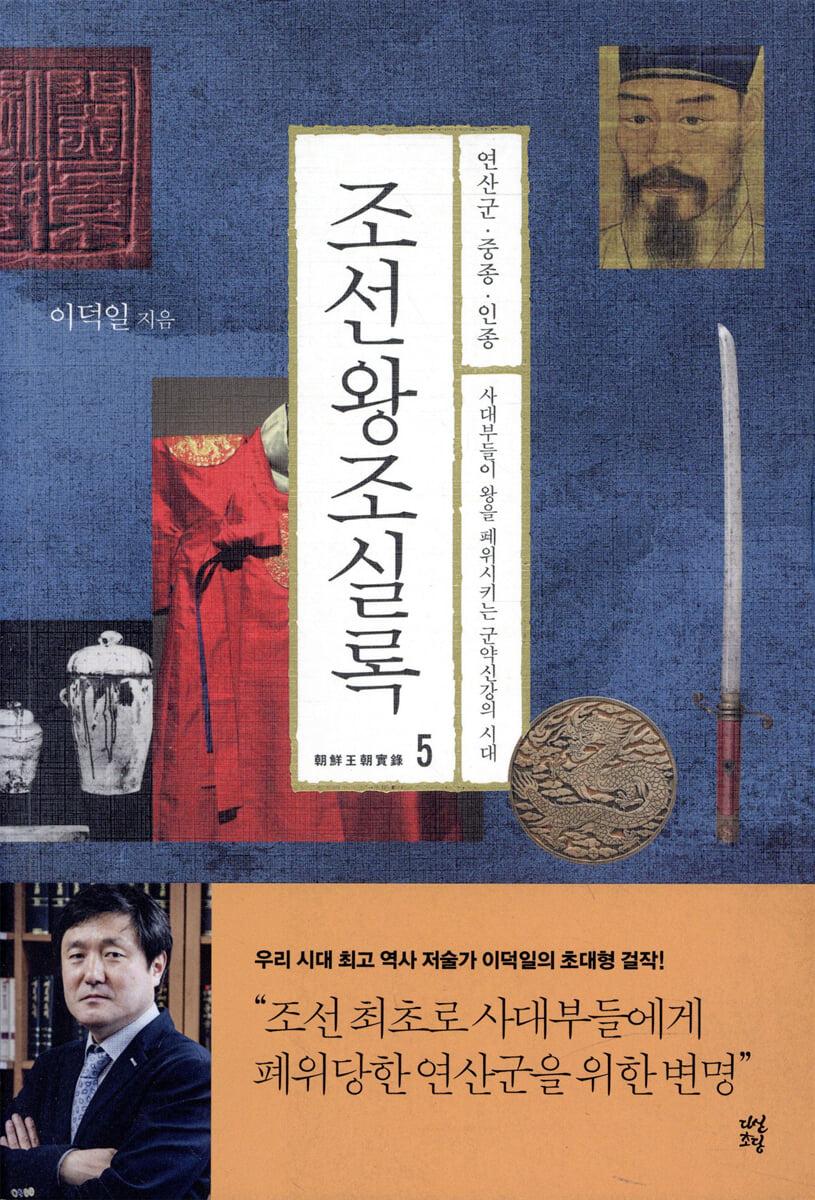
Annals of the Joseon Dynasty 5
 |
Description
Book Introduction
"An Apology for King Yeonsangun, the First King in Joseon to Be Deposed by the Aristocrats"
The return of a historical book that traces the truth between the lines of historical records!
Was Yeonsangun truly dethroned because he was so obscene and tyrannical toward his subjects? The Heungcheong, who symbolized Yeonsangun's debauchery, were in fact artists.
He also consoled the people by providing them with grain during hunting trips that were also part of military training, and he provided them with fair compensation when demolishing houses near the palace.
Yeonsangun dreamed of absolute monarchy and did not share power and wealth with his subjects, so he became an enemy of both the Hun-gu and the Sarim.
The Hun-gu faction killed him with a sword, and the Sa-rim killed him twice with a brush.
On the other hand, King Jungjong, known as a wise king who promoted Jo Gwang-jo, was a cowardly person who got caught up in the power struggle among his subjects and killed his concubine, Lady Park Gyeongbin, and his son, Prince Bokseong.
He was busy maintaining his position by moving between the Hun-gu and Sarim, and left behind almost no political achievements.
The era of King Yeonsangun, King Jungjong, and King Injong was marked by power struggles among the aristocracy, and as divine power surpassed royal power, Joseon was transformed into a country where the king was weak and the subjects were strong.
The return of a historical book that traces the truth between the lines of historical records!
Was Yeonsangun truly dethroned because he was so obscene and tyrannical toward his subjects? The Heungcheong, who symbolized Yeonsangun's debauchery, were in fact artists.
He also consoled the people by providing them with grain during hunting trips that were also part of military training, and he provided them with fair compensation when demolishing houses near the palace.
Yeonsangun dreamed of absolute monarchy and did not share power and wealth with his subjects, so he became an enemy of both the Hun-gu and the Sarim.
The Hun-gu faction killed him with a sword, and the Sa-rim killed him twice with a brush.
On the other hand, King Jungjong, known as a wise king who promoted Jo Gwang-jo, was a cowardly person who got caught up in the power struggle among his subjects and killed his concubine, Lady Park Gyeongbin, and his son, Prince Bokseong.
He was busy maintaining his position by moving between the Hun-gu and Sarim, and left behind almost no political achievements.
The era of King Yeonsangun, King Jungjong, and King Injong was marked by power struggles among the aristocracy, and as divine power surpassed royal power, Joseon was transformed into a country where the king was weak and the subjects were strong.
index
Introduction: Reading the Annals of the Joseon Dynasty
Part 1: Yeonsangun, the lonely monarch who dreamed of absolute power
◆ Image created by 『Yeonsangun Diary』
King Seongjong and King Yeonsangun as seen by the historian
Compilation principles of the 『Diary of King Yeonsangun』
Conflict surrounding the water and land disaster
◆ Biological mother complex
The Dilemma of Blessed Birth
When did King Yeonsangun learn about the deposed Queen Yun?
Posthumous honors of the queen
◆ The Rebellion of 1885
The funeral of the mother of Yu Ja-gwang, a meritorious subject, coincided with the national mourning of King Seongjong.
The Censors' Rebuttal to Yu Ja-gwang's Mother's Funeral
The officials who reside in the embassy
The four scholars who denied Sejo's rule
"Condolence Message" that expanded the scope of the Oksa
"Suljusi" criticizing Sejo for usurping the throne from King Danjong
Kim Jong-jik's disciples are being scorched
◆ The Dream of a Military Monarch and the Gapja Incident
Hunting and military training
Strengthening military power and frustrating the conquest of the Jurchen people
Lee Se-jwa's wife and Heo Chim's sister
A typhoon is coming
◆ Jungjong's Rebellion and the Decline of the Royal Power
A conspiracy of treason sprouting from within
The words of a monarch who lost the favor of the nobles
The monarch died after two months
◆ An excuse for the Yeonsangun
The contents of the 『Yeonsangun Diary』 predicted by Yeonsangun
Was he a tyrant to his people as well?
Was he a debauched and reckless monarch?
Part 2: King Jungjong, a monarch who wandered between the meritorious subjects and the Sarim
◆ I don't even know if I'll become a king
Lady Shin, wife of Prince Jinseong who was expelled
Bulk appointment of meritorious subjects
The new king is passionate about competitions
The three chieftains of the rebellion, the subjects above the king
◆ I am not a puppet king
The top contributors to be eliminated: Park Young-moon and Shin Yun-moo
The reemergence of the Sarim and Jo Gwang-jo
Advocating for the reinstatement of King Jungjong's first wife, Lady Shin
Jo Gwang-jo, who changed the game
◆ The different views of King Jungjong and the Sarim
King Jungjong and Sarim had different destinations
Hyeonryang and Hyeonsil
land reform
The River of No Return, Wihun Deleted
◆ The Gimi Incident, the Hun'gu's counterattack, and King Jungjong's sudden change
Jo becomes king?
Sarim being eliminated by a single person
◆ The Three Japanese Invasions and the Military Supo System
The Three Po War and the Imjin Pact
Military service exemption system that replaces military service with money
◆ The world of relatives, Daeyun and Soyun
Confusing coordination
The Crown Prince's Curse Incident
The death of the Crown Prince and King Jungjong in the fire
Part 3 Race, the King who died before he could bloom
◆ Between the former king and the scholars
Jo Gwang-jo's identity, virtue, and virtue
Two monarchs who ruined good conditions with their own mistakes: Yeonsangun and Jungjong
Chronology
Search
Part 1: Yeonsangun, the lonely monarch who dreamed of absolute power
◆ Image created by 『Yeonsangun Diary』
King Seongjong and King Yeonsangun as seen by the historian
Compilation principles of the 『Diary of King Yeonsangun』
Conflict surrounding the water and land disaster
◆ Biological mother complex
The Dilemma of Blessed Birth
When did King Yeonsangun learn about the deposed Queen Yun?
Posthumous honors of the queen
◆ The Rebellion of 1885
The funeral of the mother of Yu Ja-gwang, a meritorious subject, coincided with the national mourning of King Seongjong.
The Censors' Rebuttal to Yu Ja-gwang's Mother's Funeral
The officials who reside in the embassy
The four scholars who denied Sejo's rule
"Condolence Message" that expanded the scope of the Oksa
"Suljusi" criticizing Sejo for usurping the throne from King Danjong
Kim Jong-jik's disciples are being scorched
◆ The Dream of a Military Monarch and the Gapja Incident
Hunting and military training
Strengthening military power and frustrating the conquest of the Jurchen people
Lee Se-jwa's wife and Heo Chim's sister
A typhoon is coming
◆ Jungjong's Rebellion and the Decline of the Royal Power
A conspiracy of treason sprouting from within
The words of a monarch who lost the favor of the nobles
The monarch died after two months
◆ An excuse for the Yeonsangun
The contents of the 『Yeonsangun Diary』 predicted by Yeonsangun
Was he a tyrant to his people as well?
Was he a debauched and reckless monarch?
Part 2: King Jungjong, a monarch who wandered between the meritorious subjects and the Sarim
◆ I don't even know if I'll become a king
Lady Shin, wife of Prince Jinseong who was expelled
Bulk appointment of meritorious subjects
The new king is passionate about competitions
The three chieftains of the rebellion, the subjects above the king
◆ I am not a puppet king
The top contributors to be eliminated: Park Young-moon and Shin Yun-moo
The reemergence of the Sarim and Jo Gwang-jo
Advocating for the reinstatement of King Jungjong's first wife, Lady Shin
Jo Gwang-jo, who changed the game
◆ The different views of King Jungjong and the Sarim
King Jungjong and Sarim had different destinations
Hyeonryang and Hyeonsil
land reform
The River of No Return, Wihun Deleted
◆ The Gimi Incident, the Hun'gu's counterattack, and King Jungjong's sudden change
Jo becomes king?
Sarim being eliminated by a single person
◆ The Three Japanese Invasions and the Military Supo System
The Three Po War and the Imjin Pact
Military service exemption system that replaces military service with money
◆ The world of relatives, Daeyun and Soyun
Confusing coordination
The Crown Prince's Curse Incident
The death of the Crown Prince and King Jungjong in the fire
Part 3 Race, the King who died before he could bloom
◆ Between the former king and the scholars
Jo Gwang-jo's identity, virtue, and virtue
Two monarchs who ruined good conditions with their own mistakes: Yeonsangun and Jungjong
Chronology
Search
Into the book
On August 18th, in the 4th year of his reign, after the Muosahwa Incident, King Yeonsangun went out to the western suburbs to encourage the people to farm. Upon returning, he ordered the soldiers who were guarding the mountain behind Yeonhui Palace to hunt foxes and rabbits.
The hunting article from August 21st of that month well describes the nature of Yeonsangun's hunting.
“The king inspected the farming in Donggyo (東郊) and reached Jeongot (箭串) to hunt wild animals in the crane-wing formation. He stayed at Hwayangjeong (華陽亭) and had the royal secretary, the historian, and others each write and present poems.
“He also set up a crane wing formation in Mireuk-dong and hunted wild animals, and when he returned to the palace, he fed the farmers on the roadside.”
Crane-wing formation refers to a military formation that is formed like a crane spreading its wings and then annihilates the enemy.
For Yeonsangun, hunting was military training.
Also, just as he provided food to the people on the roadside on his way back to the palace, hunting in his place was one of the political duties of eliminating animals that were damaging crops and meeting the people directly to provide food.
However, the scholar-officials, who were already steeped in the idea of revering literature but looking down on martial arts, requested that the monarch only teach Confucianism.
This was bound to lead to a clash with Yeonsangun, who was trying to strengthen his military power.
---From "Hunting and Military Training"
The image created by the group of noblemen who drove out King Yeonsangun is that King Yeonsangun was a tyrant even to the people.
The 『Diary of King Yeonsangun』 and 『Annals of King Jungjong』 written by these scholars contain countless examples of King Yeonsangun being a tyrant to the people.
The question is, if King Yeonsangun killed even his meritorious subjects while saying he would 'correct the trend of despising the superiors', what would have happened to the people?
On August 14, 1499, the 5th year of King Yeonsangun's reign, Jeong Gwang-pil (鄭光弼), the royal inspector, reported at the royal lecture.
“I heard that there was a woman living by the Seogang River, and her owner was roasting her with a hot iron skewer.
He barely survived and said, 'It's because my master burned me.'
“Even if you are a king, you cannot be this cruel when it comes to punishment, so how much more so for a subordinate?” King Yeonsangun praised Jeong Gwang-pil.
“It is a very tragic thing.
“If you didn’t tell me, how would I know?” … Seungji Kwonju reported in the Gyeongguk Daejeon that when it came to punishing slaves, in cases where it did not lead to death, there was no choice but to hold a funeral.
The problem was that up to this point it could be redeemed with money.
King Yeonsangun issued a royal decree.
“Lee Gyeong-eun, don’t be fooled, just make a decision.”
Since the king had specifically ordered it, the soldiers would have beaten the market even more harshly.
In this way, King Yeonsangun severely punished Lee Gyeong, who had set his female servant on fire, within the limits of the law.
---From "Was he a tyrant to his people too?"
On the day Jo Gwang-jo died, the officer added this:
After the king ascended to the throne, even if the censors discussed people's crimes and wanted to punish them harshly, the king would always reduce their punishment, and no one was killed because of the king's will. This time, the censors did not request to punish Jo Gwang-jo more, but suddenly gave this order. Didn't they guess what the current situation was and give this order? They served him closely from both sides and saw him three times a day, so their affection must have been very close, like father and son. But when a change occurred overnight, they punished him harshly and without mercy, and now even the killing came from the king's decision.
There is not a single bit of pity or compassion, so compared to the previous incident of Dotai's love, it seems as if it came from two kings. (『Jungjong Sillok』, December 16)
The officer pointed out King Jungjong's double standard.
In a way, this was King Jungjong's personality and essence.
Opportunism was King Jungjong's characteristic.
When the censors asked him to kill someone, he would pretend to be lenient and create a benevolent image, but when something went against his intentions even slightly, his cruel nature would be revealed and he would kill people as if they were flies. This was King Jungjong.
The killing of Park Yeong-mun and Shin Yun-mu was fundamentally the same as the killing of Jo Gwang-jo.
Because everyone was a threat to their own status.
The reason Jo Gwang-jo died was because he tried to disband the group of meritorious retainers and because he had gained the trust of the people greater than that of King Jungjong.
---From "The Sarim Eliminated by a Simple Rule"
The scholar-officials who were disappointed with Jungjong had high expectations for Injong.
The 『National Treasures』 states this:
Every day, I woke up before dawn, greeted the morning people, looked after the table, and then went to the Western Room three times a day.
In the morning lectures, I read the classics, and in the evening lectures and the afternoon lectures, I read the historical books. If something happened and I couldn't go to the study, I always felt uneasy.
I read books like 『Geunsarok (近思錄)』, 『Self-defense Edition (自警編)』, and 『Daehakyeonui (大學習入)』 until late at night, and the next morning I read the books I was going to lecture on at the library.
I usually sat upright all day, never once stretching or leaning my legs, and this didn't change even in the bitter cold of winter or the hottest days of summer.
He was calm, quiet, deep and heavy, and never let a joke slip through his lips.
King Jungjong was delighted and considered it a virtuous instrument bestowed by heaven. He selected renowned Confucian scholars and appointed them as guests and staff to assist in the accomplishment. Whenever the guests left the Western Yan, they would rejoice together and say, “Yao and Shun have been born again in our East.” (『National Treasures』 「Injong」)
Scholars had high expectations for King Injong's ascension to the throne.
The greatest expectation was that the people would bring to justice those who were unjustly killed during the Gyeomyo Incident and that they would once again pursue the extreme political achievements that Jo Gwang-jo and others had tried to achieve.
The hunting article from August 21st of that month well describes the nature of Yeonsangun's hunting.
“The king inspected the farming in Donggyo (東郊) and reached Jeongot (箭串) to hunt wild animals in the crane-wing formation. He stayed at Hwayangjeong (華陽亭) and had the royal secretary, the historian, and others each write and present poems.
“He also set up a crane wing formation in Mireuk-dong and hunted wild animals, and when he returned to the palace, he fed the farmers on the roadside.”
Crane-wing formation refers to a military formation that is formed like a crane spreading its wings and then annihilates the enemy.
For Yeonsangun, hunting was military training.
Also, just as he provided food to the people on the roadside on his way back to the palace, hunting in his place was one of the political duties of eliminating animals that were damaging crops and meeting the people directly to provide food.
However, the scholar-officials, who were already steeped in the idea of revering literature but looking down on martial arts, requested that the monarch only teach Confucianism.
This was bound to lead to a clash with Yeonsangun, who was trying to strengthen his military power.
---From "Hunting and Military Training"
The image created by the group of noblemen who drove out King Yeonsangun is that King Yeonsangun was a tyrant even to the people.
The 『Diary of King Yeonsangun』 and 『Annals of King Jungjong』 written by these scholars contain countless examples of King Yeonsangun being a tyrant to the people.
The question is, if King Yeonsangun killed even his meritorious subjects while saying he would 'correct the trend of despising the superiors', what would have happened to the people?
On August 14, 1499, the 5th year of King Yeonsangun's reign, Jeong Gwang-pil (鄭光弼), the royal inspector, reported at the royal lecture.
“I heard that there was a woman living by the Seogang River, and her owner was roasting her with a hot iron skewer.
He barely survived and said, 'It's because my master burned me.'
“Even if you are a king, you cannot be this cruel when it comes to punishment, so how much more so for a subordinate?” King Yeonsangun praised Jeong Gwang-pil.
“It is a very tragic thing.
“If you didn’t tell me, how would I know?” … Seungji Kwonju reported in the Gyeongguk Daejeon that when it came to punishing slaves, in cases where it did not lead to death, there was no choice but to hold a funeral.
The problem was that up to this point it could be redeemed with money.
King Yeonsangun issued a royal decree.
“Lee Gyeong-eun, don’t be fooled, just make a decision.”
Since the king had specifically ordered it, the soldiers would have beaten the market even more harshly.
In this way, King Yeonsangun severely punished Lee Gyeong, who had set his female servant on fire, within the limits of the law.
---From "Was he a tyrant to his people too?"
On the day Jo Gwang-jo died, the officer added this:
After the king ascended to the throne, even if the censors discussed people's crimes and wanted to punish them harshly, the king would always reduce their punishment, and no one was killed because of the king's will. This time, the censors did not request to punish Jo Gwang-jo more, but suddenly gave this order. Didn't they guess what the current situation was and give this order? They served him closely from both sides and saw him three times a day, so their affection must have been very close, like father and son. But when a change occurred overnight, they punished him harshly and without mercy, and now even the killing came from the king's decision.
There is not a single bit of pity or compassion, so compared to the previous incident of Dotai's love, it seems as if it came from two kings. (『Jungjong Sillok』, December 16)
The officer pointed out King Jungjong's double standard.
In a way, this was King Jungjong's personality and essence.
Opportunism was King Jungjong's characteristic.
When the censors asked him to kill someone, he would pretend to be lenient and create a benevolent image, but when something went against his intentions even slightly, his cruel nature would be revealed and he would kill people as if they were flies. This was King Jungjong.
The killing of Park Yeong-mun and Shin Yun-mu was fundamentally the same as the killing of Jo Gwang-jo.
Because everyone was a threat to their own status.
The reason Jo Gwang-jo died was because he tried to disband the group of meritorious retainers and because he had gained the trust of the people greater than that of King Jungjong.
---From "The Sarim Eliminated by a Simple Rule"
The scholar-officials who were disappointed with Jungjong had high expectations for Injong.
The 『National Treasures』 states this:
Every day, I woke up before dawn, greeted the morning people, looked after the table, and then went to the Western Room three times a day.
In the morning lectures, I read the classics, and in the evening lectures and the afternoon lectures, I read the historical books. If something happened and I couldn't go to the study, I always felt uneasy.
I read books like 『Geunsarok (近思錄)』, 『Self-defense Edition (自警編)』, and 『Daehakyeonui (大學習入)』 until late at night, and the next morning I read the books I was going to lecture on at the library.
I usually sat upright all day, never once stretching or leaning my legs, and this didn't change even in the bitter cold of winter or the hottest days of summer.
He was calm, quiet, deep and heavy, and never let a joke slip through his lips.
King Jungjong was delighted and considered it a virtuous instrument bestowed by heaven. He selected renowned Confucian scholars and appointed them as guests and staff to assist in the accomplishment. Whenever the guests left the Western Yan, they would rejoice together and say, “Yao and Shun have been born again in our East.” (『National Treasures』 「Injong」)
Scholars had high expectations for King Injong's ascension to the throne.
The greatest expectation was that the people would bring to justice those who were unjustly killed during the Gyeomyo Incident and that they would once again pursue the extreme political achievements that Jo Gwang-jo and others had tried to achieve.
---From "Jo Gwang-jo's Identity, Worthiness, and Revenge"
Publisher's Review
『Yeonsangun Diary』 (Korean: 연산군 일기)
The Annals are divided into a description of facts and an opinion of historians.
Until now, we have known King Yeonsangun as a great tyrant and a debauched monarch.
And for that reason, a rebellion occurred and he was dethroned.
The basis of this belief was the 『Diary of King Yeonsangun』.
Actually, let's look at the 『Diary of King Yeonsangun』.
Lady Park, wife of Prince Wolsan Lee Jeong, died.
People said that she was favored by the king and died after taking medicine to conceive.
In this passage, the truth is that Mrs. Park, the wife of Seungpyeong, died.
It is not known whether it is true or not that people say that she died after taking medicine while pregnant with the king's favor.
Nevertheless, we have accepted this as fact.
Compared to the custom of the time when the wives of noblemen were the same age as their husbands or one or two years older, Lady Seungpyeong's age at the time of her death is estimated to have been 53 to 55 years old.
At that time, it was nearly impossible for a woman of this age to become pregnant.
Joseon prohibited building houses within 100 feet of the palace walls.
Accordingly, King Yeonsangun ordered the demolition of private houses, but first sent officials to the house owners to inform them of the reason.
A Dangsangwan is a 3rd rank Tongjeongdaebu or higher, and a Musin is a 3rd rank Jeolchungjang or higher, a high-ranking official who ascends the building where the king is present and discusses state affairs.
This is the first time that such a high-ranking official has been sent to begin the persuasion process.
Additionally, the houses to be demolished were divided into four grades and cotton was provided, and work was done by waiting for spring to come.
In light of this, it seems questionable to simply label Yeonsangun as a tyrant.
The reason King Yeonsangun was deposed was because he was a monarch who dreamed of absolute monarchy.
King Yeonsangun did not share the property of those who were sacrificed during the Muosahwa and Gapjasahwa with his subjects.
This was a different measure from that of Sejo or Seongjong, who shared property and power with their subjects.
Yeonsangun did not recognize the aristocrats as partners in running the country and did not believe that Joseon should be governed by Neo-Confucianism.
Therefore, the Hun-gu faction killed King Yeonsangun with a sword through a rebellion, and the Sarim faction killed King Yeonsangun twice through a brush in the Annals of the Joseon Dynasty.
There are also suspicions about the death of Yeonsangun.
It was on October 7, 1506 (the first year of King Jungjong's reign) that a report came in that King Yeonsangun was suffering from dysentery.
And the date mentioned when Yeonsangun died the next day, the 8th, was October 6th.
The day before it was reported that Yeonsangun had fallen ill, Yeonsangun had already died.
It was highly likely that he was killed rather than died of natural causes.
Even though he died from the contagious disease, there is no record of his living companions or soldiers guarding his place of exile being infected.
Why did King Jungjong kill his concubines and even his son?
King Jungjong, who became king through a coup, had no real power whatsoever.
The three leaders of the coup, Park Won-jong, Seong Hui-an, and Yu Sun-jeong, were on the throne.
The only fortunate thing was that the three opposing generals died early.
King Jungjong appointed Sarim members, including Jo Gwang-jo, to keep the power of the meritorious retainers in check, but King Jungjong and Sarim had different goals.
The Sarim's goal was to make Joseon a peaceful and peaceful era based on Neo-Confucianism, but King Jungjong's goal was to maintain his position.
The reform of the Sarim faction seemed to be going smoothly at one point.
By abolishing the Sogyeokseo and implementing the Hyeonryanggwa, he increased his power within the government.
But the situation changed overnight when the issue of deleting the merit certificate was raised.
King Jungjong needed both the Hun-gu and the Sarim factions.
However, when the Sarim tried to completely eliminate the Hun-gu faction, he changed his attitude and immediately expelled the Sarim faction from the government and killed them.
He was also forced into a situation where he was involved in a power struggle among his subjects and ended up killing his concubine, Lady Park Gyeongbin, and his son, Prince Bokseong, Im Ima.
The vacuum left by the power struggle between the Hun-gu and Sa-rim was filled by the royal relatives, and the fight between the Dae-yun and So-yun even shook the position of Crown Prince Lee Ho.
King Injong, who ascended the throne after King Jungjong, was born with the qualities of a wise king, but passed away after only nine months on the throne.
It was Joseon's misfortune.
The era of military and new powers that broke away from normal dynastic states
During the reigns of King Yeonsangun, King Jungjong, and King Injo, Joseon transformed into a country where the king was weak and the subjects were strong.
King Yeonsangun, who dreamed of absolute monarchy, and King Jungjong, who wandered between the meritorious retainers and the Sarim, were both politically unsuccessful, and the court was consumed by power struggles among its subjects.
This period, when Joseon began to deviate from being a normal dynastic state, can be evaluated as a period of historical regression.
The regression of history is not just a problem of 500 years ago.
What is the current state of South Korea? Is it advancing in the direction of historical progress, establishing concrete agendas and resolving practical issues? Or is it repeating the historical regression caused by the zero-sum game within the political sphere? This book resonates deeply with readers today.
The Annals are divided into a description of facts and an opinion of historians.
Until now, we have known King Yeonsangun as a great tyrant and a debauched monarch.
And for that reason, a rebellion occurred and he was dethroned.
The basis of this belief was the 『Diary of King Yeonsangun』.
Actually, let's look at the 『Diary of King Yeonsangun』.
Lady Park, wife of Prince Wolsan Lee Jeong, died.
People said that she was favored by the king and died after taking medicine to conceive.
In this passage, the truth is that Mrs. Park, the wife of Seungpyeong, died.
It is not known whether it is true or not that people say that she died after taking medicine while pregnant with the king's favor.
Nevertheless, we have accepted this as fact.
Compared to the custom of the time when the wives of noblemen were the same age as their husbands or one or two years older, Lady Seungpyeong's age at the time of her death is estimated to have been 53 to 55 years old.
At that time, it was nearly impossible for a woman of this age to become pregnant.
Joseon prohibited building houses within 100 feet of the palace walls.
Accordingly, King Yeonsangun ordered the demolition of private houses, but first sent officials to the house owners to inform them of the reason.
A Dangsangwan is a 3rd rank Tongjeongdaebu or higher, and a Musin is a 3rd rank Jeolchungjang or higher, a high-ranking official who ascends the building where the king is present and discusses state affairs.
This is the first time that such a high-ranking official has been sent to begin the persuasion process.
Additionally, the houses to be demolished were divided into four grades and cotton was provided, and work was done by waiting for spring to come.
In light of this, it seems questionable to simply label Yeonsangun as a tyrant.
The reason King Yeonsangun was deposed was because he was a monarch who dreamed of absolute monarchy.
King Yeonsangun did not share the property of those who were sacrificed during the Muosahwa and Gapjasahwa with his subjects.
This was a different measure from that of Sejo or Seongjong, who shared property and power with their subjects.
Yeonsangun did not recognize the aristocrats as partners in running the country and did not believe that Joseon should be governed by Neo-Confucianism.
Therefore, the Hun-gu faction killed King Yeonsangun with a sword through a rebellion, and the Sarim faction killed King Yeonsangun twice through a brush in the Annals of the Joseon Dynasty.
There are also suspicions about the death of Yeonsangun.
It was on October 7, 1506 (the first year of King Jungjong's reign) that a report came in that King Yeonsangun was suffering from dysentery.
And the date mentioned when Yeonsangun died the next day, the 8th, was October 6th.
The day before it was reported that Yeonsangun had fallen ill, Yeonsangun had already died.
It was highly likely that he was killed rather than died of natural causes.
Even though he died from the contagious disease, there is no record of his living companions or soldiers guarding his place of exile being infected.
Why did King Jungjong kill his concubines and even his son?
King Jungjong, who became king through a coup, had no real power whatsoever.
The three leaders of the coup, Park Won-jong, Seong Hui-an, and Yu Sun-jeong, were on the throne.
The only fortunate thing was that the three opposing generals died early.
King Jungjong appointed Sarim members, including Jo Gwang-jo, to keep the power of the meritorious retainers in check, but King Jungjong and Sarim had different goals.
The Sarim's goal was to make Joseon a peaceful and peaceful era based on Neo-Confucianism, but King Jungjong's goal was to maintain his position.
The reform of the Sarim faction seemed to be going smoothly at one point.
By abolishing the Sogyeokseo and implementing the Hyeonryanggwa, he increased his power within the government.
But the situation changed overnight when the issue of deleting the merit certificate was raised.
King Jungjong needed both the Hun-gu and the Sarim factions.
However, when the Sarim tried to completely eliminate the Hun-gu faction, he changed his attitude and immediately expelled the Sarim faction from the government and killed them.
He was also forced into a situation where he was involved in a power struggle among his subjects and ended up killing his concubine, Lady Park Gyeongbin, and his son, Prince Bokseong, Im Ima.
The vacuum left by the power struggle between the Hun-gu and Sa-rim was filled by the royal relatives, and the fight between the Dae-yun and So-yun even shook the position of Crown Prince Lee Ho.
King Injong, who ascended the throne after King Jungjong, was born with the qualities of a wise king, but passed away after only nine months on the throne.
It was Joseon's misfortune.
The era of military and new powers that broke away from normal dynastic states
During the reigns of King Yeonsangun, King Jungjong, and King Injo, Joseon transformed into a country where the king was weak and the subjects were strong.
King Yeonsangun, who dreamed of absolute monarchy, and King Jungjong, who wandered between the meritorious retainers and the Sarim, were both politically unsuccessful, and the court was consumed by power struggles among its subjects.
This period, when Joseon began to deviate from being a normal dynastic state, can be evaluated as a period of historical regression.
The regression of history is not just a problem of 500 years ago.
What is the current state of South Korea? Is it advancing in the direction of historical progress, establishing concrete agendas and resolving practical issues? Or is it repeating the historical regression caused by the zero-sum game within the political sphere? This book resonates deeply with readers today.
GOODS SPECIFICS
- Date of issue: July 4, 2022
- Page count, weight, size: 348 pages | 628g | 153*225*22mm
- ISBN13: 9791130691398
- ISBN10: 113069139X
You may also like
카테고리
korean


korean

![GQ KOREA Mark (Monthly): December [2025]](http://librairie.coreenne.fr/cdn/shop/files/8ef265dbbfbf186523ed75ba7319009d.jpg?v=1765340328&width=3840)


