

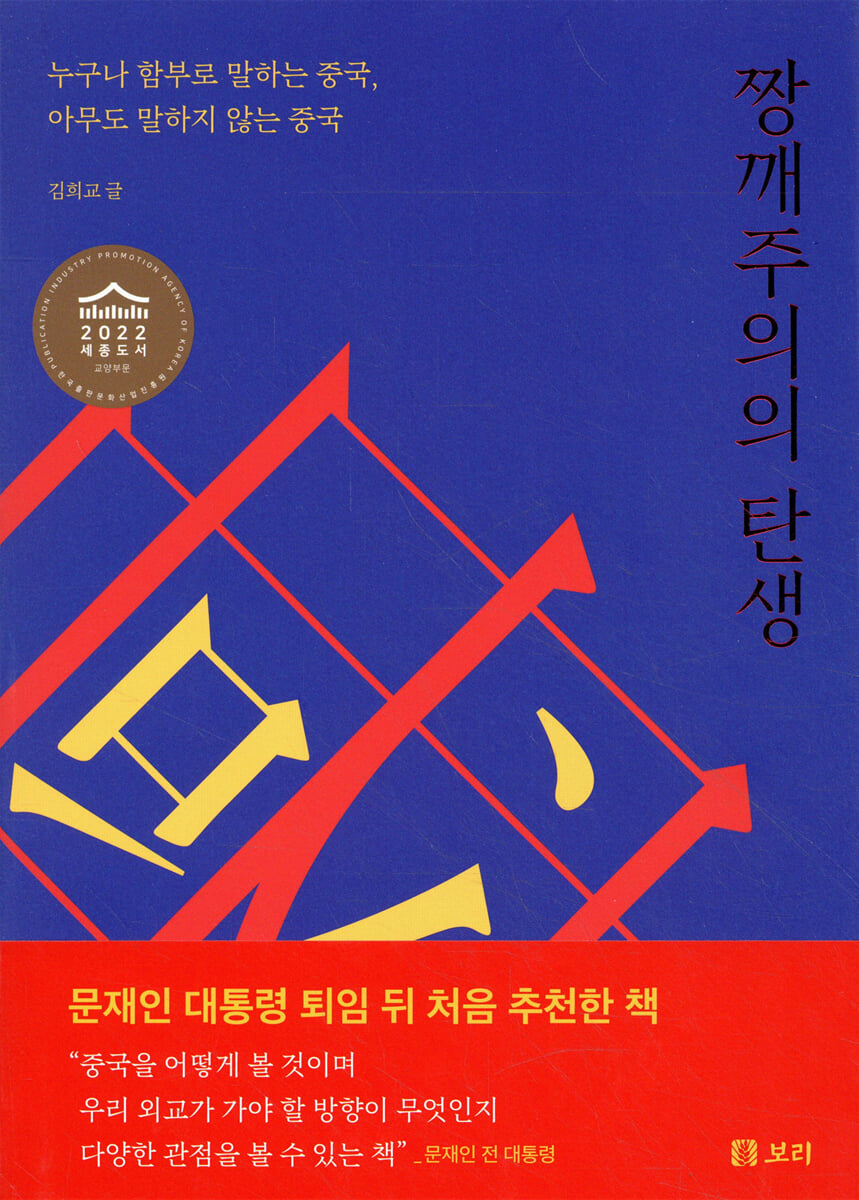
The birth of Jjangkeism
 |
Description
Book Introduction
The third volume of the Barley Humanities series, “The Birth of Chinaism - Everyone Talks About China, No One Talks About China,” has been published.
As anti-Chinese sentiment and hatred intensified, the term "Jjang-gae" became the mainstream frame for perceiving China in Korean society.
So when did anti-Chinese sentiment begin to emerge in Korean society?
『The Birth of Jjang-Kae-Im』 explains the time period, concept, and historical context of the term ‘Jjang-Kae’ and analyzes how ‘Jjang-Kae-Im’ is formed and distributed in current Korean society.
It corrects the prejudices and misunderstandings surrounding Chinese discourse that have spread through hatred, and explains why critical Chinese discourse is necessary in Korean society.
Furthermore, in order to escape from being a divided nation, Korea asks what China should be, and shifts the geopolitics of knowledge from China to Korea.
The author argues that Korea can become a leading player in the era of multilateralism, and sheds new light on Korea-China relations from a decolonial perspective and a peace regime perspective.
As anti-Chinese sentiment and hatred intensified, the term "Jjang-gae" became the mainstream frame for perceiving China in Korean society.
So when did anti-Chinese sentiment begin to emerge in Korean society?
『The Birth of Jjang-Kae-Im』 explains the time period, concept, and historical context of the term ‘Jjang-Kae’ and analyzes how ‘Jjang-Kae-Im’ is formed and distributed in current Korean society.
It corrects the prejudices and misunderstandings surrounding Chinese discourse that have spread through hatred, and explains why critical Chinese discourse is necessary in Korean society.
Furthermore, in order to escape from being a divided nation, Korea asks what China should be, and shifts the geopolitics of knowledge from China to Korea.
The author argues that Korea can become a leading player in the era of multilateralism, and sheds new light on Korea-China relations from a decolonial perspective and a peace regime perspective.
- You can preview some of the book's contents.
Preview
index
When publishing a book
Part 1: China, where you can talk carelessly
1.
Has Santa really disappeared?
2.
Santa Claus came to China too
3.
Where were all those correspondents?
4.
China, where you can speak carelessly
Part 2: The Shaking 'Postwar System'
1.
Establishment of the San Francisco System
2.
Blockaded China, Excluded Korean Peninsula
3.
The emergence of the Kissinger system
4.
The Kissinger System's Crisis
Part 3: The Crisis of Korean Conservatism and China
1.
The Crisis of Korean Conservatism
2.
The clash between the US in security and China in economy
3.
The Northeast Project Incident: Back to Security
4.
THAAD: South Korean Conservatism's New Cold War Project
5.
Wuhan Pneumonia: A Quasi-Racist Project of Korean Conservatism
Part 4: The Birth of Jjangkeism
1.
The revival of Jjang-gae
2.
Jjang-gae and Jjang-gae-ism
3.
The Historicity of Chinese Communism: Heteronormative Modernity and an Incomplete View of China
Part 5: The Frame of Jang-Kae-Im: Pseudo-Racism
1.
uncivilized China
2.
Bad China
3.
China is the problem
4.
One and only China
Part 6: The Frame of the Jangkeism I: I Defending the Neocolonial System
1.
There is no way China can succeed.
2.
China seeks hegemony
3.
China will once again dominate the Korean Peninsula.
4.
We Must Stand with America: The Lost Dream of Decolonization
Part 7: The Frame of the Jangkeism III: The Problem of Capital as China's Problem
1.
fine dust from China
2.
China is taking over Jeju Island
3.
Chinese landlord
4.
Ssangyong Motors' technology leak
Part 8: The Frame of the Jang-Kae-Issue IV: Building a New Cold War System
1.
Military excavation
2.
freedom of navigation
3.
Intelligence Agency Confucius Institute
4.
pro-China regime
Part 9: Distribution Channels of Chinese Discourse
1.
The textbook of Chinese reporting: The South China Morning Post
2.
The Frame's Base: Western Media
3.
A Sample Room of Chinese Tradition: The Huanqiu Shibao
4.
The Lost Progressive China Frame
5.
Absence of channels for progressive discourse distribution
Part 10: The Korean Media's Critical Reporting Techniques
:For three months from June to August 2020
Analysis of Chinese Reports in Korean Media
1.
Promotes anger and hatred rather than reporting facts
2.
Using emotional and negative words that contain preconceived notions
3.
Even the actions of a few Chinese people are reported as a problem affecting all of China.
4.
Reporting on China's good and bad points
5.
Global problems and natural phenomena are also China's fault.
6.
America's actions are a matter of national strategy,
China's actions are a moral issue
7.
If that's the case in the US, then so be it
8.
China's position is non-existent or for show
9.
Raise the issue and don't care about the outcome
10.
Almost all media outlets repeat a report from one media outlet.
Part 11: Even within the progressive camp, racist rhetoric is prevalent.
1.
The daily life of Jjangkeism
2.
Even progressives speak carelessly about China
3.
The missing front, the absent camp
Part 12: Korea's Progressive Camp's Discourse on China
1.
The disappearance of practical Chinese discourse
2.
The frame that China is also a problem
3.
The appropriation of liberal universal values
4.
Socialist China Frame
5.
The Disappeared Discourse on the Peace System
Part 13: The Crisis of the San Francisco System
1.
The Fall of American Hegemony
2.
China's containment policy and American hegemony
3.
Conflicts among domestic interest groups in the United States
4.
Conflict of mutual interests between allies
5.
The differentiation between security conservatism and economic conservatism
The opportunity has arrived to usher in an era of multilateralism.
1.
Blockade of China is impossible
2.
China's growth
3.
Asia's growth
4.
The growth of opposing forces
5.
Chained international division of labor system
6.
Military power with mutual checks and balances
7.
Diversification of cultural leadership
Part 15: Peace Regime and China
1.
Viewing China from a Peace System Perspective
2.
China as a deterrent to war
3.
The central axis of multilateralism
4.
The radical nature of the single market
5.
capital-restrictive party-state system
6.
Experience of an inward-looking country
7.
common life world
8.
Beyond Jjang-Kae-Im: Dreaming of a Different World
supplement
References
Search
Part 1: China, where you can talk carelessly
1.
Has Santa really disappeared?
2.
Santa Claus came to China too
3.
Where were all those correspondents?
4.
China, where you can speak carelessly
Part 2: The Shaking 'Postwar System'
1.
Establishment of the San Francisco System
2.
Blockaded China, Excluded Korean Peninsula
3.
The emergence of the Kissinger system
4.
The Kissinger System's Crisis
Part 3: The Crisis of Korean Conservatism and China
1.
The Crisis of Korean Conservatism
2.
The clash between the US in security and China in economy
3.
The Northeast Project Incident: Back to Security
4.
THAAD: South Korean Conservatism's New Cold War Project
5.
Wuhan Pneumonia: A Quasi-Racist Project of Korean Conservatism
Part 4: The Birth of Jjangkeism
1.
The revival of Jjang-gae
2.
Jjang-gae and Jjang-gae-ism
3.
The Historicity of Chinese Communism: Heteronormative Modernity and an Incomplete View of China
Part 5: The Frame of Jang-Kae-Im: Pseudo-Racism
1.
uncivilized China
2.
Bad China
3.
China is the problem
4.
One and only China
Part 6: The Frame of the Jangkeism I: I Defending the Neocolonial System
1.
There is no way China can succeed.
2.
China seeks hegemony
3.
China will once again dominate the Korean Peninsula.
4.
We Must Stand with America: The Lost Dream of Decolonization
Part 7: The Frame of the Jangkeism III: The Problem of Capital as China's Problem
1.
fine dust from China
2.
China is taking over Jeju Island
3.
Chinese landlord
4.
Ssangyong Motors' technology leak
Part 8: The Frame of the Jang-Kae-Issue IV: Building a New Cold War System
1.
Military excavation
2.
freedom of navigation
3.
Intelligence Agency Confucius Institute
4.
pro-China regime
Part 9: Distribution Channels of Chinese Discourse
1.
The textbook of Chinese reporting: The South China Morning Post
2.
The Frame's Base: Western Media
3.
A Sample Room of Chinese Tradition: The Huanqiu Shibao
4.
The Lost Progressive China Frame
5.
Absence of channels for progressive discourse distribution
Part 10: The Korean Media's Critical Reporting Techniques
:For three months from June to August 2020
Analysis of Chinese Reports in Korean Media
1.
Promotes anger and hatred rather than reporting facts
2.
Using emotional and negative words that contain preconceived notions
3.
Even the actions of a few Chinese people are reported as a problem affecting all of China.
4.
Reporting on China's good and bad points
5.
Global problems and natural phenomena are also China's fault.
6.
America's actions are a matter of national strategy,
China's actions are a moral issue
7.
If that's the case in the US, then so be it
8.
China's position is non-existent or for show
9.
Raise the issue and don't care about the outcome
10.
Almost all media outlets repeat a report from one media outlet.
Part 11: Even within the progressive camp, racist rhetoric is prevalent.
1.
The daily life of Jjangkeism
2.
Even progressives speak carelessly about China
3.
The missing front, the absent camp
Part 12: Korea's Progressive Camp's Discourse on China
1.
The disappearance of practical Chinese discourse
2.
The frame that China is also a problem
3.
The appropriation of liberal universal values
4.
Socialist China Frame
5.
The Disappeared Discourse on the Peace System
Part 13: The Crisis of the San Francisco System
1.
The Fall of American Hegemony
2.
China's containment policy and American hegemony
3.
Conflicts among domestic interest groups in the United States
4.
Conflict of mutual interests between allies
5.
The differentiation between security conservatism and economic conservatism
The opportunity has arrived to usher in an era of multilateralism.
1.
Blockade of China is impossible
2.
China's growth
3.
Asia's growth
4.
The growth of opposing forces
5.
Chained international division of labor system
6.
Military power with mutual checks and balances
7.
Diversification of cultural leadership
Part 15: Peace Regime and China
1.
Viewing China from a Peace System Perspective
2.
China as a deterrent to war
3.
The central axis of multilateralism
4.
The radical nature of the single market
5.
capital-restrictive party-state system
6.
Experience of an inward-looking country
7.
common life world
8.
Beyond Jjang-Kae-Im: Dreaming of a Different World
supplement
References
Search
Detailed image

Into the book
For us, China is different from Africa.
China is such an important stakeholder that our worldview cannot help but be directly reflected in our perspective on it.
But why have we come to speak so carelessly about China? Where are all those correspondents? Why are Korean progressives silent? The absence of counter-discourse, as described by Césaire, who has been grappling with the issue of neocolonialism in Africa, is now evident in Chinese discourse.
--- p.37
In that respect, the Korean perspective on China within the post-war system was bound to be divisive.
The theory of China's collapse, which asserts that socialist China is destined to collapse, and the theory of China's threat, which asserts that China's rise will pose a threat to its neighbors, are mutually incompatible arguments. Yet, they have grown together under the economic supremacy of seeking to utilize China as a market without much conflict.
This is how the dual strategy of relying on the US for security and China for the economy was born.
--- p.66
Since diplomatic relations were established not to live together as good neighbors with China, but because China was a market, there was no place for communitarianism that sought to become good neighbors with China.
As China's rapid economic growth put Chinese products in competition with Korean products, anti-Chinese sentiment among economic supremacists rapidly increased.
The South Korea-China relationship, formed without a sense of community as neighbors, naturally led to conflict over issues that could only be resolved by becoming neighbors: historical issues, pollution and territorial waters, fine dust, cultural sovereignty, and peace regimes.
Through such historical twists and turns, China's image as a China that the public perceives has become established very easily.
--- p.107
It is also a geopolitically advantageous location that allows us to make our voice heard in the face of the United States and China.
The strategic geography of Asia, shaped by the competition between Central America and the United States, has made it possible for Philippine President Duterte to pursue a tough, neutral diplomatic approach.
Duterte demanded the withdrawal of American troops from the United States and filed a complaint with the United Nations against China, claiming sovereignty over the South China Sea.
But no one could mess with the Philippines.
The US clung to China's request for permission to station its troops, and China opened its purse strings.
--- p.187~188
The world is no longer in an era where the United States dominates everything, nor is it an era where the United States is the world.
The concept of the world as used by Korean conservative media clearly reveals that Eurocentrism is still entrenched and that they view modern Europe as their own coordinates.
--- p.249
Therefore, Western universal values and systems do not directly lead to democracy in East Asia.
In Korea, it is easy to borrow Marxist theory and frame it as a "socialist China" to emphasize how violent the current Chinese system is, or to equate Western systems with democracy and then emphasize the "backwardness" of China's one-party system, or to bring in idealistic ecology to criticize China's developmentalism as the "world's factory."
--- p.464
The counter-power has grown on the basis of the era of multilateralism within the post-war system and is seeking a post-San Francisco system future.
The success or failure of Korea's peace regime hinges on whether Korea's progressive elites can discover the new modern powers emerging in the era of multilateralism and present an agenda that will break through the Cold War-era planning of security conservatism and create a new world within the framework they need.
--- p.566
From a historical perspective, establishing a regional peace system in East Asia would mean opening up an era entirely different from the San Francisco System.
The core of this is the transformation of the neocolonial state-to-state system with vertical hierarchical relationships into an equal state relationship.
The peace regime on the Korean Peninsula consists of two axes: the end of the division of the Korean Peninsula and the formation of an East Asian regional community.
Economically, we need to regionalize, and politically, we need to build a cooperative multilateral system.
The way to create economic regionalization must be a sustainable development approach, and the way to create cooperative multilateralism must be demilitaristic and peaceful.
At the same time, borders must be broken down and reterritorialization must be implemented to enable free movement.
--- p.588
It is time for pacifists to move beyond the framework of China-China relations and establish a framework for a peace system and take the lead in the agenda.
A peace regime agenda does not mean praising China by turning a blind eye to its problems and saying that China is unconditionally on our side.
It is to see China as it is through the framework of a peace regime.
Just as the peace regime framework cannot be US-centric, it cannot be China-centric either.
It is time to break away from the colonial frame of asking people to take sides and start a fight to gather pacifists under the frame of a peace system.
--- p.646~647
With China on the rise, America's neocolonial system faltering, Asia's growing power, and neither the US nor China securing hegemony, now is our opportunity.
Let's dream of 100 years.
A dream I've had for the past 100 years.
A dream to be enjoyed for the next 100 years.
The most important thing to do to overcome the stereotype is to dream.
China is such an important stakeholder that our worldview cannot help but be directly reflected in our perspective on it.
But why have we come to speak so carelessly about China? Where are all those correspondents? Why are Korean progressives silent? The absence of counter-discourse, as described by Césaire, who has been grappling with the issue of neocolonialism in Africa, is now evident in Chinese discourse.
--- p.37
In that respect, the Korean perspective on China within the post-war system was bound to be divisive.
The theory of China's collapse, which asserts that socialist China is destined to collapse, and the theory of China's threat, which asserts that China's rise will pose a threat to its neighbors, are mutually incompatible arguments. Yet, they have grown together under the economic supremacy of seeking to utilize China as a market without much conflict.
This is how the dual strategy of relying on the US for security and China for the economy was born.
--- p.66
Since diplomatic relations were established not to live together as good neighbors with China, but because China was a market, there was no place for communitarianism that sought to become good neighbors with China.
As China's rapid economic growth put Chinese products in competition with Korean products, anti-Chinese sentiment among economic supremacists rapidly increased.
The South Korea-China relationship, formed without a sense of community as neighbors, naturally led to conflict over issues that could only be resolved by becoming neighbors: historical issues, pollution and territorial waters, fine dust, cultural sovereignty, and peace regimes.
Through such historical twists and turns, China's image as a China that the public perceives has become established very easily.
--- p.107
It is also a geopolitically advantageous location that allows us to make our voice heard in the face of the United States and China.
The strategic geography of Asia, shaped by the competition between Central America and the United States, has made it possible for Philippine President Duterte to pursue a tough, neutral diplomatic approach.
Duterte demanded the withdrawal of American troops from the United States and filed a complaint with the United Nations against China, claiming sovereignty over the South China Sea.
But no one could mess with the Philippines.
The US clung to China's request for permission to station its troops, and China opened its purse strings.
--- p.187~188
The world is no longer in an era where the United States dominates everything, nor is it an era where the United States is the world.
The concept of the world as used by Korean conservative media clearly reveals that Eurocentrism is still entrenched and that they view modern Europe as their own coordinates.
--- p.249
Therefore, Western universal values and systems do not directly lead to democracy in East Asia.
In Korea, it is easy to borrow Marxist theory and frame it as a "socialist China" to emphasize how violent the current Chinese system is, or to equate Western systems with democracy and then emphasize the "backwardness" of China's one-party system, or to bring in idealistic ecology to criticize China's developmentalism as the "world's factory."
--- p.464
The counter-power has grown on the basis of the era of multilateralism within the post-war system and is seeking a post-San Francisco system future.
The success or failure of Korea's peace regime hinges on whether Korea's progressive elites can discover the new modern powers emerging in the era of multilateralism and present an agenda that will break through the Cold War-era planning of security conservatism and create a new world within the framework they need.
--- p.566
From a historical perspective, establishing a regional peace system in East Asia would mean opening up an era entirely different from the San Francisco System.
The core of this is the transformation of the neocolonial state-to-state system with vertical hierarchical relationships into an equal state relationship.
The peace regime on the Korean Peninsula consists of two axes: the end of the division of the Korean Peninsula and the formation of an East Asian regional community.
Economically, we need to regionalize, and politically, we need to build a cooperative multilateral system.
The way to create economic regionalization must be a sustainable development approach, and the way to create cooperative multilateralism must be demilitaristic and peaceful.
At the same time, borders must be broken down and reterritorialization must be implemented to enable free movement.
--- p.588
It is time for pacifists to move beyond the framework of China-China relations and establish a framework for a peace system and take the lead in the agenda.
A peace regime agenda does not mean praising China by turning a blind eye to its problems and saying that China is unconditionally on our side.
It is to see China as it is through the framework of a peace regime.
Just as the peace regime framework cannot be US-centric, it cannot be China-centric either.
It is time to break away from the colonial frame of asking people to take sides and start a fight to gather pacifists under the frame of a peace system.
--- p.646~647
With China on the rise, America's neocolonial system faltering, Asia's growing power, and neither the US nor China securing hegemony, now is our opportunity.
Let's dream of 100 years.
A dream I've had for the past 100 years.
A dream to be enjoyed for the next 100 years.
The most important thing to do to overcome the stereotype is to dream.
--- p.652
Publisher's Review
Korean society's perception of China: China-ism
It is easy to think of the term 'Jjang-gae' as simply a derogatory term for China and Chinese people.
However, this term has historicity.
Before the Sino-Japanese War in 1894, Chinese people living in Korea were not objects of hatred.
However, as China lost the Sino-Japanese War and Japan began to take over Korea, perceptions of the Chinese changed.
The Japanese portrayed the Chinese as an inferior and uncivilized people, and Koreans, too, were incorporated into Japan's colonial discourse and began to look down on the Chinese.
After liberation, the US military government, the outbreak of the Korean War, China's participation in the war, and the spread of anti-communism amplified hatred and hostility toward China.
Although Sinophobia eased after South Korea and China established diplomatic relations in 1992, as China rises and the US-China conflict intensifies, anti-Chinese sentiment is spreading in Korean society.
In this book, the author explains the process of forming Jang-Kae-Im and analyzes how the Jang-Kae-Im frame operates throughout society.
The frames of Chinese communism include the pseudo-racism that has been passed down since the colonial Joseon Dynasty, the neo-colonial system that advocates a vertical alliance system centered on the United States, the frame that attributes the problem of capital to China's problem, and the new Cold War system that recognizes China again through the anti-communist frame.
Within this framework, the author examines what kind of China everyone talks about and what kind of China no one talks about.
The concept of "Jjang-gae" embodies the hatred inherent in Western racism. As Caroline Emke argues in "Hate Society," the hated entity in a hate society is always ambiguous.
I can't tell if Jjang-gae refers to China or Chinese people.
I don't know if all Chinese people are bad, or if bad people are Chinese.
(…) One thing is clear.
It is certain that the word "Jjang-Kae," a vague collective term created by someone, is becoming the recipient of hatred.
_From page 89
The Kissinger System's Crisis: A Return to the Cold War
Since the San Francisco system, Korea, China, the US, and Japan have maintained order among their countries through the Kissinger system.
If the San Francisco system was a system in which the United States formed an alliance with Japan and South Korea and excluded China from the international community, the Kissinger system was a system in which the United States incorporated China into the international economic system for economic reasons.
Under the Kissinger system, China and the United States experienced economic revival, and East Asia maintained a period of peace, albeit an incomplete one.
But the United States felt threatened by China's economic growth.
Ultimately, the United States abandoned the Kissinger system and adopted a strategy of containment of China in order to return to the San Francisco system.
The author argues that the US-China conflict is not caused by China being the problem, but rather by the US's strategy of containing China.
The book offers a new interpretation of the US-China conflict from a post-Eurocentric and post-colonial perspective, moving beyond a Eurocentric and US-centric perspective.
America's new Cold War strategy was not a sudden decision made by the Trump administration.
Since the 1990s, when China's economy was on the rise, the US government and opposition parties have been promoting the "China threat theory."
This phenomenon indirectly shows that from this period onwards, the United States felt that China's growth was a significant threat.
Page 57
The normalization and structuration of Jjangkeism
The spread of Jang-Kae-Im also has to do with the sense of crisis within Korean conservatism.
Externally, the US-centric post-war system was shaken, and internally, anti-communism and pro-Americanism were weakening, so conservatives put forward pro-China sentiment to protect their system.
As China-ism becomes the norm, everyone now says, “China is the problem.”
This framing leads us to conclude that China is bad, rather than judging China-related issues based on facts.
The author analyzes the frame of Chinese ideology that operated in the conservative camp while covering major issues such as 'fine dust from China,' 'Wuhan virus,' 'military expansion,' and 'Chinese hegemony.'
We further examine in depth how these frames have led to the perception of China as an enemy.
It is a clear fact that China produces a lot of fine dust.
But that doesn't mean it's 'uncivilized China' or 'bad China'.
The biggest reason is the international division of labor system.
The garbage crisis in Seoul's Gangnam District in 2018, which occurred when China banned the import of waste plastic, was a symbolic event that clearly demonstrated the international division of labor system.
China, incorporated into the international division of labor system through the Kissinger system, has been called the world's factory and has served as a key manufacturing base.
Page 255
The disappearance of critical discourse on Jang-Kae-Im
Korean progressivism is not immune to Sinophobia.
In the progressive camp, liberalism has been monopolized as a universal value since democratization.
This frame holds that democracy is completed only when representative democracy, a market economy, and a free civil society are established.
But this is Western-centric thinking.
The Western model of democracy has been applied to China, resulting in interpretations and criticisms of China today.
The author suggests that before telling us where China should go, we should ask ourselves what China is.
The idea is to shift the geopolitics of knowledge from China to Korea.
This book examines the reasons for the disappearance of practical China discourse within the Korean progressive camp and suggests the direction in which the progressive camp should pursue its discourse on China.
Analysis of the distribution channels of Chinese discourse
The book also focuses on the channels through which Jjangkeism is distributed.
When I read Chinese articles on portal sites, it seems like China deserves to be criticized.
But if you look at the Chinese media outlets that Korean media mainly cites, it becomes understandable why there are so many articles geared towards Sinophobia.
The author analyzes how the Hong Kong newspaper South China Morning Post, the English-language version of the Chinese newspaper Global Times, and other news agencies, which are cited by the Korean media when reporting on Chinese news, report on China.
Let's find out what impact these articles had on people and what frame they used to view China.
From a unipolar system to a multilateral era
So, can the United States destroy the Kissinger system and return to the San Francisco system?
However, the international community is being reorganized by the rise of China, the decline of American hegemony, conflicts of interest within the United States, the growth of Asia, the emergence of countervailing powers, and the international division of labor system.
The author develops his argument for moving toward an era of multilateralism through various documents, articles, and expert opinions.
This does not mean that the American era is over and the Chinese era is coming, nor does it mean that we have to choose between the two.
A new era is dawning that neither the United States nor China can dominate.
The author argues that amidst these changes, Korea is fully qualified to usher in an era of multilateralism.
Moving beyond ideology and toward a peace regime
Now, Korea must choose which countries to cooperate with and what common goals to set.
Korea remains the world's only divided country.
China's role is necessary to resolve North Korea's missile and nuclear issues.
China acts as a war-deterring nation in Northeast Asia.
It has also existed as a 'neighbor' with a long history of cultural affinity with Korea.
If Korea and China write a common history rather than a history of division, they can advance the establishment of a peace regime in Northeast Asia.
The author emphasizes that pacifists must break away from the framework of Jang-Kae-Ju and create a new framework.
Looking at China and the Chinese people from the perspective of a peace system, he says we must dream of a world different from the one we have today.
Just because the era of multilateralism has arrived does not mean that it will soon become our era.
In such an era, there are always countries that are ahead and countries that are behind.
History is created by the combination of the political and economic structures that are in place here and now and the efforts of people to change them.
Now, all that remains is the efforts of the people who live in this space.
_Page 650
It is easy to think of the term 'Jjang-gae' as simply a derogatory term for China and Chinese people.
However, this term has historicity.
Before the Sino-Japanese War in 1894, Chinese people living in Korea were not objects of hatred.
However, as China lost the Sino-Japanese War and Japan began to take over Korea, perceptions of the Chinese changed.
The Japanese portrayed the Chinese as an inferior and uncivilized people, and Koreans, too, were incorporated into Japan's colonial discourse and began to look down on the Chinese.
After liberation, the US military government, the outbreak of the Korean War, China's participation in the war, and the spread of anti-communism amplified hatred and hostility toward China.
Although Sinophobia eased after South Korea and China established diplomatic relations in 1992, as China rises and the US-China conflict intensifies, anti-Chinese sentiment is spreading in Korean society.
In this book, the author explains the process of forming Jang-Kae-Im and analyzes how the Jang-Kae-Im frame operates throughout society.
The frames of Chinese communism include the pseudo-racism that has been passed down since the colonial Joseon Dynasty, the neo-colonial system that advocates a vertical alliance system centered on the United States, the frame that attributes the problem of capital to China's problem, and the new Cold War system that recognizes China again through the anti-communist frame.
Within this framework, the author examines what kind of China everyone talks about and what kind of China no one talks about.
The concept of "Jjang-gae" embodies the hatred inherent in Western racism. As Caroline Emke argues in "Hate Society," the hated entity in a hate society is always ambiguous.
I can't tell if Jjang-gae refers to China or Chinese people.
I don't know if all Chinese people are bad, or if bad people are Chinese.
(…) One thing is clear.
It is certain that the word "Jjang-Kae," a vague collective term created by someone, is becoming the recipient of hatred.
_From page 89
The Kissinger System's Crisis: A Return to the Cold War
Since the San Francisco system, Korea, China, the US, and Japan have maintained order among their countries through the Kissinger system.
If the San Francisco system was a system in which the United States formed an alliance with Japan and South Korea and excluded China from the international community, the Kissinger system was a system in which the United States incorporated China into the international economic system for economic reasons.
Under the Kissinger system, China and the United States experienced economic revival, and East Asia maintained a period of peace, albeit an incomplete one.
But the United States felt threatened by China's economic growth.
Ultimately, the United States abandoned the Kissinger system and adopted a strategy of containment of China in order to return to the San Francisco system.
The author argues that the US-China conflict is not caused by China being the problem, but rather by the US's strategy of containing China.
The book offers a new interpretation of the US-China conflict from a post-Eurocentric and post-colonial perspective, moving beyond a Eurocentric and US-centric perspective.
America's new Cold War strategy was not a sudden decision made by the Trump administration.
Since the 1990s, when China's economy was on the rise, the US government and opposition parties have been promoting the "China threat theory."
This phenomenon indirectly shows that from this period onwards, the United States felt that China's growth was a significant threat.
Page 57
The normalization and structuration of Jjangkeism
The spread of Jang-Kae-Im also has to do with the sense of crisis within Korean conservatism.
Externally, the US-centric post-war system was shaken, and internally, anti-communism and pro-Americanism were weakening, so conservatives put forward pro-China sentiment to protect their system.
As China-ism becomes the norm, everyone now says, “China is the problem.”
This framing leads us to conclude that China is bad, rather than judging China-related issues based on facts.
The author analyzes the frame of Chinese ideology that operated in the conservative camp while covering major issues such as 'fine dust from China,' 'Wuhan virus,' 'military expansion,' and 'Chinese hegemony.'
We further examine in depth how these frames have led to the perception of China as an enemy.
It is a clear fact that China produces a lot of fine dust.
But that doesn't mean it's 'uncivilized China' or 'bad China'.
The biggest reason is the international division of labor system.
The garbage crisis in Seoul's Gangnam District in 2018, which occurred when China banned the import of waste plastic, was a symbolic event that clearly demonstrated the international division of labor system.
China, incorporated into the international division of labor system through the Kissinger system, has been called the world's factory and has served as a key manufacturing base.
Page 255
The disappearance of critical discourse on Jang-Kae-Im
Korean progressivism is not immune to Sinophobia.
In the progressive camp, liberalism has been monopolized as a universal value since democratization.
This frame holds that democracy is completed only when representative democracy, a market economy, and a free civil society are established.
But this is Western-centric thinking.
The Western model of democracy has been applied to China, resulting in interpretations and criticisms of China today.
The author suggests that before telling us where China should go, we should ask ourselves what China is.
The idea is to shift the geopolitics of knowledge from China to Korea.
This book examines the reasons for the disappearance of practical China discourse within the Korean progressive camp and suggests the direction in which the progressive camp should pursue its discourse on China.
Analysis of the distribution channels of Chinese discourse
The book also focuses on the channels through which Jjangkeism is distributed.
When I read Chinese articles on portal sites, it seems like China deserves to be criticized.
But if you look at the Chinese media outlets that Korean media mainly cites, it becomes understandable why there are so many articles geared towards Sinophobia.
The author analyzes how the Hong Kong newspaper South China Morning Post, the English-language version of the Chinese newspaper Global Times, and other news agencies, which are cited by the Korean media when reporting on Chinese news, report on China.
Let's find out what impact these articles had on people and what frame they used to view China.
From a unipolar system to a multilateral era
So, can the United States destroy the Kissinger system and return to the San Francisco system?
However, the international community is being reorganized by the rise of China, the decline of American hegemony, conflicts of interest within the United States, the growth of Asia, the emergence of countervailing powers, and the international division of labor system.
The author develops his argument for moving toward an era of multilateralism through various documents, articles, and expert opinions.
This does not mean that the American era is over and the Chinese era is coming, nor does it mean that we have to choose between the two.
A new era is dawning that neither the United States nor China can dominate.
The author argues that amidst these changes, Korea is fully qualified to usher in an era of multilateralism.
Moving beyond ideology and toward a peace regime
Now, Korea must choose which countries to cooperate with and what common goals to set.
Korea remains the world's only divided country.
China's role is necessary to resolve North Korea's missile and nuclear issues.
China acts as a war-deterring nation in Northeast Asia.
It has also existed as a 'neighbor' with a long history of cultural affinity with Korea.
If Korea and China write a common history rather than a history of division, they can advance the establishment of a peace regime in Northeast Asia.
The author emphasizes that pacifists must break away from the framework of Jang-Kae-Ju and create a new framework.
Looking at China and the Chinese people from the perspective of a peace system, he says we must dream of a world different from the one we have today.
Just because the era of multilateralism has arrived does not mean that it will soon become our era.
In such an era, there are always countries that are ahead and countries that are behind.
History is created by the combination of the political and economic structures that are in place here and now and the efforts of people to change them.
Now, all that remains is the efforts of the people who live in this space.
_Page 650
GOODS SPECIFICS
- Publication date: April 25, 2022
- Format: Hardcover book binding method guide
- Page count, weight, size: 676 pages | 1,056g | 152*215*35mm
- ISBN13: 9791163142379
- ISBN10: 1163142379
You may also like
카테고리
korean


korean

![GQ KOREA Mark (Monthly): December [2025]](http://librairie.coreenne.fr/cdn/shop/files/8ef265dbbfbf186523ed75ba7319009d.jpg?v=1765340328&width=3840)


