

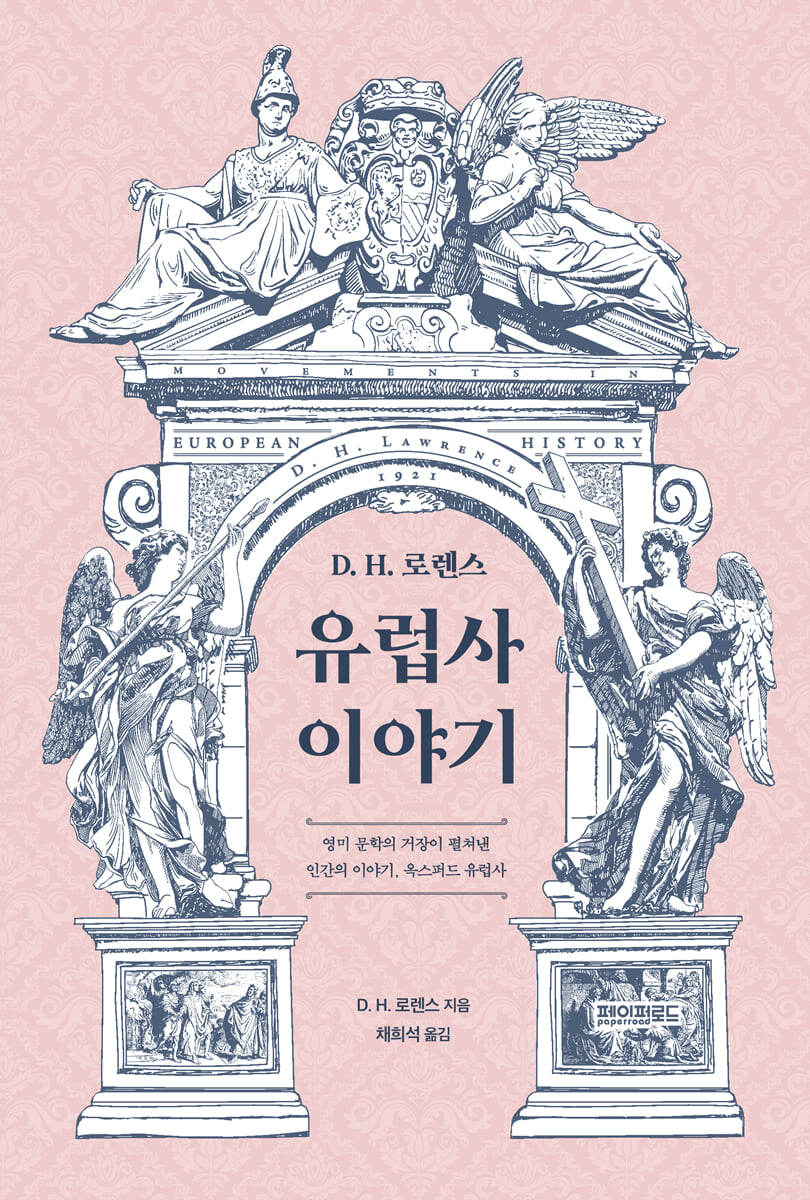
DH Lawrence's European History
 |
Description
Book Introduction
The Oxford History of Europe: A Human Story Unfolded by a Master of Anglo-American Literature
Exactly one hundred years ago, students at Oxford University were gripped by curiosity.
Because I couldn't figure out whose work this history book with its flowing style and lively narrative was.
The book was a breathtaking account of the process from the founding of ancient Rome to the formation of modern European states.
This book, which analyzes the people and events in history as if exploring the scandals of human history created by desire, possesses both the merits of a rigorous history book and the charm of a novel, while remaining perfectly faithful to its educational purpose.
In a single volume, Lawrence presents 2,500 years of European history, making ambitious claims that are now accepted as established theories, but which no historian at the time could have made.
To this end, Lawrence begins his book by criticizing precisely three approaches to historical narrative.
The first is the existing history book, which is written simply by listing only facts.
This approach reduces history to dead knowledge in books rather than stories.
The second is a history book that pursues vividness like a photograph.
These historical books portray people in history as if they were characters in a novel.
Great men, heroes, and villains of all time become embroiled in conspiracies and conflicts, fall in love, and engage in mundane conversations, creating a page in history.
Exactly one hundred years ago, students at Oxford University were gripped by curiosity.
Because I couldn't figure out whose work this history book with its flowing style and lively narrative was.
The book was a breathtaking account of the process from the founding of ancient Rome to the formation of modern European states.
This book, which analyzes the people and events in history as if exploring the scandals of human history created by desire, possesses both the merits of a rigorous history book and the charm of a novel, while remaining perfectly faithful to its educational purpose.
In a single volume, Lawrence presents 2,500 years of European history, making ambitious claims that are now accepted as established theories, but which no historian at the time could have made.
To this end, Lawrence begins his book by criticizing precisely three approaches to historical narrative.
The first is the existing history book, which is written simply by listing only facts.
This approach reduces history to dead knowledge in books rather than stories.
The second is a history book that pursues vividness like a photograph.
These historical books portray people in history as if they were characters in a novel.
Great men, heroes, and villains of all time become embroiled in conspiracies and conflicts, fall in love, and engage in mundane conversations, creating a page in history.
- You can preview some of the book's contents.
Preview
index
Introduction 7
I Rome 13
II Constantinople 29
III Christianity 47
IV Germanic peoples 81
V Goths and Vandals 101
VI Huns 125
VII Gaul 147
VIII The Franks and Charlemagne 171
IX Popes and Emperors 197
X Crusade 231
Italy after the Hohenstaufen Dynasty 266
XII The End of the Age of Faith 289
XIII Renaissance 319
XIV Reformation 349
XV Overlord 371
XVI French Revolution 393
XVII Prussia 425
XVIII Italy 451
XIX The Unification of Germany 491
Translator's Note 515
I Rome 13
II Constantinople 29
III Christianity 47
IV Germanic peoples 81
V Goths and Vandals 101
VI Huns 125
VII Gaul 147
VIII The Franks and Charlemagne 171
IX Popes and Emperors 197
X Crusade 231
Italy after the Hohenstaufen Dynasty 266
XII The End of the Age of Faith 289
XIII Renaissance 319
XIV Reformation 349
XV Overlord 371
XVI French Revolution 393
XVII Prussia 425
XVIII Italy 451
XIX The Unification of Germany 491
Translator's Note 515
Detailed image

Into the book
Unfortunately for us, there is nothing more difficult than reconstructing the 'private' reality of a bygone era.
Human beings are beings bound by place and time.
In an era, there is only a human form that fits that era.
So Shakespeare's Caesar is an Elizabethan Caesar, not a Roman Caesar, and Bernard Shaw's Caesar is a Victorian Caesar, and neither of these is the real Caesar.
--- From the "Preface"
At the heart of the Romans was a passion for simple and practical 'truth'.
This point is even clearly evident in the trial of Jesus.
Each of them was either vain or immoral.
But in social activities, especially in matters relating to justice and human freedom, he pursued, to an unusual degree, fairness between people and justice between individuals and nations, and he sought the total truth on any controversial issue.
Even when the emperor or governor was cruel or foolish, they still tried to discern what was true and right.
Although they did not always choose and act on the right things.
--- From "Rome"
Whatever the circumstances, it is clear that a pitiful and terrible fate befell the Christians.
But the persecution ended as quickly as it was sudden and brutal.
Nero would have forgotten that Christians ever existed within a month of the persecution ending.
However, according to the records of Tacitus and Pliny, we can see that a vague but deep hatred toward Christians was widespread in the hearts of the people.
Why did Tacitus believe these poor people deserved the most severe punishment? What was their crime? The answer was the Jews' supposed hatred of humanity.
--- From "Christianity"
On the one hand, the warriors were lazy and violent.
They spent half their lives lying around the fireplace in their homes or on the grass outside, drinking until they were drunk, or gambling together in groups.
Or, sitting in the spacious rooms of the chieftain's wooden house, he watched the spectacle of naked youths feasting on vast quantities of meat or performing a dangerous dance with agility and speed surrounded by sharp spears.
Then, when he got tired of these foolish games, he would get up, blow the horn, run out of the house, and hunt bears, wild boars, and deer.
Of course, even better than that was gathering for war.
--- From "Germanic Peoples"
While the great Roman Empire was declining within the borders of Constantinople, the rest of Europe was flooded with barbarian tribes from Germany, Russia, and Asia.
These savages eventually settled in one place, and, whether or not they mixed with the local natives, they laid or formed the foundations of a great modern nation.
These are the British, French, Spaniards, Lombards, Swiss, Bulgarians, etc. of today.
They were all the products of wild interbreeding between different races.
--- From "The Goths and the Vandals"
Human or not, the Romans soon had to deal with these Huns.
The main force of these groups was slowly approaching.
The women were brought in on a large, crude cart pulled by five or six oxen.
Captives and slaves walked alongside a large wagon loaded with loot.
Behind them, a herd of livestock lined up.
So, the march of the group had to naturally slow down.
--- From "The Huns"
But his hope was destined to be unrealized.
In 486, the young Frank Clovis attacked Syagrius.
Syagrius fled south to Toulouse, the capital of the young Visigothic king Alaric, to survive.
Clovis sent envoys and warriors to the Mediterranean to demand that Alaric of Toulouse hand over Syagrius. Alaric, unaware that he was inviting a formidable neighbor into his territory, handed Syagrius over to him, and Clovis had Syagrius beheaded on the spot.
--- From "The Franks and Charlemagne"
Gold and silver, jewels and silk, and elaborate furniture were piled high and in disarray.
“Who would hesitate to undertake any war of conquest if they could possess such treasures?” said the greedy Norman Bohemond.
Driven by greed, he took all the treasure.
From then on, the Greeks thought that Bohemianism had succumbed to materialism.
Robert of Normandy, Stephen of Chartres, and Raymond of Toulouse all knelt before the throne of the Byzantine emperor, splendid and dazzling in their turn.
--- From "The Crusades"
This new Christian world was beyond Dante's grasp.
So, to him, heaven was a much less vivid place than hell.
The world he knew best was the world of the past, a world of tumultuous and violent passions, punished in hell.
Mental happiness was not his world.
He belonged to the old world.
--- From "Renaissance"
“Dear brother, if I do not return, if my enemies send me to the gallows, then you must hold fast to the truth and teach it to the end.
“If you survive, my death is not so important.” He set out on his journey, prepared to die.
--- From "Reformation"
“Look at him,” said Madame Dubarry, pointing to the sad, handsome face of King Charles.
“Your Congress too
“I will cut off the head of God.” Madame Dubarry incited the King to great anger at the lawyers who interfered in every matter.
Louis arrested and exiled the most important members of the Assembly and dissolved the Assembly itself.
--- From "The French Revolution"
“Dear Garibaldi, how are you?”
“Yes, Your Majesty.
“What about Your Majesty?”
“It’s the best.”
The two shook hands.
(...) In the pouring rain, Garibaldi and Vittorio Emanuele rode through the streets of Naples, both in aggrieved.
The two people didn't like each other.
However, the one who received the most enthusiastic welcome during the march was Garibaldi.
This made the king even more displeased.
--- From "Italy"
“A nation awakens through a nation, and a king disappears through a king.”
The great Germanic peoples have never had a king or become a nation-state since the Middle Ages.
Germany itself was the mother of many nations, but it had not achieved national unity.
Germany could only be unified under a strong leader.
A struggle for leadership arose between Austria and Prussia.
Human beings are beings bound by place and time.
In an era, there is only a human form that fits that era.
So Shakespeare's Caesar is an Elizabethan Caesar, not a Roman Caesar, and Bernard Shaw's Caesar is a Victorian Caesar, and neither of these is the real Caesar.
--- From the "Preface"
At the heart of the Romans was a passion for simple and practical 'truth'.
This point is even clearly evident in the trial of Jesus.
Each of them was either vain or immoral.
But in social activities, especially in matters relating to justice and human freedom, he pursued, to an unusual degree, fairness between people and justice between individuals and nations, and he sought the total truth on any controversial issue.
Even when the emperor or governor was cruel or foolish, they still tried to discern what was true and right.
Although they did not always choose and act on the right things.
--- From "Rome"
Whatever the circumstances, it is clear that a pitiful and terrible fate befell the Christians.
But the persecution ended as quickly as it was sudden and brutal.
Nero would have forgotten that Christians ever existed within a month of the persecution ending.
However, according to the records of Tacitus and Pliny, we can see that a vague but deep hatred toward Christians was widespread in the hearts of the people.
Why did Tacitus believe these poor people deserved the most severe punishment? What was their crime? The answer was the Jews' supposed hatred of humanity.
--- From "Christianity"
On the one hand, the warriors were lazy and violent.
They spent half their lives lying around the fireplace in their homes or on the grass outside, drinking until they were drunk, or gambling together in groups.
Or, sitting in the spacious rooms of the chieftain's wooden house, he watched the spectacle of naked youths feasting on vast quantities of meat or performing a dangerous dance with agility and speed surrounded by sharp spears.
Then, when he got tired of these foolish games, he would get up, blow the horn, run out of the house, and hunt bears, wild boars, and deer.
Of course, even better than that was gathering for war.
--- From "Germanic Peoples"
While the great Roman Empire was declining within the borders of Constantinople, the rest of Europe was flooded with barbarian tribes from Germany, Russia, and Asia.
These savages eventually settled in one place, and, whether or not they mixed with the local natives, they laid or formed the foundations of a great modern nation.
These are the British, French, Spaniards, Lombards, Swiss, Bulgarians, etc. of today.
They were all the products of wild interbreeding between different races.
--- From "The Goths and the Vandals"
Human or not, the Romans soon had to deal with these Huns.
The main force of these groups was slowly approaching.
The women were brought in on a large, crude cart pulled by five or six oxen.
Captives and slaves walked alongside a large wagon loaded with loot.
Behind them, a herd of livestock lined up.
So, the march of the group had to naturally slow down.
--- From "The Huns"
But his hope was destined to be unrealized.
In 486, the young Frank Clovis attacked Syagrius.
Syagrius fled south to Toulouse, the capital of the young Visigothic king Alaric, to survive.
Clovis sent envoys and warriors to the Mediterranean to demand that Alaric of Toulouse hand over Syagrius. Alaric, unaware that he was inviting a formidable neighbor into his territory, handed Syagrius over to him, and Clovis had Syagrius beheaded on the spot.
--- From "The Franks and Charlemagne"
Gold and silver, jewels and silk, and elaborate furniture were piled high and in disarray.
“Who would hesitate to undertake any war of conquest if they could possess such treasures?” said the greedy Norman Bohemond.
Driven by greed, he took all the treasure.
From then on, the Greeks thought that Bohemianism had succumbed to materialism.
Robert of Normandy, Stephen of Chartres, and Raymond of Toulouse all knelt before the throne of the Byzantine emperor, splendid and dazzling in their turn.
--- From "The Crusades"
This new Christian world was beyond Dante's grasp.
So, to him, heaven was a much less vivid place than hell.
The world he knew best was the world of the past, a world of tumultuous and violent passions, punished in hell.
Mental happiness was not his world.
He belonged to the old world.
--- From "Renaissance"
“Dear brother, if I do not return, if my enemies send me to the gallows, then you must hold fast to the truth and teach it to the end.
“If you survive, my death is not so important.” He set out on his journey, prepared to die.
--- From "Reformation"
“Look at him,” said Madame Dubarry, pointing to the sad, handsome face of King Charles.
“Your Congress too
“I will cut off the head of God.” Madame Dubarry incited the King to great anger at the lawyers who interfered in every matter.
Louis arrested and exiled the most important members of the Assembly and dissolved the Assembly itself.
--- From "The French Revolution"
“Dear Garibaldi, how are you?”
“Yes, Your Majesty.
“What about Your Majesty?”
“It’s the best.”
The two shook hands.
(...) In the pouring rain, Garibaldi and Vittorio Emanuele rode through the streets of Naples, both in aggrieved.
The two people didn't like each other.
However, the one who received the most enthusiastic welcome during the march was Garibaldi.
This made the king even more displeased.
--- From "Italy"
“A nation awakens through a nation, and a king disappears through a king.”
The great Germanic peoples have never had a king or become a nation-state since the Middle Ages.
Germany itself was the mother of many nations, but it had not achieved national unity.
Germany could only be unified under a strong leader.
A struggle for leadership arose between Austria and Prussia.
--- From "The Unification of Germany"
Publisher's Review
A masterpiece by a master of Anglo-American literature
The Human Story, Oxford European History
Exactly one hundred years ago, students at Oxford University were gripped by curiosity.
Because I couldn't figure out whose work this history book with its flowing style and lively narrative was.
The book was a breathtaking account of the process from the founding of ancient Rome to the formation of modern European states.
This book, which analyzes the people and events in history as if exploring the scandals of human history created by desire, possesses both the merits of a rigorous history book and the charm of a novel, while remaining perfectly faithful to its educational purpose.
It contained both the inevitable questions and answers to ‘What is history?’ and ‘What is man in history?’
But whose work is this? Among the known historians, Lawrence H.
DavidsonLawrence H.
There was no such thing as Davison.
The same was true among educators and writers.
It was several years before the identity of this author, who was fluent in the roles of novelist, critic, historian, and educator, became known.
But there were unavoidable circumstances here.
The author was in an unavoidable predicament at the peak of his creative career.
He ran away with the wife of a teacher he had helped during his college years, but was caught again and barely managed to get married a few years later. However, each book he published was accused of obscenity and had its publication banned, and his wife, a German citizen, was even suspected of being a spy in England, where the author was working.
Every time I picked up my pen, words poured out like a spirit, but most of them were indiscriminately censored or could not even be published.
Finger-pointing continued, and the economic situation also became difficult.
At that time, it was Oxford University that offered him the opportunity to write a history book.
For Oxford, entrusting him, a former educator, critic, painter, poet, and novelist, with writing a kind of new 'history textbook' that breaks away from the established answers was a new challenge, but also a choice that found the best author.
As soon as the author received the commission, he completed the manuscript in one stroke, and after it was published under a pseudonym instead of his real name, the response that started at one university soon spread to other universities and the general readership.
The book is 『Story of European History』 and the author is none other than D., who is famous for writing problematic novels such as 『Lady Chatterley's Lover』, 『Rainbow』, and 『Sons and Lovers』.
H. Lawrence.
Just as human desire creates events
History is created by inexplicable human actions.
In a single volume, Lawrence presents 2,500 years of European history, making ambitious claims that are now accepted as accepted theories, but which no historian at the time could have made.
To this end, Lawrence begins his book by criticizing precisely three approaches to historical narrative.
The first is the existing history book, which is written simply by listing only facts.
This approach reduces history to dead knowledge in books rather than stories.
The second is a history book that pursues vividness like a photograph.
These historical books portray people in history as if they were characters in a novel.
Great men, heroes, and villains of all time become embroiled in conspiracies and conflicts, fall in love, and engage in mundane conversations, creating a page in history.
At least in terms of interest, this method can be particularly fascinating to read for younger readers, but Lawrence counters that this method has the negative effect of removing historicity from history.
Shakespeare's Caesar is an Elizabethan Caesar, not a Roman Caesar, and Bernard Shaw's Caesar is a Victorian Caesar, and neither of these, however charming, is the real Caesar.
And the third is a history book that emphasizes logic and causality, just like science.
After uncovering each incident, the historian creates a large chain that runs through the incidents.
If a great scholar works, the result is a perfectly logical history.
The cause, effect, and development of the incident are all 'logically' flawless.
If only we could ignore the problem that all that logic is not factual but merely the result of inference.
According to Lawrence, scientific history is nothing more than a forced argument that says, "Even if something is not true, it is plausible, so accept it as fact."
The saying, “There is more than one truth in history,” is common sense these days, but even in this day and age, it is difficult to find a history book that strictly applies that saying other than Lawrence’s book, “Story of European History.”
As befits its ambitious introduction, the book is engaging yet rigorous, filled with vivid historical scenes and scenes.
The fact that Lawrence brings history to life with only dry historical records, without any of the fabricated scenes that novelists tend to use, makes us realize why, despite the stigma of being a pornographer, most critics do not hesitate to consider him a master of Anglo-American literature.
For example, the move to Constantinople, a major event in Roman history, is nothing more than fragments of fact despite the many historical sources available. However, Lawrence's Constantinople, depicted through these sources, is a vibrant scene of history, where ships laden with marble are anchored, merchant ships laden with timber enter, smoke rises from lime-baking cauldrons, thousands of slaves carry loads, and architects and engineers are at work.
In the background is Emperor Constantine, dressed in purple, watching the unloading, while beyond his vision is the moat of the walls of Constantine, which had just begun construction.
A loaded carriage enters the arched square, and when the covering is removed, Greek and Asian sculptures are revealed inside.
The power of a master that cannot be surpassed by 'overly textbook-like' history books
The place for lessons is not in history books, but in history itself.
But even more striking than these vivid descriptions are the long narratives that unfold from ancient times through the Middle Ages and into modern times, giving rise to nations we are familiar with today, such as Germany, France, and the United Kingdom.
Lawrence, in short, says that in human history there exist two impulses, or motives for action, that alternate.
One is the desire for peace through prosperity through production, and the other is the desire for victorious war through military force.
These two desires apply themselves in turn to make humans fit for their time.
However, since history is created by a diverse group of people, it is difficult to explain all of this history with a single logic.
So, “there is no worldly reason for an event as massive and crazy as the Crusades.”
In the same sense, “there is no ‘reason’ for the Renaissance, just as there is no explanation for why a magpie cries.”
So, all we can do as descendants who did not live through those times is to observe history and be moved by the whirlpool of impulses created by humans, the very flow of history itself.
But in the midst of this, something happens within us, the observers, the posterity, and the readers of this book, that the existing 'overly textbook-like' history books have failed to accomplish.
By simply observing the sometimes rational and sometimes irrational dramas that humans create and their consequences, readers will be able to gain something truly historical, something beyond the commonplace lessons.
Some call it 'the lessons of history', others 'the wisdom of life' or 'insight' for short.
“Life creates its own great gestures.
Humans are a component of this gesture.
History repeats this gesture.
So, humans revive that gesture once again and realize themselves in the past.
“A person who does not understand the lessons of history is a person who has not realized himself in the past.”
- From the author's words
The Human Story, Oxford European History
Exactly one hundred years ago, students at Oxford University were gripped by curiosity.
Because I couldn't figure out whose work this history book with its flowing style and lively narrative was.
The book was a breathtaking account of the process from the founding of ancient Rome to the formation of modern European states.
This book, which analyzes the people and events in history as if exploring the scandals of human history created by desire, possesses both the merits of a rigorous history book and the charm of a novel, while remaining perfectly faithful to its educational purpose.
It contained both the inevitable questions and answers to ‘What is history?’ and ‘What is man in history?’
But whose work is this? Among the known historians, Lawrence H.
DavidsonLawrence H.
There was no such thing as Davison.
The same was true among educators and writers.
It was several years before the identity of this author, who was fluent in the roles of novelist, critic, historian, and educator, became known.
But there were unavoidable circumstances here.
The author was in an unavoidable predicament at the peak of his creative career.
He ran away with the wife of a teacher he had helped during his college years, but was caught again and barely managed to get married a few years later. However, each book he published was accused of obscenity and had its publication banned, and his wife, a German citizen, was even suspected of being a spy in England, where the author was working.
Every time I picked up my pen, words poured out like a spirit, but most of them were indiscriminately censored or could not even be published.
Finger-pointing continued, and the economic situation also became difficult.
At that time, it was Oxford University that offered him the opportunity to write a history book.
For Oxford, entrusting him, a former educator, critic, painter, poet, and novelist, with writing a kind of new 'history textbook' that breaks away from the established answers was a new challenge, but also a choice that found the best author.
As soon as the author received the commission, he completed the manuscript in one stroke, and after it was published under a pseudonym instead of his real name, the response that started at one university soon spread to other universities and the general readership.
The book is 『Story of European History』 and the author is none other than D., who is famous for writing problematic novels such as 『Lady Chatterley's Lover』, 『Rainbow』, and 『Sons and Lovers』.
H. Lawrence.
Just as human desire creates events
History is created by inexplicable human actions.
In a single volume, Lawrence presents 2,500 years of European history, making ambitious claims that are now accepted as accepted theories, but which no historian at the time could have made.
To this end, Lawrence begins his book by criticizing precisely three approaches to historical narrative.
The first is the existing history book, which is written simply by listing only facts.
This approach reduces history to dead knowledge in books rather than stories.
The second is a history book that pursues vividness like a photograph.
These historical books portray people in history as if they were characters in a novel.
Great men, heroes, and villains of all time become embroiled in conspiracies and conflicts, fall in love, and engage in mundane conversations, creating a page in history.
At least in terms of interest, this method can be particularly fascinating to read for younger readers, but Lawrence counters that this method has the negative effect of removing historicity from history.
Shakespeare's Caesar is an Elizabethan Caesar, not a Roman Caesar, and Bernard Shaw's Caesar is a Victorian Caesar, and neither of these, however charming, is the real Caesar.
And the third is a history book that emphasizes logic and causality, just like science.
After uncovering each incident, the historian creates a large chain that runs through the incidents.
If a great scholar works, the result is a perfectly logical history.
The cause, effect, and development of the incident are all 'logically' flawless.
If only we could ignore the problem that all that logic is not factual but merely the result of inference.
According to Lawrence, scientific history is nothing more than a forced argument that says, "Even if something is not true, it is plausible, so accept it as fact."
The saying, “There is more than one truth in history,” is common sense these days, but even in this day and age, it is difficult to find a history book that strictly applies that saying other than Lawrence’s book, “Story of European History.”
As befits its ambitious introduction, the book is engaging yet rigorous, filled with vivid historical scenes and scenes.
The fact that Lawrence brings history to life with only dry historical records, without any of the fabricated scenes that novelists tend to use, makes us realize why, despite the stigma of being a pornographer, most critics do not hesitate to consider him a master of Anglo-American literature.
For example, the move to Constantinople, a major event in Roman history, is nothing more than fragments of fact despite the many historical sources available. However, Lawrence's Constantinople, depicted through these sources, is a vibrant scene of history, where ships laden with marble are anchored, merchant ships laden with timber enter, smoke rises from lime-baking cauldrons, thousands of slaves carry loads, and architects and engineers are at work.
In the background is Emperor Constantine, dressed in purple, watching the unloading, while beyond his vision is the moat of the walls of Constantine, which had just begun construction.
A loaded carriage enters the arched square, and when the covering is removed, Greek and Asian sculptures are revealed inside.
The power of a master that cannot be surpassed by 'overly textbook-like' history books
The place for lessons is not in history books, but in history itself.
But even more striking than these vivid descriptions are the long narratives that unfold from ancient times through the Middle Ages and into modern times, giving rise to nations we are familiar with today, such as Germany, France, and the United Kingdom.
Lawrence, in short, says that in human history there exist two impulses, or motives for action, that alternate.
One is the desire for peace through prosperity through production, and the other is the desire for victorious war through military force.
These two desires apply themselves in turn to make humans fit for their time.
However, since history is created by a diverse group of people, it is difficult to explain all of this history with a single logic.
So, “there is no worldly reason for an event as massive and crazy as the Crusades.”
In the same sense, “there is no ‘reason’ for the Renaissance, just as there is no explanation for why a magpie cries.”
So, all we can do as descendants who did not live through those times is to observe history and be moved by the whirlpool of impulses created by humans, the very flow of history itself.
But in the midst of this, something happens within us, the observers, the posterity, and the readers of this book, that the existing 'overly textbook-like' history books have failed to accomplish.
By simply observing the sometimes rational and sometimes irrational dramas that humans create and their consequences, readers will be able to gain something truly historical, something beyond the commonplace lessons.
Some call it 'the lessons of history', others 'the wisdom of life' or 'insight' for short.
“Life creates its own great gestures.
Humans are a component of this gesture.
History repeats this gesture.
So, humans revive that gesture once again and realize themselves in the past.
“A person who does not understand the lessons of history is a person who has not realized himself in the past.”
- From the author's words
GOODS SPECIFICS
- Publication date: March 19, 2021
- Page count, weight, size: 520 pages | 774g | 152*224*30mm
- ISBN13: 9791190475419
- ISBN10: 1190475413
You may also like
카테고리
korean


korean

![GQ KOREA Mark (Monthly): December [2025]](http://librairie.coreenne.fr/cdn/shop/files/8ef265dbbfbf186523ed75ba7319009d.jpg?v=1765340328&width=3840)


