

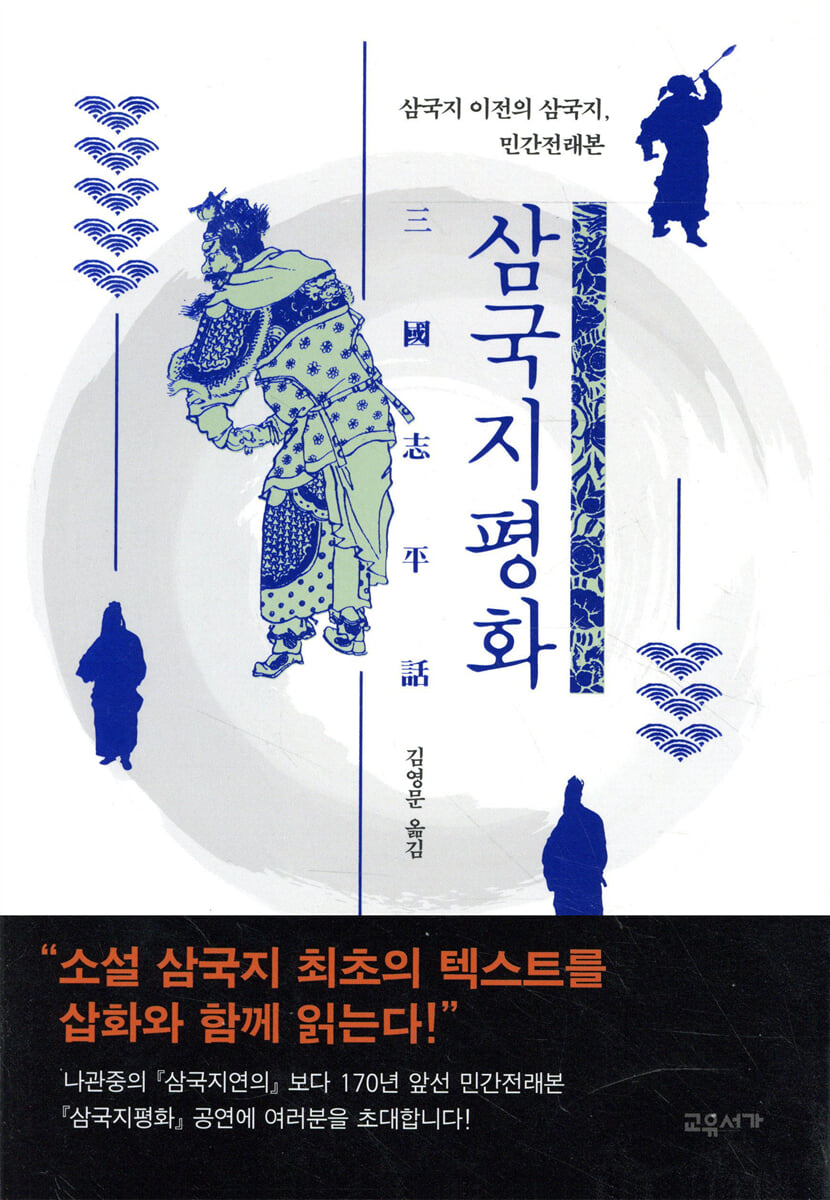
Three Kingdoms Peace
 |
Description
Book Introduction
The first text of the novel "Romance of the Three Kingdoms"
A folk tale that predates 『Romance of the Three Kingdoms』 by 170 years!
A fast-paced, engaging, gear-centric story
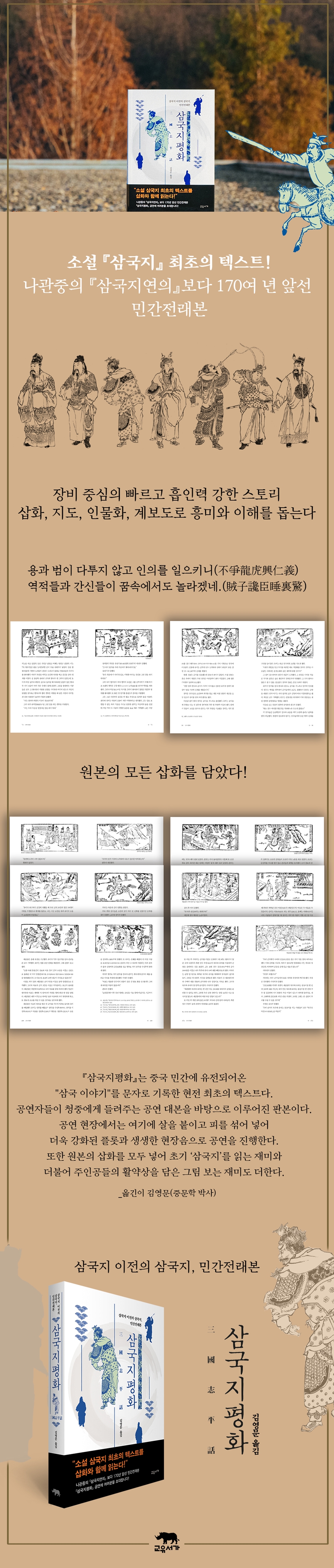
Illustrations, maps, portraits, and genealogical charts enhance interest and understanding.
The dragon and the tiger do not fight, but give rise to benevolence and righteousness.
Traitors and treacherous officials will be surprised even in their dreams.
The word 'Peace' means the script of a storytelling performance genre at that time.
Since the Song Dynasty, in Chinese folk entertainment, long-form historical story performances have been called 'Gangsa (講史)'.
This 'lecturer' gradually evolved into a genre of storytelling performances without a window, and the scripts of these storytelling performances were gradually written into a reading material, which is 'Peace'.
This book is a complete Korean translation of the 『Romance of the Three Kingdoms』, published by an unknown author in Jian'an, Fujian Province, southern China during the reign of Emperor Zhi of the Yuan Dynasty (1321-1323).
It is the earliest text of the extant novel 『Romance of the Three Kingdoms』, predating 『Romance of the Three Kingdoms』 by 170 years.
As the title 'Peace' suggests, which means a script for a storytelling performance genre at the time, the descriptions are somewhat rough, but the story unfolds quickly and concisely.
Additionally, the characteristic of changing from a performance script to a long novel is clearly shown.
This book, consisting of three volumes (upper, middle, and lower), is composed to be as faithful to the original text as possible, with illustrations on every page, and to match the content of the text as much as possible, as space permits.
In addition, portraits, genealogical charts, and maps were inserted to help understand the story.
This book provides a starting point for understanding the origins, formation, and changes of the 'Story of the Three Kingdoms' by comparing it with the historical record 'Romance of the Three Kingdoms' and the novel 'Romance of the Three Kingdoms'.
It also allows us to confirm the close connection between the ‘Story of Chu and Han’ and the ‘Story of the Three Kingdoms.’
A folk tale that predates 『Romance of the Three Kingdoms』 by 170 years!
A fast-paced, engaging, gear-centric story
Illustrations, maps, portraits, and genealogical charts enhance interest and understanding.
The dragon and the tiger do not fight, but give rise to benevolence and righteousness.
Traitors and treacherous officials will be surprised even in their dreams.
The word 'Peace' means the script of a storytelling performance genre at that time.
Since the Song Dynasty, in Chinese folk entertainment, long-form historical story performances have been called 'Gangsa (講史)'.
This 'lecturer' gradually evolved into a genre of storytelling performances without a window, and the scripts of these storytelling performances were gradually written into a reading material, which is 'Peace'.
This book is a complete Korean translation of the 『Romance of the Three Kingdoms』, published by an unknown author in Jian'an, Fujian Province, southern China during the reign of Emperor Zhi of the Yuan Dynasty (1321-1323).
It is the earliest text of the extant novel 『Romance of the Three Kingdoms』, predating 『Romance of the Three Kingdoms』 by 170 years.
As the title 'Peace' suggests, which means a script for a storytelling performance genre at the time, the descriptions are somewhat rough, but the story unfolds quickly and concisely.
Additionally, the characteristic of changing from a performance script to a long novel is clearly shown.
This book, consisting of three volumes (upper, middle, and lower), is composed to be as faithful to the original text as possible, with illustrations on every page, and to match the content of the text as much as possible, as space permits.
In addition, portraits, genealogical charts, and maps were inserted to help understand the story.
This book provides a starting point for understanding the origins, formation, and changes of the 'Story of the Three Kingdoms' by comparing it with the historical record 'Romance of the Three Kingdoms' and the novel 'Romance of the Three Kingdoms'.
It also allows us to confirm the close connection between the ‘Story of Chu and Han’ and the ‘Story of the Three Kingdoms.’
- You can preview some of the book's contents.
Preview
index
Translator's Preface
clear
award
middle
under
clear
award
middle
under
Detailed image
Into the book
The word 'peace' refers to the script of the storytelling performance genre at that time.
Since the Song Dynasty, in Chinese folk entertainment, long historical story performances have been called 'gangsa'.
This 'lecturer' gradually evolved into a genre of storytelling performances without a window, and the scripts for these storytelling performances were gradually transcribed into reading materials, which is 'Peace'.
--- p.31~32
Your Majesty, don't you understand the meaning of that sign? An unruly ruler is bound to have wicked subjects. This is the will of the Emperor of Heaven.
The act of criticizing Qin Shi Huang reveals a resentment towards the Emperor of Heaven.
Therefore, the Emperor of Heaven has appointed me to be the king who governs the underworld in the Bowonjijeon.
If you judge the case without any personal bias in the afterlife, Your Majesty will become the emperor of this world.
If the judgment is wrong, you will be cast into the shadows and will never be able to become human again.
--- p.53
Since Gaozu of Han betrayed the three meritorious subjects, let the three meritorious subjects divide the Han kingdom among themselves.
Give the Central Plains to Han Xin and make him Cao Cao; give the land of Shu and Western Chuan to Peng Yue and make him Liu Bei; give the East China Sea and Changsha to Ying Bu and make him Sun Quan, the King of Wu.
--- p.59
The two followed the equipment to his house.
There was a peach orchard in the backyard, and a small pavilion in the middle of it.
The equipment invited the two people and set up a drinking party on the pavilion, where they enjoyed drinking together.
Then, the three people each revealed their ages.
Deokgong was the oldest, followed by Guan Yu, and had the least equipment.
Thus, the older one became the older brother and the younger one became the younger brother.
He caught a white horse and offered it to heaven, and caught a five-headed horse and offered it to earth.
Although the three were not born on the same day, they promised to die on the same day.
--- p.74
As the equipment twirled its long spear around as if it had no choice, the enemy was unable to advance.
He had no idea how many enemy spears he had broken.
The soldiers in the enemy camp all shouted and scattered in surprise.
No one could stop the equipment that was moving freely through the enemy lines with its cavalry.
--- p.81~82
The equipment was so angry that it rode out on horseback.
He held the long-armed sword in his hand and, with his eyes wide open, stabbed it straight at Lu Bu.
The two horses fought each other for 30 rounds, but no winner was determined.
The usual equipment was good for killing enemies, but now it had found its match.
After another 30-round fight, Zhang Fei cut off Lu Bu's spearhead with his spear and covered it with his face.
--- p.121
After committing a crime in Chang'an, Lu Bu fled east from Dongguan to Xuzhou.
It is said that Cao Cao, while supporting His Majesty the Emperor's holy land, led 100,000 soldiers and 100 famous generals to station in Suizhou and capture Lu Bu.
I will go to Sushu with 18 cavalrymen to meet with the tribute and borrow troops to defeat Lu Bu.
--- p.140
That night, Zhang Fei and Liu Bei led 30,000 soldiers and attacked Cao Cao's camp in the middle of the night.
But the real thing was empty.
Liu Bei and Zhang Fei were surrounded by Cao Cao's troops.
They slaughtered each other, but as day broke, not a single one returned.
The life and death of Emperor Huang Shu and Zhang Fei were also unknown.
--- p.167
Liu Bei's gaining popularity was like a fish gaining water.
It goes without saying that the bravery of the soldiers was unparalleled in the world, and their strength was also incomparable.
The three countries, each focusing on one aspect of heaven, geography, and humanity, established their own country.
Liu Bei finally hired Zhuge Liang as his military commander.
When Zhuge Liang left the hut, he was twenty-nine years old.
--- p.208
At this time, Zhou Yu mobilized a ship with a tent.
When Cao Cao's soldiers fired arrows, many of them struck the tent on the left side of Zhou Yu's warship.
Then, Zhou Yu ordered the rowers to change the direction of the ship, so that the enemy's arrows were caught on the right side of the ship.
After some time, Juyu's barracks were filled with arrows.
--- p.237
In heaven and earth, only three people can offer sacrifices and bring about the wind.
First, Emperor Xianyuan used Fenghou as a military officer to force Chiyou to surrender.
It is also said that Sunim also used Goyo as a military force and caused the wind to blow, putting Sammyo in trouble.
Now, this Zhuge Liang, using the magic of the Ha Dao Luo Shu, wants to help you by creating a southeast wind on the day you launch a fire attack.
--- p.245
When Huang Shu Liu Bei defended Jingzhou, the people sang songs of peace and prosperity, patting their bellies, and spoke of Huang Shu's virtuous virtues.
--- p.263
In less than ten days, Zhuge Liang raised an army and divided it into three units.
He ordered Zhao Yun to take Zhao Cheng, Zhang Fei to take Pazhou Road, and Zhuge Liang himself to take the road leading to Jiamen Pass.
The three units had only 80,000 troops, less than 100,000.
Guan Yu defended Jingzhou.
--- p.308
After receiving Ma Chao's surrender, Zhuge Liang gathered his troops and returned to Yi Province to pay tribute to Liu Bei.
Liu Bei held a banquet and made Guan Yu the Marquis of Zhao, Zhang Fei the Marquis of Xu, Ma Chao the Marquis of Zhengyuan, Huang Zhong the Marquis of Zhenglan, and Zhao Yun the Marquis of Yi.
Liu Bei also bestowed grace upon these five men and appointed them as the Five Tiger Generals.
--- p.318~319
When Guan Yu went out to battle, the two armies attacked together.
Guan Yu was in trouble at a mountain pass southeast of Jingzhou.
A few days after Guan Yu was in trouble, a heavy rain fell.
Afterwards, the generals of the two states of Wu and Wei arrived in Jingzhou and reported that the sage had returned to heaven.
Since the Song Dynasty, in Chinese folk entertainment, long historical story performances have been called 'gangsa'.
This 'lecturer' gradually evolved into a genre of storytelling performances without a window, and the scripts for these storytelling performances were gradually transcribed into reading materials, which is 'Peace'.
--- p.31~32
Your Majesty, don't you understand the meaning of that sign? An unruly ruler is bound to have wicked subjects. This is the will of the Emperor of Heaven.
The act of criticizing Qin Shi Huang reveals a resentment towards the Emperor of Heaven.
Therefore, the Emperor of Heaven has appointed me to be the king who governs the underworld in the Bowonjijeon.
If you judge the case without any personal bias in the afterlife, Your Majesty will become the emperor of this world.
If the judgment is wrong, you will be cast into the shadows and will never be able to become human again.
--- p.53
Since Gaozu of Han betrayed the three meritorious subjects, let the three meritorious subjects divide the Han kingdom among themselves.
Give the Central Plains to Han Xin and make him Cao Cao; give the land of Shu and Western Chuan to Peng Yue and make him Liu Bei; give the East China Sea and Changsha to Ying Bu and make him Sun Quan, the King of Wu.
--- p.59
The two followed the equipment to his house.
There was a peach orchard in the backyard, and a small pavilion in the middle of it.
The equipment invited the two people and set up a drinking party on the pavilion, where they enjoyed drinking together.
Then, the three people each revealed their ages.
Deokgong was the oldest, followed by Guan Yu, and had the least equipment.
Thus, the older one became the older brother and the younger one became the younger brother.
He caught a white horse and offered it to heaven, and caught a five-headed horse and offered it to earth.
Although the three were not born on the same day, they promised to die on the same day.
--- p.74
As the equipment twirled its long spear around as if it had no choice, the enemy was unable to advance.
He had no idea how many enemy spears he had broken.
The soldiers in the enemy camp all shouted and scattered in surprise.
No one could stop the equipment that was moving freely through the enemy lines with its cavalry.
--- p.81~82
The equipment was so angry that it rode out on horseback.
He held the long-armed sword in his hand and, with his eyes wide open, stabbed it straight at Lu Bu.
The two horses fought each other for 30 rounds, but no winner was determined.
The usual equipment was good for killing enemies, but now it had found its match.
After another 30-round fight, Zhang Fei cut off Lu Bu's spearhead with his spear and covered it with his face.
--- p.121
After committing a crime in Chang'an, Lu Bu fled east from Dongguan to Xuzhou.
It is said that Cao Cao, while supporting His Majesty the Emperor's holy land, led 100,000 soldiers and 100 famous generals to station in Suizhou and capture Lu Bu.
I will go to Sushu with 18 cavalrymen to meet with the tribute and borrow troops to defeat Lu Bu.
--- p.140
That night, Zhang Fei and Liu Bei led 30,000 soldiers and attacked Cao Cao's camp in the middle of the night.
But the real thing was empty.
Liu Bei and Zhang Fei were surrounded by Cao Cao's troops.
They slaughtered each other, but as day broke, not a single one returned.
The life and death of Emperor Huang Shu and Zhang Fei were also unknown.
--- p.167
Liu Bei's gaining popularity was like a fish gaining water.
It goes without saying that the bravery of the soldiers was unparalleled in the world, and their strength was also incomparable.
The three countries, each focusing on one aspect of heaven, geography, and humanity, established their own country.
Liu Bei finally hired Zhuge Liang as his military commander.
When Zhuge Liang left the hut, he was twenty-nine years old.
--- p.208
At this time, Zhou Yu mobilized a ship with a tent.
When Cao Cao's soldiers fired arrows, many of them struck the tent on the left side of Zhou Yu's warship.
Then, Zhou Yu ordered the rowers to change the direction of the ship, so that the enemy's arrows were caught on the right side of the ship.
After some time, Juyu's barracks were filled with arrows.
--- p.237
In heaven and earth, only three people can offer sacrifices and bring about the wind.
First, Emperor Xianyuan used Fenghou as a military officer to force Chiyou to surrender.
It is also said that Sunim also used Goyo as a military force and caused the wind to blow, putting Sammyo in trouble.
Now, this Zhuge Liang, using the magic of the Ha Dao Luo Shu, wants to help you by creating a southeast wind on the day you launch a fire attack.
--- p.245
When Huang Shu Liu Bei defended Jingzhou, the people sang songs of peace and prosperity, patting their bellies, and spoke of Huang Shu's virtuous virtues.
--- p.263
In less than ten days, Zhuge Liang raised an army and divided it into three units.
He ordered Zhao Yun to take Zhao Cheng, Zhang Fei to take Pazhou Road, and Zhuge Liang himself to take the road leading to Jiamen Pass.
The three units had only 80,000 troops, less than 100,000.
Guan Yu defended Jingzhou.
--- p.308
After receiving Ma Chao's surrender, Zhuge Liang gathered his troops and returned to Yi Province to pay tribute to Liu Bei.
Liu Bei held a banquet and made Guan Yu the Marquis of Zhao, Zhang Fei the Marquis of Xu, Ma Chao the Marquis of Zhengyuan, Huang Zhong the Marquis of Zhenglan, and Zhao Yun the Marquis of Yi.
Liu Bei also bestowed grace upon these five men and appointed them as the Five Tiger Generals.
--- p.318~319
When Guan Yu went out to battle, the two armies attacked together.
Guan Yu was in trouble at a mountain pass southeast of Jingzhou.
A few days after Guan Yu was in trouble, a heavy rain fell.
Afterwards, the generals of the two states of Wu and Wei arrived in Jingzhou and reported that the sage had returned to heaven.
--- p.340
Publisher's Review
If the incident of wandering to escape from trouble had not occurred (不因?難身漂泊)
How could I have met someone who values loyalty while dividing wealth? (?遇分金重義知)
The origins of the "Three Kingdoms" story, texts preceding the "Romance of the Three Kingdoms"
『Romance of the Three Kingdoms』 was published during the Yuan Dynasty's Ji Zhi era, and is approximately 170 years older than 『Romance of the Three Kingdoms』, which was first published during the Ming Dynasty's Hongzhi era.
These stories of the Three Kingdoms were widely circulated among the people for generations, and there are records of them being performed during the Tang and Song Dynasties.
However, the only extant text of the novel 『Romance of the Three Kingdoms』 before 『Romance of the Three Kingdoms』 is 『Romance of the Three Kingdoms Peace』.
This is because there is no text of the Three Kingdoms story that has been handed down before 『Romance of the Three Kingdoms』.
Thus, although we could not know the content and structure, the handed down version of 『Romance of the Three Kingdoms』 allows us to depict the process of change in the ‘Story of the Three Kingdoms’, starting from the official history 『Romance of the Three Kingdoms』, through various folk performance genres, and ending in 『Romance of the Three Kingdoms』.
Zhao Yun went out with a spear in his hand.
The equipment was equipped and he swung his long-armed sword and tried to kill Zhao Yun.
The moment the two words crossed, the two generals' spears shook like snakes.
The fierce battle lasted for 30 rounds.
The equipment exploded in anger.
“I’ve seen people use spears well before, but this guy is really strong!”
Forget the existing novel 『Romance of the Three Kingdoms』!
A 'Three Kingdoms Story' Different from 'Romance of the Three Kingdoms'
Even if we only consider domestic books related to the Romance of the Three Kingdoms, the variety is truly enormous.
Although each has its own characteristics, the most eye-catching part of 『Romance of the Three Kingdoms』, the first text of the novel 『Romance of the Three Kingdoms』, is the introduction.
The story begins with the characters Han Xin, Peng Yue, and Ying Bu, who died with a grudge against Gaozu Liu Bang, being reincarnated as Cao Cao, Liu Bei, and Sun Quan in the afterlife through a trial, and taking revenge on Liu Bang, who was reincarnated as Emperor Xian, the last king of the Han Dynasty.
Also, the performance of the equipment is so dazzling that it could be called 'Equipment 『Romance of the Three Kingdoms』'.
Zhang Fei is prominently depicted in the first half of the book before Zhuge Liang appears, such as leading the Peach Garden Oath, fighting and defeating Lu Bu at Hulao Pass, breaking through Lu Bu's encirclement at Xiaobai Fortress to ask for reinforcements from Cao Cao, losing Xu Zhou and parting ways with Liu Bei and Guan Yu, entering Gucheng and calling himself the Great King of Wucheng and using the era name of Gao Huai.
In addition, it is quite interesting to read the details of the scenes depicting Zhuge Liang's role and characters in the Battle of Red Cliffs and compare them with those in Romance of the Three Kingdoms.
When the three kingdoms fought to divide the world, the heroic General Guan Yu had many great ambitions.
He cut bones, healed wounds, and removed diseases; he cut flesh with a steel knife, and prevented chronic diseases.
He welcomed the guests without changing his words or expression, and he poured his drink with a dignified appearance.
This too must be a secret method hidden by the immortals, so the renowned doctor of the ages is called Hwa-tuo.
Read an exciting performance
From lecturer to peace, from long novel!
『Romance of the Three Kingdoms: Peace』 shows the process of development from a long-form historical narrative performance, ‘Gangsa (講史)’, to a narrative performance script, ‘Pyeonghwa (平話),’ and then to a long-form novel.
Compared to the long-form novels of the Ming Dynasty, it is very simple and plain, but the formal characteristics of the long-form novel are well expressed.
It contains the common cliches of the storytellers of the time, such as 'the story is divided into two', a poem that summarizes and comments on the preceding content at each important part, a heading that serves as the chapter title of a later long novel, and a title within the text that summarizes the content.
That's why the descriptions are a bit rough, but the story unfolds quickly and concisely.
If you read this book with these characteristics in mind, you will feel the thrill of experiencing the storyteller's flexibility and improvisation, as if you were watching a full-length historical narrative performance.
How could I have met someone who values loyalty while dividing wealth? (?遇分金重義知)
The origins of the "Three Kingdoms" story, texts preceding the "Romance of the Three Kingdoms"
『Romance of the Three Kingdoms』 was published during the Yuan Dynasty's Ji Zhi era, and is approximately 170 years older than 『Romance of the Three Kingdoms』, which was first published during the Ming Dynasty's Hongzhi era.
These stories of the Three Kingdoms were widely circulated among the people for generations, and there are records of them being performed during the Tang and Song Dynasties.
However, the only extant text of the novel 『Romance of the Three Kingdoms』 before 『Romance of the Three Kingdoms』 is 『Romance of the Three Kingdoms Peace』.
This is because there is no text of the Three Kingdoms story that has been handed down before 『Romance of the Three Kingdoms』.
Thus, although we could not know the content and structure, the handed down version of 『Romance of the Three Kingdoms』 allows us to depict the process of change in the ‘Story of the Three Kingdoms’, starting from the official history 『Romance of the Three Kingdoms』, through various folk performance genres, and ending in 『Romance of the Three Kingdoms』.
Zhao Yun went out with a spear in his hand.
The equipment was equipped and he swung his long-armed sword and tried to kill Zhao Yun.
The moment the two words crossed, the two generals' spears shook like snakes.
The fierce battle lasted for 30 rounds.
The equipment exploded in anger.
“I’ve seen people use spears well before, but this guy is really strong!”
Forget the existing novel 『Romance of the Three Kingdoms』!
A 'Three Kingdoms Story' Different from 'Romance of the Three Kingdoms'
Even if we only consider domestic books related to the Romance of the Three Kingdoms, the variety is truly enormous.
Although each has its own characteristics, the most eye-catching part of 『Romance of the Three Kingdoms』, the first text of the novel 『Romance of the Three Kingdoms』, is the introduction.
The story begins with the characters Han Xin, Peng Yue, and Ying Bu, who died with a grudge against Gaozu Liu Bang, being reincarnated as Cao Cao, Liu Bei, and Sun Quan in the afterlife through a trial, and taking revenge on Liu Bang, who was reincarnated as Emperor Xian, the last king of the Han Dynasty.
Also, the performance of the equipment is so dazzling that it could be called 'Equipment 『Romance of the Three Kingdoms』'.
Zhang Fei is prominently depicted in the first half of the book before Zhuge Liang appears, such as leading the Peach Garden Oath, fighting and defeating Lu Bu at Hulao Pass, breaking through Lu Bu's encirclement at Xiaobai Fortress to ask for reinforcements from Cao Cao, losing Xu Zhou and parting ways with Liu Bei and Guan Yu, entering Gucheng and calling himself the Great King of Wucheng and using the era name of Gao Huai.
In addition, it is quite interesting to read the details of the scenes depicting Zhuge Liang's role and characters in the Battle of Red Cliffs and compare them with those in Romance of the Three Kingdoms.
When the three kingdoms fought to divide the world, the heroic General Guan Yu had many great ambitions.
He cut bones, healed wounds, and removed diseases; he cut flesh with a steel knife, and prevented chronic diseases.
He welcomed the guests without changing his words or expression, and he poured his drink with a dignified appearance.
This too must be a secret method hidden by the immortals, so the renowned doctor of the ages is called Hwa-tuo.
Read an exciting performance
From lecturer to peace, from long novel!
『Romance of the Three Kingdoms: Peace』 shows the process of development from a long-form historical narrative performance, ‘Gangsa (講史)’, to a narrative performance script, ‘Pyeonghwa (平話),’ and then to a long-form novel.
Compared to the long-form novels of the Ming Dynasty, it is very simple and plain, but the formal characteristics of the long-form novel are well expressed.
It contains the common cliches of the storytellers of the time, such as 'the story is divided into two', a poem that summarizes and comments on the preceding content at each important part, a heading that serves as the chapter title of a later long novel, and a title within the text that summarizes the content.
That's why the descriptions are a bit rough, but the story unfolds quickly and concisely.
If you read this book with these characteristics in mind, you will feel the thrill of experiencing the storyteller's flexibility and improvisation, as if you were watching a full-length historical narrative performance.
GOODS SPECIFICS
- Date of publication: December 7, 2020
- Page count, weight, size: 392 pages | 620g | 148*215*30mm
- ISBN13: 9791190277952
- ISBN10: 1190277956
You may also like
카테고리
korean


korean

![GQ KOREA Mark (Monthly): December [2025]](http://librairie.coreenne.fr/cdn/shop/files/8ef265dbbfbf186523ed75ba7319009d.jpg?v=1765340328&width=3840)


