

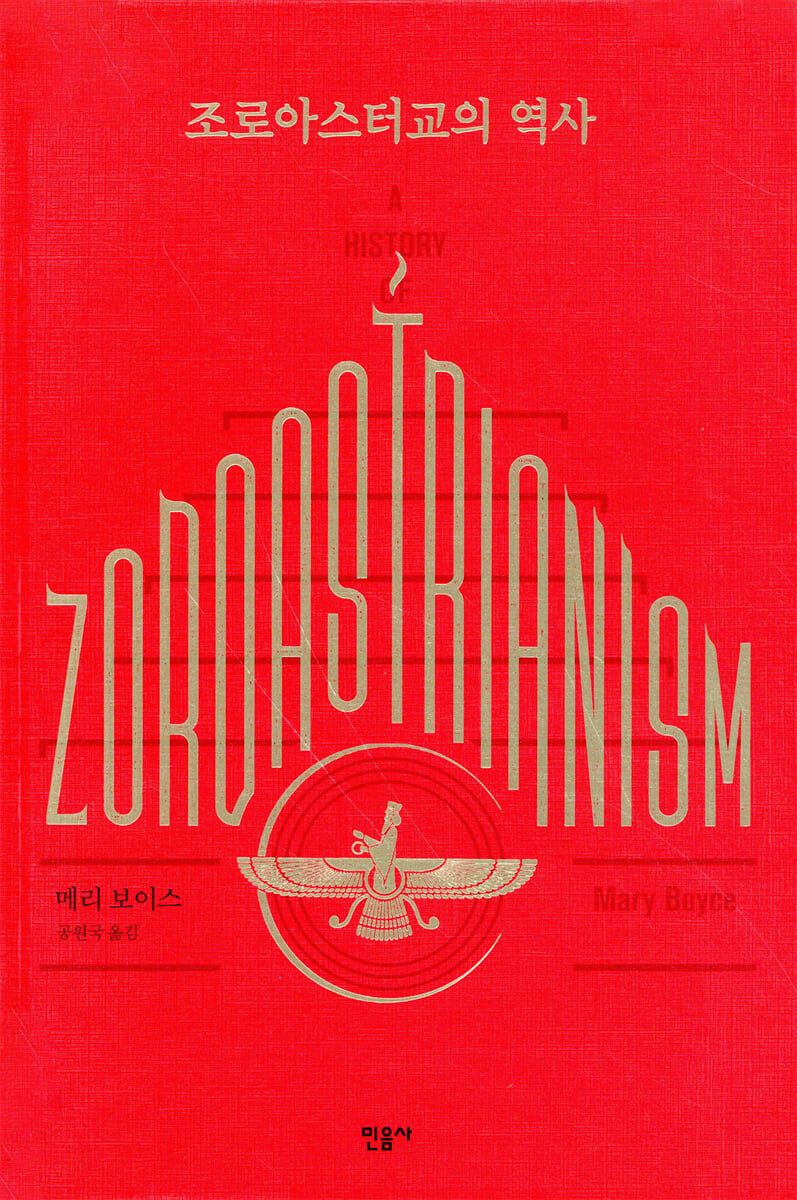
History of Zoroastrianism
 |
Description
Book Introduction
Mary Boyce, a leading authority on Zoroastrianism, has published her masterpiece, A History of Zoroastrianism, in its first Korean translation by Minumsa.
In this book, Zoroastrianism is revealed not as an ancient religion shrouded in mystery, but as the first world religion with universal teachings.
The author's extensive knowledge, having dedicated his life to the study of Zoroastrianism, takes readers across 3,000 years to the era of the prophet Zoroaster (Zarathustra).
It also shows why this religion is a great legacy of human thought through extraordinary figures and wondrous events that dispel myths and misunderstandings.
In this book, Zoroastrianism is revealed not as an ancient religion shrouded in mystery, but as the first world religion with universal teachings.
The author's extensive knowledge, having dedicated his life to the study of Zoroastrianism, takes readers across 3,000 years to the era of the prophet Zoroaster (Zarathustra).
It also shows why this religion is a great legacy of human thought through extraordinary figures and wondrous events that dispel myths and misunderstandings.
- You can preview some of the book's contents.
Preview
index
Before reading this book
Translator's Note
introduction
Abbreviation table
Part 1: Polytheistic Background
Chapter 1 Overview
Chapter 2: The Gods of Iran in the Polytheistic Era
Chapter 3: Demons and Evil Deeds, Legendary Animals, the First Men and Heroes
Chapter 4 Death, the Afterlife, and Funeral Rituals
Chapter 5: The Nature of the World and Its Origins
Chapter 6: Polytheistic Worship Rituals
Part 2 Zoroaster and His Teachings
Chapter 7 Zoroaster
Chapter 8: Ahura Mazda, Angra Mainyu, and the Benevolent Immortals
Chapter 9 Two States and Three Times
Part 3: Faith before History
Chapter 10: Unrecorded Centuries
Chapter 11: Legends of Zoroaster and His Sons
Chapter 12: The Law of Purity
Appendix Zoroastrian Funeral Rituals
A Selected List of Frequently Cited References
main
Search
Translator's Note
introduction
Abbreviation table
Part 1: Polytheistic Background
Chapter 1 Overview
Chapter 2: The Gods of Iran in the Polytheistic Era
Chapter 3: Demons and Evil Deeds, Legendary Animals, the First Men and Heroes
Chapter 4 Death, the Afterlife, and Funeral Rituals
Chapter 5: The Nature of the World and Its Origins
Chapter 6: Polytheistic Worship Rituals
Part 2 Zoroaster and His Teachings
Chapter 7 Zoroaster
Chapter 8: Ahura Mazda, Angra Mainyu, and the Benevolent Immortals
Chapter 9 Two States and Three Times
Part 3: Faith before History
Chapter 10: Unrecorded Centuries
Chapter 11: Legends of Zoroaster and His Sons
Chapter 12: The Law of Purity
Appendix Zoroastrian Funeral Rituals
A Selected List of Frequently Cited References
main
Search
Into the book
The best guide is, of course, the traditions of his community, which seem to have been preserved with continuity and consistency to the present day.
This tradition contains doctrines that are very familiar to Christians and Muslims (due to borrowings), but at the same time retains something uniquely Zoroastrian and quite different from them.
--- p.50
“His dwelling is as vast as the whole world (earth)”, “He observes all that exists between heaven and earth”, “He embraces heaven with his greatness, and the earth with his glory”. In these expressions, the high gods of the Indo-Iranians already resemble the monotheistic gods, and in their greatness they foreshadow Zoroaster’s own concept of the Supreme God.
--- p.52
Through Zoroaster's teachings, this underworld was seen not merely as a negative place, but as a world of punishment, a virtual hell, and the Daevas were demoted to become inhabitants of the underworld, hated by those who truly followed the Prophet.
--- p.123
Before we continue to gather what information we can about the early history of this faith, we must undertake the following important task.
That is, to elaborate on Zoroaster's own teachings and to explore what was so new and challenging about them that they inspired self-sacrificing devotion in some and deadly hatred in others, leading to Zoroastrianism's early baptism in blood, like Christianity's infancy.
--- p.249
As a result of their teachings, Zoroastrians developed a unique sense of religious obligation toward fellow creatures and their environment.
By looking after the welfare of animals and causing them as little harm as possible in this imperfect world, encouraging plants and trees to grow to their fullest potential, tilling and fertilizing the soil, not polluting water and fire, and even polishing and preserving metal tools to keep them beautiful and shiny, Zoroastrians not only honor each Amesha Spenta but also do their own small part in keeping the world in a state of Spenta (goodness).
--- p.287
Zoroaster taught that at that bridge, a strict moral judgment takes place where God's grace is of no avail.
Instead, the thoughts, words, and actions that each person has accumulated since becoming an adult are measured precisely and meticulously on a scale as fine as the width of a hair.
If a person's good outweighs his evil, he will be saved; if it is lighter, he will be condemned to the underworld, which Zoroaster considered a hell of torment, "the abode of the worst intentions (archista mana)."
The wicked will endure there “a long period of misery and darkness, bad food and cries of sorrow.”
--- p.308
By offering this hope of salvation to all morally good people who accepted his teachings, Zoroaster clearly broke with the older, aristocratic and priestly traditions.
In ancient traditions, the lowest members of the community, including women and slaves, would have been consigned to the underworld kingdom of shadows in the afterlife.
This tradition contains doctrines that are very familiar to Christians and Muslims (due to borrowings), but at the same time retains something uniquely Zoroastrian and quite different from them.
--- p.50
“His dwelling is as vast as the whole world (earth)”, “He observes all that exists between heaven and earth”, “He embraces heaven with his greatness, and the earth with his glory”. In these expressions, the high gods of the Indo-Iranians already resemble the monotheistic gods, and in their greatness they foreshadow Zoroaster’s own concept of the Supreme God.
--- p.52
Through Zoroaster's teachings, this underworld was seen not merely as a negative place, but as a world of punishment, a virtual hell, and the Daevas were demoted to become inhabitants of the underworld, hated by those who truly followed the Prophet.
--- p.123
Before we continue to gather what information we can about the early history of this faith, we must undertake the following important task.
That is, to elaborate on Zoroaster's own teachings and to explore what was so new and challenging about them that they inspired self-sacrificing devotion in some and deadly hatred in others, leading to Zoroastrianism's early baptism in blood, like Christianity's infancy.
--- p.249
As a result of their teachings, Zoroastrians developed a unique sense of religious obligation toward fellow creatures and their environment.
By looking after the welfare of animals and causing them as little harm as possible in this imperfect world, encouraging plants and trees to grow to their fullest potential, tilling and fertilizing the soil, not polluting water and fire, and even polishing and preserving metal tools to keep them beautiful and shiny, Zoroastrians not only honor each Amesha Spenta but also do their own small part in keeping the world in a state of Spenta (goodness).
--- p.287
Zoroaster taught that at that bridge, a strict moral judgment takes place where God's grace is of no avail.
Instead, the thoughts, words, and actions that each person has accumulated since becoming an adult are measured precisely and meticulously on a scale as fine as the width of a hair.
If a person's good outweighs his evil, he will be saved; if it is lighter, he will be condemned to the underworld, which Zoroaster considered a hell of torment, "the abode of the worst intentions (archista mana)."
The wicked will endure there “a long period of misery and darkness, bad food and cries of sorrow.”
--- p.308
By offering this hope of salvation to all morally good people who accepted his teachings, Zoroaster clearly broke with the older, aristocratic and priestly traditions.
In ancient traditions, the lowest members of the community, including women and slaves, would have been consigned to the underworld kingdom of shadows in the afterlife.
--- p.326
Publisher's Review
The religion that has had the greatest influence on modern religion
Debunking Zoroastrian Myths and Misconceptions
“Zoroaster’s eschatological teachings, including individual judgment, bodily resurrection, the Last Judgment, and eternal life, have, through borrowing, come to resemble Judaism, Christianity, and Islam profoundly, and have had a profound influence on the lives and thinking of people in countless regions.”
Around 1000 BC, a fundamental change occurred in human history.
Humanity, which had been worshipping nature and pursuing worldly blessings, has now entered a new phase, the so-called 'Axial Age'.
Zoroastrianism, which originated particularly in eastern Persia, presented important moral values that were not present in existing primitive religions, such as moderation, asceticism, and cleanliness.
The archetypes of religions that still captivate people today, as well as familiar concepts like the Last Judgment, Heaven and Hell, also emerged at this time.
Meanwhile, Zoroastrianism is also one of the most misunderstood religions.
Zoroastrianism is sometimes translated as 'fire religion', but strictly speaking, it does not worship fire itself.
Although it is true that it had a great influence on the monotheistic ideas of Christianity, Islam, and Judaism, Zoroastrianism itself was born from a polytheistic background and is not a religion that worships only one God.
It is not a familiar fact to many people that the word 'Zarathustra' in Nietzsche's world-class classic book, 'Thus Spoke Zarathustra', is the German pronunciation of Zoroaster.
There is also a misconception that Zoroastrianism is an ancient religion that has long since disappeared.
However, Zoroastrianism is a religion that still exists today.
In India, there is a sect of Zoroastrians called the Parsis, and the founder of the Tata Group, which is also the parent company of a domestic automobile company, is a Parsis.
In the recently popular film "Bohemian Rhapsody" about the band Queen, Parsi Freddie Mercury and his family were portrayed.
Mercury's favorite white stage costumes are reminiscent of the pure white sudras worn by Zoroastrians.
Mercury's father's message, which is often cited as a famous line in the movie, is itself a maxim that contains the ethical core of Zoroastrianism.
"Good thoughts, good words, good deeds."
This book, "A History of Zoroastrianism," rigorously argues the beginnings of Zoroastrianism, a religion that remains largely unknown and surrounded by misunderstanding despite its significant influence on later generations.
A leading authority on Zoroastrian studies
Mary Boyce's masterpiece
Meet the first domestic translation
The author, Mary Boyce, is a world-renowned scholar and authority on ancient religion.
Born in Darjeeling, British India, he devoted himself to research, teaching, and writing at Royal Holloway College, University of London, and SOAS from 1944 until his retirement in 1982, and is recognized as a leading authority on ancient and medieval religions, including Zoroastrianism.
『History of Zoroastrianism』 is his greatest work and serves as the foundation for the study of ancient religions.
This book is the first of a three-volume series on Zoroastrianism, published in 1975. It reconstructs the history of Zoroastrianism in its early stages and the teachings of its founder, Zoroaster, and thus encapsulates the essence of Zoroastrianism.
Translator Park Gong-guk is a historian and anthropologist who studied Oriental history, Chinese regional studies, and anthropology at Seoul National University and Fudan University in China. He devoted his scholarly skills to the complex task of translation.
This is the first time that Voice's work has been introduced in Korea.
founder of the Reformed religion
The Teachings of Zarathustra (Zoroaster)
Presenting moral ethics
“Whether male or female… I will take with me all those whom I have led to plead with you, and I will cross the bridge of judgment.” (Y.
46.10)
It is important to note that Zoroaster's teachings were very reformist and different from the ideas of existing religions.
For example, Zoroaster taught that anyone who is morally good can be saved, regardless of gender, education, or class.
This message of equality ran counter to the aristocratic and priest-centered religion of the time.
Additionally, Zoroaster firmly rejected Daeva (daeva, meaning 'shining', 'splendid', meaning 'god', 'immortal', but in Zoroastrian usage it is used to mean 'false god', 'devil') and emphasized the worship of Ahura Mazda (Lord of Wisdom).
It can be seen as a kind of moral standard that requires worshipping Ahura Mazda, the symbol of goodness, and rejecting anything evil.
However, this was very difficult to accept for those who worshipped Daeva at the time.
Zoroaster's new and challenging ideas brought him hatred and threats, and ultimately led to his murder by fanatics of other religions.
However, Zoroaster's teachings did not disappear and have continued to this day.
Zoroastrianism's influence has permeated not only the ethics of Zoroastrianism but also those of Christianity, Islam, and Judaism.
The general Christian values of moderation, abstinence, and cleanliness can be seen as influenced by Zoroastrianism.
Another reason why we pay attention to the history of Zoroastrianism today is because Zoroastrianism was the first religion to present moral standards.
If the gods of previous religions were gods who rewarded human desires for wealth and power, Zoroastrianism worships Ahura Mazda, the god who symbolizes goodness itself.
Following the teachings of their founder, Zoroastrians developed a religious sense of duty towards the animals and the environment around them.
It is an effort to recreate the perfect state of Ahura Mazda, that is, a state of harmony and happiness.
They sought to fulfill their duties by looking after the welfare of animals and causing them as little distress as possible in this imperfect world, encouraging plants and trees to grow as much as possible, tilling and fertilizing the soil, and not polluting water and fire.
In line with this teaching, Zoroastrians also gradually abandoned the practice of animal sacrifice, which originated from a polytheistic background.
Debunking Zoroastrian Myths and Misconceptions
“Zoroaster’s eschatological teachings, including individual judgment, bodily resurrection, the Last Judgment, and eternal life, have, through borrowing, come to resemble Judaism, Christianity, and Islam profoundly, and have had a profound influence on the lives and thinking of people in countless regions.”
Around 1000 BC, a fundamental change occurred in human history.
Humanity, which had been worshipping nature and pursuing worldly blessings, has now entered a new phase, the so-called 'Axial Age'.
Zoroastrianism, which originated particularly in eastern Persia, presented important moral values that were not present in existing primitive religions, such as moderation, asceticism, and cleanliness.
The archetypes of religions that still captivate people today, as well as familiar concepts like the Last Judgment, Heaven and Hell, also emerged at this time.
Meanwhile, Zoroastrianism is also one of the most misunderstood religions.
Zoroastrianism is sometimes translated as 'fire religion', but strictly speaking, it does not worship fire itself.
Although it is true that it had a great influence on the monotheistic ideas of Christianity, Islam, and Judaism, Zoroastrianism itself was born from a polytheistic background and is not a religion that worships only one God.
It is not a familiar fact to many people that the word 'Zarathustra' in Nietzsche's world-class classic book, 'Thus Spoke Zarathustra', is the German pronunciation of Zoroaster.
There is also a misconception that Zoroastrianism is an ancient religion that has long since disappeared.
However, Zoroastrianism is a religion that still exists today.
In India, there is a sect of Zoroastrians called the Parsis, and the founder of the Tata Group, which is also the parent company of a domestic automobile company, is a Parsis.
In the recently popular film "Bohemian Rhapsody" about the band Queen, Parsi Freddie Mercury and his family were portrayed.
Mercury's favorite white stage costumes are reminiscent of the pure white sudras worn by Zoroastrians.
Mercury's father's message, which is often cited as a famous line in the movie, is itself a maxim that contains the ethical core of Zoroastrianism.
"Good thoughts, good words, good deeds."
This book, "A History of Zoroastrianism," rigorously argues the beginnings of Zoroastrianism, a religion that remains largely unknown and surrounded by misunderstanding despite its significant influence on later generations.
A leading authority on Zoroastrian studies
Mary Boyce's masterpiece
Meet the first domestic translation
The author, Mary Boyce, is a world-renowned scholar and authority on ancient religion.
Born in Darjeeling, British India, he devoted himself to research, teaching, and writing at Royal Holloway College, University of London, and SOAS from 1944 until his retirement in 1982, and is recognized as a leading authority on ancient and medieval religions, including Zoroastrianism.
『History of Zoroastrianism』 is his greatest work and serves as the foundation for the study of ancient religions.
This book is the first of a three-volume series on Zoroastrianism, published in 1975. It reconstructs the history of Zoroastrianism in its early stages and the teachings of its founder, Zoroaster, and thus encapsulates the essence of Zoroastrianism.
Translator Park Gong-guk is a historian and anthropologist who studied Oriental history, Chinese regional studies, and anthropology at Seoul National University and Fudan University in China. He devoted his scholarly skills to the complex task of translation.
This is the first time that Voice's work has been introduced in Korea.
founder of the Reformed religion
The Teachings of Zarathustra (Zoroaster)
Presenting moral ethics
“Whether male or female… I will take with me all those whom I have led to plead with you, and I will cross the bridge of judgment.” (Y.
46.10)
It is important to note that Zoroaster's teachings were very reformist and different from the ideas of existing religions.
For example, Zoroaster taught that anyone who is morally good can be saved, regardless of gender, education, or class.
This message of equality ran counter to the aristocratic and priest-centered religion of the time.
Additionally, Zoroaster firmly rejected Daeva (daeva, meaning 'shining', 'splendid', meaning 'god', 'immortal', but in Zoroastrian usage it is used to mean 'false god', 'devil') and emphasized the worship of Ahura Mazda (Lord of Wisdom).
It can be seen as a kind of moral standard that requires worshipping Ahura Mazda, the symbol of goodness, and rejecting anything evil.
However, this was very difficult to accept for those who worshipped Daeva at the time.
Zoroaster's new and challenging ideas brought him hatred and threats, and ultimately led to his murder by fanatics of other religions.
However, Zoroaster's teachings did not disappear and have continued to this day.
Zoroastrianism's influence has permeated not only the ethics of Zoroastrianism but also those of Christianity, Islam, and Judaism.
The general Christian values of moderation, abstinence, and cleanliness can be seen as influenced by Zoroastrianism.
Another reason why we pay attention to the history of Zoroastrianism today is because Zoroastrianism was the first religion to present moral standards.
If the gods of previous religions were gods who rewarded human desires for wealth and power, Zoroastrianism worships Ahura Mazda, the god who symbolizes goodness itself.
Following the teachings of their founder, Zoroastrians developed a religious sense of duty towards the animals and the environment around them.
It is an effort to recreate the perfect state of Ahura Mazda, that is, a state of harmony and happiness.
They sought to fulfill their duties by looking after the welfare of animals and causing them as little distress as possible in this imperfect world, encouraging plants and trees to grow as much as possible, tilling and fertilizing the soil, and not polluting water and fire.
In line with this teaching, Zoroastrians also gradually abandoned the practice of animal sacrifice, which originated from a polytheistic background.
GOODS SPECIFICS
- Date of issue: June 30, 2020
- Format: Hardcover book binding method guide
- Page count, weight, size: 592 pages | 934g | 160*230*33mm
- ISBN13: 9788937472718
- ISBN10: 8937472716
You may also like
카테고리
korean


korean

![GQ KOREA Mark (Monthly): December [2025]](http://librairie.coreenne.fr/cdn/shop/files/8ef265dbbfbf186523ed75ba7319009d.jpg?v=1765340328&width=3840)


